C h a z z W r i t e s . c o m

See all my books at AllThatChazz.com.

Authors: Build a better business card with these tweaks

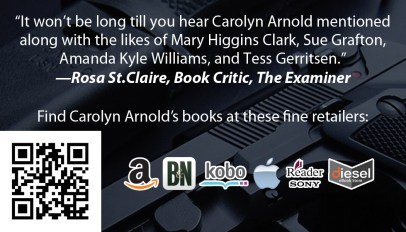
I met Facebook friend and author Carolyn Arnold as she sold books at an event. She’s given me permission to show you her business card. It’s important because she did something very right.

I think it’s important because I’ve seen a lot of bad business cards. A card that looks cheap might hurt you. A card that’s crammed with too much information really repels people.

Cards that advertise the publisher on one side and another unrelated business on the back? Don’t do that. It saps credibility from both companies.

Look at what Carolyn’s done.

The logos for each platform show where you can get Carolyn’s books. Very good idea. I also like seeing the books in 3D, with spines. (# 147 on the things I need to do to make web presentations of my books prettier.)

Also note the QR code. Scan it with a mobile device and it takes you to her website, carolynarnold.net.

I’m not that technologically advanced yet, but it’s a pretty nifty feature for those who are into QR codes.

Carolyn Arnold Business Card Front 2013


Carolyn Arnold Business Card Back 2013


And perhaps best of all is the killer quote from The Examiner‘s book critic. If you can incorporate any of these helpful elements into your business card, I recommend it. It comes off very professional.

Even when they aren’t aware of it, readers want to be assured they’re in good hands with someone who knows what they’re doing. A business card alone won’t earn you a new reader. You have to be nice and skilled and have good books to sell. There are many variables that contribute to success. If one of those variables isn’t in place, it can suck all the gas out of your engine. Carolyn nailed it.

Have another look at your business card.

Then get out to more events where you can actually use it.

Filed under: author platform, , , , , , , , , , , ,

The Secret Alphabet of Independent Publishing

"You will laugh your ass off!" ~ Author of Cybrgrrl, Maxwell Cynn

“You will laugh your ass off!” ~ Author of Cybrgrrl, Maxwell Cynn

A is for All of it, which is what we want. (A used to stand for Agent.)

B is for Book, of course, and ebooks are “real” books, too. Literature is about the content not the container.

C is for Cutting prices. It would be bad for writers, but at 70%, we’re still getting paid more per unit sold than in traditional publishing. Also, price cuts sure make now a great time to be a reader.

D is for Deadlines. Don’t take forever to write your book. More time procrastinating doesn’t make a better book.

E is for E-books on E-readers. But you know your kindle is a transitional device, right? The phones are getting bigger again and tablets are coming down in price. We don’t want a device to do one thing. We want one device to be a web surfer, camera, phone, app catalogue, music box, GPS, ebook reader and best friend on our hip.

F is for Future. It’s the direction to look. If you don’t like it, you can change it whereas the past requires an annoying child named Sherman, a dog named Mister Peabody and a Wayback machine.

G is for Guidelines, because guidelines are malleable. There really aren’t many unbreakable rules worth obsessing over. You already know the rules because they’re obvious or you ignore common sense or you’re a slave to unthinking tyranny. The cool kids prefer more options.

H is for Hope. It’s good to have some, especially in this business. When there’s no reason to have any, that’s when you need it most.

I is for Intermediator. Have as few of these as possible. Upload your books yourself if you can, or get help from an independent contractor. This will allow you more choices of forks down the road.

J is for Just you. The myth and prejudice against independent publishing is that’s it’s just you. You are alone, except for the editors, graphic artist, beta editorial team, volunteers, publicity teams and whoever else you can hire or cajole into helping you get your book discovered. Sure, other than that little cyclone of industry, it’s all you.

K is for Killing characters. Killing someone readers love who they were sure would make it to the end? Delicious. (Note: killing darlings is overrated.)

L is for Love. It’s why we write. If you have other motivations, that’s fine, but releasing dopamine as you create is, like reading, a very rewarding addiction. The biological pharmacy in your brain simulates love. Endorphins won’t land you in a dirty rehab unit with a roommate who won’t stop telling that story about the time he tried to get high on burnt bananas and smoking his own hair.

M is for Money. It can happen, but probably not so don’t write for money. As above, write for love. If money does happen, people will resent you slightly less when you claim you never expected it.

N is for Naysayers. Most of them will never write near as many books as you will. Just say no to naysayers. If you sleep with your naysayer, someone’s in the wrong bed.

O is for the Obsession to know things. It seeps into the writing so you can drench your fiction with non-fiction and trenchant verisimilitude. For instance, This Plague of Days, Season Two weaves the Apocalypse with interesting tidbits about Irish legends, military history and the mortal wounds inflicted by the blue-ringed octopus. Mine is the only zombie/plague/autism story that teaches you Latin in an entertaining way, guaranteed!

P is for Portent. Warnings that something big is about to happen are especially fun when you give readers an earnest warning and they still don’t see it until it coming. They’ll only see the clues in retrospect. Secret trails to revelation and love of language are why people reread books. Do it well and someone might think your book isn’t just suspense, but maybe even “literary” or (praise Thor) “important”.

Q is for Quitting. If the project is wrong, quit. If it’s right and you’re just whining, quit whining and finish it. If you aren’t excited to write this book, find another you will be excited about all the way through or for our sake, please do stop. 

R is for Ripoffs. It’s a minefield out there: Fake agents who try to make money off reading fees; publishers who won’t pay; people who use disreputable business practices and call them policies. (R is also for Research. It’s how to avoid R is for Ripoffs.)

S is for Sustained Action. Promoting your work need not be an exhausting blitz. Dig in for the long game and promote at a slower pace. Don’t promote the same stuff to the same audience all the time lest you exhaust them. Keep writing new books. Don’t pin your hopes to one book. Sure, you might accidentally hitch your wagon to a star, but chances are excellent you’ll hitch your wagon to a stump, especially if this is your first rodeo.

T is for Trying. You’ll hate yourself if you don’t try. Losers will hate you because you did try. That’s why they’re called losers. They work from a different definition of failure than you and I. They confuse boring with winning.

U is for Unpublish. If something isn’t working, take it off the market and replace it with your tweaked story, new cover or new edition. Unlike traditional publishing, you have more options. You can adapt. Ours is a different, more flexible, business model. Use that advantage.

V is for Victory. There is no victory. Banish the concept from your life. There are only ups and downs and we’re all trying to make more ups.

Victory is very useful in fiction, however. Readers want to escape real life’s mundanity so it makes them happier when the protagonist achieves victory at the end of a story.

To go all Conan and see your enemies driven before you and to hear the lamentation of the Evil Mort from Accounting? That’s fiction. Working in a cubicle farm with no hope of retirement while Mort gets promoted and vacations in Brazil? That’s real. The real-life Mort is why we all crave escape into stories.

W is for Wit. They say brevity is wit’s soul, but I can take a pounding of wit in dialogue all day and all night, Mr. Sorkin.

Please note that snark is not quite wit. That’s a blunt tool meant only for peeling the outer layer of flesh. Meanness is the opposite of wit. That’s a blunt fool’s weapon. Wit’s funny and smart. When that sword cuts, we see light flashing down the steel blade. Wit allows the victim to take the hit and nod, “Touché!” with a smile.

X is for X-ray vision. All writers have this power. I can see into purses and pockets and the lives of strangers at the mall. I can work backward or forward to tell you who they are and their story of heartbreak in their senior year of high school. I diagnose disease at a distance. I know what you did last summer. I can give your life history and your death meaning, so do not screw with me.

Z is for Zero. It’s what we’re paid for writing. We are never paid for writing. We write for love, remember? If the money ever arrives, we’re paid for putting up with dehumanizing reviews, pretending to take them well and staying silent about them forever. We’re paid for the sad paperwork at tax time. We’re paid for the sting when someone sneers with casual cruelty, “So, are you a big deal yet?” We’re paid pennies an hour for the sacrifices our loved ones make so we can keep writing. 

Writing a good book is a happy, selfish act for the writer.

We are addicts, helpless in our defiance and desperate to monetize our work so we can have the freedom 

to score more of Creation’s sweet biochemical cascade.

Escape reality. Get high on a story.

~ I am Robert Chazz Chute, the author of Self-help for Stoners and this was the high I was talking about. This Plague of Days, Season Two scintillates brains October 1. Get Season One and check out all my books here. I hope to be your favorite candy man one day.

Filed under: author platform, Publicity & Promotion, publishing, Writers, writing tips, , , , , , , , , , , , , , , , , ,

Writers: Are you sitting on the money?

They call it the Cliff. You can do Author Marketing Club and Bookbub and free promotions and blow giveaways out the digital door. You can even start catching fire and getting traction and selling books for (gasp!) actual money. Then, the fall from grace comes. Sales drop off, often steeply. What happened? You ran off the Cliff. Lots of people do. In this post, we’re going to think about climbing back up and promoting our previous works again (and doing it better this time) because I suspect we’re sitting on money.

I’m rethinking the old marketing paradigm that’s always oriented to what’s new. 

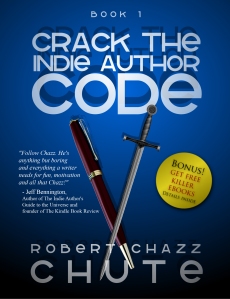
It’s the thing we should question most: accepted wisdom. Despite all my efforts, old wave thinking is still permeating my brain. In traditional publishing, you get a short window to get traction and then the bookstores return your books to the publisherCrack the Indie Author Code for credit. That’s the structure of the short tail market. In long tail marketing, our books are up forever (or at least until the cyber war brings us all low). Still, we tend to think of our books as hitting big (or not) and then the graph points down. We’re mimicking thinking and marketing patterns from traditional wisdom because all old ideas are awesome, right? Oh, wait…

Case #1

I’ve been meaning to do this for a while and by not sleeping, I’m finally getting to it. I pulled Crack the Indie Author Code and Write Your Book, Aspire to Inspire from print. I didn’t like the look of the interior design. I’m fixing them and will make Crack the Indie Author Code available in print again soon. (They’re both still out there as ebooks.)

Self Help for Stoners JPEGCase #2

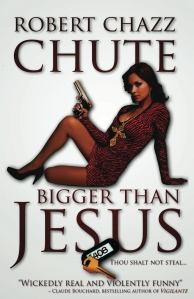
Self-help for Stoners was my first book. It’s funny and strange and with an intermediary. I used Bookbaby for that collection and I want to get it back at Ex Parte Press and put it out myself. I’m sure I can make it go higher once I have full and instant control of the marketing. I queried Amazon about the process today because I’m afraid of losing the reviews. Either way, I do need to steer my ship and reach out to stoners and non-stoners, alike and anew. (If you’re a Bigger Than Jesus and Higher Than Jesus fan, my luckless Cuban hit man appears first in Self-help for Stoners, by the way.)

This post won’t help you much if you only have one book to sell, but here are my thoughts on renewed marketing efforts: 

If you have one book, write more. No whining,

If you have a backlist, who is to say what’s old and what’s renewable? You’re the one to say.

If you have a bunch of books, I bet you’re a better writer by now. Why not revisit those books and do new editions?

Consider the power of bundling books. You could enliven your Amazon dashboard with more happy green up arrows. Stop sitting on the money.

Lots of people missed your fledgling efforts the first time. You didn’t know what you were doing. Who did? Any book they haven’t read is new to them. 

The most powerful promotions tend to be the first ones. But maybe that’s because we don’t put the same marketing efforts into books we published a couple of years ago. In digital, the term backlist is less relevant. As long as it’s clear it’s a new edition or a new launch or you’ve added material, what’s the problem? 

Maybe those early efforts flopped because you had a lousy cover. Get a new, better cover* and launch it right this time. With all you’ve learned about marketing since your early efforts, it’s bound to do better, right?

Most fiction doesn’t get stale. Our efforts get stale because we want to focus on the new thing. Maybe the old thing is only old in your mind. With some tweaking, a fresh edit and a new campaign, you might have a book people will love and buy. Reuse, recycle, repurpose. Turn short stories into collections. Open up to new possibilities with prequels to your books. Tie books together. Add to your series. Serialize. There’s plenty of fun to be mined in what you’ve already accomplished.

Your problem with these suggestions isn’t necessarily that my head is full of feathers. Your problem is the same as mine. This will take a lot of time and you feel you’ve already covered this ground. But most of us didn’t cover this ground well the first time. There are new promotional tools now. Yes, time management can be tough and we can only do what we can do. But that’s business. We are not special snowflakes, but we’re letting good stuff go cold.

*About good covers, I know a guy. He’s Kit Foster of KitFosterDesign.com. He’s an award-winning graphic artist with an extensive portfolio who works well with indies and traditional publishers. Like my covers? Kit did them all. Check out his site. You’ll be glad you did.

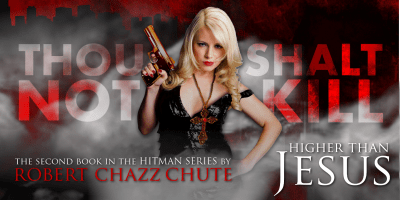
Dark Higher Than Jesus banner ad

Filed under: author platform, Books, ebooks, Publicity & Promotion, publishing, , , , , , , , , , , , , , , , , , , ,

Writers: Are you in the echo chamber?

I love my writing community here. I’ve learned a lot from others and, as indies, we share a lot of information. We’re a generous bunch with each other. I appreciate your comments and participation on my little writing and publishing blog. Because I’m a sweet bunny pooping love everywhere, I have to tell you something with love:

Writers talk to other writers too much. We must talk to readers more.

Let’s make this go down easy by using an example from another industry.

When massage therapists try to figure out their businesses, they ask their peers and senior massage therapists for their opinions. They want to drink from the well of experience. It’s a good notion that frequently goes awry. Their peers are often as clueless as they are and senior therapists either don’t have the same problems or their advice is out of date. Take pricing, for example. They’ll set fees based on what they’d pay. But many massage therapists would never pay for massage. They don’t have enough money or they swap treatments with other therapists. Massage treatment is for people with real jobs and insurance coverage, not us.

Stick with me and hold my hand, because this is about to get uncomfortable.

Writers need to listen to readers more.

Sadly, writers often don’t have much money to spare so we use libraries or search for free a lot. Most of us buy books when we can, but with budgets as tight as they are, we’re often not your audience. As a result, many of our industry’s book prices are artificially depressed. We’re asking the wrong audience what we should do. (I’ve taken this advice. I just raised prices on some of my books and generally, the trend will be up.)

A veteran writer who’s “made it” (whatever that means) often doesn’t know all the variables that contributed to his or her success. If someone coasted to indie success from a high in traditional publishing, they can’t tell you much about the current scene. Precious few people attribute any of their success to luck. It had to be their sheer brilliance. However, many of us are brilliant and we’re still eating boot soup.

So, what not to do?

If you don’t tweet others at all, you may as well be on Mars.

If you rarely check your direct messages, you’re in the bubble.

If you only check your mentions on Twitter, you’re screaming into the echo chamber.

If you follow three people and two of those are your other Twitter accounts, you’re only hearing yourself plus you’re a raging narcissist (and not in a good way).

If you only have conversations with people who don’t buy books, you’re surveying the wrong people.

If you only speak to people who “buy” free books, you’re engaging the wrong audience. (Readers who buy with money instead of a click are often suspicious if your book is priced too low, for instance.)

If you don’t take new information in and seriously consider change, you’re for slavery. (Your own.)

If you do have conversations with readers from time to time and you talk about them, you’re on a smoother path.

If you don’t cultivate supportive friends, you’ll be alone, surrounded by fiends and without a fire ax or holy water.

If you only attend conventions with other writers instead of fans, you’ll have a great time talking to people who agree with you: “Wow, it sure is hard to connect to new readers!”

If you never get out and talk to real people in the real world and only connect with people on a safe and cyber basis, who will you learn to hate so you can kill them in your next novel?

If somebody says, “I prefer paper books,” and you reflexively say, “How Amish of you! Ebooks are the only future!”, that was kind of funny, but you should be listening instead of cracking that same joke open again. It’s rotten on the inside.

If you say all this social engagement is too hard and it takes away from your writing time, I’m sorry. I thought you were writing to be read. Get a calendar or time management software. At least tweet or email during commercials.

If you immediately dismiss everyone with whom you disagree, you’ll never learn the secret to…well, anything really. Plus, you’ll come across as a jerk.

I’m not suggesting you allow me or readers or reviewers or anyone else to run your life. I am saying that if you recognize yourself in this list and it gives you that squirmy squirts feeling, adapt accordingly. Listen.
You should listen to me. I’m a writer.

Filed under: author platform, getting it done, Publicity & Promotion, publishing, Rant, readers, , , , , , , , , , , , , , ,

FAQs: How to write books agents will hate (but readers might love)

My luckless hit man is a funny guy in big trouble.

My luckless hit man is a funny guy in big trouble.

Yesterday I told you how a well-meaning friend with experience in traditional publishing gave me advice I thought was askew. As we struggle to gain traction in the marketplace, we get a lot of well-meaning advice we can’t take. (You’ve probably read that sort of advice here from me.) My friend’s other foray at saving me from myself was to tell me to court agents. “With World War Z, zombies are big this summer! Find horror agents and get traditionally published!” he said.

It’s not that it’s necessarily bad advice. However, it’s bad advice for me. Here’s a list of the things I do in my books that repel agents like fried bat armpits at the wedding feast:

1. Bigger Than Jesus and Higher Than Jesus is written in second person, present tense. Unconventional scares agents away. They’re trying to make money after all. I don’t blame them, but I’m in the Art and Brain Tickle business first. I have this crazy notion that being me will lead to making money. Eventually.

2. The assassin/anti-hero in the Hit Man Series is neurotic and afraid of women. (Name another hardboiled gunner who has that problem. Take your time. I’ll wait.)

3. My hit man suffered childhood sexual abuse. He’s also hilarious. Those elements rarely sit side by side comfortably.

4. Hardboiled isn’t selling hard right now. Or is it humor? Or is it action adventure? Easily classifiable is really important to a lot of people who aren’t me.

5. The titles may offend some Christians, especially since it’s crime fiction with a lot of swearing.

6. The titles are confusing until you understand that the assassin, Jesus Diaz, is Cuban and it’s pronounced “HAY-SOOSE”. In fairness, agents and publishers should be repelled by these titles. It wasn’t the best strategy because any title that requires explanation sucks. After two books, I’m committed and in love. I also have a plan around this problem after the next novel in the series is published early next year.

7. In my zombie series, This Plague of Days, the zombies aren’t “true” and “traditional”. It begins with a flu pandemic. You get to see how society gets to dystopian before the action kicks into ever higher gear. The slow burn requires more buy-in from sophisticated readers. Underestimating readers’ intelligence is an easier bet.

Season One has five episodes. Get each one for 99 cents or get all of Season One at a discount for $3.99.

Season One has five episodes. Get each one for 99 cents or get all of Season One at a discount for $3.99.

8. This Plague of Days has an autistic hero who rarely speaks and whose special interest is dictionaries and Latin phrases. Sounds like sales suicide when I put it like that, huh? That sort of gamble can pay off in a book. It’s death in the tough sell of a query letter.

9. The table of contents is a long, dark poem embedded with clues to the bigger story. Reread that and tell me I’m not silly. I know it.

10. Who will serialize a book unless I do it with my imprint? (Amazon Serials didn’t bite but readers are buying in.) Besides hooking up with Kit Foster of KitFosterDesign.com for his awesome covers, serialization has been my best sales strategy yet. This Plague of Days is a sprawling story tracking action over two continents with a big cast of characters. (At times you may wonder, is Chazz British or American? Split the difference. I’m Canadian.) It was too long to publish as just one book and the serialization model fit best.

When you look at that list, which idea comes across stronger? A or B?

A. All agents are evil, lazy and lack imagination.

B. I am determined to fail.

It pains me to say that all agents are not evil. I’ll save further discussion of agents for my next post.

For more on the why of this post, the writer’s character and how this relates to Joyland by Stephen King

click here for my latest post on ThisPlagueOfDays.com:

Writing Against the Grain: B Movies, A Treatments and the Deceptive Familiar


Filed under: agents, book marketing, Publicity & Promotion, publishing, self-publishing, , , , , , , , , , , , , , , , , ,

FAQs: Leverage free to move more books

The question comes up constantly: Is the exclusivity of KDP Select and giving away books (“selling” free) worth it? 

Can't have just one chip? Season One has five episodes. Get each one for 99 cents or get all of Season One at a discount for $3.99.

Can’t have just one chip? Season One has five episodes. Get each one for 99 cents or get all of Season One at a discount for $3.99.

For many, it’s not worth it, but maybe that’s because they haven’t combined enrolment in the program with other tools. When the KDP Select program launched, it was lucrative and an excellent tool for discoverability. Now? KDP Select is not easy and perfect certainly. For instance, top free books used to be listed beside top paid books. Now free ebooks are found by clicking a tab. That’s an important difference. It cuts down on happy discoveries by kismet. People who find free ebooks now are searching for free books (and quite possibly are committed to never paying for a book again.)

However, Amazon is where I move and sell books and get traction with new readers.

Some authors seem to have success moving books on Barnes & Noble if they sell romance or science fiction, but generally? The alternative sales platforms are far less helpful than Amazon and KDP Select.

For instance, sometimes I can’t find books on Apple that I know are there! It’s also a pain publishing to Apple at all unless you go through Smashwords or Draft2Digital. (I used to like Smashwords but now I’m past impatient with their failures to upgrade their site.) Meanwhile, I sell little on B&N. Sony isn’t worth the time it takes for me to format for them even though that’s just a click of a button. Kobo does some things well and they’re in many countries. However, Amazon is preferred because it works best for me. (Maybe it’s different for you but if you’re doing better on a platform other than Amazon, statistically you’re an outlier.)

The alternatives usually suck.

The other book sales platforms continue to refuse to steal the best ideas (i.e. promo coupons from Smashwords; user interface and customer focus from Amazon. And they still wonder why the Mighty Zon is the big dog eating their lunch. True, KDP Select is not a flamethrower anymore. It’s a six-gun. However, the competition is still trying to figure out slingshots, so going with Amazon exclusively 90 days at a time is still the best bet.

Yes, be careful of exclusivity.

When you in enroll in KDP Select, do not set it up to automatically renew. Reevaluate whether the program is working for you every three months and change tactics as necessary. If it becomes intolerable for some reason, we can bail out within 90 days.

To make KDP Select work, use the Author Marketing Club and Bookbub wisely to make the promotion go big.

I recommend doing no more than two days of free at a time. Have lots of other books to sell, preferably series or serials. Pump those promo days with the tools at AMC (like the free ebook submission tool.) Bookbub is probably the best PR tool available. It costs, but that’s because it targets readers interested in your genre so it works. You can promote sales of free ebooks or discounted books (under $2.99.)

If your goal is visibility, being in KDP Select is only one tactic in a larger strategy. Brace yourself for bad reviews from the one-star wonders. That tells you you’re reaching new people who don’t get you. Don’t worry. Others will get you and what you’re doing. Giving away books so new fans can find you isn’t the death of literature. Obscurity is our enemy. Get the most you can from KDP Select and use these tools to avoid wasting your promotion days.

I highly recommend serialization.

It’s working for me. Episode One of This Plague of Days promotes all the other episodes in the serial plus sales of my other books. I give away individual episodes. However, I don’t generally give away all of Season One except to book bloggers for reviews. This Plague of Days is a sprawling story that’s my investment in a long-term career so I give away the appetizer but sell the other courses. All my strategies are long-term strategies.

Who shouldn’t use KDP Select to promote their books?

I’d caution anyone with just one book to hold off on great expectations and write more books before waging major campaigns. Once readers discover they love you, have something else ready for them to buy.

Don’t go big if your book isn’t ready for prime time. More publicity for a bad book will make it go down in flames faster. Get back to the keyboard instead, develop, work with your editor or find a new editorial team.

If you already have a huge mailing list and a substantial fan base, you have more options instead of relying on KDP Select and exclusivity could hurt your sales figures (though I’d still consider it for one three-month contract period at KDP Select.)

If you find me unpersuasive and giving books away in the hope of finding new readers offends you, don’t do it. Gifts should be given with a light heart.


Filed under: Publicity & Promotion, publishing, This Plague of Days, , , , , , , , , , , , , , ,

Book Marketing Top 10: When less is more

Some marketing efforts are hurt by doing too much. Here are 10 examples:

Season One: Sponsor of the Cool People Podcast.  Can't have just one chip? Season One has five episodes. Get each one for 99 cents or get all of Season One at a discount for $3.99. Season Two hits this September.

Season One: Sponsor of the Cool People Podcast.
Can’t have just one chip? Season One has five episodes. Get each one for 99 cents or get all of Season One at a discount for $3.99. Season Two hits this September.

1. First there were big author tours. Then radio. Now, podcast and blogging niches are more effective.

Many marketing efforts benefit from going small, personal and specific. Instead of getting a few minutes on radio (while people are in their cars or having breakfast and definitely not buying) better to get on a podcast. Instead of planes and multi-city tours and paying for plane fare, podcasts yield more exposure to a smaller, targeted and invested audience.

Podcasts are usually easier to access. You’ll get more time and sell more books with a podcast interview than by trying to squeeze in a few words between car ads and the giggling Morning Zoo Crew. 

The same principle applies to blogging. I’d rather be featured by a big book blogger than in a local newspaper. (Ask your dad what a newspaper is. If he’s old enough, he might even still get one.)

2. Curation with commentary from bloggers is valuable. Bots drawing from dozens of tweets are not.

Before I knew what Paper.li was, I emailed someone to thank them for including me in their daily electronic newspaper. I soon realized that there’s nothing special about inclusion by bots in an array of harvested tweets. However, when someone reblogs my posts, that’s a personal recommendation that’s much more effective. (Thanks for all the reblogs, Armand Rosamilia!) When someone gives me the mucho bump of love on Twitter, it means more and helps more. (Thanks for your ongoing support and enthusiasm, Eden Baylee!)

Curation tools like Scoopit! are also valuable, as long as the post includes commentary. The difference is that a human makes those choices. “Set it and forget it” is nice for thermostats, but bleating out content without evaluation and recommendation is craptacular, both for the tweeter, the tweeted and, most importantly, our readers.

3. Too much email contact leads to friction. Ease off.

I have a couple of newsletter subscriptions that hit me daily. They’re too relentless. When I fall behind, the emails pile up in my inbox. I tell myself I’ll get around to reading it all, but deletion is more likely. I do open newsletters that fire at me at a slower rate. Give me a chance to look forward to hearing from you.

How much is too much? Wait until you have something to say, something new to announce or something to offer. Too much rah-rah-rah is so much blah-blah-blah.

Similarly, If you’re relying on book event promotions that arrive in an email blast crammed with other book events, find a way to stand out. My morning Goodreads email feels like a firehose aimed at a teacup. (Sadly, the teacup in this analogy is my brain.) Do something different and approach potential readers in varied ways. When one nail is hit too much, too often, it cracks the wood. (That’s a better analogy!) See Item 5 for what I’m doing differently and Items 7 and 8 for effective e-blast options.

4. Use a professional to get things sorted out.

I was briefly part of an affiliate program on another of my blogs. The product was good, but the program was plagued with technical problems. A day didn’t go by without an update on how said problems were being fixed. Then they weren’t. Again! I dumped the program.

I am an Amazon affiliate on my author site. It’s relatively simple. I get updates from them once a month and each update is relevant to me. That’s what to aim for.

5. Complications make us weary.

Make your offers uncomplicated.

My first draft of my viral video offer (details here) was too complicated. I ran it past a friend who suggested tweaks. I had explained too much and made too many jokes instead of getting right to it. I make a lot of jokes in my books, but when it comes to offers and promotions, people just want to know their rewards and prizes and what they have to do to get them. That’s all.

6. Tweet to content.

I use tweet teams sometimes, but much less than I used to and only for special occasions. We all have book tweet and email fatigue, don’t we? Make your tweets funny or intriguing. Tweet to your blog. Your website is the proper locus of sales. Twitter is not where to sell hard or often. Twitter is a place to help people find good stuff.

This has several positive effects:

Helping people tells them you’re not an ass (and if you are an ass, you can’t hide.)

You build your mailing list on your website, not on Twitter.

Your author site is your public face. Potential readers connect with you there, not through a sales link.

Twitter can still be useful, but when it’s not hooked up to content, readers stop paying attention.

7. Aim at targets.

Bookbub works best as a book promotion service because it doesn’t send out a long list of books to everyone. Bookbub knows what genres subscribers are most interested in. Romance readers don’t get sales copy to horror books. Fewer people receive the message, but those people are more likely to buy and less likely to saddle you with one or two-star reviews because they just aren’t that into you.

in the marketing war for our attention, sniper rifles work at long distances. Shotguns do not.

8. Be choosy.

For the last two days, I’ve done a free promotion of Episode One of This Plague of Days. (The sale ends at midnight and, as I type this, it’s the last few hours of the sale. Grab it free or, if you got this too late, Episode One is only 99 cents so, you know the drill.

I’ve held #1 in Dystopian and #1 in Post-apocalyptic for most of the two-day run. That’s probably mostly due to being chosen as a featured author on Freebooksy. They’re choosy, so their email blasts are taken more seriously than some other book promotion services.

Thanks to everyone who helped me give thousands of copies of Episode One away to spread the word. I appreciate your Facebook entries, tweets and clicks. And I don’t forget who helped me. Sincerely, thank you. I have a lot of friends and allies through this blog and I’m grateful.

9. More text = more confusion.

You’ll notice I have a lot of sales links to the right. This blog has gone through several redesigns over the years and I’ll be renovating again soon. However, the other day as I was researching book promotion services, I ran across a website that was literally like reading a phone book. The crammed type fuzzed the signal to noise. It was nearly unreadable. That’s not a good sign when the blog owners set themselves up as book marketing experts. More white space adds focus and more punch to the text. (See below for my post on blog scanning vs blog reading.)

Crack the Indie Author Code10. Small is an attitude that’s easier to relate to.

My writing and publishing guides are journeys through the mud of independent publishing. I chronicled the struggles more than the success. Success teaches less than mistakes can. I was (and continue to be) very honest about my mistakes over the last couple of years of steering the Ex Parte Press imprint. Instead of telling anyone what to do, I did research and gave opinions and examples. I experimented. I tell you what worked for me and what didn’t work. I’m just now beginning to feel like I have a solid idea of what I’m doing. Mostly because now we have more tools at our disposal than we used to have. Independent publishing has matured.

We’re walking together to find our way here. I don’t listen to some experts because their viewpoints come from such a different experience. One indie guru’s solution to marketing problems is to throw money. I don’t know what he’s talking about or to whom. Others are well-established because they came to self-publishing early with trad publishing inertia and lineage mojo. 

They aren’t us. We’re small, but we are getting bigger.

We’re getting traction. We have better tools now and we’re honing them.

No matter what, we’ll remember where we came from and the friends who helped us up and out.


Filed under: blogs & blogging, book marketing, book trailer, Books, getting it done, Publicity & Promotion, publishing, , , , , , , , , , , , , , , , , ,

Video, Audio and Pixels: Hugh Howey hits and This Plague of Days launches Episode 5

And here, folks, are the announcements as promised. It’s a cornucopia of fun stuff to feed your hungry, hungry hippocampus:

See the rest of the interview on my YouTube channel here, or subscribe at CoolPeoplePodcast.com.

Also available on iTunes (or on Stitcher through the show link to the All That Chazz podcast.)

This Plague of Days: The first zombie thriller on the autism spectrum.

Episode 5 is now available! Get each ep for just 99 cents or get the discount deal and get all of Season One for just $3.99.

Episode 5 is now available! Get each ep for just 99 cents or get the discount deal and get all of Season One for just $3.99.

In Episode 5 of This Plague of Days, it’s all action as the Spencer family faces great loss in the Midwest and Dr. Sinjin-Smythe runs for his life in London. Dump your expectations of what a zombie apocalypse can deliver. The survivors of the plagues can be just as dangerous as any horde of rampaging zombies.

From the latest review on Amazon…

“The final episode of Season One did exactly what it was supposed to do. It twisted your stomach in knots, let go slightly, then snatched your stomach away until the second season is available.

All the immediate conflicts were resolved in a satisfying way, not rushed, not unrealistic. There’s plenty of ground to cover next season, and the last few lines will leave you guessing. Well done, Chute. You’ve crafted a high-brow zombie thriller that stands out from the rest.” ~ Ava Easterby

Coming late to the Apocalypse? No problem! 

This Plague of Days scares me to death! I just can’t put it down; I have to see what happens next.

A review from Victor Morin

The mind virus is created. Spread the infection. If you already have read it, please review it.Thanks! ~ Chazz

The mind virus is created. Spread the infection. If you already have read it, please review it.Thanks! ~ Chazz


Filed under: book trailer, Books, Horror, podcasts, This Plague of Days, , , , , , , , , , , , , , , , , , , , , , ,

How I’ll sell more books by studying my author ranking

Before you read this article about author rankings, a quick heads up: I’m inviting you to something fun that could help you in your writing endeavours. The link at the bottom of this article will take you to ThisPlagueOfDays.com for a post you’ll like about the advantages of serialization. At the bottom of that post, click on The Link for the Curious to get a secret (not a spoiler!) about This Plague of Days.

Episode 4 releases today!

Episode 4 releases today!

Go to Author Central and have a look at your author rank. This shows you how you’re doing compared to other authors on Amazon. That’s not very useful information, but there is something to be gleaned from these charts.

Author rank on Amazon is interesting or depressing, depending on your score. However, the public never sees your author rank unless you’re in the top 100. As you click through and look at charts, the blue points are your highest rank on any given day (not your average for the day). The orange point is your placement right now.

These rankings are based on sales figures of digital, paper and audio. (So, as I’ve mentioned in this space, if you aren’t exploring your audio options yet, get on that.)

It’s good to own a genre if you can

If you’re really smart, you picked a genre and tried to dominate it. All or most of your books will be in one category and you won’t have many charts to click through. I’m not all that smart. I think focussing all your energy in one genre is probably a good idea. It is good advice I couldn’t take. I bubble over with ideas for books in various genres. Many of us are cursed that way.

For instance, I came up with an insta-book on doing business with the Vine app simply because (a) I was so enthused about the new app, and (b) I was working on the gargantuan This Plague of Days and felt like it had been too long since I’d published anything new. Not wanting to be forgotten, I wrote and published Six Seconds in one week. (Publishing gave my other books a bit of a boost, too, so there’s that.)

Gleaning what’s good to know from Amazon’s author rank 

I have three books in non-fiction (business and publishing).

For the Hit Man Series, I ranked higher in mystery than I did in thrillers, though I ranked consistently higher in action/adventure and science fiction and fantasy.

I don’t consider myself a sci-fantasy writer. However, This Plague of Days fits neatly in the sci-fi subcategory of apocalyptic/post-apocalyptic.

According to my author ranks, I rank best as a horror writer. I have several books of short stories on Amazon, but since they’re under the too vague “literature and contemporary fiction” categories, my rank there is weaker. Too general doesn’t help. I could and should put Murders Among Dead Trees under the horror category, too. It fits the tone for that collection.

Beware, however, of drilling too deep into a stagnant subcategory. The Hit Man Series sells better when categorized as action adventure and mystery. Hardboiled is a stagnant subcategory Bigger Than Jesus and Higher Than Jesus languished in too long. They were ignored because I messed up my category choice.

The mind virus is created. Spread the infection. Each of five episodes is only 99 cents each. Get the whole Season for the discount at $3.99. (And if you already have read it, please review it.) Thanks! ~ Chazz

The mind virus is created. Spread the infection. Each of five episodes is only 99 cents each. Get the whole Season for the discount at $3.99. (And if you already have read it, please review it.) Thanks! ~ Chazz

Bonus hint

How can you tell if a subcategory is too small or dead? Check out a few forums on the genre. If the board has few members or the most recent posts aren’t in the current calendar year, uh-oh!)

Don’t major in your minor

People major in their minor all the time. They’re lousy at formatting but they spend days on a task they should farm out to someone else. They should be writing but since they don’t want to delegate, they’re doing something other than writing and revising. The author ranking by genre shows us what we do best by identifying what books people want more.

Author ranking gives us clues how we should categorize our books on Amazon for greater discoverability and tells us what our major is. You could look at bare book sales, but with author rankings by genre, Amazon does that for you in a clearer way that doesn’t allow you to fool yourself with short-term variables. Look for trends across categories for clues to optimize your books’ chances.

What the clues from author rankings told me

1. As I studied my rankings, I was reassured that I made a good choice to pursue the horror category.

2. I have two more books in the Hit Man Series in the chamber, but I won’t pull the trigger on those until things slow down with my plague serial. This Plague of Days, Season Two hits in September, so Jesus Diaz fans will have to wait just a bit longer while I major in my major.

3. As I write the next book about my loveable but luckless Cuban hit man, I’ll amp up the mystery so it fits more comfortably in that category.

4. For the books that perform less powerfully, I have some ideas that will breathe life into old titles as I create new ones.

5. The work that stands alone doesn’t perform as well. I knew this, of course, but I can see it in the charts. This is bad news because I have another huge book that was to be a one-off. Then it occurred to me. This is good news. It’s so huge, I could serialize it as I’m doing with This Plague of Days.

For more on the beauties of serialization, click here.

(That’s also where you’ll find the link to my defiant secret.)

~ Robert Chazz Chute is the author of Self-help for Stoners, Murders Among Dead Trees, Crack the Indie Author Code, Six Seconds, Write Your Book: Aspire to Inspire, Bigger Than Jesus, Higher Than Jesus and the zombie apocalypse serial, This Plague of Days. Read, love, review and please spread the word.

Filed under: Amazon, , , , , , , , , , , , , , , , , , , , , ,

Why your interviews don’t work and how to fix the problem

See on Scoop.itWriting and reading fiction

A fun yet uncomfortable author interview: The Questions with Robert Chazz Chute: Writer on dSavannah Rambles

Robert Chazz Chute‘s insight:

Most author interviews don’t get read. If they are read, they are lightly scanned. Too often, the same questions are asked and worse, the same answers squeak out to an audience that does not care. There are people who care about where you get your ideas or how you started writing. Those people are your mom (maybe) and the fans who are already into your books. No conversions for you!

Regular Interviews Don’t Create New Readers

Regular interviews bore old readers. They convert no one. Some author interviews make me wish they’d preserved the mystery and shut up. Mostly, I just delete, ignore and move on to see if the Internet has any playful cat videos (like you). Author interviews as they are generally practiced are lousy promotional tools. If you’re going to bother with an arduoous guest blog tour for your book, break the old paradigm.

The Solution is Umbilical Lint

Writers should avoid cliches, so enough about (slurp) how much coffee we drink. Tell us about the Hunter S Thompson acid trip you took in Juarez at spring break. Tell us about your hilarious colonoscopy (I did on the All That Chazz podcast). Share news. News is new. Be entertaining and don’t go for the standard questions and useless answers.

This week, in my post “Author Armand Rosamilia Hates Canada” we got a lot of hits, retweets and comments. People had a good time with Armand’s fun answers to my silly questions about his secret life as a belly button lint sculptor. We made people laugh and intrigued them. Getting read, whether it’s in your books or for your book tour, starts with getting people interested. Don’t lead with “How long have you been writing?” Who cares? Those sorts of questions are for authors who are already on the NYT bestseller list. (And even them, yech.)

Don’t be Afraid to be Bizarre…or Honest

In my latest interview with dSavannah (at the link below) I give honest answers and some of them are funny but uncomfortable. Some answers involve time travel to save my childhood and career. I give an honest answer that involves my mother’s death. (I didn’t kill her. That’s my story and I’m sticking to it.) Be honest, informative, helpful, make jokes and use more imagination. You do that when you’re writing your books. Do that when you talk about your work, too. Just don’t be so earnest! To sell art, be more artful.

If You Want Nice Fans with a Sense of Humor, Be One of Them

Another example? Listen in to my giggly interview with cool Jessica McHugh at CoolPeoplePodcast.com. You might hate me but you’ll fall in love with her and you’ll want to check out her books. Our books are extensions of our personalities. Have one. That gives a reader hope they’ll like your books.

Read Armand Rosmilia’s audacious Fatty Arbuckle reference in his post here. Armand looks like a death metal biker dude, acts like a teddy bear and is a fun guy. We got such great feedback on “Author Armand Rosamilia Hates Canada”, he told me that in his next interview he plans to bomb Alaska. I think that’s something we can all get behind.

Entertainment is the first step to engagement. Are you not entertained?

If not, the author interview failed.

See on dsavannah.com

Filed under: author platform, author Q&A, authors, My fiction, publishing, , , , , , ,

Bestseller with over 1,000 reviews!
Winner of the North Street Book Prize, Reader's Favorite, the
Literary Titan Award, the Hollywood Book Festival, and the
New York Book Festival.

http://mybook.to/OurZombieHours
A NEW ZOMBIE ANTHOLOGY

Winner of Writer's Digest's 2014 Honorable Mention in Self-published Ebook Awards in Genre

The first 81 lessons to get your Buffy on

More lessons to help you survive Armageddon

"You will laugh your ass off!" ~ Maxwell Cynn, author of Cybergrrl

Available now!

Fast-paced terror, new threats, more twists.

An autistic boy versus our world in free fall

Suspense to melt your face and play with your brain.

Action like a Guy Ritchie film. Funny like Woody Allen when he was funny.

Jesus: Sexier and even more addicted to love.

You can pick this ebook up for free today at this link: http://bit.ly/TheNightMan

Join my inner circle at AllThatChazz.com

See my books, blogs, links and podcasts.

Enter your email address to follow this blog and receive notifications of new posts by email.

Join 2,061 other subscribers