C h a z z W r i t e s . c o m

See all my books at AllThatChazz.com.

Why you’re going to make it

As indie authors, we’re all encouraged to work harder. That’s frustrating to hear because I don’t know any indie authors who aren’t working hard. But I’ve got good news. Your chances of achieving some measure of success are better than we’ve been led to believe. Here’s why:

1. Businesses fail all the time, big and small. But our overhead is so low, we can continue after we fail! When your hardware store goes out of business, you’re done. We get a few kicks in the ass, but authors also get more kicks at the can.

2. Every business that ever made it to sustainable got there because the boss/producer didn’t quit. Many of the biggest success stories come from people who failed and failed and failed at their chosen path but were too dumb to quit. Stubborn is our advantage.

Being a writer isn’t just a job. It’s an identity. It’s a compulsion. How often do you really consider quitting? For many of us, we never seriously consider stepping on the brake. We’re writers and we always will be.

3. We have the right attitude and mindset about what we do. When a software engineer keeps his head down through seventy days straight of boring coding to come up with an amazing game, he’s applauded. Wow! Look at the art he created after all the boring stuff he did! Imagine all the fun stuff he went without to produce all that work!

Coding relentlessly may sound boring to us, but he’s probably into it precisely the same way we’re into books. Everyone has parts of their job they don’t like, of course, but could coding be any more boring than your eighth round of edits on a 100,000 word manuscript where the timeline and logistics still don’t quite work? 

What we admire in entrepreneurs is true of authorpreneurs. We make things happen in our business because we have passion for detail and it never occurs to us to quit. People who don’t quit write more books.

4. People who write more books have a greater chance at rewards, monetary and otherwise. 

Years ago, I met Dick #1 who asked Guy #1 what he did for a living. “I’m into convenience stores,” Guy #1 said.

Later, after Guy #1 walked away, Dick #1 said something disparaging about how little money anyone could make out of a convenience store. 

“You’re a fraction right,” I said. “How much do you think somebody could make out of a convenience store in a year?”

Dick #1 sneered. “Not much. $10,000. $15,000, maybe.”

“Well,” I said, “don’t get too judgy. He makes a lot more than you think he does.”

“Impossible!”

“Guy #1 owns ten convenience stores,” I explained. “And stop being a #1 Dick.”

So it is with books. Publish and somebody will dig your flavor and spread the word. Put a lot out there (improving with each book.) We can do okay in the long run. This isn’t an all or nothing game. It’s just a really long game.

5. The path to success is linear. You know what to do or you can learn what to do. All you have to do is continue.

Years ago, it seemed like the biggest topic was writer’s block and finding time to write. Finding time is still a challenge, but people whine less about writer’s block and I think I know why. They know they will be published now. Your destiny is in your hands and it’s not in anyone else’s. 

We aren’t worried about gatekeepers now. We’re anxious for many reasons, but our entrails don’t go into knots because we could spend years writing a book that no one will have a chance to read. We know we are spending energy toward a realizable goal that will happen: publication. If you knew you were going to the Olympics to stand before the world no matter what, you’d train every day. That’s us. To get to the big show, all we have to do is get on with it. 

6. There is a low bar to success. I’m not talking about becoming a millionaire. Not necessarily, anyway (though that indicates a high level of achievement.) Success is different for everyone, but you’ve got a much better shot at success than anybody daring to open a new yoga studio, hardware store or any other endeavour that requires employees, rent and huge bank loans. So cheer up. Authorpreneur is actually a pretty safe business venture.

Like many businesses, it starts off as a hobby and grows or it doesn’t, but you probably aren’t risking everything to do it. Plus, you get to do what you love. A lot of people are stuck in frustrating businesses where they feel thwarted. I often feel thwarted as a writer. I’m often envious of other people’s success. But I don’t love what I do any less. Loving what you do is perhaps the only immediate success, but it’s powerful.

7. Does finding 1,000 true fans really feel that intimidating? Many gurus say (as a general rule) 1,000 true fans is all we really need to reach sustainability. That’s less than the number of people in the tiny village I’m from. My goal is eventually to find 10,000 true fans. I can picture that. It doesn’t seem unreasonable.

The Staples Centre in Toronto has 19,000 seats and that’s just one city showing up to watch the Raptors play! (Sure, a Canadian invented basketball, but few are that excited about the Raptors. Still, they have enough die hard fans to keep the lights on and the refreshment stands busy.)

Getting half as big as the Raptors at the the writing game seems doable if I live long enough. That’s why I’m drinking more green smoothies, working out and eating less sugar. And writing my ass off.

8. Remember the statistic about how most indies make less than $500? Sure. That’s depressing. But I look at it like mortality stats. We used to die a lot younger, but that was because of the infant mortality rate. It’s a myth that people only lived to thirty a few hundred years ago. Many people lived longer but the infant mortality rate dragged down the average age.

You’ve just read all the way down to Item #8 on a blog post about writing that’s more than a 1,000 words. I’d say you’re pretty serious about this writing thing. Lots of people aren’t. Lots of people weren’t and they could imagine doing something else besides writing. For them it was TL; DR (Too Long; Didn’t Read.) They’re off pornsurfing while you stayed to hear me out to the end. You are not going to let your writing perish due to crib death. You’re in the survivors club and you know what I’m talking about when I talk about the writing life. Your chances of doing better than average are better than average. That’s why you are going to make it.
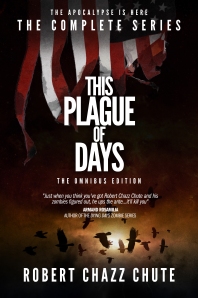
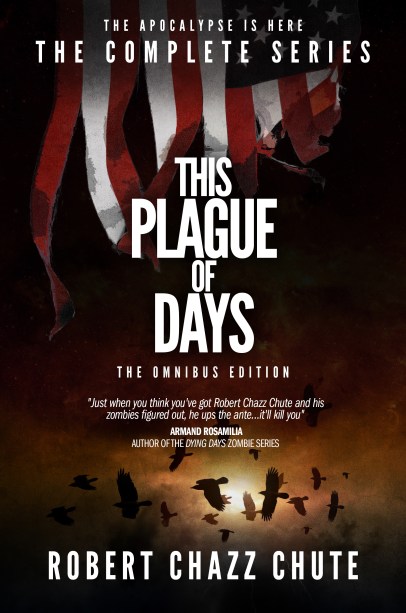
This Plague of Days OMNIBUS (Large)~ I am Robert Chazz Chute and I’ve written eleven books. I’ll write at least three more this year and they are going to be awesome. I am your happy warrior of the word. Check out my books at the author site, AllThatChazz.com. Find out more about my doomsday book with the autistic hero at ThisPlagueOfDays.com.

If you’ve read, This Plague of Days, Omnibus Edition (pictured and clickable, above), please review it. That would be awesome. Thanks!


Filed under: publishing, self-publishing, What about Chazz?, What about you?, Writers, , , , , , , , , , , , , ,

Writing Moonlighting Top 10: There’s going to be a pie fight!

There are many ways to write and no one can say any are “wrong”. Well, the kitten sacrifice was a little much. Here’s one way to go:

Anybody remember the TV show Moonlighting? It was a comedy that was on TV when Bruce Willis was adorable and Cybill Shepherd was Cybill Shepherd. During production, sometimes the planning seemed haphazard. The lowest guy on the totem pole in the writing room would run down a hall, stick his head in the door at the props department and scream, “There’s going to be a pie fight! Get 500 pies ready!”


That’s writing toward a scene.

They didn’t have everything else filled in yet, but they knew they wanted a big set piece and pie would fly.

From Google: 

set piece
noun
A thing that has been carefully or elaborately planned or composed, in particular.
A self-contained passage or section of a novel, play, film, or piece of music arranged in an elaborate or conventional pattern for maximum effect.

What’s this mean to you and your readers?

Deliver maximum effect.

You’re writing your book. Events happen. Complications ensue. Characters conflict. You know. Story stuff. A set piece is a story beat but not every beat is a set piece. This strategy reverse engineers your novel. You think about the big scenes you want to deliver and sketch those out so you can lay the groundwork and build the ladder or plant the garden. Pick your writing metaphor here. Without that context, it will feel stuck on so be careful to stitch tightly and weave over the seams.

The Big Scene: Put on the Helmet of Imagination!

The Last Evil Clown fights The One Good Mime atop Mt. Rushmore. Or the nuke detonates in Dubuque just as the hero teleports away to the bridge of an exploding starship. Whatever. You could write the context that gets your readers there and excited about it.

Set pieces are big stakes scenes so:

1. Add the ticking clock device. 
2. Kill a major character.
3. See it as the movie scene where the special effects department blows wads of cash.
4. Make it a major turning point.
5. Reveal something huge.
6. Deny the protagonist their easy victory.
7. Award the main character their vengeance.
8. Reward the villain with a huge comeuppance.
9. Pay off the reader with a spectacle, or at least something spectacular.
10. Books are long. Don’t have just one set piece.
Robert Chazz Chute This Plague of Days: Season 3~ In This Plague of Days, Season 3, the big battles constitute set pieces. Not every set piece has to be a violent cataclysm though. When the big secret is revealed in the library in Season 3, that’s a set piece, too. You’ll know when you get there because you’ll suspect I wrote it high on acid. If you don’t know what I’m talking about, I have something for your TBR pile. 

Filed under: Writing exercise, writing tips, , , , , , , , , , , , , , , , , ,

You are not an idiot Part II

“Nobody ever went broke underestimating the intelligence of the American public.”

~ H. L. Mencken

“Still! Don’t be that guy!”

~ Robert Chazz Chute

This part is about writing.

If you’re as cynical (or perhaps as realistic) as H.L. Mencken, you’ll dumb down your books to appeal to a wider audience. As Chris Rock observed, “Most people are B and C students.” A critic once told Sly Stallone his movies were for dumb people. Sly’s brilliant answer? “That’s okay. There are lots of them.”

It would be snobby to suggest every book should be “literature”, whatever that means. I like lots of dumb things. (For instance, I’ve seen every ninja movie ever made.) What I write, a lot of people would call “pulp.” They wouldn’t be wrong, either. (Check this link to The Vintage Library to read what pulp was really about. It’s not the pejorative some critics think it is!)

I’m not demanding that anyone write “up” or “down” to their audience. I’m not in the tell-you-what-to-do business. I’m in the brain-tickle business. I will tell you a quick story, though.

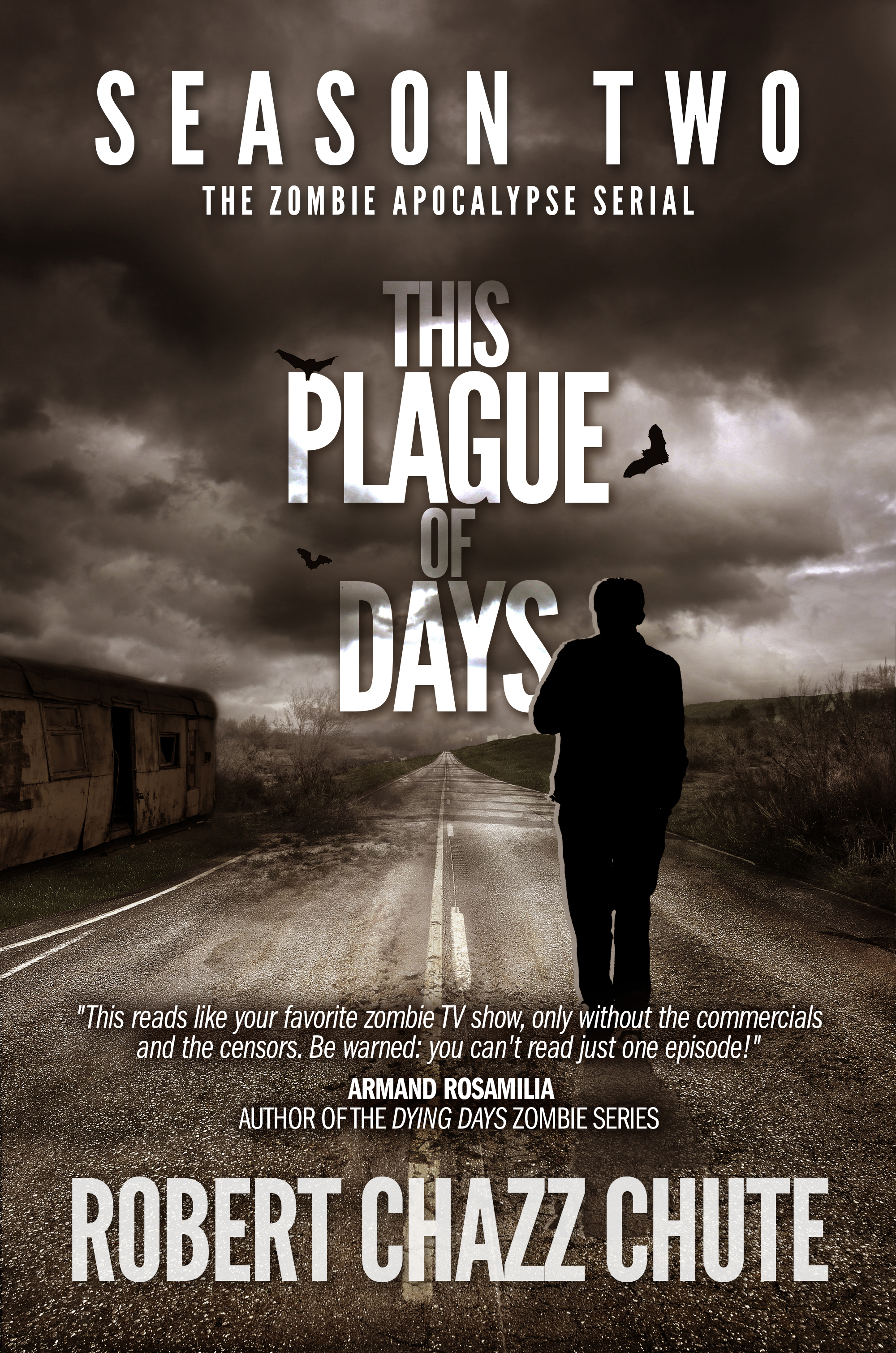
I just got a positive review of This Plague of Days by a person who identified themselves as autistic. My protagonist for those books is on the spectrum and, for that reader at least, the hero passed muster. That review is very precious to me for obvious reasons. I wouldn’t have received it if I didn’t reach a little.

This Plague of Days plays with language and expectations. It’s got a lot of Latin proverbs and a tiny bit of poetry amid the evolving carnage. It’s soft sci-fi with zombies and vampires and family dynamics amid disaster. The plot ventures into dark fantasy. Though readers may come in with low expectations because it’s essentially an end of the world dystopian saga about ordinary people facing infected monsters, the narrative never assumes the reader is an idiot. Escapist ≠ dumb.

The problem with stretching out and reaching as a writer is that someone, as a reviewer, will slap your hand for trying too hard. It’s true that some readers won’t read as closely as you’d like. They won’t “get it.” But few one-star reviews are worthy of serious consideration anyway, right?

Those who do grok it will love your work more.

What can I tell you about aiming higher versus what H.L. Mencken would consider “playing it safe”?

This is my 1336th post on this blog. Sift through and you’ll find I’ve frequently implored my fellow writers to “Follow the Art.” By that I mean, write what serves the story.

Today, I’m asking that when you write, be you. Be unique. Whether your goal is to write something fun and silly or earth shattering in its literary aspirations, be real. Whatever we do, our goal is to entertain. I write to entertain myself first, though. If readers dig my trip, cool. I try not to let reviews influence my game.

I’m taking the question away from a debate about whether to aim lower to achieve higher commercial success. I’m suggesting, as always, that we follow the Art. Be you because there’s only one of you. Don’t try to write like other people. Please don’t envy other writers’ success because envy is irrelevant. Please write what only you could write. Ultimately, it’s not about what seems smart and what’s really dumb. It’s about story.

All stories say something about the world and the writer who is the lens to that world.

Be a true lens that delivers clarity. The sights we point to may please the eye and ear and heart. Often the mind, but not necessarily. Lots of Charles Bukowski’s work is pretty dumb, but his lens was honest and I love his stuff. Though I admire their capacity for terrible vengeance, ninjas don’t say much about today’s world. They don’t say much at all. However, American Ninja 2 is still more fun for me than trying to stuff Ulysses in my head. Ooh! And Sho Kusugi in Pray for Death? Genius! Especially the execution with the buzz saw.

Robert Chazz Chute Bio Picture~ Hi. I’m Chazz. I write my variety of suspense. You can find all that stuff on Amazon here.

And now, some of it’s on Kobo.


Filed under: author platform, publishing, What about Chazz?, What about you?, Writers, writing tips, , , , , , , , , , , , , , , , , , , , , ,
On Writers, Publishing and Entitlement (with jokes in parentheticals)

This is not a story about titles. You’re thinking of “titling.” We digress today from the relentless cheerfulness and positivity of this blog to have a look at how some in traditional publishing still see us.

But first, since what’s to come triggered a memory of indignity, a story from the trenches: 

I was once a sales rep representing several publishing houses. Hang in there for the big honkin’ point at the end.

Once upon a time I worked for an oh-so-serious publishing house in downtown Toronto. We published oh-so-serious books that were sometimes hard to sell. No surprise. We were Canadian, after all. Worse, we published books that had to sound Canadian, or vaguely British, and not even of the 20th Century. (Told you this was an old war story.)

Unfortunately, the publishing house was close to a then-fairly-famous bookstore. The publisher would take authors out to lunch. On the way back from that hoity-toity lunch, the publisher would take authors to that bookstore to say, “We put your book on that shelf and aren’t we both so lucky to be fabulous swells? No promises on your next novel, but I’ll try to get you a government subsistence grant which I shall pen from my Swiss Chalet.” (Not the chicken restaurant. An actual Swiss Chalet. You get the classist dynamic.)

The publisher, a wealthy glitterati, was draped in diamonds even during the day, not knowing that was gauche and should be reserved for dining at night (with Queen Elizabeth.)

The author, a poverty-stricken member of the lowly literati, wore elbow patches on his ratty old sports jacket. Not to appear avuncular and professorial. To cover actual holes. The ink-stained wretches get the crumbs their betters forget to throw to the dogs. Traditional publishing hasn’t changed that much through the years. (This was the late ’80s. Now, there are no lunches with the wretches. Just ignored emails. Anyway, you get the income inequality dynamic.)

One terrible day, the bookstore tour backfired.

The nearby bookstore did not have the author’s book. We published it and it was not there. (Clutch those pearls. Here’s where it gets ugly.) The bookstore owner, infamous for being a dick, did not order the book in question in any quantity. They weren’t “out”. They didn’t order and didn’t plan to do so. (“Ev-er!” as we used to say.) The publisher was wounded and embarrassed, of course, for herself and for the author. (Soon the rage would be turned on me, your-ever-loving Chazz, so don’t feel too bad for her.)

The dick didn’t want that crap novel in his store, as was his right. He didn’t like the author’s work and he didn’t like the author personally. That was perfectly understandable. Nobody but snobs liked that author’s books and nobody but his mom liked the author. I especially didn’t like him after he threw (as we called it back in the day) “a hissy.”

I was the sales rep to that bookstore. I received the publisher’s anguished memo recounting her horror. The note ended with two words, “What’s wrong?!”

Since she was the boss and also the acquisitions editor for this boring book and this insipid author, naturally, we couldn’t tell her the truth. I wanted to express exactly what I’ve written here since I wasn’t being paid enough to lie. I campaigned for the truth. However, a cooler head prevailed and my immediate boss dragged his sorry ass over to the dick’s bookstore and grovelled to get it in stock.

I felt bad for him. And me. I’d already done my job. I tried to sell the dick a book and he said no and we moved on to the other 100 books in the catalogue because that’s what grown-ups do, even when they hate each other’s guts. (That bookstore is now closed. The dick is still alive. In related news, voodoo dolls do not work. At least they don’t work this far north of the equator.)

The first point is that no one can force any place that sells books into selling any particular book. Free will and freedom and eagles and moose and all that and whatnot. It’s a business and the author in question wasn’t a social fellow. The bookstore owner wasn’t a social fellow. Their poor sales rep (i.e. me) was in the middle and I didn’t appreciate dealing with either of them.

Do I regret my time as a sales rep for big publishing? I’ve learned more as a micro-publisher. As a micro-publisher, I finally found love. Thank you. 

And now…the point: A video to blow your mind.

Today I witnessed a spectacle of what The Passive Guy of The Passive Voice refers to as Amazon Derangement Syndrome. I’m about to provide you a link that shows a lot of things. I see derangement, certainly. Also, a sharp tang of smug even I have never aspired to. On the video you’ll see a lot of fear and other weirdness. Calling Amazon a monopoly when they are merely winning at competition, for instance, is pretty weird.

You will also witness entitlement. Make that Entitlement with a big E. As in, how dare Amazon not carry certain books even though they are available elsewhere? (It wouldn’t actually matter if they weren’t carried elsewhere, by the way. No bookstore carries all books. Not even online bookstores.)

Or how about this one: How dare Amazon sell Big Publishing’s books at the price that’s stamped on their books? The word “democracy” is floated out there willy-nilly. There is a distinct disconnect from reality. There are also a few lies or blind falsehoods and errors. I’ll let you figure out which belongs to whom. (See the comment thread — below — for help with that.)

For every problem Big Publishing has, they have someone else to blame. Well…one thing, actually. It’s always Amazon’s fault. Pay attention to the guy beside the woman who isn’t really moderating the debate. That’s Passive Guy himself AKA the rational one. The rest are very afraid and make few good points. When James Patterson wheels off into something about burning books, I have no clue what the #$@! he is on about. 

Here’s the video of the most lopsided debate ever.

You’ll also find the comment thread over at The Passive Voice illuminating.

Filed under: author platform, book marketing, , , , , , , , , , , , , , , , , , ,

The Business of Writing Top 10: How to have more fun

Have you ever watched shows like World’s Funniest Commercials?

This Plague of Days OMNIBUS (Large)When the show took a commercial break, did you sit on your couch and watch the regular commercials and wonder why they had to be so bland? Or did you go make a sandwich or run for the bathroom? Commercials don’t have to be as bad as they often are. Think of the annual hype around Superbowl commercials. How is it that the rest of the year, commercials are background noise for making sandwiches and flushing? The ad industry should try harder.

And so should we. Book promotion can be fun. We should take fun more seriously.

When we write our books, we are at our best. We’re witty and play with ideas and irony. We tell stories. We’re in the entertainment business. So why lose all that buoyancy when it comes to promoting our work? Advertising is writing, too. Yes, writing back cover blurbs and advertising copy is a somewhat different skill set, but this is not rocket science. Examples of good and bad sales copy are all around us. Emulate what works on you.
Some copywriters will enthuse that, sure, maybe you can write a book, but leave a couple of paragraphs of sales copy to a professional. That sounds rather convenient and self-serving, doesn’t it? IRobert Chazz Chute This Plague of Days: Season 3 don’t believe it. It’s great to be able to hand off such work to others with confidence, but for most of us, we’re writing our own promotional copy. Let’s loosen up and raise the bar.

If you can write a book, you can promote your work effectively without falling back on the cliché of “Buy my book!” I admit, there are writers who only say “buy my book” on Twitter and they are derided everywhere. I think this happens because no one has given them permission to be as imaginative and bouncy as they are when they write their books. It’s all writing, not a separate challenge. If it feels too different from writing books, it’s probably erring on the side of bland.

This is your permission slip:

1. Have more fun. There’s a reason it’s Rule #1. It’s that important, for you and your readers.

2. Use more pull quotes from your work of genius.

3. Make a joke. Be self-deprecating. Be different. Dare to show some personality. Let the joy leak through from your usual writing.

4. Craft something you’d want to read and act upon as a reader.

5. Relax. This is a marathon, not a sprint. Your sales plan doesn’t have to come together within a week or two of your book launch. Ebooks are forever and there are plenty of kicks at the marketing can ahead.

6. Sell less and interact more. Conversations are good. Blaring at is bad.

7. If you can’t interact, curate.

8. Selling effectively is never about selling. It’s about helping your tribe identify their want and need for you. I’m not here to sell. I’m here to help you buy. Stop being so self-conscious and apologetic about what you’re doing and do what you do in books: Put on a show!

9. Not all books are for everyone. Identify where your readers hang out and go there. Advertising for a niche and to a tribe willing to spread your good word is more important than trying to be all things to all people.

Smile. Rejection is a gift. It relieves you of the stress of dealing with boneheads later.

10. Tell more stories, not just in writing books, but in your promotional efforts, too.

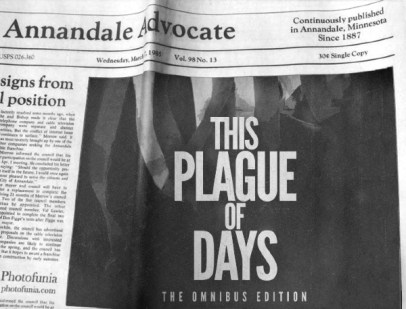
Here’s an example of some fun I had on Facebook today:

Newspaper

“Abandoned to an unfeeling universe, an increasing number of Americans are turning to This Plague of Days to confront ‘the horror of it all,'” an anonymous State Department official said. High-level advisors at the White House confirm, “An autistic boy named Jaimie Spencer, 16, of Kansas City, Missouri, may be key to resolving existential ennui. There are jokes, too, but mostly it freaks us out.”

Senator John McCain stated that Congress still can’t decide if Chute’s book is “literary bull****, zombie bull**** or ‘some other bull****.'” The gridlock continues.

Senator Rand Paul is threatening a filibuster, stating, “This is not horror per se! This is dark fantasy and President Obama knows it!” The secret of This Plague of Days remains classified to all but those who read to the end. Rumors of secret video and an offer of a free ebook are confined to those who read the TPOD Omnibus Edition. While Progressives call that anti-egalitarian and elitist, Secretary of State John Kerry said (in a speech that felt like three hours), “That’s capitalism. Whaddaya gonna do?

Meanwhile, the US Congress approval rating has sunk to a new low of 8%, still above public approval of McDonalds’ fishwich and slightly below mononucleosis as a diet strategy.

However, in a stunning break from party lines in a gracious “hands across the aisle” gesture, Speaker John Boehner and Liberal Senator Harry Reid did come to some concord and issued a joint statement. “The pace really picks up in Season 2 and the gross outs were balanced by some high-minded stuff neither of us really understood. We are all frightened for the Spencer family and keep them in our prayers.”

Robert Chazz Chute Bio Picture~ That was fun. I wrote a post recently answering reader’s questions about This Plague of Days. Find that here.

Filed under: author platform, book marketing, Publicity & Promotion, , , , , , , , , , , , , , , , , , , ,

Art matters. Writing matters. We matter.

Graphic designers make a big difference to readers and the success of authors. A snarky writer once told me I was a hack, too concerned about the look of my book covers. Once.

Everyone else knows, yes, of course we do indeed judge books by their covers.

You can say it shouldn’t matter all you want, but beautiful people and beautiful things get more attention. I won’t find out if you have a great personality and keen intelligence if, when I spot you from across the room, you appear to be surrounded by flies because you’ve rubbed dog feces in your hair. That’s life. That’s science. 

My graphic designer is the brilliant Kit Foster of KitFosterDesign.com. Check out his portfolio.

Kit is my friend and ally. He helps to make my existence matter. He’s helping me get my message out, subliminal and subtextual. It’s that important. All my books are about escaping who I was. They’re about all of us rising to the higher potential of what we could be. Everything I write is about making our existence — yours and mine — matter. Book covers are the come hither stare that lets me into your brain, to play in the Mindfield, to turn the words, to entertain, laugh and think. That’s what it means and why Art matters.

That’s the why. A book cover with solid art is part of the how.

Here is the new cover for the This Plague of Days, Omnibus Edition. It’s not at all what I pictured for the Omnibus cover. It’s better. I just let Kit do what he does best so I can concentrate on what I do best.

This Plague of Days OMNIBUS (Large)

To find out about more about secret video and to get a free ebook with your purchase of the TPOD Omnibus Edition, click here.

~ I am Robert Chazz Chute and, even though I occasionally write books with zombies in them, I am not a hack. It’s not the subject matter that makes the hack. It’s a lack of passion. Ultimately, with every twist, turn, joke and murder, I’m writing about me. And you. 

The suspense is in making our existence matter. Can we do it?

We will.


Filed under: book marketing, self-publishing, This Plague of Days, , , , , , , , , , , , , , , , , , , ,

TOP 10 in The Art of Seduction (and getting read)

Helpful or informative blog posts shouldn’t be hampered by headlines that repel readers. Here are some how-to suggestions for better headlines and variables that hurt the spread of your word:

1. Relentlessly negative headlines. Occasionally going negative with headlines can increase the number of people checking out what you have to say. If condemnation is all you’ve got, I’d rather watch puppies and kittens wrestle on YouTube.

2. Sex sells, but not too much. You’ll get fewer retweets among the squares. Many of the people who aren’t square won’t retweet, either. It’s not that they’re prudes, but Mom’s on Twitter, too. Stay classy…like “The Art of Seduction” instead of the sexier headline I’m really thinking of. 

3. Insular headlines don’t help. “Cover reveal”, for instance. Please give us more of a reason to click that link. It’s not that cover reveals are necessarily bad. It’s that it’s only for the people who already know you. We all want to expand our audiences beyond our inner circles, so be more welcoming to the uninitiated.

4. Vague headlines. “Author interview” seems a tad lacklustre, especially if you don’t at least name the author.

5. Pull quotes are better. You just did a hilarious interview with an author. Quote them in the headline or add the joke to your tweet. To get us to click the link, we want to know we’ll have fun when we get to your blog.

6. Provocative is fine. Don’t be misleading or a dick. In the case of today’s headline, I added the parenthetical “getting read” so those clicking quick would still have their clothes on by the time the page loaded. Please note that all my blog content is enjoyed best naked, however. That’s how I write it.

7. A headline is a promise of a sort. The headline should fit the content, but make both more fun. When I was in Journalism school we were told to only write headlines with verbs in them. I don’t believe in putting writers in straitjackets, but it’s not a terrible idea.

8. Brief is better but your tweet doesn’t have to be limited to your headline. Add appropriate hashtags. Add a pull quote. Offer more clues so we know what to expect. Can’t do it with one attention-grabby headline? Follow up with another tweet tomorrow that doesn’t use the headline but points out an angle of the content. Or write a better headline in the first place. 

9. Spend more time on writing headlines. What would get you to click? The words, “how to” and “review” get more clicks. Asking a question can get people to check out what you have to say. Using key words in your tags will help you find more readers, so think about what words you would search to find out about your topic. However, don’t overuse key words. Google spiders are smarter than they used to be about that and, worse, that kind of thinking lends itself to flat, repetitive articles.

10. Write your headline last. Some people write headlines first to maintain focus, but that can lead to plain and linear headlines (which aren’t necessarily bad if it’s something people need immediately and it’s something they’re searching for.) The first stab is not always best and it will be more clever if you give it some time to percolate as you write. People like Top 10 lists, perhaps for the brevity (and so they get less of me naked.)

BONUS

It’s okay to tweet old posts if the material is evergreen. Get more mileage out of your work. It’s still going to be new to a lot of people.

Robert Chazz Chute Bio Picture~ Have you seen that new gorgeous and bodacious you asked for? Check this out at ThisPlagueOfDays.com.

Filed under: author platform, , , , , , , , , , , , , , , ,

Sweet Book Pie: Bonuses for readers, a tip for writers

When ebooks first emerged, the goal was to make them appear as much like paper books as possible. Generally, we’re still doing that and that’s a good thing. I’m not a fan of “enhanced” ebooks that pack in distractions. I don’t want the soundtrack to the battle scene as I read. I want to immerse myself in the story. A movie is a movie and the media don’t mix well. The movie we make in our heads from reading is usually superior, anyway.

I did use video in a different way to reach out to readers in This Plague of Days, but it’s a link buried in the back of the TPOD Omnibus, not something to accompany the story. (I told you about that secret video and the free ebook bonus last week, so click here if you missed that.) 

But yet another secret awaits in the This Plague of Days Omnibus.

Many readers may not really be aware of it. This is where thinking about ebooks as ebooks comes in. I did something fun with the Table of Contents, but you have to look for it to see it all at once. The key is, the Table of Contents doesn’t have to go in the front of ebooks.

Go find it Scooby Gang! 

To get the TOC in This Plague of Days, Omnibus Edition, you have to “go to” the TOC (which I placed in the back of the book.) I did this for several reasons. The main one is that it’s another Easter egg for TPOD readers. 

The TPOD TOC is one long, dark poem. It contains veiled hints and clues to the story arc from beginning to end. Much of the poem will make more sense in retrospect. To get all of it at once, it’s in the back of the TPOD Omnibus Edition, but the individual ebooks (Seasons 1, 2 and 3) yield chunks of it, as well. 


Why I love it:

It was fun to create. I like poetry, especially dark and mysterious poetry. I enjoy the fact that readers will see how it all comes together upon finishing the trilogy. I love the fact that I did something different from the expected. That’s my thing. To be perfectly honest, I love that I’ve done something a mainstream publisher probably wouldn’t allow me to do. I don’t consider myself an experimental novelist, at all. I just think it’s a fun add-on in this case.

Sure, readers could skip from chapter head to chapter head to get it, but that’s awkward. Most people won’t do that and you don’t get the full effect reading it piecemeal. Will it gain more readers? Nah, probably not many. I think of it as a little extra for people who are deep into TPOD. Cater to them what dig your grooviness and you’ll get more of those groovy people.

But there’s a much more important reason to put the TOC in the back of your ebook.

It’s about the size of the free sample on your sales page. When readers look at samples, they want to get into the story quickly. With non-fiction, I do want a peek at the TOC up front so I can grok what will be covered. With fiction, the TOC gets in the way of the narrative and cuts down on the sample size. To get readers deeper into the story, we have to get that TOC out of the way so we give the reader a bigger sample of sweet book pie.

Whenever possible, give the readers more pie so they can decide if they like your flavor. I’d rather have thousands read the sample before buying and say no than have dissatisfied readers who were looking for dragon/Big Foot erotica and, inexplicably, bought my book instead. Unread samples are where most bad reviews come from.

Generous samples get people to buy cartloads of stuff from Costco every weekend. Much of it they didn’t know they wanted until somebody said, “Would you like to try a taste?” 

Add value. Add fun. Play with the reader. Give ’em more pie. Always give more pie. Put your next novel’s TOC in the back of the book.


Robert Chazz Chute Bio Picture~ This Plague of Days book bargains continue. Find out about that here. 

Or not. I mean, geez. It’s a low pressure situation, man. Chillax and enjoy as the apocalypse unfolds all around us. You’re already soaking in it so you may as well soak it in.

Filed under: author platform, Books, ebooks, writing tips, , , , , , , , , , , ,

Writing: Where the money is

Everybody wonders what the next big thing will be in our expanding industry. In other words, “Where’s the money?”

As it relates to writing as an industry, money looks sparse at first glance. I mean, banking, drugs and guns is where the big money is. However, for our industry? The big money in writing is in the beams and braces. Infrastructure. The money will go to people who service our needs as indies. So ask yourself, what do we need?

1. Book apps. We don’t really understand book apps. Programmers do. Book apps with a subscription service could work, especially for certain authors who are in traditional publishing now but will soon make the leap to self-publishing.

2. Author cooperatives. Box sets may already be on the way out, but I think more authors will share resources and trade skills, either in small, structured groups or as part of a time bank organization, or both.

3. Organization provision: Many of us cringe at the idea of a union because it reeks of gatekeepers. I’d say that’s only because the writers unions that have been proposed for indies so far stink of more gatekeeping. Innovators out to advocate instead of control could do better than that, for us and for themselves.

4. An alternative to ACX that’s more generous to creators. ACX was awesome. Technically, it’s still awesome though the creator share is down. Have you noticed that, since ACX lowered the pay rate, we aren’t talking about ACX near so much anymore? We’re still using it because audiobooks are our future. For some, they’re our today! We’d like more choices and we’d like to get back to the bigger cut, though. (The obstacle is effective distribution, so that will have to be bankrolled.)

5. Selling direct from websites will become more popular. You can use Gumroad to sell digital products now. The problem is, no one wants to sideload their kindle with a pdf. Find a way around that problem and we’ll all be doing it to some degree. Fewer buttons, one click. That’s key.

6. Discoverability tools are more important than information. Make more discoverability tools (like you’ll find at Author Marketing Club, for instance.) Information is free everywhere, including here. Ways to help readers find us are harder to come by.

7. Services that promote indie authors will make money. Bookbub is at the top of the heap now, but BookGorilla is cheaper. The Fussy Librarian is very low cost. if I recall correctly, the latter was built partially in response to Bookbub’s fees. Bookbub has big lists of subscribers, sure, but they have competition and it’s growing because Bookbub is so hard to get into and can be so expensive.

8. The company that finds a way to make it easier for books to be printed and distributed (cheaper, faster and easier than it can be done at present) and get it to libraries and bookstores will make a lot of money. Be the new Lightning Source, for instance, but make it as easy to deal with as CreateSpace. (LS has improved in this regard, but I’ve checked it out and it still feels like a hassle.)

9. Translation houses. Everybody knows foreign language publishing is going to be huge. What we don’t know is whom to trust to translate our work and whom to ask to make sure the translations are any good. We’ll also need people (formerly known as agents) whose sole occupation is dealing in foreign rights sales. The markets are waiting, but most of us aren’t ready.

10. The next destination website for our readers. We need a destination website that operates as a cool magazine that curates our work to readers. We need to provide a way for readers to find us and vice versa. We don’t need another Writer’s Digest. We need a Reader’s Digest, if you will, for our work but catering to readers. If there aren’t click to buy and click to explore buttons at the end of each story or sample, it will still miss the mark.

You could, of course, simply write the next big thing.

We are writers, after all. We don’t want to think about all this tech stuff. That’s why someone with the skills to fulfill these needs will eventually appear and get paid.

If you’re still bent on writing to make money, the trouble is that no one knows what the next big thing really will be. No one saw Fifty Shades of Gray coming. It’s not like it was the first book of erotica to go on sale, but it went huge. Its imitators didn’t make near as much dough. Breaking out is not something you can chase, exactly. It happens to you and there are too many variables outside your control.

Just write the best book you can. When your book is ready, I really hope those trusty translation houses will be up and running and ready for business.

What are your ideas for the support structure our industry needs?

~ The good news. I’m now in the Top 100 Horror Authors on Amazon! The book launch bargains continue for This Plague of Days here. See what all the fuss is about, see the video and find the secret.

Filed under: author platform, , , , , , , , , , , , , , , , ,

Why I unpublished from Amazon (it’s about sales pages, not Hachette)

This isn’t a story about getting away from Amazon. It’s about sales page management, and you need to be aware, sales pages are not something you can just “set and forget.” You have to keep an eye on them for glitches. A glitch just happened to me.

Today, I had a shock.

In the middle of my book launch for This Plague of Days, Season 3 and the TPOD Omnibus Edition, the Omnibus suddenly wasn’t on my Amazon sales page anymore! I checked and that’s the only reason I knew it had disappeared.

Gone! Oh, no! Not now!

I refreshed the page and knocked back a vodka.

Still gone!

I cursed my fate and invoked Thor’s intervention.

Still nothing. Dammit, Thor!

Naturally, after those early strategies failed, I contacted Amazon. They said they’d get back to me within 24 hours. If this had been my first rodeo, I would have pooped kittens. However, they generally get back faster than that and, in this case, I had the fastest response I’ve ever had.

The email assured me there was a “slight glitch” that deleted the book from my sales page. Maybe a slight glitch to them, but I just launched! My interviews are appearing across various blogs promoting my latest books. It was a big deal to me. The email further assured me that the problem would be corrected within “one to three days.”

One to three days?

Vomit.

No, not really. Like I said, this ain’t my first time on a horse. Those emails always allow a long time for their fixes, but the Amazonian techs have, invariably, acted much faster than that. And so it was. This Plague of Days, Omnibus Edition featuring the complete three seasons of the apocalyptic saga with the autistic protagonist trying to save the world? We’re back, baby!

They fixed it within a couple of hours. I have it on good authority other sales platforms don’t swoop in to fix problems nearly so quickly.

Check your pages and make sure all your books are there from time to time.

Further thoughts on sales pages and serialization

After I brought out Season 3 in my series, I had a problem. The sales page looked cluttered and my work is not displayed in the order I’d prefer for greatest sales advantage. What to do? I skipped calling on Thor since he doesn’t show up unless I dress up as a hot chick. (I’m still carrying some winter weight and can’t sell the hotpants.) I sent another email to Amazon:

Could I, perhaps, edit my sales page to make it less cluttered and show my wares to greatest advantage? 

The reply was, for now, a polite no. My Amazon contact did agree that mine was actually a good idea and they would pass the suggestion up the line. Currently, the order of book display is based on sales figures. Self-help for Stoners has been on sale longest, so it’s up top. That’s not the problem. Serial episodes are. 

My Serialization Problem. 

Season One of This Plague of Days was released as one book, but also as five episodes (and each episode’s price was 99 cents.) My Season One episodes sat there, clogging the page and confusing customers. 

I came up with a solution that fit my longer game plan.

I unpublished the five episodes from the first book and set the price for Season One at just 99 cents.

This presents several advantages:

1. At 99 cents, Season One is a low barrier to entry into the series.

2. It gives readers a break on price. 

3. It promotes my visibility and my other books. Sales are up, author rank is up.

4. It avoids (I hope) angry reviews from people mistakenly purchasing Episode IV and V at 99 cents each when they could have had all of Season One (which contains all five episodes) for one incredibly low price. It’s couch change, yes, but some reviewers go nuclear over such things and outrage is rarely expressed with a sense of proportionality. Angry? Burn down somebody’s house! Mildly annoyed? Burn down somebody’s house! See what I mean?

A note about the trouble with serialization.

Serialization certainly has its advantages and helped Season One  and Season Two get more attention. However, no matter how much you might explain it and lay it out in the descriptions and vary the cover art, some readers seem determined to confuse Seasons and Episodes despite a lifetime of watching television. Quick to click, I guess.

I’m very sensitive to criticism (so yes, wow! I know! I am in the wrong business!) Anyway, the last thing I want is for readers to be confused or feel ripped off. That’s another reason Season Three is one huge book instead of broken into episodes. Serialization put me on the map, but the Law of Diminishing Returns has kicked in.

I still have episodes of Season Two on Amazon obstructing the view on my sales page. It is, as it has always been, cheaper to buy the season than to buy the episodes. I can’t let it go at 99 cents, though, so those episodes are going to stay up for a long time. Until Amazon changes its policy and allows me to control title placement, they stay and Season Two is priced as low as I will make it. When I do get control, the eps will go to the back of the sales page. I could just unpublish them, but I don’t want to leave the few who just bought Season 2, Episode III in the lurch.

How long is long enough to wait for those readers to catch up and complete their S2 episode purchases? A year? Two? I don’t know.

~ The TPOD book launch bargains continue.


Tell me when you discovered the secret of the TPOD Omnibus and I’ll send you my next thriller as an ebook. Details here.

Filed under: author platform, Books, free ebooks, self-publishing, , , , , , , , , , , , , , , , , ,

Bestseller with over 1,000 reviews!
Winner of the North Street Book Prize, Reader's Favorite, the
Literary Titan Award, the Hollywood Book Festival, and the
New York Book Festival.

http://mybook.to/OurZombieHours
A NEW ZOMBIE ANTHOLOGY

Winner of Writer's Digest's 2014 Honorable Mention in Self-published Ebook Awards in Genre

The first 81 lessons to get your Buffy on

More lessons to help you survive Armageddon

"You will laugh your ass off!" ~ Maxwell Cynn, author of Cybergrrl

Available now!

Fast-paced terror, new threats, more twists.

An autistic boy versus our world in free fall

Suspense to melt your face and play with your brain.

Action like a Guy Ritchie film. Funny like Woody Allen when he was funny.

Jesus: Sexier and even more addicted to love.

You can pick this ebook up for free today at this link: http://bit.ly/TheNightMan

Join my inner circle at AllThatChazz.com

See my books, blogs, links and podcasts.

Enter your email address to follow this blog and receive notifications of new posts by email.

Join 2,063 other subscribers