C h a z z W r i t e s . c o m

See all my books at AllThatChazz.com.

Brainstorming better book titles (and what can kill a good one)

1. The tone of the title should match the genre. If your thriller’s title makes potential readers think of young adult romance, keep brainstorming.

2. Non-fiction titles tend to be linear promises to provide solutions to a problem you have identified. Deliver.
My luckless hit man is a funny guy in big trouble.

My luckless hit man is a funny guy in big trouble.

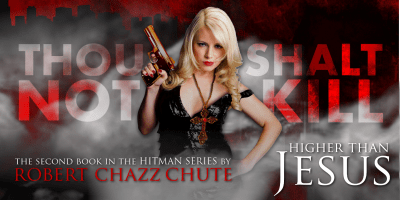
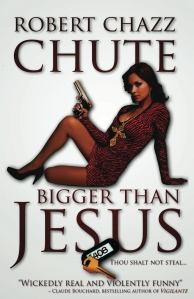
3. Intriguing is good. Confusing is not. That’s a fine balance. I loved the titles Bigger Than Jesus and Higher Than Jesus. However, it’s pronounced “Hay-soose” and it’s about a funny, hardboiled Cuban hit man. Titles you (and I) have to explain (endlessly!) are not good titles. The cover treatment by Kit Foster of Kit Foster Design saves me from readers who buy my crime novels thinking they are religious books. Also, I do have another solution to this problem. I’ll explore that next year, after a couple more books are written. In the meantime, I remain an idiot for thinking those titles would serve me better than they did.

What? You thought I write these blog posts because I get everything right the first time? Ha! No.

4. When you’re brainstorming, think in terms of keywords. A short, killer, catchy title can be helped a lot by a more explanatory subtitle. Don’t go overboard with keywords, though. If you run out of breath, forget the rest halfway through, or can’t cram the whole title on the cover, rethink. We’ve got to be able to read the title without squinting, so don’t cram it.

5. Generally try to avoid titles that are very long. After catching the title in a wisp of conversation, the potential customer has to remember it all the way back to their computer or the bookstore so they can order it.

6. What’s the central theme, promise or event that’s crucial to your story? Brainstorm titles out of that.

7. Think in terms of brand and series. Can you connect titles in some way? A is for Alibi is already taken, but think about what might fit. I have two new series planned for the end of next year that connect tangentially to existing books.

8. Come up with a bunch of titles and throw out a bunch. Don’t get too attached to a title early on. Some authors feel they need a title before they can begin to write. Your story may change, so just keep that WIP title tentative and to yourself for now.

9. You can take titles from phrases from the Bible or Shakespeare or be completely original. Go for memorable. However, don’t let the absence of a title stop you from beginning to write. It will probably emerge from the manuscript organically. Use a focus group of trusted friends or fellow writers to save you from your worst impulses.

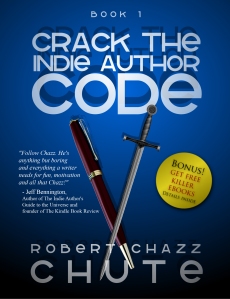
10. Build a brand around your author name, not your title. I don’t want people more excited about my title than they are about me writing another book. That’s why the name “Robert Chazz Chute” is so big on the cover. Make them want to buy the next [insert your name here], not the title. I don’t really like the title, Doctor Sleep, for instance. But it’s Stephen King! Of course I want to read it!

I’m convinced that titles really don’t matter quite as much as we’d like to think.

I can name a lot of titles that shatter these ten well-meant suggestions. It’s like naming a band. Lots of band names sound pretty stupid or obtuse at first, but if the music is any good, people don’t even think about it much. I doubt everyone was enthused about the name The Beatles or Led Zeppelin on their first encounter (before hearing the songs.) I didn’t like the title Fight Club. The book is about so much more than that. However, I got over it quickly.

It’s true for TV shows, too. The first time I heard the name MASH as a little kid, I thought the TV series had something to do with potatoes. The Pink Panther? I didn’t know it was animated, so I pictured an actual pink panther skulking through the jungle. Without seeing it (and hearing its musical theme by Henry Mancini) I had no idea it was destined to become so iconic.

To sell more books, what’s ultimately more important than the title? Your graphic artist.

A good graphic artist can build on an awesome hook. A bad cover can sabotage even your most clever title.

A great title doesn’t matter if no one can see it. Don’t undermine that title you’ve put so much thought into. You need an excellent graphic artist to support your efforts. A great cover maximizes the power of your title and your author name. That’s why I use…wait for the shameless, enthusiastic plug for my Scottish buddy…

Kit Foster of KitFosterDesign.com

Check out his portfolio for powerful images

that pump up all the authors he serves.
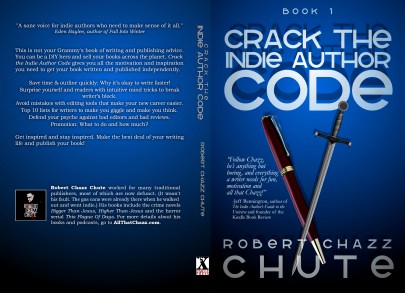
By the way, Crack the Indie Author Code 2nd Edition is out in paperback at $9.99. Smaller format, with jokes.

By the way, Crack the Indie Author Code 2nd Edition is out in paperback at $9.99. Smaller format, with jokes.

~ I’m Robert Chazz Chute. With my serial, This Plague of Days, I’ve written two bestsellers. However, my catalogue of my inspirational errors in the early going will tell you more about the challenges of being an indie author. Get Crack the Indie Author Code. I don’t scold you and it’s actually pretty funny. The 6 x 9 print version is about ten bucks and Christmas is coming, so get on that or Christmas is cancelled and Santa’s elves will turn into goblins. It’s up to you to save Christmas from rampaging goblins. It’s up to you and you alone. No pressure.

Filed under: author platform, Publicity & Promotion, publishing, , , , , , , , , , , , , , , , , , , ,

Top Ten: Make your writing count

braingasm cover1. One is the loneliest number. It’s you, the author, facing the blank page. There’s no one with whom to share responsibility to write and no one to share the blame for when you get it wrong. You are alone in here until you allow the ghosts to come forward and their voices to speak.

2. Two is you and your reader. You become invisible. The reader disappears. That leaves the story as the bridge, hanging in the air between two indefinite points and reaching through time. If the story is strong, the ethereal is made real and two indefinite points connect in mutual imagination. This is the only magic I know.

3. Three, as in “Rule of”. No one knows why the Rule of Three works. It just does. Lists of two feel insufficient and weak. A list of more than three feels pedantic, overblown, overly long, simply too much and see what I’m doing here? If you do, then you are paying attention, astute and onboard.

4. Four is the number of years you were in university, supposedly learning how to write. If you fell for that, well…I did, too. We would have spent all that money better had we hit the road, read a lot and just wrote. You may want one, but you don’t need an MFA. You need a little recklessness and exposure to the world and curiosity to lead you to what you need to know. I learned more about writing in my first two weeks as a newspaperman than I did in four years of a journalism degree. 

5. Five is age five, as in when you start to remember things you can use against your parents in your first novel. Wherever a remembered childhood begins is where you begin collecting fodder, drama and trauma (see? Rule of Three!) that you will cannibalize until the Alzheimer’s gets its hooks in deep.

6. Six times three is the Number of the Beast and it sounds like “sex” and it was my lucky number when I believed in lucky numbers. Six is the number of degrees of separation and Kevin Bacon. Six represents the tentative connections upon which all fiction is built. Less than six is too linear. Six means you’re making fragile neural connections between ideas to construct something new and fresh and interesting. Shore up that spider web against high winds and less imaginative minds with facts and a realistic context that supports the suspension of disbelief.

7. Seven is the number of things scientists say we can do at one time. Don’t do that. Do one thing at one time. Do not multi-task. When you are writing, write. Until you can make the world go away, there’s no chance of building that bridge over the fog to reach readers.

8. Eight is a good number of beta readers and proofers. Chances are you can’t find eight excellent pre-publication readers willing to comb your manuscript. However, try for half that and use the others for specific skill sets. My survival expert and cartographer, for instance, knows where Saint-Louis-du-Ha! Ha! is.

9. Nine is the number of relatives you were sure would buy your book. At the family Christmas party, they will be disappointingly vague, clueless and heartless about your literary endeavours. Or worse, they will have read it and will shrug off the experience in crushing silence. Or worse still, they’ll ask you to ship them a free copy.

10. Ten is the top ten list you pray you’ll get on even if you don’t believe in God. Ten is the number of good reviews you need to get on many promotional lists. Ten is how you remember the date you took to the prom. Ten is a number representing what’s best. Ten is the number of digits on the hand that pulls you up from anonymity with a tweet of endorsement, a clap on the back and a congratulatory handshake. Ten equals Hope.

Today, you are one.

Write often, boldly and well.

Your writing will count.

Your readers will be innumerable.

~ I’m Robert Chazz Chute. I have a large Irish family and a large Japanese family. I wish they liked me enough to buy my books. Fortunately, #5.


Filed under: author platform, Top Ten, Writers, writing tips, , , , , , , , ,

Et tu, Kobo? Anger and the Cost-benefit Analysis

By now, most authors know about Kobo’s rash move to yank all indie authors from its platform. Today, we talk about Kobo and reevaluating our marketing strategies so we can manage time and energy and make more money.

If you came in late to the debacle, here’s what started it:

They condemned indie authors in an over-reaction to a news story about pornographic ebooks invading WH Smith through Kobo. Instead of weeding out individual books they deemed offensive, they painted us all with the same brush and pulled a digital-ton of indie ebooks.  They didn’t just hit indie porn and erotica titles. They hit all of us, the tall and the small, and legal. (For more details, check “Related articles” below).

Hitting the big, red nuke button was a major tactical error. Failing to open lines of communication also didn’t help. Kobo was put in a tough position because of their relationship with WH Smith. Kobo did announce the bulk removal was temporary and they’d review books before putting them up for sale. How long that could take, we have no idea. Kobo probably doesn’t know, either. Sounds like a gargantuan task. Better filters would have served them well.

Two of my crime novels were pulled from Kobo.

Bigger Than Jesus and Higher Than Jesus disappeared from the store. Bigger Than Jesus is now back, but not for long. I’m pulling it from Kobo and everywhere else, except Amazon and CreateSpace. I’ll also begin selling paperbacks from my website (but more on that another time.)

Some authors are (or were) making money with Kobo. Amazon is not the only game to play, so you’ll see the same advice everywhere: “Don’t put all your eggs in one basket! Put your books across all platforms! Amazon’s free books scheme with KDP Select doesn’t work anymore.”

Today, I’m going to challenge the egg basket wisdom. First, let’s talk Kobo beef.

1. Kobo’s platform is flawed. Where are the reviews? And (I’ve said this many times) why aren’t they stealing the best ideas from the other platforms? Amazon is the model they aren’t emulating. Kobo isn’t alone in this regard. Over at Smashwords, the website is still very ’90s. Still!

2. Instead of taking the time and energy to spread ourselves across many platforms, I suggest you look where books are actually moving. This won’t help you if you have one book, but after a few, you know which platforms butter your bread and which poop in your cereal bowl. My books sell on Amazon, Barnes and Noble and in print. That’s it. Avengers, assemble! Activate the 80/20 rule! 

3. Some people love Kobo. They’re in a lot of markets and there are nice people there. I’ve spoken to someone from the company and she couldn’t have been nicer. I’ve heard interviews on the Self Publishing Podcast. Kobo has awesome representatives who communicate their respect for authors and care about what we’re doing. I want to love them! But the company screwed up all that good will in one big, bad move that was not thought through.

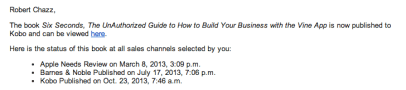
4. Then I got this email this morning from Draft2Digital, informing me that a book I published to Amazon (within 24 hours) back in February 2013 was finally on, you guessed it, Kobo.

Screen Shot 2013-10-23 at 9.27.16 AM

Barnes and Noble published Six Seconds in July and Kobo’s right on the case, finally getting my book about marketing with the Vine app out into the world today? What the bloody hell? It’s been so long, I’d forgotten I’d even selected them as a sales channel.

Trying to publish this book with Apple is also a hassle. That’s two of Amazon’s competitors failing the cost-benefit analysis. The tragedy is that Amazon doesn’t have to be perfect to dominate. It just has to avoid the razor wire and landmines its suicidal competitors throw themselves upon. In a healthier market, the competition would be smarter and closer on Amazon’s heels.

5. Then there’s the hypocrisy. Kobo says they aren’t for censorship as they pull indie authors. They’re free to publish and not publish what they want, but this was a blanket condemnation of indies. That no doubt pleased traditional publishers. It must have been particularly gleeful for the legacy publishers of erotica who were immune from the cull.

It has to be said, there are all kinds of works of literature that contain intense violence. Many of my books contain violence, but not all were pulled. I’m arguing none should be pulled because, if you want to protect children from pornographic ebooks, it’s your job to make sure your kids don’t buy them. Kobo is a company. Parents are parents.

I don’t want media companies to act like parents, especially when we’re talking about fiction. I had parents already and look how that turned out. I’m nobody’s kid anymore and I’ll make my choices for me and my kids, thanks. (As all preachers’ kids know, it’s the suppressed and repressed ones that go too wild once they hit Frosh Week, anyway.)

6. Okay, so that’s enough spanking Kobo. Let’s talk book marketing strategy and rethink it.

As far as KDP Select goes, it’s true it doesn’t work as well as it did. However, does it not work for so many authors because they’re expecting it to work on its own? The book has to be strong and the cover art must be awesome. We all know that, but are author-publishers stopping short, assuming those variables are enough gas for their sales engine? How many oft-referenced cases of KDP Select “failures of free” are actually KDP failures? Are authors doing enough to promote those free days?

Using Author Marketing Club tools and Bookbub, Freebooksy and other advertising and promotion services in combination with free promo days through the exclusive Select program, This Plague of Days, Seasons One and Two became bestsellers. This was long after many authors abandoned KDP Select because “free doesn’t work anymore” became common currency among us.

Your cost-benefit analysis may be different, but I urge you to do a cost-benefit analysis.

As pressures mount, spreading ourselves everywhere takes time and energy we could be using more profitably. If you sell books on Kobo, keep them. If you’re that one author who makes cash selling on Sony or Diesel, go for it. The only platform I’d say everyone should to be on is Amazon because they’re the bus that’s gassed up.

“But what if Amazon makes the same mistake Kobo did? They’ve pulled books willy-nilly before! Isn’t Kobo’s fiasco an example of why we have to spread our books to all platforms to minimize risk?”

After the hoopla Kobo’s decision caused, I don’t think Amazon would be or could be that stupid. Besides, it’s not about allegiance to a platform or blind tribalism. It’s going with what works for you. At worst, if you really can’t stand being in Amazon’s exclusive contract, you can reevaluate and bail at 90 days.

True, spreading everywhere insulates us from dumb mistakes, but it would also minimize potential profit drastically. Unsuccessful businesses play not to lose.  Play to win. I mentioned I sell some books on B&N, but the return is so low, it’s not even a factor. Until the other platforms come up with better ways to market us, Amazon is my puddin’. 

This is math. Look at where your books are selling.

Put your time and energy into getting more books into those channels and leveraging that advantage with books like Let’s Get Visible by David Gaughran. (And if you haven’t published yet, buy Crack the Indie Author Code by some thoughtful and encouraging idiot.)

Are you selling even a little bit on Kobo? Who cares? Use the 80/20 rule. Focus your energy where it does the most good. That’s why I’m pulling my crime novels from Kobo. I had other plans to market the Hit Man Series. Now I’m going to pull them back to KDP Select and leverage that series better than I did the first time. I wasn’t in the Author Marketing Club when Bigger Than Jesus came out. I only have two series, so I must reevaluate non-Amazon successes and failures and act accordingly.

This is also emotion.

I admit it, emotion plays a role. Nothing’s broken so I’m not in a rage. I am annoyed. Kobo made their decision for short-term reasons that did not respect indie authors. We are the publishing revolution, remember? They pulled our books without warning. We don’t matter to them and I’m hurt. It’s not just the principle. It’s the money.

I’m sure I don’t matter to Amazon, either, but at least Amazon can publish my books in a timely manner and move them. Ultimately, I’m not leaving because of Kobo’s instability. My annoyance led me to reevaluate what Kobo was doing for me. I’m not punishing Kobo at all, but the fact that I can pull my crime novels and not hurt myself tells me I should refocus my energies.

I’ll go back to Kobo one day, if they’re still around by then. Who knows? Maybe this debacle is just what they needed to reevaluate their platform and marketing strategies, too.

Tips and inspiration for the indie author's journey to publication.

Tips and inspiration for the indie author’s journey to publication.

~ Hi. My name is Chazz and I’m much nicer than I appear here. I’m usually pretty sweet and funny unless I’m writing suspense. Then the serrated knives come out and things get twisty. I love people, though books give me less back sass. I’m a contrarian, but not for the sake of being contrary. I just don’t understand how the world works. There are so many example of how it doesn’t work, I get distracted easily.

I believe in love and readers and curiosity and the written word’s power to release dopamine. I’m in the brain tickle business and I’m grateful for that every day. Find all my books here for the foreseeable future.

Filed under: author platform, Books, , , , , , , , , , , , , , , ,

Writing and the Day Job: When dreams don’t come true on schedule

Let’s get a myth out of the way immediately.

Some writers say it’s a rule that a day job keeps writers in touch with the real world and, to be good, writers need real world interactions to draw upon for their fiction. Maybe that’s true for them and their process. I had enough drama to draw from before I left home as a teenager. I deal in fiction. Imagination and Google are more useful to me than interactions with actual humans in Meat Space.

Meat Space humans are difficult for me to deal with. I see the world differently and they don’t all get my sense of humor. I’m a little weird and sometimes I have to make myself shut up so all the weirdness doesn’t escape at once and scare people away. In books, it’s easier. I’m supposed to be strange when I write. If you’re reading this blog, there’s a good chance you relate to that. When we go corporate, no one’s supposed to suspect our minds are active.

Even when I’m lying, I try to tell the truth.

I lie to myself about a few things, but I’m honest for readers, sometimes painfully so. That’s why I’m unveiling some vulnerability and complexity here. I wrote a post last night about going back to a day job. Fourteen years ago, I was in the same office, doing sort of the same thing. (Long story.) The point is, in the post I wrote to readers, I was emphasizing the positive. It wasn’t a lie when I wrote it. It’s not a lie as I type this.

However, sometimes my enthusiasm for my return to the real world is a lie. Starting up yet another business is creative and exciting and stressful. When my enthusiasm is down and my pride is butt-hurt, there’s a reason for that. It’s called Entitlement. As in “False sense of”. I have that affliction sometimes. I’m not proud of it. In down moments, I do feel bad about needing to return to work.

But I feel worse about the sacrifices my family has had to make to support my dream. There’s tension when the bills come in. We don’t talk about it, but we know. We don’t take vacations like all the kids’ friends do. Every purchase feels like a commitment to a serious investment. How long will this coat last? Is the van’s muffler a ghost yet? The living room rug absolutely must be burned and replaced. As mentioned in my previous post, poverty sucks.

The Revealing Question

I ran into a friend and former client who got the news I was returning to my old workplace. “Are you okay with that?” he asked.

The question was gentle and well-meaning. He knows that, for me, the last two years dedicated to writing have been the best two years of my life. When I’m at the keyboard, I’m home and having fun creating chaos. I’ve used those two years (mostly) wisely. Ah, but the question. “Are you okay with that?” Depending on my mood, it’s loaded with should haves and what ifs and worries about dealing with an unknown public.

If This Plague of Days wasn’t taking off, I’d have a huge problem with my return. It would feel like capitulation and a backwards step. I’d feel like a loser if not for the seeds of success very slowly budding. I’ve also published ten books in two years. My readership is growing. The timing would have been ideal if the growth I see now happened a year or so ago. But having a hit isn’t like that and hits don’t last, either. There are too many variables and they aren’t all under my control. To pay the bills, I have to do what I did two years ago. I’m risking starting another business.

I’m not quitting writing.

To take things to the next level, I need to have more money coming in to support my family and my imprint, Ex Parte Press. The schools seem to request more cash for projects, school trips and class support almost weekly. Bookbub promotions are not cheap. And yeah, that living room rug is a bio-hazard that no carpet cleaner can cure. Back to work I go.

The Good News

The day job isn’t so demanding in the number of hours it takes.

I can write between clients and still be very productive. In many ways, my day job will be an ideal complement. I can control my time and I still work for myself. I’ll have two businesses. That will undoubtedly diminish some book productivity, but I’ll still have more time than most writers so I should not, must not, whine.

It must also be said that in my other, newer business, I’m really good at it. There are much worse things to be doing with my time. It’s noble work that helps people and yes, I am expert. If not for that expertise and writing, I’d be looking on Monster.com for “Hired assassin”. I’ve considered dog-walking, but only if it was 1980 when nobody had to pick up after their dogs.

We do what we must. We move forward. We make what fun we can from whatever we do. That sense of entitlement with which I am sometimes afflicted? It doesn’t serve me. It doesn’t help any of us. I’m earning my readers, one at a time. Though it is deep and dark, we are finding each other in the forest. It’s going to be fine.

~ These are my books. This is the new business. Tonight, as I write this, I feel no chagrin.

Filed under: author platform, authors and money, book marketing, getting it done, self-publishing, Writers, writing tips, , , , , , , , , , , , ,

The Secret Alphabet of Independent Publishing

"You will laugh your ass off!" ~ Author of Cybrgrrl, Maxwell Cynn

“You will laugh your ass off!” ~ Author of Cybrgrrl, Maxwell Cynn

A is for All of it, which is what we want. (A used to stand for Agent.)

B is for Book, of course, and ebooks are “real” books, too. Literature is about the content not the container.

C is for Cutting prices. It would be bad for writers, but at 70%, we’re still getting paid more per unit sold than in traditional publishing. Also, price cuts sure make now a great time to be a reader.

D is for Deadlines. Don’t take forever to write your book. More time procrastinating doesn’t make a better book.

E is for E-books on E-readers. But you know your kindle is a transitional device, right? The phones are getting bigger again and tablets are coming down in price. We don’t want a device to do one thing. We want one device to be a web surfer, camera, phone, app catalogue, music box, GPS, ebook reader and best friend on our hip.

F is for Future. It’s the direction to look. If you don’t like it, you can change it whereas the past requires an annoying child named Sherman, a dog named Mister Peabody and a Wayback machine.

G is for Guidelines, because guidelines are malleable. There really aren’t many unbreakable rules worth obsessing over. You already know the rules because they’re obvious or you ignore common sense or you’re a slave to unthinking tyranny. The cool kids prefer more options.

H is for Hope. It’s good to have some, especially in this business. When there’s no reason to have any, that’s when you need it most.

I is for Intermediator. Have as few of these as possible. Upload your books yourself if you can, or get help from an independent contractor. This will allow you more choices of forks down the road.

J is for Just you. The myth and prejudice against independent publishing is that’s it’s just you. You are alone, except for the editors, graphic artist, beta editorial team, volunteers, publicity teams and whoever else you can hire or cajole into helping you get your book discovered. Sure, other than that little cyclone of industry, it’s all you.

K is for Killing characters. Killing someone readers love who they were sure would make it to the end? Delicious. (Note: killing darlings is overrated.)

L is for Love. It’s why we write. If you have other motivations, that’s fine, but releasing dopamine as you create is, like reading, a very rewarding addiction. The biological pharmacy in your brain simulates love. Endorphins won’t land you in a dirty rehab unit with a roommate who won’t stop telling that story about the time he tried to get high on burnt bananas and smoking his own hair.

M is for Money. It can happen, but probably not so don’t write for money. As above, write for love. If money does happen, people will resent you slightly less when you claim you never expected it.

N is for Naysayers. Most of them will never write near as many books as you will. Just say no to naysayers. If you sleep with your naysayer, someone’s in the wrong bed.

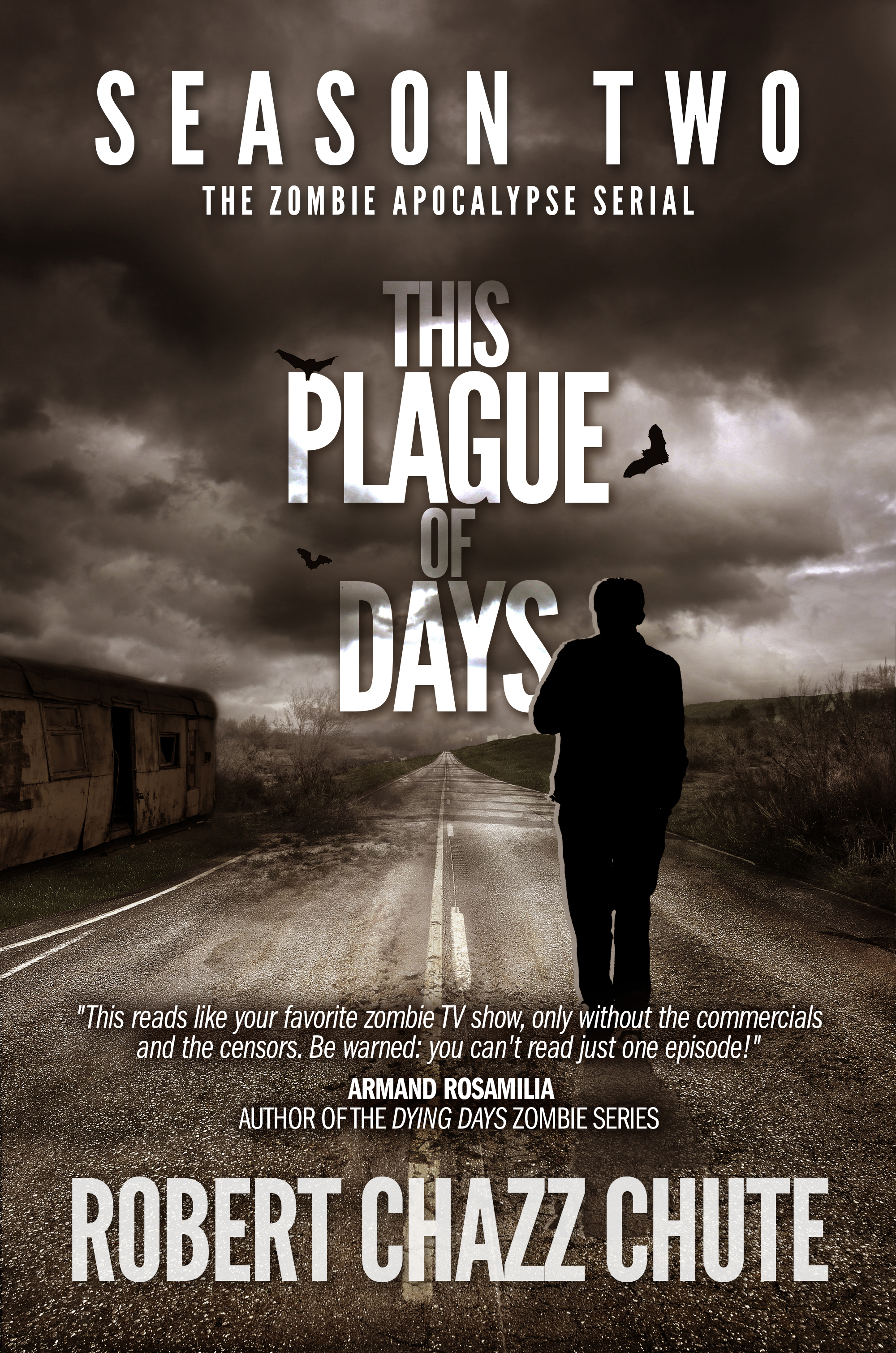
O is for the Obsession to know things. It seeps into the writing so you can drench your fiction with non-fiction and trenchant verisimilitude. For instance, This Plague of Days, Season Two weaves the Apocalypse with interesting tidbits about Irish legends, military history and the mortal wounds inflicted by the blue-ringed octopus. Mine is the only zombie/plague/autism story that teaches you Latin in an entertaining way, guaranteed!

P is for Portent. Warnings that something big is about to happen are especially fun when you give readers an earnest warning and they still don’t see it until it coming. They’ll only see the clues in retrospect. Secret trails to revelation and love of language are why people reread books. Do it well and someone might think your book isn’t just suspense, but maybe even “literary” or (praise Thor) “important”.

Q is for Quitting. If the project is wrong, quit. If it’s right and you’re just whining, quit whining and finish it. If you aren’t excited to write this book, find another you will be excited about all the way through or for our sake, please do stop. 

R is for Ripoffs. It’s a minefield out there: Fake agents who try to make money off reading fees; publishers who won’t pay; people who use disreputable business practices and call them policies. (R is also for Research. It’s how to avoid R is for Ripoffs.)

S is for Sustained Action. Promoting your work need not be an exhausting blitz. Dig in for the long game and promote at a slower pace. Don’t promote the same stuff to the same audience all the time lest you exhaust them. Keep writing new books. Don’t pin your hopes to one book. Sure, you might accidentally hitch your wagon to a star, but chances are excellent you’ll hitch your wagon to a stump, especially if this is your first rodeo.

T is for Trying. You’ll hate yourself if you don’t try. Losers will hate you because you did try. That’s why they’re called losers. They work from a different definition of failure than you and I. They confuse boring with winning.

U is for Unpublish. If something isn’t working, take it off the market and replace it with your tweaked story, new cover or new edition. Unlike traditional publishing, you have more options. You can adapt. Ours is a different, more flexible, business model. Use that advantage.

V is for Victory. There is no victory. Banish the concept from your life. There are only ups and downs and we’re all trying to make more ups.

Victory is very useful in fiction, however. Readers want to escape real life’s mundanity so it makes them happier when the protagonist achieves victory at the end of a story.

To go all Conan and see your enemies driven before you and to hear the lamentation of the Evil Mort from Accounting? That’s fiction. Working in a cubicle farm with no hope of retirement while Mort gets promoted and vacations in Brazil? That’s real. The real-life Mort is why we all crave escape into stories.

W is for Wit. They say brevity is wit’s soul, but I can take a pounding of wit in dialogue all day and all night, Mr. Sorkin.

Please note that snark is not quite wit. That’s a blunt tool meant only for peeling the outer layer of flesh. Meanness is the opposite of wit. That’s a blunt fool’s weapon. Wit’s funny and smart. When that sword cuts, we see light flashing down the steel blade. Wit allows the victim to take the hit and nod, “Touché!” with a smile.

X is for X-ray vision. All writers have this power. I can see into purses and pockets and the lives of strangers at the mall. I can work backward or forward to tell you who they are and their story of heartbreak in their senior year of high school. I diagnose disease at a distance. I know what you did last summer. I can give your life history and your death meaning, so do not screw with me.

Z is for Zero. It’s what we’re paid for writing. We are never paid for writing. We write for love, remember? If the money ever arrives, we’re paid for putting up with dehumanizing reviews, pretending to take them well and staying silent about them forever. We’re paid for the sad paperwork at tax time. We’re paid for the sting when someone sneers with casual cruelty, “So, are you a big deal yet?” We’re paid pennies an hour for the sacrifices our loved ones make so we can keep writing. 

Writing a good book is a happy, selfish act for the writer.

We are addicts, helpless in our defiance and desperate to monetize our work so we can have the freedom 

to score more of Creation’s sweet biochemical cascade.

Escape reality. Get high on a story.

~ I am Robert Chazz Chute, the author of Self-help for Stoners and this was the high I was talking about. This Plague of Days, Season Two scintillates brains October 1. Get Season One and check out all my books here. I hope to be your favorite candy man one day.

Filed under: author platform, Publicity & Promotion, publishing, Writers, writing tips, , , , , , , , , , , , , , , , , ,

Writers: Are you sitting on the money?

They call it the Cliff. You can do Author Marketing Club and Bookbub and free promotions and blow giveaways out the digital door. You can even start catching fire and getting traction and selling books for (gasp!) actual money. Then, the fall from grace comes. Sales drop off, often steeply. What happened? You ran off the Cliff. Lots of people do. In this post, we’re going to think about climbing back up and promoting our previous works again (and doing it better this time) because I suspect we’re sitting on money.

I’m rethinking the old marketing paradigm that’s always oriented to what’s new. 

It’s the thing we should question most: accepted wisdom. Despite all my efforts, old wave thinking is still permeating my brain. In traditional publishing, you get a short window to get traction and then the bookstores return your books to the publisherCrack the Indie Author Code for credit. That’s the structure of the short tail market. In long tail marketing, our books are up forever (or at least until the cyber war brings us all low). Still, we tend to think of our books as hitting big (or not) and then the graph points down. We’re mimicking thinking and marketing patterns from traditional wisdom because all old ideas are awesome, right? Oh, wait…

Case #1

I’ve been meaning to do this for a while and by not sleeping, I’m finally getting to it. I pulled Crack the Indie Author Code and Write Your Book, Aspire to Inspire from print. I didn’t like the look of the interior design. I’m fixing them and will make Crack the Indie Author Code available in print again soon. (They’re both still out there as ebooks.)

Self Help for Stoners JPEGCase #2

Self-help for Stoners was my first book. It’s funny and strange and with an intermediary. I used Bookbaby for that collection and I want to get it back at Ex Parte Press and put it out myself. I’m sure I can make it go higher once I have full and instant control of the marketing. I queried Amazon about the process today because I’m afraid of losing the reviews. Either way, I do need to steer my ship and reach out to stoners and non-stoners, alike and anew. (If you’re a Bigger Than Jesus and Higher Than Jesus fan, my luckless Cuban hit man appears first in Self-help for Stoners, by the way.)

This post won’t help you much if you only have one book to sell, but here are my thoughts on renewed marketing efforts: 

If you have one book, write more. No whining,

If you have a backlist, who is to say what’s old and what’s renewable? You’re the one to say.

If you have a bunch of books, I bet you’re a better writer by now. Why not revisit those books and do new editions?

Consider the power of bundling books. You could enliven your Amazon dashboard with more happy green up arrows. Stop sitting on the money.

Lots of people missed your fledgling efforts the first time. You didn’t know what you were doing. Who did? Any book they haven’t read is new to them. 

The most powerful promotions tend to be the first ones. But maybe that’s because we don’t put the same marketing efforts into books we published a couple of years ago. In digital, the term backlist is less relevant. As long as it’s clear it’s a new edition or a new launch or you’ve added material, what’s the problem? 

Maybe those early efforts flopped because you had a lousy cover. Get a new, better cover* and launch it right this time. With all you’ve learned about marketing since your early efforts, it’s bound to do better, right?

Most fiction doesn’t get stale. Our efforts get stale because we want to focus on the new thing. Maybe the old thing is only old in your mind. With some tweaking, a fresh edit and a new campaign, you might have a book people will love and buy. Reuse, recycle, repurpose. Turn short stories into collections. Open up to new possibilities with prequels to your books. Tie books together. Add to your series. Serialize. There’s plenty of fun to be mined in what you’ve already accomplished.

Your problem with these suggestions isn’t necessarily that my head is full of feathers. Your problem is the same as mine. This will take a lot of time and you feel you’ve already covered this ground. But most of us didn’t cover this ground well the first time. There are new promotional tools now. Yes, time management can be tough and we can only do what we can do. But that’s business. We are not special snowflakes, but we’re letting good stuff go cold.

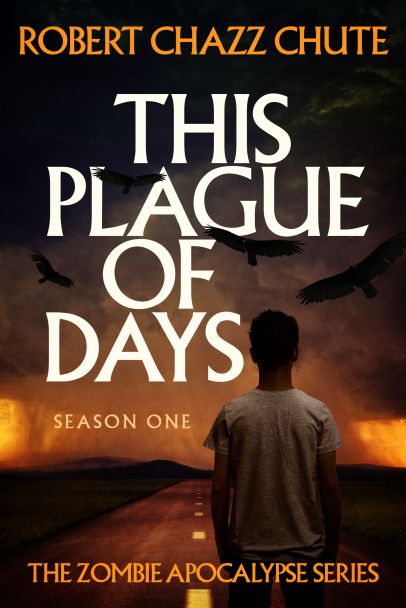
*About good covers, I know a guy. He’s Kit Foster of KitFosterDesign.com. He’s an award-winning graphic artist with an extensive portfolio who works well with indies and traditional publishers. Like my covers? Kit did them all. Check out his site. You’ll be glad you did.

Dark Higher Than Jesus banner ad

Filed under: author platform, Books, ebooks, Publicity & Promotion, publishing, , , , , , , , , , , , , , , , , , , ,

Writers: Are you in the echo chamber?

I love my writing community here. I’ve learned a lot from others and, as indies, we share a lot of information. We’re a generous bunch with each other. I appreciate your comments and participation on my little writing and publishing blog. Because I’m a sweet bunny pooping love everywhere, I have to tell you something with love:

Writers talk to other writers too much. We must talk to readers more.

Let’s make this go down easy by using an example from another industry.

When massage therapists try to figure out their businesses, they ask their peers and senior massage therapists for their opinions. They want to drink from the well of experience. It’s a good notion that frequently goes awry. Their peers are often as clueless as they are and senior therapists either don’t have the same problems or their advice is out of date. Take pricing, for example. They’ll set fees based on what they’d pay. But many massage therapists would never pay for massage. They don’t have enough money or they swap treatments with other therapists. Massage treatment is for people with real jobs and insurance coverage, not us.

Stick with me and hold my hand, because this is about to get uncomfortable.

Writers need to listen to readers more.

Sadly, writers often don’t have much money to spare so we use libraries or search for free a lot. Most of us buy books when we can, but with budgets as tight as they are, we’re often not your audience. As a result, many of our industry’s book prices are artificially depressed. We’re asking the wrong audience what we should do. (I’ve taken this advice. I just raised prices on some of my books and generally, the trend will be up.)

A veteran writer who’s “made it” (whatever that means) often doesn’t know all the variables that contributed to his or her success. If someone coasted to indie success from a high in traditional publishing, they can’t tell you much about the current scene. Precious few people attribute any of their success to luck. It had to be their sheer brilliance. However, many of us are brilliant and we’re still eating boot soup.

So, what not to do?

If you don’t tweet others at all, you may as well be on Mars.

If you rarely check your direct messages, you’re in the bubble.

If you only check your mentions on Twitter, you’re screaming into the echo chamber.

If you follow three people and two of those are your other Twitter accounts, you’re only hearing yourself plus you’re a raging narcissist (and not in a good way).

If you only have conversations with people who don’t buy books, you’re surveying the wrong people.

If you only speak to people who “buy” free books, you’re engaging the wrong audience. (Readers who buy with money instead of a click are often suspicious if your book is priced too low, for instance.)

If you don’t take new information in and seriously consider change, you’re for slavery. (Your own.)

If you do have conversations with readers from time to time and you talk about them, you’re on a smoother path.

If you don’t cultivate supportive friends, you’ll be alone, surrounded by fiends and without a fire ax or holy water.

If you only attend conventions with other writers instead of fans, you’ll have a great time talking to people who agree with you: “Wow, it sure is hard to connect to new readers!”

If you never get out and talk to real people in the real world and only connect with people on a safe and cyber basis, who will you learn to hate so you can kill them in your next novel?

If somebody says, “I prefer paper books,” and you reflexively say, “How Amish of you! Ebooks are the only future!”, that was kind of funny, but you should be listening instead of cracking that same joke open again. It’s rotten on the inside.

If you say all this social engagement is too hard and it takes away from your writing time, I’m sorry. I thought you were writing to be read. Get a calendar or time management software. At least tweet or email during commercials.
If you immediately dismiss everyone with whom you disagree, you’ll never learn the secret to…well, anything really. Plus, you’ll come across as a jerk.

I’m not suggesting you allow me or readers or reviewers or anyone else to run your life. I am saying that if you recognize yourself in this list and it gives you that squirmy squirts feeling, adapt accordingly. Listen.

You should listen to me. I’m a writer.

Filed under: author platform, getting it done, Publicity & Promotion, publishing, Rant, readers, , , , , , , , , , , , , , ,

Books: Ventures, Misadventures, Adventures and Brutal Honesty

Crack the Indie Author CodeWhen George Lucas screened  Star Wars, most of his fellow filmmakers in the room looked at each other and said, “American Graffiti was awesome, George, but this space opera thing…yuck!” It was Stephen Spielberg who played the contrarian. “You guys don’t get it!” he said. “This is going to be huge!” And of course, Spielberg was right.

My personal Lord and Saviour of The Written Word, William Goldman, famously said of the Hollywood film business, “Nobody knows anything.” It’s true, no one can know what will hit and which will miss. Someone comes up with the somewhat moronic expression YOLO (the idiot’s “Carpe diem”) and it’s suddenly on t-shirts everywhere. True for us, too. You may write a heavy, ambitious tome, but it’s a tiny book like The Little Prince that captures the hearts and imaginations of generations of readers.

So it is with marketing books.

Agents say they can “guide your career”, but if that were true, anyone with a sentient agent would have a fabulous career. No one knows anything in publishing, either. That’s not meant as an insult, but as a reflection of reality. Publishing is famous (or infamous) for placing bets on many horses, hoping the big bets will pay off and cover the losers’ ubiquitous failures. Few industries have a miss rate as high as book publishing (though Hollywood’s screwing up even more than usual lately.)

So it is with my books, too!Self Help for Stoners JPEG

The summer is winding down and I find I must split my mania among many ventures. I’m in a philosophical mood and looking back at what took off, what has not, and why. We at Ex Parte Press are not lounging in the money, chocolate and champagne pool at the moment. (But we still have high hopes.)

  • Bigger Than Jesus and Higher Than Jesus are critical successes among the few critics who are aware of my funny Cuban hit man and his tragic past. Alas, hardboiled and funny suspense isn’t trending at the moment. Nonetheless, I have more Hit Man books planned. Jesus Diaz will just have to wait a bit longer as I concentrate my efforts where readers have demonstrated more enthusiasm. I love Jesus, and can’t wait to get him back on the warpath in Hollywood. An assassin who can make movie references and quick quips while getting beaten up deserves more books. He’ll get them.
  • My first funny short story collection, Self-help for Stoners, sells just a little but steadily. It’s a tribute to Kit Foster of KitFosterDesign.com that the cover is repinned on Pinterest several times a week, every week. Later this fall I will stop using an intermediary so I can take back control of marketing that book. I have no doubt I can take it much higher once that happens. I’d have done it by now but I’ve been perpetually swamped for months with This Plague of Days.
  • Six Seconds, my book about using the Vine app to market your business was an instant book with lots of great advice. I’ve moved books and marketed my podcasts having fun with mini videos. Though Vine remains the superior product, Instagram changed their app to ape Vine so Instagram has many more users. I bet on the wrong horse, not every at bat is a home-run, insert your metaphor for failure here.
  • This Plague of Days, Season One is getting traction. It might even be on the cusp of taking off. I’ll find out when Season Two hits at the end of September. (Here’s my latest post with hints and expectations for Season Two.) Early feedback is very encouraging. As in this, from the beta team: “Suspense and plot and action – all of them are on steroids in this book…overall impression is you have brought this thing to the next level.”

Mind the towering caveat in the following paragraph:

My luckless hit man is a funny guy in big trouble.

My luckless hit man is a funny guy in big trouble.

So you see, I’m no better (or worse) at stabbing at the imagination of readers than anyone else. I don’t know what will sell buckets of books. No one does. It’s something that happens to you, as long as you pretend your destiny is under your control and do everything you can to get discovered. You can hit the target. We’re all shooting blindfolded in the dark, sure, but if you take enough wild shots, aiming matters less. You write the best book you can and engage more readers and attend some sad, ill-attended bookstore signings and do whatever else you can think of to fire off signal flares without becoming a Twitter pariah.

This is not to say that good advice isn’t out there. It’s just that so much good advice conflicts!

The great Chuck Wendig talks about voice (or the force of personality) being more important than “brand”. Others can’t talk about anything else but brand, stats and system gaming. Hugh Howey is the outlier that didn’t really market anything when he started Wool (though he says Facebook helps him most these days.) Some insist on lots of links to your other work in the back of each book. Others say that’s overkill and intelligent readers will find you easily if they love you enough to bother with a google search. Some book marketers are passive as a policy (or lazy.) Others are so active, it’s pretty close to obnoxious.

And still, nobody knows anything. Not for sure. There are too many variables to success and the situation is fluid. We, writers and publishers all, dance on tightropes while juggling feathers in wind storms and hope readers will cast a glance our way and enjoy the silly monkey dance.

Still, you’ll find advice about tactics everywhere.

Just this week, I pushed the Author Marketing Club and Bookbub. Solid advice I stand behind. But keep in mind, these are tactics. The potency of tactics can wax and wane according to many variables. That’s what’s hot now and into the near future. After that? New tools will emerge because good ideas get copied. Sometimes imitators are new and improved and often the copier doesn’t have enough toner.

Strategy is long-term thinking. Strategy says: Write more. Get more feedback. Write more books. Get better. Higher+than+Jesus+Front+1029

This is the only advice I know that lasts. (You’ll find that and much more about the writing and publishing life in Crack the Indie Author Code and Write Your Book: Aspire to Inspire. Crack sells a bit while the second book hardly moves at all. Why? Who knows? Nobody. Nobody knows anything! My Lord and Saviour told me so.

However, I’ll let you in on a little secret: I have a third book about writing and publishing in the chamber ready to fire. When This Plague of Days hits big, readers will pick up all my books about writing and publishing. After the fact, they’ll say, “Well, no wonder.” 

The Johnny-come-latelies won’t know what you know. My overnight success wasn’t overnight. Success always seems inevitable, but only in retrospect. Until you make it, no one cares about you and your book. Those who do give you any thought probably think you a fool. (Insert an image of your disapproving in-laws here.)

Ah. But, afterwards? You’re a genius.*

~ *Afterwards, You’re a Genius is a wonderful book I recommend for anyone interested in scientists with lyrical sensibilities.

For more on the rising action and scary high stakes in the spiralling weirdness of an autistic boy fighting zombies, read this post at ThisPlagueOfDays.com. 

For more on my adventures in self-pubishing, swallowing bitter pills and my peculiar brain mania, there’s this post on the writing life at my author site. 


Filed under: author platform, getting it done, self-publishing, , , , , , , , , , , , , , , , , , , , ,

FAQs: Would I go with an agent?

Crack the Indie Author CodeWhen I attended the Banff Publishing Workshop, most attendees were bent on writing and managing magazines and publishing houses.* I knew one nice woman who wanted to be agent. I wonder what she’s doing now? There’s an excellent chance she’s selling real estate. Too bad. She really was nice. Same is true of all my classmates in journalism school who were let go from their newspaper jobs about the time they turned 40. Changing media delivery paradigms sure do stir up chaos.

Given my last post, you might think I’m against agents. Not at all. I think agents could be very useful for negotiating foreign rights for my imprint in the future, for instance.

However, their role is much reduced and smart agents are changing their games. At a recent writing conference, writers were not chasing agents so much. The Meet-An-Agent appointment schedule could not be filled. Now more agents are chasing writers and they’re very interested in how your self-published books are doing. They weren’t at all interested a short time ago. In fact, some were quite pissy about the prospect. But now? Establish a happy track record and they might come a courtin’.

The short answer to this post’s title is:

I’d be interested in hearing what an agent feels he or she could do for me. There are good agents out there. I think hybrid publishing maximizes exposure and opportunities for you and your readers. Look at Wool author Hugh Howey’s experience. An agent found him and she was willing to travel outside the ruts of old publishing’s logging road to get Hugh a deal that worked for everyone.

The long answer? Let’s go with bullet points so I can make this shorter:

  • The submissions process can be a long ordeal. Long as in, are you young enough to begin now?)
  • You may be asked to make major changes to your manuscript. If you succeed in getting a book deal, you’ll make even more major changes.
  • You may choose to make the requested changes and they still won’t take you on. (They may even forget the changes they suggested. Yes, that’s happened.)
  • You can get an agent but still fail to place the book with a publisher. An agent is a person, not a guarantee of slinging back cosmos in Manhattan with your new editor.
  • The myth is that you choose an agent. The fact is if someone sends you a contract, most authors pee their pants and quickly sign. Regret is for later.
  • You can find an agent, dance joyously and then find out it’s a scam (as happened to a friend of mine.)
  • You could bypass the agent and submit directly to publishing houses and they’ll still read it. (They say they don’t, but most will.)
  • As Dean Wesley Smith has said, agents should be your employees. I’m sure he’s right. Guess how many agents see their professional status that way?
  • Submit to the wrong agent who blogs and they’ll mock your submission. Unprofessional, I’d say. As Will McEvoy said recently, “Snark is the idiot’s version of wit.”
  • Good agents have precious few slots open for new clients. Bad agents and scammers demand reading fees.
  • Rather than submit query letters to agents, many agents find new clients via recommendations from the authors in their stable. Who you know? Yeah, that’s still a thing. It’s called networking. Ignore the denials.
  • Getting an agent is tougher than getting published. Why not publish it yourself first and start selling now? As I’ve said many times, Amazon is the new slush pile.
  • Some agents live in fear of submitting manuscripts that might not be accepted. They have to be so sure, they’re too risk averse. One agent complained that one false move with a particular editor would lose her access forever. This sad story tells me that’s a crazed editor. It also tells me that’s an agent who is too fearful, forever doomed to be chasing trends instead of helping to make them.
  • The agent/author relationship is like a marriage: They have a piece of you forever even after the divorce.
  • Lazy agents say, “This would be hard to sell.” As a former sales rep for many publishing companies, I can assure you that there are few easy sales. We don’t need you for easy sales. Selling is part of the job. The better question is, “How can I sell this and to whom?”
  • Often when they say, “This would be a hard sell”, they aren’t lazy. It’s a euphemism for, “I think this is crap but why not be diplomatic?” They’re being kind. Don’t resent them for it. Move on.
  • You’ll get a better deal with a good agent than without her. A good agent will more than pay for herself. However, some agents are getting paid for doing very little. They treat the publisher’s contract as set in stone. That’s supposed to be the publisher’s attitude. It’s a bad attitude for the person negotiating for you.
  • Good agents can act as a buffer and help resolve conflicts with editors. Bad agents are the source of personality conflicts.
  • You have to trust your agent. You don’t have to love your agent. It’s a business relationship. That’s less clear in the beginning when you’re riding high. It’s very clear when they dump your mid-lister ass.
  • A good agent can do things you can’t and navigate the tiny details of contracts. A good agent can pay great dividends for their fifteen percent.
  • But an entertainment lawyer can practice law and navigate the tiny details of contracts and you pay them once. Hm.
  • A good agent can justify their participation in your enterprise without sounding old-school entitled about it. They work in listening mode.
  • Trad publishing has changed. Good agents know it and are adapting to serve their clients better.

TPOD 0616 EP 1 coverAuthors who love their agents are everywhere. A plethora of horror stories about agents also span the Internet, just as there are snarky complaints about clueless authors everywhere.

A better question is about the human variable: You.

Would you feel better with an experienced, connected agent helping you on an ongoing basis?

Or does the prospect fill you with anxiety?

Are you happier as a publisher/author/entrepreneur who pays for an entertainment lawyer’s expertise on an ad hoc basis?

Enter the relationship self-aware, eyes open.

Even better:

How do you find a good agent if you want one?

Ask an author in your genre who is already delighted with their agent.

*FYI: A magazine is something people used to subscribe to and read, like a blog but made out of glossy paper. Publishing houses were places that had an undeserved reputation for great cocktail parties that were vaguely upper crust, literate and British, no matter where they were located or how little the worker drones were paid.)

~ Robert Chazz Chute was one of those worker drones. He is the author of This Plague of Days World flu pandemic! Autism! Zombies! Oh, my!

Filed under: agents, Books, publishing, self-publishing, , , , , , , , , , , , , , , ,

FAQs: How to write books agents will hate (but readers might love)

My luckless hit man is a funny guy in big trouble.

My luckless hit man is a funny guy in big trouble.

Yesterday I told you how a well-meaning friend with experience in traditional publishing gave me advice I thought was askew. As we struggle to gain traction in the marketplace, we get a lot of well-meaning advice we can’t take. (You’ve probably read that sort of advice here from me.) My friend’s other foray at saving me from myself was to tell me to court agents. “With World War Z, zombies are big this summer! Find horror agents and get traditionally published!” he said.

It’s not that it’s necessarily bad advice. However, it’s bad advice for me. Here’s a list of the things I do in my books that repel agents like fried bat armpits at the wedding feast:

1. Bigger Than Jesus and Higher Than Jesus is written in second person, present tense. Unconventional scares agents away. They’re trying to make money after all. I don’t blame them, but I’m in the Art and Brain Tickle business first. I have this crazy notion that being me will lead to making money. Eventually.

2. The assassin/anti-hero in the Hit Man Series is neurotic and afraid of women. (Name another hardboiled gunner who has that problem. Take your time. I’ll wait.)

3. My hit man suffered childhood sexual abuse. He’s also hilarious. Those elements rarely sit side by side comfortably.

4. Hardboiled isn’t selling hard right now. Or is it humor? Or is it action adventure? Easily classifiable is really important to a lot of people who aren’t me.

5. The titles may offend some Christians, especially since it’s crime fiction with a lot of swearing.

6. The titles are confusing until you understand that the assassin, Jesus Diaz, is Cuban and it’s pronounced “HAY-SOOSE”. In fairness, agents and publishers should be repelled by these titles. It wasn’t the best strategy because any title that requires explanation sucks. After two books, I’m committed and in love. I also have a plan around this problem after the next novel in the series is published early next year.

7. In my zombie series, This Plague of Days, the zombies aren’t “true” and “traditional”. It begins with a flu pandemic. You get to see how society gets to dystopian before the action kicks into ever higher gear. The slow burn requires more buy-in from sophisticated readers. Underestimating readers’ intelligence is an easier bet.

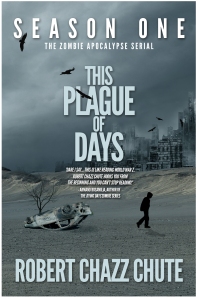
Season One has five episodes. Get each one for 99 cents or get all of Season One at a discount for $3.99.

Season One has five episodes. Get each one for 99 cents or get all of Season One at a discount for $3.99.

8. This Plague of Days has an autistic hero who rarely speaks and whose special interest is dictionaries and Latin phrases. Sounds like sales suicide when I put it like that, huh? That sort of gamble can pay off in a book. It’s death in the tough sell of a query letter.

9. The table of contents is a long, dark poem embedded with clues to the bigger story. Reread that and tell me I’m not silly. I know it.

10. Who will serialize a book unless I do it with my imprint? (Amazon Serials didn’t bite but readers are buying in.) Besides hooking up with Kit Foster of KitFosterDesign.com for his awesome covers, serialization has been my best sales strategy yet. This Plague of Days is a sprawling story tracking action over two continents with a big cast of characters. (At times you may wonder, is Chazz British or American? Split the difference. I’m Canadian.) It was too long to publish as just one book and the serialization model fit best.

When you look at that list, which idea comes across stronger? A or B?

A. All agents are evil, lazy and lack imagination.

B. I am determined to fail.

It pains me to say that all agents are not evil. I’ll save further discussion of agents for my next post.

For more on the why of this post, the writer’s character and how this relates to Joyland by Stephen King

click here for my latest post on ThisPlagueOfDays.com:

Writing Against the Grain: B Movies, A Treatments and the Deceptive Familiar


Filed under: agents, book marketing, Publicity & Promotion, publishing, self-publishing, , , , , , , , , , , , , , , , , ,

Bestseller with over 1,000 reviews!
Winner of the North Street Book Prize, Reader's Favorite, the
Literary Titan Award, the Hollywood Book Festival, and the
New York Book Festival.

http://mybook.to/OurZombieHours
A NEW ZOMBIE ANTHOLOGY

Winner of Writer's Digest's 2014 Honorable Mention in Self-published Ebook Awards in Genre

The first 81 lessons to get your Buffy on

More lessons to help you survive Armageddon

"You will laugh your ass off!" ~ Maxwell Cynn, author of Cybergrrl

Available now!

Fast-paced terror, new threats, more twists.

An autistic boy versus our world in free fall

Suspense to melt your face and play with your brain.

Action like a Guy Ritchie film. Funny like Woody Allen when he was funny.

Jesus: Sexier and even more addicted to love.

You can pick this ebook up for free today at this link: http://bit.ly/TheNightMan

Join my inner circle at AllThatChazz.com

See my books, blogs, links and podcasts.

Enter your email address to follow this blog and receive notifications of new posts by email.

Join 2,063 other subscribers