C h a z z W r i t e s . c o m

See all my books at AllThatChazz.com.

Writers: Saving Money and Making It (Part 1)

This week we’re going to talk about writers and money.

Mostly, we’ll talk about not having any because that’s reality for most of us.

Forget the clichés about how writing in a garret or a ditch lined with beer-vomit fuels us creatively. Poverty sucks. Worrying about income and outgo all the time drains us creatively. As a guy who’s basically been unemployed for two years, I have a lot to say on this subject, but let’s start by saving you $1,200 a year or more with one phone call.

You use the Internet for research (I hope). Call whoever supplies you with TV, Internet and your phone. I did this last week. I started the conversation with, “When I leave Bell, do you guys come get the satellite dish and leave holes in my shingles or how does that work exactly?”

“Why would you want to leave Bell, sir?”

“Because I just found out a buddy of mine in the same neighborhood with roughly the same services is paying $100 less a month than I am!”

This is true, by the way. This isn’t about scamming any company. It’s about solving the problem of being overcharged.

The guy I spoke to in Billing was befuddled as to what to do with me so I took the direct approach and said, “You want to transfer me to the Retention Department now.” That’s where the magic happens. The people in Retention are authorized to massage your bill and squeeze out money and happiness for you. The communications market is becoming more competitive and they don’t want to lose a customer.

Next I spoke with a helpful fellow who went through my communications package with me. I was paying for ten features on my landline. I don’t even know what those ten features could be. I dumped all but voicemail and caller ID.

If it were up to me, I’d dump the landline altogether, but we have to keep it so obnoxious telemarketers can harass us about buying gold and cleaning our air ducts. I also dropped my long distance plan. Use Skype for long distance. Skype is free. 

We’re on the net constantly so there were no services to reduce. However, Retention guy “put a promo on it”. That means he knocked $6/month off the price because I bothered to call. That’s $72 a year on one component of the monthly bill, just because I said my bill was too high (which it was.) We also edited down the satellite package. Everybody gets a lot of channels they don’t watch. Kill them.

We haven’t noticed any loss of services or channels, but that one phone call (which took about half an hour) knocked those bills down precipitously. I haven’t got the first bill yet, but I will save about $1,600 in the next 12 months. Your mileage will vary, depending on how much you’re getting screwed to the wall by your service providers already.

In Canada, we no longer have pennies. Sure, a penny saved is a penny earned, but I’m talking about a significant amount of dough. I “earned” $1,600 in half an hour. Make the call.

Part 2 of this week’s series for writers will be about Writing and The Day Job. Stay tuned.

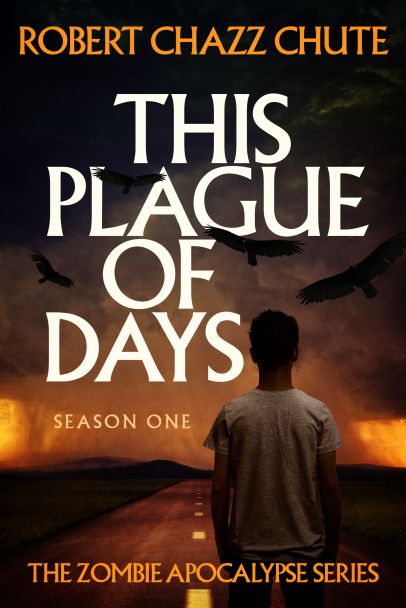
For an article about gratitude, readers and sneak peeks of This Plague of Days, click here.

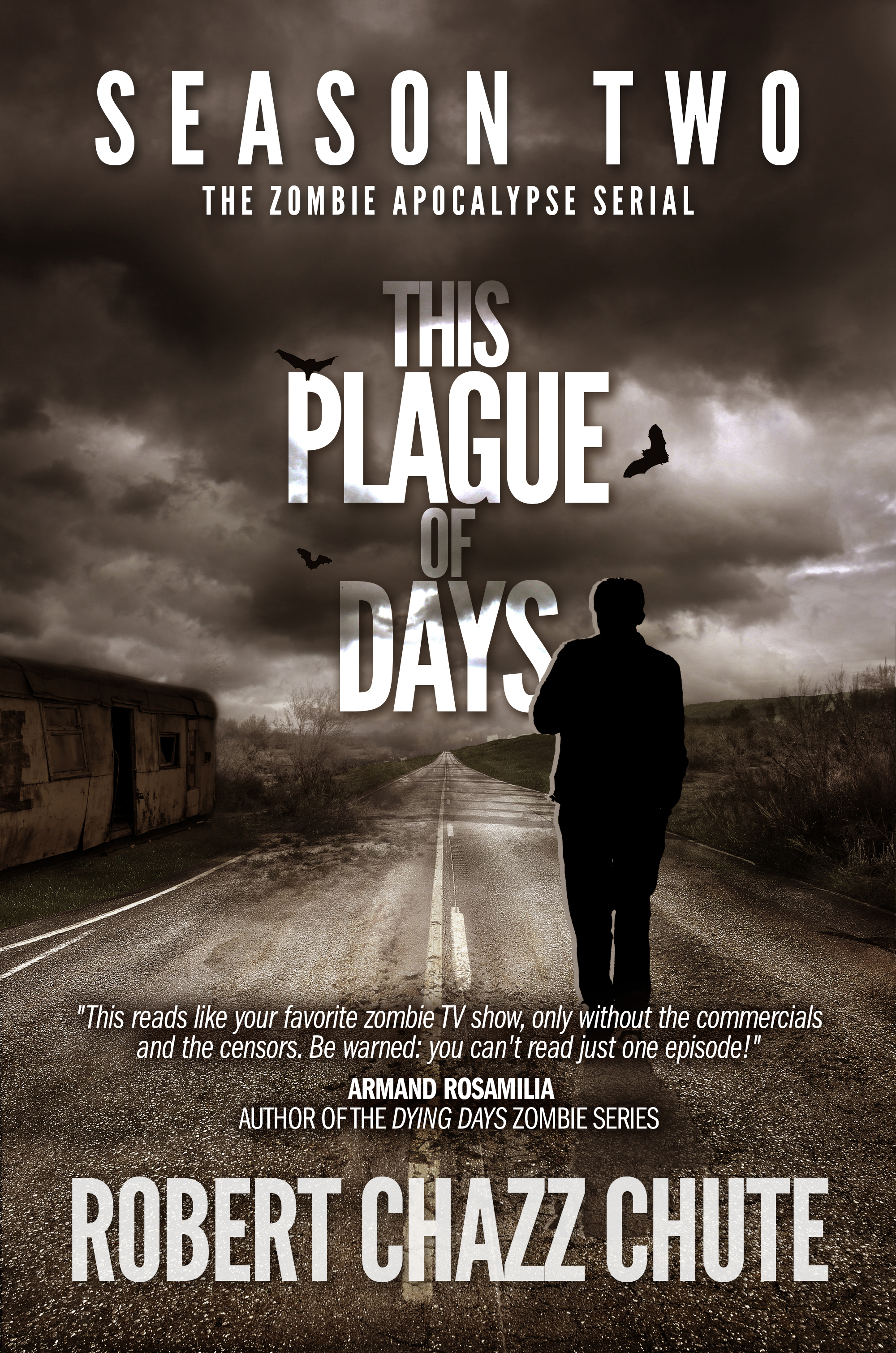
Meanwhile, if you’re reading This Plague of Days as a serial, Episode 3 is out now!
Episode 3 of Season 2 (not Season 3 yet!) is now available. Click on the right sidebar to grab the complete Season One and Two.

Episode 3 of Season 2 (not Season 3 yet!) is now available. Click on the right sidebar to grab the complete Season One and Two.

Photo on 12-05-23 at 4.39 PM~ I’m Robert Chazz Chute. I wrote a couple of books about an autistic kid versus the zombie apocalypse. Sure, that sounds ridiculous, until you understand that it’s also an international thriller and a Latin primer. This Plague of Days, Seasons One and Two have both achieved bestseller status. I’m still broke, but that will change.

Filed under: authors and money, Rant, What about Chazz?, What about you?, Writers, , , , , , , , , , ,

Top 10 How to be happy (oddly, this will infuriate people it’s meant to help)

This is probably the sort of topic where, if you get it, you don’t need it. If you don’t see it, you probably never will. (Then why blog about it? Because I don’t see any windmills! Now gimme that lance! Let’s go tilting!)

Change can happen though.

A bureaucracy, that shall remain nameless, gave off a lot of bad hoodoo. They’re infamous for holding the people they serve in contempt. The way they related to people led, in part, to the installation of bulletproof glass in their place of business. (I’m not kidding.)

Recently, they responded to the wails from those who paid their salaries. The video they sent out stopped short of an apology, but they did acknowledge they needed to set a new tone. They promised to work on changing their corporate culture.

I was one of their most strident critics. If they’re sincere, I’m surprised how willing I am to forgive and forget. The changes I see so far are free and subtle. I dealt with them again recently and a few pleases and thank yous was all it took to ease my wariness. It seemed, in the span of a few short paragraphs, that they weren’t trying to make me feel like a dirtbag. Refreshing.

Which brings us to blogging and relating to people.

I’ve found myself skipping past the blog titles that say, “Here are X number of reasons your blog sucks.” Maybe there’s good information in there, but I’m an author with an Irish family on one flank and teenagers closing in on the other. I’ve got enough negativity in my life. I already have a dim view of the world and I enjoy it in fiction. Less so, when someone harangues me.

I attended a webinar that made me sad.

The guy was knowledgeable, but the way he communicates needs to soften. The louder he talked, the less we heard. He then confessed that a big business opportunity fell through because of “conflicting styles and interpersonal stuff.”

I think I know the problem. It was the abrasive guy. “Go-getter” and “jerk” don’t have to be synonymous. The adage is not that you get more flies with corpses.

Which brings us to Kit Foster of KitFosterDesign.com.

My friend, supporter and sounding board, Kit’s a graphic artist who is a great resource for any publisher. He works with all of us, big and small. But that’s the least of why you should do business with him.

He knew I was feeling down the other day. He took the time to write a kind note that hit me at just the right time. Clearly, if you’re an author or publisher, this is the sort of person with whom you want to work. He does great work and his portfolio is impressive. You’ll get great covers and he’s not done until you’re happy. Work with Kit Foster and you’ll sell more books.

But many people can deliver book covers at a reasonable price, right?

Sure, I guess. But how many will bother to send you an email that makes you feel better when you’re down?

For a lot of people, anytime they see you’re down is when they start kicking.

How can we make more people like Kit?

1. Go back in time and get nicer parents, smoke helpful medicines or be Scottish, I suppose. I’m not sure what makes Kit the way he is.

2. Some medical schools use actors to teach doctors what compassion looks like so they can fake it. I don’t know if that sticks. I’ve often said the only thing I learned from Survivor was that jerks and psychotics can’t fake being nice for a month, even for a million dollars.

3. We can practice random acts of kindness and see if that elevates our mood. Happier people are nicer people. This doesn’t apply to people who get happy for the wrong reasons. If you’re one of those psychos, seek professional help before the rest of us rise up and throttle you.

4. We can practice gratitude (I guess I’m doing that now.) It sounds kind of hippie, but there’s science that shows the more thankful you are for what you already have, the happier you will be.

5. If you can’t manage these suggestions, professional scuba diving limits your ability to damage the rest of us, so take one for the team and go scream at fish. 

6. Use Kit’s services at KitFosterDesign.com. Maybe exposure helps by osmosis.

7. If you’re angry at somebody, make sure you know why you’re really angry.

Here’s how you’ll know you’re angry or sad about something else besides the target of your ire: You should have a range of emotional responses. If you review a book with the same level of vitriol that should be reserved for skinning live puppies? You’re Monty Burns and you have a problem, no matter how catchy the tune you sing about making fur coats.


8. If you’re already happy, spread it like fertilizer. Maybe it will grow. A bookstore employee told me she didn’t aim for happy. She aimed for contentment. Ironically, that suggestion made me happier.

9. Exercise. Meds to treat depression and disorder. Talk therapy. Total gene and personality transplant or personal tragedy that leads to an unlikely transformation. I don’t recommend leaving the problem so long that the solution is that last option.

10. Take Joe Rogan’s suggestion and pretend a documentary film crew is following you around, recording the lost time, outbursts and ill temper. Do that for one day and you might decide it’s time to change all your other days.

When you look up to find you’re surrounded by happy, creative, productive people and you don’t resent them for it?

You’ll know then you’re on the right track.

~ I’m Robert Chazz Chute. I am not happy all the time. I am working on improvement. Check out my books and podcasts at AllThatChazz.com.

Filed under: author platform, getting it done, publishing, , , , , , , , , , , , , , , , ,

Authors: Build a better business card with these tweaks

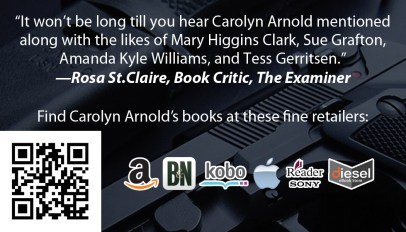
I met Facebook friend and author Carolyn Arnold as she sold books at an event. She’s given me permission to show you her business card. It’s important because she did something very right.

I think it’s important because I’ve seen a lot of bad business cards. A card that looks cheap might hurt you. A card that’s crammed with too much information really repels people.

Cards that advertise the publisher on one side and another unrelated business on the back? Don’t do that. It saps credibility from both companies.

Look at what Carolyn’s done.

The logos for each platform show where you can get Carolyn’s books. Very good idea. I also like seeing the books in 3D, with spines. (# 147 on the things I need to do to make web presentations of my books prettier.)

Also note the QR code. Scan it with a mobile device and it takes you to her website, carolynarnold.net.

I’m not that technologically advanced yet, but it’s a pretty nifty feature for those who are into QR codes.

Carolyn Arnold Business Card Front 2013


Carolyn Arnold Business Card Back 2013


And perhaps best of all is the killer quote from The Examiner‘s book critic. If you can incorporate any of these helpful elements into your business card, I recommend it. It comes off very professional.

Even when they aren’t aware of it, readers want to be assured they’re in good hands with someone who knows what they’re doing. A business card alone won’t earn you a new reader. You have to be nice and skilled and have good books to sell. There are many variables that contribute to success. If one of those variables isn’t in place, it can suck all the gas out of your engine. Carolyn nailed it.

Have another look at your business card.

Then get out to more events where you can actually use it.

Filed under: author platform, , , , , , , , , , , ,

The Secret Alphabet of Independent Publishing

"You will laugh your ass off!" ~ Author of Cybrgrrl, Maxwell Cynn

“You will laugh your ass off!” ~ Author of Cybrgrrl, Maxwell Cynn

A is for All of it, which is what we want. (A used to stand for Agent.)

B is for Book, of course, and ebooks are “real” books, too. Literature is about the content not the container.

C is for Cutting prices. It would be bad for writers, but at 70%, we’re still getting paid more per unit sold than in traditional publishing. Also, price cuts sure make now a great time to be a reader.

D is for Deadlines. Don’t take forever to write your book. More time procrastinating doesn’t make a better book.

E is for E-books on E-readers. But you know your kindle is a transitional device, right? The phones are getting bigger again and tablets are coming down in price. We don’t want a device to do one thing. We want one device to be a web surfer, camera, phone, app catalogue, music box, GPS, ebook reader and best friend on our hip.

F is for Future. It’s the direction to look. If you don’t like it, you can change it whereas the past requires an annoying child named Sherman, a dog named Mister Peabody and a Wayback machine.

G is for Guidelines, because guidelines are malleable. There really aren’t many unbreakable rules worth obsessing over. You already know the rules because they’re obvious or you ignore common sense or you’re a slave to unthinking tyranny. The cool kids prefer more options.

H is for Hope. It’s good to have some, especially in this business. When there’s no reason to have any, that’s when you need it most.

I is for Intermediator. Have as few of these as possible. Upload your books yourself if you can, or get help from an independent contractor. This will allow you more choices of forks down the road.

J is for Just you. The myth and prejudice against independent publishing is that’s it’s just you. You are alone, except for the editors, graphic artist, beta editorial team, volunteers, publicity teams and whoever else you can hire or cajole into helping you get your book discovered. Sure, other than that little cyclone of industry, it’s all you.

K is for Killing characters. Killing someone readers love who they were sure would make it to the end? Delicious. (Note: killing darlings is overrated.)

L is for Love. It’s why we write. If you have other motivations, that’s fine, but releasing dopamine as you create is, like reading, a very rewarding addiction. The biological pharmacy in your brain simulates love. Endorphins won’t land you in a dirty rehab unit with a roommate who won’t stop telling that story about the time he tried to get high on burnt bananas and smoking his own hair.

M is for Money. It can happen, but probably not so don’t write for money. As above, write for love. If money does happen, people will resent you slightly less when you claim you never expected it.

N is for Naysayers. Most of them will never write near as many books as you will. Just say no to naysayers. If you sleep with your naysayer, someone’s in the wrong bed.

O is for the Obsession to know things. It seeps into the writing so you can drench your fiction with non-fiction and trenchant verisimilitude. For instance, This Plague of Days, Season Two weaves the Apocalypse with interesting tidbits about Irish legends, military history and the mortal wounds inflicted by the blue-ringed octopus. Mine is the only zombie/plague/autism story that teaches you Latin in an entertaining way, guaranteed!

P is for Portent. Warnings that something big is about to happen are especially fun when you give readers an earnest warning and they still don’t see it until it coming. They’ll only see the clues in retrospect. Secret trails to revelation and love of language are why people reread books. Do it well and someone might think your book isn’t just suspense, but maybe even “literary” or (praise Thor) “important”.

Q is for Quitting. If the project is wrong, quit. If it’s right and you’re just whining, quit whining and finish it. If you aren’t excited to write this book, find another you will be excited about all the way through or for our sake, please do stop. 

R is for Ripoffs. It’s a minefield out there: Fake agents who try to make money off reading fees; publishers who won’t pay; people who use disreputable business practices and call them policies. (R is also for Research. It’s how to avoid R is for Ripoffs.)
S is for Sustained Action. Promoting your work need not be an exhausting blitz. Dig in for the long game and promote at a slower pace. Don’t promote the same stuff to the same audience all the time lest you exhaust them. Keep writing new books. Don’t pin your hopes to one book. Sure, you might accidentally hitch your wagon to a star, but chances are excellent you’ll hitch your wagon to a stump, especially if this is your first rodeo.

T is for Trying. You’ll hate yourself if you don’t try. Losers will hate you because you did try. That’s why they’re called losers. They work from a different definition of failure than you and I. They confuse boring with winning.

U is for Unpublish. If something isn’t working, take it off the market and replace it with your tweaked story, new cover or new edition. Unlike traditional publishing, you have more options. You can adapt. Ours is a different, more flexible, business model. Use that advantage.

V is for Victory. There is no victory. Banish the concept from your life. There are only ups and downs and we’re all trying to make more ups.

Victory is very useful in fiction, however. Readers want to escape real life’s mundanity so it makes them happier when the protagonist achieves victory at the end of a story.

To go all Conan and see your enemies driven before you and to hear the lamentation of the Evil Mort from Accounting? That’s fiction. Working in a cubicle farm with no hope of retirement while Mort gets promoted and vacations in Brazil? That’s real. The real-life Mort is why we all crave escape into stories.

W is for Wit. They say brevity is wit’s soul, but I can take a pounding of wit in dialogue all day and all night, Mr. Sorkin.

Please note that snark is not quite wit. That’s a blunt tool meant only for peeling the outer layer of flesh. Meanness is the opposite of wit. That’s a blunt fool’s weapon. Wit’s funny and smart. When that sword cuts, we see light flashing down the steel blade. Wit allows the victim to take the hit and nod, “Touché!” with a smile.

X is for X-ray vision. All writers have this power. I can see into purses and pockets and the lives of strangers at the mall. I can work backward or forward to tell you who they are and their story of heartbreak in their senior year of high school. I diagnose disease at a distance. I know what you did last summer. I can give your life history and your death meaning, so do not screw with me.

Z is for Zero. It’s what we’re paid for writing. We are never paid for writing. We write for love, remember? If the money ever arrives, we’re paid for putting up with dehumanizing reviews, pretending to take them well and staying silent about them forever. We’re paid for the sad paperwork at tax time. We’re paid for the sting when someone sneers with casual cruelty, “So, are you a big deal yet?” We’re paid pennies an hour for the sacrifices our loved ones make so we can keep writing. 

Writing a good book is a happy, selfish act for the writer.

We are addicts, helpless in our defiance and desperate to monetize our work so we can have the freedom 

to score more of Creation’s sweet biochemical cascade.

Escape reality. Get high on a story.

~ I am Robert Chazz Chute, the author of Self-help for Stoners and this was the high I was talking about. This Plague of Days, Season Two scintillates brains October 1. Get Season One and check out all my books here. I hope to be your favorite candy man one day.

Filed under: author platform, Publicity & Promotion, publishing, Writers, writing tips, , , , , , , , , , , , , , , , , ,

Writers: Are you sitting on the money?

They call it the Cliff. You can do Author Marketing Club and Bookbub and free promotions and blow giveaways out the digital door. You can even start catching fire and getting traction and selling books for (gasp!) actual money. Then, the fall from grace comes. Sales drop off, often steeply. What happened? You ran off the Cliff. Lots of people do. In this post, we’re going to think about climbing back up and promoting our previous works again (and doing it better this time) because I suspect we’re sitting on money.

I’m rethinking the old marketing paradigm that’s always oriented to what’s new. 

It’s the thing we should question most: accepted wisdom. Despite all my efforts, old wave thinking is still permeating my brain. In traditional publishing, you get a short window to get traction and then the bookstores return your books to the publisherCrack the Indie Author Code for credit. That’s the structure of the short tail market. In long tail marketing, our books are up forever (or at least until the cyber war brings us all low). Still, we tend to think of our books as hitting big (or not) and then the graph points down. We’re mimicking thinking and marketing patterns from traditional wisdom because all old ideas are awesome, right? Oh, wait…

Case #1

I’ve been meaning to do this for a while and by not sleeping, I’m finally getting to it. I pulled Crack the Indie Author Code and Write Your Book, Aspire to Inspire from print. I didn’t like the look of the interior design. I’m fixing them and will make Crack the Indie Author Code available in print again soon. (They’re both still out there as ebooks.)

Self Help for Stoners JPEGCase #2

Self-help for Stoners was my first book. It’s funny and strange and with an intermediary. I used Bookbaby for that collection and I want to get it back at Ex Parte Press and put it out myself. I’m sure I can make it go higher once I have full and instant control of the marketing. I queried Amazon about the process today because I’m afraid of losing the reviews. Either way, I do need to steer my ship and reach out to stoners and non-stoners, alike and anew. (If you’re a Bigger Than Jesus and Higher Than Jesus fan, my luckless Cuban hit man appears first in Self-help for Stoners, by the way.)

This post won’t help you much if you only have one book to sell, but here are my thoughts on renewed marketing efforts: 

If you have one book, write more. No whining,

If you have a backlist, who is to say what’s old and what’s renewable? You’re the one to say.

If you have a bunch of books, I bet you’re a better writer by now. Why not revisit those books and do new editions?

Consider the power of bundling books. You could enliven your Amazon dashboard with more happy green up arrows. Stop sitting on the money.

Lots of people missed your fledgling efforts the first time. You didn’t know what you were doing. Who did? Any book they haven’t read is new to them. 

The most powerful promotions tend to be the first ones. But maybe that’s because we don’t put the same marketing efforts into books we published a couple of years ago. In digital, the term backlist is less relevant. As long as it’s clear it’s a new edition or a new launch or you’ve added material, what’s the problem? 

Maybe those early efforts flopped because you had a lousy cover. Get a new, better cover* and launch it right this time. With all you’ve learned about marketing since your early efforts, it’s bound to do better, right?

Most fiction doesn’t get stale. Our efforts get stale because we want to focus on the new thing. Maybe the old thing is only old in your mind. With some tweaking, a fresh edit and a new campaign, you might have a book people will love and buy. Reuse, recycle, repurpose. Turn short stories into collections. Open up to new possibilities with prequels to your books. Tie books together. Add to your series. Serialize. There’s plenty of fun to be mined in what you’ve already accomplished.

Your problem with these suggestions isn’t necessarily that my head is full of feathers. Your problem is the same as mine. This will take a lot of time and you feel you’ve already covered this ground. But most of us didn’t cover this ground well the first time. There are new promotional tools now. Yes, time management can be tough and we can only do what we can do. But that’s business. We are not special snowflakes, but we’re letting good stuff go cold.

*About good covers, I know a guy. He’s Kit Foster of KitFosterDesign.com. He’s an award-winning graphic artist with an extensive portfolio who works well with indies and traditional publishers. Like my covers? Kit did them all. Check out his site. You’ll be glad you did.

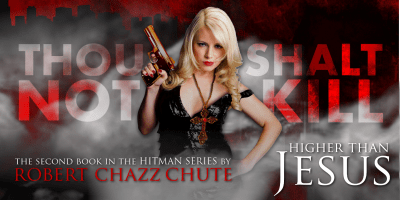
Dark Higher Than Jesus banner ad

Filed under: author platform, Books, ebooks, Publicity & Promotion, publishing, , , , , , , , , , , , , , , , , , , ,

FAQs: Would I go with an agent?

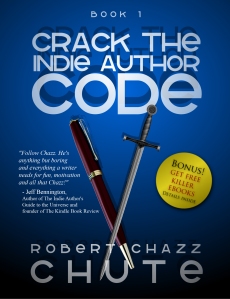
Crack the Indie Author CodeWhen I attended the Banff Publishing Workshop, most attendees were bent on writing and managing magazines and publishing houses.* I knew one nice woman who wanted to be agent. I wonder what she’s doing now? There’s an excellent chance she’s selling real estate. Too bad. She really was nice. Same is true of all my classmates in journalism school who were let go from their newspaper jobs about the time they turned 40. Changing media delivery paradigms sure do stir up chaos.

Given my last post, you might think I’m against agents. Not at all. I think agents could be very useful for negotiating foreign rights for my imprint in the future, for instance.

However, their role is much reduced and smart agents are changing their games. At a recent writing conference, writers were not chasing agents so much. The Meet-An-Agent appointment schedule could not be filled. Now more agents are chasing writers and they’re very interested in how your self-published books are doing. They weren’t at all interested a short time ago. In fact, some were quite pissy about the prospect. But now? Establish a happy track record and they might come a courtin’.

The short answer to this post’s title is:

I’d be interested in hearing what an agent feels he or she could do for me. There are good agents out there. I think hybrid publishing maximizes exposure and opportunities for you and your readers. Look at Wool author Hugh Howey’s experience. An agent found him and she was willing to travel outside the ruts of old publishing’s logging road to get Hugh a deal that worked for everyone.

The long answer? Let’s go with bullet points so I can make this shorter:

  • The submissions process can be a long ordeal. Long as in, are you young enough to begin now?)
  • You may be asked to make major changes to your manuscript. If you succeed in getting a book deal, you’ll make even more major changes.
  • You may choose to make the requested changes and they still won’t take you on. (They may even forget the changes they suggested. Yes, that’s happened.)
  • You can get an agent but still fail to place the book with a publisher. An agent is a person, not a guarantee of slinging back cosmos in Manhattan with your new editor.
  • The myth is that you choose an agent. The fact is if someone sends you a contract, most authors pee their pants and quickly sign. Regret is for later.
  • You can find an agent, dance joyously and then find out it’s a scam (as happened to a friend of mine.)
  • You could bypass the agent and submit directly to publishing houses and they’ll still read it. (They say they don’t, but most will.)
  • As Dean Wesley Smith has said, agents should be your employees. I’m sure he’s right. Guess how many agents see their professional status that way?
  • Submit to the wrong agent who blogs and they’ll mock your submission. Unprofessional, I’d say. As Will McEvoy said recently, “Snark is the idiot’s version of wit.”
  • Good agents have precious few slots open for new clients. Bad agents and scammers demand reading fees.
  • Rather than submit query letters to agents, many agents find new clients via recommendations from the authors in their stable. Who you know? Yeah, that’s still a thing. It’s called networking. Ignore the denials.
  • Getting an agent is tougher than getting published. Why not publish it yourself first and start selling now? As I’ve said many times, Amazon is the new slush pile.
  • Some agents live in fear of submitting manuscripts that might not be accepted. They have to be so sure, they’re too risk averse. One agent complained that one false move with a particular editor would lose her access forever. This sad story tells me that’s a crazed editor. It also tells me that’s an agent who is too fearful, forever doomed to be chasing trends instead of helping to make them.
  • The agent/author relationship is like a marriage: They have a piece of you forever even after the divorce.
  • Lazy agents say, “This would be hard to sell.” As a former sales rep for many publishing companies, I can assure you that there are few easy sales. We don’t need you for easy sales. Selling is part of the job. The better question is, “How can I sell this and to whom?”
  • Often when they say, “This would be a hard sell”, they aren’t lazy. It’s a euphemism for, “I think this is crap but why not be diplomatic?” They’re being kind. Don’t resent them for it. Move on.
  • You’ll get a better deal with a good agent than without her. A good agent will more than pay for herself. However, some agents are getting paid for doing very little. They treat the publisher’s contract as set in stone. That’s supposed to be the publisher’s attitude. It’s a bad attitude for the person negotiating for you.
  • Good agents can act as a buffer and help resolve conflicts with editors. Bad agents are the source of personality conflicts.
  • You have to trust your agent. You don’t have to love your agent. It’s a business relationship. That’s less clear in the beginning when you’re riding high. It’s very clear when they dump your mid-lister ass.
  • A good agent can do things you can’t and navigate the tiny details of contracts. A good agent can pay great dividends for their fifteen percent.
  • But an entertainment lawyer can practice law and navigate the tiny details of contracts and you pay them once. Hm.
  • A good agent can justify their participation in your enterprise without sounding old-school entitled about it. They work in listening mode.
  • Trad publishing has changed. Good agents know it and are adapting to serve their clients better.

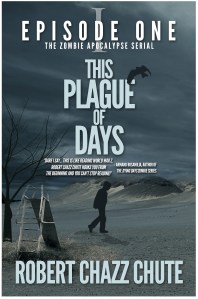
TPOD 0616 EP 1 coverAuthors who love their agents are everywhere. A plethora of horror stories about agents also span the Internet, just as there are snarky complaints about clueless authors everywhere.

A better question is about the human variable: You.

Would you feel better with an experienced, connected agent helping you on an ongoing basis?

Or does the prospect fill you with anxiety?

Are you happier as a publisher/author/entrepreneur who pays for an entertainment lawyer’s expertise on an ad hoc basis?

Enter the relationship self-aware, eyes open.

Even better:

How do you find a good agent if you want one?

Ask an author in your genre who is already delighted with their agent.

*FYI: A magazine is something people used to subscribe to and read, like a blog but made out of glossy paper. Publishing houses were places that had an undeserved reputation for great cocktail parties that were vaguely upper crust, literate and British, no matter where they were located or how little the worker drones were paid.)

~ Robert Chazz Chute was one of those worker drones. He is the author of This Plague of Days World flu pandemic! Autism! Zombies! Oh, my!

Filed under: agents, Books, publishing, self-publishing, , , , , , , , , , , , , , , ,

Combat the horrors of self-promotion (with fun)

Recently an article appeared in The Weeklings that was picked up by Salon. It was called The Horrors of Self-promotion by author Sean Beaudoin. I felt sorry for the author and, I admit, a touch of impatience, too. His problem is not unique. Most of us suffer hypothermia from a lack of limelight heat. I have the feeling he doesn’t read this blog. Alas. His best marketing so far was complaining about marketing and getting picked up by Salon. I don’t know how many more times that will work since I’ve seen this kind of story on Salon before. Repeatedly!

So, to solutions:

You know that rule about writing a book that states: If you’re bored, readers are bored? Same goes for self-promotion. Find a way to get them invested. Yes, give stuff away! Reward them for being helpful. Helping others helps you and never hurts. (That link will show you how to get stuff by reposting a video from my author site.)

Joanna Penn calls authors helping authors “coopetition”. That sums up why I do podcasts with authors, for instance. Besides, we’re in a lonely profession. It’s fun to talk to like-minded people like Hugh Howey, Jessica McHugh and Armand Rosamilia.)

If you hate Twitter, you won’t use it right. It’s supposed to be a fun, social discovery tool. If you hate Facebook, maybe it’s not the place for you. Those are supposed to be friends and fans you’re hanging out with. These are platforms to discover cool stuff and have conversations. I often can’t converse for long, so usually I choose to tweet useful information. (Follow me @rchazzchute and I’ll prove it.) However, there are plenty more options, both DIY and getting assistance.

We’re writers! We’re creative people. Find a way to have fun with promotions!

1. I’ve said this many times, but it bears repeating: The writing comes first. Social media is for in-between times that would otherwise be unproductive. Most of my tweeting happens from my iPod for that reason. If I’m at my desktop, I’m writing and revising Season Two.

2. For most authors, working with a publicist doesn’t make sense. However, if you really hate promoting books, maybe you should consider how you can farm it out. Can’t afford a publicist? Start with Fiverr.com. My buddy Jeff Bennington has a post about that here. Need more? Outsource or get an intern with whom you can teach and share. Contact your local college or get on Kijiji and find someone who needs experience in your subject or business.

(Please note: It’s not an internship if they aren’t learning anything. Interns don’t do laundry and are not slaves. They learn writing skills, gain publishing information and an important, perhaps first, entry for their resume. That said, if you’re predisposed to go this route, you’ll probably learn tech skills from them, too.)

3. Work with the platform that suits you best. Every day someone repins the cover to my book Self-help for Stoners on Pinterest. I do no other promotion for that book (since I still don’t have time to get it out from under Bookbaby’s distribution yet.) It’s passive, but the word spreads and it sells despite my lack of effort beyond Pinterest and Vine. (Vine’s discussed in #10.)

4. Some people over-correct and fail to promote at all. Maybe that’s shyness, although most authors who make a point of telling you how awful social media is are snobs. Mostly, they’re really complaining about a personal time management issue. We all have the same amount of time: 24 hours in a day. Use it right, don’t complain and reread Item #1. 

5. Some authors are snobs about social media because they’re tired of all the bad promotion that happens on Twitter. They need to exercise more patience, but they aren’t wrong, either. (See my post below, Book Marketing Top 10: When Less is More and tweet to content, not sales links!)

6. Don’t go into denial. Someone said their readers don’t hang out on social media. One in four people worldwide are on social networks and more than half of North Americans are on social media. That number will only grow. If your readers aren’t on social media (Amish people and older people who frequent Renaissance fairs), you better go to them. Get a booth by the guy who sells beer but calls it mead. Compensate somehow because otherwise you’re hurting your discoverability. Go where readers are, electronically or in person.

Readers have hungry minds. Therefore, they are so on social media!

7. Write another book. Too often I speak to nice people who believe their one book should find its audience organically. However, even organic plants need water. More books give your readers more opportunities to discover your awesomeness. Do not deny them your awesomeness. That way, madness lies.

8. I’ve recently posted about the many advantages of the Author Marketing Club and the tools they make available. With their free submission tool, you can harness the power of book promotion websites without hammering your own audience repeatedly. If you’re only tweeting to your followers, you’re doing it wrong. First, write stuff that’s useful, funny or retweetable. Then get on Triberr and expand your reach.

9. Blog. I have many blogs (all listed here) and reach out to varied audiences (writers, readers, podcast lovers, polymaths, the morbidly obese and schlubs like me, just trying to get their shit together.) However, ChazzWrites is the blog with the highest Alexa score. I do them all for the fun of it. If I hated it, I wouldn’t do it. I suggest ideas and try to be useful and helpful. I often try to be funny. People who get my flavor and like the taste will click the ubiquitous links to my books. Or not. But if you don’t blog, there’s no way for anyone to get what you’re about except unconvincing sales links that mostly sound the same.

Should books sell themselves? Yes, in a perfect world. You saw the news feed this morning. Does this look like a perfect world to you?

Are there exceptions and can you do nothing and still be a hit? Sure. It happened to Hugh Howey. His success is quite organic and, of course, well-deserved. However, that’s not the way to bet. Hugh told me so himself on the Cool People Podcast. Unfortunately, the norm is that many deserving books are ignored. It’s not that many of them aren’t good or even great. It’s that no one has helped readers find them effectively. Yet!

Look, I know all you want to do is write. We all just want to write and be taken care of by legions of adoring loved ones and fans. It would be great if we all had robot butlers, too. We don’t. Grow up and find a way to have fun with your chores so they aren’t chores anymore.

10. Do something different. Twitter isn’t everything. I get love and attention using Vine, for instance. If you don’t know Vine, I wrote a book about it. Basically, it’s six-second video and it’s surprisingly fun and addictive. I can choose to post the videos only to Vine, to Facebook, to Twitter or even embed vines (videos) like these fun and/or disturbing examples. 

Find what works for you. Then go do that as much or as little as you can stand. But please, no more complaining. There’s too much fun to be had and too many options to enjoy to waste time complaining. Unless you get picked up by Salon. Then maybe that worked. Sean Beaudoin! Did that work? Are you feeling better? Let us know!

~ I’m Robert Chazz Chute because “Robert Chute” is already taken by a Native American author and poet who surely wouldn’t want to be confused with a crime novelist and horror author. I was recently challenged about why I wrote a book with zombies in it. (Well…not the Romero kind. More the 28 Days Later variety.) Anyway, I justified my love over at ThisPlagueofDays.com with this saucy post. You might enjoy that post, too. Fewer links, more sass.

Filed under: author platform, book marketing, Publicity & Promotion, publishing, self-publishing, , , , , , , , , , , , , , ,

Today’s ordeal: Insults aren’t a marketing strategy

I talked to a bad sad person today who tried to push me around and deceive.

After a little more research, I figured out he was trying to sell me more of his own services but he wasn’t up front about it. Devious! I responded with reluctance because I hate hard sells and I’m suspicious of verbal sleight of hand. Then he switched from persuasion to an attempt at bullying. Why does any marketer think mean works? I guess he knew he wasn’t getting a sale so he had to get the venom out of his system. (Note: He’s not alone in thinking bullying works in sales. I suppose there are some gym memberships that prove bullying does work, but I don’t recommend it.)

He tried to spin a few dollars into “consulting”, amping a cheap offer ($15) into (I’m guessing) one or two thousand dollars. That’s quite a stretch to the next sales level, isn’t it? If he was as savvy at marketing as he says he is, he’d recognize he’s fishing in the wrong pool. And he’s angry at the fish.

When he wasn’t clear on his offer, I tried to determine if he was willing to work within a budget (any budget!) He went from wheedling to puffery to obfuscation to contempt in four sentences. I figured out what he was up to. What it amounted to was, “That thing I tried to sell you for $15 that I said would be awesome? Tricked you! What I said would be awesome is worthless and sucks, but if you don’t buy the platinum package (which I won’t define) you’re an idiot…” Blah-de-blah. Nonsense and hurt feelings ensue.

So that was eight minutes and ten seconds from hell. Skype tells you exactly how long you’ve been in hell. Convenient. He told me I’d wasted 15 minute of his time. Odd, he wasn’t worried about wasting my time with deception and insults, but we’re all the centre of our own universes, aren’t we?

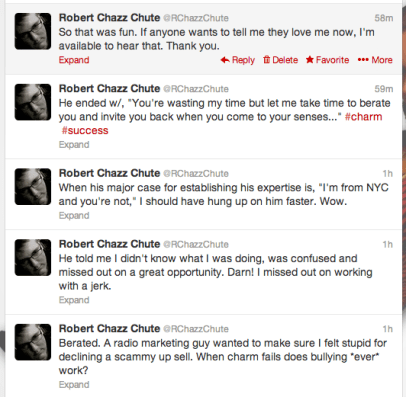
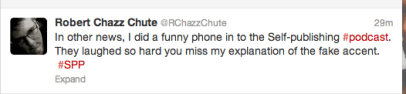
Here’s my Twitter stream (read from the bottom up) from today’s encounter with the outside world. This is why I hide in my writing cave and avoid human contact. It was a delightful reminder of what not to do. Okay, not so delightful, but instructive. Basically, desperate and mean doesn’t work.

Does this seem mean? I don’t think so. If I were mean, I’d tell you his name. Instead, I’ll say, caveat emptor and hang up faster than I did.

Screen Shot 2013-07-18 at 4.47.17 PM

Screen Shot 2013-07-18 at 4.45.36 PM

Start here and read up for the details of how not to market.

On the other hand, it was fun getting a phone call through to SPP!

Click here to see how I'm recruiting allies in the struggle to get visible (without dealing with Mr. Nasty Meany Big Time).

Click here to see how I’m recruiting allies in the struggle to get visible (without dealing with Mr. Nasty Meany Big Time).

~ For the record, I didn’t hang up on him because my mama raised someone who’s hopelessly polite. I also believe it’s important to give nasty people enough rope to hang themselves so I can spin the ordeal into a post on my blog. At least I get something out of it that way. Click either of the images above and you’ll see my latest marketing attempt for This Plague of Days. It’s the opposite of what was tried on me today. My approach is to go for win-win instead of deceive-insult. If my approach doesn’t work, I guess I could move to New York and give berating potential customers a try. Okay, now I’m officially letting this go. Have a peaceful day.

Filed under: book marketing, , , , , , , , , , ,

Amazon: Throttled Part 1

In today’s mega post, Part 1 of 3, I explore Amazon’s change of Terms of Service that throttles free ebook promotion and what it might mean to you.

Or, skip to Part 2, where I give new, pointed advice about book promotion dos and don’ts (and some of it is not very nice )

Or skip to Part 3, where I invite you to join me in a new way to reach readers who would otherwise never know you or your work.


Amazon’s Terms of Service have changed.

Amazon sent out this decree recently:

“In addition, notwithstanding the advertising fee rates described on this page or anything to the contrary contained in this Operating Agreement, if we determine you are primarily promoting free Kindle eBooks (i.e., eBooks for which the customer purchase price is $0.00), YOU WILL NOT BE ELIGIBLE TO EARN ANY ADVERTISING FEES DURING ANY MONTH IN WHICH YOU MEET THE FOLLOWING CONDITIONS:
(a) 20,000 or more free Kindle eBooks are ordered and downloaded during Sessions attributed to your Special Links; and
(b) At least 80% of all Kindle eBooks ordered and downloaded during Sessions attributed to your Special Links are free Kindle eBooks.”

Ed Robertson broke down the numbers and some possible implications here. 

Free is throttled.

That’s okay. For most of us, free was in a coma, anyway.

From the flaking, protective teflon coating of your brain pan to the tip of the peak of Despair, indie authors everywhere wonder, “Amazon is discouraging websites that publicize free books? What Next?” Amazon doesn’t make emotional decisions. It makes business decisions. Now it’s time for us to make business decisions, too. I come to praise Amazon, not to bury it. (I’m relieved Free is over or at least reined in, but that’s because of Parts 2 and 3 of this thought train. If you only depend on KDP Select free days to promote your work, it’s time to get new egg baskets.)

Why Amazon’s bad news is a good thing and what we can do about it in three parts:

You’re going to hear a lot of uproar about free days going away. It’s understandable. Websites promoting free ebooks won’t be getting those juicy affiliate commissions anymore, so there are fewer choices in promoting our books. Authors need help to get the word out about their books. Some thoughts on our predicament:

1. For some, Free rocked as a short-term strategy. Free was always a poor long-term strategy. It undermined the market. Many readers, feeling entitled and smug, filled their kindles but never got around to reading all those hoarded books. I sure couldn’t read them all. Aim a 500-pound-per-square-inch fire hose at a teacup. That teacup will not retain a lot of water. Our overly full kindles are teacups.

2. Free was over, anyway. Everywhere I look, someone’s offering a giveaway but I’m already overloaded. I’m giving Six Seconds away as gifts to get honest reviews, but I’m not trying the scatter shot of Amazon free days anymore. Free helped for a short time. The biggest bumps came in the earliest KDP Select Days. If you got in early, you had a good shot at making money. After the algorithm changed? For most of us, the answer is “much less so”.

3. Some people still made money, and will continue to do so, with Free. These sturdy outliers have good books, but just as important, they have marshalled forces to get the word out about their books without relying on those throttled websites to spread the word. I know a couple of authors who did so well with free listings that they don’t cower one bit at paying a bunch for advertising their books. They’re happier because we can expect more signal and less noise since free ebooks won’t crowd out the paid ones as much.

4. Some of those free ebook websites will continue without the affiliate sales. Amazon is like the cops announcing it’s time to shut off the stereo, end the party and go home. Some other sites will simply shrug and start referring their subscribers to non-Amazon platforms.

5. Some websites will adapt well. The TOS changes were pretty much met with a shrug at Digital Book Today because their business model doesn’t rely on free book links to make them rich.

6. Fore sites that do rely heavily on those affiliate links, far fewer free ebooks will be pushed and it will be harder for us to be among the chosen few. For many of those sites, it was already darn hard to get your giveaway listed anyway, so many authors won’t notice a difference.

7. Cheap books can be pushed without punishment, therefore 99 cents is back in play. The “I’d buy that for a dollar!” price point is back. It had a brief spike before Free rose up to crush it, but now 99 cents looks fresh and ready for vengeance. Thirty cents or so isn’t an impressive pay out to authors. It is more than zero, but the bad news is you’ll still have to sell whatever tattoo space that is left on your body on Fiverr.com to pay for a can of beans to share with the other hobos under a bridge.

8. The good news is that there’s a huge gap in the buyer’s mind between free and cheap. With that tiny investment, you’ll get fewer one-star reviews from disappointed people who mistakenly grabbed up your book in a free book spree. (You know the sort. They blame you for their unwillingness to read a product description.)

9. We’re going to have to adapt more. Even more. Sure, you probably aren’t making money and this profession is usually a glorified hobby that disappoints your parents. Your friends make encouraging sounds with their mouths, but their sidelong glances say they’re worried about you. Nonetheless, this is the game. Calling this a game suggests this is play. That might help you get through this. Take it too seriously and you’ll be out here with me on a ledge worrying about bills. If you’re a worried indie author out on a ledge, take comfort in the fact that (look left, look right) twas always thus and plenty of traditionally published authors are out in the wind contemplating doom, too.

10. KDP Select has less and less to offer. Are those library sales worth it? Are five free days (over 90-day, exclusive commitments) going to pay off when you have a harder time promoting them? Probably not, in most cases. It’s a reasonable guess that Amazon throttled back on free because they were paying out too much for those affiliate referrals. Will Amazon come up with another program to address our problem created by their solution? I don’t know. No one knows (but I do doubt it.)

Despite the TOS change, a lot of authors are still stuck in KDP Select until their 90-day term is over. It happens I have only one book left in KDP Select and I used up all my free days before Christmas as I launched Murders Among Dead Trees. Lucky timing. If I was stuck with all my books in KDP Select now, I would be very annoyed at being in that canoe without a paddle.)

11. Kobo and Apple smell opportunity. Draft2Digital rises and maybe Smashwords will, at least and  finally, update their look. The great migration across other platforms had already begun. KDP Select has been steadily turning off authors since last spring. Now there’s more reason for us to explore our options. Perhaps the #2 contender, Kobo, will offer a new program to lure us to their lair. Or maybe you’ll get around to selling books straight from your website.

12. As detailed in Crack the Indie Author Code and Write Your Book: Aspire to Inspire, the only book promotion tool I have confidence in (that isn’t unethical) is: Write More Books! I amended that decree with: Write shorter books. And more of them.

But what else can we do to promote our books?

I have some ideas about what we can do and

some strong ideas about what we shouldn’t do.

CLICK HERE FOR

PART 2: THROTTLING YOU (AND SOME OF THIS ISN’T VERY NICE)

SKIP TO PART 3: What we can do about this, together.

Filed under: book marketing, publishing, , , , , , , , , , , , , , , , , , , , ,

Free ebook offer: How to drive traffic to you with Vine

This the first book about Vine. The Vine app is the most fun available on the Internet since all that nakedness. It’s quick and easy video that could help you promote your blog, website and business.

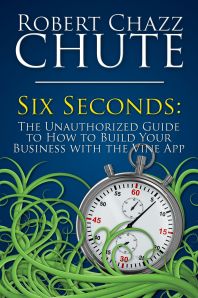
Six+Seconds+copy

My new book, Six Seconds, The Unauthorized Guide to How to Build Your Business with the Vine App is now available on Amazon. It’s Ex Parte Press’s first instant biz book (Instabiz book?). If you liked the breezy tone of Crack the Indie Author Code, you might like this even more since it’s mercifully short at 18,000 words. Come for the jokes, stay for the Internet marketing ideas.

It’s about Vine, invented by Twitter but video Twitter. It’s the wave of the future and damn fun, so you need to get in early (like a Twitter do-over.) I fell in love with the app as a toy and then figured out how it could be a tool. When I mentioned my podcast, traffic to my author site shot up. I’m relieved to find a fun way to promote my work and enliven my Twitter stream with video.

The free ebook offer:

I’m giving away 20 copies to anyone willing to have a look and give the book an honest review.

Send your email address* to expartepress AT gmail DOT com

I’ll send a kindle copy your way immediately, no questions asked.

There won’t be any free days in the future since I’m opting out of KDP Select and making it available across all major platforms. This is the freeness here and now. (I’m doing a separate offer on Facebook. FYI: this is an additional 20 copies.)

And now a special note about your email privacy:

*I won’t keep your email address and I won’t give it away or sell it. And I’ll lobotomize the ninja monkey clone assassin who acts as my assistant in the lab if he even glimpses your email address.

Igor! I have some bad news for you!

~ On the other hand, if you’d like to receive my All That Chazz newsletter, you can subscribe to that at my author site, AllThatChazz.com. Thank you.

Filed under: Publicity & Promotion, publishing, Video, Vine, , , , , , , , , , , , , , , , ,

Bestseller with over 1,000 reviews!
Winner of the North Street Book Prize, Reader's Favorite, the
Literary Titan Award, the Hollywood Book Festival, and the
New York Book Festival.

http://mybook.to/OurZombieHours
A NEW ZOMBIE ANTHOLOGY

Winner of Writer's Digest's 2014 Honorable Mention in Self-published Ebook Awards in Genre

The first 81 lessons to get your Buffy on

More lessons to help you survive Armageddon

"You will laugh your ass off!" ~ Maxwell Cynn, author of Cybergrrl

Available now!

Fast-paced terror, new threats, more twists.

An autistic boy versus our world in free fall

Suspense to melt your face and play with your brain.

Action like a Guy Ritchie film. Funny like Woody Allen when he was funny.

Jesus: Sexier and even more addicted to love.

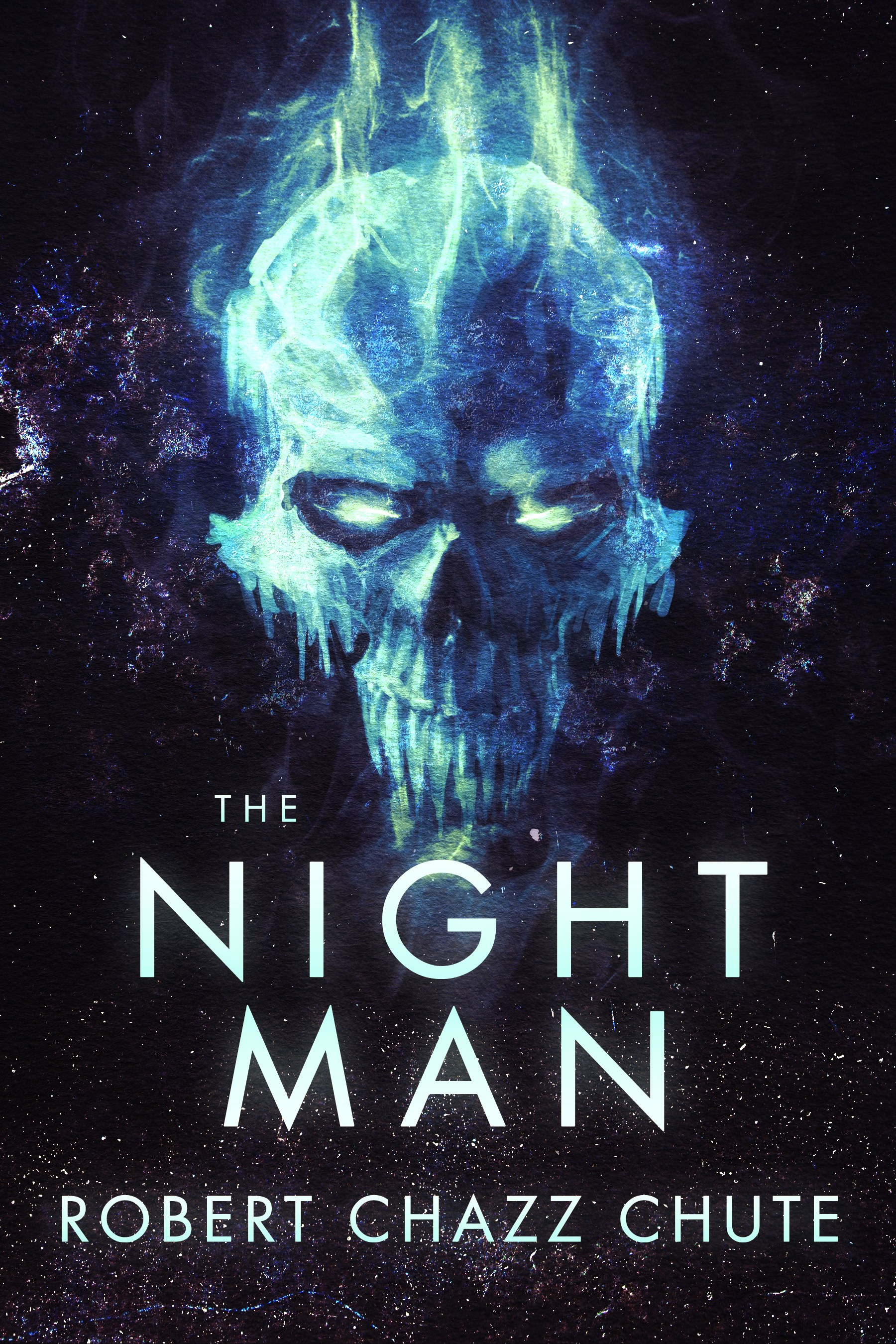
You can pick this ebook up for free today at this link: http://bit.ly/TheNightMan

Join my inner circle at AllThatChazz.com

See my books, blogs, links and podcasts.

Enter your email address to follow this blog and receive notifications of new posts by email.

Join 2,061 other subscribers