C h a z z W r i t e s . c o m

See all my books at AllThatChazz.com.

What resources do new publishers need (besides a darn good book)?

You’re a writer. You have a winning attitude and you clean up nice. You’re determined to publish a book this year. What’s needed?

Scrivener

Scrivener helps me write all my books. After experiencing its ability to organize a manuscript so I can bop around and rearrange elements easily, I’d never go back to Word. There’s a free trial or buy it for $45 USD. I now consider this software a need, at least for me.

Editors

Lionheart for editorial services. They did great job (fast and very reasonably priced) formatting my last book for print. I plan to use their services much more in the future. After many frustrating attempts, I realized I could lose my writing time to formatting or I could hand it over to an expert. (Special thanks to Jordanna East for the tip.)

This editor, Jason Whited, also comes highly recommended by the guys at Self-Publishing Podcast. (I guess he had a small hole in his schedule because if  you use his services before February 15, 2014, he’s knocking 25% off his fee.)

The Graphic Artist

Hire Kit Foster at KitFosterDesign.com to design your covers (ebooks, print, audiobook, web banners, logo designs, advertising.) He works for traditional publishers and indies makes beautiful covers. As regular readers of this blog know, I can’t say enough nice things about Kit.

A website

You at least need an author page. WordPress is cheap and easy. If you expect to sell with affiliate links, self-hosted is better. If you’re going with GoDaddy or Hostgator for a domain name, just get the minimum and avoid all the upsells on features you don’t need. Hover is now my preferred place for domain names because they don’t do all the upselling and the price includes a lot of what other places sell piece by piece. Hover isn’t evil.

If you want to get more fancy so you have superior design, support and a badass sales page, try Squarespace.com. The domain name is included in the price at SquareSpace. I’d have moved my author site over to Squarespace already, but the platform isn’t as friendly to podcasting as WordPress (yet).

Social Media

You’ll need a Twitter account and Facebook. (Free to begin, cheap to advertise upon and of limited effectiveness in that regard.) You’ll notice I haven’t included LinkedIn. That’s because I’m not sold on its efficacy as a tool for authors. Some authors like LI more than I do. It can be useful if you’re looking for a job.

You’ll also find forums for authors there, but I put LinkedIn and Tumblr in the same category: nice but optional. My Tumblr posts my stuff automatically. I don’t hang out there. Sadly, Google+ hasn’t really caught on as much as it will. Google+ will get bigger once Facebook alienates more users.

Sales Platforms

An Amazon account for ebooks and CreateSpace for printing. All these accounts are free to open. Other sales platforms like Kobo etc.,… are by choice and as needed. (Many indies will tell you that you must be on all platforms. That’s a debate for another post. Read that here.)

Understand that you are the publisher now and (what fun!) you’re a business owner. Amazon, Kobo, Apple and the like are not publishers. They are sales platforms. The money you hope to get from these online catalogues is not a royalty. Those are sales figures, not royalties.

Since you’re the publisher, I’d form a LLC (US) or register a sole proprietorship (Canada). Do you have to? No. But I think it’s more professional, keeps the bank account out of the hobby category and the Ex Parte Press logo on the spine of my books says, “Yeah, this is real.” ex parte press logo 1
Some platforms don’t require ISBNs. I think they’re a good idea. In the United States, you purchase them through Bowker. In Canada, ISBNs are free except for sending books to the national library.

An accountant

The tax system is far too complicated for mere mortals. When looking for an accountant, don’t ask for a referral from your kid’s orthodontist. He’s got lots of money and will have a slick, high-priced suit for an accountant a young start-up such as ours can’t afford. Ask a dental hygienist instead. She’ll have someone reliable she’s used for years whose fees are not exorbitant. Your accountant won’t wear a $3,000 suit, but who needs that for a bit of handholding? Big companies need high power to hide their assets. We just need a friendly guide through the system so we can have some peace of mind.

Use Wave or Easy Accounting Pilot or any simple spreadsheet program to record all the income, receipts, mileage, publishing and equipment expenditures. This is a do-it-yourself project. Don’t show up at the accountant’s office with a box full of receipts. If you do, no matter how inexpensive their services, the time they have to take to peer at crumpled receipts will run up your accounting bill.

Report all income and pay your taxes. The good news is, chances are excellent you won’t have any such thing as income for a while. However, that laptop, if used for your publishing business, is a write-off. Consult with your accountant. Ask how much of your office space is allowable to claim. Software and hardware have different allowable claims. Find out how much your government is allowing for mileage this year and keep a mileage log. It probably won’t be much, but when’s the last time you burnt a $20 bill? Lose track of receipts and you torch money and Thor knows we can’t afford to do that.

Author Marketing Club

Spend $100 on an Author Marketing Club membership, though even their free tools are good. Do not spend thousands on a publicist. This is especially true if you don’t have thousands of dollars or if you have only one book to sell. Most authors are their own publicity department (just as it is with most traditionally published authors, really).

And remember, the writing always comes first. Twitter, Facebook and promotion is for time that would be otherwise unproductive.

Friends

I don’t have many friends, but through my books, I’ve made friends with new people for the first time in a couple of decades. As I detailed in a recent and surprisingly popular post, friends and allies are not afterthoughts and frivolous relationships. They’re important to help us deal with our questions, our stress and even our workload. No indie who is successful is truly independent. We depend on others for street teams, beta readers, information and support. We’re publishers who crowdfund. We swap services, advice and guest posts and play in our allies’ blog tours and promotional opportunities. This is shoestring publishing that stretches our resources to the limit as we make books to the best of our ability.

Don’t try to publish without support from a writer’s group or like-minded indies, friends and/or family. (Not everyone will be onboard, so don’t expect moon pies from everybody, either.) I’m lucky to have beta readers with extensive military experience. One of my best friends trains elite SWAT and all their input has been invaluable to my crime novels and This Plague of Days. One of my friends is an English major and writer who is vigilant for plot issues and insists I never take a shortcut. Another beta reader is a proud and vocal member of the Grammar Police. Most friends and family won’t buy your books, but with help from a chosen few, you can reach the strangers who will buy your books. Have as big a beta reading team as you can manage, as long as it remains productive.

We need friends to save us from ourselves. I guess that’s true no matter what we’re doing.

What would you add to this list for new publishers who are taking their first steps into the indie pool?

~ This week I went through a bunch of this stuff with a budding self-publisher over the phone. She didn’t have a Twitter account yet, so it got me thinking about the necessities to begin. I think if you start off with the items I’ve listed above, you’ve got a lot of bases covered as you start your journey. I’m sure I’ve forgotten something and I know there are advanced options to add to the list. For instance, going to ACX for audiobook creation is a logical next step after you’ve published an ebook and you’re in print. Please add your recommendations in the comments thread so we can help new indies start off well.

Filed under: author platform, Publicity & Promotion, publishing, , , , , , , , , , , , , , ,

The real value of TBR lists (that you hardly ever get to)

Besides the chance at author discoverability through also-boughts, what is the value of all those to-be-read books you and I will probably never get to? (I say this with love and without judgment, as an author and fellow hoarder of books and ebooks.)

To shine a light in the dark, I spoke recently with an author who has her books for sale everywhere but Amazon.

(It matters little why she wasn’t on Amazon, except to say it was a misunderstanding of the platform’s requirements, not a principled, moral stance.)

“But we have to be on Amazon,” I told her. “Exclusive or not is your choice, but if you want to reach more readers, you must be on Amazon.”

“Why?”

“Because that’s where so many readers are. Amazon is out front and will remain so for the foreseeable future.”

“Why?”

“Because their customers are locked in.”

“What do you mean ‘locked in’? Everyone could switch to Kobo tomorrow.”

“But they won’t. Amazon has millions of customers whose first device was a kindle and so their library is on kindle. Kindle devices have come down in price and improved, so those readers will stick with kindle. They’re suffering the delusion that someday they’ll win the lottery, move to the French Riviera and finally have time to read all those hoarded books on a topless beach.”

“That’s not rational,” she sniffed.

“If I switched devices, it would be like burning all my books. And maybe that’s irrational, but we are talking about humans, yes? I have so few Vulcan readers.”

“But devices and companies go away. Look at MySpace and AOL and Kodak.”

“And the not-so-bright future of the Nook,” I added. “Yeah, companies go away if they fail to adapt to competition. But all those free downloads to long TBR lists give Amazon an immense legacy advantage. Kobo might be #2 in the e-reader market, but they’re a distant #2. Amazon’s the greyhound out front chasing the rabbit. The others are three-legged purse dogs running in circles around the starting line.”

“That’s ridiculous. If I wanted to switch, why couldn’t I just port my Kindle downloads over to Kobo?”

“Amazon would have to permit that, I’m guessing. They’re different systems. There are workarounds, but most readers won’t do it. For instance, I’ve got Calibre but I hardly ever use it.”

“Why not?”

“Because it’s harder to use and more time-consuming than the one-click buy that shoots straight to my kindle. People stick with what they know and what’s easy. For instance, everyone complains about Facebook, but they hardly ever leave and a bunch of those who do leave come back for more abuse. They don’t hang out at G+ because all their friends and family are still on Facebook. Their network is locked in, even if they don’t want to be. For Amazon and Facebook to start to worry, they must have a real threat of competition.”

“I heard Instagram is getting even more popular than Facebook with young people,” she said. “Facebook has serious competition there.”

“For that niche and possibly into the future, yeah, which must be why Facebook bought it already. No competition.”

“Oh,” she said.

“To compete with the greyhound, the little yappy dogs have to take steroids and get going in the right direction. But the greyhound will probably eat their steroids. The big dog always has more money for R&D.”

“You’ve lost me in the canine metaphor. I don’t hang out at the dog track.”

“Come up with a new way to reach customers and someone will finance it. If it’s a really good idea, it will probably be the leader of the pack buying you out, making sure they stay the pack leader.”

“But what about all those companies that fail?”

“Nothing lasts forever, sure. Apple seems to have lost some direction since Jobs died and the stock’s down. Mostly, big companies fail because they lower their standards or try to hold on to the old paradigm instead of improving and evolving. Like how the Big Six publishers became the Big Five. Soon to be fewer, probably.”

“Ah. So…you really think I should sell on Amazon?”

“It’s up to you, but for me, it’s the only platform that’s not optional. There are exceptions. Some authors seem to move romance and crime better on B&N and Kobo. If they choose to pull you out of the haystack and promote you, you might have a shot. But mostly, and for me? If I wasn’t selling on Amazon, I wouldn’t be selling books.”

“So all those free ebooks on my TBR cyber-pile is just Amazon insuring customer loyalty?”

“I wouldn’t call it loyalty. No matter what the Supreme Court and Mitt Haircut say, corporations aren’t people, my friend. Companies rarely inspire love. Call it inertia. Also, I’m sure they really do hope you’ll buy somebody’s books and make a ton of money the way they say it was intended. I’m talking more about customer behavior here, not whether Amazon’s packed to the rafters with cynical geniuses who can see into the future.”

“So what do you think of free ebooks as a promotional tool?”

“It’s not the sharpest tool in the shed, but most of the discoverability tools are pretty dull.”

“Sounds like you love Amazon,” she said, her eyes narrowing.

“No. If the little dogs started running faster, I’d bet on them. Until then, I’m riding the big dog. And you know…sometimes…once in a long while, I’ll find an author in that TBR pile I thought I’d never get to. And sometimes, I’m blown away and I want to read more of their books. Then I’m in true buying mode. Free ebooks is fake buying mode. But it does happen that I find someone I like there and spend real dough.”

“Name one,” she said.

“I’ll name three. Alex Kimmell, Jordanna East and Armand Rosamilia.”

“I’ll add them to my TBR pile,” she said.

“Make sure you get to them.”

~ Robert Chazz Chute is an author with ten books in your TBR pile you still haven’t gotten to. How will you ever fall in love? 

Filed under: Amazon, author platform, book marketing, Books, e-reader, ebooks, free ebooks, Publicity & Promotion, publishing, Writers, , , , , , , , , , , , , ,

What did not help me sell This Plague of Days: Publishing problems and solutions PART III

I’ve tried a lot of things to get the word out about my books. Here’s what didn’t work and some things I’d do differently now.

PUBLICITY PROBLEMS

A. There was no detectable return on investment with most of my experiments with book videos from Fiverr.com. Fortunately, I paid little or nothing for them, so call that a reasonable experiment gone awry. Book trailers are generally weak (as I’ve blogged about many times.) If someone ever figures out how to make movie-trailer quality promo videos inexpensively, they’ll have a viable business case. There’s a better way to use video (see Solutions below.)

TPOD T-shirtB. Promises of rewards for spreading the word about This Plague of Days didn’t work. I wasted my time and that of my graphic designer trying to come up with cool t-shirts for the campaign. (Fortunately, Kit at KitFosterDesign.com, is patient and kind.) I ended up ordering two t-shirts of my design. They were way too expensive. I wear them.

C. My podcasts (AllThatChazz.com and CoolPeoplePodcast.com) don’t cause people to read my books…mostly or directly. (Interestingly, I can track stats that show a correlation in sales: I sell the most print books in those areas where my podcast is most popular. ) However, as you’ll see below, I think my podcasts help me most in indirect ways.

PROMOTION SOLUTIONS

1. I do have plans to use video again in different ways. Video can work well if done cheaply and with the right content. For instance, the Jesus video has worked to help me sell my crime novel. It’s on the front page of ChazzWrites.com and I’ll leave that up forever. People love that one because it’s so funny and silly and effective. I like the ink in water video at the top, too. That one does grab attention.

I found both on Fiverr.com. Fiverr offerings can be hit and miss. I’ve mostly used the site for video animation. Some other offerings strike me as ineffective, silly and ineffective or sleazy ploys.

One more detail about video 

Using the Vine app did connect me with new readers as well as help me discover a guest for the Cool People Podcast. In the future, I’ll do more short, informal videos. Video book reviews are very effective.

Any video can work if it’s funny, informational or contains a more personal message. The problem with Fiverr videos is that they’re impersonal. Just like with Twitter accounts, people want to hear from the author, not an intermediary. With Vine, Instagram or a quick video (shorter’s better) posted through your YouTube account and to your blog, video is still powerful. Make it yourself while you’re walking around. Make cheap and DIY work for you instead of against you.

For more tips on using video effectively to promote your book or business, there’s this:

Click it to grab it. On sale now for just 99 cents.

Click it to grab it. On sale now for just 99 cents.

2. For future promotions, I need to reach more people. My goal is to plug into a larger network. I’m working toward it. Over the last week or so I have over 1,000 more followers on Twitter. In the future, I also have to find a local company that can make a decent t-shirt without charging an arm, leg and kidney.

WHAT SAVED ME? YOU.

When word did spread about This Plague of Days, I ended up having little to do with it directly. It happened organically.

People with relatives who were on the autism spectrum fell in love with the protagonist. It began to snowball from there, one tweet, email and review at a time.

When you can’t make it happen immediately, sometimes all you can do is wait patiently. If there is resonance, people will find you. I’m eternally grateful to those who share their love of my books simply because they felt moved to do so. People want to share stuff they love so others can enjoy it. If you can’t do anything else, connect with readers viscerally. When book lovers step up to be heard about book recommendations, they are loud!

3. My podcast helps immensely, but not in the way I expected. Because of my podcasts, I’ve appeared on many other podcasts. That sells books. My podcasts also connect me with great people (especially the Cool People Podcast.) I would never have connected with those great people without getting into podcasting.

I became friends with fellow horror author Armand Rosamilia through the show. He’s blurbed my covers and is a great supporter of my work, including this blog. I’ve made new friends and reconnected with old ones. I’ve appeared on Inverse Delirium twice and I’ve been promoted on The 40-year-old Boy and the School of Podcasting many times. Around the launch of Season 3 of This Plague of Days, I will appear on the Rocking Self-Publishing Podcast. That’s a big deal to me.

Some strategies fail in one way but succeed in ways you didn’t expect. Experiment as much as you can afford. The more shots you take, the more you hit.

And finally:

Spend more time on writing and more money on the books themselves.

Don’t think about marketing and promotion all the time.

Don’t think about it at all if you only have one book to sell.

Write another book instead.

Whatever else you do, the writing must come first.

Tips and inspiration for the writer's journey to publication.

Tips and inspiration for the writer’s journey to publication.

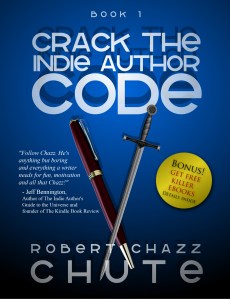
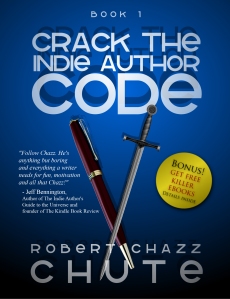
~ Hey did you know I also wrote a couple of books full of inspiration and writing advice that also manage to be funny? Yeah. That’s right. I made it funny instead of writing another of those scolding kinds of writing and publishing books that make you feel like crap. It would be a good idea to go get those now. You’ll learn a lot from my petty successes and catalogue of failures. Crack the Indie Author Code, people!

Filed under: author platform, book marketing, Publicity & Promotion, publishing, , , , , , , , , , , ,

How I sold This Plague of Days, PART II

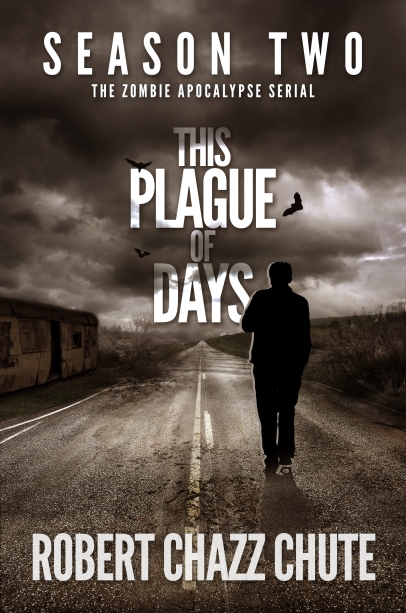
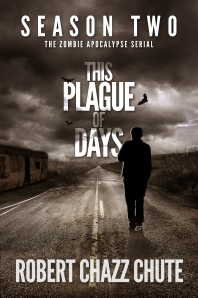
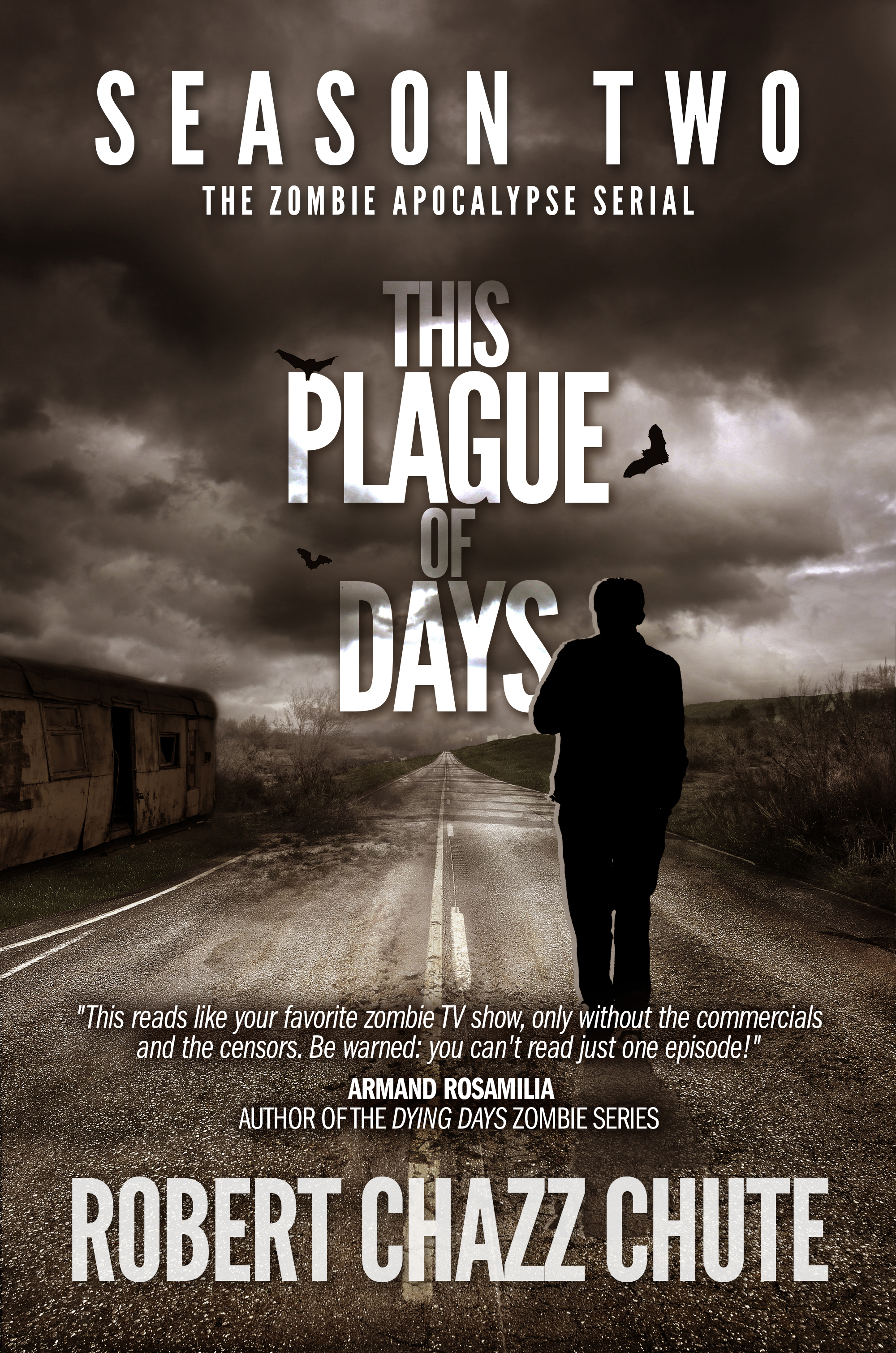
This Plague of Days Season 2

If I had to nail down what strategies worked to sell This Plague of Days, here are the elements that had to come together:

1. Good story. A selective mute on the autistic spectrum versus the Sutr plagues + a CDC virologist’s band of refugees on the run as Europe falls to the infected = Cool.

2. Kit Foster’s great covers. You can have a great story, but without KitFosterDesign.com, who would have bothered to have a look in the first place?

3. Serialization. See yesterday’s post for oh-so-many details on how and why that worked.

4. Bookbub. I got a flood of great reviews from the giveaway. Season One was a bestseller in September because of the free Bookbub giveaway. Season Two became a bestseller two weeks later in October.

5. Amazon exclusivity. This Plague of Days couldn’t have been free for the duration of the Bookbub giveaway if I wasn’t enrolled in the KDP Select program exclusively. (Note that while it is possible to price match down to free on Amazon, it’s not dependable or predictable if or when you’ll get the price down or back up when you want it. Price matching to get to free is not practical for pulse giveaways.)

The Ins and Outs of Bookbub

Bookbub wasn’t very expensive in the horror and science fiction categories, though I believe those fees went up since my promotion. (Click here to see Bookbub fees and stats on ROI.) If I wrote romance, I couldn’t afford their advertising program. I’ve heard some complaints about Bookbub lately, mostly about the fees for service. However, author and Cool People Podcast guest Renee Pawlish also raised questions about its reach on her blog. (Click this link to read Renee’s analysis and be sure to read the comments for a lively discussion and more factors to consider).

It will be interesting to see how prices for advertising change in a more competitive market. I advocated for Bookbub early on. However, while strategies may be long-term, tools are not. As more services like it arise, Bookbub won’t be the only free ebook promotion service on authors’ minds. In fact, many of you may already be using The Fussy Librarian or opting for the multitude of promotional services listed at Author Marketing Club. If you want more options, I suggest you support those services. For instance, The Fussy Librarian’s influence is growing and the operator has pledged to keep fees from authors low.

We don’t have to hit home runs with big services if we percolate into readers’ consciousness by hitting a lot of singles, doubles and triples. (There goes the only baseball analogy I understand.) Book bloggers and smaller, up and coming book promotion companies may be viable options or become more so. Author Marketing Club makes it easy to hit a bunch at once. 

Some book promotion services aren’t very strong, but it’s a new year and our infrastructure is deepening. Other book promotion services that have been around for a while are harder to get into.

If you get onto Pixel of Ink’s offerings, that’s a tribute to luck, your blurb and your cover art. Some services ask for so many reviews before allowing inclusion, the Law of Diminishing Returns kicks in. For instance, it gets to a point where the author thinks, I needed the service more when I had fewer reviews! If a book promotion service demands fifteen to twenty rave reviews to qualify for inclusion, they better deliver sales at a reasonable rate (whatever “reasonable” is will vary by author.) 

The Ups and Downs of Amazon

Over a year ago, several gurus said the advantage of being exclusive with KDP Select was gone. In the last few months, I’ve read several successful writers again report that they’re moving books on other platforms and anyone who doesn’t broaden their reader base with more platforms is an idiot.

I guess I’m an idiot, but I’m a happier idiot than I’d be if I’d diversified as many have advised. I did experiment quite a bit with those other platforms and ended up pulling several books back after good trial runs. They did nothing for me. My books sell on Amazon and, as long as that continues, I’ll stick with it.

In my experience, the other platforms are far behind the Mighty Zon and can’t seem to come up with ways to get my books moving there. Vague terms like “establishing a presence” on other platforms and worries about putting my eggs all in one basket won’t dissuade me as long as I still see returns on my work that the other platforms can’t seem to touch. KDP exclusivity is not as lucrative as it once was, but you don’t torch the car because it’s not as good as when you rolled it off the lot. If I want to escape KDP exclusivity, the worst case scenario is I’m free of the agreement within 90 days.

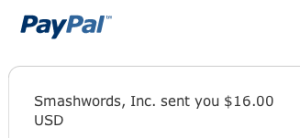
I’ve talked to writers for whom diversification is working. If that’s you, carry on happily. See my screenshot of my latest news from Smashwords?Screen Shot 2014-01-27 at 7.16.53 PM

No, it’s not time for me to diversify yet. When it is time, that jump can be made in pretty short order.

If Kobo were to offer to pluck me out of the rough and promote me, it would be a different story. If Apple weren’t so difficult to deal with, I might go for it. I’m not banning my books from other platforms forever, but I won’t abandon the exclusivity at KDP as long as it’s still working. It’s important to understand that other platforms work differently from Amazon. Other platforms choose what they’ll push at customers much as brick and mortar bookstores do. With Amazon’s algorithms and search engine, the customer’s choices determines what is marketed to them. The readers are the gatekeepers there.

This allegiance to Amazon is not an ideological stand. It’s accounting. The other platform paid me pennies. Amazon still pays me dollars. As soon as I’ve determined I’ve squeezed as much as I can out of Amazon promotional opportunities, I’ll give Kobo et al another try. I hope the other platforms will have stolen the best ideas from other players by then. At the very least, everyone should take something from what Smashwords does best: give us promo codes so we can better publicize out work. Amazon is the industry leader. I’m surprised the other platforms don’t experiment with emulation more.

~ As stated in yesterday’s long treatise, one author’s poison is another author’s chocolate latte birthday cake. Amazon’s still cake for me. 

Next post: What didn’t work for me in promoting This Plague of Days.

Filed under: author platform, book marketing, Publicity & Promotion, publishing, self-publishing, , , , , , , , , , , , , , , , ,

This Plague of Days: How I sold my autistic zombie apocalypse through serialization PART 1

This week, I’m making This Plague of Days a case study for those interested in drilling deep. This will be a series of blog posts about strategies, platforms and book marketing: what worked, what hasn’t worked, what won’t and what might. I hope it helps you to sell your books, if only by avoiding my errors.

Topics will include various format releases, selling in different ways, pricing and publicity. You’ll find out how This Plague of Days became a bestseller (in its teeny-tiny category) and the ways in which I’ve failed miserably. I’ll also hit on how my strategy is changing for the conclusion of This Plague of Days. Season 3 comes out this spring. I’m always experimenting, looking for new and different ways to reach readers and make them happy. Sometimes what I thought was the wide road to glory turned into a goat path into a dead-end. As always, I’ll be honest about it.

On sale now for just $2.99. I mean, c'mon!On sale until Feb. 1, 2014 for just $2.99. I mean, c’mon!

HOW I LAUNCHED THE SERIAL

My strategy for launching This Plague of Days, Season One was to put the whole ebook out first. I waited a week. The sky didn’t shatter with raging need for my latest contribution to suspense and horror literature. Then, over the next five weeks, I released the book broken into episodes as a serial. Each episode came one week apart at 99 cents each.

Each section ended on a cliffhanger so readers were given a choice:

Wait another week to find out what happens next, come back to Amazon and download the next episode. (0.99 x 5 = $4.95)

Or, preferably:  forget all that nonsense and just buy the book for less money than it cost to get all the episodes piecemeal. I sold the ebooks at $3.99 with pulsing price dips to $2.99 plus a couple of promotional giveaways at $0.00. (More on that in another post, but hey, Seasons One and Two are at $2.99 until Feb 1. Take a hint and have some fun. It’s too cold to go outside so you might as well read.)

Print has been so little of my income in the past that creating the paperback was a low priority. I did that last. (That’s changing, as you’ll soon see in a post coming later this week.)

HOW TO SERIALIZE CORRECTLY

My nastiest reviewer noted with dismay that I’d written it like a television serial (as if I’d somehow done so by accident.) Most people actually liked the format and appreciated its quirks as added value.

That said, serialization doesn’t work if you break the narrative the wrong way. Take an ongoing television drama. Let’s say, The Walking Dead or House of Cards. Cliffhangers, wit, surprises and reversals are the gears of the engine that give a serial forward momentum. Each transition should scream, “That’s not the end you expected. Now turn the page for more!”

Not all books are suited to the serial format and it’s not just about taking any book, breaking it apart and selling off the chunks. It’s about adding value to the reader and certainly not making more cash off selling episodes at 99 cents. For get-rich-quick ideas, boy, are you on the wrong blog!

ABOUT ADDED VALUE AND STANDING OUT

With an autistic hero who mostly doesn’t speak and a story that spans Europe, America and Canada, my story is unusual. You meet a lot of characters but they don’t meet each other for a long time, if at all. The plagues start off based in reality and later supernatural elements à la The Stand develop as the Sutr virus evolves. I did weird things with how I laid the saga out, too.

The Table of Contents comprises a long, dark poem with clues to what’s coming. Each episode begins with “Notes from The Last Cafe”, which adds to the intrigue. That mystery is not actually solved until late in Season 3. Also, Seasons One and Two contain a secret. The first three readers to guess it correctly will get characters named after them. I’m receiving guesses every week, but so far, no one has won. (Check out ThisPlagueOfDays.com for more on that.)

THE PROS OF SERIALIZATION

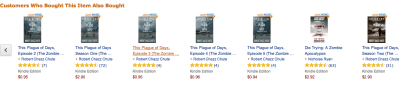
1. My also-boughts proliferated on Amazon so customers saw the work of my brilliant graphic designer, Kit Foster, pepper those lists. They didn’t just see one cover. They saw six, each different, but in keeping with the tone and theme of each season. Repetition and increased exposure got attention to the book it wouldn’t have caught otherwise. Here’s what that looked like:

TPOD 0616 EP 1 cover
The Also-boughts (below) harnessed the power of repetition in advertising.

Screen Shot 2014-01-26 at 3.49.28 PM


2. Best of all, readers who dig This Plague of Days went ahead and bought the entire season immediately. Some even took Season One, Episode One as a big, cheap sample and went back to buy both seasons in their entirety.

An important detail that’s a pro and a con

Those people who were tepid on an autistic kid in the zombie apocalypse tended to just try Episode One. Each episode ranges from 15- 25,000 words, so they got a generous read. The zombies don’t actually show up for a while and they aren’t even “true” zombies in the Romero sense. If readers didn’t care for the pace at which I built the tension, early instalments took the hits of less-than-entranced reviews and readers dropped away.

The majority loved it and went on to leave stellar reviews on each season. This somewhat inoculated the books from negative ratings because the non-enthused bailed out. Serialization gave them that easy option.

THE CONS

1. Serials are a harder sell. Some people hate serials and won’t buy them. Others click indiscriminately and then will rank you lower even if they like the book. (Yes, I know that’s crazy, but I’ve seen it. Fortunately, those few are outliers.)

2. Despite going to great lengths to explain and differentiate between seasons and episodes with covers and sales copy warnings, some readers still got confused about what they were buying in what sequence. Each cover was clearly labelled and to some, that didn’t matter. (Too quick to click the one-click buy, I guess.) That got me a couple of bad reviews. I explained to those reviewers in the comment thread of their review that anyone who buys something in error can easily return it to Amazon for a full refund. Still, those negative reviews remain.

3. Episodes that sell for 99 cents make next to no money. Somebody’s going to object to that, but the math on my sales reports says it’s true. I’d have to sell way more episodes to equal the sale of one book/season. In my quest to find 1,000 true fans, this is one of the trade-offs along the way to helping us find each other. I don’t resent the journey.

4. Maybe it’s my sense of price resistance, but I don’t see charging more than 99 cents per episode. You could give less in word count per episode, but you also have to ask yourself, how much and how often do you want to format and upload files? Drag it out with more episodes and other costs rise higher.

5. I can see by my sales stats that The Law of Diminishing Returns has kicked in with respect to sales of each episode. With so many positive reviews on Season One and Two, it makes less sense for me to serialize now. As I move away from serialization in Season 3, those who liked serialization might ding me for it (even though, with the way I priced it, that’s irrational.) 

6. Serialization that’s not hooked up to Amazon’s auto-delivery system is problematic. The customer has to remember to come back each week and download the new episode. I did apply to Amazon to publish this serial with them. I never heard back. Had they gone for it, you might have heard of me before today.

7. Now that my Amazon sales page is populated with all those episodes from Seasons One and Two, it looks too busy. I’d rather just display the seasons (and eventually The Complete This Plague of Days) so it’s easy for readers to zero in on those books and click buy. How long must I wait before I can clean it up? I can’t simply unpublish the episodes in case someone’s still thinking of getting around to finishing the serial episode by episode? Do I wait a year? Two? Three?

CONCLUSIONS

You’ll note that the Pro column has two entries and I list seven disadvantages. I wish the analysis were that simple.

In my final analysis — not necessarily yours — the disadvantages I list are the cost of getting the book known. In this case, any damage was mitigated by moderate success. Serialization helped readers and hardcore fans find This Plague of Days (and in some cases, my other books.) Therefore, the sacrifice of getting roughly 30 cents on the sale of episodes is the cost of experimentation. For advertising so well in the also-boughts on Amazon, it was worth it. Season One has 72 reviews so far. Season Two has 31. That’s much more attention than my other books got. (Shocking because Murders Among Dead Trees is genius, dammit! And only 99 cents until February 1, 2014. I’m trawling for reviews from the bargain bin so…well, you know. Check it out, if only to read my favorite three-star review ever.)

Those two pros carry more tonnage than the feather-light cons. I don’t regret serializing Seasons One and Two. Without serialization, I wouldn’t have those problems. Some problems are the good kind to have. Without serialization, I’d probably be (even more!) anonymous in the literary landscape.

That’s why marketing Season 3 will be interesting. The revolution will not be serialized. Stay tuned.

~ This is a case study which may or may not apply to you. I’m not telling anyone what they should do. This is just my experience and my reasoning on serialization. Next post: Amazon, Bookbub and all those other platforms.


Filed under: author platform, Publicity & Promotion, publishing, self-publishing, writing tips, , , , , , , , , , , , , , , , ,

World’s Biggest: The Unfortunate Death of the Last Big Bookstore and What Happens Next

For a long time I’ve predicted the thinning of bookstores. They’re not going away completely, but you’ll have to drive farther afield to get to one. When I was a sales rep for numerous publishers, the bookstore chains decimated independent bookstores. Most of the little stores I visited with my sample case and catalogues are long gone. Now, it’s the chain’s turn.

Still, I got a shock this week. My shrine is closing.

In the heart of Toronto lies a huge bookstore, three levels and 64,000 square feet. Soon it will empty to the bare walls. The World’s Biggest Bookstore is shutting its doors in February. It was great for treasure hunting. The Indigo book chain’s lease won’t be renewed and tourists and book lovers won’t wander into World’s Biggest anymore. This store, a champion of the paper book, will be no doubt be replaced by high-end condos for people who trade stocks on Bay Street. 

When the sale was announced, the owner of the property (son of the original bookstore owner, Jack Cole, who founded the store in 1980) said the deal is about a real estate sale, not the slow death of the bricks and mortar bookstore. Whether for a massive real estate sale or for other reasons, World’s Biggest is the flagship of the Indigo fleet. It’s going down and will not resurface.

It was a destination bookstore and we won’t see its like again.

Whenever in downtown Toronto, if you could read, you just had to go there to browse. I never left without an armful of books. I took out-of-town friends there to wander the aisles. It was such a great place to hang out and…brace yourself for the unexpected…they didn’t even have to sell coffee, knick knacks and dustables in order to lure people to shop.

There are many other bookstores, of course, but they’re all lookalikes.

In the announcement, the owners of World’s Biggest invited customers to slip down a block or two to visit nearby Indigo locations. I have a chain bookstore down the street from my home that looks exactly like all the others. I don’t need to go to Toronto to get that experience. I don’t even have to drive five minutes to my nearest Indigo bookstore to look at paperbacks. The Starbucks looks busier than the bookstore most days and Amazon’s catalogue is more extensive than any bookstore could possibly offer, anyway.

Amazon is the World’s Biggest now.

My social scene will have to come from Skype and social media. My destination now is my keyboard, my kindle and the ease of the one-click buy. For the Starbucks experience, I’ll set the coffeemaker between the couch and the wood stove. Goodbye, World’s Biggest. I won’t dwell on nostalgia or write a treatise on the tragedy of any more lost bookstores or pen an ode to the smell of book glue.

I write. I read. I stay home. The world turns, turns away, and moves on.

Filed under: Amazon, book marketing, publishing, , , , , , , , ,

Post-holiday sales and writing stronger characters readers will love (and love to hate)

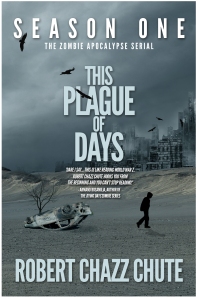
Season One of This Plague of Days is the siege. Sutr-X was the pandemic. Sutr-Z's next and it's coming for you and the Queen's corgis.

Season One of This Plague of Days is the siege. Sutr-X was the pandemic. Sutr-Z’s next and it’s coming for you and the Queen’s corgis.

1. Good characters have secrets they are trying to keep from the other characters. For instance, there is no major character in my zombie apocalypse, This Plague of Days, who does not guard a secret that’s contributing to the hullabaloo. Plenty of room for conflict there. Secrets are hard to keep and the longer they’re kept, the bigger the explosion when the secrets are revealed.

2. Good characters do not get along. In This Plague of Days, the matriarch is a Christian. The patriarch is atheist. They love each other, despite their differences, but it makes for some friction and they cope with problems much differently. They also begin to come closer to the other’s position, so rather than getting preachy, it’s an exploration of how people cope in a crisis. These details make them relatable so readers care about them.

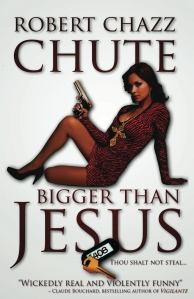
3. Good characters have competing motivations. In Bigger Than Jesus, my Cuban hit man kills for love. Competing characters want power, sex, money and vengeance. All those characters are after the same thing for different reasons, so tension is built as allegiances are broken.

4. Good minor characters don’t know they’re minor characters. Everyone is the star of their own movie. If your henchmen might as well have the labels “Heavy #1 and #2”, give them more life history. I have a bad guy, a drunken marauder, in Season One of This Plague of Days you don’t really get to know. He wears a wedding dress into battle (stolen from the protagonist’s mother.) It’s a brief brush stroke that lets the reader figure out the rest as to where that guy is coming from while fuelling reader outrage.

Now in paperback!

Now in paperback!

5. Good characters are conflicted and can change. Sometimes, real people do in fact do something uncharacteristic. That makes them interesting. To make this believable, give them good reasons to change their behavior. With enough correct and detailed context, you can make the reader believe an out of character choice is logical at the time. Let a bad guy aspire to be a hero. Let a hero do something petty, just for spite (and the joke.) People who are too sure of themselves are often boring, unimaginative, predictable. I hate predictable choices in plots, don’t you?

6. Good characters, even heroes, make bad decisions that make them more interesting. As with #5, context makes this work. The reincarnation of Battlestar Galactica is a perfect example. You were probably rooting for the human heroes in the show, but they made terrible decisions all the time. Overall, that didn’t make them bad per se. It made them less predictable, more interesting and more human.

So, for instance, victims who are chronically bullied are tragic figures. Push that victim too far and they can fight back believably. If the bullied person overcorrects and becomes a bully or a killer, or fights back and fails, that’s even more interesting. The reader will expect them to triumph. You could give them that happy ending, but don’t deliver it too quickly or in a way they can anticipate.

Click it now to get a huge short story collection of dark fun. On sale now for only 99 cents. Love it? Give it a review, please.

Click it now to get a huge short story collection of dark fun. On sale now for only 99 cents. Love it? Give it a review, please.

In The Dangerous Kind (ahem: my novella found in the huge collection of short stories, Murders Among Dead Trees on sale for a short time for just 99 cents) a boy forms a plan to murder his abusive older brother on a hunting trip. Complications ensue and his resolution comes in a way neither he, nor the reader, expects. No spoilers. Just go read it. You’ll love it.

7. Good characters have conversations. I’m already mentioned Tarantino recently as the apex writer of tangential dialogue, but there are many examples. Think of Tony Soprano’s conversations with his therapist or all the geeky arguments about Star Wars and comics stuffed into Kevin Smith movies.

Bigger Than Jesus, for instance, is stuffed with movie references. I didn’t do that just for the jokes. I did it so readers who were uncomfortable rooting for an assassin would discover they shared a lot of common ground with my luckless Cuban hit man. The Hit Man Series works because, despite what he does for a living, Jesus is always trying to escape his life in the Spanish mafia. He’s actually very funny and loveable. Throw in a tragic childhood and all those little conversations really aren’t tangential at all. They’re the key to the character’s choices. That connects him to readers.

8. Good characters have depth. Anybody can write a scene with two hit men disposing of a body. I’d write that scene with the details you’d expect, I suppose, but I’d have the assassins argue over the Obamacare while pouring concrete.

In This Plague of Days, we learn how a deadly octopus leads to Dayo’s migration to England. When the Sutr virus outbreak hits and Buckingham Palace is attacked by zombies. I want you to know who Dayo is and why she got that way. You don’t have to do a ton of research to give every character a rich family history (and if you do, I don’t suggest you use it all.) Give us just enough to make them feel real and just enough for us to feel like we’re witnessing a friend’s death when you murder them horrifically. (Attention Plaguers: I’m not saying Dayo will die in Season 3. I’m not saying she won’t. I’m not saying. You will find out her last name in Season 3, but that’s all I’ll promise.)

My luckless hit man is a funny guy in big trouble.

My luckless hit man is a funny guy in big trouble.

9. Good characters have physical problems. Most heroes in action movies get a scratch high on the forehead, even after a couple of hours of near misses, crashes and mortal combat. Picture wounds in most any old movie with Bruce Willis and Harrison Ford. All that fighting and not one chipped tooth? Really? Not one broken hand after all those haymakers? That’s why everyone remembers Jack Nicholson’s cut nose in Chinatown. He dared to look bad for the camera.

In Bigger Than Jesus, Jesus Diaz has the snot beaten out of him from the beginning. I’m trained in pathology, so physical ills turn up a lot as I give characters more barriers to their goals. I made the hero of This Plague of Days an autistic selective mute. In Vertigo, Jimmy Stewart’s goals wouldn’t be so tough to deal with if he didn’t have…you guessed it…vertigo. In Rear Window, he’s got a leg in a cast when the villain comes to kill him. Mo’ problems = mo’ thrills.

10. Good characters are familiar, but not necessarily archetypal.

Shiva, in This Plague of Days, is the Snidely Whiplash of the story. She’s a big character who, in the movie, will be played by Helena Bonham Carter or some dark beauty from Bollywood who isn’t afraid to chew the scenery. The whole moustache-twirling bit is archetypal. However, when her secret is revealed, we understand why she wiped out a major chunk of the world’s population and why she thinks she’s doing the right thing as a bio-terrorist. Her motivations are pure even though any sane observer sees her as pure evil. Before we’re done with This Plague of Days, you may even feel sorry for her. Sure, she’s a vain bitch, but so’s your sister and deep down, you still love her.

Crack the Indie Author CodeHere’s the thing about familiarity.

I don’t suggest you do as Larry David did, modelling the character of Cosmo Kramer on Seinfeld on an actual person. That sounds like a lawsuit in the making. However, take your crazy Aunt Sadie’s Red Rose Tea figurine collection and make it the fancy of the brutish pro wrestler you saw on TV once. Take information, life experience, Wikipedia and expertise you possess and put it in the blender of your imagination. Find their combinations and permutations. Come up with something new, familiar, yet not clichéd. Don’t make your character recognizable as a family member because Aunt Sadie will sue. She’s crazy, remember?

We are surrounded by fascinating characters. Write them and build something fresh.

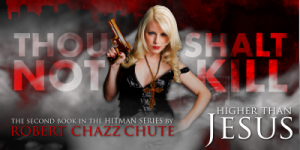
Click here to get Higher Than Jesus, #2 in The Hit Man Series

Click here to get Higher Than Jesus, #2 in The Hit Man Series

~ Robert Chazz Chute is a complex character, better suited to minimal human interaction. However, I’m friendly on Twitter. Follow me @rchazzchute. I tweet about writing, books and publishing.

Filed under: writing tips, , , , , , , , , , , , , , , , , , , , , , , , , , , , , , ,

The writer, depression and getting the word music to play again

By the way, Crack the Indie Author Code 2nd Edition is out in paperback at $9.99. Smaller format, with jokes.

By the way, Crack the Indie Author Code 2nd Edition is out in paperback at $9.99. Smaller format, with jokes.

A fellow writer meant well when she told me that if you can allow anyone to discourage you from writing, you shouldn’t be a writer. That sounds tough-minded and strong, doesn’t it? It would be good advice to take, but unfortunately, I’m still human. Darn the luck, my skin is no thicker or thinner than it ever was. It will surprise no one, given the sort of dark stuff I often write, that I obsess over the negative. I do not remember sunny days. That’s who I am. Maybe I could fix it with some talk therapy, gene manipulation and a personality transplant.

So, yes, rude email hurt can me and my productivity. A bad review can ruin the morning and robs me of a night’s rest. I’m prone to depression and yes, I’m feeling it now. Due to several factors, I haven’t faced the blank screen bravely in days. I’ve been ill and trying to keep up with the demands of my new day job and, not to whine, but the depletion started with one condescending, presumptuous email. 

I’m letting a terrorist win. The worry treadmill is running. I’ve written ten books, but the negative cyclotron has kicked in. “How can I be a writer? I can’t even type properly.”

When I observe the disparity between Goodreads ratings and Amazon ratings (work is often valued one star less on GR even if the review sounds equally positive), I have an urge to reevaluate my life choices. If I’d gone to that Second City audition or to film school instead…but that way madness lies. At least until I fix the time machine. But enough about me.

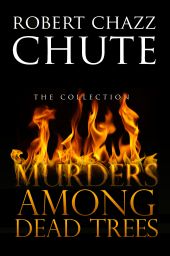
Murders+Among+Dead+Trees+1121-1

What to do when you’re feeling down and not writing*:

1. Call a friend. Do not talk about your problem. Talk about what your friend wants to talk about.

To shore up your ego defences, you’ve already read and reread your happy reviews. Your friend isn’t going to tell you anything new and you’ve already got your “Atta-boy!”

The point of this phone call is to break the obsessive cycle of repetitive arguments, cutting retorts and vengeful homicide plots running through your head. This is a time for jokes. Ask about your friend’s life. 

2. Okay, so, being human, naturally you want another “Atta-boy!” Engage a fan who can’t wait for the next book. A little positive pressure may be all you need to get back to writing the next book in the series.

3. Write a blog post to vent, but only if you must and your friends aren’t answering their phones. (Ooh! Meta!)

4. Remind yourself that this is the firstiest of First World Problems and set the oven timer. How much more wallowing do you plan to allow yourself? More than one more pathetic hour and you’ll burn your life.

The three most powerful words are “I love you.”

The two most powerful? “Begin again.”

~ from Crack the Indie Author Code

5. Read the negative reviews of your favorite books. Choose the classics that you think everyone simply must adore. Realize some people will not be pleased.

Now in paperback!

Now in paperback!

Ev-er.

Or they’re trolls feeding an emotional need that has nothing to do with literary criticism. Or they’re too stupid to get you. I used to think that all readers, because they can read, must be smarter than average. Read some one-star reviews, especially the ones that bring down an author’s rating because Amazon didn’t deliver the book fast enough or they don’t like reading on a kindle and would have preferred paper. Clearly, my supposition about all readers being intelligent was not true.

6. Help somebody else with something. Shovel the walk and bring in the wood and be productive. Productiveness is a habit. This tip works better is you don’t do it for yourself. Do it for the old neighbor with the bum ticker and the broken leg.

7. Read something good that inspires you. Remember this feeling of transcending the great, dirty world? This delicious escape is why you are a writer. 

8. Realize that nothing will be perfect and the critics might have a point about something. Correct errors and move on.

9. But if they’re too harsh and stop you from writing at all, you’ve allowed a rude outlier to rob you, and most readers, of joy. It’s too easy for trolls to throw bombs. You write books, not a few, nasty paragraphs. We’re not allowed to critique reviewers so they’re safe from what you’re feeling now. Don’t let bullies win. Not letting bullies win is another reason you’re a writer.

10. Bing! The oven timer went off.

Start writing again. Anything. Just start. Within five minutes, you’ll be sucked into the other world again. Just get through that first five minutes and write. You aren’t facing a whole book. You don’t have to worry about word count or bad reviews or bruised egos or where to find a Luger, thick rope and kerosene at three in the morning. All you have to do is start writing and get through the first five minutes. Maybe less.

You can gut out five minutes. You don’t even have to act tough to start. Just start. An appreciative audience is out in the future, waiting and hoping you’ll get through the next five minutes. Maybe less.You will fall back into the groove and the word music will begin to play. And a one, and a two and a three…

If none of these suggestions work, call a doctor. Maybe it’s exercise, kale shakes and an anti-depressant you need to elude the mean reds.


Filed under: book reviews, publishing, web reviews, Writers, writing tips, , , , , , , , , , , , , , , , , ,

What to do now that #NaNoWriMo is done

By the way, Crack the Indie Author Code 2nd Edition is out in paperback at $9.99. Smaller format, with jokes.

By the way, Crack the Indie Author Code 2nd Edition is out in paperback at $9.99. Smaller format, but still has lots of jokes.

Start another book. Brainstorm or sketch out another book outline or write a short story or just sit down and see where else you can go at the keyboard. Keep that feather pen scratching. Keep going. 

People will tell you to celebrate. Writers (because we aren’t “people”) will ask, “What else ya got?”

You could take a break, sure. But now that you’ve done NaNoWriMo, don’t you feel you’ve got a good habit going? Habits are hard to break into. To get into the daily writing habit takes practice, just like you’ve been doing all this month. Why stop now? To publish, you must write a lot, rewrite, revise and edit. Good habits are too easy to drop for you to waste all that behavioural inertia you have steaming in your skull engine.

Now isn’t the time to put your feet up.

If you still have some scenes from your NaNoWriMo project that you didn’t fill in right away, you can do those now. Now is the perfect time. The context is still fresh in your mind. Tackle any empty spaces you’ve left behind so when you come back to it, you won’t become perplexed and stymied later. Otherwise, leave your NaNoWriMo manuscript alone.

Why am I telling you to start a new project as quickly as you can?

Because someone might be tempted to dive right back in so they have a novel by Christmas. You know you need some time to cogitate while the manuscript rests for a bit. Otherwise, the Nano haters will run in circles with their hands over their ears screaming, “I told you so!” None of us wants those killjoys to be right.

Besides, if you go back too soon, you might be discouraged at how much work the book needs. Or worse, some might think their rush job is still brilliant. That’s lethal to ever having anyone tell you they’re a fan of your work.

And now for the tough stuff. I’m asking that you hold two contradictory ideas in your mind at one time and act accordingly.

1. Congratulations! You beat NaNo! Good on you! I bet there were days when the words came quickly and days where it felt like your brain was full of molasses. However, you faced down time management problems and got it done anyway. Sometimes it wasn’t easy, yet, you got past 50,000 words! You did it! This is a huge accomplishment!

and

2. Writing a little less than a couple of thousand words a day is no big deal.

Yes, some writers are more precious about their word count and make a great show of how slow they can produce. Mostly? I suspect they’re counting procrastination time as writing time. Screw that. I come from a journalistic background where deadlines are not livelines. We slam it in and knock it out and we’re good.

At least take that attitude with the first draft so you’ll have something to gut and edit. Blank screens have no atoms and pixels bouncing off each other to create new neural pathways and fresh angles to feed reader rapture. The first draft is usually simple, straight narrative. I always find the jokes, dialogue and theme in the second pass.

Professional writers write to deadlines all the time and they do so consistently.

You know that now, so it’s not about what “they”, the writers, do anymore. It’s what you do because you’re a writer. Keep going.

We’re creative. Writing’s what we do to wield god powers and get back at our brothers and sisters. We do it because it’s much cooler at the Christmas party to answer “What do you do?” with, “I write.” Say that and you’ve got a conversation. (Try explaining your wage ape existence in middle management to a hapless stranger and they’ll run for the punch bowl.)

We do it for play, for love and money and hope and for readers. It’s fantastic to find a scene to write that, even as you’re knocking it out, you say, “This! This will melt their faces and make them want to read me for the rest of their lives and tell all their friends! Ta-freakin’-da!

Mostly, writing is what we do because it is who we are.*

*If you didn’t carry out NanoWriMo’s challenge this November, what better testament to your mettle than to do it on your own? Now. You’ll feel more smug and self-righteous this time around. There are twelve months in a year. You don’t have to risk waiting another year for the next party bus to take you to your life’s to-do list.

See you in the trenches in the morning

with 3,000 more words. If it’s a bad day.

Yes, you may stop writing

when you’re out of blood.

Season One of This Plague of Days is the siege. Sutr-X was the pandemic. Sutr-Z's next and it's coming for you and the Queen's corgis.

Season One of This Plague of Days is the siege. Sutr-X was the pandemic. Sutr-Z’s next and it’s coming for you and the Queen’s corgis.

~ Robert Chazz Chute wrote a bunch of beastly books, including This Plague of Days. Season One’s in paperback. If you’re a writer looking for more inspiration, Robert also recommends Crack the Indie Author Code. But he would say that since he is me and we’re all about inspiring writers not to be weak. We’re all about the conquering and hefting the bale and writerly whatnot. And writing about ourselves in the third person apparently.

What? Still waffling? Still? After all that? Holy Jebus! Read this review of Crack the Indie Author Code then, for the love of Thor and for the love of the sweet consumer that is you and your writing career! And your family’s writing career. Don’t forget to get Mom one for Christmas, too.

Filed under: NanNoWriMo, , , , , , , , , , , , , , , , , , ,

This Plague of Days: Season One arrives in paperback! (Plus stuff for you)

Special thanks to Kit Foster of KitFosterDesign.com for his kick-ass cover skills! 

If you’re looking to get a cover, I always recommend Kit! Plus, he’s Scottish!

Have a look at the beauty below (i.e. buy it) and be sure to check out his portfolio.

Pageflex Persona [document: PRS0000039_00004]

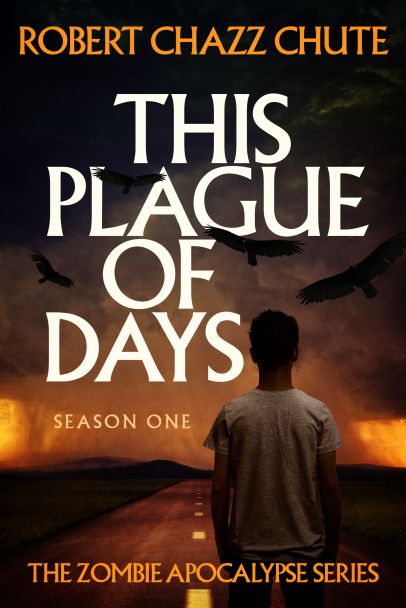
This Plague of Days, Season One teaches Latin proverbs and brings you into the mind of a very unlikely hero on the autistic spectrum. Zombies attack and royal Corgis are in big trouble. Maybe the Queen, too. (That’s my motto: Give the people what they want.)

This book makes a great Halloween gift, Christmas present or something to scare the bejeebers out of friends, family and enemies. If you’ve been waiting for the paperback, here you go. Working on getting Season Two out in print next. 

Serialization pros and cons

Not into my books but want more about publishing in savvy ways?

Season 2 is the quest. Expect big trouble in Ireland and Iceland because I think countries beginning with I are narcissistic and need to be taken down a peg or two by bloodthirsty zombies.

Season 2 is the quest. Expect big trouble in Ireland and Iceland because I think countries beginning with I are narcissistic and need to be taken down a peg or two by bloodthirsty zombies.

Okay, if you came for the pithy stuff about the downside of serialization and why I collapsed to the haters and won’t serialize Season Three of This Plague of Days, you’ll want to check out this post: 

Why I won’t do this again

The contest that challenges you to find a secret hidden in plain sight

Yes, there’s also an intriguing contest going on and your immortality is at stake.

Find the secret, win a life everlasting in book and audio form.

I love a mystery wrapped in an enigma concealed in a burrito, don’t you?

~ Robert Chazz Chute is…writing in the third person again. Get your NaNoWriMo inspiration and hope for the publishing future by reading Crack the Indie Author Code in paperback and ebook. Just kidding about the Ireland being narcissistic thing. You know I love the land of my ancestors. But Iceland? Well, you’re on notice for realsies, Icepops!

Filed under: Amazon, Publicity & Promotion, publishing, self-publishing, This Plague of Days, , , , , , , , , , , , , , , , , , , , , , , , , , , , , ,

Bestseller with over 1,000 reviews!
Winner of the North Street Book Prize, Reader's Favorite, the
Literary Titan Award, the Hollywood Book Festival, and the
New York Book Festival.

http://mybook.to/OurZombieHours
A NEW ZOMBIE ANTHOLOGY

Winner of Writer's Digest's 2014 Honorable Mention in Self-published Ebook Awards in Genre

The first 81 lessons to get your Buffy on

More lessons to help you survive Armageddon

"You will laugh your ass off!" ~ Maxwell Cynn, author of Cybergrrl

Available now!

Fast-paced terror, new threats, more twists.

An autistic boy versus our world in free fall

Suspense to melt your face and play with your brain.

Action like a Guy Ritchie film. Funny like Woody Allen when he was funny.

Jesus: Sexier and even more addicted to love.

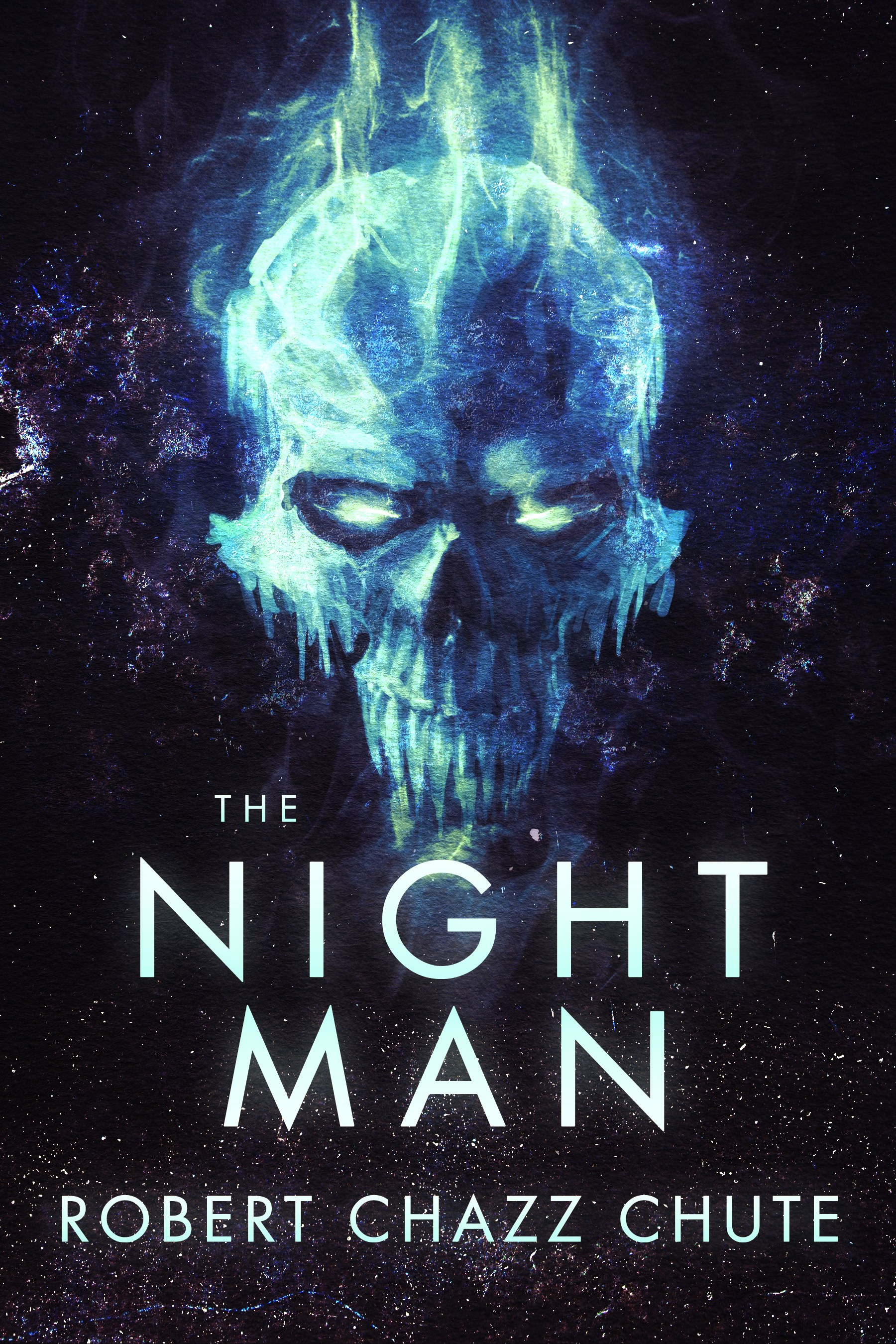
You can pick this ebook up for free today at this link: http://bit.ly/TheNightMan

Join my inner circle at AllThatChazz.com

See my books, blogs, links and podcasts.

Enter your email address to follow this blog and receive notifications of new posts by email.

Join 2,063 other subscribers