C h a z z W r i t e s . c o m

See all my books at AllThatChazz.com.

When Readers Wander Away

Readers wander away.

There’s so much new and shiny stuff out there. There are new word confections to smell and taste, luring readers away from The Magic That is You. Let’s talk about reader attrition and how to combat it because keeping an old reader, fan, friend, client or spouse is easier (and less expensive) than gaining a new one.

I used to listen to all of the Smodcast podcast network religiously. Then I wandered away to get lost in the labyrinth of choice. I subscribe to more than 100 podcasts. Smodcast had some funny stuff, but I’m more into news and politics as the world blows up in slow motion, so I moved on to the plethora.

Almost everybody moves on.
Crack the Indie Author CodeAudiences are fluid. In my first book on writing and publishing, I said ten percent of people love you no matter what you do and ten percent hate you no matter what you do. The remaining eighty percent are consumers who may enjoy what you offer them, but they aren’t committing to the long haul. The passengers you have on the Crazy Train now won’t be aboard at the last station.

Confession Time

This week I went through boxes of files looking up addresses of former clients for my new business venture. It felt like cavorting in the Huge Catalogue of My Carnival of Past Failures. I had names in there I didn’t recognize. There were a bunch of clients I saw, once, years ago. Another group saw me a few times and they felt that was plenty. People move, lose jobs, get new ones, divorce, move again, remarry, forget about us and die. I probably pushed a few away by not nodding on cue, too. I’m lousy at that. I wonder how many of those addresses aren’t dead and stale?

In the end, I came up with a minute mailing list of hardcore fans and a few fringe possibilities. Twenty years in the business and to count the letters I’m sending out? You could count them all on your fingers and toes…but not all your toes.

Nurture the readers who think of themselves as fans.

The people who dig what you do? We all dig them back. Fans are awesome. They’re helpful and they’re motivated to leave reviews and they get us. Engage them. And why wouldn’t you? They’re fun and they know where you’re coming from so you have lots to talk about.

Fans are the people who are most like you. Our minds connect.

Be tolerant of people who don’t get you. 

You can even welcome these folks because most of them don’t hate you.* These people can change their minds. They might take you or they might leave you. They aren’t invested in you, but they might buy what you’re selling.

Ignore haters

They won’t change their minds because they hate everything. Hate is all they have and most of them can’t even be funny about it because they’re serotonin-disenfranchised. Haters are in no one’s demographic and they’re already cursed enough. They’re unhappy and it’s not really about you. The poor things can’t seem to enjoy anything. Move on quickly and don’t let them get any of their default setting on you. 

Own a genre

If I had to do it all again, I’d focus on one genre and write only that. That’s not how my mind works, but that’s my problem. I’d also write series exclusively. Preferably I’d set out to claim a beachhead in a big, well-read genre. (Read: Hardboiled with jokes wasn’t a big enough genre.) 
My luckless hit man is a funny guy in big trouble.

My luckless hit man is a funny guy in big trouble.

When you get lost in the woods, experts tell you to stay in one spot so you can be found. Same with literature. Moving targets, unless you’re Isaac Asimov forty years ago, are harder to find.

Go out of your way to find new readers and maybe even fans.

Facebook is the place to nurture community. Twitter is the place to find new people, discover new things and begin conversations. LinkedIn is where you go for people to talk at each other and say how everyone’s doing everything wrong in order to impress potential employers. (Sorry. That was my experience.)

Bookbub is hot. Author Marketing Club is hot. Publicists with small lists or lists that are too general and unsegmented** are cold. 

Write more quality books.

With each book, we get better. We refine our style and process. Write more. Be better. Build a bigger fire so the rescuers can find you.

Be different enough that you stand out.

People love identifiable genres that challenge expectations. Everyone loves “same thing only different.” It makes them comfortable, and you discoverable, without boring them. I’ve already said enough about this in previous posts, and this post is too long, so…

Go where readers are.

Writers are excited to meet with other writers. Meeting readers often freaks us out. Feel the fear and poop your pants anyway. It’ll make a great story. Do signings, readings, conventions (for readers) and get a business card with your hottest book cover on it. Everyone has hot and cold runs. Make sure readers get a chance to remember you at the top of the hill so you have some inertia to get up the next hill.

Be honest, but be nice. Be a person.

From the I-shouldn’t-have-to-say-this Department: Jerks around the world try to justify the jerkiness with, “I’m just being honest.” Probably a lie. Chances are, they’re just being mean to make themselves feel better.

A blogger I’ve followed a long time lost me today. I detected a mean tone in something they wrote that didn’t sit right and gave me indigestion. It didn’t sound like they were trying to be helpful and the smart and funny didn’t outweigh the nastiness. I need more positivity in my life. I’m a bit low on serotonin, too. Goodbye, blogger.

You’re supposed to lose some readers.

The only thing you can depend on is Change. As you progress as an artist, a bunch who did like you won’t be along for the whole trip. Maybe you switched to a genre they don’t read. Maybe they’re the sort of people who prefer bands “before they sell out.” (Read: “…before they become popular” or “before they repeat themselves too much.”) Maybe they only love underdogs or you squeaked out too much happiness when your book took off and now they feel resentment. Maybe they outgrew you or vice versa. Perhaps we aren’t so awesome after all and don’t deserve them. Not every book is going to be a home run and that’s where some readers will step off.

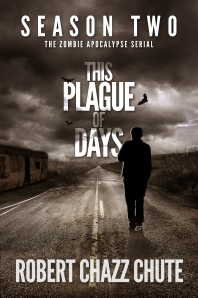
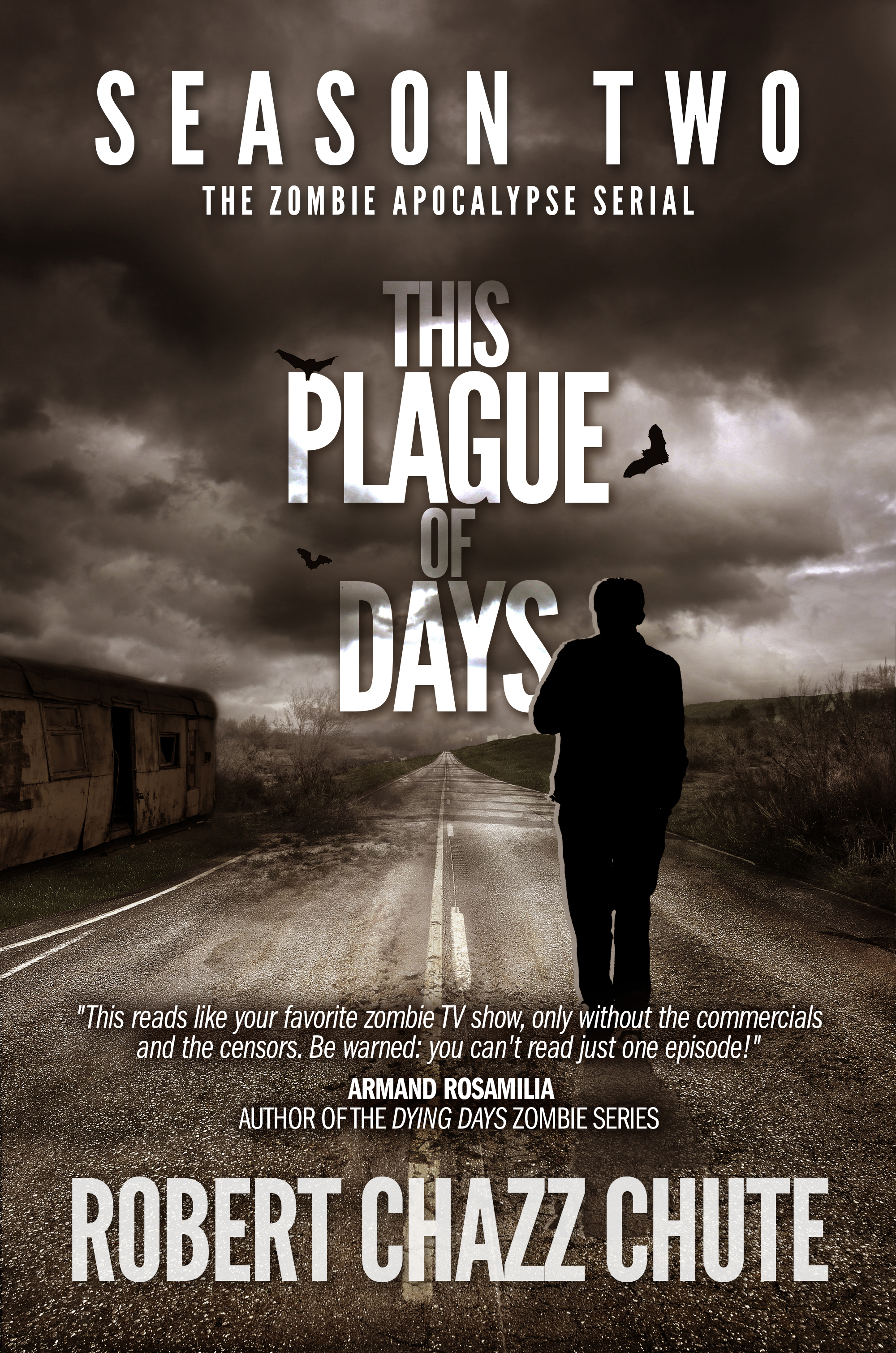
I lost a reader recently who loved Season One of This Plague of Days but didn’t like where Season Two took them. I’m helpless in this regard. I followed where the Art took me and Season Two is markedly different in some aspects. However, for the characters and story to evolve and do things and go places, I had to use different gas in the narrative engine. I promised something different from the usual zombie apocalypse and I’m delivering. Most people dig it. However, it pains me most to lose a reader who loved the first iteration but was less enthused about the next. It saddens me they won’t see the big payoffs on the way in Season Three.

I’m the literary engineer and the conductor, but I’m also a passenger on the Crazy Train. I go where the train takes me to the end of the line. I wonder how many fellow passengers I’ll have at the last stop?

This is why we all need those fans to nurture us in return.

People will buy your stories or not, but most readers will never say a word to you. As a writer working alone, driving the train through the night? It’s lonely work. We go through long, black tunnels between books. In the dark, every engineer looks back into the quiet train and wonders, Is anyone really still back there?

*Note: It’s not you, the writer, who should be hated. It’s a book, not genocide, though some people come on so strong in their negative reviews, you’d think babies were being slaughtered with each chapter.

It is legitimate to dislike a book, of course. But readers don’t generally distinguish a book from its author. Neither do authors. When we see a bad review, we don’t think, Oh, they didn’t like that book. We think, She hates me. She probably does. A lot of people are that harsh, for one thing. Also, since your book is a product of your mind, so naturally we identify with our work.

**Unsegmented refers to mailing lists where the subscriber doesn’t identify which genres they’re interested in hearing about. Send your romance sample out to everyone and a bunch of readers will grab it and dislike it because they signed up for steampunk and wouldn’t read a romance with a gun to their head.

~ I’m Robert Chazz Chute. I write a bunch of stuff that’s funny and suspenseful and strange. I’d tell you more, but I have to dash off to be ignored and invisible in a totally different field. See my books here. Buy them, even. Thanks.

Filed under: author platform, book marketing, publishing, , , , , , , , , ,

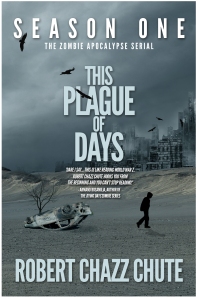
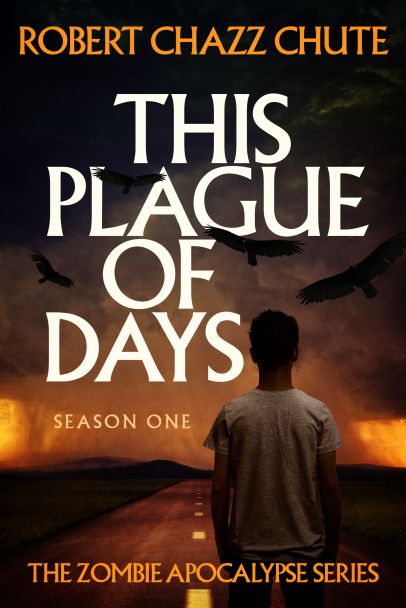
This Plague of Days: Season One arrives in paperback! (Plus stuff for you)

Special thanks to Kit Foster of KitFosterDesign.com for his kick-ass cover skills! 

If you’re looking to get a cover, I always recommend Kit! Plus, he’s Scottish!

Have a look at the beauty below (i.e. buy it) and be sure to check out his portfolio.

Pageflex Persona [document: PRS0000039_00004]

This Plague of Days, Season One teaches Latin proverbs and brings you into the mind of a very unlikely hero on the autistic spectrum. Zombies attack and royal Corgis are in big trouble. Maybe the Queen, too. (That’s my motto: Give the people what they want.)

This book makes a great Halloween gift, Christmas present or something to scare the bejeebers out of friends, family and enemies. If you’ve been waiting for the paperback, here you go. Working on getting Season Two out in print next. 

Serialization pros and cons

Not into my books but want more about publishing in savvy ways?

Season 2 is the quest. Expect big trouble in Ireland and Iceland because I think countries beginning with I are narcissistic and need to be taken down a peg or two by bloodthirsty zombies.

Season 2 is the quest. Expect big trouble in Ireland and Iceland because I think countries beginning with I are narcissistic and need to be taken down a peg or two by bloodthirsty zombies.

Okay, if you came for the pithy stuff about the downside of serialization and why I collapsed to the haters and won’t serialize Season Three of This Plague of Days, you’ll want to check out this post: 

Why I won’t do this again

The contest that challenges you to find a secret hidden in plain sight

Yes, there’s also an intriguing contest going on and your immortality is at stake.

Find the secret, win a life everlasting in book and audio form.

I love a mystery wrapped in an enigma concealed in a burrito, don’t you?

~ Robert Chazz Chute is…writing in the third person again. Get your NaNoWriMo inspiration and hope for the publishing future by reading Crack the Indie Author Code in paperback and ebook. Just kidding about the Ireland being narcissistic thing. You know I love the land of my ancestors. But Iceland? Well, you’re on notice for realsies, Icepops!

Filed under: Amazon, Publicity & Promotion, publishing, self-publishing, This Plague of Days, , , , , , , , , , , , , , , , , , , , , , , , , , , , , ,

Top 10 How to be happy (oddly, this will infuriate people it’s meant to help)

This is probably the sort of topic where, if you get it, you don’t need it. If you don’t see it, you probably never will. (Then why blog about it? Because I don’t see any windmills! Now gimme that lance! Let’s go tilting!)

Change can happen though.

A bureaucracy, that shall remain nameless, gave off a lot of bad hoodoo. They’re infamous for holding the people they serve in contempt. The way they related to people led, in part, to the installation of bulletproof glass in their place of business. (I’m not kidding.)

Recently, they responded to the wails from those who paid their salaries. The video they sent out stopped short of an apology, but they did acknowledge they needed to set a new tone. They promised to work on changing their corporate culture.

I was one of their most strident critics. If they’re sincere, I’m surprised how willing I am to forgive and forget. The changes I see so far are free and subtle. I dealt with them again recently and a few pleases and thank yous was all it took to ease my wariness. It seemed, in the span of a few short paragraphs, that they weren’t trying to make me feel like a dirtbag. Refreshing.

Which brings us to blogging and relating to people.

I’ve found myself skipping past the blog titles that say, “Here are X number of reasons your blog sucks.” Maybe there’s good information in there, but I’m an author with an Irish family on one flank and teenagers closing in on the other. I’ve got enough negativity in my life. I already have a dim view of the world and I enjoy it in fiction. Less so, when someone harangues me.

I attended a webinar that made me sad.

The guy was knowledgeable, but the way he communicates needs to soften. The louder he talked, the less we heard. He then confessed that a big business opportunity fell through because of “conflicting styles and interpersonal stuff.”

I think I know the problem. It was the abrasive guy. “Go-getter” and “jerk” don’t have to be synonymous. The adage is not that you get more flies with corpses.

Which brings us to Kit Foster of KitFosterDesign.com.

My friend, supporter and sounding board, Kit’s a graphic artist who is a great resource for any publisher. He works with all of us, big and small. But that’s the least of why you should do business with him.

He knew I was feeling down the other day. He took the time to write a kind note that hit me at just the right time. Clearly, if you’re an author or publisher, this is the sort of person with whom you want to work. He does great work and his portfolio is impressive. You’ll get great covers and he’s not done until you’re happy. Work with Kit Foster and you’ll sell more books.

But many people can deliver book covers at a reasonable price, right?

Sure, I guess. But how many will bother to send you an email that makes you feel better when you’re down?

For a lot of people, anytime they see you’re down is when they start kicking.

How can we make more people like Kit?

1. Go back in time and get nicer parents, smoke helpful medicines or be Scottish, I suppose. I’m not sure what makes Kit the way he is.

2. Some medical schools use actors to teach doctors what compassion looks like so they can fake it. I don’t know if that sticks. I’ve often said the only thing I learned from Survivor was that jerks and psychotics can’t fake being nice for a month, even for a million dollars.

3. We can practice random acts of kindness and see if that elevates our mood. Happier people are nicer people. This doesn’t apply to people who get happy for the wrong reasons. If you’re one of those psychos, seek professional help before the rest of us rise up and throttle you.

4. We can practice gratitude (I guess I’m doing that now.) It sounds kind of hippie, but there’s science that shows the more thankful you are for what you already have, the happier you will be.

5. If you can’t manage these suggestions, professional scuba diving limits your ability to damage the rest of us, so take one for the team and go scream at fish. 

6. Use Kit’s services at KitFosterDesign.com. Maybe exposure helps by osmosis.

7. If you’re angry at somebody, make sure you know why you’re really angry.

Here’s how you’ll know you’re angry or sad about something else besides the target of your ire: You should have a range of emotional responses. If you review a book with the same level of vitriol that should be reserved for skinning live puppies? You’re Monty Burns and you have a problem, no matter how catchy the tune you sing about making fur coats.


8. If you’re already happy, spread it like fertilizer. Maybe it will grow. A bookstore employee told me she didn’t aim for happy. She aimed for contentment. Ironically, that suggestion made me happier.

9. Exercise. Meds to treat depression and disorder. Talk therapy. Total gene and personality transplant or personal tragedy that leads to an unlikely transformation. I don’t recommend leaving the problem so long that the solution is that last option.

10. Take Joe Rogan’s suggestion and pretend a documentary film crew is following you around, recording the lost time, outbursts and ill temper. Do that for one day and you might decide it’s time to change all your other days.

When you look up to find you’re surrounded by happy, creative, productive people and you don’t resent them for it?

You’ll know then you’re on the right track.

~ I’m Robert Chazz Chute. I am not happy all the time. I am working on improvement. Check out my books and podcasts at AllThatChazz.com.

Filed under: author platform, getting it done, publishing, , , , , , , , , , , , , , , , ,

Are readers changing and what does that mean to writers?

A friend of mine is an old-school, English major sort of guy. He was extolling the virtues of literature as we once knew it: contemplative novels; long treatises on the nature of the human condition; and “serious” novels chosen by a small cabal of unknown gatekeepers. His eyes gleamed for the nostalgia of MFA glories, tiny lit mag aspirations and the New York Times bestseller lists of old world, analog publishing.

This is the sort of conversation that takes me places I didn’t expect to go. Only in talking it out, and writing it out here, have I discovered and understood what I think about New versus Old writing, reading and publishing.

The “issue” is, have readers’ tastes changed?

All generalizations weaken questions and answers, but there’s validity waiting down there in the dark. Let’s delve.

Pre-WWII, many schools in the first world taught Latin and Greek. Long recitations of poetry were valued. My mom was an excellent example of that brand of scholarship. Two days before she died, riddled with cancer and taken low by the drugs meant to ease her pain, she recited, “The Village Blacksmith” by Henry Wadsworth Longfellow. My father listened, tears in his eyes, as her voice came, suddenly strong. “Under the spreading chestnut tree, the village smithy stands…”

Latin’s gone and Greek’s forgotten, unless you’re Greek. Rote recitation has ebbed. Penmanship as a skill is dismissed as obsolete. With the economy what it is and university fees rising, majoring in English is quite a luxury. I’m sure there aren’t as many women’s studies or Medieval studies programs as there were when I was in university. There’s a greater emphasis on job prep now. If you’re some kind of doctor or engineer, you can still make university pay. It seems we have less time to think about big issues, though. Like what happens when the doctor fails and what awaits us in the Abyss?

I guess, for that, there’s idiotic YouTube distractions and warm, fuzzy Facebook memes.

The rest is up to us, the writers.

Some curricula we’ll miss and others we’re glad to let go.

I feel very lucky to have received the one course in university I relished most. The Foundation Year Program at the University of King’s College was the history of philosophy and the philosophy of history. Best course ever. They called it a “programme” because they were the sort of Canadians who aspired to reek of British universities’ plummy pretension. Those Brit professors they emulated would look on us as snow-shoed colonials, but where else in Canada could you ask “what is the soul” and watch duelling professors fight over the answer for half an hour?

It was a great opportunity. Job skills were approached somewhat tangentially for many of us. We don’t know how to weld or split the genes for Monsanto that will kill us. With the death of newspapers, our journalism degrees are largely quaint and useless, but damn, we’re great conversationalists.

But that’s more nostalgia. What about now?

Many high school students and their families are seriously challenging the value of a university degree given that no jobs are waiting. Add  in the costs of paying off that bill for most of the rest of their lives. Or never.

University fees have put on a lot of weight and are suddenly much less sexy. As the middle class shrinks down to the working poor, the dream marriage of career and long, happy retirement is doomed.

The generations who dressed up for air travel and studied Greek laid the groundwork and built the infrastructure for our modern civilization. They were sharp enough to use slide rules to deliver humans to the moon and back and dumb enough to invent the atomic bomb.

From what I’ve observed, “kids today” are probably up for the great and bad challenges, too. However, our politicians suck and so bridges and highways crumble and kids starve.

All civilizations that manage to rise, fall. We’re on the slide. As writers, we can help slow the inevitable, discourage idiots from hastening the collapse and/or entertain everybody on the way down.

What are the “classics” going to be for students now?

To Kill a Mockingbird? The Old Man and the Sea? Romeo and Juliet? Goethe?

I don’t think so. What students across North America and beyond will have in common as adults are these new classics: Breaking Bad, The Walking Dead, and Glee. These are our culture’s touchstones at the moment. 

And get used to a much more transient definition of “classic”.

Lucy crying at Desi for a job at the club is classic comedy for today’s waiting-to-die-on-a-ventilator-in-a-few-minutes generation.

For us? I’m not sure they make funny sit-coms anymore. And I don’t think I’ll be in an old age home some day screaming deafly, “Anybody remember that Frasier episode where Niles had heart surgery?”

This year’s college freshmen aren’t talking about their common love of Tolstoy. Take any pair of well-educated, first year roommates and, if and when they talk culture, they’ll be talking about the good old days of The Sopranos and The Wire. They’ll speak of Hollywood all the way back one decade, when the movie machine didn’t suck like Dyson vacuum cleaners. That’s if they aren’t talking sports.

Pop culture, not Euclid, is our commonality now. When you’re looking to make new friends on a bus trip, don’t ask what your sexy seat-mate loved about Dante’s Inferno. (Trust me, I tried it. It’s not the touchstone I’d hoped for.)

The habit of reading is established (or not) in our early years or in jail. But it’s not all on parents and educators and the prison industry. The market has changed, too. Our attention is fractured by so many choices. Writers are competing with Grand Theft Auto and free Internet porn. Talk about quixotic aspirations!

What does this mean to writers? I’ll tell you what I told my friend about writing and publishing:

1. Authors are expected to produce more books faster to gain readerships and hold them.

2. Series and serials are in. Writing books like a TV season (as someone complained of This Plague of Days recently) is in. No, I mean to say it’s IN! As in, that’s what I meant to do!

3. Pop culture references are in. They light up the cozy familiarity cells of the brain. Trying to make books “eternal” with zero pop references? Out.

4. More genre mash-ups are in. I sure didn’t see zombie erotica coming, so slice that mash as thin as you want. Keywords are relevant. Bookshelf labels are much less relevant.

5. Pulp. We can push back the walls of what readers expect from pulp, too. The Cuban assassin in my crime novels is politically aware and has a lot to say about drug addiction. My latest work tackles global warming, US foreign policy and the nature of God, though the recipe’s nutrients are hidden in the neuro-fudge cake of zombies versus vampires.

6. Niches are in. Appealing to a deep niche is achievable. Trying to appeal to wide audiences is out, or at least it’s something that happens to you. It’s probably not something you can make happen.

7. Ebooks are here to stay. Seems obvious, but there’s still some resistance from publishers on the remote island of Manhattan who don’t know the war is over.

8. Shorter books are in. I once thought that meant short stories are coming back, but by my sales stats, either I was wrong then or I’m impatient now. The economics and timelines of more books, faster, demand shorter books.

9. Intermediators will return with honor. The more books you write, the more you wish you had help. This week I lost four hours of writing to formatting a print book. We, the relentless writers and publishers, need help. We’ll be looking for more minions and partners, though, not publishers. After months of sixteen hour days, I am exhausted. Viva la outsourcing!

10. Hybrid authorship is becoming more appealing, as long as we retain our e-rights and audio rights. Once the Big Five stop chiseling their contracts in stone, call me.

11. Book prices will still be all over the place, charging what the market will bear.

12. Jonathan Franzen will still complain about social media comprising the end of the world, but Huffington Post will give up publishing his rants. The Amish aren’t Huffpo‘s demographic. The irony of complaining about social media on the Internet will swallow itself whole and disappear in a flash of yin quantum, pixelated justice, balancing out Franzen’s Neo-Luddite yang. Gee, I hope media starts ignoring Anne Coulter sometime soon, too.

13. Blog posts like this one won’t survive. Too Long To Read and too snooty by half. Unless you’re deep in my niche, who’s got the time for these presumptuous pronouncements about my betters?

Relax.

Breaking Bad taught as much or more about the dangers of hubris than any Greek tragedy.

Everyone’s reflex to hate the future is just resistance to change away from the comfortable. Nostalgia is not thinking. It supplants thinking. It’s an old blanket that’s getting ratty.

We will adapt until the grid collapses and we start eating rats and insects to survive. Then we’ll have more time to devote to those deep conversations we’re not having. Those end of the world stories around campfires are going to be awesome.

~ Find out more about my books and podcasts at AllThatChazz.com and ThisPlagueOfDays.com. Defy expectations and love me for me, because I miss Heavy D.

Filed under: publishing, Writers, writing tips, , , , , , , , , , , , , ,

Marketing books: Thirteen video options

Season One of This Plague of Days is free until midnight tonight.

Season Two launches in two weeks.

Book trailers are problematic. Video can be done well. It often isn’t.

Most of them are too long. Production values are typically lower than viewers’ expectations. We’re trained to expect CGI on the level of major movie studios. Also, there’s little evidence trailers generate any sales. Go big and you’ll spend money with no return on the investment. Go too small and you might not be proud of it. Here are magnificent options, ranging from giving up and doing zilch to going big. Since I’m in touch with reality, most options are no-budget or low-budget.

Alternative 1

Don’t do it. It’s not worth the bother.

Alternative 2

Play with iMovie in your spare time. If it’s fun, great, but certainly don’t lose writing time to it. 

Alternative 3

Rather than worry about making a little movie and learning an editing program, do six seconds on Vine and/or fifteen seconds on Instagram. Focus on one quick, easy message. Don’t spell out the link to the camera. Leave the link in the caption. Note that people love video with cats.

Alternative 4

Upload to Youtube from your camera, iPod, iPhone or Android. Viewers will be more forgiving of low production values if they see you didn’t try to make it fancy. Just talk to the camera with a joke and/or announcement.

Alternative 5

Video pulls more clicks to your blog. Combine it with punchy posts for greater effect and more subscribers.

People have more tolerance for a short, laid back video than they will for long blog posts. For instance, yesterday’s post went deep into serialization and book pricing strategy. It was only for the most serious of book marketers and publishers. However, many more readers will click the video above and read this blog post for information because it has video and the text is breezy and scannable.

Alternative 6

Focus on what’s cool or ironically cool. Make it fun for you and the viewer. Try for the opposite of earnest and don’t try to tell too much of the plot of your book. Let the visuals do more work. Entertain first and come sideways at giving out information. One of the best book trailers I’ve seen was an author who talked about the glamour of the writing life while he scrubbed toilets.

Alternative 7

As I’ve suggested in the past, try a quote trailer. A quote trailer simply pulls intriguing quotes from your book. Don’t forget to include a buy link. Keep it short. No spoilers.

Alternative 8 

Use Animoto, as I did, for the video above. I already had the book covers. It took all of five minutes to use the free option for a video shorter than 30 seconds. The fire effect was appropriate and the music was a nice fit. Cool, huh? Animoto includes sharing options so you can export it to Vimeo, YouTube, Facebook, etc.,…

Alternative 9

If people don’t respond to your stabs at filmmaking, try making it more about you and how you can help others instead of making it about the book. Video reviews and how-to stuff get more hits. Funny’s always good, too.

I put up video of my podcasts to get more viewers and listeners. Some people simply prefer video to audio, or a YouTube video is how they will discover a podcast. Interaction in an interview setting can be easier to pull off than talking directly to the camera. Some people, like Hugh Howey, do it well and even dance for reviews. For most of us, solo videos look like hollow-eyed, stuttering hostage videos pleading for ransom under the threat of death.

Alternative 10

Have you set up your YouTube channel yet? It’s a great place to collect your video book reviews, too. Video reviews get more attention on Amazon than written ones, so it’s worth doing, for you and for authors.

Alternative 11

Go with Fiverr.com and get help to create quick videos like I did for my promotion plan for This Plague of Days. Check out my video samples at the link.

Alternative 12

If you really want to go big, get a semi-pro involved. There’s no proven ROI and most professional video production is expensive. Therefore, consider approaching a drama class or a film school. If your book trailer becomes a school project, at least your vanity project will benefit the education of a young actor or filmmaker in a concrete way. You could go the Scott Sigler route and make it a contest. Since every entry went up on YouTube for judging, Sigler’s books got multiple ads and multiple hits.

Alternative 13

I think Kevin Smith and Steven Spielberg are available for princely sums, but if you’ve just won the lottery, go with any of the above options and get your video production done free or cheap. Starving children everywhere would appreciate your generous donations. If you’re rich enough to consider professional directorial help, good karma’s the better way to go.

BONUS

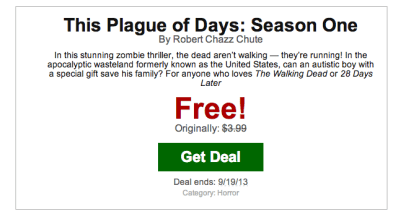
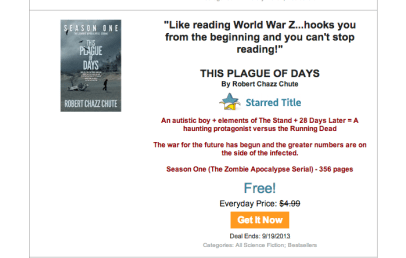
Are you on Bookbub? Here's what the email looks like for my TPOD promo. Sale ends at midnight, never to return. Enjoy.

Are you on Bookbub? Here’s what the email looks like for my TPOD promo. Sale ends at midnight, never to return. Enjoy.

Screen Shot 2013-09-19 at 12.53.17 PM

Bookbub allows you to showcase deals to many targeted readers who are interested in your genre. Got a deal? Get noticed with Bookbub.

Filed under: author platform, book trailer, Books, Publicity & Promotion, publishing, , , , , , , , , , , , , , , , , , , , , , , ,

Ebook pricing, free promotions and you

The complete first season is FREE for two days. Click now.

The complete first season is FREE for two days. Click now.

Generosity feels great and, in this incarnation of the book business, generosity is a marketing strategy if done right. Today, a giveaway and a case study in real time. (If you don’t know anything about This Plague of Days, check out ThisPlagueOfDays.com for sneak peeks.)

I released This Plague of Days, Season 1 as a serial. There were many reasons for doing it this way. I wrote it like a television mini-series and serialization opens up marketing opportunities. On the first day of Season One, I published the complete first season and Episode 1. Four more episodes followed each Monday. The episodes sold for 99 cents each or readers could get the whole season for $3.99.

For my initial giveaway, I put the first episode up for free for two days. I don’t believe in long promotions. By the time you’re done more than two days, you’ve exhausted your connections and momentum slows. I gave away about 1500 downloads of Episode 1 and stayed at the top of the Post-apocalyptic and Dystopian charts on the free side of Amazon for those two days. It’s really exciting sitting at #1 and #2 beside Hugh Howey.

An interesting thing happened next:

A bunch of readers liked Episode 1 but they stuck with the individual episodes. I watched my dashboard charts light up green with sales of Episodes 2, 3, 4 and 5 as people who got Episode 1 for free worked their way through the serial. The complete book of the season sold a bit, too, (at $3.99) but it seemed for readers to jump from episodes to the season at once, the discount would have had to be even deeper.

Pros and Cons of This Strategy

Pro: I gained a bunch of reviews for This Plague Of Days. Most readers dug it.

Con: Readers of Episode 1 only see the dad is an atheist and they may not stick around for the sweep of the story’s longer arc. The atheist dad has doubts about his lack of belief and his religious wife has doubts about her faith. I don’t dump it all in Episode 1 so, with serialization, you get judged by what you lead with. I’m not complaining. If you do something similar to what I’m doing, stay true to your vision, but don’t expect everyone to wait patiently for the payoffs later on. I have secret seeds planted in Season One that don’t bloom until Season Three.

Con: You’ll always get your worst reviews from free promotions.

Con: Some people who click free will never click “buy”. (Actually, that’s unfortunate, but it’s not really a “con” per se. I mention it because I anticipate resistance to these tactics. However, it’s not a true deficit in that it’s mostly irrelevant. These readers aren’t in my long-term equation for the same reasons the cobalt industry, Cadillac and Vera Wang don’t target me as a customer. Just as I’ll never be in those businesses’ target demographics, I’m hunting for converts, not free book shelvers.

Pro: All those downloads got me Also-bought listings and Amazon started selling the book for me with their mailing list. That’s a major plus on the brand visibility side of the argument.

Pro: As summer sales of Season One ebbed, I saw the momentum from July evaporate. I did what few say makes sense. I put the price up to $4.99. No one’s buying the episodes now, but they are buying the complete first season at the higher price. That could indicate that Season One was underpriced. Probably, but as I’ll argue below, that’s okay. I’m in this for the long-term. Discoverability is more important than sales for now.

What I’m doing differently for Season Two

In This Plague of Days, I’m trying to give a B movie an A treatment. To get traction for an unknown serial aimed at a smart crowd in an unfamiliar format, I think the starting price was fair and good for Season One. If you didn’t jump aboard before, for two days only, Season One of This Plague of Days is free to download on September 18 and 19th. (If you love it, please review it.) Season Two will also have some bonus material in the back.

Why give away an entire book? Isn’t that evil and the death of literature?

Season One is the gateway drug to Season Two and, for two days only, the first taste is free.

I’m using Freebooksy and Bookbub to let the world know. This publicity does cost money, potentially a few nasty reviews and maybe I’m leaving money on the table. However, it will get my name and Season One into the hands of at least 5,000 people. (If that doesn’t sound like much to you, consider that 5,000 paid sales equals a bestseller in Canada. I expect to hit #1 and #2 again and have some sales momentum behind me as I slide into the October launch of Season Two. This is marketing as an exercise in delayed gratification. I’ll sell more of Season Two because I’ll get more readers in on the ground floor of the serial. Besides, it’s a one-time only sale. Most readers will find the cash for the full price under their couch cushions, so let’s not get too dramatic about the losses or gains.

To put it another way, a la Seth Godin, “Too many people are reading my free ebook is not a problem” (as long as there are other books to sell.) To paraphrase author Cory Doctorow, Free isn’t my problem, “obscurity is my problem.” And finally, I quote myself for emphasis, “Generosity feels great…(and) discoverability is more important than sales for now.”

Season 2 launches Oct 1.

Season 2 launches Oct 1.

The Rationale: Season Two of This Plague of Days launches in a couple of weeks.

The story and the virus evolve together. This time out, TPOD has a different pace. Season One was like a television serial. Season Two is the action movie. It gets more paranormal and it’s loaded with surprises, chills and blood spills. Expect new villains and more twists from Ireland to Iceland to the Indianapolis Speedway. You’ll see the invasion of New York, the Midwest and the terrible events at Canada’s border with Michigan. It’ll sell for $4.99 this fall. In a month or so I’ll do a giveaway of Season Two, Episode 1 only.

Eventually I’ll put This Plague Of Days across more platforms and go for a price match so Episode 1 of Season One will be perma-free. I’ll experiment with price points, but the complete Season Two will never go free. The law of diminishing returns kicks in if you’re trying to get people to jump into the middle. (Ironically, you could jump straight into Season Two without reading Season One and you wouldn’t be lost at all. However, people don’t believe that. I never got into Ally McBeal because I missed the first episode.)

About Audiences

People who love zombies were very patient with Season One. The zombies don’t show up immediately but the dread keeps rising so I guess the suspense satisfied them until the heavier horror kicked in. They don’t have to wait for any action in Season Two, so I expect this phase of TPOD will go big all the way to Christmas (especially as other promotions kick in.)

The other thing that surprised me was how readers with family connections to autism, developmental delays and handicaps responded to the story. The protagonist is on the spectrum and those readers enjoyed seeing the world through his eyes. It’s not a long screed (and certainly punchier than this post) but those readers responded well to discussions of what it’s like to be the parent of an autistic kid. The family loves Jaimie, but they don’t romanticize his disabilities and his sister treats him like a normal kid treats a sibling who is often difficult to live with.

About Price Resistance

Selling episodes at 99 cents with 30% to me won’t keep me in cat food, but it did help with visibility. I gather those who started buying episodes in Season One will mostly choose to get the complete second season so they can find out right away what happens to the Spencer family and the British refugees.

It seems the greatest resistance to price increases lay not with the readers, but with yours truly. More readers are discovering my books at higher price points. I guess those higher prices make them confidant I know what I’m doing. So, while I’m still advocating short-term discount promotions, the trend with all my book prices is for them to climb. Done right, with a giveaway of sufficient numbers, free can still work. If I thought I could get more traction on other platforms, I’d try a different strategy. However, regarding promotion, it appears the other platforms are still lacking.

If you’re reading this on September 18 or 19th, 2013,

grab your free copy of the complete first Season of This Plague of Days here.

And please tell a friend. Thanks!


Filed under: author platform, Publicity & Promotion, publishing, , , , , , , , , , , , , , , , , ,

The Secret Alphabet of Independent Publishing

"You will laugh your ass off!" ~ Author of Cybrgrrl, Maxwell Cynn

“You will laugh your ass off!” ~ Author of Cybrgrrl, Maxwell Cynn

A is for All of it, which is what we want. (A used to stand for Agent.)

B is for Book, of course, and ebooks are “real” books, too. Literature is about the content not the container.

C is for Cutting prices. It would be bad for writers, but at 70%, we’re still getting paid more per unit sold than in traditional publishing. Also, price cuts sure make now a great time to be a reader.

D is for Deadlines. Don’t take forever to write your book. More time procrastinating doesn’t make a better book.

E is for E-books on E-readers. But you know your kindle is a transitional device, right? The phones are getting bigger again and tablets are coming down in price. We don’t want a device to do one thing. We want one device to be a web surfer, camera, phone, app catalogue, music box, GPS, ebook reader and best friend on our hip.

F is for Future. It’s the direction to look. If you don’t like it, you can change it whereas the past requires an annoying child named Sherman, a dog named Mister Peabody and a Wayback machine.

G is for Guidelines, because guidelines are malleable. There really aren’t many unbreakable rules worth obsessing over. You already know the rules because they’re obvious or you ignore common sense or you’re a slave to unthinking tyranny. The cool kids prefer more options.

H is for Hope. It’s good to have some, especially in this business. When there’s no reason to have any, that’s when you need it most.

I is for Intermediator. Have as few of these as possible. Upload your books yourself if you can, or get help from an independent contractor. This will allow you more choices of forks down the road.

J is for Just you. The myth and prejudice against independent publishing is that’s it’s just you. You are alone, except for the editors, graphic artist, beta editorial team, volunteers, publicity teams and whoever else you can hire or cajole into helping you get your book discovered. Sure, other than that little cyclone of industry, it’s all you.

K is for Killing characters. Killing someone readers love who they were sure would make it to the end? Delicious. (Note: killing darlings is overrated.)

L is for Love. It’s why we write. If you have other motivations, that’s fine, but releasing dopamine as you create is, like reading, a very rewarding addiction. The biological pharmacy in your brain simulates love. Endorphins won’t land you in a dirty rehab unit with a roommate who won’t stop telling that story about the time he tried to get high on burnt bananas and smoking his own hair.

M is for Money. It can happen, but probably not so don’t write for money. As above, write for love. If money does happen, people will resent you slightly less when you claim you never expected it.

N is for Naysayers. Most of them will never write near as many books as you will. Just say no to naysayers. If you sleep with your naysayer, someone’s in the wrong bed.

O is for the Obsession to know things. It seeps into the writing so you can drench your fiction with non-fiction and trenchant verisimilitude. For instance, This Plague of Days, Season Two weaves the Apocalypse with interesting tidbits about Irish legends, military history and the mortal wounds inflicted by the blue-ringed octopus. Mine is the only zombie/plague/autism story that teaches you Latin in an entertaining way, guaranteed!

P is for Portent. Warnings that something big is about to happen are especially fun when you give readers an earnest warning and they still don’t see it until it coming. They’ll only see the clues in retrospect. Secret trails to revelation and love of language are why people reread books. Do it well and someone might think your book isn’t just suspense, but maybe even “literary” or (praise Thor) “important”.

Q is for Quitting. If the project is wrong, quit. If it’s right and you’re just whining, quit whining and finish it. If you aren’t excited to write this book, find another you will be excited about all the way through or for our sake, please do stop. 

R is for Ripoffs. It’s a minefield out there: Fake agents who try to make money off reading fees; publishers who won’t pay; people who use disreputable business practices and call them policies. (R is also for Research. It’s how to avoid R is for Ripoffs.)

S is for Sustained Action. Promoting your work need not be an exhausting blitz. Dig in for the long game and promote at a slower pace. Don’t promote the same stuff to the same audience all the time lest you exhaust them. Keep writing new books. Don’t pin your hopes to one book. Sure, you might accidentally hitch your wagon to a star, but chances are excellent you’ll hitch your wagon to a stump, especially if this is your first rodeo.

T is for Trying. You’ll hate yourself if you don’t try. Losers will hate you because you did try. That’s why they’re called losers. They work from a different definition of failure than you and I. They confuse boring with winning.

U is for Unpublish. If something isn’t working, take it off the market and replace it with your tweaked story, new cover or new edition. Unlike traditional publishing, you have more options. You can adapt. Ours is a different, more flexible, business model. Use that advantage.

V is for Victory. There is no victory. Banish the concept from your life. There are only ups and downs and we’re all trying to make more ups.

Victory is very useful in fiction, however. Readers want to escape real life’s mundanity so it makes them happier when the protagonist achieves victory at the end of a story.

To go all Conan and see your enemies driven before you and to hear the lamentation of the Evil Mort from Accounting? That’s fiction. Working in a cubicle farm with no hope of retirement while Mort gets promoted and vacations in Brazil? That’s real. The real-life Mort is why we all crave escape into stories.

W is for Wit. They say brevity is wit’s soul, but I can take a pounding of wit in dialogue all day and all night, Mr. Sorkin.

Please note that snark is not quite wit. That’s a blunt tool meant only for peeling the outer layer of flesh. Meanness is the opposite of wit. That’s a blunt fool’s weapon. Wit’s funny and smart. When that sword cuts, we see light flashing down the steel blade. Wit allows the victim to take the hit and nod, “Touché!” with a smile.

X is for X-ray vision. All writers have this power. I can see into purses and pockets and the lives of strangers at the mall. I can work backward or forward to tell you who they are and their story of heartbreak in their senior year of high school. I diagnose disease at a distance. I know what you did last summer. I can give your life history and your death meaning, so do not screw with me.

Z is for Zero. It’s what we’re paid for writing. We are never paid for writing. We write for love, remember? If the money ever arrives, we’re paid for putting up with dehumanizing reviews, pretending to take them well and staying silent about them forever. We’re paid for the sad paperwork at tax time. We’re paid for the sting when someone sneers with casual cruelty, “So, are you a big deal yet?” We’re paid pennies an hour for the sacrifices our loved ones make so we can keep writing. 

Writing a good book is a happy, selfish act for the writer.

We are addicts, helpless in our defiance and desperate to monetize our work so we can have the freedom 

to score more of Creation’s sweet biochemical cascade.

Escape reality. Get high on a story.

~ I am Robert Chazz Chute, the author of Self-help for Stoners and this was the high I was talking about. This Plague of Days, Season Two scintillates brains October 1. Get Season One and check out all my books here. I hope to be your favorite candy man one day.

Filed under: author platform, Publicity & Promotion, publishing, Writers, writing tips, , , , , , , , , , , , , , , , , ,

Writers: Are you sitting on the money?

They call it the Cliff. You can do Author Marketing Club and Bookbub and free promotions and blow giveaways out the digital door. You can even start catching fire and getting traction and selling books for (gasp!) actual money. Then, the fall from grace comes. Sales drop off, often steeply. What happened? You ran off the Cliff. Lots of people do. In this post, we’re going to think about climbing back up and promoting our previous works again (and doing it better this time) because I suspect we’re sitting on money.

I’m rethinking the old marketing paradigm that’s always oriented to what’s new. 

It’s the thing we should question most: accepted wisdom. Despite all my efforts, old wave thinking is still permeating my brain. In traditional publishing, you get a short window to get traction and then the bookstores return your books to the publisherCrack the Indie Author Code for credit. That’s the structure of the short tail market. In long tail marketing, our books are up forever (or at least until the cyber war brings us all low). Still, we tend to think of our books as hitting big (or not) and then the graph points down. We’re mimicking thinking and marketing patterns from traditional wisdom because all old ideas are awesome, right? Oh, wait…

Case #1

I’ve been meaning to do this for a while and by not sleeping, I’m finally getting to it. I pulled Crack the Indie Author Code and Write Your Book, Aspire to Inspire from print. I didn’t like the look of the interior design. I’m fixing them and will make Crack the Indie Author Code available in print again soon. (They’re both still out there as ebooks.)

Self Help for Stoners JPEGCase #2

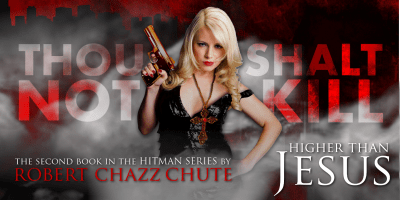
Self-help for Stoners was my first book. It’s funny and strange and with an intermediary. I used Bookbaby for that collection and I want to get it back at Ex Parte Press and put it out myself. I’m sure I can make it go higher once I have full and instant control of the marketing. I queried Amazon about the process today because I’m afraid of losing the reviews. Either way, I do need to steer my ship and reach out to stoners and non-stoners, alike and anew. (If you’re a Bigger Than Jesus and Higher Than Jesus fan, my luckless Cuban hit man appears first in Self-help for Stoners, by the way.)

This post won’t help you much if you only have one book to sell, but here are my thoughts on renewed marketing efforts: 

If you have one book, write more. No whining,

If you have a backlist, who is to say what’s old and what’s renewable? You’re the one to say.

If you have a bunch of books, I bet you’re a better writer by now. Why not revisit those books and do new editions?

Consider the power of bundling books. You could enliven your Amazon dashboard with more happy green up arrows. Stop sitting on the money.

Lots of people missed your fledgling efforts the first time. You didn’t know what you were doing. Who did? Any book they haven’t read is new to them. 

The most powerful promotions tend to be the first ones. But maybe that’s because we don’t put the same marketing efforts into books we published a couple of years ago. In digital, the term backlist is less relevant. As long as it’s clear it’s a new edition or a new launch or you’ve added material, what’s the problem? 

Maybe those early efforts flopped because you had a lousy cover. Get a new, better cover* and launch it right this time. With all you’ve learned about marketing since your early efforts, it’s bound to do better, right?

Most fiction doesn’t get stale. Our efforts get stale because we want to focus on the new thing. Maybe the old thing is only old in your mind. With some tweaking, a fresh edit and a new campaign, you might have a book people will love and buy. Reuse, recycle, repurpose. Turn short stories into collections. Open up to new possibilities with prequels to your books. Tie books together. Add to your series. Serialize. There’s plenty of fun to be mined in what you’ve already accomplished.

Your problem with these suggestions isn’t necessarily that my head is full of feathers. Your problem is the same as mine. This will take a lot of time and you feel you’ve already covered this ground. But most of us didn’t cover this ground well the first time. There are new promotional tools now. Yes, time management can be tough and we can only do what we can do. But that’s business. We are not special snowflakes, but we’re letting good stuff go cold.

*About good covers, I know a guy. He’s Kit Foster of KitFosterDesign.com. He’s an award-winning graphic artist with an extensive portfolio who works well with indies and traditional publishers. Like my covers? Kit did them all. Check out his site. You’ll be glad you did.

Dark Higher Than Jesus banner ad

Filed under: author platform, Books, ebooks, Publicity & Promotion, publishing, , , , , , , , , , , , , , , , , , , ,

Writers: Are you in the echo chamber?

I love my writing community here. I’ve learned a lot from others and, as indies, we share a lot of information. We’re a generous bunch with each other. I appreciate your comments and participation on my little writing and publishing blog. Because I’m a sweet bunny pooping love everywhere, I have to tell you something with love:

Writers talk to other writers too much. We must talk to readers more.

Let’s make this go down easy by using an example from another industry.

When massage therapists try to figure out their businesses, they ask their peers and senior massage therapists for their opinions. They want to drink from the well of experience. It’s a good notion that frequently goes awry. Their peers are often as clueless as they are and senior therapists either don’t have the same problems or their advice is out of date. Take pricing, for example. They’ll set fees based on what they’d pay. But many massage therapists would never pay for massage. They don’t have enough money or they swap treatments with other therapists. Massage treatment is for people with real jobs and insurance coverage, not us.

Stick with me and hold my hand, because this is about to get uncomfortable.

Writers need to listen to readers more.

Sadly, writers often don’t have much money to spare so we use libraries or search for free a lot. Most of us buy books when we can, but with budgets as tight as they are, we’re often not your audience. As a result, many of our industry’s book prices are artificially depressed. We’re asking the wrong audience what we should do. (I’ve taken this advice. I just raised prices on some of my books and generally, the trend will be up.)

A veteran writer who’s “made it” (whatever that means) often doesn’t know all the variables that contributed to his or her success. If someone coasted to indie success from a high in traditional publishing, they can’t tell you much about the current scene. Precious few people attribute any of their success to luck. It had to be their sheer brilliance. However, many of us are brilliant and we’re still eating boot soup.

So, what not to do?

If you don’t tweet others at all, you may as well be on Mars.

If you rarely check your direct messages, you’re in the bubble.

If you only check your mentions on Twitter, you’re screaming into the echo chamber.

If you follow three people and two of those are your other Twitter accounts, you’re only hearing yourself plus you’re a raging narcissist (and not in a good way).

If you only have conversations with people who don’t buy books, you’re surveying the wrong people.

If you only speak to people who “buy” free books, you’re engaging the wrong audience. (Readers who buy with money instead of a click are often suspicious if your book is priced too low, for instance.)

If you don’t take new information in and seriously consider change, you’re for slavery. (Your own.)

If you do have conversations with readers from time to time and you talk about them, you’re on a smoother path.

If you don’t cultivate supportive friends, you’ll be alone, surrounded by fiends and without a fire ax or holy water.

If you only attend conventions with other writers instead of fans, you’ll have a great time talking to people who agree with you: “Wow, it sure is hard to connect to new readers!”

If you never get out and talk to real people in the real world and only connect with people on a safe and cyber basis, who will you learn to hate so you can kill them in your next novel?

If somebody says, “I prefer paper books,” and you reflexively say, “How Amish of you! Ebooks are the only future!”, that was kind of funny, but you should be listening instead of cracking that same joke open again. It’s rotten on the inside.

If you say all this social engagement is too hard and it takes away from your writing time, I’m sorry. I thought you were writing to be read. Get a calendar or time management software. At least tweet or email during commercials.

If you immediately dismiss everyone with whom you disagree, you’ll never learn the secret to…well, anything really. Plus, you’ll come across as a jerk.

I’m not suggesting you allow me or readers or reviewers or anyone else to run your life. I am saying that if you recognize yourself in this list and it gives you that squirmy squirts feeling, adapt accordingly. Listen.

You should listen to me. I’m a writer.

Filed under: author platform, getting it done, Publicity & Promotion, publishing, Rant, readers, , , , , , , , , , , , , , ,

The World’s End…and our beginning

TPOD season 1 ecoverFor most, the last milestone of summer just slipped by. Labor Day’s demise means the end of bikinis, bikini dreams and the return to indoctrination centres. But Time’s notches are  artificial milestones, like New year’s resolutions, your anniversary or waiting to start your new diet on Monday morning. If you need to begin again, now is the time whenever now happens to be.

For instance, don’t wait until it’s your anniversary to send flowers. It’ll mean more because it’s not a special day. Any day can be made special, momentous or mundane. Our choices make it so. Let’s take a moment to think about those important choices and a fun Simon Pegg movie.

I saw The World’s End today.

Mostly, I liked it, especially when it didn’t take itself seriously. However, between that and the trailer for Last Vegas, a depressing theme returns. Last Vegas is old guys “getting the band back together” for one last blowout party before making funeral arrangements.

Even the last Bond movie explored mortality’s dark territory. Note to Hollywood: James Bond getting old is something no Bond movie should ever explore. Bond is timeless, cool and indestructible, just like we wish we were. We want a vicarious thrill ride with babes sporting unlikely names, not a vicarious prostate exam.

Comedies that pound on mortality? That’s a hard target. Getting old and worrying about mortality are what doctor’s appointments are for. When I’m guzzling overpriced popcorn, I don’t want a reminder that my time is limited. If the best is behind us, why go forward unless it’s merely out of habit? (Insert Jack Nicholson impression here: “What if this is as good as it gets?”)

So let’s focus on the positive.  

Defy the forces of Time. Ignore Time’s dictates. Do what you want to do. Often, when we aren’t doing what we want to do, we’re forgetting:

  1. our dreams from childhood.
  2. that our time is limited.
  3. who we are.

Reality check: But most of us can’t do all we want to do.

As per my last post, I have to start another business to shore up Ex Parte Press. But I haven’t forgotten childhood dreams, mortality or who I am. Simon Pegg (whom I love, but geez, man!) wouldn’t let me forget, even as I tried escape into a movie to forget my problems for a couple of hours. It’s not Simon’s fault, though. I identified too much with the film’s immature main character crying out, “We want to be free!” and “They told me when to go to bed!” 

I’m still working toward my dreams and freedom. I’m still writing brain tickles and suspense. I hope you’re undeterred and writing madly, too.

If not, don’t wait.

Begin again.

Now.

Live a life full of new beginnings and you can ignore what happens just before the credits roll.

~ Robert Chazz Chute is the author of a bunch of books. His neural net fires into the dark wildly. He does not wear collars. He eschews ties. If you want an easier, happier life, those are bad bets but a jerk’s gotta do what a jerk’s gotta do.


Filed under: getting it done, publishing, Writers, , , , , , , , , , , , , , , ,

Bestseller with over 1,000 reviews!
Winner of the North Street Book Prize, Reader's Favorite, the
Literary Titan Award, the Hollywood Book Festival, and the
New York Book Festival.

http://mybook.to/OurZombieHours
A NEW ZOMBIE ANTHOLOGY

Winner of Writer's Digest's 2014 Honorable Mention in Self-published Ebook Awards in Genre

The first 81 lessons to get your Buffy on

More lessons to help you survive Armageddon

"You will laugh your ass off!" ~ Maxwell Cynn, author of Cybergrrl

Available now!

Fast-paced terror, new threats, more twists.

An autistic boy versus our world in free fall

Suspense to melt your face and play with your brain.

Action like a Guy Ritchie film. Funny like Woody Allen when he was funny.

Jesus: Sexier and even more addicted to love.

You can pick this ebook up for free today at this link: http://bit.ly/TheNightMan

Join my inner circle at AllThatChazz.com

See my books, blogs, links and podcasts.

Enter your email address to follow this blog and receive notifications of new posts by email.

Join 2,063 other subscribers