C h a z z W r i t e s . c o m

See all my books at AllThatChazz.com.

Dexter, My Panic Attack, and You

Michael C. Hall is reprising his most famous role in Dexter, New Blood. That this limited series is back is remarkable. The original series ended in 2013 and it did not end well. A bit about that, then let’s talk about The Bounce and how it applies to you and me.

In 2013, I listened to a podcast that was all about Dexter. This pod went deep, right down to the music cues. This was for hardcore fans who obviously loved the series. Most viewers agree that the show peaked at the end of the season with John Lithgow (no spoilers here.) This podcast was for fans who stuck with it to the bitter end. Count me among that hardy crew of diehards.

That so stipulated, the podcast had two letters shows wherein fans wrote to express their final thoughts. The overwhelming evidence was that most people were terribly disappointed. Let’s be real about this: endings are hard.

Evidence

  1. Kim’s Convenience’s end was anticlimactic and seemed mostly pointless, as if they didn’t know what to do with it. And don’t get me started on the end of the second-last season, where I thought my TV cut out prematurely.
  2. The Sopranos end is memorable for the wrong reasons. I thought the bartender Tony beat up several times should have come back to kill him for personal beef, not mob business. That end seems fitting since he was such a shitty person.
  3. Breaking Bad was fantastic, but they missed an opportunity when he meets his end without ever sampling his own product. That’s my only complaint there.
  4. I didn’t see the final season of Game of Thrones for a while. I heard it was terrible. When I finally did see it, honestly, I couldn’t figure out what everyone was complaining about. Was the end really that bad. I found it quite consistent. It seems bad is the consensus since so many fans have disavowed it and GOT disappeared from pop culture so thoroughly.
  5. How I Met Your Mother met with outrage at the end. They tried something and I applaud the experiment. The problem with the execution was it was a comedy that managed to land as a downer rather than achieving romance. That’s not why fans tuned in for so many years.

    Let’s first acknowledge there is such a thing as toxic fandom. If you’ve written a book, eventually some reviewer who thinks they’re helpful will try educate you on how you should have done it better. Even though the longest thing they ever wrote was three paragraphs of a sour review, they’re very confident they could have saved you if only they’d sat on your shoulder and told you what to do. Note to those reviewers: better not to do that. Like it or don’t like it. Write your own. You’ll probably find it’s not as easy as you think.

The Triumph of Hope Over Experience

Most famously, the fans brought Star Trek back to become a fantastic franchise with so many iterations it’s a disappointment again. Firefly returned as a movie because fans campaigned for it. It is generally acknowledged that the space western got short shrift from network execs who couldn’t find their ass with both hands. Similar story with Family Guy. The network canceled the series, but after three million DVD sales, brought it back to great success. FOX cancelled twenty-nine other shows in the meantime, so when it came back from its hiatus, Family Guy mocked them for it. Twenty-nine! The Winston Churchill joke comes to mind: “You can always count on the Americans to do the right thing after they’ve tried everything else.”

Finding the Way Back

The return of Dexter is a little different from other risings from the grave. They’re coming back to fix it. The final episode was so ill-conceived and ill-received, it was not relegated to the dustbin of TV trivia. It failed so hard, they’re getting another kick at the can. That’s what I call The Bounce. And you know what? It’s a good thing. We can learn from this,

I know it can be frustrating to see old ideas get recycled. It often seems like there are no original ideas in Hollywood. Perhaps your book should be made into a movie or a popular TV series. I know several of my books deserve to be made into films to stir the soul and make boffo box office. However, Dexter was very good before it went sour and it was always watchable. It’s taken a weird circuitous route to get to this place, but I think it deserves another chance to entertain us. Let’s be happy about it. Skepticism is understandable, but cynicism isn’t fun and hey, stay real. The stakes are low.

I miss Dexter living in Miami. I miss Angel Batista being sweet and kind and utterly oblivious to Dexter’s serial killer ways. Masuka was hilarious as comic relief in the original series. But there are new and fun characters to enjoy in this new iteration. I’m glad Dexter is back, and I enjoyed the first episode.
Welcome back, buddy!

What does The Bounce have to do with us?

As writers, you are the studio. If a book fails, you can kill the series or resurrect it in a new iteration. You have the freedom to edit it again, to add or delete chapters, to relaunch it. You don’t have to appeal to a network or suck up to a committee. You’re free to bounce back as many times as you can stand.

Last night, I had a panic attack. Those Bookbub ads I was experimenting with only worked on the first-in-series of AFTER Life, the one I give away for free. Three or four problems hit me all at once and I spiraled down. I couldn’t catch my breath. Caught up in catastrophizing, I felt like I was drowning and maybe dying.

This morning, I’m back to writing. I’m in NaNoWriMo and the word count is on track. I’m happy with what I’m creating. I am committed to bouncing back.

Lots of things fall apart for many reasons. You can’t control all the variables that lead to failure or success. As a writer, you are positioned to steer your own ship. If you steered into the rocks, you can fix the hull or jump onto another ship. It’s okay. We’re going to be okay.

The old joke is that a second marriage is the triumph of hope over experience. Art is a different story. Every book launch is full of hope. Every writer tends some small fire that signals they’ll “make it” (whatever that means to you.)

Make art. Just make art. Try not to panic.

Filed under: writing, writing advice, , , , , , , , , , , , , , , , , , , , , ,

Fans are Sexy

Unless you write as a hobby, authors need fans. Not just casual readers. Fans. Here are the 5Ws of getting sexy.

The Why

  1. Authors need reviews as social proof in order to gain more readers.
  2. Promotional sites often require a minimum number of reviews and/or a minimum rating before we can advertise on those platforms to find more readers.
  3. When we’re feeling down and hopeless, it’s the fans that bring us back up and get us writing again.

The What

  1. Buy our art so we can make more art. Poverty and hunger pangs distracts us from our mission. (Also please be aware, pirate sites give your devices cancer and infect your soul with incurable scabies.)
  2. Tell other readers about your favorite authors. Word of mouth makes our kung fu strong.
  3. Please review our books.
  4. Stock up on our books for Christmas gifts.
  5. Let your favorite author know you’re rooting for them. A quick email or tweet will make their day. This is a tough business, and some of us are prone to anxiety and depression. (Stares hard.)

The Where

  1. Review what you love wherever you bought the book. Seek out that “Write a Review” button. It’s on the book’s sales page somewhere.
  2. Tell your local bookstore you want to order your favorite author’s book.
  3. Tell your librarian the same.
  4. Tell your friends down at the ole swimmin’ hole, during a bank heist, at the golf course, and on Zoom.
  5. Suggest books to your enemies with the passive aggressive message that reading more will contribute to their personal growth and increase their capacity for empathy. Those bastards probably won’t take your recommendation, but you can walk away feeling good about that sick burn.
  6. Share your reviews and book recommendations on social media.

The Who

  1. You, if you’re a reader and you like art someone produced.
  2. If you’re an author reading this, I get it. You’re too humble. You’re self-conscious about asking for help. Your Dad, who loves David Baldacci books, isn’t keen on your thrillers, and hates your horror and science fiction. It’s okay. The people who support you understand you need to keep writing and buy groceries. Ask for help.
  3. Dad, if you’re reading this, I won’t be sending you my latest apocalyptic novel for Christmas. A David Baldacci book is on the way. Never mind, go back to listening to Lawrence Welk. And no, we won’t be talking about this.*

    *Okay, #2 and #3 of this section might involve some…ahem…projection.

The When

  1. No time like the present.
  2. See #1.
  3. The Rule of 3 compels me to add #3. (Also, it should be CDO because OCD is in the wrong order.)

BONUS: What Fans Receive in Return

  1. Writers give you their dreams for a small price and, by spreading the love, you help them fulfill their dreams. Priceless.
  2. You might get more books from that author or more books in a series you enjoy. If there aren’t enough sales and/or reviews on a series, the ROI isn’t there so chances are solid said series could die on the vine.
  3. The joy of helping other readers discover something they might love. Recommending books feels good.
  4. The fun of having someone share the experience of the book. Then you’ll have a fellow reader with whom you can discuss the book.
  5. Being the sort of person who reads and recommends books makes you look smarter. It’s more powerful than the nerdiest of nerd glasses and you will instantly become 87% sexier. 87%! That’s just science.
  6. In reading our pithy, funny amazing novels, you will find jokes you can later pass off as your own in casual conversation.
  7. You will earn our eternal gratitude, and who doesn’t want the warm fuzzies from a group of maniacs who sit around all day fantasizing about new and clever ways to get away with murder?

    EDIT: The police inform me that #7 came off as more threatening than I intended. So…hey! Eternal gratitude! You got it!

~ I’m Robert Chazz Chute. Find all my apocalyptic epics and killer crime thrillers at AllThatChazz.com.

Filed under: publishing, , , , , , , , , , , ,

Canuck Versus Yank Spelling


Someone asked, why do you use American spelling in your books even though you’re Canadian?

About 2% of my book sales come from Canada and 85%+ come from the United States. There is a small minority of readers who are very vocal about spelling color with u.

Colour? That’s not what I was taught in school!”

Using American spelling, I’m catering to the bulk of my readership. I want to optimize the chance I’ll make the most people happy.

Think I’m exaggerating about reader response? Step on the Oxford comma landmine. Some people get so heated about their pro-Oxford comma stance, I caved to their demands.

Someone reading this right now is thinking, “Well, yeah, but that’s only because always using the Oxford comma is the one true way. It’s not my way, it’s the right way, every time, all the time! Without the Oxford comma, my world makes no sense. We must have order!”

Sigh. I said I’d do it and I did it, okay?
Lord liftin’, ease off ya jeezly big bullies! Sorry!

(Don’t come at me. I’m only exaggerating a little. I’m sure they’re plenty fun at parties as long as the Oxford comma doesn’t come up in conversation…but they do bring it up.)

Where was I? Oh, yeah. American spelling.

When I worked at Harlequin, one of their historical romance lines was British and the style guide reflected that fact. The company got an irate letter from a reader who took the time to point out every “mistake” in a novel. Anything other than American spelling was wrong in her eyes. The letter concluded with, “A company of your size shouldn’t allow this many mistakes to get into a book. Hire me and fire all your stupid editors.”

The letter was passed around the editorial department. We dedicated and underpaid professionals had a good chuckle and went back to producing 80 titles a month in two shifts, 9 a.m. to 5 p.m., and 5 – 1 a.m.

Canadians don’t blink at American spelling, probably because, with the exception of Schitt’s Creek, American culture floods north, not south. Because of our relatively small population, the Canadian book market doesn’t pay enough to keep me in snacks. I’m happy to make readers comfortable and tell stories in ways that reduce any distraction.

On the other hand, there was the 60-something podcast host out of New York who expressed shock and surprise there is such a thing as a Canadian English dictionary. I mean, my guy, it’s almost as if we’re a different country. Sorry, eh?

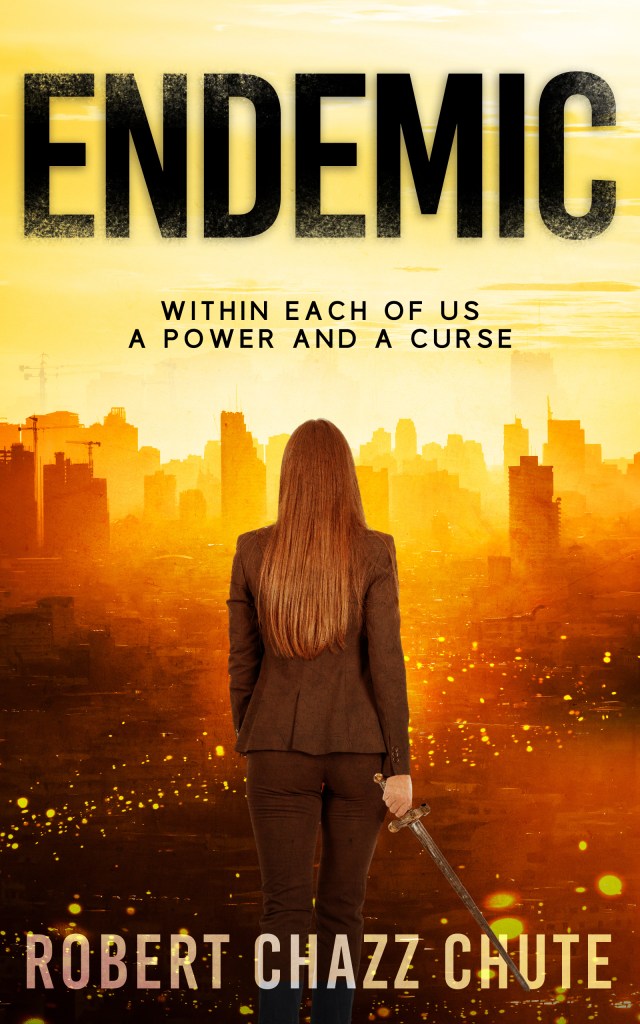
I’ve just released my latest post-apocalyptic/dystopian epic. Curiously enough, I humbly suggest you buy it, please.

Reviews of Endemic so far:

If you’re tired of the formulaic schlock that clutters dystopian literature, then you need to read Endemic. The author has created a unique tale that serves up the best of deep characterization, nuanced plot, and emotional impact. Read this and you’ll soon be looking for other books by Robert Chazz Chute. ~ RF Kacy

What if COVID-19 never lets go of our world? What would happen to society? Robert Chazz Chute does not write escapist literature. He extrapolates the present into plausible but decidedly unwanted futures. The story centres on Ovid Fairweather, a 30-ish editor turned gardener, trying to survive in a New York City that is most definitely not a tourist destination. Betrayed and besieged at every turn, Ovid’s resilience and determination in the face of impossible circumstances drew me in. This is dystopian fiction at its finest. ~ Russell Sawatsky

Endemic takes us on a journey of the mind of an unassuming survivor who must learn to cope with a collapsed environment. Not unlike the current reactions to our contemporary pandemic, Endemic illustrates that diverse choices can lead to survival or a slow demise as a ‘thirder’. The sudden jolts as the narrative swiftly changes course ensure that the reader keeps on their toes, adapting as quickly as the protagonist must in the search for safe refuge. Thanks Robert Chazz Chute for another innovative ride and a tale well told. ~ Janice Bull

~ Check out all my apocalyptic epics and killer crime thrillers at AllThatChazz.com.


Filed under: writing advice, , , , , , , , , , , ,

Writing Fairweather and Foul

I recently received the most aggressive fortune in a fortune cookie ever: For a good cause, wrongdoing may be virtuous (pictured). Sums up a lot of fiction, doesn’t it? It spoke to a central question in my newest big book, though! (See below. Oh, and by the way, Endemic is FREE today, Tuesday, November 2, 2021!)

How good does the cause have to be? How bad can I be?

Papa, Don’t Preach

In fiction, themes and messages are best when they emerge from the narrative organically. If a writer sets out to create a message from the beginning, it might turn into a lecture rather than a story. Readers want to be entertained. Don’t write fiction to teach them something. Set out to discover something.

Why Endemic?

Someone asked me why my latest novel is called Endemic. There are layers;

  1. Of course, when a pandemic doesn’t go away, the disease becomes endemic. That’s the broad stroke of world-building and the basis of my novel.
  2. Ovid Fairweather, the protagonist of Endemic, is neurotic and nerdy. A former book editor, she gets into urban farming to survive the viral apocalypse. She’s a very unlikely heroine who has conversations with her dead psychotherapist. To defend herself, she commits violent acts. A conflicted soul, she wonders if her capacity to do the things she does was dormant, waiting to emerge her entire life. Was her violent nature endemic? Was it learned? Or was it merely a reaction to terrible circumstances?
  3. So, was Anne Frank right? Are people basically good? And if they aren’t, can they be redeemed? What actions are required to achieve redemption? Who dictates which transgressors can be forgiven? What punishments await sinners? If a trait is endemic, can we change?

Disaster stories and horror are most interesting, not for the disaster itself, but how people react to circumstance. Can we come together or will it always be “every man for himself”? Human nature is fascinating. That’s the exploration boiling underneath all the plot, witty dialogue, and action.

Going Deeper than Good or Bad

There’s a common mistake anyone can fall into. It’s the notion that everyone is either all good or all bad. If they agree with you, they’re geniuses. If they mostly agree, but don’t use your phrasing, they’re idiots you need to educate. Cultural divides don’t get bridged that way.

In real life, people often have a hard time with others. When we find out heroes who champion our cause are flawed, we’re sorely disappointed. There are still plenty of people who don’t want to hear that Mother Teresa was for suffering or that their favorite Hollywood star treats the help horribly.

In fiction, we try to avoid portraying protagonists as flawless. Flawless is boring, so readers appreciate characters who are not paragons of virtue 24/7/365. Common tropes support the detective who has seen too much, so she drinks too much. The serial killer may be evil, but as long as Dexter likes kids and kills serial killers, we’re rooting for him to get away with his crimes.

When you write your novel, you want your characters to be relatable. Readers want someone to like. Avoid writing characters who are so perfect no one can dislike them. That character may be likable, but the story will have less conflict and end up being boring.

Ovid Fairweather is perhaps my most conflicted character yet. The past haunts her. She isn’t sure whether she’s the heroine or the villain. I’m confident most readers will root for her even as she waffles and worries. She is quirky and neurotic so Ovid has a lot of challenges to rise above, just like the rest of us.

Find out for yourself here

I was a nail. I am a hammer.

As the United States falls to disease, killers and thieves rule New York. Bookish, neurotic, and nerdy, Ovid Fairweather finds herself trapped in the struggle for survival. 

Bullied by her father, haunted by her dead therapist, and hunted by marauders, Ovid is forced to fight.

With only the voices in her head as her guides, an unlikely heroine will become a queen.

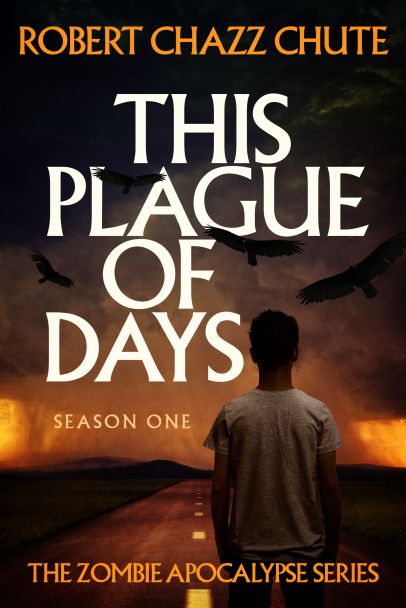
Fun, surprising, and suspenseful, Endemic is the new apocalyptic novel from the author of Citizen Second Class, This Plague of Days, and AFTER Life.

BEGIN YOUR NEXT BINGE READ

and

DO YOUR CHRISTMAS SHOPPING HERE.

~ For all my apocalyptic epics and killer crime thrillers, please do visit my author site, AllThatChazz.com.

Filed under: publishing, writing advice, , , , , , , , , , , , ,

How to Make Short Stories Pay

First, You Have to Write Shorts that Do Not Fizzle

One of the books I’m planning is aliens versus humans so I thought I’d check out The Invasion (new on Apple+). Inspiration comes from everywhere. Well, everywhere but The Invasion.

I respect bold choices in storytelling. I love the building tension to be found in a slow burn. However, what’s on display in The Invasion is big budget, overstuffed with melodrama, gratuitous titillation, and a lot of irrelevance. Worst of all? No aliens! It’s as if they set out to construct an alien invasion that none of the supermodel/actors notice for a long time. Whatever the producers are doing, it’s not getting to the point. I’m three episodes in. This show is beautifully shot, but they have yet to light the fuse. Any Mission Impossible script lights the fuse fast. The Invasion fizzles and fails to launch.

I’ve toyed with scriptwriting, but more of my experience that’s a close parallel comes from writing short stories. Short stories used to be so much more popular and magazines paid good money for them. Kurt Vonnegut did well with selling short stories before moving on to novels. Stephen King published shorts in porn magazines before Carrie hit. One of the joys of my childhood was reading sci-fi in Omni. If I could bring one magazine back, it would be Omni, but even then the mag was financed by the success of Penthouse. Omni was a gorgeous magazine with stunning prints of spaceships, but the business model wasn’t sustainable.

Like a Good TV or Movie Script, Short Stories are Economical

The challenge of writing short stories is to get where you’re going fast without sacrificing character development. You’ve got to paint a picture with fewer brushstrokes. The writing is tight with no room for flab.

I started out writing short stories and have won some awards for them. However, I got to a place where I thought I’d never write short stories again. There’s too little money in it and I must keep the lights on. However, I relented. My novel release schedule got punctuated by anthologies because it’s a joy. I do love writing long form, of course, but each novel is a marathon. Short stories deliver the boost of adrenaline you get from sprinting around the track.

Possible Platforms for Short Fiction

If you enjoy writing short, I’d encourage you to do so. If you want to make them pay like they did in the old days, it’s not going to be like that.

Let’s get past the age of the dinosaurs: Ignore small literary publications. They take forever, competition is stiff, they pay in bird cage lining, and their circulations are tiny. Your blog can reach more of your audience directly and immediately. Once a great thing, they’re now a pretentious holdover from a lost era. If you write genre fiction, it’s especially wasteful. If your short story is really good, you could get a sneering rejection from an MFA who attended the Iowa Workshop. So…yay? Nay.

Already got a following and a big list of subscribers? Make Patreon work for you. But really, your newsletter list better be huge because you’re going to have to promote it effectively. Patreon can be a lot of work to maintain, so set your expectations accordingly.

You could write short on Medium. Some writers enjoy that very much, but it’s not an ideal outlet for fiction.
For more on the challenges and strategies of writing fiction on Medium, read this informative blog post.

You could also try serializing your work by writing short and fast for Amazon’s new venture: Vella. However, given all I’ve read and heard about the challenges of writing and promoting on Vella, I do not recommend it at this time. It’s an interesting idea, and I did serialize some of my fiction when I started out. However, my assessment is that Vella is not ready for Primetime.

For more on the pros and cons of Vella, read this article on Medium.

Or read this writer’s experience on Vella.

If Vella still intrigues you and you want to try it out, get some help navigating it by joining a Vella Facebook group.


Before anyone complains, I must also note that there is a difference between writing serialized fiction and penning self-contained short stories. We’re already deep in the weeds here, so I’ll save that for another post.

Cool, Rob, but how do you make short stories pay?

Write novels, preferably in series, and use short stories as a way in for new readers.

You could write a short story prequel to your full-length novels and give that away everywhere (with links to your first-in-series).

I’m Your Candy Man

If you dig thrillers but you’ve never heard of The Night Man, you might not want to take a chance on me. However, my suspense anthology (Sometime Soon, Somewhere Close) isn’t the time commitment of reading a full-length thriller. It’s also cheaper. I write apocalyptic and dystopian thrillers, too, so All Empires Fall serves as a gateway drug to my novels.

Reading fiction is a lovely addiction. Give readers a taste they enjoy and they will come back for more. Whether you use short stories as a cheap entry point or as a free reader magnet for newsletter subscribers, the monetary payoff is unlikely to be immediate. It can be incredibly satisfying, though.

If you want to release rapidly to stay top of mind among your fan base, writing short can ease your stress immensely. It takes me far less time to write an anthology of short stories than it does to craft the complexity of a full-length novel. Hitting publish more often is fun and you’re throwing more spaghetti against the wall to see what sticks. In publishing, big or small, that counts as market research.

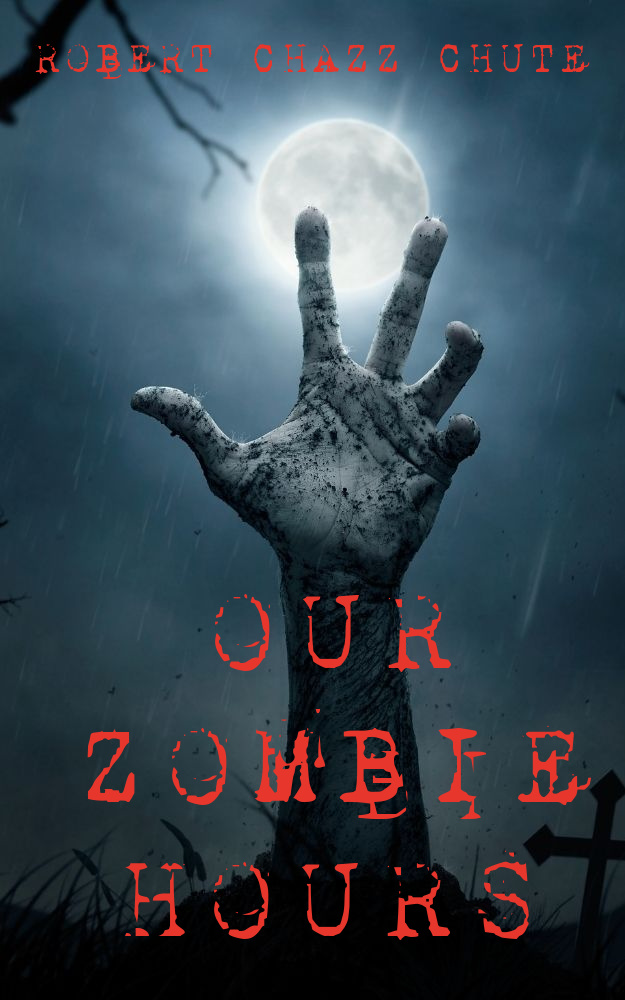
My newest anthology is Our Zombie Hours. It’s a bit of horror for the purists, just in time for Halloween (and it’s free until midnight tonight).

Take a blurb to the face:

From the author of This Plague of Days, AFTER Life, and Endemic comes five adventures from the front line of the zombie apocalypse. As society collapses, humans often prove themselves more dangerous than the infected. Enjoy these fresh stories that explore survival, heroism, and betrayal in a world gone mad. A fun night of horror awaits. 

PICK UP Our Zombie hours, NOW ON AMAZON

Today is Saturday, October 23. Get Our Zombie Hours by midnight, and it’s free. After that, the anthology is astoundingly inexpensive. I’m hoping you’re an addict looking for a word fix. I want to be your Candy Man for life.

See all my drugs at my author site, AllThatChazz.com.

Filed under: short stories, , , , , , , , , , , , , , , , , , , , , ,

The Real Writing Life

To be an author requires a lot of patience and not a little audacity. You spend many hours working alone, charting your own course and assuming someone will want your art. Of course, to bring your creation to market, you’ll need help from editors, proofreaders, beta readers, and graphic artists. I’m speaking here of all the time you face the blinking cursor and the blank page. I was reminded this week of the joys and frustrations of sailing solo.

The Obstacles in Your Way

The Movies That Made Us (on Netflix) has a great behind-the-scenes breakdown of what it took to get Elf made. When the primaries were brought together to create a modern Christmas classic, none of them were considered bankable. Even Will Ferrell wasn’t considered leading man material. The amazingly talented director, Jon Favreau, wasn’t money yet. The writer was unknown, but what they did have was vision. Film is a collaborative medium, and in this case, the creative team were all on the same page. It was the studio that stood in the way, even going so far as to try to edit it down to something it wasn’t. The higher-ups just didn’t “get it.”

Fortunately, a more ambitious artistic vision won out over the cynical studio execs. Favreau’s vision won out and commerce was served without compromising a film with real heart. Working by committee is difficult. Hollywood is full of stories of great scripts that got squashed, derided, or ignored for years before somehow making it to the screen and becoming a triumph. There’s a great book titled Afterwards, You’re a Genius. Looking back, everybody says, “Of course, it’s a success!” Going forward, people aren’t so sure.

Do anything, and plenty of naysayers will emerge to helpfully inform you what you’re attempting won’t work. Often, the people who say they’d do it differently don’t do anything at all. Sometimes I wonder how anything great makes it to the big screen.

And then there’s Paterson

The tiniest movie I’ve watched in a long time is Paterson, starring Adam Driver. It’s so low-key, you’ll watch it thinking, Where is this going? It’s a small, meditative film that flirts with the surreal. It’s a fairly uneventful week in the life of a bus driver who loves poetry. That’s it. No explosions. No action sequences. I can’t even say there’s a plot per se. However, it does have charm, and it offers an experience where the quotidian is the point. If you’re a Fast & Furious devotee, you might find this one soporific. I found something to love, though.

First, it’s kind of amazing this movie exists. No matter how small the movie is, big money and an army of participants are needed. Remember when a movie only required one production company? Now, movies are so expensive, I get tired and irritated just slogging through the opening credits as we get a slew of title cards and logos. (For example: A production of A Working Title Films, in association with Armchair Studios, a film by Lawrence Blahdiblah, with Fade in Innovators, and The Super8 Incubator and oh my God, get to it, I’m already out of popcorn!)

Second, Paterson is about an artist trying to create while dealing with the day-to-day struggle to survive. He writes poetry for the experience itself. Money must be made, and that’s what the day job is for. However, passions must be fostered and he draws on the mundane to create something beautiful.

The bus driver steals precious moments from the beginning of his shift to jot down a few lines in his notebook. His partner stays at home, painting everything while dreaming of becoming a country music star who’s also hoping to become a cupcake entrepreneur. The bartender aspires to win a chess tournament while a rapper works on spitting rhymes in a laundromat.

Meeting the rapper, the bus driver looks around the empty laundromat and says, “This is your lab?”

“Wherever I am,” the rapper replies, “that’s where it happens.”

That’s the creative spirit, always on duty, always practicing and perfecting, taking in everything to feed the muse.

Despite the surreal undertones, Paterson does not happen in an alternative universe. This is the world of any artist in our world. We create because something within urges us to do so. Most of those efforts will go unheralded. There is only one Jon Favreau, but we’re all out here, doing our thing. Most of us couldn’t tell you why. We just love words and stories. We’re trapped in the amber of the everyday, but we dream of more. We create worlds.

This sounds like a romantic notion, but it’s not. Yesterday, I completed final edits on my next big book. I think I’ve created an apocalyptic classic in Endemic (to be released early November). At 390 pages and 100,000 words, it’s an ambitious story about a neurotic book nerd facing down marauders in a plague-ravaged New York City. I was elated to send out the ARCs and excited to finally get the graphics set up for the hardcover and paperback. This has been two years in the making, so I could barely contain myself as my ARC team replied with their excitement and congratulations.

Pop the champagne, right? Um, no.

While still in the throes of self-congratulation, I had to go get winter tires on my car. Due to a miscommunication on my part, my son had taken the car to work. I stepped onto an empty driveway and panicked a little. I had to run to his workplace to pick up the car. Meanwhile, my laptop has failed and my desktop is iffy, too, so I’m struggling with how to afford to buy a new dream machine.

And that, my friends, is the writing life. Toil in obscurity, do the dishes, get your ass back in the chair in front of the keyboard. Maybe you’ll win an award, but that’s one night and then it’s back to work. Maybe you’ll make it big and have assistants to fetch you scones and coffee one day, but probably not. There’s only one Jon Favreau, but there are millions of writers across the world doing their thing because…I don’t know. Just because, man. We have to.

~ Check out my apocalyptic epics and killer crime thrillers at my author site, AllThatChazz.com.

Filed under: the writing life, , , , , , ,

Every Writer Needs a Gari

I’ve taken a bunch of writing workshops, but one thing I learned that I consider most valuable is about managing expectations. A very successful author stood at the front of the room and pulled a manuscript from her bag. The stack of paper bound by rubber bands was replete with Post-It Notes, all corrections from her editor. I don’t know whether it was her line editor or copy editor, but I can tell you the notes were copious, several to a page. That’s normal. Expect problems and recruit more pairs of eyes to comb your manuscript.

When I worked at Harlequin, we had many tiers of editors and proofers working on each manuscript. A few typos and whatnot still slipped through the net. We can aim for excellence, but perfection will always hover just beyond our grasp. You know why? Because we don’t know what we don’t know. Everybody needs a safety net. Whether you pay an editor or recruit a passel of beta readers (preferably both), pobody’s nerfect.

As I write this, I’m going through revisions on two new books (coming soon). I didn’t know the difference between a chartered accountant and a CPA. I didn’t think to check, either. However, my beta reader caught it. He also knew that it’s not restauranteur (with an n). It’s restaurateur. Somebody reading this doesn’t believe me because they, like me, have been spelling it incorrectly their entire lives. (For more on why the n is left out, enjoy this article from Mental Floss.)

Every time I think, Yeah, I’ve gone through the manuscript a few times. Surely, it’s pretty clean. Nope! And why? I’m not careless and I’m not an idiot, but I don’t know what I don’t know. The idiosyncrasies of comma placement often befuddle me. When I read a sentence, sometimes my brain fills in blanks so I miss something that should or shouldn’t be there. I publish in American English, but I sometimes write in Canadian. There are subtle differences and nuances, like whether to write Grade 4, or fourth grade. Some regional or Irish idioms that I grew up with would sound odd and unfamiliar to American readers.

Writing primarily for an American audience, I’ll take something for granted they may not. For instance, I wrote, “She took up after them,” instead of “She took off after them.” To me, took off connotes speed. Took up means the chase is on, but the runner is trailing and not catching up. Once our masterpieces are sanded smooth, readers stumble less. You want an easy glide path into their brains so you can highjack the feed of their consciousness. That’s where recruiting help comes in.

Fortunately, I have Gari Strawn of strawnediting.com on my side. Among Gari’s strengths are her tireless curiosity and a keen eye for details. I also suspect she sleeps with the Chicago Manual of Style under her pillow. She knows things, eases my stress, and allows me to focus on the story.

Confused about when to write a number out or type the numeral? Trained as a journalist, I was stuck in the AP Stylebook mindset until Gari reminded me of CMOS guidelines. Russ, my beta reader, and Gari, my assiduous editor, help to make my work better and clearer. Even Batman had Robin watching his back, so, no, most people cannot reliably edit their own work. Some authors will push back on this idea and say, “I’ve been an editor so I can edit my work.” Put aside the premise that you don’t know what you don’t know. To those writers, I would ask, “Why would you want to work without a net?” Please tell me it’s not pride. Would you rather hear about your misses privately and correct them, or read about them publicly in a negative book review?

Good editors and capable beta readers are out there and they do want to help you. If it’s not an editor, work with other writers. Recruit a team of beta readers. Since I began working with Gari, I’m more confident when I hit that big scary button marked Publish.

Something may still slip through, but that’s the case with every published book. Manage your expectations, strive for excellence, let others help. Expecting perfection is unhealthy and unrealistic, but making your books as wonderful as you can manage is much easier on you in the long-term.

~ I write killer crime thrillers and apocalyptic epics. Get the links to all my work at my author site, AllThatChazz.com.

Filed under: Editing, Editors, writing advice, writing tips, , , , , , , , , , , , , , , ,

Show me you are a writer

You know this meme:

Tell me you’re X without telling me you’re X.
It just occurred to me that this is another version of a good writing guideline: Show, don’t tell.

Good fiction exploits resonance and a certain amount of circuitousness. Don’t tell me your heroine is brave. Let the character demonstrate her bravery. Book readers want to meet the author halfway to achieve an immersive experience. They don’t want a telegram.

Of course, there are times to tell, not show. When dialogue is interesting and clever, let it be said in quotes. If the dialogue is merely informative and delivers zero bam-pop-pow, then it’s time to tell instead of show.

Telling:

He asked me if I wanted a coffee before the interview, and I declined.

Showing:

“Fancy a hot cup of java?”

“No offense, sir, but I make it my policy to never accept any beverage from a person of interest in a poisoning case.”

~ Robert Chazz Chute shows and tells appropriately. His killer crime thrillers and apocalyptic epics deliver lots of bam-pop-pow. Check out his books on his author site, AllThatChazz.com.

Filed under: writing, writing advice, writing tips, , , , , , , ,

Finding the Genre Vibe

When you’re writing, understand the tropes of your genre even if you don’t adhere to them closely. Lean into those and you’ll make your readers feel comfortable that they’re getting what they expected when they clicked the buy button. It’s a truism: People want the same thing, only different. Avoid cliches, sure, but tropes are often helpful in getting a reader and keeping a reader.

I must admit, I have not always stuck with what’s expected. My two zombie trilogies colored outside the lines. This Plague of Days is vastly different from a lot of books with “Zombie Apocalypse” in the subtitle. It’s a slow burn that builds and builds and relies heavily on supernatural elements and a mute hero on the spectrum. AFTER Life has plenty of zombie action, but the nanotechnology involved places the trilogy firmly in the techno thriller and least science fiction categories.

It may seem simple, but there are plenty of niches to drill down to and you don’t always know. When I published This Plague of Days, I thought I was writing straight horror. Then I got a Bookbub, and their marketing experts helpfully informed me I was writing science fiction. I suspect the success I had with TPOD was in part because of its contrast with other zombie books.

Now, when someone asks, I follow Stephen King’s example and say I’m a suspense writer. Mostly my backlist is suspenseful sci-fi. Other times, it’s crime fiction, but it’s all suspenseful. I’m a big fan of twists and turns. As I write this, my trusty Editrix Supreme, Gari Strawn of strawnediting.com, is working on my newest big book. It’s called Endemic, a survivalist thriller set in New York during the viral apocalypse. It does not have zombies in it, but there are infected people who are zombie-adjacent. The protagonist is a 38-year-old woman who is a very unlikely heroine. I like unlikely protagonists. If someone is prepared for their mission, the stakes are lowered. Will Endemic be different enough, or too different? We’ll see.

In the Meantime

While I wait for the final edits of Endemic, I cranked out a pop-up anthology. There was a time when I thought I was done writing short stories. However, I can produce them quickly and I enjoy writing them. Anthologies don’t sell as well as full novels, but I can use it for other purposes, such as creating an IP that leads to other IPs. Need a reader magnet to boost your newsletter? Short stories can give subscribers a sense of your style without the time commitment of a full free novel.

Leaning In

I’ve been reading a couple of gurus who are very deep into writing the same thing, only different. It can be profitable catering to a particular niche. If you’ve read X author and had a good time, you’ll probably read the rest of her books to get a similarly joyful experience. Browsing around, you’ll find successful authors who do this and their branding shows it. They have no shortage of entertaining stories their readership loves. Perhaps their biggest worry is burnout or that their graphic designer will die and they’ll have to find another who can create the same style of cover art. It is a good strategy and I do not disparage it.

For this coming anthology, I’m doing something I haven’t done before. I’m leaning into the zombie/horror tropes and giving readers more what they expect from the genre. That is not to say there won’t be twists and turns. I still offer plenty of those. However, there are no sci-fi elements. I just want to scare people for Halloween (and beyond).

Meaning

For all my writing, I look for meaning. The characters have to be relatable. Even if the good guys and bad guys are wading into the Wondrous Pool of the Fantastic, it’s important that readers find resonance. We all understand jealousy, anger, and fear. Tapping into our common human experience triggers the empathic parts of our brain. That’s when the world of the book envelops the reader.

You can accomplish that state by telling an entertaining story readers expect, or you can do it while pushing at the boundaries of their expectations. The trick is to do it in such a way that you reel them in instead of freaking them out.

Please note: Some minority of readers will always freak out.

Example: This Plague of Days has zombies and vampires in it. Some readers will never accept those genres colliding. They’ll take zombies, but introduce a smarter bloodthirsty killer, and suddenly they’re breaking the spine of the book and yelling, “Bullshit!” My thought was, what’s a sentient zombie? A vampire. Never mind that evolution, and never mind if you get a few reviewers who kick back against any genre-bending. That’s okay. Everybody gets an opinion. Relax and write your book.

There’s always someone who will say, “I would have done x, y, and zombie differently.” To which I reply, “Great! Go write that. Express yourself! Then somebody can try to educate you as to what they would have done differently. Then you’ll understand me better. Heh-heh-heh!

To put it crudely, meeting reader expectations does not make any writer a hack. Ideas are cheap. It’s the execution of the story you choose to tell that will elevate the work in readers’ minds or fall short of their expectations. I like blowing through their expectations, but it can be fun to play the game within restrictions, too. As Hitchcock said, a limited budget makes one more creative.

Endemic is a big book that will defy expectations because the protagonist is older, nerdy, and neurotic. She and I share several of the same neuroses, in fact. Our Zombie Hours is a small anthology playing to readers’ expectations of the horror genre. I’m oddly optimistic each book will find a readership.

To go deeper on writing, reading, and marketing that resonates with more readers, I suggest you check out 7 Figure Fiction: How to Use Universal Fantasy to Sell Your Books to Anyone by T. Taylor. It’s an enjoyable, quick read that will get you thinking about adding butter to your writing recipe and boost reader engagement with your words.

It’s all about resonance. Do you dig my vibe?

~ Robert Chazz Chute occasionally writes about himself in the third person (like right now) to encourage you to read his books. He writes apocalyptic epics and killer crime thrillers. Browse them all at his author site, AllThatChazz.com.

Filed under: book marketing, This Plague of Days, writing, writing advice, writing tips, , , , , , , , , , , , , , , , , , , , , ,

An Apocalypse in the Middle of an Apocalypse

When I started publishing books in 2010, my pace got faster as I refined my processes. Take a couple of books through the editorial process and you identify quirks, mistakes, and inefficiencies you can avoid with future projects. At one point, I wrote five books in one year (and that was while I still had a day job). I took three days to format my first book. Back when I serialized This Plague of Days, I refined that formatting process down to a few minutes. Some things get easier with experience, feedback, and repetition. Then along came a killer pandemic and all my routines and expectations got torpedoed.

Trouble writing? This bud’s for you, bud.

Not Coping with COVID-19

The last book I put out was a thriller called The Night Man. That was Christmas, 2019. Almost two years later, I’m finally about to publish again. For several reasons, I took my time with my new book. This apocalyptic tale is a compelling experience that, in part, explores how we respond to disaster (or don’t). Endemic asks, “What happens when a pandemic never ends?” It’s not a short read, but the pacing will make it feel that way. I put so much of myself into this book that, despite its grand setting and sweeping scenes, the story is a relatable cautionary tale about what happens when variant storms strike. I wish the story wasn’t so relatable. The immediacy of viral dangers affected my writing routines negatively. What follows are my suggestions if you have been similarly afflicted.

How to Write (or not) in the Middle of an Ongoing Disaster

  • Put yourself on a social media diet. If the TikTok warning comes up suggesting you go outside to smell the roses, you know you’ve been on the app too long. It’s easy to get sucked into doom scrolling. I sure did. Though the news might give you ideas, it can just as easily suck away writing energy. So much of the news is repetitive that listening to a third epidemiologist in one day is counterproductive.
  • Self-care. Maybe that means remembering to take a shower. Perhaps exercise is missing from your day. Look at what’s missing and fill that need.
  • Writing sprints with a willing writing buddy work.
  • Setting a timer and writing your first draft as fast as you can in short bursts works, too.
  • Focus on what you can do, not what you can’t do.
  • Think of each chapter as a short story instead of setting your sights on a huge word count. “I am going to write 500 words before the top of the hour,” sounds reasonable and doable. “I’m going to knock out a massive epic of 150,000 words by the end of the month,” is intimidating.
  • Tell stories you feel a great need to tell. Passion alone may not take you all the way to the end of the project, but it should give you some inertia. Hacks don’t have passion. Business considerations are for before and after the writing session, not during. Write the story.
  • Abandon unreasonable expectations. If you’re writing 200 words a day, don’t torture yourself with promises to craft 10,000 words tomorrow morning.
  • There is no rule that says you have to produce x number of books a year. Things change. Your response can change. Do what you can do and want to do. What you think you need to do can’t be bigger than what you can do.
  • Avoid martyrdom. I’ve pulled my share of all-nighters as a writer. I don’t do that anymore because I know if I push myself too hard for too long, I’ll get burned out. I want to write useful pages. Longer hours might just give you more mistakes to fix.
  • You are a writer, not a robot. Accept that now isn’t necessarily your time to accomplish x, y, or z. The rise and grind ethos is fine if you can stay healthy working at a blistering pace. Some people get energy from that approach. It’s not for everyone, though. Is anything?
  • Many go-getters and gurus will encourage you to “get back to normal.” The pandemic is not over and, to me, such admonitions feel like celebrating a touchdown at the 30-yard line. I understand the inclination to pretend this disaster isn’t ongoing, but it is. These are not normal times and not everyone is okay. Not everyone’s losses or ability to respond to challenges are equal. Be kind to yourself.
  • Some writers have found the lockdown experience energizing to their work. I know of no stats that suggest what and where that split is. On the other hand, many people have quit their jobs. Writing is a job you can turn your back on. You can quit and focus your energies elsewhere. If it’s not good for you right now, be honest with yourself when you need to walk away.
  • Professionalism? Sure, I’m all for it. Set a schedule. Have a dedicated work space and show up. Establish flowcharts of your action plans for writing and marketing. Measure and record your quantitative output. Keep an eye on the quality of your input. Do the thing … as long as it’s helping you, not hurting. Writing is supposed to be fun, remember?
  • Hydration, sufficient sleep, a healthy diet, and exercise are all important. However, these are not panaceas. When people need help with physical and mental issues, some well-meaning cheerleaders will appear to tell you to go for a walk in the sunshine. That’s fine as far as it goes, but if your pancreas is merely serving a decorative function, you’re going to need more intervention than nice thoughts and meditation. If you need professional help, get it.
  • Another’s writer’s success can be motivating. That’s not true for me, though. When Amazon tells me an author I follow has come out with their fourth book in four weeks, I don’t feel good about myself. Besides, there are too many variables to replicate another’s path precisely. Do not compare your output to anyone else’s production schedule.
  • Procrastinate productively, whatever that means for you. If you need a nap and can do so, enjoy that nap. If you want to clean up your workspace, go head. However, don’t tell yourself you’re going to write “sometime” today and end up torturing yourself with I-should-haves. If you’re going to take the day off from writing, choose to do so consciously and choose early in the day. The worst writing days are the ones you tell yourself you were supposed to have had and didn’t execute.
  • A caution about procrastination: Are you one of those travelers who pack your entire wardrobe for a weekend getaway? When traveling, take half the clothes and twice the money. When writing, no, you don’t need to do so much research. Research to achieve verisimilitude is encouraged. Research that pushes your deadline back a month is procrastination.
  • Rely on social support. We have all grown more isolated in the last year and a half. Break loneliness. Talk to friends on the phone. Enjoy a Zoom call. Reach out and text someone. Share another cute dog video. Think of it as physical distancing, not social distancing.
  • Prioritize. That sounds like I’m scolding, so let me rephrase: Be lazy about the right things. Say no to the right things and yes to the write things. For instance, me to She Who Must Be Obeyed: “I got a lot of words down today, but I didn’t mow the lawn. It’ll keep another day.” Or, “I’m sick of the Sunday Bean Soup I made. It’s the fourth day in a row. Wanna order pizza?”
  • Writing, but you’re not feeling that last scene? Maybe it’s time to reward yourself with a short story to submit to an anthology. The right change can boost your creative energy. Taking a break can mean going for a swim. It might mean putting your energy into that mystery you’ve always dreamed of. You know, the one where the orangutan escapes from the zoo and solves heinous crimes with his sidekick, a Mormon sign language interpreter with a penchant for exotic cheeses. Do you, boo!
  • Blocked? Start writing about that. What does that frustration feel like? What childhood affront does that pain remind you of? Thinking about writing and not doing so is pain. Starting to write about anything, primes the pump and gets the juices flowing. Write fast, write now, and edit later. Silence your inner critic and dive in. Soon you’ll look up from the page and discover you’ve been at it a while and now you have something to work with. Blank pages are notoriously difficult to edit.
  • Read something that inspires you. You can read as a writer and analyze the narrative. I’d suggest you read like a reader instead. Remember the joy of reading? Let that feeling percolate so you’ll come back to your love of the written word.
  • Find what motivated you before you lost your mojo. There aren’t any wrong answers. Love, spite, competition, proving your ex wrong? Whatever gets you back to the writing mindset.
  • Aim for excellence, not perfection. Perfectionism is self-hatred. Some writers speak of putting out “minimum viable product.” I’m nervous about that wording and how it can be twisted. However, if it helps to get you writing, consider that there are plenty of successful writers entertaining legions of happy readers. Not all of them are solely focused on writing The Best Thing Ever Written. They are writing to entertain without the burden of a subjective and snobby literary standard.

What helped me most?

I faced challenges to my mental and physical health over the past couple of years. Chronic insomnia robbed me of many productive days, for instance. What I needed was time. I wrote a little, poking at my WIP. I didn’t manage to write every day. The best I could do was four days out of seven. When I allowed a limit and told myself it was okay not to write on a certain day (or series of days), the stress headaches went away. Taking my time with the story fueled my creativity. Patience made for a richer, more layered novel.

Writing a little at a time, I got where I needed to be. This month, I’ll release my first book in a long time. I’m healthier these days. My mojo and ambitions are rising again. There will be a hardcover, paperback, and a podcast of Endemic. Next year, expect an audiobook. Endemic holds echoes of my most successful series, This Plague of Days. I took my time. Endemic was worth the wait.

~ For all my killer crime thrillers and apocalyptic epics, please do check out my links at AllThatChazz.com.

http://www.AllThatChazz.com

Look for Endemic on Amazon later this month. To get your heads-up about when it’s available, sign up for updates at AllThatChazz.com.

Filed under: publishing, writing, writing advice, writing tips, , , , , , , , , , , ,

Bestseller with over 1,000 reviews!
Winner of the North Street Book Prize, Reader's Favorite, the
Literary Titan Award, the Hollywood Book Festival, and the
New York Book Festival.

http://mybook.to/OurZombieHours
A NEW ZOMBIE ANTHOLOGY

Winner of Writer's Digest's 2014 Honorable Mention in Self-published Ebook Awards in Genre

The first 81 lessons to get your Buffy on

More lessons to help you survive Armageddon

"You will laugh your ass off!" ~ Maxwell Cynn, author of Cybergrrl

Available now!

Fast-paced terror, new threats, more twists.

An autistic boy versus our world in free fall

Suspense to melt your face and play with your brain.

Action like a Guy Ritchie film. Funny like Woody Allen when he was funny.

Jesus: Sexier and even more addicted to love.

You can pick this ebook up for free today at this link: http://bit.ly/TheNightMan

Join my inner circle at AllThatChazz.com

See my books, blogs, links and podcasts.

Enter your email address to follow this blog and receive notifications of new posts by email.

Join 2,063 other subscribers