C h a z z W r i t e s . c o m

See all my books at AllThatChazz.com.

The New Seven Words or Less Contest

A quick-moving plot with lots of surprises and a clear-eyed examination of addiction.

As I wrote Higher Than Jesus, the second in my crime novel series, I held the Six Words or Less Contest. It was so much fun, I’m doing it again, but with an extra word to give you the flexibility you need for a great entry.

Here’s the deal:

You can have a character running around in a crime novel with your name on him or her. All you have to do to win is come up with the funniest slogan for the side of a bakery delivery truck you can imagine. The catch? It has to be seven words or less and it has to be original, funny, memorable and somewhat plausible (so swearing is out for this one.) The contest ends December 7. Enter as many times as you like in the comments section below. 

The winning entry will be used in my next crime novel, Hollywood Jesus. (You guessed it. It takes place in California.) The winner will be chosen by a vote held from Dec. 7 to Dec. 10, 2012. The top three entries get a digital copy. The grand prize winner will get a free copy of the book in digital and paperback. Have fun with it! 

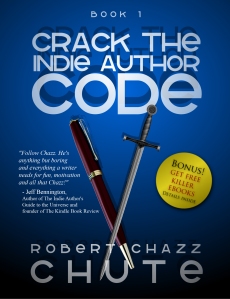
~ Robert Chazz Chute’s favorite bakery product is chocolate croissants with rich coffee. He’s also written two guides to writing, publishing and promotion. Crack the Indie Author Code is currently #1 in publishing and #4 in writing, and FREE this week on Amazon. Get your copy of Crack the Indie Author Code before Friday at midnight or before the sun explodes, whichever comes first. For more publishing and promotion tips, get Write Your Book: Aspire to Inspire. For more on books by Chazz and to hear the All That Chazz podcast, go to AllThatChazz.com.

Free to you Nov. 26 – 30, 2012. Click it to grab it now, please, or I shoot this puppy.

Filed under: publishing, , , , , , , , , , , , , , , , , , , , ,

#NaNoWriMo: And what if you don’t?

Free to you Nov. 26 – 30, 2012. If you love it, please review it. Thanks!

What happens if you aren’t a “winner” at National Novel Writing Month? The Mayan Apocalypse was set aside for you. The end is near and it’s going to be like that John Cusack movie, 2012, only longer, with burnt popcorn and more uncomfortable seats. 

Well, no, actually. NaNoWriMo isn’t another of those insipid chain letters that will kill you with a falling baby grand piano if you don’t complete it within the specified time. Fifty-thousand words and one month is an arbitrary deadline. It’s a fun and, I think, worthwhile challenge, but just because you didn’t make the quota — and there’s still time left, by the way — doesn’t mean you aren’t a writer. Mom still loves you, though she still prefers your brother Ted. Dad doesn’t think you’re any less unemployable (or more employable) than you were last month at about this time. You dog does not judge you…harshly. You still don’t take him out for enough walks, though. The status quo is preserved.

You’re certainly no farther behind than all those people who did make it to 50,000 words but will never look at their manuscript again. Their art is stillborn. Sadly, plenty of people who enter NaNoWriMo   have something worthy of publishing but will never know. The challenge, to them, was just a challenge, like how long can you go just eating pineapple and refried beans? Years from now they will sit in a dingy bar packed to the rafters with Rue and say, “Yeah, I wrote a novel once.” Before taking another long pull on a long neck, they’ll finish with a whisper, “…sort of.”

So what are you feeling so bad about? If you’re not going to make it to 50,000 words but you’re still reading this post, I bet you’re more serious than Mr. Sort Of. You’ve made it this far, looking for commiseration and a shoulder to cry on and all that. You don’t need a shoulder to cry on (and cleavage is better for that activity.) What you need is more time.

Many people don’t finish NaNoWriMo for great reasons. Stuff happens. Cats sit on your keyboard. Your sister called too many times at midnight to complain about her husband and how his new boyfriend leaves the toilet seat up. People get sick. Maybe you got tied up with work that actually pays. That’s important. Maybe you got sucked into a marathon of Hillybilly Hand Fish— okay, even my cheerleading efforts have limits. Shoot yourself.

I’m a cheerleader for anyone who writes to a daily word count, whether they are in NaNoWriMo or slogging through and constantly sweating a book out. Today I wrote a mere 1,900 words. I usually write close to three thousand a day. What’s galactically unjust is an author friend of mine reported that she just wrote over 4,000 words yesterday. (Pavarti! Dang it! That should have been me!) You see, my NaNoWriMo challenge is 365/24/7. You know books aren’t written in a month and you know this challenge is just a start. If you wrote enough so you have a good start on a novel, good for you. It can still be brilliant. Arbitrary is just so damned arbitrary, don’t you find?

Maybe you’re simply one of those tortured artists who take a little longer to write a masterpiece. If you’re a Canadian author, for instance, the government’s Royal Department of Vaunted Canlit requires that each book must take several years to write, with extra points awarded if you write about hard Arctic winters, houses made of sod and relentless, howling blizzards. To qualify, each revision must be completed in a birch bark canoe. If CBC Television scrapes any conflict out of your book and makes it into a movie (entirely in sepia tones with lots of bonnets or at least Labrador outports), you’re a serious Canlit contender. Congrats, you poor bastard. When Jian Ghomeshi interviews you on CBC Radio, answer in murmured Zen koans and only allow a small, smug smile, like you’re holding in a fart worthy of Margaret Atwood. There’s no money in being part of the Canadian literary establishment, so instead you get a trace of mystique among U of T English majors — wear a big hat and a long coat to readings — and the vague recognition that occasionally accompanies that ghostly, elusive thing that is “Canadian celebrity”.

Even if you aren’t Canadian, there are still great hurdles to overcome before you write your book and earn the respect of the literary establishment. First, you must never mention any connection between your Great American Novel and NaNoWriMo. Next, leather elbow patches are a must and always refer to the story as “the Text”. (Make sure they hear the capital T.) To really rock the foundations of letters and get Mark Twain and Kurt Vonnegut to step aside for a new, greater entry into The Great Works of Literature Hall of Fame (and Gas Bar), give that manuscript of yours another couple of weeks.

BONUS TIP: If you’re going to take a day off from writing anyway, avoid misery and decide that at the beginning of the day. If it flogs you all day and at bedtime you decide today’s not a day to write, you’ve paid a needless stress debt. There’s enough stress in the world without adding to it.

A quick-moving plot with lots of surprises and a clear-eyed examination of addiction.

~ In addition to writing about publishing in Crack the Indie Author Code and Write Your book: Aspire to Inspire, Robert Chazz Chute plots murder constantly, often in relation to fiction. His latest is a delightfully violent and occasionally sexy romp called Higher Than Jesus. He begs that you buy it and read it and review it because he has no shame anymore. Pride is a luxury bought with money. Sure, that last bit sounds like Jane Eyre, but those are his words! (This is also a  good time to admit that I, Chazz, am currently writing these words about myself in the third person. I’ve rarely loathed myself more deeply.) For more on books of suspense and nonsense by Chazz or to hear the free All That Chazz podcast, slum in his grimy little author site just off the Jersey turnpike in back of a dark bar with lipstick on the glasses, AllThatChazz.com. The glasses are all dirty mason jars and the bartender is a study in jailhouse tattoos.

Filed under: publishing, , , , , , , , , , , , , , , , , , ,

#NaNoWriMo: You can’t murder Miss Marple

Free to you Nov. 26 – 30, 2012

There’s an essential difference between a book that stands alone and a book in a series. In a one-off, anything can happen. In particular, you can kill off your protagonist. You’d be very unhappy with an Agatha Christie novel that ended with the gory strangulation of that sweet Miss Marple using piano wire. (What is it about piano wire that we always associate with strangulation? Was there a sale? Home Depot has lots of wire, but none in the category of “Piano”. Barbed wire would be meaner and razor wire would be more efficient. Yes, I spend too much time thinking about these issues.)

Though Sherlock Holmes went over the falls because Conan Doyle was sick of writing his “mere entertainments”, Sherlock survived in the end. It’s generally bad form to take a reader in hand and walk them through an intriguing story only to kill off the protagonist. It often makes the reader feel they’ve invested a lot of time and energy into a hero or heroine for naught. Kill off the intrepid heroine and, unless you follow her into an amazing Afterlife, readers will feel cheated of the victory they expected. Exceptions exist, but downer endings without some larger goal achieved easily go sour. Be careful about killing off the good guy.

When you write a series, character is even more important than usual because no matter what pressure cookers you throw your protagonist into, the reader is pretty sure he or she will come out reasonably okay in the end and uncooked. Character is key. Sacrifices are demanded. Red shirts are required. Captain Kirk was responsible for the deaths of many of the Enterprise Crew. Everybody would be much safer if they stayed home on Earth, but, whether we’re writers, appreciative readers or just out of Starfleet Academy and beaming down to the planet in Come-Eat-My-Face Red, “Risk is our business.”

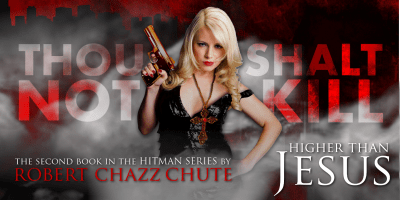
Click the image to get Higher Than Jesus

The trick is to get the reader invested in your protagonist’s goals, make them real and ensure they are sympathetic. For example, my hit man, Jesus Diaz, is an orphan with a history of childhood abuse. That’s explored in the first book in the series, Bigger Than Jesus. In  Higher Than Jesus, he’s dealing with moral issues around what he does for a living while battling Vicodin addiction and some bad guys who are much worse than he. He’s also in love again and out to save the future Mrs. Diaz. Despite everything against him, Jesus is also a funny guy and the deeper the trouble, the funnier he is. That’s his key to multiple books.

Somebody asked me if my inspiration for that quirk was Spider-Man. I used to collect comics and yes, Spider-man is, as they used to say in the Silver Age of comics, “a real cut-up”. However, I first discovered the power of the funny in myself when I encountered a guy with a knife intent on slicing me up. My fear fuelled something in me and I was never as hilarious as when I was sure I was about to die. It was under the controlled conditions of an Operating Room, but still…

Click it to get it.

Click for suspense and hilarious frivolity in Self-help for Stoners.

~Robert Chazz Chute is the author of crime novels, two books about writing and publishing and several books of suspense, including Self-help for Stoners. He has hugged the man who inspired the book, director Kevin Smith of Silent Bob fame, but it was a man-hug. Self-help for Stoners is in Kevin Smith’s bathroom for reading when the whim strikes. Hear the podcast and consume the muted glory that is his author site at AllThatChazz.com.

Filed under: publishing, , , , , , , , , , , , , , , , , ,

#NaNoWriMo: Evolving a series from one book

“You will laugh your ass off!” ~ Author of Cybrgrrl, Maxwell Cynn

Readers love books in a series. Maybe when you’re done your NaNoWriMo manuscript, you may consider turning one book into several. I’m having an interesting experience with my crime novel series I thought I should share with you because it’s a new thing for me and it may be helpful to pull back the curtain on the process as it’s evolving.

Last year, I wrote a short story about Jesus Diaz, a hit man I included in my suspense collection Self-help for Stoners. The assassin I wrote about was a mature and experienced, cold-blooded sort of guy who, at the request of their soon-to-be ex wives, killed men going through divorce. Jesus (pronounced Hay-soose) knew what he was doing and was very slick. Still, things went awry in an interesting way. That was the beginning of the Hit Man Series, but I didn’t know that then.

The revelation came when I thought, I want to write a Coen brothers’ movie! Self-help for Stoners has a lot of funny stuff in it (my favorite is the funny erotica) but I wanted to write a whole novel that played with one character in a quirky way. I thought about what origins a guy like Jesus might have to make him more sympathetic. Despite what he does as an enforcer, he does not see himself as the bad guy. No bad guy does. He’s a victim and a vigilante caught in the gears of New York’s Machine (the Spanish mob).  Think of all those Coen brothers’ movies and you’ll get some of the flavor: The Big Lebowski, Fargo, Raising Arizona, Blood Simple and Miller’s Crossing. Death always waits on the wide and easy road out of town. Perfect fit. I write about Escape. All my books and every one of my stories is ultimately about Escape. Along the way, I try to find a balance between realism and funny. People don’t get knocked out too easily in my stories, for instance. There are some bad guys who are entertainingly dumb, but nobody’s dumb just to make the plot work. Everyone has a goal that conflicts with everyone else’s motives and perspective.

“Worthy of Elmore Leonard with shades of Thomas Harris…”

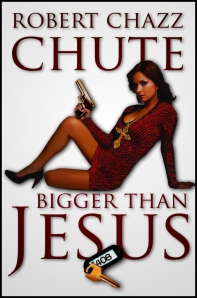
The first book in the series is Bigger Than Jesus. I wanted to start the action off with a bang, so when we meet Jesus Diaz, he’s hanging off the side of a building in New York. The book reads like one long chase scene with a few sparse flashbacks to give depth to the character. Dexter is driven by psychological issues. Jesus is driven by circumstance and a need for money and delusions of grandeur. He’s obsessed with movies and wants the life he see in them. In the first book, there’s no sex but lots of violence and funny dialogue. I’d call it more gritty than gory. The story often plunges the reader into a web of deception and, because everything is seen from Jesus’ limited perspective, we only uncover the mystery of what waits in locker #408 as the Cuban hit man discovers the truth. Jesus begins his story arc as a guy who can lie well and has some skills he learned in the military, but he’s certainly no master assassin.

I watched and listened carefully for feedback before and after publication. People loved the jokes and surprises. Some thought there should be more sex and less swearing. I kept that in mind as I got into writing the second book in the series, Higher Than Jesus. I put in more jokes and surprises and yes, more sex. We discover new things about Jesus Diaz’s history. (That’s kind of a fun tip of the hat, playing with readers as they find out that Jesus has been lying to himself as well as others.)

Higher Than Jesus has a fast pace, but not quite as fast as Bigger Than Jesus. We slow down long enough for a funny and somewhat poignant chapter in which my hit man is failing at group therapy. We get into issues around addiction, too. From the first chapter, the tension slides in like a knife between ribs with a quarter twist as Jesus kills a bad guy on Christmas Day. Complications ensue around an arms deal that has national and historic ramifications. He’s learning and getting better at his job, but things still go awry.

Free on Amazon until November 23: A quick-moving plot with lots of surprises and a clear-eyed examination of addiction.

Through each book I used research and consulted with friends, one who’s ex-military and another who is a SWAT trainer. Some clever aspects of the plot turned on technical details my research supplied. As I write Hollywood Jesus, my hit man is still on the run from the mob and the FBI. The events from the first two books are by no means erased. What’s different as I write the third book in the series is Jesus’s confidence and competence. He’s still at the mercy of Murphy’s Law, but now the book includes the latest technology and techniques in espionage and counter-espionage. Jesus is a troubleshooter for a security firm, specializing in dealing with celebrity stalkers. He deals with them in very unorthodox ways, often using their own tactics against them. None of the tactics or tech is too far out there, so it’s not like a Bond movie, with Roger Moore. However, there’s a lot of very cool spy tech that’s available to anyone commercially. 

What’s the arc of the series so far?:

#1 was a pure crime adventure with dark childhood secrets driving the character and a mystery leading to escape. That whipped the action across the finish line.

#2 goes deeper into the character, but at its heart it’s hardboiled action with a chapter that drips with sex and a lot of violent action broken up by fast, witty dialogue. There’s less swearing, especially since one bad guy hardly says a word and the other sees himself as quite pure and above all that. I’m proudest of the psychological gameplay throughout, the funny chaos, the clever kills and a fight scene that actually reveals something about the character and his past instead of fighting for action’s sale alone.

#3: I’m still writing Hollywood Jesus, but I think that, though the story starts fast, the tension cranks up with more range of emotion. Yesterday, for instance, Jesus confronted a very deadly and powerful stalker to make Jesus (and the reader) understand the enormity of the danger he faces. That night, Jesus scans the audience at a comedy club for the celeb stalker as the client does her act onstage. We got a sense of why this celebrity is so special and worth protecting. I loved writing that scene because every line is from the stand up act I’ve had in my head for a while and I think it’s pretty hilarious. (I’ve been thinking about doing an open mic at Yuk Yuks sometime, so maybe I’ll try my material onstage myself before publication to see if I get the same laughs as Legs Gabrielle.)

The tech stuff in Hollywood Jesus fascinates me and always has. I’m drawing on a large library of dirty tricks, revenge fantasies and bad guy techniques I’ve researched for years. This is an amazing time to be a crime novelist. There’s so much information to draw on.

What’s stays the same among all three books so far?

The humor. One thing I share with Jesus is smart-assery, especially when in danger. Reversals and bad fortune plague Jesus, often because his plans and my plots are so elaborate and my hit man is not as smart as he thinks he is. The assassin’s character does change through the books. By the third, he’s wary of falling in love too quickly, which is a fatal flaw with him. He begins to see himself differently by the end of the second book so, though he’s always been clever, by the opening of Hollywood, he’s more proactive and in control…or so he thinks.

Things are rarely as they appear in the Hit Man Series. I have an outline, but I’m not sure of all the details of what’s coming. For Jesus, I’m more of a pantser than a plotter. I can’t wait to see what he does about what I throw at him tomorrow.

Grab Higher Than Jesus before midnight, Friday, November 23rd

and it’s free!

(There’s an intriguing offer for more free ebooks inside and, fair warning, all the prices will be going up soon.)

~ Robert Chazz Chute writes hardboiled suspense with quirky twists. He’s also written two books about writing and publishing: Crack the Indie Author Code and Write Your Book: Aspire to Inspire.

Filed under: publishing, , , , , , , , , , , , , , , , , , ,

Not Free Much Longer: The Dangerous Kind & Other Stories

The Dangerous Kind & Other Stories (2nd Edition) is free for the last time for just a bit longer.

Here’s an excerpt I’m sure many writers can relate to.

Grab The Dangerous Kind & Other Stories here.

Stay-at-home dad.

40.

Broke.

This is not the future I did not plan. The future I did not plan, but thought somehow would take care of itself, is not taking care of itself. Squeegee kids aren’t broke like me. They aren’t still paying for a vacuüm they bought on credit last Christmas. Credit card debt is kicking my ass, or was, until my dad intervened and I discovered there are prices to be paid which are much higher than the interest on VISA.

I have no excuses and, like the rest of my generation, no clue. My wife, Cecelia, has a nursing job at an old folk’s home and I take little freelance editing jobs here and there. My main occupation is to watch our two boys and rub Cecilia’s feet when she gets home after a long shift. We have her tiny retirement investment plan. The statements go unread because neither of us read Bewilder, an alphanumeric language only understood by people in the financial services industry. We hope it works out.

My father learned his financial skills from his parents during the Depression. Grandpa was an Episcopalian preacher in Poeticule Bay before the roads were paved, when everything arrived by boat. The congregation often fed the minister’s family with cod and lobsters rather than feed the collection plate a few coins. Dad scraped up a little money here and there and somehow became what it seems no one can be anymore: The mythic Self-made Man.

Dad would lie in bed and plot his escape from poverty while his brother counted pennies into a mason jar each night. Childhood was so short then, it was almost imperceptible. They did escape. My father’s generation had smaller dreams and the discipline and savvy to make those lies true. They made something of themselves and I have no idea what that might feel like. Instead of selling things, my wife and I had kids and bought stuff off the TV because that was our little slice of the American dream. We trusted the Future, but the banks killed it and the government never arrested anyone for Future’s murder.

My uncle is still alive, too. He gambles his ample retirement fund with various Vegas casinos and heart by-pass specialists. Dad and Mum were snowbirds. After she died, he gave up on Poeticule Bay, Maine permanently and moved to Boca. He watches the sunrise and the sunset, takes pictures of pelicans wheeling over the water like pterodactyls and ponders his only son’s squandered potential.

“We never needed much, certainly not near as much as kids today think they need. I still don’t need much,” Dad says. “If it comes down to it, I could live off a greased rag for a month.”

Dad’s speaking to me over the phone, but he sounds like he could be talking to himself. I guess that’s true since, while he talks, I’m thinking of my boys and how all their friends have iPods now. The technological future is finally here and the party rages on without my kids.

Dad graduated from pennies to folding money, mason jars to stock portfolios. When I was a kid asking for a few dollars to buy something, his answer was always the same. “Why do you think you need that, boy?”

I was not deprived exactly. Dad provided clothes, food and shelter. But my wants? My wants eclipsed the sun. I wanted to fill my room with books and toys and music because that is how you buy happiness. Less is not more. Less is less.

My father wanted my childhood to be as short as his was and my room to be as bare as a monk’s meditation chamber. I denied him that satisfaction so long, I still don’t feel like a man. And yes, he still calls me “Boy.”

In this book, people are desperate to escape small-town Maine and maybe even elude themselves. The novella, The Dangerous Kind, is psychological mayhem and my tribute to Stephen King’s suspense.

Dad owned Poeticule Bay’s only hardware store. Early each morning he went off to work freshly shaved and optimistic. Each night he shambled home to supper, miserable. By the last spoonful of dessert he resolved that tomorrow would be better. What I did not understand then was that the tomorrow he was thinking about was the far-off tomorrow, the arthritic future wandering Floridian beaches alone collecting shells.

Retirement is not in my future. I have fitful dreams of being a writer. That is the same retreating mirage I saw on the distant horizon when I was eight. There are haphazard moments of clarity when I compose eagerly. Then I turn on the TV and fall asleep. Words with promise have died. Clever lines form skeins of sentences. I reach in spasms. I worry I’m already too late. The bills mark time.

Awake and rubbing my eyes, I am smack in middle age on the brink of last chances. I am halfway between those early promises and the sum of me. That distant horizon still recedes. I am not a bestselling author whose book is soon to be a major motion picture. I’m not even a grown-up.

Yet.

In this frame of mind, I made excuses to Dad why I could not load the whole family in a jet and wing off south for a visit. I let slip that I could not come because my wife and I had to pay off credit cards. I said too damn much.

Dad called back at seven the next morning. My debt had been gnawing at him through the night. The kids were still in bed so I was, too. “Time you got up, boy! I suppose Cecilia was at work an hour ago!”

He’s not big on preambles. Why don’t I have call display on the phone by the bed?

I didn’t tell him I was up till three last night writing. That would just be another mistake to hold on to and bring up at Christmas. “Is the book done yet? When do we see it in stores and how much will you be paid? How much, boy? That doesn’t sound like much.”

I thought about telling him the kids were painting each other with glue again and that I had to hang up. I didn’t, though. I listened because he was talking about giving me money. His was a generous offer of an interest-free loan to kill the credit cards and raise the possibility of a future without debt.

I’ll owe him.

Instead.

Again.

I said I’d think about it, like I still had a choice and pride.

Later, when I looked upon my innocent boys’ debt-free faces, I had to remember how to build a smile. Each grim facial reconstruction soon fell from my lips and I had to rearrange my face again. When they want the latest robot dinosaur, will my card be maxed out again? Will their memory of me be The Failure Who Always Said No? How different is that from the Self-made Man who says, “Why do you think you need that, boy?”

What will happen when they grow up? When they go to college and fall into the same — or a deeper — debt trap, I will pull them out of that hole if I have a rope. No money? No rope. No hope. There lies the soul of shame’s pain.

Each New Year’s Eve, Cecilia and I say this will be the year we “get some breathing room.” We’ll save money…somehow. We’ll win the lottery or I’ll sell my novel or…something. What’s likely to change since we aren’t doing anything different? We never speak of this secret aloud for fear that, like some magic curse, the danger will only be made real in the speaking.

I’m worried about the slow, spreading stain in the bedroom ceiling. Will roofers even accept a credit card? How much will new eaves troughs cost? Will the furnace die this winter?

“How much?” Dad asked.

“Ten thousand,” I said. I braced myself but he did not say anything. The weight of the silence on the phone line stretched out. His disappointment was that heavy. My scalp burned and my body felt skinned by rusty carrot scrapers. “Five hundred a month okay?” I ventured.

“Yeah,” he said. “Promise you’ll cut up your credit cards?”

The next pause was mine, the startled kind.

“Yes,” I lied. What if I have to rent a car or get a hotel room for some ugly, unforeseen reason? I think about the roof, the furnace, the eaves troughs, the latest dinosaur robot and the look on my boys’ faces when a classmate gets a new computer. My father will not understand why I will never cut up my credit cards.

I must have that safety net for emergencies, even if it could hang me. I could try to explain my situation, what my real life is like. That’s definitely what I should do.

“Um…Dad?”

Go ahead, I say to myself, sweating and now out of my body. Tell him! Tell him that the best things in life aren’t free! Tell him iPods buy love and happiness. Explain how you’re asking for $10,000 because that’s all your stupid pride can bear to ask but you could ask for twice as much and still not cover your debt! Tell him there’s little hope but you wish he shared your dreams for success, anyway. Give him another reason to call you “Boy.”

“Yeah?” he says.

All he’s got waiting for you is the sucker punch of a loan, judgement and condemnation.

“Thanks, Dad.”

“Yeah.”

I hang up the phone, my head hot and pounding. The kids are watching a SpongeBob rerun. My wife won’t be back from work for another hour. I could steal a nap.

Instead, I sit down. I dream big.

I write.

Grab The Dangerous Kind & Other Stories here.


Filed under: publishing, , , , , , , , , , , , , , , , , , ,

#NaNoWriMo: Tools to get you back on track & stay inspired

Right about now, if you’re doing National Novel Writing Month, you’re feeling a little tired and you have two complaints: Where do I take my story from here and how can I better manage my time to meet my writing goals?

I can help. First, here’s a link to my guest post on Masquerade Crew today. This excerpt from my book, Crack the Indie Author Code, is an easy, fun and  genuinely intuitive exercise that will turbocharge your NaNoWriMo efforts and make your manuscript fresh. I call the strategy my Trio approach to story creation. You’ll love it and your readers will, too.

And now your free time management tool: The SlimTimer. I found it through The Nerdist Way by Chris Hardwick. (With all those Star Wars jokes and references in my books, you must have guessed my nerd secret, huh?) This tool will help you track your activities and find time. Only what is measured can be improved. Measure your day with this timer.  Then make time you didn’t know you had, get back on track and stay on track.

Crack the Indie Author Code is Book One. Write Your Book: Aspire to Inspire is Book Two in my series on writing and publishing. For fresh inspiration, I offer this uber cool image to motivate you to persist with writing your book so you, too, can have a cool ad like this!

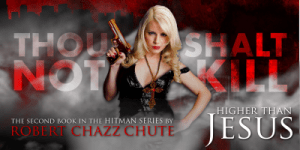
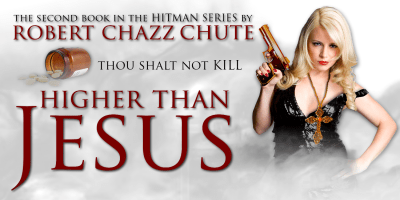
Click the image to get Higher Than Jesus

Often when we think of graphic designers, we only think about book covers. Kit Foster from KitFosterDesign.com sent me this ad this morning. I’m using the white variation above in the Orangeberry book tour. Pretty cool, huh? Kit is not only an author and the sponsor of the All That Chazz podcast, he’s also an amazing designer. He does book covers, web banners, Quote Art and much more. If you have a podcast, you need art. If you need an ad, check out Kit’s portfolio and go get help. Great images grab eyeballs.

Graphic designers can do more than just book covers. Kit is a great consultant. For instance, it was he who suggested that I add a tag line to my covers using the ten commandments to reflect some aspect of the plots through the series. In Bigger Than Jesus, it was “Thou shalt not steal.” In Higher Than Jesus, it’s “Thou shalt not kill.” In the next book, Hollywood Jesus, it’s “Thou shalt not covet.” That tweak added a lot to the look and tone I wanted to achieve. Tweak your covers. Don’t let them lie there, weak and ugly.

I’m so excited about how my books are turning out (which explains how linktastic I am today), I want you to be excited about your books, too. Go write one.

Filed under: publishing, , , , , , , , , , , , , , , , , , , , , , , , , , , , , ,

My crucial brain hack to win #NaNoWriMo

There’s a trick I use for problem-solving, plot twists, brainstorming and inspiration that really works. (I blogged about it long ago, but it’s so powerful, it bears repeating and you probably haven’t seen it.)  This writing tip will be especially useful to you if you’re a pantser, but plotters can use it, too.

I wrote Bigger Than Jesus and Higher Than Jesus (each over 60-some thousand words in about a month for the first drafts) using the hypnogogic state. I wrote these thrillers chapter by chapter, covering at least a couple of thousand words a day. Most nights I went to bed not knowing what adventures and twists my hit man, Jesus Diaz, would face in the morning.

If you’ve read the books, you know  it’s always something surprising. Things go well and things go awry (mostly awry) in clever, unexpected ways. Getting into the hypnogogic state is not hypnosis per se, but this technique does access a state of mind that’s particularly useful for writers, especially during National Novel Writing Month where you need a lot of cool ideas in a short time.
To access the hypnogogic state for greater creativity:

STEP 1: Just before I go to sleep, I plant the seed. What question do I want answered in the morning? (e.g. What will happen to my Cuban hit man in the next chapter? How will he get off that cliff he’s hanging from?)

STEP 2: Go to sleep. No light in the bedroom, no TV. Beds are for sex and sleeping and that’s all. Turn your clock face away so the big glowing red numbers don’t taunt you. Avoid stimulants, alcohol and exercise late in the day. The magnesium in mineral water can help you relax, but don’t drink so much you’re up peeing all night. Do whatever you normally do to achieve a good night’s sleep.

STEP 3: Wake up slow. It’s far preferable if you do not wake to an alarm clock. The time between sleeping and waking is a precious time and you want to prolong it. (That’s what all that great stuff in Step 2 is about, so you don’t need to wake to alarm bells.)

In that time between sleeping, dreaming and waking? That is where you will access your creative genius and, as you slowly swim up to consciousness, ask yourself: What’s the answer? The answer will come to you in that special, relaxed state.

Sounds too simple doesn’t it? It works for me every night and every morning.

~For more writing tips, inspiration and motivation for your journey from keyboard to publishing, pick up Crack the Indie Author Code and Write Your Book: Aspire to Inspire by Robert Chazz Chute. Chazz — a former newspaper journalist, magazine columnist and insider in traditional publishing — now has seven books for sale.

Filed under: publishing, , , , , , , , , , , , , , , , , , ,

Please don’t bet on one book

Your stock of books are doors to your literary house. The more doors you have, the more points of entry you give to potential readers. More is better. More

An electric ceiling fan.

An electric ceiling fan. (Photo credit: Wikipedia)

multiplies opportunities for readers to discover you. Please don’t ask us all to squeeze in one door. Some authors bet they are Harper Lee and one book will take them on a To Kill a Mockingbird rocket ride to the top. It doesn’t work.

For example, I know a nice guy. You probably know one, too. The nice guy I’m thinking of published a novel more than a decade ago. He pushed that one book hard to little success. Recently, I noticed that he’s still pushing it. It’s not that you should give up on a novel’s eventual success in the market. With ebooks, the market is forever, or at least until the sun explodes or the zombies rise. But this good dude has nothing else to sell so he’s presenting a tiny target. That’s good on the battlefield and tragic in the marketplace.

And suppose a bunch of people did like that one book? Then what? They say, “I bought your book! Loved it. What else have you written that I could buy and read and love and spread the word about?”

Silence. Lost opportunity. Lost income. Despair. A rope knotted in a noose tied to a ceiling fan. A tipped chair in a dark room.

This author is a smart and talented guy, so he must have more to say. Somehow, he hasn’t managed to write another book and he’s still hoping readers will line up for that one special book. Unfortunately, the book’s not that special. He’s special. I’m not giving up on him, but he has to write and publish more books.

Being nice and smart and talented isn’t enough.

Write. Publish. Ship. Deliver. Deliver braingasms.

Filed under: publishing, , , , , , ,

Book sales on Twitter: One click doesn’t work

I’ve changed the way I use Twitter. I’m not about making rules for how people use social media. Twitter Narcs are

English: A pie chart created in Excel 2007 sho...

English: A pie chart created in Excel 2007 showing the content of tweets on Twitter, based on the data gathered by Pear Analytics in 2009. (Photo credit: Wikipedia)

annoying. However, by the end of this post, I hope you’ll vary the way you try to sell your books. We’re drowning in the sameness of “Buy my books!” We have to sex up our tweeting.

Most book sales tweets have a crippling weakness that’s hurting sales. Twitter is so awesome everyone is using it to sell books in the same way. That makes it anti-awesome for your book sales. Using a one-click approach, sending me straight to Amazon without providing enough information or value, is not working. 

What doesn’t work well:

Title of book. Go buy it. Here’s the link.

What’s only microscopically better:

Title of book. Review: “Scintillating!” Here’s the link.

The problem:

Too many tweets are trying to make sales by just telling us to buy.

We’re so flooded with ugly tweets, it’s too easy to ignore them all.

What I’m suggesting:

Be more clever and change up the ask. Sure, promote however you want, but give me more to go on than generic messages like: “Great book!” “New post!” “Another new post!”

We need more showing, not telling, in those 140 characters. Give me a clue or hashtag the genre. I want to like you, but dress up a little and show me you care about me. It’s not about you. It’s about us.

Best:

Please pull me back to your blog and seduce me.

I’ll buy, but I need more to go on to make that first click toward falling in love with you.

On World Literary Cafe Tweet Teams this week, I didn’t try to send people straight to Amazon. I provided links to my blog posts, a cool graphic, and my podcast (where I’m giving Bigger Than Jesus away for free one chapter at a time). There’s added value to my audience that way.

Examples:

RT RChazzChute Hear the #thriller Bigger Than Jesus as a #podcast. http://bit.ly/TkBSGs #WLCAuthor (Or buy the book http://amzn.to/Nm6xj4)

RT @rchazzchute It’s a meme, baby! Self-help for Stoners #excerpt & #inspiration http://bit.ly/NNhBDI #suspense #fiction #WLCAuthor   

RT @rchazzchute Hear all the suspenseful #fiction & #comedy #podcasts http://bit.ly/OBRMeT #WLCAuthor #whatwaitsinlocker408

RT @rchazzchute #Thought for the Day: #Creation. http://bit.ly/TUTtVX and The Value of #Writing & #Reading http://bit.ly/Pd1JfN #WLCAuthor

RT @rchazzchute Just working on the next instalment in The Hit Man Series. (Excerpt of the hook to Chap.6) http://bit.ly/SPU7on #WLCAuthor

RT @rchazzchute Did Han shoot first? Catch 2 chapters of Bigger Than Jesus for the explanation. http://bit.ly/S8JgDm #suspense #WLCAuthor

RT @RChazzChute WIP Sneak peek! 1st there was Bigger Than Jesus. Next comes Higher Than Jesus. http://bit.ly/S5dHGT #crime #novel #WLCAuthor

RT @rchazzchute Quote Trailers http://bit.ly/OF1YPp & Quote Art http://bit.ly/NlwJM1 promote your books. #WLCAuthor 

More content and seduction is why Triberr works:

On Triberr, everyone on your tribe retweets your blog post summary (assuming they’ve read your post and have no objections.) Information spreads. Something in the summary captures the tweetosphere’s interest so they come to your blog. They find you helpful, funny, sexy or useful. Do that enough and maybe they’ll get smitten, click on a book link to the “Buy with one click” button.

True, if you don’t send me straight to Amazon, it’s more than one click to buy. However, too many tweets that look the same get ignored because it’s an overload of data without enough information or value. Will there be exceptions? Sure. I don’t think there’s anything wrong with announcements of book launches. I’m what you call, “pro-reading.”

But, please, join me in the campaign against Bland. Bland is so Beige and, as we all know, Beige is the Mitt Romney of the colour spectrum. It seems to be everywhere, but no one’s excited about it.

Filed under: publishing, , , , , , , , , , , , , , , ,

Amazon: My last stab

GET BIGGER THAN JESUS, FREE ON AMAZON TODAY, TOMORROW AND FRIDAY

Free promotions sure aren’t what they used to be. Last December, with Amazon’s old algorithm, friends of mine made big money. Success on the free list actually translated to success on the paid list. Then everything changed and many of us have been slow to react, me included. I notice that, among my writer friends, many (most?) are selling their books on KDP Select exclusively, five free days and all, for the first three months and then they aren’t renewing with KDP. They’ll continue to sell on Amazon, but there are plenty of other places to sell besides Amazon. After that first three months of trying to take advantage of the Amazon advantage, they put their work up everywhere else, too. That’s what I’m doing with the foundation book of my crime novel series, Bigger Than Jesus.

BY THE WAY: 

Bigger Than Jesus is available for free in ebook form

until Friday, and then that’s it.

As The Hit Man Series continues, I don’t know if I’ll go exclusive at all, even for those first three months. The math just doesn’t seem to add up to a marketing strategy that’s advantageous. In truth, it hasn’t been helpful to many indie authors for some time. I stuck with it because of the timing as my previous books launched. I have three books to release before Christmas and the eggs won’t be going into one basket anymore.

Someone asked me recently, “What’s the latest success strategy for indie authors?” I encountered some resistance when I replied, “There isn’t one.” We’ve had the publicists, advertising, press releases, blogging, podcasting, Twitter (and various  derivative Twitter strategies), Facebook, Pinterest (maybe?), the 99 cent strategy, blog tours, free, Goodreads, book bloggers, etc,…. Some combination of these elements may work for someone. Though they’ve all been effective for someone individually in the past, no one strategy seems to deliver a knock-out punch. When I say there isn’t one, I don’t rule out the possibility of their effectiveness in the plural, if you have the time to do all that. (You don’t. Go write instead.) 

Which brings up the question: Will Amazon change its algorithm again so it makes sense for us to stay exclusive with KDP Select? Who knows? Amazon’s algorithms and their rationale may be deduced, but are never made explicit. That information is solely on a need-to-know basis. (Apparently, we don’t need to know.)

Amazon is good at what they do — or has been — but it’s unreasonable to expect they’ll be right all the time, even with their vast resources. More to the point, Amazon’s looking out for Amazon, not me. My evidence is they aren’t making the exclusivity clause worth it for a lot of authors (even the true believers who, in the past, made a lot of dough.) I’m losing sales on other devices because I’m not selling enough with KDP. The Amazon sales don’t make up for lost sales elsewhere. Listening to my writer buddies, it’s clear I’m not alone in that assessment.

This is a business decision and has nothing to do with damning Amazon. I’m not one of the haters whining about monopolies and painting Amazon as a bully. The market is a competition and Amazon is on top because they made a lot of great decisions early on. However, I’m not looking for a new mom to take care of me, either. Being indie doesn’t mean supplanting one boss with a new boss just because it’s easy to go on inertia and formatting anew is a pain in the ass. Next month, as soon as my three months are up, Bigger Than Jesus will be available more widely (Hello Kobo, Nook, Sony, your smart phone, your iPhone, your iPad…maybe even your toaster.)

As for book marketing’s next knock out punch? People will tell you they know what the next big thing is. Some will even try to sell you books based on giving away one ultimate secret of indie author success. I think those people are often well-intentioned and they give out a lot of good information. I’ve read a bunch about marketing ebooks lately and, frankly, I’m also skeptical about some of those easy, plug-and-play answers.

Only one strategy I know of seems like anything close to a sure thing and (WARNING!) it’s a slow, steady grind. It’s not a popular idea because it’s not easy and quick. 

Write more books.

(Do a great job!)

Put them up.

(Do what promotion you can that doesn’t interfere with your writing schedule.)

Write more books.

(Make sure they are wonderful.)

I aspire to inspire, but as for marketing? Hm. Sorry.

“Write more books” is honestly all I’ve got in stock at the moment.

I’ve said it before and it’s still all I have to say on that subject.

Filed under: publishing, , , , , , , , , , , , , , , , , , , , , , , , , , , ,

Bestseller with over 1,000 reviews!
Winner of the North Street Book Prize, Reader's Favorite, the
Literary Titan Award, the Hollywood Book Festival, and the
New York Book Festival.

http://mybook.to/OurZombieHours
A NEW ZOMBIE ANTHOLOGY

Winner of Writer's Digest's 2014 Honorable Mention in Self-published Ebook Awards in Genre

The first 81 lessons to get your Buffy on

More lessons to help you survive Armageddon

"You will laugh your ass off!" ~ Maxwell Cynn, author of Cybergrrl

Available now!

Fast-paced terror, new threats, more twists.

An autistic boy versus our world in free fall

Suspense to melt your face and play with your brain.

Action like a Guy Ritchie film. Funny like Woody Allen when he was funny.

Jesus: Sexier and even more addicted to love.

You can pick this ebook up for free today at this link: http://bit.ly/TheNightMan

Join my inner circle at AllThatChazz.com

See my books, blogs, links and podcasts.

Enter your email address to follow this blog and receive notifications of new posts by email.

Join 2,063 other subscribers