C h a z z W r i t e s . c o m

See all my books at AllThatChazz.com.

Video book reviews, secrets and policies


LMB stars

LMB stars (Photo credit: Wikipedia)


Recently I posted a video review on Amazon. If you can do it to help a book, I recommend it. Novelty gets attention (even with my ugly mug.) Since posting the video review, more authors have contacted me to read and review their books. My TBR pile is taller than I am and my kindle is just about full, so it’s not easy to get to it all (nor even physically possible.) That’s not a complaint. I’m excited at the possibility of discovering a book that pulls me in and makes me think or laugh. I prefer both. I love books. Of course I want to read everything. Since I can’t and now that I’m getting more of these requests, herein lie the secrets that make me want to review your book favorably:


1. I have writing deadlines for my own books and I have a lot to read, so please be patient. I don’t guarantee when I’ll get to it. As you’ll see, I might never get to it, but you’ll prefer my reasoning for not reviewing your book.


2. I don’t give one, two or even three-star reviews. Somebody reading this just threw up their hands or their lunch, but bear with me. This goes beyond the fact that I find most one-star reviews mean-spirited, often nonsensical, sometimes borderline illiterate and they usually treat writers of bad books like their crime is genocide. Even though they probably got it free or for less change than sits under their couch cushions, you won’t find much forgiveness, wit or transcendence in most one-stars.


But it’s not just that I couldn’t bring myself to do that to another writer unless the title actually is Mein Kampf. It’s simpler than all that. If a book is not to my taste, I don’t finish it and I don’t review what I haven’t read. Life is too short and reading something that’s not for me takes too much time. Pointing out good books is more of a service to readers, and a better use of our time, than warning people away from books we don’t care for.


Reviews that are dire warnings are kind of like taking the time to tell me what’s awful on the menu when I’m hungry and anxious to order. I want to hear about your few extra-delicious recommendations and get on with the dining experience, not a litany of what the cook screws up. Or have you ever tried to schedule an appointment with somebody who only tells you when they can’t make it? I want to kill those people. (Okay, I admit it. I have killed those people.)


On a related note: Books that aren’t to my liking will be the best book someone else has ever read. Really. Go check on reviews of books you love on any popular site. See those books that whisked you off to magic realms and changed your life? Now see all those reviews warning you off them? Corollary: Try clicking on a book you despise. See all that five-star, hyperbolic love? Nope, they can’t all be friends and family. Families aren’t that big and writers don’t have friends. We have ex-friends we betrayed and cannibalized to put into our books. All those reviews you disagree with are simply people who are different from you. Weird, isn’t it? I mean, you’re awesome. Why doesn’t everyone want to be exactly like you? Inexplicable! I’ll ponder the problem. In the interim, let’s not take reviews too seriously then, shall we? 


3. If you gift me the copy on kindle to review, you get credit for the sale and it’s also easier for me to wirelessly download it. Easier is better. (Yes, I have Calibre but frankly, not a big fan.)


4. I’m primarily a suspense writer, so mostly I read non-fiction that feeds my other obsessions, mystery, thrillers and some horror. I’ve read a good sampling of many genres, but not everything is for everybody. I don’t and can’t read everything (at least until I get the time machine fixed or become immortal) so please don’t be upset that I must refuse to read your steampunk novel. Even though it’s great, but I haven’t read enough steampunk to create an informed review.


I enjoy William Goldman, Chuck Palahniuk, Thomas Harris, Mickey Spillane, Rex Stout, Lawrence Block, Cormac McCarthy and (swoon!) Elmore Leonard. I’m not into Wodehouse. I’ve probably read more romance than you (my first jobs in publishing were at Harlequin in the Canadian Gigolo Department) but that was for pay and I’ve had my fill of impossibly handsome, rich and capable heroes named Rollo seducing women who are, despite their age, curiously sexually innocent.


5. A four-star review is a compliment, too, and, with all the distrust of five-star reviews, a happy four-star review may be even more useful to you than a five-star. However, I also believe that all that distrust is now way overhyped. If I’m that high on your fiction, you’ll get a five-star review. Ratings should reflect the tone of the review. It’s weird and confusing when the review is full of superlatives but the rating doesn’t show that same enthusiasm, isn’t it? Also, to hold back on a five-star rating for credibility’s sake alone cheats the author and that would be gaming the system, too, wouldn’t it? No one’s talking about that. Some readers within the echo chamber are afraid they’ll get fooled by fraudulent reviews when they could be reading a sample to alleviate those unbearable terrors.


6. I’m nice. I’m acting as a reviewer, not an editor. The review is not about me and this is not a teaching opportunity. I do not scold or lecture authors.

Some bad review habits are egregious. I don’t do things like this: “I wish the story had gone in a different direction,”; “I would have done it differently,” (of course everyone would do it differently!); “Too much swearing!” (that’s usually the realism leaking out); “The level of sex bothered me” (unless it’s BDSM in a children’s book, someone else enjoyed it); tiny grammar niggles; minor factual quibbles; and, finally, rest assured that my world doesn’t collapse when I spot a few typos. I don’t count them in a review. I find that petty and off the mark.


Also fitting under this category, let’s walk through what I think is on the mark: Some readers worry that writers are too nice to other writers. Sometimes the opposite is true simply because writers read as writers. We’re not enjoying the flight and looking at the clouds. We’re thinking about the workings of the engines that bear us aloft and how that knocking we hear is going to make the plane crash into the ocean. That attitude can suck a lot of joy from the reading experience, as any enlightened first-year English Lit students will tell you. Most readers don’t read like that! They aren’t as stringent nor are they strident. Most people really just want a good story and that’s what I’m looking for when I read a book to review it.


7. What does bother me: Fiction that requires the characters act like idiots for the story to work (e.g. incompetent henchmen and goals too easily achieved); stories that don’t work within their worlds unless I’m an idiot; deus ex machina; not enough conflict and tension; fiction without non-fiction ideas (your grade eight teacher called them themes); and clichés that aren’t twisted. (A twisted cliché makes something new and unexpected out of something worn out and expected.) 


8. What I like: I enjoy snappy dialogue and a sense of humor if it suits what you’re trying to achieve. Often at least some levity is exactly what even the most sinister stuff needs to switch up the mood and avoid the drone of a monotone. Try to induce a range of emotion. Ups and downs make roller coasters.

For example, one of my WIPs is a dystopian novel about an autistic child in the middle of a plague that kills most people on earth. That doesn’t mean I don’t make some jokes. For a slightly better known example (ha!), The Dark Knight Rises, as good as it was at times, needed a little more of Joss Whedon’s lighter touch from The Avengers. DKR had elements of opera at its high points and long funeral lows. I prefer stories with more range.


I enjoy fiction that achieves what it set out to achieve. For instance, you won’t hear something silly from me, like a complaint that Abraham Lincoln, Vampire Hunter is “not historically accurate.” Yes, even a professional reviewer did that and, oh my Thor, if I have to explain why that’s upside down, please stop reading now and go watch Honey Boo Boo. Please!


9. I do not include spoilers. A good review doesn’t recount the plot and suck the joy of surprise and discovery out of the work for potential readers. I say what I liked and how I reacted to the characters and setting. I say how the story affected me emotionally or intellectually. I react to the experience of reading the book and what makes it interesting to me and unique. (Unique often doesn’t work, but when it works, swoon!)


10. Most reviews will be pretty short. A video review longer than a minute is not watched. If I review a book, I’m sharing my enthusiasm and yes, I’m unabashedly trying to sell your book to potential readers. I made it through the reading and reviewed it, so naturally I’m sharing and spreading the joy of your work with readers who enjoy your genre.


For me, reviews are about finding the like-minded. There are plenty of good and even great books out there. Let’s go find the good ones and focus our energies on spreading that good news. 


Filed under: publishing, , , , , , , , , , , , , , , , ,

Bad Contract? It’s Your Fault, You Naughty Author | The Passive Voice

See on Scoop.itWriting and reading fiction

Passive Guy raises eloquent objections about an agent’s defense of stringent publisher contracts. 


It is disturbing how many times I’ve seen some agents defend the status quo. It’s as if they’ve forgotten who they’re working for. Draw your own conclusions at the link. ~ Chazz

See on www.thepassivevoice.com

Filed under: publishing

Are ebook contests worth the entry fee?

Usually I’m here spouting my opinion about publishing or sharing what I find that’s useful for indie authors.

English: Ribbon for contests

English: Ribbon for contests (Photo credit: Wikipedia)

Today, I’m asking for your opinion of ebook awards. Help me with this, please.

I just ran across PIA (Publishing Innovation Awards), for instance. It’s $199 to submit a book in a single category. Wow. (That qualifies as a “wow” because it’s the most expensive contest I’ve seen.) Huge companies are behind it, which is reassuring, though one wonders how much their corporate sponsorship has put a dent in that entry fee? Most entry fees for awards available to indie authors seem to be in the $50 to $69 range. The one I’ve spotted that’s free to enter is also no doubt the best known: Amazon’s Breakthrough Novel Award. Other awards ask for a more hefty fee for one book but you can enter a second book at a much reduced fee.

I googled for reviews of some of these contests, but that got me pages and pages of the winners trumpeting their books (not reviews of the contest experience itself.) Maybe that means these awards are totally worth the expense of entry and the winners gained readers, provided social proof of excellence and improved sales. A seal of approval on any book is no doubt somewhat reassuring to potential readers, even if they’ve never heard of the award.

FYI: The Book Designer has a handy list of contests here. It’s a little out of date but most of the information still applies. Note that it’s just a list, not an endorsement of any particular contest.

I’ll start you off with this observation: My first thought about the QED award was that it looks good and has a happy track record according to their website. There was an awful lot of reading and pitching before I found the cost of entry. (It’s on the FAQ page, though I’m not sure what the alternative $125 for QED consideration might include. Is $125 for getting evaluated on their 13-point form? Hm.) The search for the contest fee was annoying. If the QED is an awesome opportunity and I’m a fool for hesitating, jump on it. Their deadline is November 15.

What’s your experience? Do contests for authors excite you or are you suspicious some may be merely moneymakers for those who conceive them? Would you enter your books into a contest or is your promotional budget best spent elsewhere? I welcome your thoughts and comments. Thanks for helping me with this.

Filed under: publishing, , , , , , , , , , , ,

The Next Big Thing Blog Hop

The foundation book of the Hit Man Series is available as an ebook and in paperback.

I’m in the middle of revisions on next my crime novel, so I’m grateful that the amazing Bridgette O’Hare suggested the Next Big Thing Blog Hop. As I creep closer to publishing Higher Than Jesus, she asked me ten questions about my Work in Progress. Ta-da!

What is the working title of your book? 

Higher Than Jesus (It’s pronounced “Hay-soose”. The “Higher” is a reference to drugs and thrills.) This is the second in The Hit Man Series. The foundation book was Bigger Than Jesus (released in June.) Five books are planned in the series so far. It’s a lot of fun, because stuff we thought we knew about Jesus Diaz from the first book go deeper. He has a darker past than I revealed the first time around and there are a lot of layers to his onion. The one thing you can count on with Jesus is that not much ever goes according to plan.

Where did the idea come from for the book?

The main character began with a cool idea I had for a suspense story called “The Inevitable” which appeared in my first book, Self-help for Stoners. Our first glimpse of Jesus was as a Cuban hit man who helps out women going through ugly divorces. That’s actually a glimpse of Jesus in the future, as a more experienced, mature assassin.

What genre does your book fall under?

Suspense, thriller, action/adventure. Whichever category appeals to you more.

Which actors would you choose to play your characters in a movie rendition?

I picture Enrique Eglesias as Jesus right now, but I’ve thought John Leguizamo, too. For the role of Willow Clemont, I’d need a very tall blonde glamazon. I’m not sure which actress fits the bill best. I’m not up on my tall, blonde actresses. As for the role of Chilli Gillie (another recurring good guy character from my Poeticule Bay Stories) who shows up in Higher Than Jesus, it’s kind of a sore subject. I pictured Michael Clarke Duncan. Sadly, he just died of a heart attack. I note Chilli’s resemblance to Mr. Duncan several times in the book and now I’m debating about rewriting that aspect and how to do so.

What is the one-sentence synopsis of your book?

In Higher Than Jesus, luckless hit man Jesus Diaz is on the run in Chicago when he takes up a mission to free himself and his girlfriend from addiction to Vicodin and to thwart the evil plans of a group of gun running white supremacists.

Will your book be self-published or represented by an agency?

I’m published by Ex Parte Press. This is the one company that cares most about my book. It’s my company.

How long did it take you to write the first draft of your manuscript?

The first draft was a month or two. I write fast. Then the long editorial tail kicks in. That has more people involved, and so, more variables.

What other books would you compare this story to within your genre?

The pace of Blake Crouch’s Run had a big impact on me as well as an old book by William Goldman called Edged Weapons. I like a book that skips along at a fast clip with lots of chuckles and clever surprises. I should also add that fans of Bigger Than influenced Higher Than quite a bit. Everyone commented on how funny Bigger Than Jesus was in unexpected ways. From what fans said, I decided that I needed to keep the pacing and reversals of the first book, but to always look for the humor in situations that aren’t all that funny. That’s what I do on and off the clock, anyway. I think finding the cosmic joke is what we all have to do to get through every day.

Who or What inspired you to write this book?

I have a dopamine addiction, so I’m compelled to write. I was born this way. Why write this book in particular? I read a lot, but I’m having a hard time finding this sort of book. Humorous books don’t tend to have a lot of action. Books with a lot of action often fall short on humor. I love snappy dialogue, so I probably owe more of an inspirational debt to the Coen brothers’ movies and Quentin Tarantino movies. If you can’t find the book you want to read, you have to write it.

What else about your book might pique the reader’s interest?

There’s a lot in there that provides deep context and verisimilitude for the plot, like some controversial observations about talk therapy, PTSD and drug addiction. My wife is a psychologist and I had to warn her that Jesus comes down hard on talk therapy, but it’s mental stimulation I’m dealing out. I’m not presenting Truth with a capital T, but an opinion from a guy who has serious problems, like killing people for a living.

Also, as a former military policeman, Jesus uses some clever surveillance tactics, skip tracer ruses and knowledge about IEDs that are all drawn from real life. Between research and some things I picked up from experts, the story yields some fun, interesting details and new twists that will amaze. Promise.

Who’s up next in the Next Big Thing Blog Hop? Look for more posts next Wednesday from:

The always-encouraging Jo Michaels, the lovely Jordanna East, the historically mysterious Laura Seeber, lover of all things just Lee Ann Sontheimer Murphy and the ever-enthusiastic Ronald Fischman.

Related articles

Filed under: publishing, , , , , , , , , , , , ,

Quote Art: A new way to promote your books

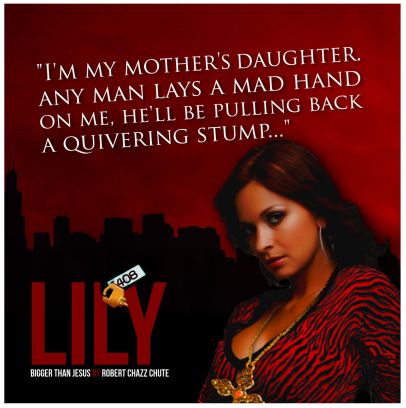
This is not a book cover. It’s Quote Art for my suspense novel, Bigger Than Jesus. The quote is pulled from the book. The art is by Kit Foster of KitFosterDesign.com.

Jesus Diaz is my luckless Cuban hit man in the first of the Hit Man Series: Bigger Than Jesus. (It’s pronounced “Hay-soose”.) Follow his exploits as he tries to escape New York’s Spanish mob with a fortune in stolen mafia money and the lovely Lily Vasquez.

Great book covers sell books. Now picture a quote pulled from your book with another compelling, related image. See it on Facebook, as a Twitpic, on your author site or as a poster at your next book signing. Quote Art is a different way to promote your books to new audiences. It’s a clue about your characters and another chance to intrigue potential readers. Why try to grab them with just one image when you can hold their attention with more using a new, integrated and savvy marketing tool?

Click it to grab the paperback or the ebook. Thanks!

Kit is my graphic designer. If you’re a regular reader, you know I’ve already sung his praises. Now I’m complimenting him for his innovation in doing something a little different to help me spread the word about my books. Thanks again, Kit!

To find out more about his book cover designs and to see samples of his art,

go to KitFosterDesign.com.

Want another marketing tool to build buzz?

I need a couple more volunteers for my Next Big Thing Blog Hop post. If you have a work in progress you want to build some buzz about, I have two more spots available for this event. All you have to do is answer ten quick questions about your WIP and post them on your blog a week from Wednesday. You link back to me and I link to you and the word spreads farther. Volunteer at expartepress@gmail.com and I’ll send you an email with the blog hop specs.

I’m doing another blog hop in the near future, so watch this space.

Filed under: publishing, , , , , , , , , , , , , , , , ,

Self-Publishing Myth #2 – Self-Published Authors Don’t Sell Any Books • Ryan Casey

See on Scoop.itWriting and reading fiction

A series of blog posts dispelling the most common self-publishing myths, this week that self-publishined authors don’t sell any books.


This is a thoughtful and encouraging post by Ryan Casey. See what you think at the link below.

As far as putting ourselves out there goes, I have noticed many  people assume that traditionally published authors have all their marketing taken care of for them. In my experience working in traditional publishing, that wasn’t even true a long time ago. I worked for a bunch of publishers and the publicity departments generally weren’t that great at what they did. What they did well, anyone could do. Proactive authors did and do better.

By the way, I approached a bookstore about stocking my books and doing a book event. They couldn’t have been more gracious and it wasn’t at all intimidating. It was a friendly chat. Though bookstores aren’t my main focus, it’s nice to see that what many consider an obstacle to the self-published isn’t necessarily a big hairy deal. ~ Chazz

See on ryancaseybooks.com

Filed under: publishing

Literary Pet Peeves Are Counterproductive

See on Scoop.itWriting and reading fiction

My literary pet peeve is readers who have pet peeves. That’s a statement that surely won’t make me popular, but stay with me for a second. Hopefully I can get you to see things a little differently.

For good reasons that are known to people who actually read it, I wrote my crime novel, Bigger Than Jesus, in second person, present tense. After reading someone’s decree that any author who dared to try such an abomination would be immediately written off, I like this article. ~ Chazz

See on www.huffingtonpost.com

Filed under: publishing

Jackie Barbosa: “Devaluation” & Other Pricing Myths

You think your book is too good to go for such a low price? I think so, too…or rather, that’s what I feel. However, author Jackie Barbosa makes a great case for why we shouldn’t listen to those diehards who believe a low price must indicate that we’re trying to fob off a crappy book.

For instance: “…unfortunately, writers can’t make their living by depending solely on the readers who see a higher price point as a sign of quality. We have to appeal to the readers whose impulse buy point is free or 99 cents or “look, it’s under $2 and on a bestseller list so it must be a good book.”

I love this post. It’s tastes vinegary, but it’s good for us to keep in mind when we set prices for our books.  

Read the entire argument by Jackie Barbosa here.

Filed under: publishing, , , , , , , , , , ,

The Great Review Controversy, Take 2

From The Telegraph: A best-selling British crime writer, RJ Ellory, used pseudonyms to pen fake glowing reviews about his “magnificent genius” online while simultaneously criticising his rivals.

Read the link? Wasn’t that frustrating?

This time it’s a writer from the traditional side of publishing who has disappointed and embarrassed himself. As bad and individual as the act is, I’m relieved he’s not an indie author. Blame has been spread  around like confetti at a clown rally lately and I don’t want any more glitter in my jock. Will the fact that he’s traditionally published buy indies any more slack? No, but it probably won’t make things much worse for us. It’s so difficult to get reviews and build an audience that I find it disheartening to be painted with mile-wide brushes. I’m trying to make a living as a suspense novelist here!

Instead of distrusting five-star reviews — or automatically believing one-star reviews — I wish more people paid attention to reading samples. I encourage everyone to read book samples before clicking “buy” (even when, perhaps especially when, it’s “free”).

Reviews get too much weight in some people’s minds. My tastes aren’t necessarily yours, so why give so much power away to another when making reading choices? I read book samples to avoid unpleasant surprises. The first chapter usually gives me a glimpse of the quality and tone of what’s to come. Some people fail to exercise the reading sample option and then blame the author. “I wanted romance and this is fantasy! How dare she?” That’s like getting angry because the drugstore doesn’t sell coconuts.

Is Amazon really “Spamazon”? It’s the Internet. Is the fault in our tools or in ourselves? To confront the problem of bad reviews, fake reviews and attack reviews, we need to grow up, do our due diligence and keep things in perspective. You don’t believe everything you’re told. Fine. Enjoy those free reading samples and make better informed choices before the too-easy click.

Indies are mostly beautiful dreamers and bold, generous storytellers. We are not all evil scammers out to fool readers. Many of us tell entertaining stories with few resources and we perform this service for the equivalent of couch change. It’s churlish to make all authors collateral damage for the offences of others.

When the NY Times story about paid-for reviews broke last week, I was initially forgiving and didn’t take it so seriously. John Locke, for instance, may have paid for reviews, but he said he was open to honest opinions as well and he still wrote all his books which, nicely reviewed or not, a lot of people like. I wished he’d mentioned the paid-for-review strategy in his how-to book in the interest of full disclosure, but at first I figured his tactic just sped up his trip on the success train. However, when I saw so much negative reaction from potential buyers, I got sad. Unfairly or not, it hurt our reputation.

Then I realized I couldn’t approach Locke to ask for a cover blurb for my next book in The Hit Man Series. He was on my short list of authors I planned to ask for an endorsement. I’m not assuming he would have gone for it. I’m just terribly disappointed because of the damage done. (That cry of “I’ll never read indie again!” really got to me, silly as it is.) I read a few of Locke’s books and enjoyed them, but now his name is tainted with the “Paid for Reviews” badge. He’ll recover from this. Locke has a huge fan base who don’t care about this controversy. It’s probably too inside baseball for most and for people who are already fans, why would they care?

It hurt me and fellow indies, though (and we don’t have that big cash cushion to ride out the bad weather.) You know that saying, “Save a horse, ride a cowboy”? Indies need a bumper sticker, too: “Save an author, buy a book.”

Hm. That’s not near as sexy and catchy. Suggestions?

Filed under: publishing, , , , , , , , , , , , , , , , , , , ,

Paid Book Reviews: Where Do You Stand? • Ryan Casey

See on Scoop.itWriting and reading fiction

Paid book reviews are becoming an increasingly common trend as competition increases in the indie publishing world. Where do you stand?


I was unaware that paid reviews are “an increasingly common trend.” (Really? Wow. It seems like such a low priority way to spend a lot of money.) The NY Times article’s subject was about a defunct company that supplied paid book reviews. No matter. I wouldn’t pay for reviews personally. Put aside the moral question for a second: I can’t afford it and I don’t think they work, anyway.


This issue has rolled around the web for the last week. I’ve been so busy with writing and promoting that I haven’t done anything much with it. Initially I wasn’t that bothered about bought reviews. I’d be more upset if I thought all those paid-for reviews made that much difference.


But then I noticed something ugly. Since the article has spread, a sad unintended consequence has risen. I’ve read comments from a bunch of people  (potential readers!) saying they never trust any five-star reviews nor will they ever buy indie! But, hey! I earned my five-star reviews! I don’t have many reviews, but I didn’t pay for any. Why the broad brush of discrimination? I’m I to answer for all the crimes of others? I’m an innocent man, dammit! Also? Sheesh!


See what you think at the link. Here’s Ryan Casey’s take…~ Chazz

See on ryancaseybooks.com

Filed under: publishing

Bestseller with over 1,000 reviews!
Winner of the North Street Book Prize, Reader's Favorite, the
Literary Titan Award, the Hollywood Book Festival, and the
New York Book Festival.

http://mybook.to/OurZombieHours
A NEW ZOMBIE ANTHOLOGY

Winner of Writer's Digest's 2014 Honorable Mention in Self-published Ebook Awards in Genre

The first 81 lessons to get your Buffy on

More lessons to help you survive Armageddon

"You will laugh your ass off!" ~ Maxwell Cynn, author of Cybergrrl

Available now!

Fast-paced terror, new threats, more twists.

An autistic boy versus our world in free fall

Suspense to melt your face and play with your brain.

Action like a Guy Ritchie film. Funny like Woody Allen when he was funny.

Jesus: Sexier and even more addicted to love.

You can pick this ebook up for free today at this link: http://bit.ly/TheNightMan

Join my inner circle at AllThatChazz.com

See my books, blogs, links and podcasts.

Enter your email address to follow this blog and receive notifications of new posts by email.

Join 2,063 other subscribers