C h a z z W r i t e s . c o m

See all my books at AllThatChazz.com.

Writers, Readers, Nonsense and the Perpetual War on Anonymity

I have secrets to reveal about the true source of my fearsome power. And jokes. And weird East Coast expressions. Click the cover to get that article.

I have secrets to reveal about the true source of my fearsome power. And jokes. And weird East Coast expressions. Click the cover to get that article.

We complain about having to market our books. It is tough and I wish there were more and better missiles for the War on Anonymity. A few things to keep in mind:

1. Traditional or self-published, you’re still stuck doing most of your own publicity. No one will save you. You’ll have to save yourself. If you’re in the right mood, that statement can, theoretically, feel empowering.

2. Some strategies won’t work. Dump them and move on. You will, however, have to make some forays and investments here and there. Don’t let holding on to a little money now hold you back from making more money later. The risk-averse always arrive late to the party after all the daring, beautiful people have gone home with each other for a Chess Orgy…or whatever it is the beautiful people do.

3. You are not above marketing. I mean, unless you don’t care if anyone reads your work. Hm…actually, that would be quite freeing.

4. Everybody can and should do something to sell their books. Too shy does not serve you. Bookbub costs money, sure, but it’s effective. There’s also a lot you can do that costs nothing but time. I’m doing it right now and you’re watching. Is it hot in here, or is it just you?

5. When something is less effective than it used to be (Bookbub, KDP Select, pleading for sex) that doesn’t mean it’s not at all effective. You may have to spank your rump harder to get going, that’s all. 

6. When I see those tweets from collectives trying to sell books for authors, more often than not, I’m turned off.

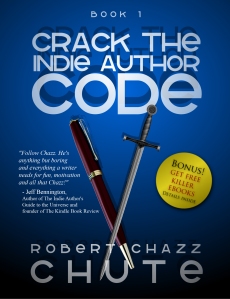
By the way, Crack the Indie Author Code 2nd Edition is out in paperback at $9.99. Smaller format, same old information if you need a NaNoWriMo kick in the inspiration. With jokes.

By the way, Crack the Indie Author Code 2nd Edition is out in paperback at $9.99. Smaller format, same old information if you need a NaNoWriMo kick in the inspiration. With jokes.

Sorry, it’s a visceral thing that is not routed through my brain. I’m not saying they’re all bad or that you shouldn’t use those services. It’s that image of one person acting relentlessly enthusiastic about the constant steam of recommended books that bothers me. Equally enthusiastic and paid to be so. It doesn’t feel organic.

I would say that if outsourcing to others is your only strategy, your rocket needs more fuel.

7. The best is when an actual reader loves your neuro-fudge book mojo so much, she has to spread the word to share the adventure to her friends so she will, in turn, gain love, respect and immortal life. Word of mouth is the hardest cake to find, but it’s the tastiest. You start by asking friends to read your book. If you’re like me, you run out of friends fast, so you have to get used to engaging strangers. I’ve made a lot of friends out of strangers lately. I like it. I wish I’d known how to chat in high school.

Facebook is your friend (except, of course, when Facebook is evil.)

8. Stop just looking for mentions of your Twitter handle and go discover more people through Twitter.

Blogs lie there, hoping to be discovered. Blogs used to be so come-hither and stick your tongue in my…um…ear. Now blogs are feeling entitled to the attention they no longer receive, getting drunk and screaming at the DJ to play Copacabana. (See, this is a blog and you’re losing interest now, but I’ll mention Silver Surfer, Klingon and a date gone bad soon, so read to the end.)

With Twitter, you go find people who are talking about your areas of interest. I’m fascinated by neurology, psychology, brutish and funny poetry, autism, comedians, alternative health, weird facts, pathology, writing, publishing and righteous vengeance as a lifestyle choice. I will never run out of new strangers who might become friends. You won’t, either. We’re writers. We’re at least a little interested in lots of things. (Search hashtag #zombies and #vampires and #agoraphobia, #writing, #insomnia, #anxiety, #depression and #headaches, slam-bam-boom…the info-cornucopia only ends when the EEG is a flat line and your heirs start arguing over your Hummel figurines.)

Aren't you sick to death of me telling you what to do? Click the cover to read jokes and confessions about my life in Not-Maine.

Aren’t you sick to death of me telling you what to do? Click the cover to read jokes and confessions about my life in Not-Maine.

9. Big-time authors who have an assistant tweet for them? Nobody’s “big-time” enough for that. Galactus could write a book and (even though he’s his herald!), if the Silver Surfer tweets about Eating Planets for Fun and Profit, we riot and unfollow.

10. There are dozens of technological solutions to most of your marketing problems, but you have to get out there. I appear, at times, curmudgeonly and a contrarian. The jokes make that easier to take…in short bursts. No technological solutions can help you if you’re a pain all the time. Don’t do that.

Do this: Be friendly. The more readers you gain, the easier it is to be friendly. Get out on Twitter and meet people. Learn about them. I like learning things. That’s an excellent place to start, and think of all the high school trauma I could have avoided if I’d known how to talk to humans.

Also, get off Twitter and meet real people at book signings, fairs, conventions and readings. Be the best you that you can attain and all that rah-rah Anthony Giant Within Robbins stuff. (Hey, that works for some cult members!)

I rush in where devils fear to tread.

On November 14 at 7 pm I’ll be interacting with actual humans in the Meatspace of London, Ontario’s Central Library. Author Mark Rayner and I will give readings and answer questions about publishing, writing and discuss the people of Whoville and how we can fight The Great Suessian Nostril Menace.

I will drink champagne from an old lady’s boot while doing a ventriloquist act with Mark on my knee. Then he’ll breakdance for about two hours straight while I recite Klingon love poetry. We work without a net, so if you’re in the area and want to see me stammer while being bludgeoned, this is the best blunt force trauma event of the night. (Lesser blunt force trauma will be at play after the show at Joe Kool’s.)

Last chance to read the blog post about Not-Maine. People with ten toes will want to check this out. Unless all the toes are on one foot. Those freaks need to move out from under the power lines and then click the link and get a few grim laughs at ThisPlagueOfDays.com.

~ Not to be too forward, but you’re very attractive and I’m feeling very drawn to you. Feeling down and vulnerable and mad at your dad? Oh, good! I thought you looked like the sort of adventurous person who needs something special tonight. The way that dress clings…I mean…wow, have you even tried fabric softener? How about you come with me? You can lie down, put some Nina Simone on low so she won’t burn, and have a sweet, hot book. C’mon back to my place. The drinks are on the bar and the books are in the sidebar. I’m Robert, by the way. Robert Chazz Chute…Isn’t that last name quite unfortunate? Buy my nonsense! Hold my books! Ease the pain…sir? It’s one night early for Halloween. I didn’t recognize you in that dress…dad. Well, this got awkward fast.

Filed under: author platform, , , , , , , , , , , , , , , , , , , ,

Top Ten for Writers: What matters?

1. Don’t take a paragraph (or a whole post!) to apologize for not posting to your blog recently. They didn’t notice your absence. You have their eyeballs for a few seconds now. Don’t waste their time with throat-clearing or they’ll click away because you don’t have anything to say.

2. “Cover reveals” don’t attract anyone but the people who are already into you. They might not hurt. I’m saying they don’t help. Find a topic that matters to you and your readers instead. To spin an old quote, mere familiarity breeds contempt, but commonality makes friends.

3. Character interviews may be interesting to a few people, but only after they’ve read your book. It gets no new readers. Character is revealed through dialogue and action within the book. In promoting a book, it’s boring without narrative content and context.

A better suggestion:

Soon I’ll interview author Mark Rayner for the Cool People Podcast. When I asked him what he’d like to talk about, he didn’t say his characters, publishing or his writing process. He wants to talk about the themes of his book. I’m looking forward to a cool interview about the singularity and how technology affects all our lives, for good and bad. It’ll be less about him and and his book and more about readers. Then they’ll want to buy The Fridgularity, his funny, smart, entertaining novel.

4. Lose long dedications in ebooks. I’ve done this because I have much for which to be grateful, but it cuts into the online sample. Stick it in the back or put a link to it on your author site. Active links to your websites and other books will expand your circle. Your inner circle will understand.

5. The Table of Contents in your ebook doesn’t have to be in the front. That’s inertial thinking from paper publishing. For fiction, at least, stick it in the rear of the book. They can get to it on their e-reader, if they want it, by hitting “Go to”.

This is especially egregious when you have a long, dark poem as a TOC (as I do in This Plague of Days). It’s something else that cuts into the length of the online sample if it’s up front.

6. Do not complain about the demands of marketing your books. That’s telling readers that trying to reach them is a burden and they are unworthy of your time.

I’m still seeing this. Any potential reader who’s done manual labor, worked retail, been unemployed and/or worked for a boss? Yeah, they all hate you when you complain about being a writer. We have the best job on earth. Even if we aren’t getting paid for it yet, it’s still that awesome.

Instead, do what’s fun for you in otherwise unproductive time, after you’ve hit your word count for the day. If a Twitter account in the voice of your character is fun for you, try that. Unless your character is amazingly funny, profound, unique or wanted for spying by the NSA, it probably won’t pay dividends, but at least you’ll be having fun.

Connect on Facebook with people. My most meaningful interactions probably happen there. Since a reader helped me identify how my Facebook settings shut people out, I’m interacting with more people.

You can even go out and meet people in the real world. I understand non-virtual, human interaction is still a thing. I read about it on the Internet. It sounds dangerous, but you can sell paper books that way.

7. The demands of the work drain our energies so we talk too much about being a writer knocking back coffee. I’ve done it, too, and it’s cliche. Time to say something new. Something about wrestling elementary school teacher-dragons naked maybe. Hm. Gotta work on that metaphor so it sounds less fun.

8. Cramming too much information on your business card doesn’t work. Trying to cram the whole story on your book cover doesn’t work. Any promotional stuff that is too long doesn’t get read. Get your graphic design and white space to do more of the work for you.

The British Special Boat Service’s former motto was “Not by strength but by guile.” Good news! We’re writers! We have the resources to use guile. Writers and small publishers don’t have enough money to attack with strength.

9. Speak with. Engage with readers. Do not talk at readers so much. Talk less about you. Talk more about them. (Nice jammies you’re wearing today, by the way, and I especially like the lacy, red bustier…sir. Better turn off that laptop cam.)

10. Talk more about what you love and less about what you hate.

People enjoy reading about what people hate, but they don’t like the hater or even believe them. For readers to get to know you, they want to know what you’re for and what you read and what you think. Or that you think. Talk about what matters, both to you and to them.

Some writers steer clear of religion and politics for fear of offending.

Sounds like a quick way to be irrelevant and bland.

As a writer, your ability to communicate makes you important to any heavy discussion. You can even contribute as a human being. Your thoughts on violence, poverty and all the ills of the world are far more important than your little writing career. If someone doesn’t read your book because you’re a vegan, for instance, do you really think you’re missing out on a thoughtful and fair review from that person?

Kids are starving and you’re really worried about losing a few reactive sci-fi readers because you’re for X and they’re for Y? Really? Surely the kids are worth losing a few bucks, aren’t they?

I’d rather express my politics on Facebook from time to time. I’d rather win more readers I like. I don’t have to have readers who agree with me about everything. However, I don’t write books for dumb people. Trying to be liked by everyone is chasing a goose into an acid factory that’s on fire. We may be poor and desperate for readers. That doesn’t mean we have to be pathetic.

But yes, it does matter that reasonable readers generally like you. (So follow the Wil Wheaton edict and “Don’t be a dick.”)

I don’t want people to be excited to read the next This Plague of Days. I want them excited to read the next book by Robert Chazz Chute, no matter if I’m writing about zombies or Shakespeare or my funny assassin. Most readers tastes are very genre-specific, but if they like you, they’ll try your other stuff.

I’ve read all of Stephen King’s work except for The Dark Tower stuff. But I did try it. That’s all anyone can ask. After that, it’s down to individual tastes.

So be nice. Be authentic. Be committed to The Good.

And write good stories. Tell the truth through lies. Bypass prejudice and reach their minds by making them laugh first.

Writing good stories will get you more readers. Write great stories and that will come. Or maybe it won’t, but the writing and the stories matter. It matters much less than starving children and nuclear proliferation, but be fully in this world as you create better worlds.

To be heard, we must have something to say that matters to readers.

Filed under: author platform, Writers, writing tips, , , , , , , , , , , , , , , , ,

#VIDEO: Jumping into the Plague of Days serial?

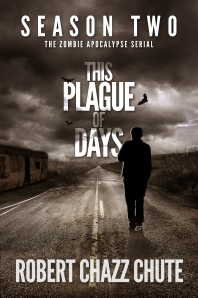
This Plague of Days 2 E1 0918 AMAZONSeason Two, Episode 1 is now out for 99 cents. There are five episodes in each season, released one week apart.

Or, grab the complete Season Two for just $3.99 until November, 2013. (There’s a chapter that fills

Season 2 is the quest.

Season 2 is the quest.

you in: “Previously in Season One“.)

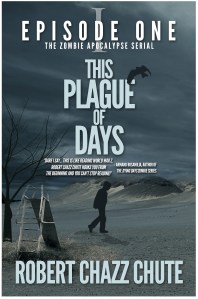
Season One of This Plague of Days is the siege.

Season One of This Plague of Days is the siege.

You can also get Season One of This Plague of Days here.

It’s kind of like writing for TV, but the imagination’s budget has no limit.

 ~ To learn more about This Plague of Days, check out ThisPlagueOfDays.com.

Filed under: This Plague of Days, , , , , , , , , , , , , , ,

Marketing books: Thirteen video options

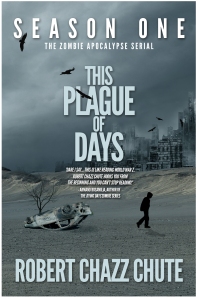
Season One of This Plague of Days is free until midnight tonight.

Season Two launches in two weeks.

Book trailers are problematic. Video can be done well. It often isn’t.

Most of them are too long. Production values are typically lower than viewers’ expectations. We’re trained to expect CGI on the level of major movie studios. Also, there’s little evidence trailers generate any sales. Go big and you’ll spend money with no return on the investment. Go too small and you might not be proud of it. Here are magnificent options, ranging from giving up and doing zilch to going big. Since I’m in touch with reality, most options are no-budget or low-budget.

Alternative 1

Don’t do it. It’s not worth the bother.

Alternative 2

Play with iMovie in your spare time. If it’s fun, great, but certainly don’t lose writing time to it. 

Alternative 3

Rather than worry about making a little movie and learning an editing program, do six seconds on Vine and/or fifteen seconds on Instagram. Focus on one quick, easy message. Don’t spell out the link to the camera. Leave the link in the caption. Note that people love video with cats.

Alternative 4

Upload to Youtube from your camera, iPod, iPhone or Android. Viewers will be more forgiving of low production values if they see you didn’t try to make it fancy. Just talk to the camera with a joke and/or announcement.

Alternative 5

Video pulls more clicks to your blog. Combine it with punchy posts for greater effect and more subscribers.

People have more tolerance for a short, laid back video than they will for long blog posts. For instance, yesterday’s post went deep into serialization and book pricing strategy. It was only for the most serious of book marketers and publishers. However, many more readers will click the video above and read this blog post for information because it has video and the text is breezy and scannable.

Alternative 6

Focus on what’s cool or ironically cool. Make it fun for you and the viewer. Try for the opposite of earnest and don’t try to tell too much of the plot of your book. Let the visuals do more work. Entertain first and come sideways at giving out information. One of the best book trailers I’ve seen was an author who talked about the glamour of the writing life while he scrubbed toilets.

Alternative 7

As I’ve suggested in the past, try a quote trailer. A quote trailer simply pulls intriguing quotes from your book. Don’t forget to include a buy link. Keep it short. No spoilers.

Alternative 8 

Use Animoto, as I did, for the video above. I already had the book covers. It took all of five minutes to use the free option for a video shorter than 30 seconds. The fire effect was appropriate and the music was a nice fit. Cool, huh? Animoto includes sharing options so you can export it to Vimeo, YouTube, Facebook, etc.,…

Alternative 9

If people don’t respond to your stabs at filmmaking, try making it more about you and how you can help others instead of making it about the book. Video reviews and how-to stuff get more hits. Funny’s always good, too.

I put up video of my podcasts to get more viewers and listeners. Some people simply prefer video to audio, or a YouTube video is how they will discover a podcast. Interaction in an interview setting can be easier to pull off than talking directly to the camera. Some people, like Hugh Howey, do it well and even dance for reviews. For most of us, solo videos look like hollow-eyed, stuttering hostage videos pleading for ransom under the threat of death.

Alternative 10

Have you set up your YouTube channel yet? It’s a great place to collect your video book reviews, too. Video reviews get more attention on Amazon than written ones, so it’s worth doing, for you and for authors.

Alternative 11

Go with Fiverr.com and get help to create quick videos like I did for my promotion plan for This Plague of Days. Check out my video samples at the link.

Alternative 12

If you really want to go big, get a semi-pro involved. There’s no proven ROI and most professional video production is expensive. Therefore, consider approaching a drama class or a film school. If your book trailer becomes a school project, at least your vanity project will benefit the education of a young actor or filmmaker in a concrete way. You could go the Scott Sigler route and make it a contest. Since every entry went up on YouTube for judging, Sigler’s books got multiple ads and multiple hits.

Alternative 13

I think Kevin Smith and Steven Spielberg are available for princely sums, but if you’ve just won the lottery, go with any of the above options and get your video production done free or cheap. Starving children everywhere would appreciate your generous donations. If you’re rich enough to consider professional directorial help, good karma’s the better way to go.

BONUS

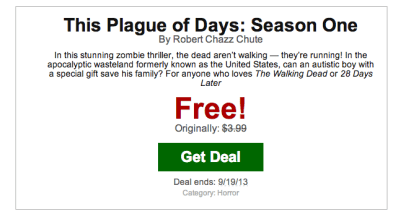
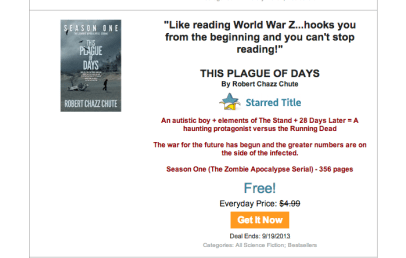
Are you on Bookbub? Here's what the email looks like for my TPOD promo. Sale ends at midnight, never to return. Enjoy.

Are you on Bookbub? Here’s what the email looks like for my TPOD promo. Sale ends at midnight, never to return. Enjoy.

Screen Shot 2013-09-19 at 12.53.17 PM

Bookbub allows you to showcase deals to many targeted readers who are interested in your genre. Got a deal? Get noticed with Bookbub.

Filed under: author platform, book trailer, Books, Publicity & Promotion, publishing, , , , , , , , , , , , , , , , , , , , , , , ,

Ebook pricing, free promotions and you

The complete first season is FREE for two days. Click now.

The complete first season is FREE for two days. Click now.

Generosity feels great and, in this incarnation of the book business, generosity is a marketing strategy if done right. Today, a giveaway and a case study in real time. (If you don’t know anything about This Plague of Days, check out ThisPlagueOfDays.com for sneak peeks.)

I released This Plague of Days, Season 1 as a serial. There were many reasons for doing it this way. I wrote it like a television mini-series and serialization opens up marketing opportunities. On the first day of Season One, I published the complete first season and Episode 1. Four more episodes followed each Monday. The episodes sold for 99 cents each or readers could get the whole season for $3.99.

For my initial giveaway, I put the first episode up for free for two days. I don’t believe in long promotions. By the time you’re done more than two days, you’ve exhausted your connections and momentum slows. I gave away about 1500 downloads of Episode 1 and stayed at the top of the Post-apocalyptic and Dystopian charts on the free side of Amazon for those two days. It’s really exciting sitting at #1 and #2 beside Hugh Howey.

An interesting thing happened next:

A bunch of readers liked Episode 1 but they stuck with the individual episodes. I watched my dashboard charts light up green with sales of Episodes 2, 3, 4 and 5 as people who got Episode 1 for free worked their way through the serial. The complete book of the season sold a bit, too, (at $3.99) but it seemed for readers to jump from episodes to the season at once, the discount would have had to be even deeper.

Pros and Cons of This Strategy

Pro: I gained a bunch of reviews for This Plague Of Days. Most readers dug it.

Con: Readers of Episode 1 only see the dad is an atheist and they may not stick around for the sweep of the story’s longer arc. The atheist dad has doubts about his lack of belief and his religious wife has doubts about her faith. I don’t dump it all in Episode 1 so, with serialization, you get judged by what you lead with. I’m not complaining. If you do something similar to what I’m doing, stay true to your vision, but don’t expect everyone to wait patiently for the payoffs later on. I have secret seeds planted in Season One that don’t bloom until Season Three.

Con: You’ll always get your worst reviews from free promotions.

Con: Some people who click free will never click “buy”. (Actually, that’s unfortunate, but it’s not really a “con” per se. I mention it because I anticipate resistance to these tactics. However, it’s not a true deficit in that it’s mostly irrelevant. These readers aren’t in my long-term equation for the same reasons the cobalt industry, Cadillac and Vera Wang don’t target me as a customer. Just as I’ll never be in those businesses’ target demographics, I’m hunting for converts, not free book shelvers.

Pro: All those downloads got me Also-bought listings and Amazon started selling the book for me with their mailing list. That’s a major plus on the brand visibility side of the argument.

Pro: As summer sales of Season One ebbed, I saw the momentum from July evaporate. I did what few say makes sense. I put the price up to $4.99. No one’s buying the episodes now, but they are buying the complete first season at the higher price. That could indicate that Season One was underpriced. Probably, but as I’ll argue below, that’s okay. I’m in this for the long-term. Discoverability is more important than sales for now.

What I’m doing differently for Season Two

In This Plague of Days, I’m trying to give a B movie an A treatment. To get traction for an unknown serial aimed at a smart crowd in an unfamiliar format, I think the starting price was fair and good for Season One. If you didn’t jump aboard before, for two days only, Season One of This Plague of Days is free to download on September 18 and 19th. (If you love it, please review it.) Season Two will also have some bonus material in the back.

Why give away an entire book? Isn’t that evil and the death of literature?

Season One is the gateway drug to Season Two and, for two days only, the first taste is free.

I’m using Freebooksy and Bookbub to let the world know. This publicity does cost money, potentially a few nasty reviews and maybe I’m leaving money on the table. However, it will get my name and Season One into the hands of at least 5,000 people. (If that doesn’t sound like much to you, consider that 5,000 paid sales equals a bestseller in Canada. I expect to hit #1 and #2 again and have some sales momentum behind me as I slide into the October launch of Season Two. This is marketing as an exercise in delayed gratification. I’ll sell more of Season Two because I’ll get more readers in on the ground floor of the serial. Besides, it’s a one-time only sale. Most readers will find the cash for the full price under their couch cushions, so let’s not get too dramatic about the losses or gains.

To put it another way, a la Seth Godin, “Too many people are reading my free ebook is not a problem” (as long as there are other books to sell.) To paraphrase author Cory Doctorow, Free isn’t my problem, “obscurity is my problem.” And finally, I quote myself for emphasis, “Generosity feels great…(and) discoverability is more important than sales for now.”

Season 2 launches Oct 1.

Season 2 launches Oct 1.

The Rationale: Season Two of This Plague of Days launches in a couple of weeks.

The story and the virus evolve together. This time out, TPOD has a different pace. Season One was like a television serial. Season Two is the action movie. It gets more paranormal and it’s loaded with surprises, chills and blood spills. Expect new villains and more twists from Ireland to Iceland to the Indianapolis Speedway. You’ll see the invasion of New York, the Midwest and the terrible events at Canada’s border with Michigan. It’ll sell for $4.99 this fall. In a month or so I’ll do a giveaway of Season Two, Episode 1 only.

Eventually I’ll put This Plague Of Days across more platforms and go for a price match so Episode 1 of Season One will be perma-free. I’ll experiment with price points, but the complete Season Two will never go free. The law of diminishing returns kicks in if you’re trying to get people to jump into the middle. (Ironically, you could jump straight into Season Two without reading Season One and you wouldn’t be lost at all. However, people don’t believe that. I never got into Ally McBeal because I missed the first episode.)

About Audiences

People who love zombies were very patient with Season One. The zombies don’t show up immediately but the dread keeps rising so I guess the suspense satisfied them until the heavier horror kicked in. They don’t have to wait for any action in Season Two, so I expect this phase of TPOD will go big all the way to Christmas (especially as other promotions kick in.)

The other thing that surprised me was how readers with family connections to autism, developmental delays and handicaps responded to the story. The protagonist is on the spectrum and those readers enjoyed seeing the world through his eyes. It’s not a long screed (and certainly punchier than this post) but those readers responded well to discussions of what it’s like to be the parent of an autistic kid. The family loves Jaimie, but they don’t romanticize his disabilities and his sister treats him like a normal kid treats a sibling who is often difficult to live with.

About Price Resistance

Selling episodes at 99 cents with 30% to me won’t keep me in cat food, but it did help with visibility. I gather those who started buying episodes in Season One will mostly choose to get the complete second season so they can find out right away what happens to the Spencer family and the British refugees.

It seems the greatest resistance to price increases lay not with the readers, but with yours truly. More readers are discovering my books at higher price points. I guess those higher prices make them confidant I know what I’m doing. So, while I’m still advocating short-term discount promotions, the trend with all my book prices is for them to climb. Done right, with a giveaway of sufficient numbers, free can still work. If I thought I could get more traction on other platforms, I’d try a different strategy. However, regarding promotion, it appears the other platforms are still lacking.

If you’re reading this on September 18 or 19th, 2013,

grab your free copy of the complete first Season of This Plague of Days here.

And please tell a friend. Thanks!


Filed under: author platform, Publicity & Promotion, publishing, , , , , , , , , , , , , , , , , ,

Writers: Are you in the echo chamber?

I love my writing community here. I’ve learned a lot from others and, as indies, we share a lot of information. We’re a generous bunch with each other. I appreciate your comments and participation on my little writing and publishing blog. Because I’m a sweet bunny pooping love everywhere, I have to tell you something with love:

Writers talk to other writers too much. We must talk to readers more.

Let’s make this go down easy by using an example from another industry.

When massage therapists try to figure out their businesses, they ask their peers and senior massage therapists for their opinions. They want to drink from the well of experience. It’s a good notion that frequently goes awry. Their peers are often as clueless as they are and senior therapists either don’t have the same problems or their advice is out of date. Take pricing, for example. They’ll set fees based on what they’d pay. But many massage therapists would never pay for massage. They don’t have enough money or they swap treatments with other therapists. Massage treatment is for people with real jobs and insurance coverage, not us.

Stick with me and hold my hand, because this is about to get uncomfortable.

Writers need to listen to readers more.

Sadly, writers often don’t have much money to spare so we use libraries or search for free a lot. Most of us buy books when we can, but with budgets as tight as they are, we’re often not your audience. As a result, many of our industry’s book prices are artificially depressed. We’re asking the wrong audience what we should do. (I’ve taken this advice. I just raised prices on some of my books and generally, the trend will be up.)

A veteran writer who’s “made it” (whatever that means) often doesn’t know all the variables that contributed to his or her success. If someone coasted to indie success from a high in traditional publishing, they can’t tell you much about the current scene. Precious few people attribute any of their success to luck. It had to be their sheer brilliance. However, many of us are brilliant and we’re still eating boot soup.

So, what not to do?

If you don’t tweet others at all, you may as well be on Mars.

If you rarely check your direct messages, you’re in the bubble.

If you only check your mentions on Twitter, you’re screaming into the echo chamber.

If you follow three people and two of those are your other Twitter accounts, you’re only hearing yourself plus you’re a raging narcissist (and not in a good way).

If you only have conversations with people who don’t buy books, you’re surveying the wrong people.

If you only speak to people who “buy” free books, you’re engaging the wrong audience. (Readers who buy with money instead of a click are often suspicious if your book is priced too low, for instance.)

If you don’t take new information in and seriously consider change, you’re for slavery. (Your own.)

If you do have conversations with readers from time to time and you talk about them, you’re on a smoother path.

If you don’t cultivate supportive friends, you’ll be alone, surrounded by fiends and without a fire ax or holy water.

If you only attend conventions with other writers instead of fans, you’ll have a great time talking to people who agree with you: “Wow, it sure is hard to connect to new readers!”

If you never get out and talk to real people in the real world and only connect with people on a safe and cyber basis, who will you learn to hate so you can kill them in your next novel?

If somebody says, “I prefer paper books,” and you reflexively say, “How Amish of you! Ebooks are the only future!”, that was kind of funny, but you should be listening instead of cracking that same joke open again. It’s rotten on the inside.

If you say all this social engagement is too hard and it takes away from your writing time, I’m sorry. I thought you were writing to be read. Get a calendar or time management software. At least tweet or email during commercials.

If you immediately dismiss everyone with whom you disagree, you’ll never learn the secret to…well, anything really. Plus, you’ll come across as a jerk.

I’m not suggesting you allow me or readers or reviewers or anyone else to run your life. I am saying that if you recognize yourself in this list and it gives you that squirmy squirts feeling, adapt accordingly. Listen.

You should listen to me. I’m a writer.

Filed under: author platform, getting it done, Publicity & Promotion, publishing, Rant, readers, , , , , , , , , , , , , , ,

Books: Ventures, Misadventures, Adventures and Brutal Honesty

Crack the Indie Author CodeWhen George Lucas screened  Star Wars, most of his fellow filmmakers in the room looked at each other and said, “American Graffiti was awesome, George, but this space opera thing…yuck!” It was Stephen Spielberg who played the contrarian. “You guys don’t get it!” he said. “This is going to be huge!” And of course, Spielberg was right.

My personal Lord and Saviour of The Written Word, William Goldman, famously said of the Hollywood film business, “Nobody knows anything.” It’s true, no one can know what will hit and which will miss. Someone comes up with the somewhat moronic expression YOLO (the idiot’s “Carpe diem”) and it’s suddenly on t-shirts everywhere. True for us, too. You may write a heavy, ambitious tome, but it’s a tiny book like The Little Prince that captures the hearts and imaginations of generations of readers.

So it is with marketing books.

Agents say they can “guide your career”, but if that were true, anyone with a sentient agent would have a fabulous career. No one knows anything in publishing, either. That’s not meant as an insult, but as a reflection of reality. Publishing is famous (or infamous) for placing bets on many horses, hoping the big bets will pay off and cover the losers’ ubiquitous failures. Few industries have a miss rate as high as book publishing (though Hollywood’s screwing up even more than usual lately.)

So it is with my books, too!Self Help for Stoners JPEG

The summer is winding down and I find I must split my mania among many ventures. I’m in a philosophical mood and looking back at what took off, what has not, and why. We at Ex Parte Press are not lounging in the money, chocolate and champagne pool at the moment. (But we still have high hopes.)

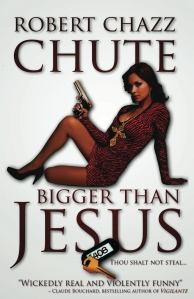
  • Bigger Than Jesus and Higher Than Jesus are critical successes among the few critics who are aware of my funny Cuban hit man and his tragic past. Alas, hardboiled and funny suspense isn’t trending at the moment. Nonetheless, I have more Hit Man books planned. Jesus Diaz will just have to wait a bit longer as I concentrate my efforts where readers have demonstrated more enthusiasm. I love Jesus, and can’t wait to get him back on the warpath in Hollywood. An assassin who can make movie references and quick quips while getting beaten up deserves more books. He’ll get them.
  • My first funny short story collection, Self-help for Stoners, sells just a little but steadily. It’s a tribute to Kit Foster of KitFosterDesign.com that the cover is repinned on Pinterest several times a week, every week. Later this fall I will stop using an intermediary so I can take back control of marketing that book. I have no doubt I can take it much higher once that happens. I’d have done it by now but I’ve been perpetually swamped for months with This Plague of Days.
  • Six Seconds, my book about using the Vine app to market your business was an instant book with lots of great advice. I’ve moved books and marketed my podcasts having fun with mini videos. Though Vine remains the superior product, Instagram changed their app to ape Vine so Instagram has many more users. I bet on the wrong horse, not every at bat is a home-run, insert your metaphor for failure here.
  • This Plague of Days, Season One is getting traction. It might even be on the cusp of taking off. I’ll find out when Season Two hits at the end of September. (Here’s my latest post with hints and expectations for Season Two.) Early feedback is very encouraging. As in this, from the beta team: “Suspense and plot and action – all of them are on steroids in this book…overall impression is you have brought this thing to the next level.”

Mind the towering caveat in the following paragraph:

My luckless hit man is a funny guy in big trouble.

My luckless hit man is a funny guy in big trouble.

So you see, I’m no better (or worse) at stabbing at the imagination of readers than anyone else. I don’t know what will sell buckets of books. No one does. It’s something that happens to you, as long as you pretend your destiny is under your control and do everything you can to get discovered. You can hit the target. We’re all shooting blindfolded in the dark, sure, but if you take enough wild shots, aiming matters less. You write the best book you can and engage more readers and attend some sad, ill-attended bookstore signings and do whatever else you can think of to fire off signal flares without becoming a Twitter pariah.

This is not to say that good advice isn’t out there. It’s just that so much good advice conflicts!

The great Chuck Wendig talks about voice (or the force of personality) being more important than “brand”. Others can’t talk about anything else but brand, stats and system gaming. Hugh Howey is the outlier that didn’t really market anything when he started Wool (though he says Facebook helps him most these days.) Some insist on lots of links to your other work in the back of each book. Others say that’s overkill and intelligent readers will find you easily if they love you enough to bother with a google search. Some book marketers are passive as a policy (or lazy.) Others are so active, it’s pretty close to obnoxious.

And still, nobody knows anything. Not for sure. There are too many variables to success and the situation is fluid. We, writers and publishers all, dance on tightropes while juggling feathers in wind storms and hope readers will cast a glance our way and enjoy the silly monkey dance.

Still, you’ll find advice about tactics everywhere.

Just this week, I pushed the Author Marketing Club and Bookbub. Solid advice I stand behind. But keep in mind, these are tactics. The potency of tactics can wax and wane according to many variables. That’s what’s hot now and into the near future. After that? New tools will emerge because good ideas get copied. Sometimes imitators are new and improved and often the copier doesn’t have enough toner.

Strategy is long-term thinking. Strategy says: Write more. Get more feedback. Write more books. Get better. Higher+than+Jesus+Front+1029

This is the only advice I know that lasts. (You’ll find that and much more about the writing and publishing life in Crack the Indie Author Code and Write Your Book: Aspire to Inspire. Crack sells a bit while the second book hardly moves at all. Why? Who knows? Nobody. Nobody knows anything! My Lord and Saviour told me so.

However, I’ll let you in on a little secret: I have a third book about writing and publishing in the chamber ready to fire. When This Plague of Days hits big, readers will pick up all my books about writing and publishing. After the fact, they’ll say, “Well, no wonder.” 

The Johnny-come-latelies won’t know what you know. My overnight success wasn’t overnight. Success always seems inevitable, but only in retrospect. Until you make it, no one cares about you and your book. Those who do give you any thought probably think you a fool. (Insert an image of your disapproving in-laws here.)

Ah. But, afterwards? You’re a genius.*

~ *Afterwards, You’re a Genius is a wonderful book I recommend for anyone interested in scientists with lyrical sensibilities.

For more on the rising action and scary high stakes in the spiralling weirdness of an autistic boy fighting zombies, read this post at ThisPlagueOfDays.com. 

For more on my adventures in self-pubishing, swallowing bitter pills and my peculiar brain mania, there’s this post on the writing life at my author site. 


Filed under: author platform, getting it done, self-publishing, , , , , , , , , , , , , , , , , , , , ,

FAQs: Would I go with an agent?

Crack the Indie Author CodeWhen I attended the Banff Publishing Workshop, most attendees were bent on writing and managing magazines and publishing houses.* I knew one nice woman who wanted to be agent. I wonder what she’s doing now? There’s an excellent chance she’s selling real estate. Too bad. She really was nice. Same is true of all my classmates in journalism school who were let go from their newspaper jobs about the time they turned 40. Changing media delivery paradigms sure do stir up chaos.

Given my last post, you might think I’m against agents. Not at all. I think agents could be very useful for negotiating foreign rights for my imprint in the future, for instance.

However, their role is much reduced and smart agents are changing their games. At a recent writing conference, writers were not chasing agents so much. The Meet-An-Agent appointment schedule could not be filled. Now more agents are chasing writers and they’re very interested in how your self-published books are doing. They weren’t at all interested a short time ago. In fact, some were quite pissy about the prospect. But now? Establish a happy track record and they might come a courtin’.

The short answer to this post’s title is:

I’d be interested in hearing what an agent feels he or she could do for me. There are good agents out there. I think hybrid publishing maximizes exposure and opportunities for you and your readers. Look at Wool author Hugh Howey’s experience. An agent found him and she was willing to travel outside the ruts of old publishing’s logging road to get Hugh a deal that worked for everyone.

The long answer? Let’s go with bullet points so I can make this shorter:

  • The submissions process can be a long ordeal. Long as in, are you young enough to begin now?)
  • You may be asked to make major changes to your manuscript. If you succeed in getting a book deal, you’ll make even more major changes.
  • You may choose to make the requested changes and they still won’t take you on. (They may even forget the changes they suggested. Yes, that’s happened.)
  • You can get an agent but still fail to place the book with a publisher. An agent is a person, not a guarantee of slinging back cosmos in Manhattan with your new editor.
  • The myth is that you choose an agent. The fact is if someone sends you a contract, most authors pee their pants and quickly sign. Regret is for later.
  • You can find an agent, dance joyously and then find out it’s a scam (as happened to a friend of mine.)
  • You could bypass the agent and submit directly to publishing houses and they’ll still read it. (They say they don’t, but most will.)
  • As Dean Wesley Smith has said, agents should be your employees. I’m sure he’s right. Guess how many agents see their professional status that way?
  • Submit to the wrong agent who blogs and they’ll mock your submission. Unprofessional, I’d say. As Will McEvoy said recently, “Snark is the idiot’s version of wit.”
  • Good agents have precious few slots open for new clients. Bad agents and scammers demand reading fees.
  • Rather than submit query letters to agents, many agents find new clients via recommendations from the authors in their stable. Who you know? Yeah, that’s still a thing. It’s called networking. Ignore the denials.
  • Getting an agent is tougher than getting published. Why not publish it yourself first and start selling now? As I’ve said many times, Amazon is the new slush pile.
  • Some agents live in fear of submitting manuscripts that might not be accepted. They have to be so sure, they’re too risk averse. One agent complained that one false move with a particular editor would lose her access forever. This sad story tells me that’s a crazed editor. It also tells me that’s an agent who is too fearful, forever doomed to be chasing trends instead of helping to make them.
  • The agent/author relationship is like a marriage: They have a piece of you forever even after the divorce.
  • Lazy agents say, “This would be hard to sell.” As a former sales rep for many publishing companies, I can assure you that there are few easy sales. We don’t need you for easy sales. Selling is part of the job. The better question is, “How can I sell this and to whom?”
  • Often when they say, “This would be a hard sell”, they aren’t lazy. It’s a euphemism for, “I think this is crap but why not be diplomatic?” They’re being kind. Don’t resent them for it. Move on.
  • You’ll get a better deal with a good agent than without her. A good agent will more than pay for herself. However, some agents are getting paid for doing very little. They treat the publisher’s contract as set in stone. That’s supposed to be the publisher’s attitude. It’s a bad attitude for the person negotiating for you.
  • Good agents can act as a buffer and help resolve conflicts with editors. Bad agents are the source of personality conflicts.
  • You have to trust your agent. You don’t have to love your agent. It’s a business relationship. That’s less clear in the beginning when you’re riding high. It’s very clear when they dump your mid-lister ass.
  • A good agent can do things you can’t and navigate the tiny details of contracts. A good agent can pay great dividends for their fifteen percent.
  • But an entertainment lawyer can practice law and navigate the tiny details of contracts and you pay them once. Hm.
  • A good agent can justify their participation in your enterprise without sounding old-school entitled about it. They work in listening mode.
  • Trad publishing has changed. Good agents know it and are adapting to serve their clients better.

TPOD 0616 EP 1 coverAuthors who love their agents are everywhere. A plethora of horror stories about agents also span the Internet, just as there are snarky complaints about clueless authors everywhere.

A better question is about the human variable: You.

Would you feel better with an experienced, connected agent helping you on an ongoing basis?

Or does the prospect fill you with anxiety?

Are you happier as a publisher/author/entrepreneur who pays for an entertainment lawyer’s expertise on an ad hoc basis?

Enter the relationship self-aware, eyes open.

Even better:

How do you find a good agent if you want one?

Ask an author in your genre who is already delighted with their agent.

*FYI: A magazine is something people used to subscribe to and read, like a blog but made out of glossy paper. Publishing houses were places that had an undeserved reputation for great cocktail parties that were vaguely upper crust, literate and British, no matter where they were located or how little the worker drones were paid.)

~ Robert Chazz Chute was one of those worker drones. He is the author of This Plague of Days World flu pandemic! Autism! Zombies! Oh, my!

Filed under: agents, Books, publishing, self-publishing, , , , , , , , , , , , , , , ,

FAQs: How to write books agents will hate (but readers might love)

My luckless hit man is a funny guy in big trouble.

My luckless hit man is a funny guy in big trouble.

Yesterday I told you how a well-meaning friend with experience in traditional publishing gave me advice I thought was askew. As we struggle to gain traction in the marketplace, we get a lot of well-meaning advice we can’t take. (You’ve probably read that sort of advice here from me.) My friend’s other foray at saving me from myself was to tell me to court agents. “With World War Z, zombies are big this summer! Find horror agents and get traditionally published!” he said.

It’s not that it’s necessarily bad advice. However, it’s bad advice for me. Here’s a list of the things I do in my books that repel agents like fried bat armpits at the wedding feast:

1. Bigger Than Jesus and Higher Than Jesus is written in second person, present tense. Unconventional scares agents away. They’re trying to make money after all. I don’t blame them, but I’m in the Art and Brain Tickle business first. I have this crazy notion that being me will lead to making money. Eventually.

2. The assassin/anti-hero in the Hit Man Series is neurotic and afraid of women. (Name another hardboiled gunner who has that problem. Take your time. I’ll wait.)

3. My hit man suffered childhood sexual abuse. He’s also hilarious. Those elements rarely sit side by side comfortably.

4. Hardboiled isn’t selling hard right now. Or is it humor? Or is it action adventure? Easily classifiable is really important to a lot of people who aren’t me.

5. The titles may offend some Christians, especially since it’s crime fiction with a lot of swearing.

6. The titles are confusing until you understand that the assassin, Jesus Diaz, is Cuban and it’s pronounced “HAY-SOOSE”. In fairness, agents and publishers should be repelled by these titles. It wasn’t the best strategy because any title that requires explanation sucks. After two books, I’m committed and in love. I also have a plan around this problem after the next novel in the series is published early next year.

7. In my zombie series, This Plague of Days, the zombies aren’t “true” and “traditional”. It begins with a flu pandemic. You get to see how society gets to dystopian before the action kicks into ever higher gear. The slow burn requires more buy-in from sophisticated readers. Underestimating readers’ intelligence is an easier bet.

Season One has five episodes. Get each one for 99 cents or get all of Season One at a discount for $3.99.

Season One has five episodes. Get each one for 99 cents or get all of Season One at a discount for $3.99.

8. This Plague of Days has an autistic hero who rarely speaks and whose special interest is dictionaries and Latin phrases. Sounds like sales suicide when I put it like that, huh? That sort of gamble can pay off in a book. It’s death in the tough sell of a query letter.

9. The table of contents is a long, dark poem embedded with clues to the bigger story. Reread that and tell me I’m not silly. I know it.

10. Who will serialize a book unless I do it with my imprint? (Amazon Serials didn’t bite but readers are buying in.) Besides hooking up with Kit Foster of KitFosterDesign.com for his awesome covers, serialization has been my best sales strategy yet. This Plague of Days is a sprawling story tracking action over two continents with a big cast of characters. (At times you may wonder, is Chazz British or American? Split the difference. I’m Canadian.) It was too long to publish as just one book and the serialization model fit best.

When you look at that list, which idea comes across stronger? A or B?

A. All agents are evil, lazy and lack imagination.

B. I am determined to fail.

It pains me to say that all agents are not evil. I’ll save further discussion of agents for my next post.

For more on the why of this post, the writer’s character and how this relates to Joyland by Stephen King

click here for my latest post on ThisPlagueOfDays.com:

Writing Against the Grain: B Movies, A Treatments and the Deceptive Familiar


Filed under: agents, book marketing, Publicity & Promotion, publishing, self-publishing, , , , , , , , , , , , , , , , , ,

Book Marketing Top 10: When less is more

Some marketing efforts are hurt by doing too much. Here are 10 examples:

Season One: Sponsor of the Cool People Podcast.  Can't have just one chip? Season One has five episodes. Get each one for 99 cents or get all of Season One at a discount for $3.99. Season Two hits this September.

Season One: Sponsor of the Cool People Podcast.
Can’t have just one chip? Season One has five episodes. Get each one for 99 cents or get all of Season One at a discount for $3.99. Season Two hits this September.

1. First there were big author tours. Then radio. Now, podcast and blogging niches are more effective.

Many marketing efforts benefit from going small, personal and specific. Instead of getting a few minutes on radio (while people are in their cars or having breakfast and definitely not buying) better to get on a podcast. Instead of planes and multi-city tours and paying for plane fare, podcasts yield more exposure to a smaller, targeted and invested audience.

Podcasts are usually easier to access. You’ll get more time and sell more books with a podcast interview than by trying to squeeze in a few words between car ads and the giggling Morning Zoo Crew. 

The same principle applies to blogging. I’d rather be featured by a big book blogger than in a local newspaper. (Ask your dad what a newspaper is. If he’s old enough, he might even still get one.)

2. Curation with commentary from bloggers is valuable. Bots drawing from dozens of tweets are not.

Before I knew what Paper.li was, I emailed someone to thank them for including me in their daily electronic newspaper. I soon realized that there’s nothing special about inclusion by bots in an array of harvested tweets. However, when someone reblogs my posts, that’s a personal recommendation that’s much more effective. (Thanks for all the reblogs, Armand Rosamilia!) When someone gives me the mucho bump of love on Twitter, it means more and helps more. (Thanks for your ongoing support and enthusiasm, Eden Baylee!)

Curation tools like Scoopit! are also valuable, as long as the post includes commentary. The difference is that a human makes those choices. “Set it and forget it” is nice for thermostats, but bleating out content without evaluation and recommendation is craptacular, both for the tweeter, the tweeted and, most importantly, our readers.

3. Too much email contact leads to friction. Ease off.

I have a couple of newsletter subscriptions that hit me daily. They’re too relentless. When I fall behind, the emails pile up in my inbox. I tell myself I’ll get around to reading it all, but deletion is more likely. I do open newsletters that fire at me at a slower rate. Give me a chance to look forward to hearing from you.

How much is too much? Wait until you have something to say, something new to announce or something to offer. Too much rah-rah-rah is so much blah-blah-blah.

Similarly, If you’re relying on book event promotions that arrive in an email blast crammed with other book events, find a way to stand out. My morning Goodreads email feels like a firehose aimed at a teacup. (Sadly, the teacup in this analogy is my brain.) Do something different and approach potential readers in varied ways. When one nail is hit too much, too often, it cracks the wood. (That’s a better analogy!) See Item 5 for what I’m doing differently and Items 7 and 8 for effective e-blast options.

4. Use a professional to get things sorted out.

I was briefly part of an affiliate program on another of my blogs. The product was good, but the program was plagued with technical problems. A day didn’t go by without an update on how said problems were being fixed. Then they weren’t. Again! I dumped the program.

I am an Amazon affiliate on my author site. It’s relatively simple. I get updates from them once a month and each update is relevant to me. That’s what to aim for.

5. Complications make us weary.

Make your offers uncomplicated.

My first draft of my viral video offer (details here) was too complicated. I ran it past a friend who suggested tweaks. I had explained too much and made too many jokes instead of getting right to it. I make a lot of jokes in my books, but when it comes to offers and promotions, people just want to know their rewards and prizes and what they have to do to get them. That’s all.

6. Tweet to content.

I use tweet teams sometimes, but much less than I used to and only for special occasions. We all have book tweet and email fatigue, don’t we? Make your tweets funny or intriguing. Tweet to your blog. Your website is the proper locus of sales. Twitter is not where to sell hard or often. Twitter is a place to help people find good stuff.

This has several positive effects:

Helping people tells them you’re not an ass (and if you are an ass, you can’t hide.)

You build your mailing list on your website, not on Twitter.

Your author site is your public face. Potential readers connect with you there, not through a sales link.

Twitter can still be useful, but when it’s not hooked up to content, readers stop paying attention.

7. Aim at targets.

Bookbub works best as a book promotion service because it doesn’t send out a long list of books to everyone. Bookbub knows what genres subscribers are most interested in. Romance readers don’t get sales copy to horror books. Fewer people receive the message, but those people are more likely to buy and less likely to saddle you with one or two-star reviews because they just aren’t that into you.

in the marketing war for our attention, sniper rifles work at long distances. Shotguns do not.

8. Be choosy.

For the last two days, I’ve done a free promotion of Episode One of This Plague of Days. (The sale ends at midnight and, as I type this, it’s the last few hours of the sale. Grab it free or, if you got this too late, Episode One is only 99 cents so, you know the drill.

I’ve held #1 in Dystopian and #1 in Post-apocalyptic for most of the two-day run. That’s probably mostly due to being chosen as a featured author on Freebooksy. They’re choosy, so their email blasts are taken more seriously than some other book promotion services.

Thanks to everyone who helped me give thousands of copies of Episode One away to spread the word. I appreciate your Facebook entries, tweets and clicks. And I don’t forget who helped me. Sincerely, thank you. I have a lot of friends and allies through this blog and I’m grateful.

9. More text = more confusion.

You’ll notice I have a lot of sales links to the right. This blog has gone through several redesigns over the years and I’ll be renovating again soon. However, the other day as I was researching book promotion services, I ran across a website that was literally like reading a phone book. The crammed type fuzzed the signal to noise. It was nearly unreadable. That’s not a good sign when the blog owners set themselves up as book marketing experts. More white space adds focus and more punch to the text. (See below for my post on blog scanning vs blog reading.)

Crack the Indie Author Code10. Small is an attitude that’s easier to relate to.

My writing and publishing guides are journeys through the mud of independent publishing. I chronicled the struggles more than the success. Success teaches less than mistakes can. I was (and continue to be) very honest about my mistakes over the last couple of years of steering the Ex Parte Press imprint. Instead of telling anyone what to do, I did research and gave opinions and examples. I experimented. I tell you what worked for me and what didn’t work. I’m just now beginning to feel like I have a solid idea of what I’m doing. Mostly because now we have more tools at our disposal than we used to have. Independent publishing has matured.

We’re walking together to find our way here. I don’t listen to some experts because their viewpoints come from such a different experience. One indie guru’s solution to marketing problems is to throw money. I don’t know what he’s talking about or to whom. Others are well-established because they came to self-publishing early with trad publishing inertia and lineage mojo. 

They aren’t us. We’re small, but we are getting bigger.

We’re getting traction. We have better tools now and we’re honing them.

No matter what, we’ll remember where we came from and the friends who helped us up and out.


Filed under: blogs & blogging, book marketing, book trailer, Books, getting it done, Publicity & Promotion, publishing, , , , , , , , , , , , , , , , , ,

Bestseller with over 1,000 reviews!
Winner of the North Street Book Prize, Reader's Favorite, the
Literary Titan Award, the Hollywood Book Festival, and the
New York Book Festival.

http://mybook.to/OurZombieHours
A NEW ZOMBIE ANTHOLOGY

Winner of Writer's Digest's 2014 Honorable Mention in Self-published Ebook Awards in Genre

The first 81 lessons to get your Buffy on

More lessons to help you survive Armageddon

"You will laugh your ass off!" ~ Maxwell Cynn, author of Cybergrrl

Available now!

Fast-paced terror, new threats, more twists.

An autistic boy versus our world in free fall

Suspense to melt your face and play with your brain.

Action like a Guy Ritchie film. Funny like Woody Allen when he was funny.

Jesus: Sexier and even more addicted to love.

You can pick this ebook up for free today at this link: http://bit.ly/TheNightMan

Join my inner circle at AllThatChazz.com

See my books, blogs, links and podcasts.

Enter your email address to follow this blog and receive notifications of new posts by email.

Join 2,063 other subscribers