C h a z z W r i t e s . c o m

See all my books at AllThatChazz.com.

Authors: Build a better business card with these tweaks

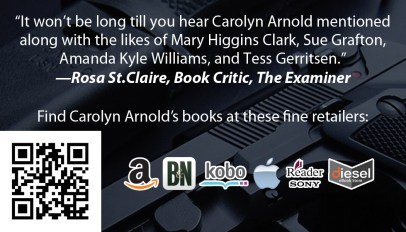
I met Facebook friend and author Carolyn Arnold as she sold books at an event. She’s given me permission to show you her business card. It’s important because she did something very right.

I think it’s important because I’ve seen a lot of bad business cards. A card that looks cheap might hurt you. A card that’s crammed with too much information really repels people.

Cards that advertise the publisher on one side and another unrelated business on the back? Don’t do that. It saps credibility from both companies.

Look at what Carolyn’s done.

The logos for each platform show where you can get Carolyn’s books. Very good idea. I also like seeing the books in 3D, with spines. (# 147 on the things I need to do to make web presentations of my books prettier.)

Also note the QR code. Scan it with a mobile device and it takes you to her website, carolynarnold.net.

I’m not that technologically advanced yet, but it’s a pretty nifty feature for those who are into QR codes.

Carolyn Arnold Business Card Front 2013


Carolyn Arnold Business Card Back 2013


And perhaps best of all is the killer quote from The Examiner‘s book critic. If you can incorporate any of these helpful elements into your business card, I recommend it. It comes off very professional.

Even when they aren’t aware of it, readers want to be assured they’re in good hands with someone who knows what they’re doing. A business card alone won’t earn you a new reader. You have to be nice and skilled and have good books to sell. There are many variables that contribute to success. If one of those variables isn’t in place, it can suck all the gas out of your engine. Carolyn nailed it.

Have another look at your business card.

Then get out to more events where you can actually use it.

Filed under: author platform, , , , , , , , , , , ,

Review: Storytelling problems and the finale of #Dexter

This isn’t my usual sort of blog post, but it’s time to talk about storytelling problems and, unfortunately, the Dexter series finale is Exhibit A. Spoilers ensue, so you’ve been warned.

1. The final season of Dexter was mostly rudderless. Masuka has a daughter. Yay! If she was a plant from the FBI, she would have been useful to the plot. Instead, she gave the comic relief guy no opportunities to do comedy. Nice topless sports bar, but otherwise, why is she there? We want Masuka to be Masuka with lines like, “Science is a cold-hearted bitch…”

2. Dexter’s struggle to become human is betrayed in the final scene. Okay, Pinocchio becomes a real boy and decides feelings suck. He returns to being a monster with his final look. The struggle wasn’t interesting enough because it more internal than external. Hard to do in film. Easier in a novel, but still tricky.

3. The last scene felt tacked on and dragged on too long. Were we really supposed to wonder if that’s Dex, or perhaps the satellite flipped the channel to a lugubrious episode of Ice Road Truckers? If they wanted to sap the power of “And the body was never found,” they should have done it in a strobe flash POV shot with bearded Dexter standing over a kill table in a cabin, long knife in hand, snowshoes on the wall. 

4. The show made us love a serial killer’s exploits in Miami. Dexter had a good life and an endless supply of pulled pork sandwiches. Now he’s alone in Alaska or Canada. Dex is alone so no one he cares for will get killed. We get it. However, you don’t leave Batman poor with no Batcave and no Batmobile. A downer ending would have been okay, but this punished viewers. He’s still Dexter, but now he’s got no inside track from inside a police station and fewer opportunities to be the Avenger. We want him on that wall! We need him on that wall!

5. The show worked best when Dexter was constantly in danger of being caught. I didn’t think Dex was ever in much danger of being caught. Maybe it was a lack of lines and physical presence, but Elway and the US Deputy Marshall never came close to feeling like a credible threat. The Marshall reminded me of Ty Pennington and looked like he should be giving one lucky family an extreme home makeover instead of closing in on Dexter. Elway’s hair looked like he might have been the front man for a New Wave band in the ’80s, but the private dick, the cat who won’t cop out when there’s danger all about? We’re not talking about Shaft here.

6. With the build up to the arrival of the hurricane, I pictured a Hitchcockian ending complete with a fight to the death aboard the Slice of Life. Once Oliver is caught (again) the narrative drive is lost and there’s no goal except to explore feelings. The folks behind the show overestimated our patience for repeated flashbacks to Deb and Dex in the maternity ward. For that to work, they needed to at least bring Rita into the flashback. (We would have forgiven so much for that cameo.) They bring Miguel’s wife back as a real estate agent, but the name “Rita” is never spoken? (They came close with Harrison’s drawing, but no.)

7. Plot holes abound through the season. It really bugs me when the mechanics of a script only work if the characters do incredibly dumb things. This season, no computer was password-protected, the Deputy Marshall doesn’t recognize Oliver and Hannah stays at Deb’s house. Perhaps most egregious (because it was in our faces every time we saw her) Hannah always looks exactly like her mugshot and it never occurs to her or Dex that she could cut and dye her hair. Even the most brainless fugitive would do that much. Man or woman, if you’re on the run, shave your head!

8. The season progressed as if there was no plan. From one episode to the next, Zack goes from being so clueless he doesn’t know to wear gloves to leaving Dex a clue behind on purpose? Anybody from the later seasons of Lost working on this thing? Can we have the writers from John Lithgow’s season, please? How about we get a mulligan?

9.  The theme of the season was the ties that bind: mother-son, father-son, sister-brother, friends and family. What got us hooked on Dexter was none of the above. Anybody else notice that when Harry disappears, it doesn’t feel like a strong beat? Harry’s been Dexter’s coach for years, but when he’s gone, it feels faster than Rick Schroeder’s throwaway disappearance from NYPD Blue.

10. The wasted opportunities made me sad. If I’d written the final season (and were king of the universe so I could do anything I want) it would have been a cat and mouse game between Dexter and Quinn and Batista. Batista had a box of paper LaGuerta left behind that contained the phone records that made her suspicious. Quinn had already been suspicious of Dex (which he let go and forgot about after Dex did him a solid.) Those suspicions are the seeds of a plot that would have carried the inertia from last season and given LaGuerta’s death significance and consequence.

Batista was the single most underused character and, I would argue, the beating human heart of the show. If he’d pursued an investigation that led to a showdown in the end, Dexter fans would be having much happier water cooler conversations today. Oh, and killing Quinn would have been a very acceptable sacrifice to drive the final wedge between Dex and Deb.

We cared about Batista because he cared about everyone else. Dex once said that if he could be anyone, he’d want to be Batista. There’s talk of a spin-off. It should be Batista, now more jaded and suspicious of everyone. Save Masuka’s return for a Three’s Company reboot.

I hate to be this guy. I’m not a hater. I loved most of Dexter. When it was good, it was great! What did they do right?

1. “I’m going to kill you with that pen.” (Plus the saucy little hesitation before pressing the alarm and the instant switch to “He tried to kill me!”)

2. Batista’s reaction to watching the recording and seeing Dexter in a whole new light. Excellent acting as always by David Zayas.

3. Jennifer Carpenter is a great actress. It’s hard to act drunk for a long time without looking silly. She did it. (Question: What does she say to Quinn just before she goes into surgery? We replayed that three times at increasing volumes and still couldn’t quite catch it. It was the worst sound work since we all came back from watching Brokeback Mountain to google what Heath Ledger’s last line was.)

4. Michael C. Hall. Excellent actor. Even in casual moments, there’s something lupine about his face. In his last look at the camera, he delivered. His best moment? There are many to choose from, but I’d go with the moment he discovers that’s not Miguel’s blood on the shirt and rams his hands through glass in a rage.

5. Charlotte Rampling is an excellent actor. I’d like to see her in more stuff. Is Bates Motel looking for a creepy neighbor lady to run against Norman’s mom on Town Council?

6. I watched the penultimate Breaking Bad immediately after watching Dexter. That flushed some of the gunk out. That’s not something Dexter got right. In fact, they went up against the Emmys, but it was fortuitous.

Filed under: reviews, writing tips, , , , , , , , ,

Marketing books: Thirteen video options

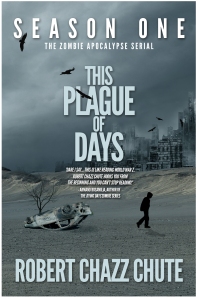
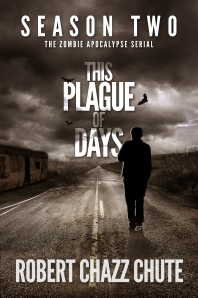
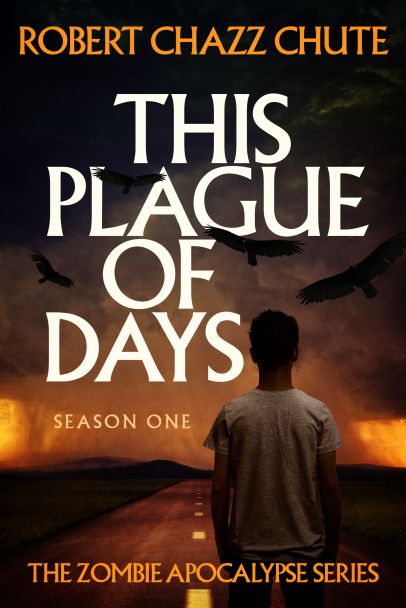
Season One of This Plague of Days is free until midnight tonight.

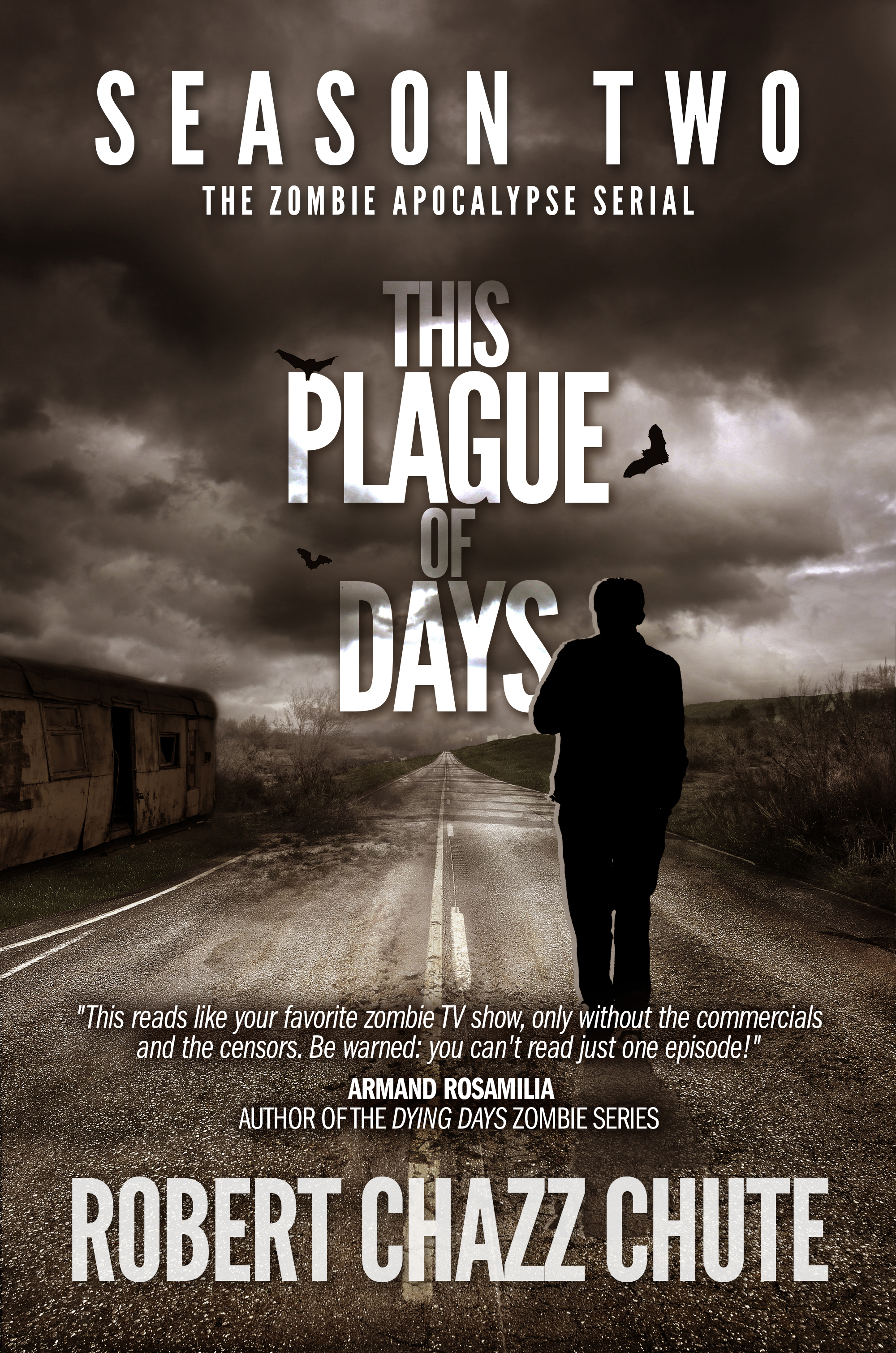
Season Two launches in two weeks.

Book trailers are problematic. Video can be done well. It often isn’t.

Most of them are too long. Production values are typically lower than viewers’ expectations. We’re trained to expect CGI on the level of major movie studios. Also, there’s little evidence trailers generate any sales. Go big and you’ll spend money with no return on the investment. Go too small and you might not be proud of it. Here are magnificent options, ranging from giving up and doing zilch to going big. Since I’m in touch with reality, most options are no-budget or low-budget.

Alternative 1

Don’t do it. It’s not worth the bother.

Alternative 2

Play with iMovie in your spare time. If it’s fun, great, but certainly don’t lose writing time to it. 

Alternative 3

Rather than worry about making a little movie and learning an editing program, do six seconds on Vine and/or fifteen seconds on Instagram. Focus on one quick, easy message. Don’t spell out the link to the camera. Leave the link in the caption. Note that people love video with cats.

Alternative 4

Upload to Youtube from your camera, iPod, iPhone or Android. Viewers will be more forgiving of low production values if they see you didn’t try to make it fancy. Just talk to the camera with a joke and/or announcement.

Alternative 5

Video pulls more clicks to your blog. Combine it with punchy posts for greater effect and more subscribers.

People have more tolerance for a short, laid back video than they will for long blog posts. For instance, yesterday’s post went deep into serialization and book pricing strategy. It was only for the most serious of book marketers and publishers. However, many more readers will click the video above and read this blog post for information because it has video and the text is breezy and scannable.

Alternative 6

Focus on what’s cool or ironically cool. Make it fun for you and the viewer. Try for the opposite of earnest and don’t try to tell too much of the plot of your book. Let the visuals do more work. Entertain first and come sideways at giving out information. One of the best book trailers I’ve seen was an author who talked about the glamour of the writing life while he scrubbed toilets.

Alternative 7

As I’ve suggested in the past, try a quote trailer. A quote trailer simply pulls intriguing quotes from your book. Don’t forget to include a buy link. Keep it short. No spoilers.

Alternative 8 

Use Animoto, as I did, for the video above. I already had the book covers. It took all of five minutes to use the free option for a video shorter than 30 seconds. The fire effect was appropriate and the music was a nice fit. Cool, huh? Animoto includes sharing options so you can export it to Vimeo, YouTube, Facebook, etc.,…

Alternative 9

If people don’t respond to your stabs at filmmaking, try making it more about you and how you can help others instead of making it about the book. Video reviews and how-to stuff get more hits. Funny’s always good, too.

I put up video of my podcasts to get more viewers and listeners. Some people simply prefer video to audio, or a YouTube video is how they will discover a podcast. Interaction in an interview setting can be easier to pull off than talking directly to the camera. Some people, like Hugh Howey, do it well and even dance for reviews. For most of us, solo videos look like hollow-eyed, stuttering hostage videos pleading for ransom under the threat of death.

Alternative 10

Have you set up your YouTube channel yet? It’s a great place to collect your video book reviews, too. Video reviews get more attention on Amazon than written ones, so it’s worth doing, for you and for authors.

Alternative 11

Go with Fiverr.com and get help to create quick videos like I did for my promotion plan for This Plague of Days. Check out my video samples at the link.

Alternative 12

If you really want to go big, get a semi-pro involved. There’s no proven ROI and most professional video production is expensive. Therefore, consider approaching a drama class or a film school. If your book trailer becomes a school project, at least your vanity project will benefit the education of a young actor or filmmaker in a concrete way. You could go the Scott Sigler route and make it a contest. Since every entry went up on YouTube for judging, Sigler’s books got multiple ads and multiple hits.

Alternative 13

I think Kevin Smith and Steven Spielberg are available for princely sums, but if you’ve just won the lottery, go with any of the above options and get your video production done free or cheap. Starving children everywhere would appreciate your generous donations. If you’re rich enough to consider professional directorial help, good karma’s the better way to go.

BONUS

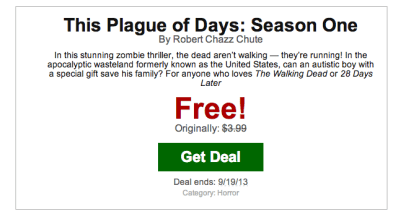
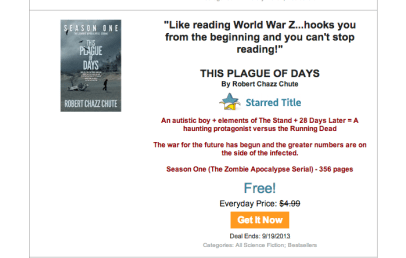
Are you on Bookbub? Here's what the email looks like for my TPOD promo. Sale ends at midnight, never to return. Enjoy.

Are you on Bookbub? Here’s what the email looks like for my TPOD promo. Sale ends at midnight, never to return. Enjoy.

Screen Shot 2013-09-19 at 12.53.17 PM

Bookbub allows you to showcase deals to many targeted readers who are interested in your genre. Got a deal? Get noticed with Bookbub.

Filed under: author platform, book trailer, Books, Publicity & Promotion, publishing, , , , , , , , , , , , , , , , , , , , , , , ,

Ebook pricing, free promotions and you

The complete first season is FREE for two days. Click now.

The complete first season is FREE for two days. Click now.

Generosity feels great and, in this incarnation of the book business, generosity is a marketing strategy if done right. Today, a giveaway and a case study in real time. (If you don’t know anything about This Plague of Days, check out ThisPlagueOfDays.com for sneak peeks.)

I released This Plague of Days, Season 1 as a serial. There were many reasons for doing it this way. I wrote it like a television mini-series and serialization opens up marketing opportunities. On the first day of Season One, I published the complete first season and Episode 1. Four more episodes followed each Monday. The episodes sold for 99 cents each or readers could get the whole season for $3.99.

For my initial giveaway, I put the first episode up for free for two days. I don’t believe in long promotions. By the time you’re done more than two days, you’ve exhausted your connections and momentum slows. I gave away about 1500 downloads of Episode 1 and stayed at the top of the Post-apocalyptic and Dystopian charts on the free side of Amazon for those two days. It’s really exciting sitting at #1 and #2 beside Hugh Howey.

An interesting thing happened next:

A bunch of readers liked Episode 1 but they stuck with the individual episodes. I watched my dashboard charts light up green with sales of Episodes 2, 3, 4 and 5 as people who got Episode 1 for free worked their way through the serial. The complete book of the season sold a bit, too, (at $3.99) but it seemed for readers to jump from episodes to the season at once, the discount would have had to be even deeper.

Pros and Cons of This Strategy

Pro: I gained a bunch of reviews for This Plague Of Days. Most readers dug it.

Con: Readers of Episode 1 only see the dad is an atheist and they may not stick around for the sweep of the story’s longer arc. The atheist dad has doubts about his lack of belief and his religious wife has doubts about her faith. I don’t dump it all in Episode 1 so, with serialization, you get judged by what you lead with. I’m not complaining. If you do something similar to what I’m doing, stay true to your vision, but don’t expect everyone to wait patiently for the payoffs later on. I have secret seeds planted in Season One that don’t bloom until Season Three.

Con: You’ll always get your worst reviews from free promotions.

Con: Some people who click free will never click “buy”. (Actually, that’s unfortunate, but it’s not really a “con” per se. I mention it because I anticipate resistance to these tactics. However, it’s not a true deficit in that it’s mostly irrelevant. These readers aren’t in my long-term equation for the same reasons the cobalt industry, Cadillac and Vera Wang don’t target me as a customer. Just as I’ll never be in those businesses’ target demographics, I’m hunting for converts, not free book shelvers.

Pro: All those downloads got me Also-bought listings and Amazon started selling the book for me with their mailing list. That’s a major plus on the brand visibility side of the argument.

Pro: As summer sales of Season One ebbed, I saw the momentum from July evaporate. I did what few say makes sense. I put the price up to $4.99. No one’s buying the episodes now, but they are buying the complete first season at the higher price. That could indicate that Season One was underpriced. Probably, but as I’ll argue below, that’s okay. I’m in this for the long-term. Discoverability is more important than sales for now.

What I’m doing differently for Season Two

In This Plague of Days, I’m trying to give a B movie an A treatment. To get traction for an unknown serial aimed at a smart crowd in an unfamiliar format, I think the starting price was fair and good for Season One. If you didn’t jump aboard before, for two days only, Season One of This Plague of Days is free to download on September 18 and 19th. (If you love it, please review it.) Season Two will also have some bonus material in the back.

Why give away an entire book? Isn’t that evil and the death of literature?

Season One is the gateway drug to Season Two and, for two days only, the first taste is free.

I’m using Freebooksy and Bookbub to let the world know. This publicity does cost money, potentially a few nasty reviews and maybe I’m leaving money on the table. However, it will get my name and Season One into the hands of at least 5,000 people. (If that doesn’t sound like much to you, consider that 5,000 paid sales equals a bestseller in Canada. I expect to hit #1 and #2 again and have some sales momentum behind me as I slide into the October launch of Season Two. This is marketing as an exercise in delayed gratification. I’ll sell more of Season Two because I’ll get more readers in on the ground floor of the serial. Besides, it’s a one-time only sale. Most readers will find the cash for the full price under their couch cushions, so let’s not get too dramatic about the losses or gains.

To put it another way, a la Seth Godin, “Too many people are reading my free ebook is not a problem” (as long as there are other books to sell.) To paraphrase author Cory Doctorow, Free isn’t my problem, “obscurity is my problem.” And finally, I quote myself for emphasis, “Generosity feels great…(and) discoverability is more important than sales for now.”

Season 2 launches Oct 1.

Season 2 launches Oct 1.

The Rationale: Season Two of This Plague of Days launches in a couple of weeks.

The story and the virus evolve together. This time out, TPOD has a different pace. Season One was like a television serial. Season Two is the action movie. It gets more paranormal and it’s loaded with surprises, chills and blood spills. Expect new villains and more twists from Ireland to Iceland to the Indianapolis Speedway. You’ll see the invasion of New York, the Midwest and the terrible events at Canada’s border with Michigan. It’ll sell for $4.99 this fall. In a month or so I’ll do a giveaway of Season Two, Episode 1 only.

Eventually I’ll put This Plague Of Days across more platforms and go for a price match so Episode 1 of Season One will be perma-free. I’ll experiment with price points, but the complete Season Two will never go free. The law of diminishing returns kicks in if you’re trying to get people to jump into the middle. (Ironically, you could jump straight into Season Two without reading Season One and you wouldn’t be lost at all. However, people don’t believe that. I never got into Ally McBeal because I missed the first episode.)

About Audiences

People who love zombies were very patient with Season One. The zombies don’t show up immediately but the dread keeps rising so I guess the suspense satisfied them until the heavier horror kicked in. They don’t have to wait for any action in Season Two, so I expect this phase of TPOD will go big all the way to Christmas (especially as other promotions kick in.)

The other thing that surprised me was how readers with family connections to autism, developmental delays and handicaps responded to the story. The protagonist is on the spectrum and those readers enjoyed seeing the world through his eyes. It’s not a long screed (and certainly punchier than this post) but those readers responded well to discussions of what it’s like to be the parent of an autistic kid. The family loves Jaimie, but they don’t romanticize his disabilities and his sister treats him like a normal kid treats a sibling who is often difficult to live with.

About Price Resistance

Selling episodes at 99 cents with 30% to me won’t keep me in cat food, but it did help with visibility. I gather those who started buying episodes in Season One will mostly choose to get the complete second season so they can find out right away what happens to the Spencer family and the British refugees.

It seems the greatest resistance to price increases lay not with the readers, but with yours truly. More readers are discovering my books at higher price points. I guess those higher prices make them confidant I know what I’m doing. So, while I’m still advocating short-term discount promotions, the trend with all my book prices is for them to climb. Done right, with a giveaway of sufficient numbers, free can still work. If I thought I could get more traction on other platforms, I’d try a different strategy. However, regarding promotion, it appears the other platforms are still lacking.

If you’re reading this on September 18 or 19th, 2013,

grab your free copy of the complete first Season of This Plague of Days here.

And please tell a friend. Thanks!


Filed under: author platform, Publicity & Promotion, publishing, , , , , , , , , , , , , , , , , ,

The Secret Alphabet of Independent Publishing

"You will laugh your ass off!" ~ Author of Cybrgrrl, Maxwell Cynn

“You will laugh your ass off!” ~ Author of Cybrgrrl, Maxwell Cynn

A is for All of it, which is what we want. (A used to stand for Agent.)

B is for Book, of course, and ebooks are “real” books, too. Literature is about the content not the container.

C is for Cutting prices. It would be bad for writers, but at 70%, we’re still getting paid more per unit sold than in traditional publishing. Also, price cuts sure make now a great time to be a reader.

D is for Deadlines. Don’t take forever to write your book. More time procrastinating doesn’t make a better book.

E is for E-books on E-readers. But you know your kindle is a transitional device, right? The phones are getting bigger again and tablets are coming down in price. We don’t want a device to do one thing. We want one device to be a web surfer, camera, phone, app catalogue, music box, GPS, ebook reader and best friend on our hip.

F is for Future. It’s the direction to look. If you don’t like it, you can change it whereas the past requires an annoying child named Sherman, a dog named Mister Peabody and a Wayback machine.

G is for Guidelines, because guidelines are malleable. There really aren’t many unbreakable rules worth obsessing over. You already know the rules because they’re obvious or you ignore common sense or you’re a slave to unthinking tyranny. The cool kids prefer more options.

H is for Hope. It’s good to have some, especially in this business. When there’s no reason to have any, that’s when you need it most.

I is for Intermediator. Have as few of these as possible. Upload your books yourself if you can, or get help from an independent contractor. This will allow you more choices of forks down the road.

J is for Just you. The myth and prejudice against independent publishing is that’s it’s just you. You are alone, except for the editors, graphic artist, beta editorial team, volunteers, publicity teams and whoever else you can hire or cajole into helping you get your book discovered. Sure, other than that little cyclone of industry, it’s all you.

K is for Killing characters. Killing someone readers love who they were sure would make it to the end? Delicious. (Note: killing darlings is overrated.)

L is for Love. It’s why we write. If you have other motivations, that’s fine, but releasing dopamine as you create is, like reading, a very rewarding addiction. The biological pharmacy in your brain simulates love. Endorphins won’t land you in a dirty rehab unit with a roommate who won’t stop telling that story about the time he tried to get high on burnt bananas and smoking his own hair.

M is for Money. It can happen, but probably not so don’t write for money. As above, write for love. If money does happen, people will resent you slightly less when you claim you never expected it.

N is for Naysayers. Most of them will never write near as many books as you will. Just say no to naysayers. If you sleep with your naysayer, someone’s in the wrong bed.

O is for the Obsession to know things. It seeps into the writing so you can drench your fiction with non-fiction and trenchant verisimilitude. For instance, This Plague of Days, Season Two weaves the Apocalypse with interesting tidbits about Irish legends, military history and the mortal wounds inflicted by the blue-ringed octopus. Mine is the only zombie/plague/autism story that teaches you Latin in an entertaining way, guaranteed!

P is for Portent. Warnings that something big is about to happen are especially fun when you give readers an earnest warning and they still don’t see it until it coming. They’ll only see the clues in retrospect. Secret trails to revelation and love of language are why people reread books. Do it well and someone might think your book isn’t just suspense, but maybe even “literary” or (praise Thor) “important”.

Q is for Quitting. If the project is wrong, quit. If it’s right and you’re just whining, quit whining and finish it. If you aren’t excited to write this book, find another you will be excited about all the way through or for our sake, please do stop. 

R is for Ripoffs. It’s a minefield out there: Fake agents who try to make money off reading fees; publishers who won’t pay; people who use disreputable business practices and call them policies. (R is also for Research. It’s how to avoid R is for Ripoffs.)

S is for Sustained Action. Promoting your work need not be an exhausting blitz. Dig in for the long game and promote at a slower pace. Don’t promote the same stuff to the same audience all the time lest you exhaust them. Keep writing new books. Don’t pin your hopes to one book. Sure, you might accidentally hitch your wagon to a star, but chances are excellent you’ll hitch your wagon to a stump, especially if this is your first rodeo.

T is for Trying. You’ll hate yourself if you don’t try. Losers will hate you because you did try. That’s why they’re called losers. They work from a different definition of failure than you and I. They confuse boring with winning.

U is for Unpublish. If something isn’t working, take it off the market and replace it with your tweaked story, new cover or new edition. Unlike traditional publishing, you have more options. You can adapt. Ours is a different, more flexible, business model. Use that advantage.

V is for Victory. There is no victory. Banish the concept from your life. There are only ups and downs and we’re all trying to make more ups.

Victory is very useful in fiction, however. Readers want to escape real life’s mundanity so it makes them happier when the protagonist achieves victory at the end of a story.

To go all Conan and see your enemies driven before you and to hear the lamentation of the Evil Mort from Accounting? That’s fiction. Working in a cubicle farm with no hope of retirement while Mort gets promoted and vacations in Brazil? That’s real. The real-life Mort is why we all crave escape into stories.

W is for Wit. They say brevity is wit’s soul, but I can take a pounding of wit in dialogue all day and all night, Mr. Sorkin.

Please note that snark is not quite wit. That’s a blunt tool meant only for peeling the outer layer of flesh. Meanness is the opposite of wit. That’s a blunt fool’s weapon. Wit’s funny and smart. When that sword cuts, we see light flashing down the steel blade. Wit allows the victim to take the hit and nod, “Touché!” with a smile.

X is for X-ray vision. All writers have this power. I can see into purses and pockets and the lives of strangers at the mall. I can work backward or forward to tell you who they are and their story of heartbreak in their senior year of high school. I diagnose disease at a distance. I know what you did last summer. I can give your life history and your death meaning, so do not screw with me.

Z is for Zero. It’s what we’re paid for writing. We are never paid for writing. We write for love, remember? If the money ever arrives, we’re paid for putting up with dehumanizing reviews, pretending to take them well and staying silent about them forever. We’re paid for the sad paperwork at tax time. We’re paid for the sting when someone sneers with casual cruelty, “So, are you a big deal yet?” We’re paid pennies an hour for the sacrifices our loved ones make so we can keep writing. 

Writing a good book is a happy, selfish act for the writer.

We are addicts, helpless in our defiance and desperate to monetize our work so we can have the freedom 

to score more of Creation’s sweet biochemical cascade.

Escape reality. Get high on a story.

~ I am Robert Chazz Chute, the author of Self-help for Stoners and this was the high I was talking about. This Plague of Days, Season Two scintillates brains October 1. Get Season One and check out all my books here. I hope to be your favorite candy man one day.

Filed under: author platform, Publicity & Promotion, publishing, Writers, writing tips, , , , , , , , , , , , , , , , , ,
Writers: Are you sitting on the money?

They call it the Cliff. You can do Author Marketing Club and Bookbub and free promotions and blow giveaways out the digital door. You can even start catching fire and getting traction and selling books for (gasp!) actual money. Then, the fall from grace comes. Sales drop off, often steeply. What happened? You ran off the Cliff. Lots of people do. In this post, we’re going to think about climbing back up and promoting our previous works again (and doing it better this time) because I suspect we’re sitting on money.

I’m rethinking the old marketing paradigm that’s always oriented to what’s new. 

It’s the thing we should question most: accepted wisdom. Despite all my efforts, old wave thinking is still permeating my brain. In traditional publishing, you get a short window to get traction and then the bookstores return your books to the publisherCrack the Indie Author Code for credit. That’s the structure of the short tail market. In long tail marketing, our books are up forever (or at least until the cyber war brings us all low). Still, we tend to think of our books as hitting big (or not) and then the graph points down. We’re mimicking thinking and marketing patterns from traditional wisdom because all old ideas are awesome, right? Oh, wait…

Case #1

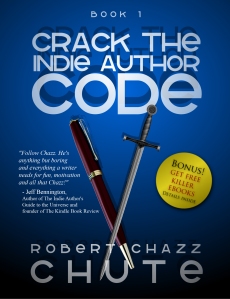
I’ve been meaning to do this for a while and by not sleeping, I’m finally getting to it. I pulled Crack the Indie Author Code and Write Your Book, Aspire to Inspire from print. I didn’t like the look of the interior design. I’m fixing them and will make Crack the Indie Author Code available in print again soon. (They’re both still out there as ebooks.)

Self Help for Stoners JPEGCase #2

Self-help for Stoners was my first book. It’s funny and strange and with an intermediary. I used Bookbaby for that collection and I want to get it back at Ex Parte Press and put it out myself. I’m sure I can make it go higher once I have full and instant control of the marketing. I queried Amazon about the process today because I’m afraid of losing the reviews. Either way, I do need to steer my ship and reach out to stoners and non-stoners, alike and anew. (If you’re a Bigger Than Jesus and Higher Than Jesus fan, my luckless Cuban hit man appears first in Self-help for Stoners, by the way.)

This post won’t help you much if you only have one book to sell, but here are my thoughts on renewed marketing efforts: 

If you have one book, write more. No whining,

If you have a backlist, who is to say what’s old and what’s renewable? You’re the one to say.

If you have a bunch of books, I bet you’re a better writer by now. Why not revisit those books and do new editions?

Consider the power of bundling books. You could enliven your Amazon dashboard with more happy green up arrows. Stop sitting on the money.

Lots of people missed your fledgling efforts the first time. You didn’t know what you were doing. Who did? Any book they haven’t read is new to them. 

The most powerful promotions tend to be the first ones. But maybe that’s because we don’t put the same marketing efforts into books we published a couple of years ago. In digital, the term backlist is less relevant. As long as it’s clear it’s a new edition or a new launch or you’ve added material, what’s the problem? 

Maybe those early efforts flopped because you had a lousy cover. Get a new, better cover* and launch it right this time. With all you’ve learned about marketing since your early efforts, it’s bound to do better, right?

Most fiction doesn’t get stale. Our efforts get stale because we want to focus on the new thing. Maybe the old thing is only old in your mind. With some tweaking, a fresh edit and a new campaign, you might have a book people will love and buy. Reuse, recycle, repurpose. Turn short stories into collections. Open up to new possibilities with prequels to your books. Tie books together. Add to your series. Serialize. There’s plenty of fun to be mined in what you’ve already accomplished.

Your problem with these suggestions isn’t necessarily that my head is full of feathers. Your problem is the same as mine. This will take a lot of time and you feel you’ve already covered this ground. But most of us didn’t cover this ground well the first time. There are new promotional tools now. Yes, time management can be tough and we can only do what we can do. But that’s business. We are not special snowflakes, but we’re letting good stuff go cold.

*About good covers, I know a guy. He’s Kit Foster of KitFosterDesign.com. He’s an award-winning graphic artist with an extensive portfolio who works well with indies and traditional publishers. Like my covers? Kit did them all. Check out his site. You’ll be glad you did.

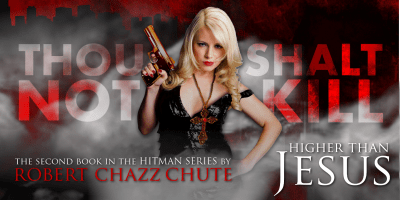
Dark Higher Than Jesus banner ad

Filed under: author platform, Books, ebooks, Publicity & Promotion, publishing, , , , , , , , , , , , , , , , , , , ,

Writers: Are you in the echo chamber?

I love my writing community here. I’ve learned a lot from others and, as indies, we share a lot of information. We’re a generous bunch with each other. I appreciate your comments and participation on my little writing and publishing blog. Because I’m a sweet bunny pooping love everywhere, I have to tell you something with love:

Writers talk to other writers too much. We must talk to readers more.

Let’s make this go down easy by using an example from another industry.

When massage therapists try to figure out their businesses, they ask their peers and senior massage therapists for their opinions. They want to drink from the well of experience. It’s a good notion that frequently goes awry. Their peers are often as clueless as they are and senior therapists either don’t have the same problems or their advice is out of date. Take pricing, for example. They’ll set fees based on what they’d pay. But many massage therapists would never pay for massage. They don’t have enough money or they swap treatments with other therapists. Massage treatment is for people with real jobs and insurance coverage, not us.

Stick with me and hold my hand, because this is about to get uncomfortable.

Writers need to listen to readers more.

Sadly, writers often don’t have much money to spare so we use libraries or search for free a lot. Most of us buy books when we can, but with budgets as tight as they are, we’re often not your audience. As a result, many of our industry’s book prices are artificially depressed. We’re asking the wrong audience what we should do. (I’ve taken this advice. I just raised prices on some of my books and generally, the trend will be up.)

A veteran writer who’s “made it” (whatever that means) often doesn’t know all the variables that contributed to his or her success. If someone coasted to indie success from a high in traditional publishing, they can’t tell you much about the current scene. Precious few people attribute any of their success to luck. It had to be their sheer brilliance. However, many of us are brilliant and we’re still eating boot soup.

So, what not to do?

If you don’t tweet others at all, you may as well be on Mars.

If you rarely check your direct messages, you’re in the bubble.

If you only check your mentions on Twitter, you’re screaming into the echo chamber.

If you follow three people and two of those are your other Twitter accounts, you’re only hearing yourself plus you’re a raging narcissist (and not in a good way).

If you only have conversations with people who don’t buy books, you’re surveying the wrong people.

If you only speak to people who “buy” free books, you’re engaging the wrong audience. (Readers who buy with money instead of a click are often suspicious if your book is priced too low, for instance.)

If you don’t take new information in and seriously consider change, you’re for slavery. (Your own.)

If you do have conversations with readers from time to time and you talk about them, you’re on a smoother path.

If you don’t cultivate supportive friends, you’ll be alone, surrounded by fiends and without a fire ax or holy water.

If you only attend conventions with other writers instead of fans, you’ll have a great time talking to people who agree with you: “Wow, it sure is hard to connect to new readers!”

If you never get out and talk to real people in the real world and only connect with people on a safe and cyber basis, who will you learn to hate so you can kill them in your next novel?

If somebody says, “I prefer paper books,” and you reflexively say, “How Amish of you! Ebooks are the only future!”, that was kind of funny, but you should be listening instead of cracking that same joke open again. It’s rotten on the inside.

If you say all this social engagement is too hard and it takes away from your writing time, I’m sorry. I thought you were writing to be read. Get a calendar or time management software. At least tweet or email during commercials.

If you immediately dismiss everyone with whom you disagree, you’ll never learn the secret to…well, anything really. Plus, you’ll come across as a jerk.

I’m not suggesting you allow me or readers or reviewers or anyone else to run your life. I am saying that if you recognize yourself in this list and it gives you that squirmy squirts feeling, adapt accordingly. Listen.

You should listen to me. I’m a writer.

Filed under: author platform, getting it done, Publicity & Promotion, publishing, Rant, readers, , , , , , , , , , , , , , ,

The World’s End…and our beginning

TPOD season 1 ecoverFor most, the last milestone of summer just slipped by. Labor Day’s demise means the end of bikinis, bikini dreams and the return to indoctrination centres. But Time’s notches are  artificial milestones, like New year’s resolutions, your anniversary or waiting to start your new diet on Monday morning. If you need to begin again, now is the time whenever now happens to be.

For instance, don’t wait until it’s your anniversary to send flowers. It’ll mean more because it’s not a special day. Any day can be made special, momentous or mundane. Our choices make it so. Let’s take a moment to think about those important choices and a fun Simon Pegg movie.

I saw The World’s End today.

Mostly, I liked it, especially when it didn’t take itself seriously. However, between that and the trailer for Last Vegas, a depressing theme returns. Last Vegas is old guys “getting the band back together” for one last blowout party before making funeral arrangements.

Even the last Bond movie explored mortality’s dark territory. Note to Hollywood: James Bond getting old is something no Bond movie should ever explore. Bond is timeless, cool and indestructible, just like we wish we were. We want a vicarious thrill ride with babes sporting unlikely names, not a vicarious prostate exam.

Comedies that pound on mortality? That’s a hard target. Getting old and worrying about mortality are what doctor’s appointments are for. When I’m guzzling overpriced popcorn, I don’t want a reminder that my time is limited. If the best is behind us, why go forward unless it’s merely out of habit? (Insert Jack Nicholson impression here: “What if this is as good as it gets?”)

So let’s focus on the positive.  

Defy the forces of Time. Ignore Time’s dictates. Do what you want to do. Often, when we aren’t doing what we want to do, we’re forgetting:

  1. our dreams from childhood.
  2. that our time is limited.
  3. who we are.

Reality check: But most of us can’t do all we want to do.

As per my last post, I have to start another business to shore up Ex Parte Press. But I haven’t forgotten childhood dreams, mortality or who I am. Simon Pegg (whom I love, but geez, man!) wouldn’t let me forget, even as I tried escape into a movie to forget my problems for a couple of hours. It’s not Simon’s fault, though. I identified too much with the film’s immature main character crying out, “We want to be free!” and “They told me when to go to bed!” 

I’m still working toward my dreams and freedom. I’m still writing brain tickles and suspense. I hope you’re undeterred and writing madly, too.

If not, don’t wait.

Begin again.

Now.

Live a life full of new beginnings and you can ignore what happens just before the credits roll.

~ Robert Chazz Chute is the author of a bunch of books. His neural net fires into the dark wildly. He does not wear collars. He eschews ties. If you want an easier, happier life, those are bad bets but a jerk’s gotta do what a jerk’s gotta do.


Filed under: getting it done, publishing, Writers, , , , , , , , , , , , , , , ,

Books: Ventures, Misadventures, Adventures and Brutal Honesty

Crack the Indie Author CodeWhen George Lucas screened  Star Wars, most of his fellow filmmakers in the room looked at each other and said, “American Graffiti was awesome, George, but this space opera thing…yuck!” It was Stephen Spielberg who played the contrarian. “You guys don’t get it!” he said. “This is going to be huge!” And of course, Spielberg was right.

My personal Lord and Saviour of The Written Word, William Goldman, famously said of the Hollywood film business, “Nobody knows anything.” It’s true, no one can know what will hit and which will miss. Someone comes up with the somewhat moronic expression YOLO (the idiot’s “Carpe diem”) and it’s suddenly on t-shirts everywhere. True for us, too. You may write a heavy, ambitious tome, but it’s a tiny book like The Little Prince that captures the hearts and imaginations of generations of readers.

So it is with marketing books.

Agents say they can “guide your career”, but if that were true, anyone with a sentient agent would have a fabulous career. No one knows anything in publishing, either. That’s not meant as an insult, but as a reflection of reality. Publishing is famous (or infamous) for placing bets on many horses, hoping the big bets will pay off and cover the losers’ ubiquitous failures. Few industries have a miss rate as high as book publishing (though Hollywood’s screwing up even more than usual lately.)

So it is with my books, too!Self Help for Stoners JPEG

The summer is winding down and I find I must split my mania among many ventures. I’m in a philosophical mood and looking back at what took off, what has not, and why. We at Ex Parte Press are not lounging in the money, chocolate and champagne pool at the moment. (But we still have high hopes.)

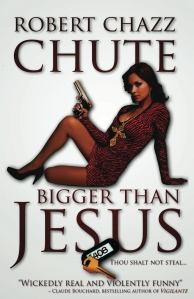
  • Bigger Than Jesus and Higher Than Jesus are critical successes among the few critics who are aware of my funny Cuban hit man and his tragic past. Alas, hardboiled and funny suspense isn’t trending at the moment. Nonetheless, I have more Hit Man books planned. Jesus Diaz will just have to wait a bit longer as I concentrate my efforts where readers have demonstrated more enthusiasm. I love Jesus, and can’t wait to get him back on the warpath in Hollywood. An assassin who can make movie references and quick quips while getting beaten up deserves more books. He’ll get them.
  • My first funny short story collection, Self-help for Stoners, sells just a little but steadily. It’s a tribute to Kit Foster of KitFosterDesign.com that the cover is repinned on Pinterest several times a week, every week. Later this fall I will stop using an intermediary so I can take back control of marketing that book. I have no doubt I can take it much higher once that happens. I’d have done it by now but I’ve been perpetually swamped for months with This Plague of Days.
  • Six Seconds, my book about using the Vine app to market your business was an instant book with lots of great advice. I’ve moved books and marketed my podcasts having fun with mini videos. Though Vine remains the superior product, Instagram changed their app to ape Vine so Instagram has many more users. I bet on the wrong horse, not every at bat is a home-run, insert your metaphor for failure here.
  • This Plague of Days, Season One is getting traction. It might even be on the cusp of taking off. I’ll find out when Season Two hits at the end of September. (Here’s my latest post with hints and expectations for Season Two.) Early feedback is very encouraging. As in this, from the beta team: “Suspense and plot and action – all of them are on steroids in this book…overall impression is you have brought this thing to the next level.”

Mind the towering caveat in the following paragraph:

My luckless hit man is a funny guy in big trouble.

My luckless hit man is a funny guy in big trouble.

So you see, I’m no better (or worse) at stabbing at the imagination of readers than anyone else. I don’t know what will sell buckets of books. No one does. It’s something that happens to you, as long as you pretend your destiny is under your control and do everything you can to get discovered. You can hit the target. We’re all shooting blindfolded in the dark, sure, but if you take enough wild shots, aiming matters less. You write the best book you can and engage more readers and attend some sad, ill-attended bookstore signings and do whatever else you can think of to fire off signal flares without becoming a Twitter pariah.

This is not to say that good advice isn’t out there. It’s just that so much good advice conflicts!

The great Chuck Wendig talks about voice (or the force of personality) being more important than “brand”. Others can’t talk about anything else but brand, stats and system gaming. Hugh Howey is the outlier that didn’t really market anything when he started Wool (though he says Facebook helps him most these days.) Some insist on lots of links to your other work in the back of each book. Others say that’s overkill and intelligent readers will find you easily if they love you enough to bother with a google search. Some book marketers are passive as a policy (or lazy.) Others are so active, it’s pretty close to obnoxious.

And still, nobody knows anything. Not for sure. There are too many variables to success and the situation is fluid. We, writers and publishers all, dance on tightropes while juggling feathers in wind storms and hope readers will cast a glance our way and enjoy the silly monkey dance.

Still, you’ll find advice about tactics everywhere.

Just this week, I pushed the Author Marketing Club and Bookbub. Solid advice I stand behind. But keep in mind, these are tactics. The potency of tactics can wax and wane according to many variables. That’s what’s hot now and into the near future. After that? New tools will emerge because good ideas get copied. Sometimes imitators are new and improved and often the copier doesn’t have enough toner.

Strategy is long-term thinking. Strategy says: Write more. Get more feedback. Write more books. Get better. Higher+than+Jesus+Front+1029

This is the only advice I know that lasts. (You’ll find that and much more about the writing and publishing life in Crack the Indie Author Code and Write Your Book: Aspire to Inspire. Crack sells a bit while the second book hardly moves at all. Why? Who knows? Nobody. Nobody knows anything! My Lord and Saviour told me so.

However, I’ll let you in on a little secret: I have a third book about writing and publishing in the chamber ready to fire. When This Plague of Days hits big, readers will pick up all my books about writing and publishing. After the fact, they’ll say, “Well, no wonder.” 

The Johnny-come-latelies won’t know what you know. My overnight success wasn’t overnight. Success always seems inevitable, but only in retrospect. Until you make it, no one cares about you and your book. Those who do give you any thought probably think you a fool. (Insert an image of your disapproving in-laws here.)

Ah. But, afterwards? You’re a genius.*

~ *Afterwards, You’re a Genius is a wonderful book I recommend for anyone interested in scientists with lyrical sensibilities.

For more on the rising action and scary high stakes in the spiralling weirdness of an autistic boy fighting zombies, read this post at ThisPlagueOfDays.com. 

For more on my adventures in self-pubishing, swallowing bitter pills and my peculiar brain mania, there’s this post on the writing life at my author site. 


Filed under: author platform, getting it done, self-publishing, , , , , , , , , , , , , , , , , , , , ,

Breaking Bad and making better storytelling choices

Season One has five episodes. Get each one for 99 cents or get all of Season One at a discount for $3.99.

When you’re in the trenches (and by that I mean when you’re at your keyboard) you must stay true to your vision. There are artistic choices to be made that will challenge some readers’ expectations. Choose more conflict and damn the torpedoes.

For instance, at the beginning of This Plague of Days, the protagonist’s sister, Anna Spencer, isn’t particularly likeable. She’s not over the top, but she is a hormonal teenager whose brother is on the autism spectrum. She calls him Ears because he has big ears. She loves her brother, but she can be mean. She’s jealous of the extra attention he gets because of his challenges. She treats him the same way many siblings treat each other in their formative years. If you’ve ever had a sister, or been one, you’ll recognize her turmoil as she matures. Now add the plague apocalypse (and later, scary, infected cannibals) and you’ve got tense family relationships facing a storm of trouble raining down evil doers and crazy cakes.

Readers who only read Episode One might not care for Anna much.

Impatient readers will never get to see how badass she gets. (I’m revising Season Two now and she’s nicer, but still working her way to badass.) If they quit reading at Episode One, they’ll never find out how circumstances and time transform her into an interesting, brave and responsible woman. Anna Spencer has an arc. All my characters have arcs and their own stories to tell. To have those stories, and the complexity I insist upon as a storyteller, the characters can’t begin as static, happy stereotypes.

This Plague of Days has nuance. Some characters you think are good now may surprise you with what they’re willing to do later. Characters you assume are bad may have altruistic motives that aren’t clear up front. Some writers say we shouldn’t even write “characters”. We should write people in all their complexity. The people you write about have to transform, and I don’t mean from likeable and nice to slightly more so.

Think how ineffective Breaking Bad would be if you didn’t watch Walter White’s transformation through the show’s seasons.

He starts off as a nebbish who reached for the brass ring and fell short. A cancer diagnosis turns him from an ordinary Chemistry teacher into a cold and calculating drug kingpin desperate for respect and safety. The cool thing about Breaking Bad is, today’s solution is always tomorrow’s problem. His character arc is entirely logical each step of the way. Throw in a fatal flaw and a few reversals and he ends up in an insane place that is believable over time. 

If Walter White had started out evil, you don’t get grim fun and complexity. You get another stupid, failed TV show (starring cast members who used to be on Baywatch) cancelled and forgotten after half a season.

Another example: Points of view must change.

In This Plague of Days, I made choices to introduce more family strain. This Plague of Days isn’t just about viruses, zombies, fires and firepower. It’s about people under pressure.

The mom is a Christian. The father is an atheist.

Faced with mortality, the mom becomes a Christian with doubts and the dad becomes an atheist with doubts. I believe in readers and I follow the story wherever it leads (i.e. toward more conflict.)

Issues of atheism versus faith are not presented all at once. This isn’t a college seminar. Near the beginning of Season One, the atheist has his say. That may repel some readers who won’t stick around for his confession, feelings of abandonment and transcendence. Too bad those same readers won’t hear the mom’s counterpoint, either. Impatient readers might seize on one aspect in the early going (for or against God, depending on when they stop reading.) I feel it’s an honest, necessary exploration woven into the fabric of a much larger story. (Not that it should matter, I’ve been a believer and an atheist but not at the same time.) I’m not pushing an agenda. I’m pushing for brain tickles. If you want to be pulled into warm marshmallow, read Chicken Soup for Something or Other. I write suspense. Not everything is for everybody.

Readers will draw their own conclusions about religion (or ignore that small aspect of the story completely.) Zombies turn some people to God. For others, zombies turns them away from faith. Put a wife and husband at the edge of the end of the world and I guarantee religion’s going to come up. It’s not my job to make up anyone’s mind. It’s my job to tickle brains and make the debate honest and interesting while the struggle for survival gets harder. Context is everything.

Don’t pander. Follow the Art and the Conflict

People will draw conclusions about you from what you write. Don’t be afraid of that or your story will suffer. You’re a writer, so we already know you’re brave and have an unreasonably high estimation and expectation of the human race. Live up to that commitment with every chapter.

Respecting the reader doesn’t mean that you try to make them like everything they read. However, most readers stay longer with stories that challenge them, make them think and make them laugh. Don’t let it come out as an info dump or a teaching moment. Let it come out naturally. Don’t make your story a seminar on your beliefs. Do let characters have strong, conflicting points of view. Have a spine, but don’t force conclusions. Let the reader do that work for themselves. Always leave room for doubt.

For the Readers

I guarantee, when you read This Plague of Days, you’ll read things you’ve never read before. You’ll learn things you probably didn’t know. (I did!) And you don’t have to agree to anything. It’s a book. It’s not a threat to the tenets of your existence.  

A fun book is a ride at the carnival, an exorcism of fears, a voyeuristic pleasure, an extended brain tickle and a happy distraction, first class on the Crazy Train. All aboard to the end of the line.

Filed under: publishing, writing tips, , , , , , , , , , , , , , , , , , , , , ,

Bestseller with over 1,000 reviews!
Winner of the North Street Book Prize, Reader's Favorite, the
Literary Titan Award, the Hollywood Book Festival, and the
New York Book Festival.

http://mybook.to/OurZombieHours
A NEW ZOMBIE ANTHOLOGY

Winner of Writer's Digest's 2014 Honorable Mention in Self-published Ebook Awards in Genre

The first 81 lessons to get your Buffy on

More lessons to help you survive Armageddon

"You will laugh your ass off!" ~ Maxwell Cynn, author of Cybergrrl

Available now!

Fast-paced terror, new threats, more twists.

An autistic boy versus our world in free fall

Suspense to melt your face and play with your brain.

Action like a Guy Ritchie film. Funny like Woody Allen when he was funny.

Jesus: Sexier and even more addicted to love.

You can pick this ebook up for free today at this link: http://bit.ly/TheNightMan

Join my inner circle at AllThatChazz.com

See my books, blogs, links and podcasts.

Enter your email address to follow this blog and receive notifications of new posts by email.

Join 2,063 other subscribers