C h a z z W r i t e s . c o m

See all my books at AllThatChazz.com.

The real value of TBR lists (that you hardly ever get to)

Besides the chance at author discoverability through also-boughts, what is the value of all those to-be-read books you and I will probably never get to? (I say this with love and without judgment, as an author and fellow hoarder of books and ebooks.)

To shine a light in the dark, I spoke recently with an author who has her books for sale everywhere but Amazon.

(It matters little why she wasn’t on Amazon, except to say it was a misunderstanding of the platform’s requirements, not a principled, moral stance.)

“But we have to be on Amazon,” I told her. “Exclusive or not is your choice, but if you want to reach more readers, you must be on Amazon.”

“Why?”

“Because that’s where so many readers are. Amazon is out front and will remain so for the foreseeable future.”

“Why?”

“Because their customers are locked in.”

“What do you mean ‘locked in’? Everyone could switch to Kobo tomorrow.”

“But they won’t. Amazon has millions of customers whose first device was a kindle and so their library is on kindle. Kindle devices have come down in price and improved, so those readers will stick with kindle. They’re suffering the delusion that someday they’ll win the lottery, move to the French Riviera and finally have time to read all those hoarded books on a topless beach.”

“That’s not rational,” she sniffed.

“If I switched devices, it would be like burning all my books. And maybe that’s irrational, but we are talking about humans, yes? I have so few Vulcan readers.”

“But devices and companies go away. Look at MySpace and AOL and Kodak.”

“And the not-so-bright future of the Nook,” I added. “Yeah, companies go away if they fail to adapt to competition. But all those free downloads to long TBR lists give Amazon an immense legacy advantage. Kobo might be #2 in the e-reader market, but they’re a distant #2. Amazon’s the greyhound out front chasing the rabbit. The others are three-legged purse dogs running in circles around the starting line.”

“That’s ridiculous. If I wanted to switch, why couldn’t I just port my Kindle downloads over to Kobo?”

“Amazon would have to permit that, I’m guessing. They’re different systems. There are workarounds, but most readers won’t do it. For instance, I’ve got Calibre but I hardly ever use it.”

“Why not?”

“Because it’s harder to use and more time-consuming than the one-click buy that shoots straight to my kindle. People stick with what they know and what’s easy. For instance, everyone complains about Facebook, but they hardly ever leave and a bunch of those who do leave come back for more abuse. They don’t hang out at G+ because all their friends and family are still on Facebook. Their network is locked in, even if they don’t want to be. For Amazon and Facebook to start to worry, they must have a real threat of competition.”

“I heard Instagram is getting even more popular than Facebook with young people,” she said. “Facebook has serious competition there.”

“For that niche and possibly into the future, yeah, which must be why Facebook bought it already. No competition.”

“Oh,” she said.

“To compete with the greyhound, the little yappy dogs have to take steroids and get going in the right direction. But the greyhound will probably eat their steroids. The big dog always has more money for R&D.”

“You’ve lost me in the canine metaphor. I don’t hang out at the dog track.”

“Come up with a new way to reach customers and someone will finance it. If it’s a really good idea, it will probably be the leader of the pack buying you out, making sure they stay the pack leader.”

“But what about all those companies that fail?”

“Nothing lasts forever, sure. Apple seems to have lost some direction since Jobs died and the stock’s down. Mostly, big companies fail because they lower their standards or try to hold on to the old paradigm instead of improving and evolving. Like how the Big Six publishers became the Big Five. Soon to be fewer, probably.”

“Ah. So…you really think I should sell on Amazon?”

“It’s up to you, but for me, it’s the only platform that’s not optional. There are exceptions. Some authors seem to move romance and crime better on B&N and Kobo. If they choose to pull you out of the haystack and promote you, you might have a shot. But mostly, and for me? If I wasn’t selling on Amazon, I wouldn’t be selling books.”

“So all those free ebooks on my TBR cyber-pile is just Amazon insuring customer loyalty?”

“I wouldn’t call it loyalty. No matter what the Supreme Court and Mitt Haircut say, corporations aren’t people, my friend. Companies rarely inspire love. Call it inertia. Also, I’m sure they really do hope you’ll buy somebody’s books and make a ton of money the way they say it was intended. I’m talking more about customer behavior here, not whether Amazon’s packed to the rafters with cynical geniuses who can see into the future.”

“So what do you think of free ebooks as a promotional tool?”

“It’s not the sharpest tool in the shed, but most of the discoverability tools are pretty dull.”

“Sounds like you love Amazon,” she said, her eyes narrowing.

“No. If the little dogs started running faster, I’d bet on them. Until then, I’m riding the big dog. And you know…sometimes…once in a long while, I’ll find an author in that TBR pile I thought I’d never get to. And sometimes, I’m blown away and I want to read more of their books. Then I’m in true buying mode. Free ebooks is fake buying mode. But it does happen that I find someone I like there and spend real dough.”

“Name one,” she said.

“I’ll name three. Alex Kimmell, Jordanna East and Armand Rosamilia.”

“I’ll add them to my TBR pile,” she said.

“Make sure you get to them.”

~ Robert Chazz Chute is an author with ten books in your TBR pile you still haven’t gotten to. How will you ever fall in love? 
Filed under: Amazon, author platform, book marketing, Books, e-reader, ebooks, free ebooks, Publicity & Promotion, publishing, Writers, , , , , , , , , , , , , ,

Et tu, Kobo? Anger and the Cost-benefit Analysis

By now, most authors know about Kobo’s rash move to yank all indie authors from its platform. Today, we talk about Kobo and reevaluating our marketing strategies so we can manage time and energy and make more money.

If you came in late to the debacle, here’s what started it:

They condemned indie authors in an over-reaction to a news story about pornographic ebooks invading WH Smith through Kobo. Instead of weeding out individual books they deemed offensive, they painted us all with the same brush and pulled a digital-ton of indie ebooks.  They didn’t just hit indie porn and erotica titles. They hit all of us, the tall and the small, and legal. (For more details, check “Related articles” below).

Hitting the big, red nuke button was a major tactical error. Failing to open lines of communication also didn’t help. Kobo was put in a tough position because of their relationship with WH Smith. Kobo did announce the bulk removal was temporary and they’d review books before putting them up for sale. How long that could take, we have no idea. Kobo probably doesn’t know, either. Sounds like a gargantuan task. Better filters would have served them well.

Two of my crime novels were pulled from Kobo.

Bigger Than Jesus and Higher Than Jesus disappeared from the store. Bigger Than Jesus is now back, but not for long. I’m pulling it from Kobo and everywhere else, except Amazon and CreateSpace. I’ll also begin selling paperbacks from my website (but more on that another time.)

Some authors are (or were) making money with Kobo. Amazon is not the only game to play, so you’ll see the same advice everywhere: “Don’t put all your eggs in one basket! Put your books across all platforms! Amazon’s free books scheme with KDP Select doesn’t work anymore.”

Today, I’m going to challenge the egg basket wisdom. First, let’s talk Kobo beef.

1. Kobo’s platform is flawed. Where are the reviews? And (I’ve said this many times) why aren’t they stealing the best ideas from the other platforms? Amazon is the model they aren’t emulating. Kobo isn’t alone in this regard. Over at Smashwords, the website is still very ’90s. Still!

2. Instead of taking the time and energy to spread ourselves across many platforms, I suggest you look where books are actually moving. This won’t help you if you have one book, but after a few, you know which platforms butter your bread and which poop in your cereal bowl. My books sell on Amazon, Barnes and Noble and in print. That’s it. Avengers, assemble! Activate the 80/20 rule! 

3. Some people love Kobo. They’re in a lot of markets and there are nice people there. I’ve spoken to someone from the company and she couldn’t have been nicer. I’ve heard interviews on the Self Publishing Podcast. Kobo has awesome representatives who communicate their respect for authors and care about what we’re doing. I want to love them! But the company screwed up all that good will in one big, bad move that was not thought through.

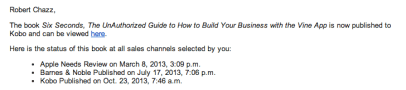
4. Then I got this email this morning from Draft2Digital, informing me that a book I published to Amazon (within 24 hours) back in February 2013 was finally on, you guessed it, Kobo.

Screen Shot 2013-10-23 at 9.27.16 AM

Barnes and Noble published Six Seconds in July and Kobo’s right on the case, finally getting my book about marketing with the Vine app out into the world today? What the bloody hell? It’s been so long, I’d forgotten I’d even selected them as a sales channel.

Trying to publish this book with Apple is also a hassle. That’s two of Amazon’s competitors failing the cost-benefit analysis. The tragedy is that Amazon doesn’t have to be perfect to dominate. It just has to avoid the razor wire and landmines its suicidal competitors throw themselves upon. In a healthier market, the competition would be smarter and closer on Amazon’s heels.

5. Then there’s the hypocrisy. Kobo says they aren’t for censorship as they pull indie authors. They’re free to publish and not publish what they want, but this was a blanket condemnation of indies. That no doubt pleased traditional publishers. It must have been particularly gleeful for the legacy publishers of erotica who were immune from the cull.

It has to be said, there are all kinds of works of literature that contain intense violence. Many of my books contain violence, but not all were pulled. I’m arguing none should be pulled because, if you want to protect children from pornographic ebooks, it’s your job to make sure your kids don’t buy them. Kobo is a company. Parents are parents.

I don’t want media companies to act like parents, especially when we’re talking about fiction. I had parents already and look how that turned out. I’m nobody’s kid anymore and I’ll make my choices for me and my kids, thanks. (As all preachers’ kids know, it’s the suppressed and repressed ones that go too wild once they hit Frosh Week, anyway.)

6. Okay, so that’s enough spanking Kobo. Let’s talk book marketing strategy and rethink it.

As far as KDP Select goes, it’s true it doesn’t work as well as it did. However, does it not work for so many authors because they’re expecting it to work on its own? The book has to be strong and the cover art must be awesome. We all know that, but are author-publishers stopping short, assuming those variables are enough gas for their sales engine? How many oft-referenced cases of KDP Select “failures of free” are actually KDP failures? Are authors doing enough to promote those free days?

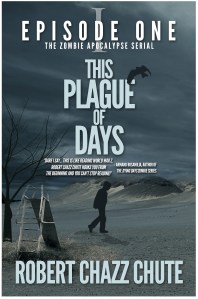
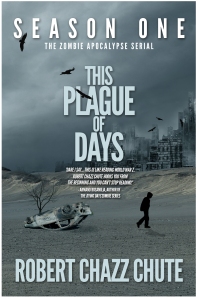
Using Author Marketing Club tools and Bookbub, Freebooksy and other advertising and promotion services in combination with free promo days through the exclusive Select program, This Plague of Days, Seasons One and Two became bestsellers. This was long after many authors abandoned KDP Select because “free doesn’t work anymore” became common currency among us.

Your cost-benefit analysis may be different, but I urge you to do a cost-benefit analysis.

As pressures mount, spreading ourselves everywhere takes time and energy we could be using more profitably. If you sell books on Kobo, keep them. If you’re that one author who makes cash selling on Sony or Diesel, go for it. The only platform I’d say everyone should to be on is Amazon because they’re the bus that’s gassed up.

“But what if Amazon makes the same mistake Kobo did? They’ve pulled books willy-nilly before! Isn’t Kobo’s fiasco an example of why we have to spread our books to all platforms to minimize risk?”

After the hoopla Kobo’s decision caused, I don’t think Amazon would be or could be that stupid. Besides, it’s not about allegiance to a platform or blind tribalism. It’s going with what works for you. At worst, if you really can’t stand being in Amazon’s exclusive contract, you can reevaluate and bail at 90 days.

True, spreading everywhere insulates us from dumb mistakes, but it would also minimize potential profit drastically. Unsuccessful businesses play not to lose.  Play to win. I mentioned I sell some books on B&N, but the return is so low, it’s not even a factor. Until the other platforms come up with better ways to market us, Amazon is my puddin’. 

This is math. Look at where your books are selling.

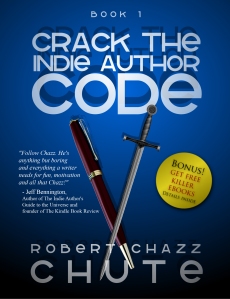
Put your time and energy into getting more books into those channels and leveraging that advantage with books like Let’s Get Visible by David Gaughran. (And if you haven’t published yet, buy Crack the Indie Author Code by some thoughtful and encouraging idiot.)

Are you selling even a little bit on Kobo? Who cares? Use the 80/20 rule. Focus your energy where it does the most good. That’s why I’m pulling my crime novels from Kobo. I had other plans to market the Hit Man Series. Now I’m going to pull them back to KDP Select and leverage that series better than I did the first time. I wasn’t in the Author Marketing Club when Bigger Than Jesus came out. I only have two series, so I must reevaluate non-Amazon successes and failures and act accordingly.

This is also emotion.

I admit it, emotion plays a role. Nothing’s broken so I’m not in a rage. I am annoyed. Kobo made their decision for short-term reasons that did not respect indie authors. We are the publishing revolution, remember? They pulled our books without warning. We don’t matter to them and I’m hurt. It’s not just the principle. It’s the money.

I’m sure I don’t matter to Amazon, either, but at least Amazon can publish my books in a timely manner and move them. Ultimately, I’m not leaving because of Kobo’s instability. My annoyance led me to reevaluate what Kobo was doing for me. I’m not punishing Kobo at all, but the fact that I can pull my crime novels and not hurt myself tells me I should refocus my energies.

I’ll go back to Kobo one day, if they’re still around by then. Who knows? Maybe this debacle is just what they needed to reevaluate their platform and marketing strategies, too.

Tips and inspiration for the indie author's journey to publication.

Tips and inspiration for the indie author’s journey to publication.

~ Hi. My name is Chazz and I’m much nicer than I appear here. I’m usually pretty sweet and funny unless I’m writing suspense. Then the serrated knives come out and things get twisty. I love people, though books give me less back sass. I’m a contrarian, but not for the sake of being contrary. I just don’t understand how the world works. There are so many example of how it doesn’t work, I get distracted easily.

I believe in love and readers and curiosity and the written word’s power to release dopamine. I’m in the brain tickle business and I’m grateful for that every day. Find all my books here for the foreseeable future.

Filed under: author platform, Books, , , , , , , , , , , , , , , ,

Marketing books: Thirteen video options

Season One of This Plague of Days is free until midnight tonight.

Season Two launches in two weeks.

Book trailers are problematic. Video can be done well. It often isn’t.

Most of them are too long. Production values are typically lower than viewers’ expectations. We’re trained to expect CGI on the level of major movie studios. Also, there’s little evidence trailers generate any sales. Go big and you’ll spend money with no return on the investment. Go too small and you might not be proud of it. Here are magnificent options, ranging from giving up and doing zilch to going big. Since I’m in touch with reality, most options are no-budget or low-budget.

Alternative 1

Don’t do it. It’s not worth the bother.

Alternative 2

Play with iMovie in your spare time. If it’s fun, great, but certainly don’t lose writing time to it. 

Alternative 3

Rather than worry about making a little movie and learning an editing program, do six seconds on Vine and/or fifteen seconds on Instagram. Focus on one quick, easy message. Don’t spell out the link to the camera. Leave the link in the caption. Note that people love video with cats.

Alternative 4

Upload to Youtube from your camera, iPod, iPhone or Android. Viewers will be more forgiving of low production values if they see you didn’t try to make it fancy. Just talk to the camera with a joke and/or announcement.

Alternative 5

Video pulls more clicks to your blog. Combine it with punchy posts for greater effect and more subscribers.

People have more tolerance for a short, laid back video than they will for long blog posts. For instance, yesterday’s post went deep into serialization and book pricing strategy. It was only for the most serious of book marketers and publishers. However, many more readers will click the video above and read this blog post for information because it has video and the text is breezy and scannable.

Alternative 6

Focus on what’s cool or ironically cool. Make it fun for you and the viewer. Try for the opposite of earnest and don’t try to tell too much of the plot of your book. Let the visuals do more work. Entertain first and come sideways at giving out information. One of the best book trailers I’ve seen was an author who talked about the glamour of the writing life while he scrubbed toilets.

Alternative 7

As I’ve suggested in the past, try a quote trailer. A quote trailer simply pulls intriguing quotes from your book. Don’t forget to include a buy link. Keep it short. No spoilers.

Alternative 8 

Use Animoto, as I did, for the video above. I already had the book covers. It took all of five minutes to use the free option for a video shorter than 30 seconds. The fire effect was appropriate and the music was a nice fit. Cool, huh? Animoto includes sharing options so you can export it to Vimeo, YouTube, Facebook, etc.,…

Alternative 9

If people don’t respond to your stabs at filmmaking, try making it more about you and how you can help others instead of making it about the book. Video reviews and how-to stuff get more hits. Funny’s always good, too.

I put up video of my podcasts to get more viewers and listeners. Some people simply prefer video to audio, or a YouTube video is how they will discover a podcast. Interaction in an interview setting can be easier to pull off than talking directly to the camera. Some people, like Hugh Howey, do it well and even dance for reviews. For most of us, solo videos look like hollow-eyed, stuttering hostage videos pleading for ransom under the threat of death.

Alternative 10

Have you set up your YouTube channel yet? It’s a great place to collect your video book reviews, too. Video reviews get more attention on Amazon than written ones, so it’s worth doing, for you and for authors.

Alternative 11

Go with Fiverr.com and get help to create quick videos like I did for my promotion plan for This Plague of Days. Check out my video samples at the link.

Alternative 12

If you really want to go big, get a semi-pro involved. There’s no proven ROI and most professional video production is expensive. Therefore, consider approaching a drama class or a film school. If your book trailer becomes a school project, at least your vanity project will benefit the education of a young actor or filmmaker in a concrete way. You could go the Scott Sigler route and make it a contest. Since every entry went up on YouTube for judging, Sigler’s books got multiple ads and multiple hits.

Alternative 13

I think Kevin Smith and Steven Spielberg are available for princely sums, but if you’ve just won the lottery, go with any of the above options and get your video production done free or cheap. Starving children everywhere would appreciate your generous donations. If you’re rich enough to consider professional directorial help, good karma’s the better way to go.

BONUS

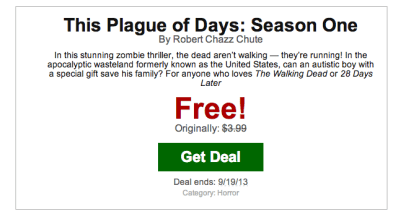
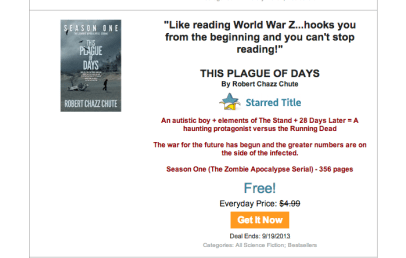
Are you on Bookbub? Here's what the email looks like for my TPOD promo. Sale ends at midnight, never to return. Enjoy.

Are you on Bookbub? Here’s what the email looks like for my TPOD promo. Sale ends at midnight, never to return. Enjoy.

Screen Shot 2013-09-19 at 12.53.17 PM

Bookbub allows you to showcase deals to many targeted readers who are interested in your genre. Got a deal? Get noticed with Bookbub.

Filed under: author platform, book trailer, Books, Publicity & Promotion, publishing, , , , , , , , , , , , , , , , , , , , , , , ,

Writers: Are you sitting on the money?

They call it the Cliff. You can do Author Marketing Club and Bookbub and free promotions and blow giveaways out the digital door. You can even start catching fire and getting traction and selling books for (gasp!) actual money. Then, the fall from grace comes. Sales drop off, often steeply. What happened? You ran off the Cliff. Lots of people do. In this post, we’re going to think about climbing back up and promoting our previous works again (and doing it better this time) because I suspect we’re sitting on money.

I’m rethinking the old marketing paradigm that’s always oriented to what’s new. 

It’s the thing we should question most: accepted wisdom. Despite all my efforts, old wave thinking is still permeating my brain. In traditional publishing, you get a short window to get traction and then the bookstores return your books to the publisherCrack the Indie Author Code for credit. That’s the structure of the short tail market. In long tail marketing, our books are up forever (or at least until the cyber war brings us all low). Still, we tend to think of our books as hitting big (or not) and then the graph points down. We’re mimicking thinking and marketing patterns from traditional wisdom because all old ideas are awesome, right? Oh, wait…

Case #1

I’ve been meaning to do this for a while and by not sleeping, I’m finally getting to it. I pulled Crack the Indie Author Code and Write Your Book, Aspire to Inspire from print. I didn’t like the look of the interior design. I’m fixing them and will make Crack the Indie Author Code available in print again soon. (They’re both still out there as ebooks.)

Self Help for Stoners JPEGCase #2

Self-help for Stoners was my first book. It’s funny and strange and with an intermediary. I used Bookbaby for that collection and I want to get it back at Ex Parte Press and put it out myself. I’m sure I can make it go higher once I have full and instant control of the marketing. I queried Amazon about the process today because I’m afraid of losing the reviews. Either way, I do need to steer my ship and reach out to stoners and non-stoners, alike and anew. (If you’re a Bigger Than Jesus and Higher Than Jesus fan, my luckless Cuban hit man appears first in Self-help for Stoners, by the way.)

This post won’t help you much if you only have one book to sell, but here are my thoughts on renewed marketing efforts: 

If you have one book, write more. No whining,

If you have a backlist, who is to say what’s old and what’s renewable? You’re the one to say.

If you have a bunch of books, I bet you’re a better writer by now. Why not revisit those books and do new editions?

Consider the power of bundling books. You could enliven your Amazon dashboard with more happy green up arrows. Stop sitting on the money.

Lots of people missed your fledgling efforts the first time. You didn’t know what you were doing. Who did? Any book they haven’t read is new to them. 

The most powerful promotions tend to be the first ones. But maybe that’s because we don’t put the same marketing efforts into books we published a couple of years ago. In digital, the term backlist is less relevant. As long as it’s clear it’s a new edition or a new launch or you’ve added material, what’s the problem? 

Maybe those early efforts flopped because you had a lousy cover. Get a new, better cover* and launch it right this time. With all you’ve learned about marketing since your early efforts, it’s bound to do better, right?

Most fiction doesn’t get stale. Our efforts get stale because we want to focus on the new thing. Maybe the old thing is only old in your mind. With some tweaking, a fresh edit and a new campaign, you might have a book people will love and buy. Reuse, recycle, repurpose. Turn short stories into collections. Open up to new possibilities with prequels to your books. Tie books together. Add to your series. Serialize. There’s plenty of fun to be mined in what you’ve already accomplished.

Your problem with these suggestions isn’t necessarily that my head is full of feathers. Your problem is the same as mine. This will take a lot of time and you feel you’ve already covered this ground. But most of us didn’t cover this ground well the first time. There are new promotional tools now. Yes, time management can be tough and we can only do what we can do. But that’s business. We are not special snowflakes, but we’re letting good stuff go cold.

*About good covers, I know a guy. He’s Kit Foster of KitFosterDesign.com. He’s an award-winning graphic artist with an extensive portfolio who works well with indies and traditional publishers. Like my covers? Kit did them all. Check out his site. You’ll be glad you did.

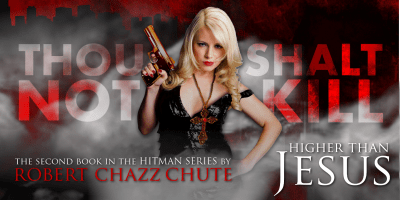
Dark Higher Than Jesus banner ad

Filed under: author platform, Books, ebooks, Publicity & Promotion, publishing, , , , , , , , , , , , , , , , , , , ,

FAQs: Would I go with an agent?

Crack the Indie Author CodeWhen I attended the Banff Publishing Workshop, most attendees were bent on writing and managing magazines and publishing houses.* I knew one nice woman who wanted to be agent. I wonder what she’s doing now? There’s an excellent chance she’s selling real estate. Too bad. She really was nice. Same is true of all my classmates in journalism school who were let go from their newspaper jobs about the time they turned 40. Changing media delivery paradigms sure do stir up chaos.

Given my last post, you might think I’m against agents. Not at all. I think agents could be very useful for negotiating foreign rights for my imprint in the future, for instance.

However, their role is much reduced and smart agents are changing their games. At a recent writing conference, writers were not chasing agents so much. The Meet-An-Agent appointment schedule could not be filled. Now more agents are chasing writers and they’re very interested in how your self-published books are doing. They weren’t at all interested a short time ago. In fact, some were quite pissy about the prospect. But now? Establish a happy track record and they might come a courtin’.

The short answer to this post’s title is:

I’d be interested in hearing what an agent feels he or she could do for me. There are good agents out there. I think hybrid publishing maximizes exposure and opportunities for you and your readers. Look at Wool author Hugh Howey’s experience. An agent found him and she was willing to travel outside the ruts of old publishing’s logging road to get Hugh a deal that worked for everyone.

The long answer? Let’s go with bullet points so I can make this shorter:

  • The submissions process can be a long ordeal. Long as in, are you young enough to begin now?)
  • You may be asked to make major changes to your manuscript. If you succeed in getting a book deal, you’ll make even more major changes.
  • You may choose to make the requested changes and they still won’t take you on. (They may even forget the changes they suggested. Yes, that’s happened.)
  • You can get an agent but still fail to place the book with a publisher. An agent is a person, not a guarantee of slinging back cosmos in Manhattan with your new editor.
  • The myth is that you choose an agent. The fact is if someone sends you a contract, most authors pee their pants and quickly sign. Regret is for later.
  • You can find an agent, dance joyously and then find out it’s a scam (as happened to a friend of mine.)
  • You could bypass the agent and submit directly to publishing houses and they’ll still read it. (They say they don’t, but most will.)
  • As Dean Wesley Smith has said, agents should be your employees. I’m sure he’s right. Guess how many agents see their professional status that way?
  • Submit to the wrong agent who blogs and they’ll mock your submission. Unprofessional, I’d say. As Will McEvoy said recently, “Snark is the idiot’s version of wit.”
  • Good agents have precious few slots open for new clients. Bad agents and scammers demand reading fees.
  • Rather than submit query letters to agents, many agents find new clients via recommendations from the authors in their stable. Who you know? Yeah, that’s still a thing. It’s called networking. Ignore the denials.
  • Getting an agent is tougher than getting published. Why not publish it yourself first and start selling now? As I’ve said many times, Amazon is the new slush pile.
  • Some agents live in fear of submitting manuscripts that might not be accepted. They have to be so sure, they’re too risk averse. One agent complained that one false move with a particular editor would lose her access forever. This sad story tells me that’s a crazed editor. It also tells me that’s an agent who is too fearful, forever doomed to be chasing trends instead of helping to make them.
  • The agent/author relationship is like a marriage: They have a piece of you forever even after the divorce.
  • Lazy agents say, “This would be hard to sell.” As a former sales rep for many publishing companies, I can assure you that there are few easy sales. We don’t need you for easy sales. Selling is part of the job. The better question is, “How can I sell this and to whom?”
  • Often when they say, “This would be a hard sell”, they aren’t lazy. It’s a euphemism for, “I think this is crap but why not be diplomatic?” They’re being kind. Don’t resent them for it. Move on.
  • You’ll get a better deal with a good agent than without her. A good agent will more than pay for herself. However, some agents are getting paid for doing very little. They treat the publisher’s contract as set in stone. That’s supposed to be the publisher’s attitude. It’s a bad attitude for the person negotiating for you.
  • Good agents can act as a buffer and help resolve conflicts with editors. Bad agents are the source of personality conflicts.
  • You have to trust your agent. You don’t have to love your agent. It’s a business relationship. That’s less clear in the beginning when you’re riding high. It’s very clear when they dump your mid-lister ass.
  • A good agent can do things you can’t and navigate the tiny details of contracts. A good agent can pay great dividends for their fifteen percent.
  • But an entertainment lawyer can practice law and navigate the tiny details of contracts and you pay them once. Hm.
  • A good agent can justify their participation in your enterprise without sounding old-school entitled about it. They work in listening mode.
  • Trad publishing has changed. Good agents know it and are adapting to serve their clients better.

TPOD 0616 EP 1 coverAuthors who love their agents are everywhere. A plethora of horror stories about agents also span the Internet, just as there are snarky complaints about clueless authors everywhere.

A better question is about the human variable: You.

Would you feel better with an experienced, connected agent helping you on an ongoing basis?

Or does the prospect fill you with anxiety?

Are you happier as a publisher/author/entrepreneur who pays for an entertainment lawyer’s expertise on an ad hoc basis?

Enter the relationship self-aware, eyes open.

Even better:

How do you find a good agent if you want one?

Ask an author in your genre who is already delighted with their agent.

*FYI: A magazine is something people used to subscribe to and read, like a blog but made out of glossy paper. Publishing houses were places that had an undeserved reputation for great cocktail parties that were vaguely upper crust, literate and British, no matter where they were located or how little the worker drones were paid.)

~ Robert Chazz Chute was one of those worker drones. He is the author of This Plague of Days World flu pandemic! Autism! Zombies! Oh, my!

Filed under: agents, Books, publishing, self-publishing, , , , , , , , , , , , , , , ,

Book Marketing Top 10: When less is more

Some marketing efforts are hurt by doing too much. Here are 10 examples:

Season One: Sponsor of the Cool People Podcast.  Can't have just one chip? Season One has five episodes. Get each one for 99 cents or get all of Season One at a discount for $3.99. Season Two hits this September.

Season One: Sponsor of the Cool People Podcast.
Can’t have just one chip? Season One has five episodes. Get each one for 99 cents or get all of Season One at a discount for $3.99. Season Two hits this September.

1. First there were big author tours. Then radio. Now, podcast and blogging niches are more effective.

Many marketing efforts benefit from going small, personal and specific. Instead of getting a few minutes on radio (while people are in their cars or having breakfast and definitely not buying) better to get on a podcast. Instead of planes and multi-city tours and paying for plane fare, podcasts yield more exposure to a smaller, targeted and invested audience.

Podcasts are usually easier to access. You’ll get more time and sell more books with a podcast interview than by trying to squeeze in a few words between car ads and the giggling Morning Zoo Crew. 

The same principle applies to blogging. I’d rather be featured by a big book blogger than in a local newspaper. (Ask your dad what a newspaper is. If he’s old enough, he might even still get one.)

2. Curation with commentary from bloggers is valuable. Bots drawing from dozens of tweets are not.

Before I knew what Paper.li was, I emailed someone to thank them for including me in their daily electronic newspaper. I soon realized that there’s nothing special about inclusion by bots in an array of harvested tweets. However, when someone reblogs my posts, that’s a personal recommendation that’s much more effective. (Thanks for all the reblogs, Armand Rosamilia!) When someone gives me the mucho bump of love on Twitter, it means more and helps more. (Thanks for your ongoing support and enthusiasm, Eden Baylee!)

Curation tools like Scoopit! are also valuable, as long as the post includes commentary. The difference is that a human makes those choices. “Set it and forget it” is nice for thermostats, but bleating out content without evaluation and recommendation is craptacular, both for the tweeter, the tweeted and, most importantly, our readers.

3. Too much email contact leads to friction. Ease off.

I have a couple of newsletter subscriptions that hit me daily. They’re too relentless. When I fall behind, the emails pile up in my inbox. I tell myself I’ll get around to reading it all, but deletion is more likely. I do open newsletters that fire at me at a slower rate. Give me a chance to look forward to hearing from you.

How much is too much? Wait until you have something to say, something new to announce or something to offer. Too much rah-rah-rah is so much blah-blah-blah.

Similarly, If you’re relying on book event promotions that arrive in an email blast crammed with other book events, find a way to stand out. My morning Goodreads email feels like a firehose aimed at a teacup. (Sadly, the teacup in this analogy is my brain.) Do something different and approach potential readers in varied ways. When one nail is hit too much, too often, it cracks the wood. (That’s a better analogy!) See Item 5 for what I’m doing differently and Items 7 and 8 for effective e-blast options.

4. Use a professional to get things sorted out.

I was briefly part of an affiliate program on another of my blogs. The product was good, but the program was plagued with technical problems. A day didn’t go by without an update on how said problems were being fixed. Then they weren’t. Again! I dumped the program.

I am an Amazon affiliate on my author site. It’s relatively simple. I get updates from them once a month and each update is relevant to me. That’s what to aim for.

5. Complications make us weary.

Make your offers uncomplicated.

My first draft of my viral video offer (details here) was too complicated. I ran it past a friend who suggested tweaks. I had explained too much and made too many jokes instead of getting right to it. I make a lot of jokes in my books, but when it comes to offers and promotions, people just want to know their rewards and prizes and what they have to do to get them. That’s all.

6. Tweet to content.

I use tweet teams sometimes, but much less than I used to and only for special occasions. We all have book tweet and email fatigue, don’t we? Make your tweets funny or intriguing. Tweet to your blog. Your website is the proper locus of sales. Twitter is not where to sell hard or often. Twitter is a place to help people find good stuff.

This has several positive effects:

Helping people tells them you’re not an ass (and if you are an ass, you can’t hide.)

You build your mailing list on your website, not on Twitter.

Your author site is your public face. Potential readers connect with you there, not through a sales link.

Twitter can still be useful, but when it’s not hooked up to content, readers stop paying attention.

7. Aim at targets.

Bookbub works best as a book promotion service because it doesn’t send out a long list of books to everyone. Bookbub knows what genres subscribers are most interested in. Romance readers don’t get sales copy to horror books. Fewer people receive the message, but those people are more likely to buy and less likely to saddle you with one or two-star reviews because they just aren’t that into you.

in the marketing war for our attention, sniper rifles work at long distances. Shotguns do not.

8. Be choosy.

For the last two days, I’ve done a free promotion of Episode One of This Plague of Days. (The sale ends at midnight and, as I type this, it’s the last few hours of the sale. Grab it free or, if you got this too late, Episode One is only 99 cents so, you know the drill.

I’ve held #1 in Dystopian and #1 in Post-apocalyptic for most of the two-day run. That’s probably mostly due to being chosen as a featured author on Freebooksy. They’re choosy, so their email blasts are taken more seriously than some other book promotion services.

Thanks to everyone who helped me give thousands of copies of Episode One away to spread the word. I appreciate your Facebook entries, tweets and clicks. And I don’t forget who helped me. Sincerely, thank you. I have a lot of friends and allies through this blog and I’m grateful.

9. More text = more confusion.

You’ll notice I have a lot of sales links to the right. This blog has gone through several redesigns over the years and I’ll be renovating again soon. However, the other day as I was researching book promotion services, I ran across a website that was literally like reading a phone book. The crammed type fuzzed the signal to noise. It was nearly unreadable. That’s not a good sign when the blog owners set themselves up as book marketing experts. More white space adds focus and more punch to the text. (See below for my post on blog scanning vs blog reading.)

Crack the Indie Author Code10. Small is an attitude that’s easier to relate to.

My writing and publishing guides are journeys through the mud of independent publishing. I chronicled the struggles more than the success. Success teaches less than mistakes can. I was (and continue to be) very honest about my mistakes over the last couple of years of steering the Ex Parte Press imprint. Instead of telling anyone what to do, I did research and gave opinions and examples. I experimented. I tell you what worked for me and what didn’t work. I’m just now beginning to feel like I have a solid idea of what I’m doing. Mostly because now we have more tools at our disposal than we used to have. Independent publishing has matured.

We’re walking together to find our way here. I don’t listen to some experts because their viewpoints come from such a different experience. One indie guru’s solution to marketing problems is to throw money. I don’t know what he’s talking about or to whom. Others are well-established because they came to self-publishing early with trad publishing inertia and lineage mojo. 

They aren’t us. We’re small, but we are getting bigger.

We’re getting traction. We have better tools now and we’re honing them.

No matter what, we’ll remember where we came from and the friends who helped us up and out.


Filed under: blogs & blogging, book marketing, book trailer, Books, getting it done, Publicity & Promotion, publishing, , , , , , , , , , , , , , , , , ,

Video, Audio and Pixels: Hugh Howey hits and This Plague of Days launches Episode 5

And here, folks, are the announcements as promised. It’s a cornucopia of fun stuff to feed your hungry, hungry hippocampus:

See the rest of the interview on my YouTube channel here, or subscribe at CoolPeoplePodcast.com.

Also available on iTunes (or on Stitcher through the show link to the All That Chazz podcast.)

This Plague of Days: The first zombie thriller on the autism spectrum.

Episode 5 is now available! Get each ep for just 99 cents or get the discount deal and get all of Season One for just $3.99.

Episode 5 is now available! Get each ep for just 99 cents or get the discount deal and get all of Season One for just $3.99.

In Episode 5 of This Plague of Days, it’s all action as the Spencer family faces great loss in the Midwest and Dr. Sinjin-Smythe runs for his life in London. Dump your expectations of what a zombie apocalypse can deliver. The survivors of the plagues can be just as dangerous as any horde of rampaging zombies.

From the latest review on Amazon…

“The final episode of Season One did exactly what it was supposed to do. It twisted your stomach in knots, let go slightly, then snatched your stomach away until the second season is available.

All the immediate conflicts were resolved in a satisfying way, not rushed, not unrealistic. There’s plenty of ground to cover next season, and the last few lines will leave you guessing. Well done, Chute. You’ve crafted a high-brow zombie thriller that stands out from the rest.” ~ Ava Easterby

Coming late to the Apocalypse? No problem! 

This Plague of Days scares me to death! I just can’t put it down; I have to see what happens next.

A review from Victor Morin

The mind virus is created. Spread the infection. If you already have read it, please review it.Thanks! ~ Chazz

The mind virus is created. Spread the infection. If you already have read it, please review it.Thanks! ~ Chazz


Filed under: book trailer, Books, Horror, podcasts, This Plague of Days, , , , , , , , , , , , , , , , , , , , , , ,

Just a quick heads up: Hugh Howey Interview

I’m interviewing author Hugh Howey today. This will be for the Cool People Podcast and will air on Monday.

If you have any questions you’d like answered from the super successful author of Wool, please leave them in the comments.

The Cool People Podcast is an organic conversation so I can’t promise I’ll get to your questions. However, I will try.

I’m really looking forward to speaking with him.


Filed under: Author profiles, authors, Books, , , , , , , ,

How I lost a job over the end of the world (and how I tried to fix it)

Episode 2 of This Plague of Days launches today!

Contagious diseases that threaten to end civilization as we know it have already affected me personally. (You know, besides the Not Wanting to Die Part. We all share that.)

I wrote the bulk of my horror serial, This Plague of Days, two years ago. I was definitely inspired by The Stand. However, the scariest book I’ve ever read is The Hot Zone by Richard Preston (and it’s non-fiction, by the way). That plays a large part in my story’s inception. The Hot Zone became much more personal when its warnings  became real to a family member. My sister-in-law has a very important job in a Toronto hospital. SARS hit Toronto hard and she was in the middle of the crisis in 2003.  

A coronavirus that may cause SARS. (transwikie...

A coronavirus that may cause SARS. (transwikied from en.wikipedia.org) (Photo credit: Wikipedia)

SARS made a huge impression on me. Helplessness came first.

Vancouver could have been hit as badly as Toronto. However, one astute nurse averted a worse disaster. She identified the symptoms of Severe Acute Respiratory Syndrome immediately. She spotted a patient in an ER waiting room and isolated the infected person to avoid an outbreak. You’d hope that best case scenario would happen every time. Toronto wasn’t so lucky.

My sister-in-law and many healthcare workers were in danger. However, they did the job they signed up for and did so bravely. As a result, several of those killed by SARS were health care workers.

Though I’d never worked in a hospital, I was in danger, too.  

Through my research, I knew the agency I worked for planned to facilitate the government’s plan to make me and my colleagues in hospitals in the event of an outbreak. The bureaucrats, without consulting the membership they said they served, were ready to give me up, volunteer me and put me and my family in harm’s way. With two young children at home, they weren’t merely ready to put me in danger. Their emergency plans put my kids in danger. (I’d have to go home sometime after being exposed to contagious diseases against my will.)

Those same bureaucrats plan to hide in their homes during an outbreak while sending me and my colleagues into the thick of it. This is especially egregious when you grok this: Where I live, doctors and nurses refused to pledge that they would report for work during a pandemic. The medical experts understand that when the world flu pandemic arrives, isolation from contagion is the surest way to save the most lives. Staying home is the best chance to avoid an ugly death in an overcrowded hospital. 
You could say I was annoyed by these policies. One bureaucrat in charge of emergency planning told me “This is the government. They can do what they want.” (I thought the point of George Orwell’s Nineteen Eighty-Four was…oh. Never mind. We live there now.)

And yet the doctors’ and nurses’ unions found a spine, maintained their dignity and refused to sign the government’s proposed pledge because (1) their membership at least got consulted, and (2) many felt the government’s plan was stupid at best. 

When humans are in charge, they make mistakes. Some mistakes are deadly.

A chest x-ray showing increased opacity in bot...

A chest x-ray showing increased opacity in both lungs, indicative of pneumonia, in a patient with SARS. (Photo credit: Wikipedia)

Were you aware that with budget cuts in many hospitals, the first to be sacrificed are the people who cost the least money? Expensive upper management is rarely cut, but the cleaning staff has to go first? Those are the people who disinfect the elevator buttons and clean computer keyboards. SARS can survive (and wait for you) a long time on an elevator button.

You know those powerful toilets you’ll find in any hospital? They can aerosolize disease really well when flushed. There’s a factoid to keep you up nights.

During SARS, hospital cafeterias were closed. That sounds like a good idea until you realize medical staff have to eat, too. Nurses ate close together in cramped nursing stations.

Respiratory masks are hot and uncomfortable.

For relief, you drink more coffee. It’s not just to deal with the stress and exhaustion. It’s to get a break from the mask. Worse? A properly fitted hospital mask that’s tested and certified will protect you from many pathogens for maybe 20 minutes to half an hour. When it gets wet, and it does simply with respiration, it doesn’t protect you from possible contagion anymore. You read that right. To screw up most masks, all you have to do is breathe. We don’t all get HAZMAT suits.

I had to go to an ER at the height of the SARS crisis for a health issue.

The medical staff all wore masks and took proper preventive measures. However, when they gathered in a tight huddle to consult each other, they  pulled their masks aside.

How the truth set me free (of a job)

With all this in mind, I attended a meeting with representatives of that governmental agency I alluded to. They told us we’d be safe with any old mask at all. However, a carpenter’s mask keeps out sawdust, not viruses. A hospital-safe mask is fitted individually and tested with noxious smoke. If you cough during the test, the mask doesn’t fit and has to be refitted. (Bonus points for shortsighted and stupid: This test costs money, so it’s often skimped on or not done at all.)

At the meeting, I stood up and objected to the cavalier policy on masks. I thought I was a helpful and worried hero of the people. Nope! I’d become a problem. Problems are things to get rid of.

The next Monday morning my supervisor called to “discuss my contract.” They told me I’d challenged them in a public meeting. (I challenged them, but the meeting was in no way public.) They said I sounded angry. Um, yeah. With me and my family’s health on the line? I was angry. But there’s a difference between righteous indignation and ranting. I thought I hit the right balance. They didn’t agree. (And not for nothing, the highest ranking officer on the phone sounded more angry than I was. I have the tape.)

They said I was free to hold my opinions, but I couldn’t work for them at the same time and express the truth. They didn’t want to risk any “dual messages” getting out.

They questioned my integrity, but I’d done my job well so I guess they couldn’t fire me. They said if I wanted to continue, closer monitoring would be necessary. (I have no idea what that means, but collars make me itch.) I believe it’s simpler than that. They didn’t like me when I wasn’t nodding my head. I wasn’t happy with them anymore, either. I resigned because I thought that was what integrity looked like.

Now I wonder if they took that as some kind of admission of guilt. Then I get angry again. As far as I know, the government’s emergency preparedness plan has not changed an iota. The danger, and loss of personal choice, is no less real.

When you can’t find your opponent’s brain, stab for the heart.

So I wrote a book about the plague that’s coming to kill us. I write about how society reacts to the threat and how civilizations fail. Then 28 Days Later types of zombies show up. Interesting Latin phrases appear for the word nerds and serious lovers of literature get some existential contemplation between zombie attacks. There’s something for everybody.

In Episode 2 of This Plague of Days, released today, I include a chapter that shows exactly how bureaucrats like my former employers could kill someone like me with the same bad decisions. Will the bureaucrats read my demonstration of the worst-case scenario? I don’t know, but I’m sure they’ll keep an open mind. (I crack myself up.) However, maybe an emotional demonstration will resonate more than a defiant lecture. At least those potentially affected by these policies might get and spread the message so next time I won’t be standing up alone.

If you still think it’s a crazy, paranoid and unlikely scenario, have a look at today’s links to real-life events on MERS in “Related Articles” below. Also consider that epidemiologists are clear: we’re long overdue for another terrible disease outbreak.

Read This Plague of Days. And please, wash your hands frequently.

This Plague of Days, Episode One (99 cents)

This Plague of Days, Episode Two (99 cents)

or

just grab

This Plague of Days, Season One

for $3.99.

Filed under: author platform, Books, My fiction, What about Chazz?, What about you?, , , , , , , , , , , , , , , , , , , , , , , ,

This Plague of Days: You will be infected

The mind virus is created. Spread the infection.

The mind virus is created. Spread the infection. Click the image to purchase.

Welcome to young Jaimie Spencer’s world.

See the collapse of America’s heartland through the eyes of a boy on the autism spectrum. Watch the rise of the zombies destroy London. Two forces. One collision course.

This Plague of Days, Season 1 is like two books in one.

Terrorists release a deadly virus: Sutr-X kills 60% of the world’s population. It mutates. Now Sutr-Z is coming for all of us. Watch how ordinary people react when everything they thought they knew is ripped away.

Look around.

Your power? Your conveniences? The gasoline for your car and all that food to choose from? Gone.

The food chain is changing. The virus is spreading. Your world is falling apart and you are meat if you can’t run, fight or hide.

This Plague of Days is a horror serial that will surprise you.

Latin phrases, contemplations on the nature of God, cannibals in the streets and a strange boy who is a selective mute with an obsession for words. Don’t miss this one.

You can get five episodes for 99 cents each week by week for a summer of grim fun or you can get all of Season 1 at a discount for just $3.99. You’re going to love it.


Related articles

Filed under: Books, My fiction, Publicity & Promotion, publishing, This Plague of Days, , , , , , , , , , , , , , , ,

Bestseller with over 1,000 reviews!
Winner of the North Street Book Prize, Reader's Favorite, the
Literary Titan Award, the Hollywood Book Festival, and the
New York Book Festival.

http://mybook.to/OurZombieHours
A NEW ZOMBIE ANTHOLOGY

Winner of Writer's Digest's 2014 Honorable Mention in Self-published Ebook Awards in Genre

The first 81 lessons to get your Buffy on

More lessons to help you survive Armageddon

"You will laugh your ass off!" ~ Maxwell Cynn, author of Cybergrrl

Available now!

Fast-paced terror, new threats, more twists.

An autistic boy versus our world in free fall

Suspense to melt your face and play with your brain.

Action like a Guy Ritchie film. Funny like Woody Allen when he was funny.

Jesus: Sexier and even more addicted to love.

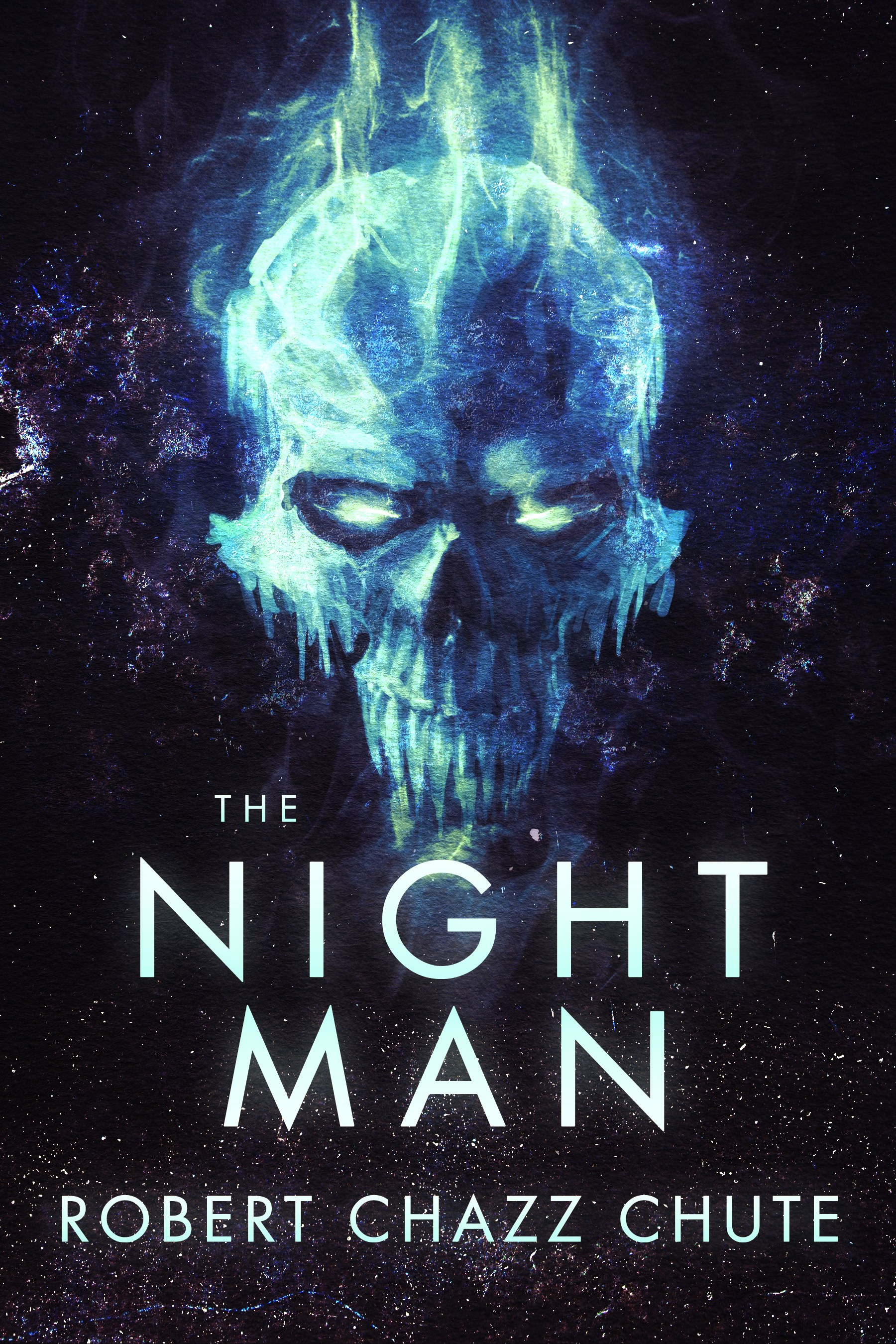
You can pick this ebook up for free today at this link: http://bit.ly/TheNightMan

Join my inner circle at AllThatChazz.com

See my books, blogs, links and podcasts.

Enter your email address to follow this blog and receive notifications of new posts by email.

Join 2,061 other subscribers