C h a z z W r i t e s . c o m

See all my books at AllThatChazz.com.

Author Blog Challenge: In 12 hours, Bigger Than Jesus

A lot can happen in twelve hours. Twelve hours ago I began work on formatting my debut crime novel, Bigger Than Jesus. I used Scrivener and I was feeling pretty optimistic that I could knock it out pretty quickly. I’ve formatted plenty before, but not with Scrivener. I’ve been writing with Scrivener, but today was the test to see if I could get the book over to Amazon in one day. Foolish pressure.

I couldn’t put the front matter in for the longest time. At one point I had two tables of contents and neither of them was quite right. I started with the Scrivener video tutorials — fell into a spiral of anguish and frustration — and then got hopelessly lost in the Scrivener manual. I found my way back to sanity by searching for people who had the same frustrations I did. Google. It’s the thing you need when you’re stuck.

That didn’t get me quite all the way to done. Some alchemy and experimentation was involved but, just a few minutes ago I yelled, “It’s alive! IT’S ALIIIIVE!” Twelve hours ago I began formatting. Twelve hours from now, it’ll be up on Amazon (fingers crossed!) I won’t believe it until I see it up there with my other precious babies.

What a day. What a night. I’ll have much more to say about Bigger Than Jesus, of course. I want to tell you about how I worked with my amazing graphic designer, Kit Foster, to come up with the cover. I want to talk about the book and the factors that brought it to fruition. I want to hint at what’s next for the series and all my other books. The important thing for me was to give it a rigorous editorial scrubbing and then send it out in the world. I’ll play catch up with all the other things I have to do to make this baby grow, but sunlight took priority over having everything in place.

And there’s so much yet to do! I have to ask people to review the book, buy the book, get blurbs. It’s going to be an audiobook and a paperback (and soon!). I have big plans for my funny, clever, hit man Jesus Salvador Diaz. People will like and pity him despite themselves because Murphy’s Law will take him down long before the NYPD, if the lovely Lily doesn’t break his heart irreparably first. His stories are a Coen brothers’ movie: bad things happen on the wide and easy road out of town.

For tonight, though, I’m going to toast my milestone, sit back and watch Real Time with Bill Maher and maybe Bridesmaids and know that I’ve put in my full day at Ex Parte Press and I don’t have to feel guilty for sitting back and watching TV tonight.

If you don’t know this feeling yet, I hope you experience it soon.

Filed under: publishing, , , , , , , , , ,

Author Blog Challenge 14: Eleven ways writers get surprised

Gremlins will push you 'round^ Look where you'...

Gremlins will push you ’round^ Look where you’re going^ Back up our battleskies^ – NARA – 535380 (Photo credit: Wikipedia)

Some surprises you’re in for when you publish your book

Please note: This list of surprises for writers is not meant to be comprehensive. The worst surprises, like dying by flaming harpoon attack to the forehead (before you finish your novel) or a hard drive exploding and taking out two floors of your house are not included. Those circumstances just aren’t lighthearted enough for my intent here. Oops. Well, I guess you’re worried about that stuff now, too.

1. You thought your manuscript was clean and it was, it was! Gremlins went in and put those ugly typos in there! That’s the only reasonable explanation.

2. Publishing your book is a huge event in your life. Remember when you had a baby and you expected the world to pause to acknowledge your contribution to, and sacrifice for, the human race? Wars should stop and the earth’s rotation should cease for a moment, if only so we can all bow. Sadly, it’s not a huge event in everyone’s else’s life. Many people are indifferent and it’s just not efficient to go out and kill all of them with a rusty axe.

3. The people you thought would love your book? They don’t. My dad still hasn’t read anything I’ve written. He’s waiting for me to write about him. (What he doesn’t know is that he really doesn’t want that!)

4. Lots of people are readers but they do not write reviews. You’ll expect reviews. Eventually you probably beg for reviews. Worse? You still won’t get them, even from friends and family! I thought about it, but there is no joke I can tag on this item that will soothe the sting. It’s more tragic than a flaming harpoon to the crotch.

5. Someone will object to something you wrote. What will surprise you is what they object to. For example, some people get riled up about which font you chose for your cover. You’ll assume that joke your main character made about religion was, at most, funny. At worst? Somewhat innocuous. Some blogger, somewhere, will call you the Anti-Christ and call on Jesus to smite you because, apparently, Jesus loved capital punishment. Oh, wait… (At least outrage and threats of censorship increase sales, so there’s that.)

6. Some people will treat you better, briefly, because you’re an author. Then they’ll treat you worse when they find out you’re a self-published author. For some reason, you have to answer for every grammatical mistake and every (so-called) undeserved success of your breed. Corollary: If you become a very successful traditionally published author, some people will hate you because lots of people read your books. Or the haters will hate because they aren’t you. Suggestion: A dog is reliably faithful. Definitely buy a dog. They can’t read so they’re blameless.

7. Formatting will be tough the first time. The first time, you’re a dim-witted chimpanzee with a keyboard. The second time you do it, you’ll be surprised how easy it is. You will have evolved to a very intelligent Rhesus monkey.

8. By the time you’re through revisions and formatting, you and your editorial team will have gone through the manuscript so many times you’ll be sick of it. This is the story you loved so much. Now your cute baby has grown into an angry, gangly, acne-scarred teenager and you just want them out of the house they can go make money and so you can make room for a sweet new baby who loves to cuddle.

9. Actual publication won’t be quite as momentous as you anticipated. How could it equal all those dreams you’ve had since childhood? You pictured a limo and an elegant cocktail party. Instead, it’s you in sweats, late at night and a little drunk on weighty potential and rum and Coke, debating if you’ve done everything you can before pushing a button. It will feel more like pulling a trigger. You may be filled with more dread of bloody failure than anticipation of success. I’m about to push that button and I’ve had stress headaches all week. I just want to sleep instead of poking around Scrivener‘s bowels to prep the manuscript for Amazon and CreateSpace. You’re not alone in the struggle, but that’s of little solace because you are alone in the room.

10. Getting someone to read your book is harder than writing your book. You’ll spend more time marketing than you ever dreamed necessary, even if you figured it would take a lot of time. Triple your marketing expectations and get a treadmill desk so your ass won’t get as big and wide as your hopes and dreams for your writing career.

11. But here’s the biggest surprise: Though you will get luckier the harder you work, it’s still a lot about luck and timing and some happenstance. Nobody admits this variable. When you win, it’s all attributable your meteoric wisdom. When you succeed, you’ll figure it’s because you made all the right moves and you knew what you were doing with every step. Revising history and shining up the truth is natural. Everybody does that. It keeps us from running away screaming from that “Click to Publish” button.

Filed under: publishing, , , , , , , , , , , , , ,

Author Blog Challenge 13: The meek will not inherit the earth or a book deal

Cover of "Neuropath"

Have a point of view. Yes, some people may hate you for it, but that’s better than being bland and not speaking your mind. Tell the truth, even when you’re lying through your face and your fiction. Why? Because (1) it’s honest, and (2) who will read bland? Some authors avoid controversy thinking they will keep a wider audience. Wrong. Wimps don’t get respect. Besides, you don’t want to act like a wimp because that’s not who you are. You are a writer. Publishing your book and putting yourself out there for critics to judge is an act of courage. The meek will not inherit the earth and, if they do, we’ll just take it from them.

Last night I read through a forum in which multiple contributors discussed and debated with author Scott Bakker. I am just on my second Bakker book (Neuropath) having just found out about him. I really enjoyed his novel, Disciple of the Dog. I have to say, the forum I read debating the merits of Bakker’s fiction was intriguing. It was not a lovefest for the author. Some criticized Bakker for being a misogynist in his fiction. Occasionally the author himself commented on the thread but the offended and the defenders kept their debate raging without him and Bakker popped in more for clarification and to make sure he wasn’t being misrepresented by others.

Personally, I have to admit I don’t understand the objections or their fervour. Just because a main character espouses some views, that doesn’t mean we are meant to emulate him or agree with him. The character is flawed. It’s fiction. From what I’ve read so far, Bakker isn’t preaching misogyny. He’s describing a character who is a misogynist. I grew up watching All in the Family’s Archie Bunker. I never had any doubt he was a racist and watching a TV show didn’t make me a racist. Characters that have complicated problems and conflicting motivations are interesting. I don’t want to read fiction that is diluted by one ideology that doesn’t acknowledge the world’s realities (and if you do, then go write that book and best of luck selling it.). In my case, I know my titles are a bit controversial and annoy some people, but I suspect they attract more people than they turn away. Those that give my books a try are in for surprises when their expectations are turned upside down, but I think that’s a good thing.

I don’t try to be controversial for the sake getting people in a rage. I call it as I see it because it’s honest and because if you don’t have something to say, something to stir in your reader, why bother writing? Writing that doesn’t stir feelings in readers makes wasted ink and useless pixels. Free speech allows self-expression but also guarantees that you’re going to be offended from time to time. If you’re offended by a piece of fiction or an argument, the answer is, “Too bad.” Don’t read it if you can’t handle it and respond like an adult to work that is meant for adults. You don’t have to read or listen to viewpoints you despise. Just stop reading and listening. (The funny thing is, the people who disagree will stay with something they hate longer than people who agree. People who say they loathe Howard Stern listen twice as long as people who describe themselves as fans. Humans are strange, aren’t they?)

On my latest podcast, in between a couple of jokes and Father’s Day stories, I tackle corporal punishment and explain why President Obama could lose the election in November if he tolerates nuance and fails to embrace dumb. I’m not worried about turning off potential readers. There are lots of readers out there and I’m not interested in catering to people who can’t tolerate free self-expression. They’d probably never buy my books, anyway.

In short, embrace the bad ass in you. 

Click it to get it.

Click for the Self-help for Stoners podcast page

P.S. In the spirit of being bold, have you subscribed to the Self-help for Stoners podcast on iTunes or Stitcher yet? It’s free and strange and you don’t have to be a stoner to love it. Or hate it, come to think of it.

If you like it, please leave a happy review on iTunes. It helps. All the podcasts can be found at AllThatChazz.com.

Filed under: publishing, , , , , , , , , , , , , , , ,

Author Blog Challenge 12: How to not write your book

Good thing I wrote a self-help book full of motivation in the form of fiction or this post would really bum me out.

Today’s Author Blog Challenge prompt is:

What’s the most challenging part of your book process?

1. Facebook has some pretty cool memes, I bet. I better check before I settle into the real work.

2. My podcast helps me market my books, so that’s sort of like writing, right?

3. Can I really start the day without watching my recording of last night’s The Daily Show with Jon Stewart first? If that’s wrong, I don’t want to be right, baby!

4. What can I do about my book while still listening to my favorite podcasts: The David Feldman Show, The 40-year-old Boy and The Joe Rogam Experience? Oh, and look, there’s a new Best of the Left and The Jimmy Dore Show! And, oh, look, it’s bedtime.

5. Reading is research, right? I should read another book before I write another chapter. Just to be safe.

6. I hear food screaming up in the kitchen. It’s in distress and I need to smother it with my colon to put it out of its misery.

7. I could do some laundry or feed the skinny pig or make even more coffee.

8. If I don’t get the dishes done before She Who Must Be Obeyed gets home, she’ll give me The Look.

9. Maybe I should go take care of some errands because once the kids get home it will be too late. (For what, I’m not sure.)

10. I wonder if there’s anything else on the Internet? And what time does Twitter close today exactly?

The most challenging part of my book process is everything but my book process.

Oh, look! There’s that helpful fear of cataclysmic failure! That train is always on time. 

Gotta go write.

Filed under: publishing, , , , , , , , , , ,

Author Blog Challenge 11: How I became God

Click the pic for more.

I cried for an old friend today. My daughter asked me about how I proposed to She Who Must Be Obeyed and that meandered back to Johnny, the minister who married us. He died of colon cancer. The tears took me by surprise — again, they always do — and I turned my head and my voice almost broke. I covered up my sorrow as I told my daughter about Johnny. My stomach twisted to think about the loss of this fine man with a young family. Johnny’s presence brought us joy. His untimely, horrible death brought chaos. Johnny wouldn’t approve, but when cancer wrung his life from him, my faith died, too. I found my way back to writing for therapy. Then I cast God aside to become Him. I have more compassion and kindness.

After I dropped my daughter off at school, the headaches and the trapped feeling roared back. I am a small god in a tiny realm. I climbed into my bed to retreat into unconsciousness for a little while. Maybe that’s why there’s so much suffering in the real world. God became bitter and He went back to bed, too.

As deep as the blade went with Johnny’s death, I know I will use this. Everything that happens to you as a writer gets sorted and recycled. That moment where I looked away to cover my tears and my voice cracked just a little? That will show up in one of my books, I’m sure.

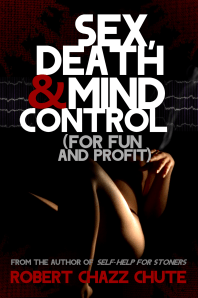
Then, tonight at my son’s soccer game, I sat beside Gillian. Our kids hold the same trophies, getting taller together in each year’s team photo. Years ago, on the school playground, she mentioned a grisly moment from her history as a personal support worker. She’d forgotten the anecdote, but I used an aspect of it in a short story, Sidewalkers, that appears in one of my collections, Sex, Death & Mind Control (for fun and profit). I won’t spoil it for you, but maggots are involved. Through fiction I transformed an awful factoid into a larger narrative, the sort of secret we file under “Not Understood” in real life.

Every challenge, met and lost, every story told to me and suffered personally…everything…everything is fodder. I cannibalize my life, my family, my enemies — especially my enemies. Fiction is a mind trick that plays with our human capacity for empathy. Through stories, we experience drama, pain and mistakes without suffering the dreary, fatal consequences. But I write not just in the service of self-expression and the market for fiction. I write to correct reality. Fiction is more neat and clean. Happy endings can happen. I can pick where to stop telling my stories so the good man doesn’t have to die, the happy seeker doesn’t become an atheist and the ugly story about maggots becomes a clever anecdote that serves a purpose. In my realm, I am a conscious god. I have more compassion than the mysterious stranger whose ways no one can know. I rewrite the world so it makes more sense.

The tears can be just as real either way. Tears that rain from Art can keep you up all night, compelled to stay awake and reading. Tears from Life send you to bed with a splitting headache and a bitterness that demands escape into softer dreams.

Related articles

Filed under: publishing, , , , , , , , ,

Author Blog Challenge 10: How to make me want to spread your word

English: A pie chart created in Excel 2007 sho...

English: A pie chart created in Excel 2007 showing the content of tweets on Twitter, based on the data gathered by Pear Analytics in 2009. (Photo credit: Wikipedia)

Regular readers know I use the Scoopit! tool to curate helpful stuff about indie publishing I find around the web. I learn a lot researching blogs, link to good content so you can find it and include my comments on the posts I recommend. Sharing and spreading publishing news is a happy bonus. If I believed in karma, helping strangers for free would be the good kind. Today, let’s talk about what makes your articles, posts and tweets attractive nuggets to link to.

But first, a true story: Anguished Author goes to A+ Agent for a meeting about her book. A+ Agent says, “The contract is signed but you need to build your platform more and you’ve got to make a viral video for the book trailer.”

Two thoughts about this story:

Writing helpful blog content and building back links is one way to build a strong platform. Author sites tend to be too much “Me, me, me,” and a more effective  author site is more about “You, you, you, the reader.” Figuring out what helps people will help you build your platform. (For instance, my author site is plastered with information about my books, yes, but it’s also my fountain of free comedy/fiction/narrative/commentary podcasts to extend my reach beyond fellow writers to the reading public.)

and

Sorry, but you don’t get to make a viral video. You make a book trailer. It will go viral or not according to the whims of other people, unless you pay a bunch of kids and robots to pimp it in chatrooms across the Internet. However, since all book trailers (except this fake one) are lame, that won’t work and you’ll fail to dictate the world’s taste. Cute and funny are your best bets since your budget for movie production is not the same as the Prometheus trailer and the audience is jaded by all that amazing acting and CGI.

So what makes me want to retweet and spread the word about your blog? There are some solid rules that are universally applicable and then there’s my capricious, subjective taste. That kind of makes me sound like a prick, but everybody’s got topics that push their buttons. The words: “how to” are probably the most powerful words in a blog headline for anyone. (See the “how to” title at the top of this post? You clicked it.) Self-publishing is a new world and everyone wants a tour guide.

Here’s what’s going through my head as I decide what to link to and promote:

1. I’m reluctant to post something that is time-limited, such as headlines that say, “Final hours of the giveaway” or “Tuesday Only!” My Twitter followers and blog readers might not get the message right away and I don’t want to annoy them with what they missed.

2. (A) Don’t write too many headlines that are too spammy. (No one knows how many “too many” is.) I don’t mind blog posts that reference your books. I do that myself freely and it makes sense to draw from firsthand experience. However, a headline that says “Buy my book” is only for your hardcore fans who will buy it no matter what. That draws no one new into your tent for the revival meeting.

2. (B) But! A major caveat since this book promotion thing is tricky: If you balance the promotional content with free education, entertainment and jokes about your genitals, that’s reasonable. Blogging is a lot of free entertainment and information provision. If you can find a reasonable balance, that’s fine with most people. Ask people to buy your book on your own blog and your own feed as long as that’s not all you do. (And by the way, just because you don’t want to read it, doesn’t make it spam. Someone else may want to whisk it off to Paris and pledge undying love over cheap red wine and croissants.) Fortune does not favour the timid. Take it from a timid person who has resolved to pretend to be an extrovert.

For instance, I auto-tweet a welcome message when anyone follows me on my twitter accounts (@rchazzchute, @thechazzsays, @expartepress). The fun message (of doom!)  provides links to my books. My guess is, people who hate that — and some really do — were never going to buy my books anyway. Others will either appreciate the heads up or suck it up, buttercup! Since adding the auto-tweets, my sales have gone up. So there. (I also don’t cooperate with the twit validation service thing. It’s slow and painful and if you want me in your feed, you want me. If you don’t, don’t. Don’t be a pansy about Twitter.)

3. No poetry. I wrote a book of poetry. I like it, but it’s too small a niche and outside what people expect when they come to ChazzWrites. It’s sad, but there it is. Margaret Atwood has written nine books of poetry last I checked, but even many of her fans would be surprised by the news that she’s one bad rhymin’ mammerjammer. Here it’s all about self-publishing, book marketing, writing craft, how-to, industry news and the occasional flambé of whimsy in your face.

4. Technical advice with specifics is great. Just this past week I linked to a post with step-by-step stuff about publishing to the Kindle. Hold my hand and I might get a crush on you. I’m easy that way. I might even whisk you off to Paris and pledge my undying love. Well, no. I’m borderline agoraphobic and I’m locked behind a hermetically sealed hatch in a subterranean bunker and you’re out in the real world doing…things. Blech! So we’re not going to Paris. However, I love tech advice and admire those tech-oriented authors from afar. Often I link to something I want to hold on to. Sure, I could just bookmark it on a reading list to get lost in the depths of my computer, but on my blog it’s easily searchable and organized.

5. Be a buddy. Long time readers may notice I mention Kit Foster quite a bit. It’s not just because he is a brilliant graphic designer. He’s also my graphic designer. Another ally in the fight is my friend Dave from the School of Podcasting. My podcast wouldn’t exist without Dave Jackson. We stay in touch on Skype and end up mentioning each other on our podcasts from time to time, too. There are certain bloggers and fellow authors who are my go-to people simply because I know them better than others. They consistently offer advice that is honest, positive and fresh.

Last week, Jeff Bennington posted a great article about working with ACX to produce audiobooks. That’s something I want to do and Jeff is consistently a trailblazer. And no, it doesn’t hurt that I’ve spoken with Jeff. We’re in touch on Twitter and the odd email. He designed my first paperback, Self-help for Stoners, and I’m quoted a couple of times in his book, The Indie Author’s Guide to the Universe. After he read my novella, The Dangerous Kind, he gave me my first cover blurb, too. I’m a shy people pleaser with an inferiority complex spackled over poorly with bravado, so anybody who’s nice and knowledgable gets links from me.

6. Be a thought leader in the industry. I often point my readers to Russell Blake, Dean Wesley Smith, Kathryn Rusch and JA Konrath. They talk real sales numbers and how scary the industry is. They say things I don’t want to hear, but argue their points well. (Also, please allow comments on your blog if you don’t already. I do not always agree with articles I link to, but if the comment thread is lively and informational, I’ll often point readers that way for the instructive debate.)

7. Join Triberr. I retweet my tribe on Triberr. Last week, I liked Caleb Pirtle’s blog post so much I linked to it from here, too. Triberr is one way I become aware of useful stuff.

8. Join a Tweet Team at World Literary Cafe. Book promotion is more effective when someone else is doing it for you and I’ve found great people that way.

9. Write a great book and be a great interview. Occasionally I run interviews with authors. Sometimes I discover authors through their books first, not through their blogs. Somehow Blake Crouch had been merrily successful for some time but, sadly, I didn’t know about him until I stumbled across Run. I subscribed and will be watching his feed for something useful that you’d enjoy. Through a mutual friend, I also just discovered Scott Bakker, author of Disciple of the Dog. It’s a brilliant book. He’s in my home town and we know the same people so I’m sure I’ll meet him at some point. I’ve promoted him on Twitter already and I hope he’ll show up here or on my podcast or both at some point.

10. Reciprocate. (This is #5 with a different angle.) Eden Baylee did a great thing in organizing Indies Unite for Joshua. I supported the campaign and Eden consistently supports my efforts as I support hers. She even interviewed me for her blog (Go ahead and check out that interview. It’s X-rated, fun and wow! I was way took honest!) Eden is a constant friend on Twitter, too, and sometime we’ll chat over coffee when next  I escape the bunker for Toronto. I don’t forget people who are kind. Sadly, I also have an eidetic memory for pinheads, too, but the point is I especially try to help people who help me.

Sometimes I point to a kind of obscure blog. Other times, I say the obvious with, “Have you seen what Joanna Penn is saying?”

Sometimes it’s all “Me! Me! Me!” I try to find the reasonable balance, though.

Filed under: publishing, , , , , , , , , , , , , , , , ,

Author Blog Challenge 9: The key to a great critique group is… (plus a funny bonus)

English: Smith & Wesson 686 6" .357 Magnum

English: Smith & Wesson 686 6″ .357 Magnum (Photo credit: Wikipedia)

*If you’ve just popped in for the funny (and insightful!) bonus, you’ll find the link to the Writing Critique Group Decoder at the bottom of this post. Thanks for visiting ChazzWrites.com and please do subscribe.

Today’s Author Blog Challenge writing prompt is: Have you participated in a critique groups? If so, how did it work out for you? If not, why have you avoided them to this point?

True story:

I visited a writing group and much of the discussion was dominated by an imperious woman who was keen to get a critiquing group started. Only she pronounced it: “Kr-eye-teaking.” Then she said, “Kudos to you!” But she pronounced it “KA-doos“.

I didn’t want to be part of her critique group.

Then another writing group invited new members and I checked it out.

Nice folks, but they were light on writing experience and didn’t read the genres in which I write. Worse, one guy (who would have been 25% of the group) spoke at great length about the book he would someday write. It was sci-fi, which was fine, but he was too invested in theory and he didn’t have a story. He had a wacky setting which took half an hour to explain. It would be hard to get invested in a story where the characters were inert alien rods…unless we’re talking about the aliens behind Third Rock from the Sun. (That’s kind of funny if you remember the details of that sit com.)
I didn’t join that group, either. We didn’t have enough in common in what we liked to read and write and if I had to hear another word about this amazing civilization living in the rings of Saturn, I would have had to shoot myself in the face.

But I do have a critique group and that’s working out great. Well, not exactly. They’re my beta team.

For my crime novel, Bigger Than Jesus, I needed a beta team to proof my manuscript and find bugs. It was the betas that reminded me that Dirty Harry didn’t carry a .357 Magnum. It was a .44. The beta team caught that the Coen brothers of movie fame don’t spell their name with an h. (I guess I was thinking of the Cohen brothers of legal fame.)

The key to finding your critique group, or beta team, is: Choose wisely. Say no. Don’t settle.

I found a great team in a SWAT trainer, an ex-military buddy, a teacher, a psychologist, two fellow writers and the funniest woman I know who also happens to be a voracious reader. They’re all getting signed copies of the paperback with a spot in the Acknowledgements section and help with their books when they decide to write them. And lollipops.

*BONUS:

A while back I wrote The Critique Group Decoder as a service to writers uninitiated in the dance. Click for the laughs. Stay for the reality.

 Related articles

Filed under: publishing, , , , , , , , , ,

Author Blog Challenge (plus a sneak peek podcast*): Outlining, pantsing, spilling & sprinting

If you just popped in for the suspenseful sneak peek podcast, click here to hear The First Fiction Friday Edition of my podcast.

The Author Blog Challenge prompt asked how I stay organized as I write. My methods have changed over time. I used to come up with plots on the fly early on. Then I got scared off from that strategy when I got deep into a dreadfully long novel and found I had to backtrack fifty pages. Hitting a dead end is, well, death. It’s a waste of time and energy and I hate it.

I started outlining because I was writing big books and I didn’t want to lose whole sections of my book in which I was already invested. When you write 80 – 100,000 words or (ye gods!) more, an outline helps. I didn’t write an outline with Roman numerals and all that formal, high school nonsense. Instead, I planned the book one cogent sentence at a time. I described the actions in each chapter to plot the arcs of A and B stories. I looked for where those paths would logically cross, discover the beats and suss out the high and low points. Index cards got to be too much to keep track of, so in the end my outline was just three pages with a numbered list. I read and reread the outline and then I didn’t look at it again. That got me through the big books pretty well.

Recently I read Run by Blake Crouch, and as Blair Warner used to say on The Facts of Life,

“I just had another one of my brilliant ideas!”

It’s about speed. I resolved to write a crime novel with the same furious pace as Run — a book I couldn’t put down. Yeah. I know it’s a cliché, but this cliché is both apt and true in the case of Run. (Great book. Buy it.)

I resolved to do the thing I love with stories. The chapters would be relatively short. They would skip along. There would be lots of twists and turns to my racetrack. I wrote Bigger Than Jesus in about a month, one chapter a day, roughly 2,000 words each. There was no outline. Instead, I wrote with the expectation that I’d get my hero into a troubling cliffhanger at the end of each chapter. If I wrote myself into a corner in the process, too bad. I’d be clever and write my way out of it and keep moving forward. Writing like this is as fresh and as exciting as walking a tightrope naked in a high wind over a crowd of angry TSA agents with a new shipment of polar mint rubber gloves.

Many nights I went to bed thinking that I had no idea what I would write in the morning, but I trusted that I could figure it out. I believed in lightning strikes. The juice kept flowing and with it came a high level of complexity. It’s a crime novel so people lie a lot. If I’d taken longer to write it, it would have necessarily been less complex because I’d be afraid of losing track of the threads. There’s shocking emotional depth, too. Nobody, including me, foresaw the strange and sad angle on my main character’s childhood. It sneaks up.

Why did this work?

1. I knew the opening chapter and the last line so I had a target at which to aim. I’m also a more confident writer than I was with those early attempts, I suppose.

2. If I didn’t know what was going to happen next, the reader wouldn’t be able to guess, either.

3. Speed. The book is not especially long and I wrote it all in a short space of time so I could keep it all in my head at once without getting lost.

How else do I keep organized? 

In the Point File, I note things like street names I’ll use twice and aspects like eye colour so they don’t change from the beginning of the book to the end. I did mess up in having twin brothers as bad guys with names that were awfully similar. I had to go back to make sure I was talking about the right brother at the correct stage of the book.

I always have a Spill File handy so if I do write something that I end up dumping, I save it for later. I might change my mind about how useless it is or I might use it another time in another story. In Bigger Than Jesus, the writing went so quickly and breezily that I never had anything to pour much into the Spill File. I wrote fast and then went back to the stage of writing where I’m always sure I’m a deluded idiot: revisions. I cut, prune and delve. More of the jokes come clear on the second pass, too. Typically, by the third pass, I begin to feel good about the book again. Bigger Than Jesus was just about as easy as writing a blog post a day, actually. Maybe easier sometimes because what dictated the action was logic and surprise. When in doubt, surprise!

Some writers labor under a notion that I once shared: To be good, you must write slowly, perhaps even at a glacial pace, and the serifs are where your heart and soul get squeezed in and choked for blood. There are books I have tinkered with for years. One short story went through many incarnations over a year before I felt I nailed the landing and deserved 10s from all the judges. However, Self-help for Stoners came together quickly and everything worked out well with that.

Bigger Than Jesus will be released in the next week or so and all the feedback I’m getting from the editorial team tells me I’m glad I didn’t buy into the idea that it had to come slowly to be worthy. I think that’s true sometimes, but not always — not for every book and not for every writer. That’s good news because I’m using the same strategy with the next book in the series. It’s coming fast and well and I do enjoy the danger of not knowing what happens in the next chapter. Those angry TSA agents are actually spurring me to succeed.

*BONUS:

Please take a few minutes to enjoy my latest podcast on the author site. It’s The First Fiction Friday Edition! 

It’s a sneak peek at Chapter 8 from my first novel in the Poeticule Bay Series:

An old woman is lost with her tiny dog in the Maine woods and snow is on the way.

Related articles

Filed under: publishing, , , , , , , , , , , , , , , , , , , ,

Author Blog Challenge Writing Prompt: Describe how the idea for your book first came to you

English: The entertitle of Buffy made on Paint.

English: The entertitle of Buffy made on Paint. (Photo credit: Wikipedia)

My books come to me in different ways:

With Self-help for Stoners, I saw that I could fit stories of suspense into a framework of a self-help book made of fiction. When Director Kevin Smith inspired me to quit my day job and pursue my writing dreams, I realized that I could put together a fun, genre-bending bathroom book that would defy expectations. It came together quickly as a wild mix of the unexpected melded with observations, parables and exhortations (to get off the couch.) It’s a book that’s very different but somehow familiar. The feedback has been great, though I’m often surprised when people debate, is this pro-drug or anti-drug? I tell them it’s neither. It’s suspense that asks you to draw conclusions about your compulsions. It’s pro-freedom and freedom of speech. Yes, it’s important to have a label so people can find you and your book, but in this case, pigeon holes are for pigeons. It was quite a thrill for me to hand Kevin Smith his own autographed copy of the book and he was happy about it, too.

Sex, Death & Mind Control is the book that came so slowly, it’s appropriate to use the word evolution. I wrote short stories over several years before attempting longer fiction. Two award winners are included in this collection and it’s suspense that can be creepy and surprising. I don’t care for gore and it’s not at all pornographic, but sex and death are outcomes of the key factor through all the stories: various forms of mind control (magic, persuasion, mind games, coercion, trickery and self-delusion) form the book’s theme.

I’m fascinated by mind control. When powerful forces use it on us, we are in danger.

When we gain control of our minds, we will win.

The Dangerous Kind is closest to my heart. It’s a novella about escape. The place it is set (Poeticule Bay, Maine) is fictional, but the setting draws on places I lived when I was a kid and the town is almost a character in the plot. Anyone who has felt small-town claustrophobia will recognize and feel the resonance. There’s a deer hunt, intrigue and an inheritance between brothers on the line, but it’s really about complex relationships and the friction that comes from people who live too close together and only think they know each other. That certainly reflects my small-town experience.

I wrote several stories where I found myself drawn back to run over the same demon roadkill on the back roads around Poeticule Bay so one of my WIPs is all about the place. I’ll run those demons down, exorcise them or make them dance for my pleasure.

Finally, Bigger Than Jesus, my crime series, springs from my dim world-view. I commented on another fiction writer’s blog recently that the criminal world is so like the world of Buffy the Vampire Slayer. In Joss Whedon‘s series, vampires and monsters run amok, but the normies somehow look past all the mayhem to maintain the illusion of stability in their lives. Vampires attack the school and the principal says it was druggies on PCP. Victims suffer and die by night as people go about their business in sunlight. Organized and disorganized crime is just like that. I’ve spent some time hanging out in courtrooms as a reporter and researcher and the stories that unfold there are by turns tragic, comedic and horrific. Homelessness, drugs, violence, confrontation and small, surprising acts of mercy: People would be amazed what happens in cities across the world, much of the stuff bubbling from underneath is never reported in the media. When I’m writing this stuff, I’m often reminded how the Cohen brothers and Elmore Leonard have it right. A lot of bad things can happen on the easy and wide route out of town.

I don’t know if twisted and dim world views and angry childhoods are required for all writers,

but those elements help me come up with my ideas for my books. 

Filed under: publishing, , , , , , , , , , , ,

Author Blog Challenge: I love the voices in my head

Michael Clarke Duncan at the Warner Brothers L...

Michael Clarke Duncan at the Warner Brothers Lot in Burbank, California. (Photo credit: Wikipedia)

One of the writing prompts for the Author Blog Challenge is to choose a favorite literary character. That’s tough. I mean, I relate to Tyler Durden from Fight Club, but the cognitive dissonance kicks me in the pills when I realize that, beside the insomnia and ennui, I am not even Tyler’s alter-ego. I have a few things in common with Portnoy from Portnoy’s Complaint, though. Ugh.

This isn’t a dodge and I don’t mean to fall into douchey pimping, but the truth is my favorite literary character is whichever one I’m writing at this moment. I have several works on the go, so let me introduce the interesting people I hang out with while strangers assume I’m staring off into space and drooling:

Legs Gabrielle is a very funny comedian whose career has fallen through the floor. She finds herself back in Poeticule Bay, Maine, in the house she ran away from as a teenager. A killer has come to town, the Sheriff disappears, the deputy is cute, her sister has cancer (and might also be crazy.) I love Legs’s sense of humour and she’s a pleasure to write for the jokes that work as  counterpoint to her emotional depth. Hollywood has rejected her, but she’s the star of her own book soon.

Chili Gillie is a Michael Clarke Duncan lookalike, Legs’ bodyguard and has Mike Tyson’s voice. He’s a sweet man who only looks mean when needed. He’s the calm rationality around which the crazy revolves. His presence is extraordinary, but he’s the most normal of my characters. Both Legs and Chili are the stars of the first story in Self-help for Stoners and Chili shows up again in Bigger Than Jesus in a larger role. I’ve got big plans for him.

Dr. Circe Papua turns up a lot in my fiction. She’s a psycho psychotherapist who is magically persuasive and can be deadly if provoked. I love her cunning, unexpected lethality. Circe’s complex relationships with her patients often demand a battle of wills and wit. She shows up in different incarnations in Self-help for Stoners, Vengeance is #1, Corrective Measures and Sex, Death & Mind Control (for fun and profit).

Jesus Diaz is a mob enforcer who doesn’t want to be what his tragic childhood and circumstance has made him. He wants, above all, to fall in love with the right woman (if he can ever find her) and go relatively straight. He’s the main character in my crime novel, Bigger Than Jesus and I like him most for three things: he’s clever and prefers to lie rather than fight; he’s not really all that tough despite his profession; and he’s funny. I like funny people and chapters that whip along, full of pops and surprises. The series reads like a Cohen brother’s movie. Bad things keep happening even though you think you have an easy way out. This book will be out very soon and I’m jonesing for it. Just nailing down the cover and then we’re just about there. Jesus Diaz originally came to me as a story for Self-help for Stoners, but in that incarnation, he’s a much older, wiser and experienced assassin.

Jack (from Corrective Measures and Sex, Death and Mind Control.) Jack is a serial killer who I find interesting because of the way he sees our world. He thinks about vengeance quite a bit, but I’m actually more interested in writing him when he’s not himself. He’s fascinating when he’s trying to fit in and working through his twisted motivations and problems. He’s a dark avenging angel who has to hide his wings (metaphorically, that is) as he punishes people he decides deserve bad ends.

What’s fun is, eventually, I’m going to have all these characters meet in one book, but they have a lot of work to do before they meet. I have a lot of books to write before that happens, too. It’s exhilarating, daunting and pretty cool. Yeah, I said so myself.

Filed under: publishing, , , , , , , , , , , , ,

Bestseller with over 1,000 reviews!
Winner of the North Street Book Prize, Reader's Favorite, the
Literary Titan Award, the Hollywood Book Festival, and the
New York Book Festival.

http://mybook.to/OurZombieHours
A NEW ZOMBIE ANTHOLOGY

Winner of Writer's Digest's 2014 Honorable Mention in Self-published Ebook Awards in Genre

The first 81 lessons to get your Buffy on

More lessons to help you survive Armageddon

"You will laugh your ass off!" ~ Maxwell Cynn, author of Cybergrrl

Available now!

Fast-paced terror, new threats, more twists.

An autistic boy versus our world in free fall

Suspense to melt your face and play with your brain.

Action like a Guy Ritchie film. Funny like Woody Allen when he was funny.

Jesus: Sexier and even more addicted to love.

You can pick this ebook up for free today at this link: http://bit.ly/TheNightMan

Join my inner circle at AllThatChazz.com

See my books, blogs, links and podcasts.

Enter your email address to follow this blog and receive notifications of new posts by email.

Join 2,063 other subscribers