C h a z z W r i t e s . c o m

See all my books at AllThatChazz.com.

Expected Costs

See on Scoop.itWriting and reading fiction

The first chapter was “The Early Decisions” which included picking a business name, setting up checking accounts, and so on. There were no real costs at all in those early steps unless your state had a small fee for registering a business name. Checking accounts are free, so are PayPal accounts, and so on.

So, the question on this second basic business-planning chapter is: “What are your expected costs?”

For those of you with a basic understanding of business, you can now see the structure of how I am setting up these chapters. Before starting into a business, there are certain things that need to be figured. Set-up costs, projected production and business costs, and projected income. You have no real data on the costs or the income, at least not accurate data, but anyone with a lick of sense who is starting a business will sit down and try to figure these factors out to some degree.

It would seem that expected costs should be tough to figure. But actually, in this business, they are not. At least for most levels. It just will take a little homework is all.

So, let me first divide this discussion into three major areas.

Cost in Money.

Cost in Time.

Set Costs.

All three areas are critical to figuring overall expected costs of producing a product.

In the first two categories I’ll divide the discussion down into three major ways of running your company: 1) Do All Work Yourself. 2) Do Some Work Yourself, and 3) Hire all work done.

And, of course, the categories cross over. If you find your time more valuable than your money, then hiring things done will be more of an option. And so on.

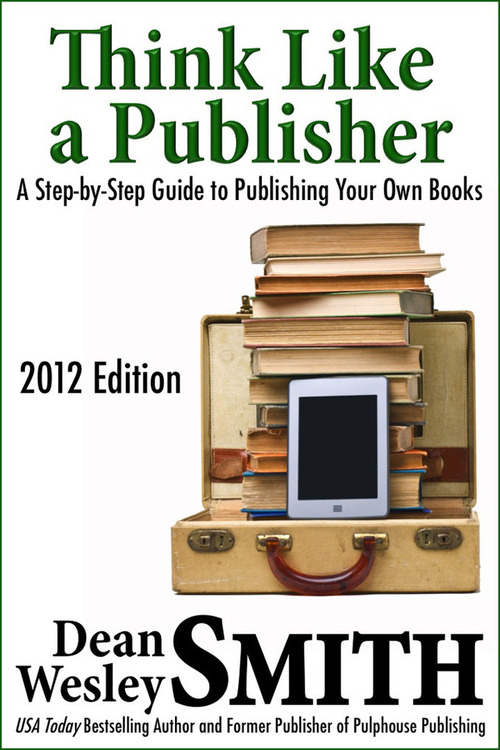
There’s much more useful information in this article on Dean Wesley’s Smith’s post.

Read on at this link:  www.deanwesleysmith.com

Filed under: publishing, , , ,

Wussies! Creativity and the boneheads in the way of artful risks

Jay McInerney at Tribeca Film Festival 2010

Jay McInerney at Tribeca Film Festival 2010 (Photo credit: Wikipedia)

I just read something from a writing advice book that annoyed me and I have to pull this sharp and spiny burr out of my nethers. It’s about what I’m going to do with point of view in the crime novel I’m writing. I’m taking a risk with this book and I know it. It’s written in second-person, present tense. That’s right! Now you’re wondering if I’ve lost my mind or if I’m just into quirky gimmicks. You’ll soon find out, but let’s talk about why I’m annoyed and you might get that way, too.

I ran across a chapter on point of view. The upshot on using second-person was that it’s best for short books (good, mine is) and is tricky to pull off. I agree with that. It is tricky. However, I have had good experience using it and several stories in Self-help for Stoners have more punch in part because of that unorthodox choice.

Then I got really annoyed because the author warned that editors and agents would be quick to reject any such manuscript because the attempt screams: I’m a Jay McInerney knock-off! You’re trying to do Bright Lights, Big City! I’m paraphrasing rather than quoting because I didn’t buy the book. I will buy the digital edition to delve further, by the way. I don’t write off a book or conclude the author is wrong just because I disagree with one paragraph. I’m annoyed not because the author is necessarily wrong, but because he may very well be right that traditional publishing is that quick to pull the trigger on any book that challenges the status quo (as if the status quo is all that hot.)

Bright Lights, Big City is a novel I admire. I found it quite engaging and funny. I wasn’t put off by all the “You, you, you,” that got so much press and critical attention but misses the point of the novel entirely. It was considered somewhat experimental at the time (and I guess it still is if the author of the advice book is correct.) Bright Lights was different, but it didn’t really deserve the “experimental” label. Aside from the use of the second-person point of view, it’s really quite a conventional novel that reminds some of Catcher in the Rye. (Try Pygmy by Chuck Palahniuk if you want experimental fiction. That’s far more daring and demanding of readers.)

The use of the word “you” — some would say overuse — doesn’t get in the way of my enjoyment of Bright Lights because it’s the jokes, the hipster context of New York ’80s nightlife and a stab or two at the literary establishment that appealed to me. I was working in the Toronto literary establishment at the time I first read it, so it spoke to me even though I didn’t have the cash or inclination to indulge in Bolivian marching powder.

We used the word experimental because there weren’t many well-known antecedents that employed second-person point of view. Now Bright Lights, Big City is the well-known antecedent and apparently some publishing professionals have long memories but very narrow minds. Bright Lights, Big City came out in 1984! So…Jay McInerney did it once and now the use of second-person is a reason for quick  rejection? He slipped under the gate but it must never allowed again! Really? They haven’t got over the shock after 28 years?

Wussies!

When my novel comes out this June, readers will agree it’s awesome like chocolate croissants, merely palatable or they’ll decide it sucks like a Dyson vacuum cleaner powered by the fearsome gravity well of a black hole. I’m betting it works and fortunately, my imprint, Ex Parte Press, will publish it. The boss can be kind of a dick, but I’m tight with him. The only gatekeepers I have to worry about are the readers traipsing the digital forests of the Amazon. I know it’s a gamble, but I don’t write so I can sound like everyone else. As much as I respect Jay McInerney*, I’m not trying to emulate him. We write to express ourselves. This is me being me. I hope you’re being you and taking some artful and calculated risks, too.

*If you’re a martial artist, please try Jay McInerney’s Ransom. If you want a distinctive voice by a confident author, read McInerney’s Story of My Life. These, along with Bright Lights, Big City, were Mr. McInerney’s first three books. They were his least conventional and I believe they were his most successful. They were the ones that were most successful with me, anyway.

Filed under: publishing, , , , , , , , , ,

How to Use Google Search Stories Video: Watch me be the drama king!

Google Logo officially released on May 2010

Google Logo officially released on May 2010 (Photo credit: Wikipedia)

You’ve seen how Go!Animate works in the previous post. Now check out Google Search Stories. This is free video software that’s even easier to use than Go!Animate. You’re telling a story with images, news, maps,

google searches and books (yes, books!) This could be a very useful promotional tool for indies when used correctly.

Easy to do: plug in search terms, tell your story creatively, add music, preview and publish to YouTube. And free.

Click here to see my Quit My Day Job post and Google Search Stories video. 

The link to make your own Google Search Story is at the bottom of the video post on my author site.

Filed under: publishing, , , , , , , , , , , ,

The Writer’s Challenge in 4 Simple Steps

Keeping with the theme that’s emerged this week, I just read an agent blog espousing why we should want to be traditionally published. I found myself rejecting most of her points easily. Validation? I can get that straight from readers. Marketing? Unless you’re Stephen King, very little is spent on marketing and I can do the promotion myself, just as they’d expect me to do with a trad contract (for free.) Partnership? Working in traditional publishing is not a partnership. Editors? I can hire editors. I can do just about everything a regular publisher can do because I am a regular publisher! (Get it?) I just happen to publish myself. Yes, I wish I had more resources, interns and more time in each day and it would be great to have the help, but I don’t have to give up the rights to my books forever to do that.

The article went on and some of the comments were misinformed and dismissive. I became exasperated because all this stuff is too familiar. I heard it in my twenties when I worked inside traditional publishing: Pay your dues, make your bones, and wait, wait, wait! We’ll value your opinion some day. Maybe.

I’ve promoted indies and traditionally published authors. I know going indie isn’t for everybody just as trad publishing isn’t for everybody. Circumstances change so we do switch back and forth. We’re all writers. We should strive to support each other because it’s a harsh world and we can each share information to become the tide that raises all boats. We are undervalued but we can value each other, respect the craft, respect the reader and respect ourselves. At least some of the people who say, “Wait, wait, wait,” are self-serving or past their “best before” date. Fortunately the world has changed and we don’t have to let someone else drive this bus and go where others want us to go. We can drive now, too.

And then I thought how tired I am of the trad vs. indie discussion and whom does it serve? I’ll do no more research today. I will not wallow in negativity. I’ll go write something great, work on my books, be the example and prove the naysayers wrong.

Trad or indie, that’s my challenge to you today:

1. Go write something great.

2. Work on your books.

3. Be the example.

4. Prove the naysayers wrong.

Filed under: publishing, , , , , ,

Indie publishing is getting better

Grammar police

Grammar police (Photo credit: the_munificent_sasquatch)

First bold statement:

The quality of indie books has improved.

We’re maturing. Ludicrously, readers expected the indie ebook revolution to produce immediate perfection, some even demanding a higher quality than they get from trad publishing. As soon as I post this, I expect a deluge of naysayers racing to come up with examples to disprove my assertion. That’s a misguided instinct, by the way. Yes, you could come up with lots of examples both tragic and comedic and I’d counter with a plethora of examples in favour of the indies. So let’s skip that and settle on this: I have over 200 books on my Kindle and my impression is that there aren’t nearly so many grammatical errors or typos as one might expect if you believe all those rabid grammarians moaning over on the Kindle boards.

Recently, I read an Amazon book review where some bonehead’s  first observation was that he’d counted five grammatical errors. Note that this was a book that he liked, but he went straight for that in his review’s first sentence. He criticized not as a book lover interested in story (which most readers are) but as a raging grammarian who couldn’t bear five errors in 250 pages. (I clicked the “non-helpful” button after I read that review.)

Second bold statement:

Most readers aren’t nearly as sensitive to typos as some would have us believe. 

As a writer, I hate errors in my books when they occur.

As a reader, I notice errors but my world doesn’t explode when I see them, either. 

In traditional publishing in the late ’80s, editorial departments were swollen with employees. Mistakes still crept in. They still do, trad or indie. We can’t afford eight levels of defence against errors. No one can hire that many editors and proofreaders. Errors will occur. But you know what?  When I get a book for $2.99 or less (or free), expecting perfection seems petty and silly, like angrily demanding lower taxes yet more services. We do need many eyes on our manuscripts. Everyone tells you to hire an editor and well you should. However, the edit and suggested corrections will also introduce errors, so comb it again. If you’ve gone through a major edit using Track Changes, for instance, you know the maddening confusion of figuring out what’s underlined and what’s not, making the changes and going cross-eyed after a few hours of peering at comma placement and comment boxes.

Most grammatical errors don’t obscure meaning so much you don’t get what the author was going for. No, this is not a call to publish your first draft, damn of consequences to readers’ understanding and comfort and ease up on yourself as a writer. This is a call for us  to celebrate the many authors who are obviously working hard to write well. Many of us are getting help to catch us when we trip.

Don’t mind the naysayers. Most of those rabid grammarians aren’t writers and I’m not even sure a bunch of them even enjoy reading that much. It’s like they take a book as a test and each typo is some kind of moral victory. That’s the Internet for you: perfectionism as a weapon to make haters feel better. But perfection is unreachable. (I just started a sentence with the word “but”! Oh, no! Yes, some people are still clinging to that.)

Perfectionism is a sign of self-loathing. Instead, go for excellence.

And lighten up. We’re getting better!

Filed under: publishing, , , , , , , , ,

A Newbie’s Guide to Publishing: Barry, Joe, & Scott Turow

Via Scoop.itWriting and reading fiction

Scott Turow’s argument, I think, looks like it’s going to be on the wrong side of history and is on the wrong side of technological innovation. But will the Department of Justince agree? Konrath and Eisler break it down as only they can in this post from A Newbie’s Guide to Publishing. (Read the original link from Turow, too! The split amongst the commenters on the original is quite instructive in that it’s often snark vs. reason.) ~ Chazz
Via jakonrath.blogspot.com

Filed under: ebooks, publishing, self-publishing, , , , , , , , , ,

The Writing World: Author Interview- Robert Chazz Chute

Via Scoop.itDevolution

This was a big bucket of fun. RaeBeth McGee over at The Writing World interviews me on my weaknesses (carefully hidden), my books (mostly obscure but gaining ground) and the bodies (corporate and otherwise) strewn behind me.

Fun interviews are one of the perks of this job. I love having fun with author interviews. Click the link to The Writing World and have a laugh. ~ Chazz
Via raebethmcgeeswriting.blogspot.com

Filed under: All That Chazz, Author profiles, Books, publishing, Useful writing links, What about Chazz?, What about you?, Writers, writing tips, , , , , , , , , , ,

Between Fact and Fiction: 10 Things I Wish I Would Have Done Differently

Via Scoop.itWriting and reading fiction

(Natalie Whipple of Between Fact & Fiction details 10 things she wishes she had done differently on her publishing journey. Good tips here and a good blog. Check it out. ~ Chazz)
Via betweenfactandfiction.blogspot.com

Filed under: authors, publishing, Useful writing links, writing tips, , , , , , ,

Mad as Hell! Huge Problem with the Book Pricing Options!

Via Scoop.itWriting and reading fiction
We’re always talking about self-publishing ebooks here, but what about paper books published independently. At WDLady’s The Nightmare Never Ends blog, she details her trials in dealing with CreateSpace and paperbook pricing. Check this link for more (and some cool illustrative cartoons.) ~ Chazz    

This is me calling the Createspace Support Representative about my book pricing options…This is me finding out that I’m going to be making -$2.13 for a book that’s $4.99…

Via wdlady.wordpress.com

Filed under: publishing, self-publishing, Useful writing links, Writers, , , , , ,

Why Amazon’s KDP Select Is God’s Gift to Authors

Via Scoop.itWriting and reading fiction

In this guest post on The Creative Penn, my buddy Jeff Bennington lays out how KDP Select worked for him, with numbers! ~ Chazz
Via www.thecreativepenn.com

Filed under: ebooks, Publicity & Promotion, publishing, self-publishing, Useful writing links, Writers, , , , , , , , , ,

Bestseller with over 1,000 reviews!
Winner of the North Street Book Prize, Reader's Favorite, the
Literary Titan Award, the Hollywood Book Festival, and the
New York Book Festival.

http://mybook.to/OurZombieHours
A NEW ZOMBIE ANTHOLOGY

Winner of Writer's Digest's 2014 Honorable Mention in Self-published Ebook Awards in Genre

The first 81 lessons to get your Buffy on

More lessons to help you survive Armageddon

"You will laugh your ass off!" ~ Maxwell Cynn, author of Cybergrrl

Available now!

Fast-paced terror, new threats, more twists.

An autistic boy versus our world in free fall

Suspense to melt your face and play with your brain.

Action like a Guy Ritchie film. Funny like Woody Allen when he was funny.

Jesus: Sexier and even more addicted to love.

You can pick this ebook up for free today at this link: http://bit.ly/TheNightMan

Join my inner circle at AllThatChazz.com

See my books, blogs, links and podcasts.

Enter your email address to follow this blog and receive notifications of new posts by email.

Join 2,063 other subscribers