C h a z z W r i t e s . c o m

See all my books at AllThatChazz.com.

Avengers Assemble! Joshua needs help!

Some time ago, author Eden Baylee sent out a distress call. Indie authors from around the world answered her SOS. Joshua, the son of author Max Cyn has leukaemia. The medical bills are high. Joshua’s hold on life is threatened. We can ease the stress and help make this one a win. Eden organized an IndieGoGo campaign so we could all contribute perks to donors and help this family in the fight. Please, join us. The rewards are awesome and the cause is just. None of us is untouched. (My mom died of lung cancer and never smoked a day in her life.)

Click here to get your warm fuzzy feeling. Thanks for your generosity.

Filed under: publishing, , , , , , , , , ,

The Myth of the Writer’s Thick Skin

I wrote about rating the dreaded one-star review last week (Scan down the page for that). Now let’s delve into the thin-skinned versus the thick-skinned as we deal with genuinely nasty and undeserved critiques. When you put yourself out there, it’s going to happen. People disagree about what’s good and some of them think that if they don’t like it, you should stop what you’re doing and stop breathing, too. (Read some of the uglier one-star reviews on Amazon or the plethora of terrible, even racist, comments on popular YouTube videos and you’ll see what I mean. I’m not talking about the thoughtful critiques you should take seriously to improve. I’m talking boneheads, here.)

Writers are often told that rejection itself is good for them. Somehow, all the bad news from agents and editors is supposed to toughen you for when you earn your right to stand among the pros and get bad reviews. What a buttload that is. Seasoned pros feel anguish over their detractors, too. You’ve heard it gets better? It doesn’t. It gets worse. Unless you have the self-possession of a serial killer, almost all of us are thin-skinned when it comes to nasty reviews. Not that it will necessarily matter to them, but one-star reviewers should know that their unkind words are burned into our brains forever. The Pulitzer and the Nobel prizes? We’ll have to dig out the letters to remember the positive stuff but our memories for nasty is eidetic and forever.

Comedian Jimmy Pardo related a great story on a podcast called The Myoclonic Jerk this week. (Download it from iTunes or Stitcher. There are some great segments on writers dealing with rejection, dejection and writer’s block.) Pardo opens up about his first and last disastrous appearance on The Tonight Show. For reasons that aren’t on him, the set did not go well and it took him years to get over it. “And this,” he points out, ” was before the Internet!” It’s a great point. The same experience today would have been vivisected across the Internet by thousands of snarky, anonymous nasties, critiqued barbarically on YouTube and would live on even now. As it was? It still took him years before he got over the trauma.

Director Kevin Smith has a cult for a fan club. He also has people waiting for him to do anything just so they can pull it apart, sometimes sight unseen. They criticize his weight and his appearance. Some people wouldn’t give him credit for making a smart artistic choice even by accident. Surprise! Surprise! Growing up fat and criticized doesn’t make you any less sensitive to the nasty comments when you grow to adulthood, especially when you get kicked off a plane for being a person of size. Hurtful comments remain hurtful because words matter, even when the losers and wannabes making said comments don’t.

Performer Penn Jillette has some really interesting things to say about criticism. His show, Penn & Teller, actually gets very few criticisms in the run of a year, but he remembers every single ugly one. The unfair critiques still bother him, but he did come to the realization that they shouldn’t. Jillette points out that every snarky criticism he takes too seriously is an insult to all the thousands of fans who take the time to send him praise. He’s right! We should focus on the reviews that can help us. Those won’t all be the five-star kind, but a healthy ego and confidence serves any writer in moving forward. Again, I’m not campaigning for worship, here. Respect will do.

Now if only we could figure out how to not let the bad reviews bother us. As I pointed out in last week’s posts about reviews, the higher you climb in Amazon’s rankings, the more likely you are to attract people who wouldn’t like your work no matter what. As author Russell Blake suggested on his blog, that could be because the one-star reviewers are grabbing up free copies to fill their Kindles indiscriminately and getting books that are outside their preferred genre. Those reviews that say, “This is crap because it isn’t at all what I expected,” are annoying. (As I suggested to all reviewers, both naughty and nice, please check the  sample before clicking the buy button.)

We can try to accentuate the positive and focus on the good. I don’t know how to do that, do you? Really? Do tell! (Seriously, we all want to know. Leave a comment on how you deal with particularly nasty reviews. One idea from last week was simply to look at the nasty reviews for the books you love and recognize you share a commonality with your most favorite writers: doofuses.)

We can grin and bear it, but not many of us can do that without a lot of pretending while we simmer inside, plot our enemies destruction and, in the end, allow a nasty review to ruin an entire morning of what would otherwise be productive time. (Hell, I got into a scuffle over politics on Facebook which slowed me down for an hour and that was with a great friend!)

We can tell ourselves to consider the source and dismiss it. It might be a good idea. It’s never actually been tried in recorded history. That’s just something people tell victims of bullies. We get hung up on that mysterious “dismissing” part of the plan.

We could meditate, which someone once said is better than sitting and doing nothing. I meditated for a long time. I learned something powerful about meditation: It’s boring and not for me.

We could tell ourselves that any critic is only talking about your book, not you. That’s might be right. Maybe it’s more like when a stranger insults your child. We all take that well.

We can theoretically just avoid reading reviews, but no one will do that and even if you did, your mom would call to read the bad review to you over the phone.

We could exercise out stress away. That’s really good advice I’m keep telling myself I should take.

There is one thing that seasoned pros do that’s different from overly delicate dilettantes: Writers keep writing. A nasty review can put a speed bump in your day, but the only remedy I know to assuage the pain of adversity is to pull my WIP up on the screen, put my head a few inches above the keyboard and write. Furiously. Move on to the next. “Next” is a powerful word. “Begin again” are two powerful words. Your people are out there. Your readers will appreciate you. And the ugly one-star reviewers writing undeserved vituperation? Nasty reviews are probably the extent of all the writing they’ll ever do.

Swear under your breath and keep writing, just like the seasoned pros! 

Continuing to write despite it all, not thick skin, is the mark of a professional writer.

If you’ve got thick skin, try a loofah.

Thin skin? That’s okay. If you look closely, writers are almost human, too.

Filed under: publishing, , , , , , , , ,

I have a friend who is still thinking of going the traditional route, and he can still publish that way after he self-publishes. This article elucidates the reasons why self-publishing is a good way to go.

Robert David MacNeil's avatarFrom Robert David MacNeil

(To read this in a black-on-white format, click here.)

WHY IT’S FOOLISH NOT TO SELF PUBLISH — PART ONE

BY ROBERT DAVID MACNEIL – I’m not a newbie at writing.  I’ve been writing books for 20 years—two through a major publishing house and three self-published.  All have sold well.

For my first book I went through the traditional publication process, partly because I thought that was what you were supposed to do, but largely because I believed the “myth.”

That myth, propagated through the media, pictures an author’s life like this… you sit at your computer, composing your latest book, occasionally taking a break to go to the mailbox and pick up your next royalty check.  The myth says once you’ve published a book, life will be easy.  You will be rich and famous.  You can live anywhere and have lots of free time.  All your problems will be…

View original post 1,899 more words

Filed under: publishing

The Window is Closing | The Passive Voice

See on Scoop.itWriting and reading fiction

The times are changing but traditional publishers are not. This is two links in one: the original article is from Futurebook and The Passive Voice comments on the lack of adaptation. Click the link for more. (And follow that blog!) ~ Chazz

See on www.thepassivevoice.com

Filed under: publishing

How to become an e-book sensation. Seriously.

See on Scoop.itWriting and reading fiction

Beverly Akerman gleans the secrets of DIY bestsellerdom from Martin Crosbie, who went from mainstream reject to e-book sensation…


(And here, friends, is a calming counterpoint from The Globe & Mail to the article linked below this one. Read both and see what you think. Cheers! ~ Chazz)

See on www.theglobeandmail.com

Filed under: publishing

Author collectives signal a new chapter for self-publishing

See on Scoop.itWriting and reading fiction

Alison Flood: With online groups working to sift out the hidden gems, and a New York co-operative instituting a ‘seal of quality’, is the world of independent publishing finally getting organised?


Please read the Guardian story at the link because I’m not feeling like the article is telling me to feel.


The Question of the Day: If you’re an independent author, some of the snobs in the comments thread of this Guardian article will make you tear your eyelashes out. However, a “seal of quality” by earnest people will at least appease those who condemn all indie books. What do you think? Could this be the next great thing for the readers who can’t be bothered to look and decide for themselves? For everyone? Is it good for authors as well as readers, or is this instituting another star chamber of a small group that gets to decide what is “worthy”? Is this an opportunity or deepening ghettoization of non-traditional literature?


To tell the truth, I got off on the wrong paw with this article as soon as I read the tagline: “Is the world of independent publishing finally getting organised?” Isn’t that kind of an oxymoron? Can indie still be indie if it’s New York trad publishing all over again? Honest questions. What are your answers? ~ Chazz

See on www.guardian.co.uk

Filed under: publishing

Keta’s Keep: The Ten Commandments of Reviewing by Mayra Calvani

See on Scoop.itWriting and reading fiction

In keeping with last week’s theme of how to review well, hit the link to Keta’s Keep for an excellent article on the subject. Good stuff! ~ Chazz

See on ketaskeep.blogspot.ca

Filed under: publishing

Expected Costs

See on Scoop.itWriting and reading fiction

The first chapter was “The Early Decisions” which included picking a business name, setting up checking accounts, and so on. There were no real costs at all in those early steps unless your state had a small fee for registering a business name. Checking accounts are free, so are PayPal accounts, and so on.

So, the question on this second basic business-planning chapter is: “What are your expected costs?”

For those of you with a basic understanding of business, you can now see the structure of how I am setting up these chapters. Before starting into a business, there are certain things that need to be figured. Set-up costs, projected production and business costs, and projected income. You have no real data on the costs or the income, at least not accurate data, but anyone with a lick of sense who is starting a business will sit down and try to figure these factors out to some degree.

It would seem that expected costs should be tough to figure. But actually, in this business, they are not. At least for most levels. It just will take a little homework is all.

So, let me first divide this discussion into three major areas.

Cost in Money.

Cost in Time.

Set Costs.

All three areas are critical to figuring overall expected costs of producing a product.

In the first two categories I’ll divide the discussion down into three major ways of running your company: 1) Do All Work Yourself. 2) Do Some Work Yourself, and 3) Hire all work done.

And, of course, the categories cross over. If you find your time more valuable than your money, then hiring things done will be more of an option. And so on.

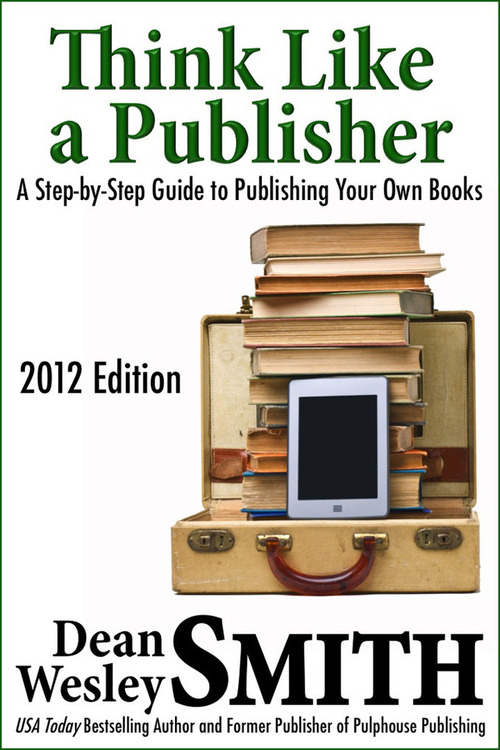
There’s much more useful information in this article on Dean Wesley’s Smith’s post.

Read on at this link:  www.deanwesleysmith.com

Filed under: publishing, , , ,

Wussies! Creativity and the boneheads in the way of artful risks

Jay McInerney at Tribeca Film Festival 2010

Jay McInerney at Tribeca Film Festival 2010 (Photo credit: Wikipedia)

I just read something from a writing advice book that annoyed me and I have to pull this sharp and spiny burr out of my nethers. It’s about what I’m going to do with point of view in the crime novel I’m writing. I’m taking a risk with this book and I know it. It’s written in second-person, present tense. That’s right! Now you’re wondering if I’ve lost my mind or if I’m just into quirky gimmicks. You’ll soon find out, but let’s talk about why I’m annoyed and you might get that way, too.

I ran across a chapter on point of view. The upshot on using second-person was that it’s best for short books (good, mine is) and is tricky to pull off. I agree with that. It is tricky. However, I have had good experience using it and several stories in Self-help for Stoners have more punch in part because of that unorthodox choice.

Then I got really annoyed because the author warned that editors and agents would be quick to reject any such manuscript because the attempt screams: I’m a Jay McInerney knock-off! You’re trying to do Bright Lights, Big City! I’m paraphrasing rather than quoting because I didn’t buy the book. I will buy the digital edition to delve further, by the way. I don’t write off a book or conclude the author is wrong just because I disagree with one paragraph. I’m annoyed not because the author is necessarily wrong, but because he may very well be right that traditional publishing is that quick to pull the trigger on any book that challenges the status quo (as if the status quo is all that hot.)

Bright Lights, Big City is a novel I admire. I found it quite engaging and funny. I wasn’t put off by all the “You, you, you,” that got so much press and critical attention but misses the point of the novel entirely. It was considered somewhat experimental at the time (and I guess it still is if the author of the advice book is correct.) Bright Lights was different, but it didn’t really deserve the “experimental” label. Aside from the use of the second-person point of view, it’s really quite a conventional novel that reminds some of Catcher in the Rye. (Try Pygmy by Chuck Palahniuk if you want experimental fiction. That’s far more daring and demanding of readers.)

The use of the word “you” — some would say overuse — doesn’t get in the way of my enjoyment of Bright Lights because it’s the jokes, the hipster context of New York ’80s nightlife and a stab or two at the literary establishment that appealed to me. I was working in the Toronto literary establishment at the time I first read it, so it spoke to me even though I didn’t have the cash or inclination to indulge in Bolivian marching powder.

We used the word experimental because there weren’t many well-known antecedents that employed second-person point of view. Now Bright Lights, Big City is the well-known antecedent and apparently some publishing professionals have long memories but very narrow minds. Bright Lights, Big City came out in 1984! So…Jay McInerney did it once and now the use of second-person is a reason for quick  rejection? He slipped under the gate but it must never allowed again! Really? They haven’t got over the shock after 28 years?

Wussies!

When my novel comes out this June, readers will agree it’s awesome like chocolate croissants, merely palatable or they’ll decide it sucks like a Dyson vacuum cleaner powered by the fearsome gravity well of a black hole. I’m betting it works and fortunately, my imprint, Ex Parte Press, will publish it. The boss can be kind of a dick, but I’m tight with him. The only gatekeepers I have to worry about are the readers traipsing the digital forests of the Amazon. I know it’s a gamble, but I don’t write so I can sound like everyone else. As much as I respect Jay McInerney*, I’m not trying to emulate him. We write to express ourselves. This is me being me. I hope you’re being you and taking some artful and calculated risks, too.

*If you’re a martial artist, please try Jay McInerney’s Ransom. If you want a distinctive voice by a confident author, read McInerney’s Story of My Life. These, along with Bright Lights, Big City, were Mr. McInerney’s first three books. They were his least conventional and I believe they were his most successful. They were the ones that were most successful with me, anyway.

Filed under: publishing, , , , , , , , , ,

Who reviews the reviewers? You could.

The second generation Amazon Kindle, showing t...

The second generation Amazon Kindle, showing the book Alice's Adventures in Wonderland (Photo credit: Wikipedia)

Maybe we need to make a concerted effort to review some reviewers so they’ll either change, cheer up or shut up. Allow me to explain before you give this blog post a one-star review.

I’m in the home stretch in completing my crime novel and after a hard day sweating over a hot keyboard, I dip into my Kindle to unwind. As I search for new books to load up on, I find myself drawn to scan Amazon reviews. The sad truth is, I haven’t been reading the five-star or four-star reviews much. I’ve been clicking on the one-star reviews and reading with horror.

There are several reasons for my self-abusive behavior: 

1. I’m looking for mistakes to avoid. Not all one-star reviews are wrong and I’m trying to glean the honest from the brutally honest. Some books are plain bad.

2. Cranky people can be funny sometimes. Sometimes on purpose. Just as villains can be more interesting to write than heroes, a bad review is often more interesting than a positive one…at least to write, possibly to read and, as far as achieving the purpose reviews are meant for? We’ll get to that in a moment. Hang in for the punch.

3. Five-star reviews tend to sound alike while the one-stars should be more interesting. This is the Anna Karenina/book review version of “Happy families are all alike; every unhappy family is unhappy in its own way.”

Generally, reading one-star reviews has proved a mistake because either it’s depressing or annoying. I should probably quit reading them. Or, we could review the reviewers in the hope they might improve just as they supposedly do for our betterment. That is the purpose, isn’t it? Or is it?
Hm. We’re writers. We should be able to do a better job than many reviewers at reviewing. Shouldn’t we?

With regard to point 1: The one-star reviewers often haven’t finished much of the book they’re reading and their criticisms are often inarticulate, too harsh or too vague. “Yuck” doesn’t inform anyone of anything except the reviewer might be a dim seven-year-old with a limited vocabulary and access to their parents’ Amazon account.

As far as point 2 goes, the hate comes through, but there’s not often a lot of creativity in the funny department. The problem is that too brutal a review isn’t a message conveyance system. It’s just a knife slashing from out of the darkness wielded by a bitter, blind assailant. Some reviewers offer such consistent patterns of hatred, I suspect they don’t enjoy reading but reviews are an outlet for problems that are traditionally worked out on a couch with the aid of powerful psychopharmaceuticals.

As for point 3: I was wrong and Anna Karenina was wrong. The hate sounds more alike than the all-out loving reviews. People love different aspects of a book but they repeat the same stuff that bothers them, often within the same one-paragraph review.

The Internet is mean because it’s anonymous. Some people mistake mean for being intelligent or funny. Nah, it’s often just mean and dumb. We keep hearing the rule “Don’t say anything on the Internet you wouldn’t say within bitch slapping distance.” It’s good advice crazy people don’t take.

Recently one of my books, Self-help for Stoners, got its first three-star review. (The others were four and five stars and wow did those make me happy!) The reviewer who gave that book three stars wasn’t in love with the drug use aspect of the book. Instead, he winced and I don’t think he meant metaphorically. I’m always intrigued how people react to that book because some have told me it’s anti-drug (Get off your ass, stoner!) and most assume it’s pro (What a wonderful world it could be. [insert trill of violins rising here] ) When people ask me straight out, I say it’s anti-censorship and pro-freedom but mostly it’s stories of suspense that challenge readers to draw their own conclusions.

Though it was a three-star review, the reviewer found a lot to love and respected the work enough to give it very thoughtful consideration that I appreciated. It was largely complimentary despite the aspects he disapproved of. That’s pretty decent and open-minded of him, don’t you think? Lots of people have three settings: love, hate and apathy. The mark of a good book review is an appreciation for nuance. Would I prefer unmitigated bouquets and cyber kisses? Of course, but it was still a good review from him and a good review for me. (In retrospect, I wish I’d sent him Sex, Death & Mind Control. He probably would have enjoyed that book more. The style has similarities and the subject matter is still suspenseful fun but there’s nothing there that could be considered advice.)

Which brings us back to those hateful one-star reviews. You know those little boxes that say: x number of y customers found this review helpful? Yes? No? I’ve been clicking “No” a lot lately. Too many of them are just too mean or uninformative or uninformed. If you think a review breaks the bitch-slapping guideline, click No. (Or click Yes if it was disapproving but helpful, funny, clever, civil or anything non-hateful and crazy.)

Suggestions:

If you only gave the book five minutes or a few pages, you aren’t qualified to review it. Move on. (I don’t know how much of a book you have to read before you’re qualified to review it. 50%? 75% 100% including the ISBN? Hence the Question of the Day at the bottom of this post.)

If you couldn’t wait to delete it because it’s somehow digitally sullying your Kindle, okay, but very often these folks are really mad at a book that was free. I’m not suggesting a free book should be bad. I’m saying, let’s keep our rage in check and our world in perspective. You tried something and it cost you nothing but time and you didn’t really give it much of that, did you? I don’t waste time finishing a book that I don’t like. There are too many good books out there and life is too short to get all OCD with, “But I got it so I’m committed to this living hell now!” C’mon. Let it go.

Please read a sample before you buy: “I thought by the title that it would be a summer romance and it turned out to be borderline porn about a war between foot-fetishistic elves and fairy vampires! I’m pissed!” We are all the star of our own movie, but just because you hated it doesn’t mean the extras milling around at the back of your set wouldn’t enjoy it. Leave it for those foot-loving peons and weirdos. Stars should be gracious with the supporting cast.

Nastiness is forever, so please check yourself before you wreck somebody else. An ill-intentioned review could  have real-world consequences. At best, you could dissuade someone from something that they could enjoy or maybe even love though you didn’t. At worst, you’re the one taking money away from some poor sod whose only crime is using too many adverbs. Ease up on the stick and don’t overshoot the runway.

What’s your motivation behind a bad review? A friend of mine has mentioned that once his book hit high rankings on Amazon, the nasty reviewers boiled out of the woodwork as if to make a point of taking him down a peg or two for having the audacity to do something that pleased a lot of other, happier people. Another author got a nasty review on her book which she suspected was payback from a writer who had asked for an honest critique and got one she didn’t like. (Warning to the petty and petulant: You don’t get help or even civility in the future if the word gets around that you’re a nit. This is the Internet. Word will get around.)

When you make a big deal about the book being a sub-standard work from an indie press, you’re smearing all hard-working, low-resource indies and dreamers with the same acid-tipped brush who are providing some grateful people with very inexpensive information and entertainment. That’s an ad hominem argument which is Latin for “Shut the $#@! up.”

Are you counting typos as you read? I recently mentioned a reviewer who said he liked a book but started off his review with the fact that he found five typos. If you can’t handle a book with five typos over 250 pages, we have a tank lined with cotton waiting that will protect you from the world. You’re too fragile for earth’s atmosphere. Once again, ease up, man! Many of us (most?) are doing all we can to prevent typos and as much as it may annoy you to find a mistake in someone else’s work, it kills writers to find it in our own books. (You can read a traditionally published book with as many typos. Lots of people hate that argument, so let’s try this tac: You can have a traditionally published book  with (what you perceive) as no typos! Yay! You will, however, have to pay ten times more money for it. Deal? Deal.)

Authors: Please read the whole review and weigh it with due consideration. Just as we hope book reviewers will be civil, gentle and thoughtful and read enough to have a reasonably informed opinion, we should assess reviews individually before clicking that dismissive “No” button. Let’s not let our egos impair our journey to improvement. (If you figure out how to do this, please write me explaining how. I’ll do anything short of meditation, a word whose language root comes from a Latin phrase meaning “Boring as $#@!”

I do thank people for decent reviews. I don’t encourage anyone replying to a nasty review. We can legitimately use the “Was this review helpful?” buttons as they were intended without getting sucked into a black hole of bitterness. If you find yourself explaining why someone should love your book — my baby! my baby! — either you wrote something incomprehensible or they’re kind of dim. Either way, arguing is a waste of time. Use that time to instead write another (great!) book and accept that no one book is for everyone.

Try this: Take a book you love. Look up the best book you ever read! Read the reviews. See all those one-star reviews? Yeah, that’s what I mean.

Question of the Day: How much of a book do you read before you feel you can honestly review it? I welcome your (helpful) comments.

Filed under: publishing, , , , , , , ,

Bestseller with over 1,000 reviews!
Winner of the North Street Book Prize, Reader's Favorite, the
Literary Titan Award, the Hollywood Book Festival, and the
New York Book Festival.

http://mybook.to/OurZombieHours
A NEW ZOMBIE ANTHOLOGY

Winner of Writer's Digest's 2014 Honorable Mention in Self-published Ebook Awards in Genre

The first 81 lessons to get your Buffy on

More lessons to help you survive Armageddon

"You will laugh your ass off!" ~ Maxwell Cynn, author of Cybergrrl

Available now!

Fast-paced terror, new threats, more twists.

An autistic boy versus our world in free fall

Suspense to melt your face and play with your brain.

Action like a Guy Ritchie film. Funny like Woody Allen when he was funny.

Jesus: Sexier and even more addicted to love.

You can pick this ebook up for free today at this link: http://bit.ly/TheNightMan

Join my inner circle at AllThatChazz.com

See my books, blogs, links and podcasts.

Enter your email address to follow this blog and receive notifications of new posts by email.

Join 2,063 other subscribers