C h a z z W r i t e s . c o m

See all my books at AllThatChazz.com.

Sex Alert! It’s here to take you away

Sex, Death & Mind Control (for fun and profit), a collection of short fiction about our three favourite things, went up on Amazon just last night! Hurray!

Please check it out by clicking the cover below. 

(I love them all and there are even a couple of award-winners in the mix.)

Also, note that you don’t have to own a Kindle to read anything from Amazon. Get your free reading app for your screen here.

Sex, Death and Mind Control

Now available at Amazon!

Filed under: My fiction, What about Chazz?, , , , , , , , ,

The unorthodox ebook license note:

Don’t worry about book piracy. If someone wants to pirate your book, they will and there’s nothing you can do about that. Worry about obscurity, not piracy. It’s much better to put your time into writing a good book and marketing it well than to slam your head against hard things you can’t control. (That got sexier than I intended.)

Anyway, instead of the usual pleading license notes about all my hard work on my books (releasing very soon now, I swear!) I opted for this as my license page:

License Notes

This ebook is licensed to you for your personal entertainment. Please do not resell this ebook or give it away to others. If you would like to share this ebook with another person, please purchase an additional copy for each recipient.

Ebooks are an inexpensive pleasure — couch change and impulse buys! — that can be enjoyed for hours, so c’mon! Don’t be a douche.

Thank you for respecting art (and starving writers, too!)

Filed under: Books, ebooks, getting it done, Intentionally Hilarious, self-publishing, Writers, writing tips, , , , , , , , ,

The downside of cheap ebooks

The_Dangerous_KindEbooks are often so inexpensive that they have become impulse buys available for mere couch change. (That’s how I’m selling my ebooks. Two of them will be up for sale November 1 at $2.99 and one long

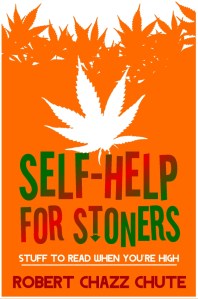
Self-help for Stoners

Available Nov. 1

short story goes for 99 cents.) It should be an easy sell for people who can read, like to read and actually do read. The Dangerous Kind, the short story, should lead people to buy the collections (Self-help for Stoners, Stuff to Read When You’re High and Sex, Death & Mind Control.) Well…it’s a good theory.

But will my work actually be read by anyone even after it’s bought?

Everybody’s to-read pile is so big!

Go to Goodreads and surf a bit and you’ll soon find a bunch of books that catch your eye, each one calling with equal force, “Add me to your to-read list!” I’ve recently become more active on Goodreads. I love the site and, after reading some personal recommendations from my GR friends, I’ve even reconsidered a couple of books I picked up and put back down at the bookstore.

An arresting cover can get surfers to slow down to gawk.

Killer ad copy helps.

Friendly, happy reviews help most.

Sex_Death_&_Mind_ControlBut if people buy it but don’t read it and then recommend it enthusiastically…

Let’s just say I can’t bear to think about that possibility very hard.

Filed under: DIY, e-reader, ebooks, My fiction, Publicity & Promotion, What about Chazz?, , , , , ,

Bookstores, buying habits, digital rights and the end of the world as we know it

I went cross-border shopping. In all our travels, I saw one bookstore and it was an empty, boarded up Borders. In the huge (and I mean huge) shopping centres we wandered through, there was not one bookstore. Not. One. I am not celebrating the shrinkage of the paper book market. I will miss bookstores and what they were. As their bookshelves shrink to bestsellers-only and mid-list authors find no (non-virtual) place for their books, we have lost shrines to knowledge and literature. When they’re gone (or when I have to travel many miles to get to one) I will feel the same nostalgia I feel now for friendly garbage collectors and milk men who brought their products to my door when I was a child.

How many years will it be before the economics of book production don’t make any sense at all? Economies of scale will, at some point, require that all books go digital unless they are specialty items for very high-end books, hobbyists with very low-end books or novelty items. Paper books are still big, but as the gifts, candles and coffee spaces in bookstores grow and book return times shrink, anyone can see where this train is going.

I still run into people who think a mid-list author should pursue paper book deals within traditional publishing to the exclusion of the electronic marketplace. Unless an author holds his or her e-rights, though, in most cases that math won’t make sense. John Locke held on to his e-rights. Locke stuck to what he was good at and the publisher acknowledged that by making the unprecedented deal. (Joe Konrath wrote convincingly that the deal was an admission of industry failure and was, in effect, a sign of End Times for trad publishing.)

Naysayers object, “Any self-published author would jump at a traditional deal.” Uh. No, that’s not true. A traditional deal will often yield the author about a buck after a book sale. Self-publish digitally, sell for just $2.99, and you’ll get about $2.00 with each sale. For those who would jump at traditional deals, authors may well make that decision for personal, emotional reasons, not as a pure business decision. The math doesn’t change but people are variable and are welcome to their (informed) choices. Video on demand, PVR and satellite replaced Blockbuster, but movies are still getting made.

As bookstores shrink and collapse, consumers are already turning away from the old model, even when it’s available.

For instance, I’ve noticed my buying habits have changed.

Here’s my shopping habit arc:

1. I bought books in bulk. Even though I sold a bunch, my many bookshelves are still groaning under the weight of shelves packed with books in double rows.

2. Then I bought half of my books in bookstores and half on Kindle. (I use my Sony Reader much less because it’s not wireless.)

3. If it’s a reference book, I’d still prefer to read it in paper for ease of use. I picked up a tech manual for my computer last week because I wanted instant answers.

4. If it’s fiction, it’s on my Kindle. I love that I can download so quickly and easily. It’s so easy, in fact, I don’t know when I’ll get to read all of my purchases.

5. I’ve pretty much given up on magazines because of all I can read on the web (on blogs, for instance.) There’s just as much expertise and good deal more depth in many blogs than magazines have space for.

6. Shipping: Paper books at a bookstore are more expensive. If I order them straight from Chapters or Amazon or download to the Kindle, I’m paying for the same products at a discount and the shipping is free, right to my door.

7. The local bookstore is for recon missions to find books I’ll order electronically. When our bookstores can’t afford looky-lou sessions and close, I’ll be doing that research exclusively by going through catalogues, watching for recommendations on book blogs and on sites like Goodreads. And my friends will tell me what they enjoyed. And I’ll say, “I used to get out of the house more.”

8. There will still be bookstores in the future. You’ll have to travel a long way to get to them and most of them will be specialty bookstores. The big inventory will be on the web. Just like now.

The eventual end of the common bookstore is not the end of the world. 

It’s only the end of the world as we know it. 


Filed under: DIY, e-reader, ebooks, self-publishing, , , , , , , ,

On judging books by their covers

Thank you to everyone for your input on the covers for my book, Self-help for Stoners, Stuff to Read When You’re High (available on all e-readers Nov. 1, cha-cha-cha!)

The input has been put in. By a huge majority, the votes are for the bright orange cover (below). When it’s on a shelf, digital or wooden, it will stand out. It was an interesting experiment to see how people reacted to the covers. The happy thing is that, even among people who weren’t so sure about the orange cover, most of them still thought that cover could be effective. The other aspect about book cover colors is a little more inside baseball: The rule of thumb is that, unless it’s a golf or gardening book, green covers don’t sell very well.  (It’s one of those weird little details I learned from the Banff Publishing Workshop. It was reinforced by years of selling books for multiple publishers. I’m not sure about much, but that tidbit is pretty consistent except for The Celestine Prophecy.) 

Soon you’ll be hearing from my graphic designer, Kit Foster of www.kitfosterdesign.com. Kit’s a novelist, too, and very talented. Someone told me the other day how impressed he was with Kit’s covers. They do look like they’re from a large publishing house, not my tiny kingdom of Ex Parte Press. We’re all told we shouldn’t judge a book by its cover, but we all do. Without a solid cover, no one will pick it up or click on it to discover the tasty treats inside.

The process of working with a graphic designer: When Kit and I started a dialogue about book covers, the arrangement evolved organically. I described what I had in mind and sent him a sample of the manuscript. He suggested a few things and I saw his wisdom and asked for some tweaks. He sent me a cover and we narrowed it down with another round or two or three of tweaks. His input was invaluable. I have no idea how he does what he does and I bowed to his experience with graphics. Even though I have a deep background in selling books, my focus was the words. Kit came up with the images to sell the words. With Sex, Drugs & Romeo, the final graphic is very close to his original proposal. With Sex, Death and Mind Control (for fun and profit), we went back and forth a bit more, but Kit was always patient and helpful. The only element I knew I wanted to keep was the author tag. I wanted it to be consistent across the bottom in cherry red on all the covers so my books would be instantly identifiable for cross-promotion purposes.

Kit’s great at what he does and a photographer friend of mine is also awesome. I’m going to ask them to guest post and drop some science on us about the art of book cover creation. In the meantime, rethink your green cover and ask for a poll from your network of writer friends and readers. People will often help if you dare to ask.

Filed under: Books, ebooks, self-publishing, What about Chazz?, , , , , , , , , , , ,

Curiosity Quills Interviews Polly Courtney | Curiosity Quills

Polly Courtney was the author who dumped her publisher at the book launch. Now that she’s telling her side of the story, the plot sickens. Check it out. ~ Chazz

Via Scoop.itWriting and reading fiction

So, you’ve finished the backbreaking work of writing, polishing, and packaging your novel for release.
Show original

Filed under: publishing, , , , , , ,

Editing tools and typo tips

Book cover (Dust jacket) for the 15th edition ...

Image via Wikipedia

Write_your_book
EDIT YOUR BOOK!

When you’re checking your manuscript, use your word processor’s Spellcheck. Some editors turn up their snobby little noses at Spellcheck, but it can flag problems you might otherwise miss. Nobody’s perfect and problems will always appear once you’ve published your book (yes, in both traditional and self-published books). Don’t take every suggestion; Spellcheck isn’t always right. It’s a tool, not a panacea. You can also use Find and Replace to look for problems Spellcheck misses: its, it’s, there, their and so on. Spellcheck doesn’t replace editors and they don’t replace thinking. But you’ll catch more using it.

To the rude editor I met at the conference who said she never used Spellcheck: Yes, I’m saying that was arrogant and, just like the rest of us, you’re not nearly as smart as you think you are. Or funny. And you need to work on your social skills. (Now I’m worried that I’m projecting.)

I don’t edit blog posts obsessively, but when I’m working on a book, I have several websites up on my browser: Chicago Manual of Style, Wikipedia, and dictionary.com. I also use Autocrit for more input.

For me, yesterday was single quote day. I wrote parts of my books with Open Office, so I had to go through the manuscript and make all my single quotes curly…and curly in the right direction. I was cross-eyed and HULK ANGRY by 5 pm.

PentecostSelf-publishing guru and author of Pentecost, Joanna Penn, has a great suggestion to deal with typos: Publish your ebook first. Your readers will let you know (politely or not) about your book’s typos. Corrections to the ebook are easier than correcting your printed book. Corrections to print books are called “second editions.” Great tip! For more information from Joanna, check out this very useful interview. I loved this inspiring interview and it helped me calm down after Curly Quote Day. Well…much later, after the photo below.

Me after Curly Quote Day

Filed under: Books, DIY, Editing, Editors, getting it done, grammar, writing tips, , , , , , , , , , , , ,

The price and value of ebooks Part II

A Picture of a eBook

Image via Wikipedia

There’s a lot of talk about ebook pricing. You’ve seen the numbers. Today I’m pointing you to the comments section on a post on this very blog because a great dialogue arose that I haven’t seen elsewhere and I don’t want it lost. A writer and a reader have a very thoughtful point-counterpoint discussion, not just about the numbers, but how they feel about the numbers.

Thanks to both Tracy Poff and Reena Jacobs for both their passion and civility as they had an impressive meeting of the minds about ebook pricing from an author’s and reader’s perspective.

You’ll find the comments under this post: Do readers expect too much of ebooks?

Filed under: author Q&A, authors, ebooks, Guest blog post, publishing, self-publishing, , , , , , , , , , ,

Writers: Not everyone will love us. I’m okay with that.

AllgemeineGesichts-Hals massage

Image via Wikipedia

I’m a couple of months away from writing and publishing full-time now. After 18 years as a massage therapist, I’m seeing an unflattering commonality between professions. Writers and massage therapists both seem to want respect desperately. And that’s the problem.

As I move into writing full-time, I see some of the same mistakes among the self-published that I witnessed in my (soon-to-be-former) occupation. Massage therapists want respect so badly they often give up their power to other health care practitioners and bureaucrats . That’s not how to gain respect. They should get respect by doing great things rather than trying to regulate to the lowest common denominator. (But that’s another rant about having a shred of dignity for another time and place.)

As writers seeking respect, we must give respect, but not require it of others artificially. Instead of respect, I suggest we seek out a readership.Respect must arise organically from circumstance and accomplishment. We have to do what we do well. That is all that’s needed. There’s a lot to that process, of course. Writing well, editing well, proofing well, formatting well, publishing with as few mistakes as possible…makes the head spin, doesn’t it? Most of all, tell a good story that keeps readers engaged. Sell a lot of books. Ultimately, sales will really get the attention of naysayers (and then they’ll really get cranky with you!)

Until then, self-published authors are called wannabes, amateurs, pretenders, unvetted, unproven, and unserious hobbyists.

Don’t worry about that.

You can mount a number of logical, fiscally sound arguments worthy of Joe Konrath, but until you deliver on the numbers, you’re just another “one of those.”

Sales figures aren’t subjective.

In my crotchety opinion, the best thing self-published authors can do is stay the course and ignore naysayers. Don’t even try to convince them. Let your success with readers be your argument. You know why, right? Because some publishers and critics and traditionally published authors don’t want to concede anything. They don’t want to give what you’re doing any respect. They fear change. They don’t want to like you. Maybe that will come later. (I’m not saying all critics and legacy authors want to dislike you, of course. However, the naysayers are loud and already get too much attention. They can hurt your feelings and sap your motivation if you give them your energy.)

You know who does want to like what you do? People who like stories. Readers. Readers and writers are not the same group. Readers differ from writers in number, grammar fetish, decibels, expertise, enjoyment and predisposition. Readers want to like your story and they want to like you. Cater to the right audience and maybe someday the naysayers will come around. If they don’t, either you didn’t do a good job or they are very determined snobs. If it’s the former, improve and carry on. If it’s the latter, screw ’em. Not everybody has to love you.

Wanting love without needing it from just any bonehead?

That’s the beginning of self-respect.

Filed under: DIY, ebooks, getting it done, self-publishing, Writers, writing tips, , , , , , , ,

Self-publishing: The Couch Change Economy vs. The Great Personality Argument

How does a guy go from getting paid $85 an hour to taking the risk of self-publishing? It’s not such a big leap.

Last night, on impulse, I bought a little tub of Heavenly Hash ice cream for $1.99. 

That explains everything, huh? Okay. Let’s go deeper:

When a new tax hike hit my province last July, my business changed. I’ve been a massage therapist for 18 years. I have great clients I care about and not just a few who care about me. To accommodate the new tax, my hourly rate went up to $85 per hour. A bunch of my clients took it in stride, but several just couldn’t afford to come in for treatment as often. I live in a lovely, but economically depressed area. Since I work as a part-time therapist and that fee is before tax, $85 an hour isn’t quite as great as it sounds. When I did my taxes, the numbers confirmed what I suspected: I like my work, but it wasn’t paying. I needed to change something if I was going to have anything left over at the end of the month. I could go back to working out of clinics full-bore and full-time and make “real” money or I could explore other options.

Then I thought, “You know, I don’t have that much to lose now.”

That’s the “A-ha” moment. I believe in my writing and marketing savvy. It was time to bet on that and switch to writing full-time. This wasn’t coming out of nowhere. I’d held several positions in traditional book publishing and trained and worked as  a journalist. As a freelance editor, columnist, features and speech writer, my writing income rose to become a healthy chunk of my overall income. Last year I spent more time working on writing and editing than I did in health care.

Also—and this is crucial—I had five novels in my drawer ready to edit and bring to fruition.

Many authors propose books and only start to write them after they get someone to ask them to do so. (That’s a smart way to do it, by the way, but it’s not the only way.) I had opportunities to go that route. However, I had  no interest in doing so. I have a strong streak of I-want-to-do-it-my-way (which doesn’t always serve me best but, for me, that’s the only way it’s going to happen and sustain.) I hadn’t sent out any manuscripts at all! As soon as I completed one book, I rushed on to the next, giddy and getting high off the writing. Writing is always way more fun than chasing agents and editors. It’s an odd kind of procrastination, staying busy kneading dough but never actually finishing a loaf of bread so you can eat it.  I helped several authors get their books published, but was in no hurry to bring my own out into the world. I was waiting for something and that something was me.

This week, I finally caught up to me. I finished the last manuscript I needed to get written before I could move forward with my grand plans to go full-time as a writer. (More on my complex marketing plans in another post, another time.)

Soon I will jump into what I call the Couch Change Economy.  You could call it the iTunes Purchasing Model or more simply, impulse buying.

That Heavenly Hash ice cream I bought? It was a stab of nostalgia that did it. I grew up in Nova Scotia. In the summer my parents would sometimes take me to the shore in the evening to cool off and watch the sunset. An old clapboard ice cream shop with poor posture  leaned into stiff Atlantic winds just 100 feet from relentless ocean waves. That was the only place I ever ate a waffle cone with two scoops of Heavenly Hash. If the tub had been priced higher, I wouldn’t have picked it up and put it in my shopping basket. I haven’t tasted it yet. I may not even finish it all. But for $1.99, it’s a cheap indulgence that reminds me of a good time with a dead mom.

When a book is cheap, no one minds taking a chance on an author they don’t know if the book sounds like it might interest them. If you don’t like a cheap ebook, you aren’t going to lose sleep over the equivalent of the sum of coins you can find in your couch.

How low that ebook price must be is the subject of many passionate discussions. 

John Locke says 99 cents (and a marketing strategy) made him a million-book seller. 

Joe Konrath has run the numbers and says $2.99 is the “sweet spot.” 

Others object that these prices devalue the work and no author who believes in their writing should charge so little. While I understand where they’re coming from, that sounds suspiciously like The Great Personality Argument. You can have a great personality, but if you don’t arrive at the party smiling, freshly scrubbed, with your hair combed, few people will approach you to discover how smart and funny you are. In short, couch change pricing sells more books than pricing on arbitrary values the author holds for his work. An author can believe in their work all they want (and they should) but for the sale, what matters is how much the buyer values the work. Your ideal readers may never discover how great your book is unless you make the package very attractive at low to no risk. Pricing at couch change levels is the No-pressure, Get-to-know-you price.

As debt ceiling negotiations rage in the United States and nervous stock market investors watch in horror as economies go off the rails, this is an excellent time to be working in a non-premium market. Low-priced items are low risk. Low-priced items sell at higher volume. (And a massage therapist doesn’t ever work in high volume.) I’m optimistic—which doesn’t come easy for me—that this is the year to make the jump if I ever will. And so I’ve begun informing my patients that I’m wrapping up my practice. Self-publishing suits the kind of hairpin I am and the math makes sense to me, if not to everyone.

Most important, writing full-time is my unfulfilled dream. I don’t believe in heaven or reincarnation, so I get one shot at making my heaven here and now.

A client (who isn’t mean but does have sarcastic streak) asked, “So when do the millions start rolling in?”

“I may never make millions,” I said. “It’s quite a loss compared to the billions I make as a massage therapist.”

We both laughed because the working poor are, considering all the challenges we face, surprisingly good-natured.

But I think things will work out. I believe in my books. I’m willing to price my work low enough that readers will find me, take a chance on something fun and quirky, new and different. Over time, I believe they will believe in me, too.

And last, consider this:

I’ve written books for years, very happily, giving no thought to getting paid at all.
Filed under: authors, Publicity & Promotion, publishing, Rant, self-publishing, , , , ,

Bestseller with over 1,000 reviews!
Winner of the North Street Book Prize, Reader's Favorite, the
Literary Titan Award, the Hollywood Book Festival, and the
New York Book Festival.

http://mybook.to/OurZombieHours
A NEW ZOMBIE ANTHOLOGY

Winner of Writer's Digest's 2014 Honorable Mention in Self-published Ebook Awards in Genre

The first 81 lessons to get your Buffy on

More lessons to help you survive Armageddon

"You will laugh your ass off!" ~ Maxwell Cynn, author of Cybergrrl

Available now!

Fast-paced terror, new threats, more twists.

An autistic boy versus our world in free fall

Suspense to melt your face and play with your brain.

Action like a Guy Ritchie film. Funny like Woody Allen when he was funny.

Jesus: Sexier and even more addicted to love.

You can pick this ebook up for free today at this link: http://bit.ly/TheNightMan

Join my inner circle at AllThatChazz.com

See my books, blogs, links and podcasts.

Enter your email address to follow this blog and receive notifications of new posts by email.

Join 2,063 other subscribers