C h a z z W r i t e s . c o m

See all my books at AllThatChazz.com.

Amazon Glitches You Don’t Want

I checked my author page today to find that several of my books were not displaying on my Amazon author profile! Several of my most popular books lacked visibility on the Zon. By reloading the page, they might come back and they might not. I just checked this afternoon and even fewer of my books were to be found on my author page! No wonder my book sales have been plummeting.

(It was at this point Rob began to sweat and curse. He had cursed before, but as he reflected on financial ruin, he brought fresh verve and creativity to the activity.)

Visibility on Amazon is always a challenge, but when the problem is indistinguishable from sabotage, it’s time to hit the panic button. I got KDP on the horn very quickly and the rep was nice, but she also informed me that I had to talk to a different department to rectify the glitch. For that, no phone call. I had to send an email. I did so and struck just the right note: polite yet 911 urgent, on fire, yet congenial. The robot told me to expect to wait twenty-four hours, longer if research is required.

In the meantime, what to do, what to do, what to freakin’ do? I reasoned there must be something more to take action on than merely sweating, cursing, and making a TikTok about it.

Action steps:


1. Do what I’m told and wait patiently for a reply. I can do that. (Butt wiggles like a chihuahua that needs to pee.)

2. Direct you to my author site at AllThatChazz.com for direct links to my books.

3. Failing that, please search Robert Chazz Chute on Amazon to find my beguiling suspense and unputdownable science fiction. (Yes, I have some financial ground to make up this month. God, how long has this been going on?!)

4. That done? Read this article from Kindlepreneur about how to deal with suspensions, terminations, and other disasters on the Amazon platform.

5. Go to your author page and see if all your books are there sittin’ pretty. If they are, huzzah! No problem. If not, revisit Step 4.

We now return to my previously scheduled sweating , cursing, and butt wiggling.

~ I am Robert Chazz Chute. I pen apocalyptic epics with heart and killer crime thrillers with muscle. I’m really quite sweet and adorable most of the time. Find my stuff at AllThatChazz.com.

Filed under: Amazon, publishing, , , , , , ,

12 Tips to Write More

I’ve written, co-written, and worked as a book doctor for a long time. People have asked, how do you keep your ass in the chair long enough to be that productive? I do have a robot in my watch that tells me to get up and move around once an hour so I don’t become pudding. I set alarms to get me to bed and get me to work, too. Setting alarms is not just for nagging you to get out of bed.


Here are my simple suggestions for increasing your word count:

  1. Clear your workspace of distractions. (I have a blanket fort because I like to hide.)
  2. Clear your calendar so you have dedicated time to write. Be specific about when and where.
  3. Get excited about the current scene you’re writing. If it’s not exciting for you, it’s not exciting for the reader. If that’s the case, maybe it’s good you’re dragging your feet on writing it.
  4. Set a timer and, especially for that first draft, get the words down as fast as you can while you race the clock. You can accomplish a lot in short bursts.
  5. Shut off the internet so you focus on the job rather than checking out the latest on Huffington Post and Twitter news. The world’s ending. There, saved you some time.
  6. Do not wait for inspiration. Inspiration strikes at the keyboard, not while you’re playing Call of Duty.
  7. Since the hardest part is starting, tell yourself you’ll just write for ten minutes. Once you start swinging that hammer, you’ll get caught up in doing more damage.
  8. Take notes between writing sessions so you’ll have prompts when you’re back in the saddle.
  9. Drop your writing session on a note that’s easy to pick up again.
  10. Accountability is helpful. That could be just you counting your streaks in an app or on a spreadsheet, getting a writing partner, or finding a writing group. Tracking and reporting keeps you writing. My mastermind group has a writing room in Slack which tends to get me going.
  11. Visualize your success and how good it will feel to publish a book. You can’t get there without the homework part of being a writer, so do the thing.
  12. Picture the sad faces of all your haters when you hit it big. Cackle about it as you type. Motivation comes and goes, but fear of failure, terror of poverty, and ambition born of spite are strong emotions.

    What keeps you at the keyboard in this ridiculous, capricious business?

~ I’m Robert Chazz Chute. I write apocalyptic epics with heart and killer crime thrillers with muscle. Find links to all my books at AllThatChazz.com.

Filed under: writing, writing advice, writing tips, , , , , , , ,

The Alphabet of Making a Better Writing Life

After writing a few or many novels, most authors will contemplate quitting in hapless disgust. Sales aren’t as expected. You’re falling into plot holes. You’re convinced no one reads books anymore, or if they do, they only read the bullshit your idiot competitors are churning out. You’re disheartened, and it’s all everyone else’s fault.

First, you’re not altogether wrong about any of that. Ha! You didn’t expect me to say that, did you? But really, there’s plenty to be despondent about if you’re paying attention to the news. I get it. Now that we’ve felt sorry for ourselves and realized we should have become orthodontists, what’s next?

Stop moaning. How are you going to get your groove back and sell more books?

If the above shittiness resonates with you, you need to step back and reevaluate your expectations. Breathe some fresh air, get some stress out with exercise, and realize things can’t possibly as catastrophic as you’re currently thinking. Most of the best and brightest among us are forgotten very quickly after we expire. Ease up on thinking any of this is really so important. You don’t have some grand legacy. That’s for precious few of us and out of our control. However, you do have a life now and this is all you get. Focus instead on creating a better now.

You probably need to take a break from social media, maybe go on a news fast for a while. I think everyone should engage with the world to make a better one, but not at the expense of your mental health. Self-flagellation helps no one.

Yes! Yes, Rob, but what to do? What to do? What to fucking do?

There’s always something different to try. Some strategies:

A. Get into anthologies.
B. Organize anthologies with other authors in your genre.
C. Maybe audiobooks or podcasts are for you.
D. YouTube (as in #booktube).
E. Scriptwriting.
F. Short stories.
G. Blog your book.
H. Reengage with your newsletter people.
I. Graphic novels.
J. Live readings.
K. Live writing on camera.
L. Engage with #booktok.
M. #bookstagram.
N. Plan something more ambitious and make a mural of index cards with your five-book plot arc.
O. Maybe a trilogy or even one novel feels too ambitious, but a novella is just right.
P. Find a pre-made cover you love and write a novella based on that art.
Q. Engage with the #writingcommunity and figure out what other writers are doing that works.
R. Review and promote other authors’ books. Other people’s art can be intimidating. Choose to be inspired instead.
S. Adopt “beginner’s mind.” Let go of your preconceptions of the way things ought to be. Do that and you’ll begin to see things the way they are.
T. Don’t buy yet another book on writing or take another course. That’s procrastination and we both know it.
U. Maybe a review has got you down, but that reader is not your audience, so relax and rely on your editorial team to keep you on track. Bounce ideas off trusted confidants. You know the adage: The same idiot you wouldn’t accept advice from isn’t the one from whom you should accept criticism.
V. Nobody’s reading? Are you? It’s time to get inspired again by reading awesome novels. Lately, I’ve devoted the last hour of the day to reading. Not only is it edifying, I’m sleeping better, too.
W. Perfectionism is the death of creativity. Let it go. You’re going for excellence, not perfection.
X. Excellence does not emerge in the first or second draft. Keep going and be more patient with yourself.
Y. Measure your outcomes so you can spot the weaknesses in your game and improve.
Z. However, become less attached to results because it’s about the journey and the joy of creation. Remember? That’s why you got into writing in the first place. You weren’t thinking of your Amazon dashboard when you began making stuff up in English class. It was about turning a sweet phrase, landing a solid joke, and twisting a plot into a pleasing knot.


I hope this helped. If it didn’t, maybe it is time to quit. That’s okay, too. It’s supposed to be fun, not eternal suffering.

~ I’m Robert Chazz Chute. I write apocalyptic epics with heart and killer crime thrillers with muscle. Endemic, my latest novel, has won three awards. Check it out along with all my stuff at AllThatChazz.com.

BUY ENDEMIC NOW

Filed under: book marketing, the writing life, writing advice, , , , , , , , , , , , , , , ,

Do Not Write By Committee

The blowback is coming. Soon, Starbucks will offer pumpkin spice lattes. I just saw a social media post in which it was pointed out that it’s a mix of cloves, ginger, cinnamon, and nutmeg. This short post ended with, “It tastes really good and it’s okay to let people like things.”

First and only comment: No thanks.

(Gee, I hope that commenter was kidding.)

Next up, I listened to an interview with the delightful Simon Pegg in which he discussed the hazards of writing a Star Trek script. The tide of toxic fandom rose because, sigh, of course it did.

“THEY KNOW WHAT THEY LOVE AND ONLY LOVE WHAT THEY KNOW.”

Simon Pegg

(By Thor, I love that deep incisive cut, don’t you?)

Toxic fandom often goes to great lengths to demonstrate how little they understand creative work. They get the end result, but don’t understand or respect creators. Some even go so far as harassing writers and actors, especially if they’re women or in the BIPOC community. Gatekeepers are a particularly sad variety of this anti-enjoyment force. If you’re telling people they have to have read all of The Sandman before they really “get it,” please stop. We do get it. You were cool before everybody else. Good for you. Now shut up.

Actor Justin Long of Life is Short with Justin Long, confessed that he joined a I Hate Justin Long Club. (Note: Justin Long is a fine actor, and also a delight.) Funnily enough, by joining the club and agreeing with them, he defused the hateful action and made the organizer look awfully petty. However, as Simon Pegg observed, that shit still hurts.

Not everyone is going to love what we write and no writer expects that. However, some readers demand a home run every time. They want what they want and don’t you dare challenge their assumptions. They read books to confirm their biases and that’s all they’re in it for. More dramatic reviews sometimes end with, “I’ll never read this author again!” Gee, whatever shall I do without that $2? On the other hand, saying goodbye saves much more money in therapy. Trying to cater to each of those angry whims would lead to a lot of sleep loss. It’s nuts to try to write for the haters. Please, write for your readers, the lovers.

When I worked as a journalist, I wrote a piece about a common medical condition and profiled a particular sufferer. I soon got an irate call from a woman who was afflicted with that condition, but it rose from a different cause. She was in an anguished rage that I did not grind her particular axe that day. With threats to contact my editor and presumably end my career, she hung up in a huff. Her life brought no joy. She is not missed.

Sometimes you’ll detect a passive-aggressive version of this energy on a social media post. To demonstrate their higher expertise, some pedant will take the point you made and claim it as their own or take it further, as if you missed something. It’s not about you. They’re trying to feel good about themselves, and if that comes at your expense, they’re okay with that. Nobody likes the Well Actually Guy, so they have to feel good vibes some other way. A reviewer who proudly described herself as a know-it-all apparently does not know that the term is a pejorative.

One of my reviews (an outlier, by the way) declared: “Rubbish!” and “tries too hard.” Not really sure what trying too hard in this context could mean, but fuck it. It doesn’t really matter. For the sin of trying to entertain someone, you will get some negative reactions that are obvious overreactions. One wonders how these folks react when they face a real problem. The danger isn’t the nasty review. The danger is that you may take it too seriously and let it shut down your creative spark.

One reader contacted me with kind of a snarky question. I answered politely, but demonstrated that his assumptions were erroneous. At the conclusion of this interaction, he told me he enjoys contacting authors “to help them.” Dude, I didn’t ask, and I wasn’t helped. Actually, I helped you and no, I will not censor myself at your command. (As I’ve said many times in this space, write with your editorial team’s feedback, but DO NOT WRITE BY COMMITTEE!)

When we give too much power to readers, we’re essentially in the Florida school system where great books are banned for being too something or other. Among many, many others, their list of objectionable books included The Hate U Give, Of Mice and Men, A Wrinkle in Time, The Handmaid’s Tale, 1984, Vampire Academy, and on and on and on until their fragility leaves them with just one book full of all kinds of violence. It’s a book they claim to revere, but few have read. For that one book, they give a lot of leeway. To be fair, some can quote the snippets they love while ignoring the uncomfortable bits. Alas, if only all authors could receive that grace.

Everybody gets to have an opinion, but don’t let them influence you too much. Don’t respect people who have no respect for you. We don’t write for everyone. We write for those who receive the frequency we’re sending. Everything else is static.

Now go write that fabulous genre-bending plot that most will love and some will absolutely hate. That’s what we do. Without us, how will the haters feel good about themselves? With us, our true readership feels better for the shared experience.

~ I’m Robert Chazz Chute. I write apocalyptic epics with heart and killer crime thrillers with muscle. Check out all my work on my author site, AllThatChazz.com

Filed under: book reviews, writing advice, , , , , , , , , , , ,

Are book contests for you?

Yesterday I announced that my trope-defying, apocalyptic sci-fi epic Endemic won two awards. That brings me up to ten writing awards in my lifetime, but let’s take a beat to evaluate whether writers should submit their work hoping for awards. It’s not for everybody all the time. Is anything? (Quick answer: definitely not.)

First book contest caveat

It depends on your goals and what stage of the writing life you’re in. I won my first couple of awards when I was still in high school. I started building a track record early, writing for the school newspaper and for my hometown paper. Back then, it was about two things. Money was a big motivator. I was a teenager. Of course, I wanted money. Second, winning those awards early on lifted my confidence. I was on track to fulfill my dream of becoming a full-time writer. Those awards undoubtedly helped my university application to get into journalism school, too. Getting positive feedback is very important to the budding writer. We’re sensitive hothouse flowers that need tending as we grow.

Later on, I graduated to writing a bit of non-fiction and more and more short stories. Short stories are a great way of developing a concise writing style. Turning plot developments on a dime is a learned skill and writing short can get you there. Feedback from a solid editor is best, but when you don’t have that resource, getting feedback from judges could be the next best thing. Again, money can be motivating. When I won $1,200 from the Toronto Star, it was a big win, but frankly, I needed the money badly. If you write for a living, I guess, teen or not, that yearning doesn’t go away. This is a tough business. I was underemployed and that $1,200 went toward fixing our crumbling chimney.

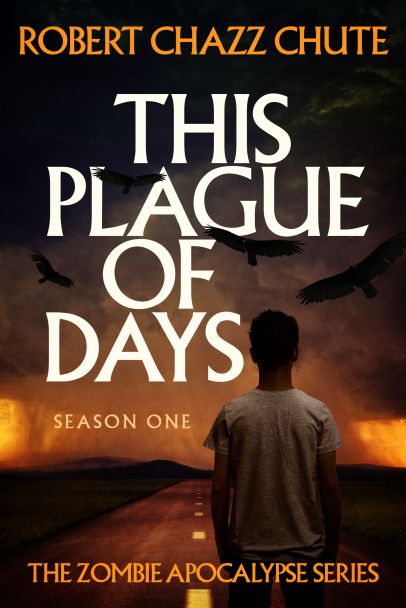
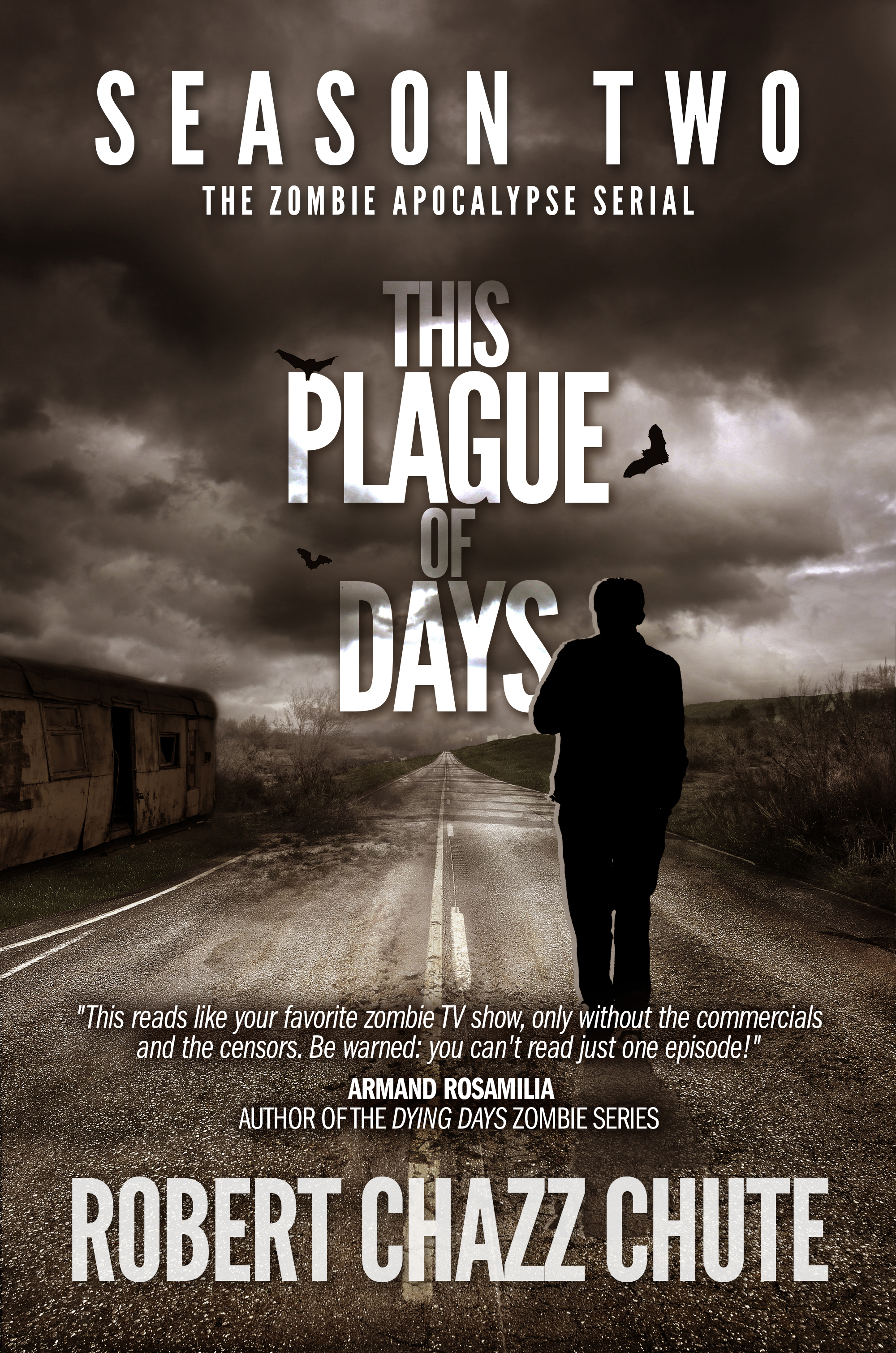
By the time I started writing longer fiction, my interest in sending in short story entries to Writer’s Digest had waned a bit. However, it’s a good thing that urge didn’t go away completely because I made a judicious choice in sending in one entry. That got This Plague of Days an honorable mention which I’m sure continues to help sell the book years later.

This year, my main motivation to enter book contests was frustration. Amazon screwed up my launch of Endemic, so I felt sabotaged from the start. Finding no success in advertising my wares, I tried paying someone else to do it right. Surely someone who’s a pro could make Amazon ads work where I failed. Nope! They couldn’t move the needle either. I had a free trial of Book Award Pro going and that got me thinking. I was confident I had a great book in Endemic, but I needed a different way to garner some attention. I needed more social proof and a workaround. Book contests? Why not? I’d tried everything else and was unsatisfied with the results. Whether it’s Facebook ads or Amazon ads, my sales seem to remain entirely organic.

Here’s the major reason you shouldn’t enter book contests

Money, as in not enough of it. If your budget is low and you have any doubts about your work, hold off until you’re confident about your entry and there’s money to spare. Entering a book you love still won’t guarantee success, of course. Book contests are a subjective endeavor and have more in common with playing the lottery than they do advertising. I don’t ordinarily submit to book contests because the cost is often prohibitive. However, I got some book doctoring work that allowed me some room in my promotions budget and I allocated some advertising funds to competition fees. Like my dad said about the stock market, only play if you’ve got gambling money. Don’t play with the grocery money.


Also, let’s face it: Some contests don’t pass the smell test.

There are scams out there that only serve to make money for the contest runners and do not benefit authors at all. Even if a contest is legit, the cost of entry may not be worth the benefit to you. There may be no benefit. It’s a competition with a lot of players. Odds are definitely against getting an award you can use as a sales tool.

What are the sales tools, you may ask? You can blog it, advertise it, promote it, alert the media, get stickers (digital and other), and announce the win in your sales copy and newsletter. After that, it’s the long-tail waiting game. (Also, those stickers and added doodads will cost you unless you make your own. If you do make your own, don’t step on the contest runner’s trademark.)

Not all contests are created equal

This morning I checked out a book contest that had a nice name that sounded impressive. I had a peek and discovered the organizers offered an ongoing competition in a vast array of categories. Too many categories. If you’re going for a Hugo or a Bram Stoker Award, those contests are in specific genres with a lot of competition so they’re more prestigious and carry more weight in the social proof department.

Please note: Even some big long-standing competitions have lost their shine due to internecine warfare. Research whatever competition you enter, not only to determine its value, but to decide if it fits with your values.

Another helpful measure

Look up past award winners. I checked out an award winner from a previous year. His book was still stuck at four reviews. There can be many reasons and variables for that to occur, but it made me think the contest was not worth the $100US entry fee. I did not succumb to the siren song of their seductive advertising copy.

If your goal is to sell more books, leveraging a book award win can be difficult. Despite winning two awards in the past two weeks, Endemic’s sales numbers have not shot up. The effect of the prestige of those wins will have to be long term (as it was with This Plague of Days). That’s my hope. In the meantime, it feels good to get some recognition for my work. I’m currently in unrelenting pain awaiting a double hip replacement. I can’t wait to become a pain-free cyborg, so while I wait, I’ll take feeling good however I can get it. There’s another big contest on the horizon, and I’m watching my email because the next win might be a game changer. Fingers crossed.

See what the fuss is all about here.

~ Check out all my apocalyptic epics and killer crime thrillers on my author site, AllThatChazz.com.

Filed under: awards, , , , , , ,

Two awards! I’m happy.

Find Endemic on Amazon

Happy News!

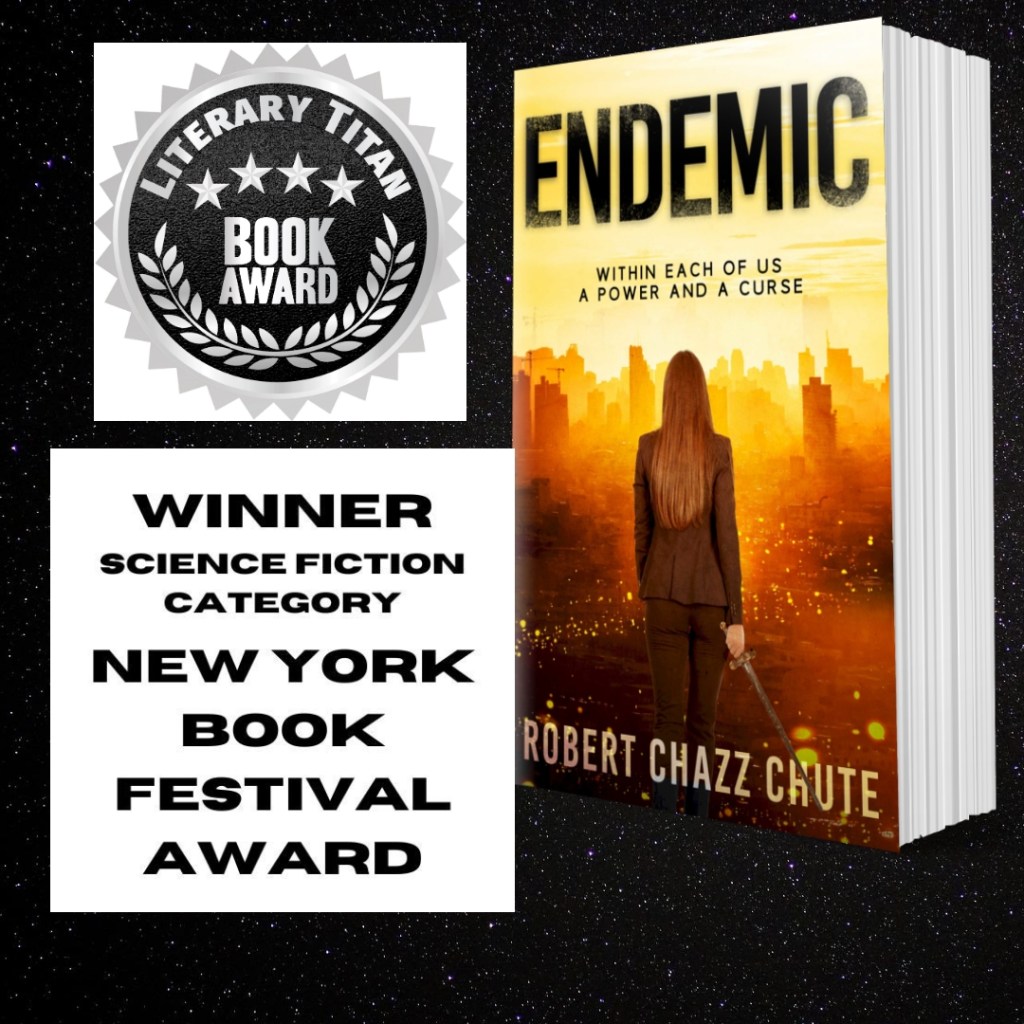
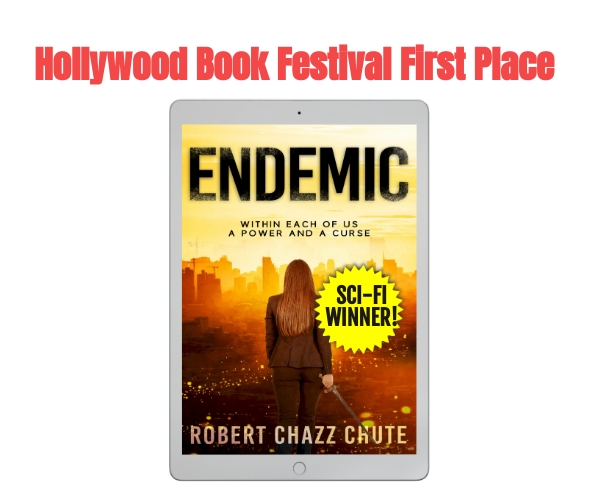
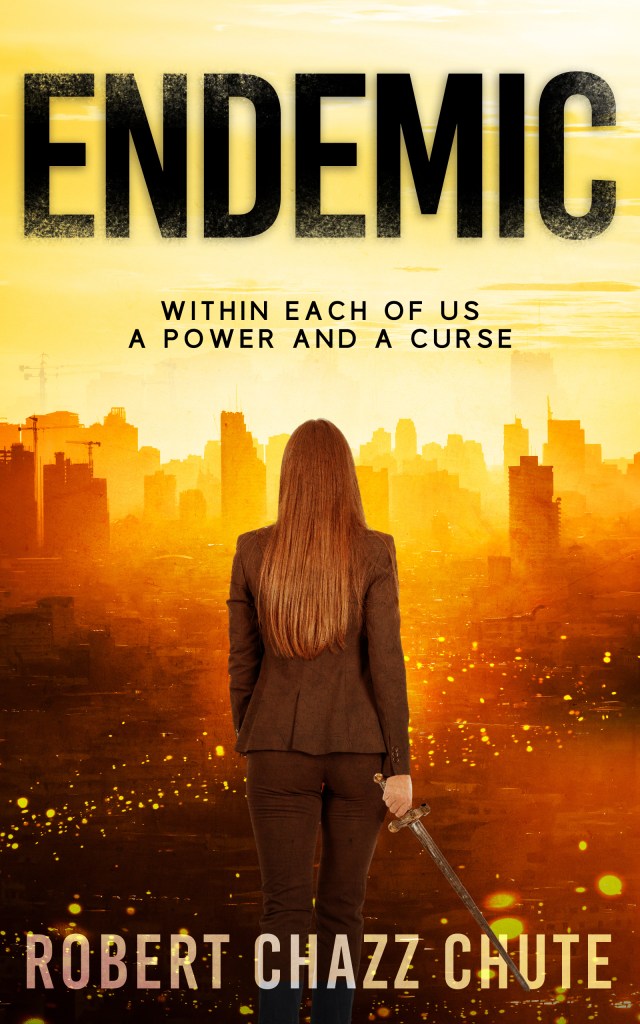
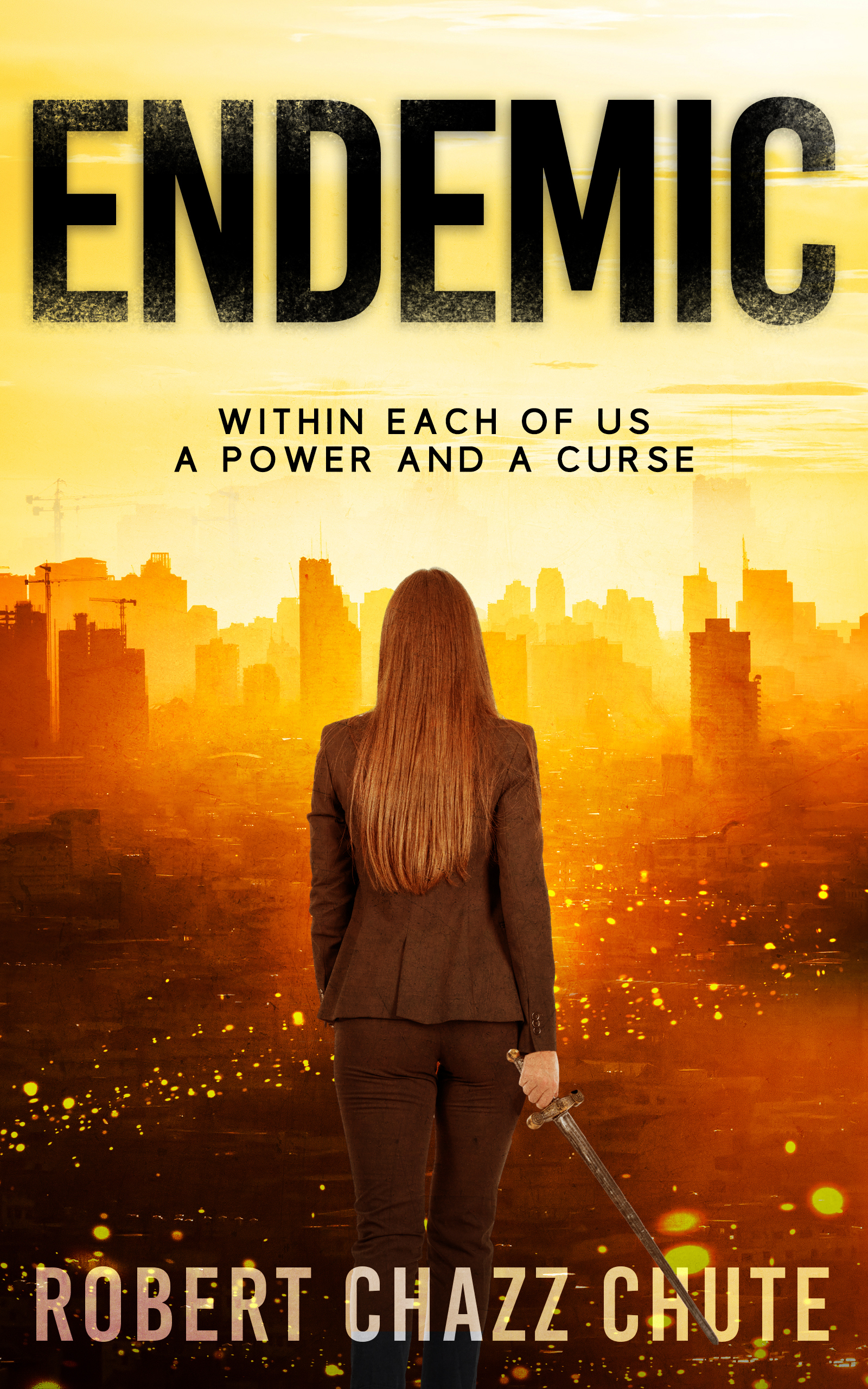
My apocalyptic epic, Endemic, won two awards recently! The novel won the science fiction and horror category at the New York Book Festival and I just found out it won a Literary Titan Award. This is my tenth award for my writing, but it never gets old.

Endemic tells the story of Ovid Fairweather, a misfit haunted by her past who, guided by her dead therapist, makes her way through the end of the world as we know it. Ovid is a nerdy book editor who used to work in traditional publishing and has some sassy takes on her former profession. I suspect that amused the judges. Despite her many quirks, our protagonist is relatable in that she’s been pushed around a lot and she’s fed up with all that. Aren’t we all?

For a more in-depth review, read what Literary Titan had to say about it here.

You can also read my interview with Literary Titan at this link.

Or, best of all, start your binge read of Endemic now

(available in ebook, paperback, or hardcover).

Filed under: awards, Endemic, , , , , , , , , , , , ,

The Best Thing To Do Tonight

You could go out dancing and drinking on a Saturday night, but let’s face it, no good can come of that. Instead, join me. I’m doing a Facebook takeover of a SF & Fantasy group tonight from 5:30 PM – 10 PM EST.

The group is called Destiny’s Lighters.

Find it at https://www.facebook.com/groups/lytonians/.

I’ll be posting eight mini blog posts about how I learned to write and give some book recommendations. Aside from some shameless self-promotion, I’ll give a free book to a lucky random commenter.

If you want to join in to ask questions (or find out what I think is wrong about a lot of apocalyptic fiction), let me know and I’ll shoot you an invite.

You’ll find my FB page at https://www.facebook.com/robert.c.chute/.

In Other News:

Literary Titan gave Endemic an interesting review. Read between the lines and you’ll figure out what they weren’t so crazy about. You’ll find the link on my author site, AllThatChazz.com.


mybook.to/MakeEndemicGoViral

Filed under: authors, , , , , , , , , ,

About Your Worst Book Reviews

This is a little boost of encouragement to writers who obsess over a few bad reviews. First, here’s a link to a fabulously successful epic fantasy called Assassin: A Dark Epic Fantasy Novel. Look at all those wonderful reviews! Most people are extraordinarily happy with their reading experience. It’s rated 4.3 out of 5 and has over 1500 reviews. Wow!

Now, if you need bother, read a few of the one-star reviews. You’d think it was an utter failure.

Clearly, much to the dismay of a tiny minority, many readers pick up what Andy Peloquin is putting down. Congratulations to Mr. Peloquin! Check out all his books here: http://www.andypeloquin.com. Enjoy.

What This Means for You, the Writer

Too often, I see worried scribes kowtow to their worst critics. They join writing groups (not a bad thing) and write by committee, trying to appease everyone (a terrible idea). Some insist they learn things from their worst reviews. Sometimes, maybe that’s true, especially if you’re a noob. More often, though, you’re giving too much weight to a troll whose hobby is crop dusting negativity.

I learned a lot about writing from working as a journalist and reading excellent novels. These days, I learn most from Gari, my editor (strawnediting.com) and from beta readers. Reader feedback is best found higher up the editorial pipeline, while you’re still in the draft phase and long before you publish. For reviews, the most useful feedback you’re likely to get is what most fans enjoyed about your work, not what a few angry people hate. Hatred is lazy and too easy. I know because it’s so easy to find. I mean, GEE-ZUZZ, just watch the news.

I can already hear the objections. No! Those are all legitimate critiques!

Sometimes they are worth noting. However, if you’ve ever received a disproportionately scathing review, check out that person’s other reviews. Too often, leaving nasty reviews is their sport. You know the type. They go over the top, sometimes even attacking an author personally for daring to think they might entertain someone. I have to wonder, do they bring that same vitriol to everything? “I must defend proper literature and this beach read most people enjoy is the death of all literature! Once I fix that, then I’ll solve the Russian-Ukraine conflict!”

Art is subjective. If you take detractors too seriously, you will become paralyzed and resort to the safest and stupidest path: You will write nothing. Worse, you might even join the ranks of the wannabe writers who love nothing. Don’t become one of those people who hate everything with pedantic zeal. A few make it their unholy mission to proclaim, “Not only did I hate it, it’s impossible anyone else could and all these happy reviews must be fake!” (Notice that they write those reviews as if authors don’t see them, as if they’d bring that same energy if they dared to be in the same room with us. Heh. Silly little rabbits.)

I was once accused of having thirty-five friends leave happy reviews on one of my books. First, ha! As if I have thirty-five friends! This person clearly had no idea how hard it is to get anyone to leave a review. Second, for that same book, that was a few hundred happy reviews ago. That particular objection looks really silly now. Again, ha!

A Note About Your Humanity

If you manage to release all your negativity about nasty reviews, let me know how. The only sure cure is to never read your reviews. That’s one option. For me, I’m prone to anxiety and depression and my happy readers keep me going. Writing a book already feels like putting a note in a bottle and tossing it into the ocean. That’s lonely business, so I need to read my reviewers, at least those who enjoy my work. One nasty review can make me sad once, but I return again and again to satisfied readers who bring me up and get me back to the keyboard.

You’ll also smell a lot of shit of the bull about “developing a thick skin.” How often have you read that in an article about writing? Unless you have the apathy of a non-artist and the arrogance of a serial killer, that’s all nonsense posturing. Writers are human, too. If you prick us, do we not bleed ink?

Not only do writers fail to separate themselves from their work, readers do that, too. They’ll assume you hold opinions you attributed to a fictional character. If they think the book is bad, they’ll think you’re bad. Once, a reviewer (oozing hatred from every pore) noted that I am Canadian. To his acidic review, he added, “I certainly hope he stays there.” A reasonable response, right? Anyway, no worries, mate! I never leave my blanket fort far beneath the frozen tundra. Also, not for nothing, go fuck yourself gently with a wire brush. Don’t be mad. I did say gently.

Alternatives for the Sweaty Writer

  1. Have someone else read your reviews and pass on the ones that won’t paralyze you. That’s one of the few things agents used to be good for, but any pal who won’t mess with you will do.
  2. If reviews scare you, go with a pen name. Go with five pen names. It’s amazing how calming it is to have a negative review fall on the head of a fictional persona. It gives you distance. “Sure, you think she should abandon her dreams and take up scuba diving in Antarctica, but at least that’s my nom de plume, not me!”
  3. Know that there is a number. The exact count will vary, but at some point, you will get enough happy reviews on a book that the nasty ones will matter much less. They may only ruin your afternoon instead of your whole day.

    Bad news: the measure resets to zero with each new book. Gird your loins and sally forth. I wouldn’t classify writing as heroic duty, but it’s not for cowards, either.
  4. C’mon! Remember? You love to write! And you write for the fans, not for the bastards. You’re not going to hit a home run every time. Keep playing because you love the game.
  5. Go read the reviews on your favorite books. Check out what’s considered high literature and/or the top ten bestsellers of all time. They all have reviews from people who hated their reading experience. Why should your masterpiece be any different?
  6. Any book that has all positive reviews has a small audience. When you start getting people who don’t dig what you do, it doesn’t mean you’ve suddenly done anything wrong. It means you’re expanding your audience and someone who is not your target audience stumbled upon it. After a free promotion, you’ll get one or two who snapped it up because it was free and now they’re sad. It’s the classic, “I don’t read books about unicorns but decided to give this a try, thus reaffirming why I hate unicorn books.” This is the equivalent of suffering celiac disease but gorging on bread because it’s free.
  7. This is all simpler than your worst imaginings. They’re wrong. I have read a couple of reviews of my work where they attributed missing bits to story failures. But there aren’t missing bits. The reviewer’s reading comprehension was poor, or they were too hurried. You can always catch a careless reading when they get basics of the plot wrong. This falls under the category of, “Tell me you’re a dummy without telling me you’re a dummy.” Do not sweat these reviews. We write for readers, not scanners.
  8. What if they’re right? So what? What if your book did have problems? Let’s not be so precious. You didn’t botch a heart transplant. You wrote a book that maybe wasn’t your best. You only get one best and nobody can agree on which one that will be. Somebody will still love it. Authors learn and grow. We have to allow for skill development. Kurt Vonnegut considered himself a failure until Slaughterhouse-Five hit, then everyone agreed just about everything he wrote was genius. (Watch Unstuck in Time, the documentary of Kurt’s life and career. It’s a salve for all your writerly burns.)
  9. Try to keep your energy on those who love you and love what you do. Love yourself more. Daring to put yourself out there, naked and vulnerable, demands a lot of self-love and not a little hubris. Most of those trolls you worry about? The longest thing they will ever write is a few paragraphs of narrow meanness. Even better? What they hated will be the reason someone else will buy and love your work.Too much puppet porn, Amish accountants, and seventeenth-century profanity? Oh, no!(Clicks buy immediately.)
  10. Let’s get practical. You’ve got groceries to buy! Couples often divorce because there isn’t any money coming in! You don’t even have time for people who will never buy another of your books! Write! Rewrite! Produce, goddammit!

Happy Conclusions

My point is not that you should never listen to your critics or dismiss every opinion. Everyone is entitled to an opinion. However, take it all with a big ole bag of salt. Some will love your work no matter what. Some will hate it no matter what. Most of the world is indifferent. A lot of people don’t even read, so don’t sweat so much. Once you release it to the world, everybody gets a vote on your work, but you always have the deciding vote. You liked it and did your best? Solid.

As for those few reviews that make you question your worth as a human being, please understand what the harshest critics do not:


Not everything is for everybody.

And that’s okay.

Hold on to that.
There’s plenty to enjoy in this world. Go find it. Go make it.

~ I am Robert Chazz Chute. I write apocalyptic epics with heart and killer crime thrillers with muscle. Find all my work on my author site, AllThatChazz.com.

Filed under: publishing, reviews, , , , , , , ,

What We Don’t Know

Have you gathered all your tax receipts yet? I recorded all my expenditures as I made them in 2021, so this should be the easiest tax prep yet. Last year, we had to chase our accountant to do his job, but that’s a long story about frustration. Short story: We’re getting a new accountant.

Today’s brief post isn’t really about taxes. It’s about what we don’t know. I’ve always used an accountant because tax law is far too complicated (by design, depending on where you live). For instance, I don’t know what the latest mileage allowance is. I could look it up, but what about the deductions or pitfalls I might miss? Hiring a professional eases my mind because I don’t know what I don’t know. There’s no shame in ignorance as long as you learn or compensate.

We don’t know what we don’t know.

When you’re outsourcing work for your writing business, keep that adage in mind. My editor is far more versed in the many subtle nuances of comma placement. She’s taught me a few things (which I promptly forgot). Instead of trying to know everything, I rely on her encyclopedic knowledge of The Chicago Manual of Style. She knows her stuff inside and out and having her on my side eases my stress.

(FYI: Looking for a great editor? Email Gari at editor@strawnediting.com.)

It’s a popular (and damaging) myth that self-publishers do it all themselves. For many of us, our editorial pipeline resembles what you might expect of a traditional publisher. With the use of beta reading teams, some authors’ editorial process is superior to trad pubs. This is especially true after all the cuts to editorial budgets among traditional publishers.

Some readers and writers are stuck in the inertia of old biases. Detecting our own ignorance is the beginning of wisdom.

What work do you outsource?

~ I’m Robert Chazz Chute. I write apocalyptic epics with heart and killer crime thrillers with muscle. Find links to all my books at AllThatChazz.com.

Filed under: publishing, , , , , , , , , , ,

Authors versus Our Demons

If you overcome your demons and publish, more demons await. Keep these 70 pithy tips in mind when the unholy fanged ones come for you:

  1. Write for a particular person or write for yourself. Just choose the right audience.
  2. Some go to the drugstore for coconuts. Ignore them. Write for people who read your genre.
  3. When you give away free books, some readers who would never read your genre will snap it up. Lower ratings often ensue.
  4. Write for people who actually like to read. (Yes, there are posers.)
  5. Feedback from chosen supporters is helpful. Not all supporters can help in a measurable way, but boosting your morale counts, too.
  6. A slim minority of reviewers think snark is sport and heckling is intelligence. They’re mistaken, but who’s going to convince them otherwise? They’ll only know if they ever dare to write their own book.
  7. Listen to your editor and yourself, not every voice in your writing group. Do not write by committee.
  8. Occasionally, a craptacular troll will grab at you from beneath a bridge. Burn that bridge. Block and move on.
  9. Getting bad reviews may mean something is off, but it’s also quite possible someone outside your target audience found you. Congratulations! Your advertising campaign is reaching a wider audience!
  10. Some reviewers are unhappy. They will project that state on you. When you check their other reviews and discover they hate just about everything, that’s a clue.
  11. Do not outsource your self-esteem to strangers on the internet.
  12. Fame is fickle, fleeting, and sometimes fantastic. Enjoy it while it lasts, even if you’re only famous in small circles.
  13. Have teachers and follow good examples. Do not have heroes. Failing that…
  14. Do not meet your heroes. (They’re only human, and sometimes worse.)
  15. Be real about your fiction. Is it the best you could do? Are you improving? Is it close enough to your vision to be released? Do you need to give it a rest or do another draft?
  16. If you’re stuck, what’s holding you back? Dig deep. (No, deeper than that.)
  17. Do you have a dated idea of how modern fiction should sound? Develop your style and chase what compels you. Is your self-confidence so low that you’re emulating the writing style of a British nobleman from the 1800s?
  18. Aim for excellence, not perfection. Perfectionism is self-loathing in coveralls. It’s also an active form of procrastination. It may look like you’re doing something, but really, you’re just looking busy. Checking out The Huffington Post again is not writing. Wordle is not writing.
  19. Some readers will make unwarranted assumptions about you based on what you write. Don’t let that deter you from communing with whatever muse moves you.
  20. Some readers look down on certain genres without reading your work or even knowing those genres. Allow them every bit of respect you would give to an amateur pharmacist wielding a rusty syringe.
  21. Some readers have fixed and/or dated ideas about certain grammar rules. “Sentence fragments aren’t sentences!” (We know.) “You can’t start a sentence with but!” (But you can.) That’s all between you and your editor.
  22. Language isn’t static. It’s fluid. Rigidity is a sign of death. If you want to put a new spin on an old phrase, I’m all for it.
  23. Giddy and high on caffeine, you’ll put little Easter eggs in your work, alluding to other stuff you’ve written. You’re the only one who will ever know. That’s okay. You’re enjoying the creative process.
  24. You will occasionally repeat yourself. That’s not the catastrophe some think it is. Don’t repeat yourself within one book, but seriously, how many themes did Kurt Vonnegut really have? One? (That being: Dammit, I wish we were more kind to each other.)
  25. “It’s been done,” is a weak objection. Everything has been done. It’s all about execution.
  26. Novelists get paid for communicating stories from our imaginations with clarity. If you aren’t putting a movie in their heads, your writing isn’t clear enough yet.
  27. Some (well, many) readers won’t follow you on that journey. That’s okay. There are still plenty of willing voyagers in your target market.
  28. Good writers will always have their detractors. Great writers, even more so.
  29. Bad readers aren’t an excuse for writers to get lazy.
  30. Huge fan bases aren’t an excuse for writers to become lazy.
  31. In writing a novel, there is no easy way out. The way out is through, ass in chair, composing like Time itself does not exist.
  32. Some readers will say your work “could have been so much better” or, “I would have done XYZ with that premise.” You liked that plot enough to spend a hefty chunk of your life writing it and publishing it. Meanwhile, the most those people have written is probably a paragraph or two of a hypercritical review. Why give their judgment more weight than yours? Have they earned that from you?
  33. If someone tells you to write “high literature” instead of to genre, you could say a lot of mean things. “I’d prefer to write something that pays” is kind of clever and more subtle. Or how about, “See my nose? See how it’s not in your business? Isn’t that cool?”
  34. You don’t have to be polite to someone who is rude to you.
  35. Some stranger may try to insinuate himself or herself into your process. Develop an inner circle of trusted readers who can fill that role.
  36. A typo will slip through. Do not panic. I repeat, DO NOT PANIC!
  37. We don’t make it on our own. We develop and depend upon trusted advisors, beta readers, editors, graphic designers, and fans. We are grateful.
  38. #37 doesn’t mean you owe everyone your time and attention equally. The fantasy that the customer’s always right has been taken way too far.
  39. Naturally, some criticism will be valid and well-intentioned. (That’s especially appreciated when it comes at you privately. Thank them for their thoughts.)
  40. You and the demons know when feedback is weaponized, so let’s not pretend.
  41. As a novelist, you write about conflict all the time, so you already know some people are just dumb and mean. “Developing a thick skin” is bullshit. Don’t buy into the idea that you shouldn’t have legitimate human reactions to aggressive nonsense.
  42. Knowing all this, it takes hubris and chutzpah to put yourself out there and publish. Be proud you dare to defy demons, those many within and those few without.
  43. There are many variables to success and you cannot control all variables. Spin the dials on what you can control.
  44. Many people will tell you they’ll buy your book. Most of them are just trying to be nice as they motor on about their day.
  45. You won’t get all the reviews you expected. Ask for more. Expect fewer.
  46. If you gift someone a book, don’t mention it afterward. If they like it, they’ll tell you. Otherwise, you’re giving out homework and quizzing them. Nobody likes tests and you definitely won’t like their answers.
  47. You will be shocked and envious at the success of authors whose work you consider inferior. Keep that shit to yourself, or at least between you and your therapist.
  48. If self-published, those unfamiliar with the battlefield will be aghast that you “aren’t properly published.”
  49. Stay in the game long enough and a traditional publisher may hit you up. SP is okay. Going hybrid or trad can be okay, too. Your dad won’t understand if you don’t jump at the chance to go with New York, but that’s fine. He sold furniture for a living, not books.
  50. Someone in your family will ask, “You write a lot. Shouldn’t you be rich and famous by now?” (Possible answer: “I don’t know, Gary. You buy all those tickets. Weren’t you supposed to win the lottery by now?” Fuckin’ Gary.)
  51. Checking your sales stats several times a day will not increase your sales.
  52. The 80/20 Rule rules.
  53. You may have to abandon a series. If it’s not worth the effort, accept that fact and be brave enough to let go. Some readers may experience a few moments of disappointment. Is that really worth your opportunity cost and the time and money it takes to put out a book you’re sure won’t pay off?
  54. Never share how much money you did or did not make off a book. For somebody, your answer will spur them to shout “Too much!” or “Not enough!” You’ll feel bad for the rest of the day, or possibly for the remainder of the decade.
  55. Someone may embarrass you by asking, “I picked up your book while it was free. Was that worth it to you?” (Possible answer: “Depends. Did you enjoy it and leave a happy review? Or are you trying to make me feel bad?”)
  56. Sometimes you’ll get probing questions that aren’t anybody’s beeswax. The inquisitors aren’t trying to be mean. They are virgins fantasizing about writing their own book one day and they want the inside scoop.
  57. Virgins think there’s a lot of inside scoop. Not really!
  58. When a well-meaning person says they downloaded your book when it was a free promotion, others within earshot will titter because they don’t understand the reasons for free promotions. Yes, you will want to murder them all for mocking what they perceive as your failure. You probably won’t kill them, though. Coward.
  59. Treasure the people who treasure you.
  60. Don’t exhaust yourself trying to be all things to all people. Demons don’t go after people pleasers so much, but energy vampires feast upon them.
  61. Respect the opinions of those who don’t treasure you. They might have a point. You don’t have to hang out with them, though. Save that trial for Hell.
  62. Writing and publishing is work. Sometimes it will be hard, but you can do difficult things.
  63. You wrote yourself into a corner and don’t know how to make a smooth escape for your protagonist. You don’t have to chuck it all or retreat 50 pages. Take a walk, give it a rest, and the answer will come. You wrote yourself into that predicament. Write your way out.
  64. Guard your energy. Protect your peace. Put a moat and barbed wire around your writing time.
  65. Set out each day to write a book that will entertain brains, melt faces, and make the reader remember your story. Create joy and do so joyously. If you’re having fun, your target reader will have fun.
  66. Though writing sessions can begin as a grudging grind, something’s amiss if it remains a slog. Maybe alpaca wrangling really is for you. Or maybe you need a break, a fresh approach, or a new story. Give it a good think before you google alpaca ranches in Montana.
  67. Not everyone shares or even understands our obsessions. This is difficult when your loved ones don’t support your dreams. If you can’t afford the surgery to get your husband a personality transplant, find a writing buddy who gets it. Your spouse may become more interested when you pay for takeout with your book earnings. Or you could drown the filthy bastard. Up to you.
  68. Believe in the value of your work. However, don’t chain your value as a human being to a manuscript. In the end, it’s just a book. It’s not your life. Your legacy comes from how others feel when you engage them.
  69. Look forward, knowing in your heart that the next book will be even better. Be the badass who tells jokes, fills minds, and touches souls.
  70. You’re daring to accomplish what many only dream of doing and I love you for it. Keep writing.

Here’s the latest:

Endemic: mybook.to/MakeEndemicGoViral
Our Alien Hours: mybook.to/OurAlienHours

Filed under: publishing, writing advice, , , , , , , , ,

Bestseller with over 1,000 reviews!
Winner of the North Street Book Prize, Reader's Favorite, the
Literary Titan Award, the Hollywood Book Festival, and the
New York Book Festival.

http://mybook.to/OurZombieHours
A NEW ZOMBIE ANTHOLOGY

Winner of Writer's Digest's 2014 Honorable Mention in Self-published Ebook Awards in Genre

The first 81 lessons to get your Buffy on

More lessons to help you survive Armageddon

"You will laugh your ass off!" ~ Maxwell Cynn, author of Cybergrrl

Available now!

Fast-paced terror, new threats, more twists.

An autistic boy versus our world in free fall

Suspense to melt your face and play with your brain.

Action like a Guy Ritchie film. Funny like Woody Allen when he was funny.

Jesus: Sexier and even more addicted to love.

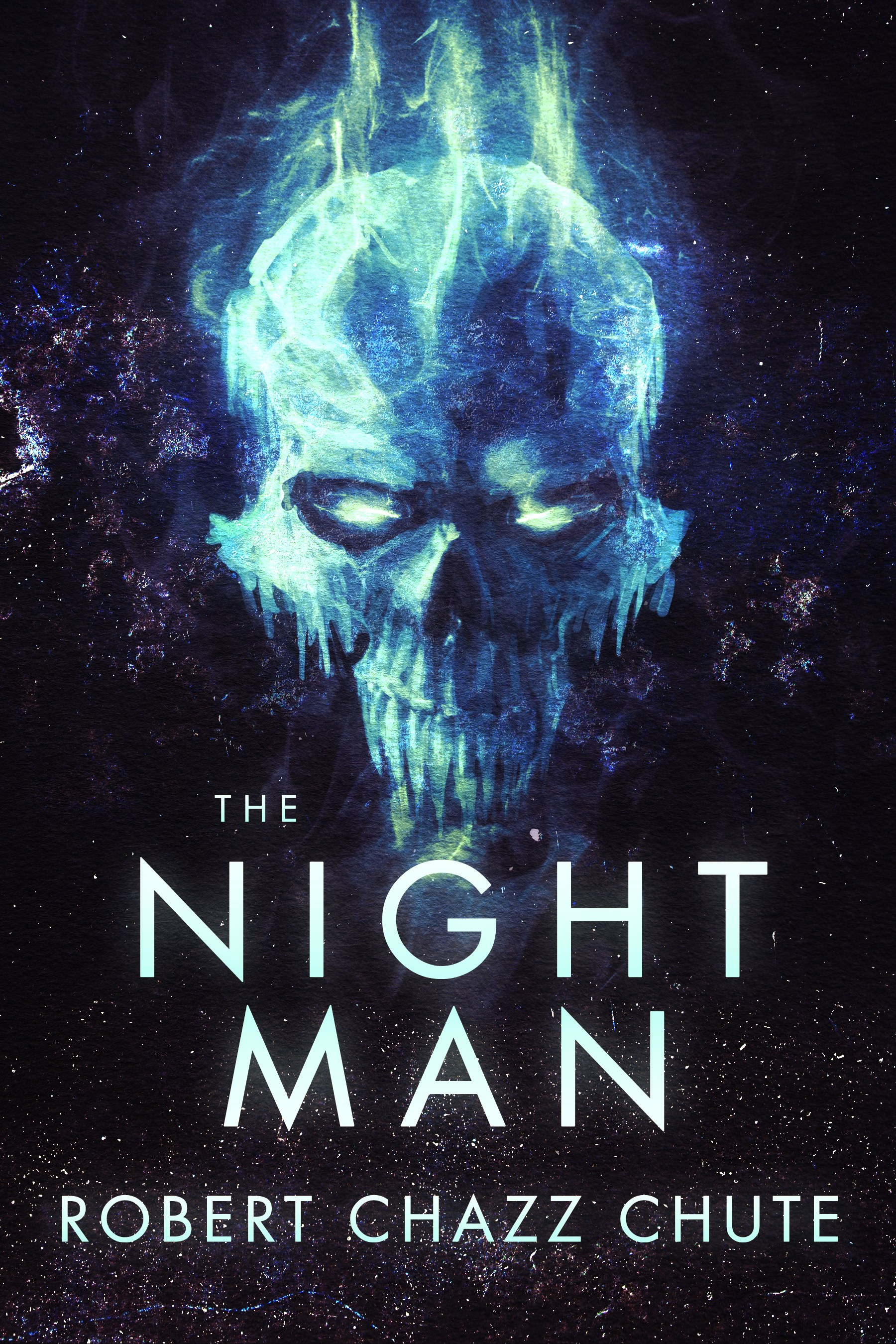
You can pick this ebook up for free today at this link: http://bit.ly/TheNightMan

Join my inner circle at AllThatChazz.com

See my books, blogs, links and podcasts.

Enter your email address to follow this blog and receive notifications of new posts by email.

Join 2,061 other subscribers