C h a z z W r i t e s . c o m

See all my books at AllThatChazz.com.

AB Challenge 22: John Leguizamo, I know you’re reading this. Call me.

Leguizamo outside the Broadway production of A...

Leguizamo outside the Broadway production of American Buffalo, November 21, 2008 (Photo credit: Wikipedia)

Today’s writing prompt: If a Hollywood agent were to come knocking on your door with an offer to turn your book into a movie and told you that you could call all the shots, who would you have direct and star in it? Write the first paragraph of Roger Ebert’s review of your film.

For my crime novel, Bigger Than Jesus, Martin Scorcese or Quentin Tarantino would be my first thought for directors.

For the Jesus Diaz, the Cuban hit man who wants out of the mob, could be played by the great John Leguizamo.

Eva Mendes comes to mind first to play the lovely Lily Vasquez, the most gorgeous woman in New York and the object of Jesus’s worship.
For Big Denny De Molina, Jesus’s best friend and biggest obstacle? Dwayne (The Rock) Johnson would be perfect, especially if he’s willing to keep the biceps but add a bit of a fat suit.

Jimmy Lima, the dangerous underboss? Jimmy Smits, of course! After his tour on Dexter, I can think of no one better for that role. Andy Garcia would be great, too.

Uma Thurman would be great as Barbara, Jimmy Lima’s wife. (Shades of an overlap with Pulp Fiction there.)

Harv and Marv, the twins with tattoos on their necks? Michael Fassbender or Ryan Gosling. (This one’s for you, ladies! Times two.)

Panama Bob is the other underboss who has skimmed a fortune in mob money (that Jesus needs to escape). I’m thinking a bold casting choice: Zach Galifianakis going against type.

For Vincent, the godfather of the piece, I’d take Jonathan Goldsmith, the actor who plays The Most Interesting Man in the World in the Dos Equis commercials.

My cousin David Strauss as the FBI agent. My other cousin is the actor and jazz singer Amy Hack. She’d be great singing a torch song in a bar.

As for the hypothetical Ebert review: I don’t have enough thumbs to point up! Run, don’t walk, to the nearest theatre to enjoy the best mob movie in ages. Jesus Diaz, played by John Leguizamo in his best role yet, is a clever hit man who wants to escape New York with stolen mafia money and his girlfriend, Lily Vasquez. In a darkly humorous trip full of witty dialogue and fast-paced action that will leave you breathless, it’s the unexpected twists and reversals you can’t see coming that elevate this to a movie you’ll want to see again and again. It’s so good, you’ll even want to buy the book by Robert Chazz Chute, too!

GET BIGGER THAN JESUS

Filed under: publishing, , , , , , , , , , , ,

Author Blog Challenge 21: My Top 20 Best (Worst?) Advice for Authors

Обкладинка книги "Над прірвою у житі"

Обкладинка книги “Над прірвою у житі” (Photo credit: Wikipedia)

1. Be weird. Draw outside the lines. Live larger. Be different. If you can’t dare to be a little strange, or stranger, you sound too much like everyone else and there’s quite enough of that. Does your book’s title sound like all the other titles in its genre? Yes? You’re already boring me, mate, and I say that with love. Be three times more daring and ten times more clever.

2. Don’t write what you know. If we all did that, where would science fantasy be? Instead, write what you care about. You’ll get enough research to fill in the holes if you care enough to give your story verisimilitude. It’s always more about relationships, characters and action than it is about the guts of your ship’s stardrive engines, anyway.

3. Lose your thesaurus. You don’t need more words to tell me the story. The right words are the ones that come to you right away. If you use the word “epigonation”, you’re showing off and annoying your reader. A stupid thing to do, especially when you wanted to sound more intelligent. That must have been your aim because, unless you are sending your books back through a time tunnel to the time of Christ, you certainly weren’t trying for clarity in your reader’s mind.

4. Spam me. I don’t mind you telling me about your books one bit. I might be interested and I like to know what my options are. If you hit me over the head too much, of course I’ll ignore or unfollow you, but that doesn’t mean you should be silent. That means be clever and funny and engaging and giving most of the time. Lights are not for hiding under bushels. Light that bushel on fire and throw illumination.

5. Get into fights on the Internet. If you are getting along with everyone all the time, you’ve either got nothing to say or you’ve got no spine. Neither attribute attracts me to what else you might have to say within your book. I’m not advocating douchebaggery or fighting for fighting’s sake. Instead, have the courage to disagree with idiots while pretending to be civil and acting as if you don’t want them dead. We all know the truth.

6. Tell, don’t show. I know, I know. Somebody’s head just exploded and no amount of repainting ever covers up that mess. However, in grown up writing class, we encounter circumstances where telling is sometimes more appropriate. It saves the reader time and skips over stuff the reader doesn’t care about so we can get to the good stuff. Be more Elmore Leonard. Be less mime. Tell when you need to. Show when you need to. There aren’t rules, only guidelines. Learning all the rules before you break them? Sounds like a waste of time on a detour, doesn’t it? Instead, just write what works and stop mucking about.

7. Strangle your strict inner grammarian. If you write for clarity, that will cover most grammar rules, anyway. Some people are still holding on to stuff from eighth grade simply because it’s what they learned in eighth grade. The rest of us are splitting infinitives with wild, naked abandon, ending sentences with prepositions and using the word “hopefully” like a normal human (i.e. technically historically wrong) — and we don’t care. And sentence fragments? Rock! Common parlance trumps grammar. If it didn’t, none of us would communicate the way we do now. Strict grammarians fantasize about a language that isn’t organic and instead is frozen in amber from Dickensian England. They’re nuts. If language could freeze (and therefore die), we’d all still be angry cave people, grunting and pointing like New Yorkers in a Brooklyn deli.

8. Stop rewriting. I’m talking about your first chapter. You’re never going to get your book finished that way. Plunge! Get your atomic turbines to speed, Batman! Write and keep moving forward. Write like I’ll chase you in my Mustang with a twelve-gauge full of rock salt if you don’t finish two chapters tonight. (Because I will.) Rewriting is for later. A first chapter, endlessly written  and rewritten to perfection, does not a book make. Rewriting too soon is a formula for you, drooling on your deathbed, wondering if you should have taken out that comma on page three, and then put it back one more time before all trace of your existence is erased and there’s no book as evidence you ever were, you zero legacy stiff!

9. Stop reading old classics and start watching more movies and reading more comic books. Your english professor thinks Hemingway is the shit because that’s what he was taught in 1980. This is generational data lag. If you insist on classics, read: Crime and Punishment (so dates will think you’re deeper than you are); Hemingway’s short stories (not his novels); Portnoy’s Complaint to instil the value of a sense of humour in literature (a rare thing, that); A Confederacy of Dunces (for douchebag cred with hot Lit. majors at the dean’s cocktail parties and the nerdy chick at the bookstore) and Catcher in the Rye (in case the writing thing doesn’t work out and you turn to the next logical career choice: serial killer.) And nothing at all from Ayn Rand. Nothing! You have nothing to learn from her unless you’re going for what not to write, do, think or be.

Why movies and comic books? Because you need to make your storytelling more visual. (Hint: If most of your “action” takes place in a suburban living room much like your own, think harder. If you’re writing a certain kind of literary fiction that demands domestic ennui and the reader’s patience (yes, the reader — as in one reader — your mom), at least spice it up somehow. Make your main character do their sensitive contemplation by the river (so they can fall in or throw themselves in or get thrown in by a helpful plot enhancer). Or put them in the kitchen, next to the handy knife block so we get a sense that something might actually happen. Events must occur!

10. Stop writing huge, ambitious books. Write shorter books and make it a series so you have hope of making some money.

11. Write for the money. You think love and passion will get you through a whole book? No. There will come a time when you hit a wall, figuratively and literally, with your manuscript. Maybe you won’t want to do one more draft or you won’t have the energy to get up early and write another chapter. Screw that weak, loser talk. If you’re writing with the hope you’ll make some money some day, you get up. You’ll go the extra clichéd mile to yank out the clichés from your manuscript like black, seething tumours. Your kid wants to see Disney before she’s too tall for the rides. Your other kid wants to finally get an iPod for his birthday since he’s the last of his friends to get one. (Ooh, that one hits close to home.) Write for money because you need it. Write for money because, if it’s just a pleasant hobby, what’s at stake when the going gets rough?

12. Pay attention to how much better every other indie author is doing than you. Get angry, envious and jealous of those talentless, lucky hacks. The reasons are similar to #11. Take your ugly motivation wherever you can find it. (Notice I just told instead of showed — #6 — and you didn’t mind.)

13. Put references to popular culture in your books. Traditional publishers always eschewed that in manuscripts.  That’s why you have to infer so much about pop culture from old novels instead of knowing specifically what people paid attention to. The worry was that contemporary references to movies and issues would date the book. I can’t imagine why. What’s modern now will be a period piece in the future. So what? They might sell more books if they paid attention to what served the story and what was most entertaining instead of sticking to rules from from Lit. 101. (See #9) It works for John Locke’s readership.

14. Stop confusing process with product (Part 1). Neo-Luddites who wax poetic about the feel of a paper book are fetishizing the medium of dead trees over the book’s content and are possibly high on glue from all that sniffing. For people who claim they value the written word so much,  they seem overly concerned about the package it’s wrapped in. It’s fine to prefer a paperback to an ebook, but expect to pay more for the privilege and, by Thor’s hammer, stop whining to authors of ebooks about your fetish! When’s the last time you went out of your way to tell a used car salesman you think he’s shifty even though you weren’t buying a car from him anyway? What purpose does complaining serve if you never intend to buy our books? If you don’t want ebooks, then don’t buy them and don’t feel you have to tell me about it. We’re getting creeped out. (Alternative: buy my paperbacks, too.)

15. Stop confusing process with product (Part 2). Last week somebody called someone else a hack because he advocated writing fast. (No, it wasn’t me who was called out, though I have advocated writing faster if you’re up for it.) It’s the writing snob’s equivalent to a George Carlin joke: “Anybody driving slower than you is an idiot and anyone driving faster is a maniac!”

The mistaken subtext here is to think that anyone writing more quantity than you must be suffering in the Quality Assurance Department of the Writer’s Brain. Consider that A. Slow writing is no guarantee of quality, either. B. What counts is the end product, not the speed with which it arrived. (The slow writing advocate in this case admitted she hadn’t actually read any of The Speedy Author’s books, so she was letting her ass talk too much, wasn’t she? C. If someone else can write faster than you and you resent them for it, that might be jealousy talking. (See #12) Or D. Maybe you just aren’t as smart as The Speedy Author, you prejudiced dummy.

16. Wait for inspiration before you write because less competition would be great for me. Oh. For you? Not so much.

17. Offend your family. Disguise them, but use them. If they didn’t want you to use all of that useful childhood trauma, they should have been nicer when they had the chance. That time you got locked in the closet after the unjust beating? That’s rich writerly soil, right there. Rename your brother Larry so he’s Harry in the book. That ought to do it. Larry’s a moron.

18. Start building your author platform long before you need it and don’t whine that it’s hard. Your book is a loudspeaker. Without a platform, your loudspeaker is pointed at empty stands in a cavernous stadium. You don’t want to do this. Why do you think that matters?

19. In fact, hey, that’s another rule! No whining, period! Nothing worth doing is going to be easy. Besides, it’s unattractive. I once stopped watching a blog because a writer felt people weren’t grateful enough for her words. Gratitude is great (see yesterday’s author blog challenge post, below) but demanding unending thanks when you really haven’t done that much in the first place is petty narcissism. Writing professionally is about generous narcissism.

20. Stop reading Writers Digest and Publishers Weekly. There’s nothing in a paper magazine you can’t get in pixels faster and cheaper. WD is a holdover from traditional publishing and that’s why their advice is still weighted toward agents and the New York cadre. Those are lengthy pursuits with questionable ends that eat up your life. It’s procrastination in the guise of relevance and productivity. It’s patriarchal, systemic paralysis by matriarchal, editorial analysis. Chasing slush pile dreams is what my friend, author Al Boudreau, refers to as “dinosaur hunting”. (Brilliant, yes?)

As for all that crap in Publishers Weekly that spouts everything you need to know about traditional publishing? That’s all stuff you never need to know before you have a book written and probably not even then. What possible difference could knowing the industry make when they only ever talk to themselves? They talk too much about trad publishing because that’s where the ads come from. It’s incestuous, out of date and out of touch. If you want to know something about publishing that’s not out of date, read Konrath and Dean Wesley Smith and Passive Guy and Russell Blake and Jeff Bennington or even (for the love of Thor) this blog’s curations for that matter.

BONUS TIP: Instead of listening to the dinosaurs who refuse to see the meteor coming, be a contrarian. Contrarians are more interesting.

Wait.

What do you mean, you agree? What kind of contrarian are you, listening to some twit you don’t even know telling you, “My Top Twenty Best (Worst?) Advice for Authors”? As if I’m preaching the bloody sermon on the Mount! What kind of nonsense is that? Go ahead and write and make your own mistakes and write your own rules.

This blog post was for, as they say, “entertainment purposes only.”

Does anybody really learn anything much from another person’s mistakes?

For anything that really matters, you have to make those life altering mistakes for yourself.

I’m not your dad. I’m another writer, tap dancing for change.

Filed under: publishing, , , , , , , , , , , , , , , , ,

Have you, by chance, checked out my podcast?

Image representing Stitcher as depicted in Cru...

Image via CrunchBase

The new pod is up at AllThatChazz.com. Witness the struggle of the sad author/wedding crasher, hear the story of the cannibal in the bad chinese restaurant, mull odd and ends about honesty and spam. I get serious about feeding starving people, starving Sally Struthers and putting the military-industrial complex on a diet. I also wrestle the Pope (not naked).

Enjoy if you can and if you like it, please review it on iTunes or hit the thumbs-up button on Stitcher. Thanks for listening!

~ Chazz

Filed under: publishing, , , , , , , , , ,

Author Blog Challenge 20: What writers owe (and an insider secret is revealed)

Garley the Persian cat

Garley the Persian cat (Photo credit: arash_rk)

I used to dream that when I finally became an author, I’d write a short acknowledgements section to myself. “Screw you all!” I’d scream. “In your face! I did this myself and I don’t owe anyone anything! Ha!” Then I’d retreat to my hermetically sealed office under a volcano within my island fortress guarded my my loyal ninja monkey assassin clones. I’d have a monocle and a white Persian cat to stroke while I ordered Hellfire missile strikes to rain down upon my enemies. As you can only imagine, that’s almost exactly what my life is like except for the thing about acknowledging people who have helped me on my publishing journey. Unexpectedly, I have the attitude of gratitude. I’m happy to have a deep stock of Hellfire missiles to protect my tropic realm and I’m grateful for all those people who have assisted me in putting out my books.

Yesterday, after my big free promo day, I sat down and wrote a little letter to a bunch of people who have been helpful along the way. Somebody slipped me some dough so I could keep going. Someone else helped me with formatting the first time I attacked the beast. Others were consultants about suitable explosives…”Um, for my crime novel’s plot!” he added hastily.

A lot of people have the wrong idea about self-publishing.

They focus on the self part.

Hitchcock said that a painter only needs a brush and a writer, a pen, but a film director needs an army. These days, indie writers need small armies, too, and many of them are volunteers. 

The key thing is: self-publishing is still publishing. You either need a graphic artist or you need to be one. You need to learn a lot about tech and promotion as well as craft. You can write a good book, but if it has a lousy cover, no one will read it. (The converse is also true, of course.) That’s why I prefer the term “indie” to “self-published”, though to the consternation of a few angry people, I do use those terms interchangeably as a concession to common parlance.

My Beta readers are volunteers. I’ll pay them in lollipops, acknowledgements in the book, a copy of the paperback and, when they’re ready to go indie, I’ll be a resource for them, too. I’m confident each of those readers could write a book if they decided to do so. I’ve thanked them all, for what that’s worth. So far all they’ve received is a book they enjoyed for free but I’ll be sure to get those lollipops to them.

I did find an unusual way to make one person’s day though. If you’re writing a book, you may wish to consider doing this (with their permission.) A great buddy of mine is undergoing treatment for cancer. It’s been a scary time that he has handled with a calm and class that I am sure I could never muster. This guy is one brave SOB. As I was writing the first draft of Bigger Than Jesus, I used his name for one of my characters.

Funny story: I called him up on Skype to ask him if I could keep his name in the book. His microphone wasn’t working. He could hear and see me but I could only see him. However, that worked out for the best because he pantomimed his approval. When somebody is that sick and you can make them laugh and smile as much as he did by putting him in your book? Why wouldn’t you? He loved the idea and showed lots of energy in giving me a thumbs up that made me laugh (and, truth to be told, a little weepy, too.)

I talked to him on the phone the other day. Things are looking up and we’re optimistic that one way or the other, he’s beaten it. Not only will he live a long life, but in a way that is tiny and totally useless except for good feelings and a funny exchange on Skype, he’s  immortalized in literature, too. I’m very grateful my buddy will be around to enjoy all the novels in The Hit Man Series and everything else I write. I’m most happy about that.

If you’re reading the Bigger Than Jesus,

my buddy is the guy wielding the SPAS-12.

Sh. Keep it to yourself.

Filed under: publishing, , , , , , , , , , , , , , ,

Author Blog Challenge 19: Choose how to grow your author platform

The Author Blog Challenge writing prompt was: What are the three most important things you are doing to grow your platform? This is such a good question and everyone has so many different answers. I don’t have an answer. I have a survey of what I do. How to grow your author platform? Eh…I have a menu of stuff from which to choose. Choose to do what you’ll enjoy so you can be effective and sustain it.

Just today I read a fellow indie author opine that one day a week of concentrated social media, pumping and pimping, hadn’t helped him a bit. Mind you, his sample was a bit too small. He was only talking about a month, which translated to four workdays. However, he’s not alone in the complaint. You can do a lot of work and still not move the needle in a measurable way, and measurable is really what counts. I suspect what was missing was connection. You have to be interested in people and what they’re doing. Interacting is better than spouting (he spouted.) Failing earnest interaction, when you just can’t bear to rip your heart out of your chest again for another blog post or comment thread, do what I do and make more jokes about strangling mimes.

I’m really very consistent in establishing my web presence. I do something every day and here’s what I’m active in: three Twitter accounts (though the main one is @rchazzchute); Facebook pages; a podcast broadcast two times a week; the author site (AllThatChazz.com) and, of course, this site. I even do a little bit of Google Plus. I always think of G+ last, but I know I picked up a new reader (who promised to review my book!) through G+ today. I know that’s a lot. This is part of my full-time job, no whining. The rest of the time, I’m writing, and no, there’s not time for much of anything else. Most people can’t devote the amount of time I do to marketing and promotion, and yes, I realize I’m very lucky to have such a supportive spouse in She Who Must Be Obeyed.

When you do a lot of social media, you do risk annoying people. I certainly risked that today. My Amazon free promo day was plastered across my podcast, my Twitter and retweeted across at least 50 other Twitter accounts. I emailed some people and reached out a bit through Facebook. Somebody must have thought, “Yeah, yeah, we get it. You’re excited about your book but I got a sammich here!” Even as I was promoting, I noticed a fellow author got cussed out severely on Facebook for his pleas. In my defence, everyone who tweeted me got my support, too. I share. They share. Some would say that adds up to a lot of noise and signal degradation. On the other hand, my novel rose from a dark place in my skull a couple of days ago to #545 on the general Amazon list last I checked (UPDATE: and #73 in Mysteries & Thrilers! Yay!) Self-help for Stoners shot up 140,000 places as a collateral benefit so something’s selling in addition to all those free books.

I curate a lot of helpful information for indie authors. On the one hand, this blog brings me a lot of traffic, but they (well…you) aren’t necessarily interested in reading suspense, funny and weird self-help in the form of fiction, strange humour and crime novels. Some people say writing about writing is a complete waste of time. I say write what you’re passionate about and you’ll never run out of blog posts. I don’t want to blog about animal husbandry. It’s icky hanging out with naked animals.

When I joined Klout, I had assumed most of my influence came through this blog or Twitter. Klout says it’s Facebook where I make the most impact (though my Ex Parte Press page only has 37 likes and my personal page only 177 friends. That’s lousy, though it’s almost 177 more friends that I ever had elsewhere.) I doubt Klout, but it’s hard to say. Besides, maybe that’s too reductionist. In layered marketing, you do a lot of things in order to appear to be just about everywhere at once, like The Flash or herpes.

So what are the three things I do that are most effective? I’m sorry. No easy answers. I couldn’t narrow it down that much. I think my podcast, though small, helps me reach out to new people around the world and when the podcast went up at 6 pm this evening, listeners snapped up the free promo. Triberr is effective. World Literary Cafe Tweet Teams help. I’m exploring new ways to advertise on a tiny (to zero budget) like Masquerade Crew, Kindle Nation Daily, and Kindle Book Review. I have to reach out to book reviewers to get noticed. I have to find crime novelists or suspense writers willing to give up a blurb for Bigger Than Jesus.

There’s only one thing I am sure will help me sell more books: I have to get the next book up. And the next, and the next and so on until I am discovered, die or you decide you want you r kids back with all their thumbs attached.

What to do?

Do what you can. Do what you love. Get the writing done first. Nothing should cut into your writing time.

How do I do it? I don’t sleep much. It’s like cramming for finals every day and night.

It would be hell, except I’m having fun.

Filed under: publishing, , , , , , , , , , , , , , , , , , ,

Author Blog Challenge 18: The Top Ten Reasons You (yes! You!) Crave This Book

Please click here to get Bigger Than Jesus

To whom will Bigger Than Jesus appeal? I have serious and much less than serious answers to this Author Blog Challenge writing prompt:

1. People who like a fast beach read of a crime thriller that’s hard to put down. I got the idea for my pacing from Blake Crouch’s Run. There’s a cliffhanger or an aha moment, or several, in every chapter. The tension only cranks up.

2. People who like old caper movies, like To Catch a Thief, Sneakers or The Italian Job. My fondest childhood memories are getting lost in movies to shut out everything else.

3. People who like Coen brothers‘ movies where simple solutions lead to more and more complex problems and the hero is thwarted again and again. Rock? Meet hard place. And now a badger is chewing your jugular as you try to do your taxes.

4. People who like funny, punchy dialogue, including a debate between two hoods: Who shot first, Han Solo or Greedo? (Yes, that’s one of the serious answers and the question does bear on the action at the time.)

5. People who like a lot of twists and surprises. I modelled my plot after screenwriter and author William Goldman‘s penchant for sucker punches where, just when you think you know what happens next, it goes a different way.

6. People who value clever more than gory. For a book about a hit man trying to escape the mob, there’s a lot of word play and when the violence does occur, it’s realistic yet somehow funny in the same way Pulp Fiction could be. The chapters skip along with logical complexity offset by humour.

7. People who like genre fiction that reaches up. Much of the novel has a lighthearted slant, but underneath, when you discover some of the main character’s history, it’s unexpectedly disturbing and heartbreaking. Are you worried I’ve just spoiled  something? Don’t be. I like magic tricks in all of my fiction. I’m telling you up front that I’m going to deceive you and you’re going to watch to catch me at my sleight of hand. The game is, I’m still going to fool you anyway. “Consider the gauntlet thrown,” he said smiling. I know this will work because I often surprised myself while writing Bigger Than Jesus.

8. Movie buffs with an Elmore Leonard sensibility in their reading tastes. Jesus Diaz, the anti-hero of the novel, is a movie buff and, since movies were a large part of his education, he sees the world through a Hollywood lens. The action is definitely influenced by Elmore Leonard’s take on shady characters having strange dialogue.

9. Readers who like a book that plays with them. The entire book is written in present tense, second-person. I loved Bright Lights, Big City for that and I decided that, after twenty-seven years, somebody should try that again. But it’s not just my personal preference or a gimmick at work. There’s a reason. Late in the novel, you get a strong hint as to why the narrative is told as it is.

10. Readers who enjoy a story that ends up in some unexpected places, like a discussion of Salvador Dali’s life, for instance. Bigger Than Jesus is a fun game and a puzzle box of a crime thriller that packs serious emotions behind it.

Some of the less serious answers to this Author Blog Challenge writing prompt include: Everyone with a Kindle or anyone who gets the free Kindle Reading app for any device, NMD (Not my dad), people who enjoy breathing, gorgeous and empowered Latinas, New York pizza joint owners who bought it thinking it was about Jesus Christ but will get sucked in anyway, criminals plotting to go straight, intelligent people (so if you don’t get it…eh, you figure it out), Beatles fans who also love the SIG Sauer, and the authorities who put me on a watch list for my Google searches because of the research for this book.

The second part of the writing prompt asked: How do I connect with them to market to them?

Um. I’m not sure. Have I convinced you yet?

Click the book cover if yes.

GET BIGGER THAN JESUS

If not, send me your email address at expartepress@gmail.com.

Maybe I’ll come to your house.

Maybe I’ll send you something in the mail.

Maybe you’ll wake up hanging upside down.

We’ll work it out.

Filed under: publishing, , , , , , , , , , , , , , , , , , ,

Author Blog Challenge 17: How to talk with your graphic designer about your book cover

Well, not your graphic designer. I can only say how I talk to my graphic designer, but I think new authors might benefit from pulling back the curtain on the process. Everybody’s a little nervous the first time they outsource a book cover, but this guy makes it easy and I recommend him. As you’ll see below, I’m going to come across as a bit of a pain in the ass in this post.

Indie author and graphic designer extraordinaire Kit Foster of Kit Foster Design creates my covers. I can’t create a good cover to save my life, but I can recognize a good one. There are certain things that are pretty easy up front: cookbooks need phat, fat, sexy food (and a thin celebrity chef on the cover); green books don’t sell unless they’re about golf or lawn care; ugly isn’t different in a good way, it’s merely ugly and won’t sell. I worked as a sales rep for several publishing companies and got so I can recognize a bad dog. That said, I have no idea how Kit does his magic to create covers (magic herbs and tattooed Scottish elves are involved), but my covers look like they could have been produced in a traditional publishing house because Kit is the go-to guy.

I rarely come to Kit with an idea for the cover image. Instead I tell him about the book or send him some chapters or the whole thing (depending what stage I’m at with the book.) I trust Kit immensely because, when I’m in revisions, I really don’t want anyone to see it before I’m done and a red bow is tied around the manuscript.

What follows are excerpts from our emails (used with Kit’s permission, of course) to give you the gist of how the Bigger Than Jesus cover came to be, what I was looking for and how we arrived where we did. There were actually at least a dozen or so emails back and forth over a month because Kit supplied new art for my podcast and whipped up a cover for the non-fiction book I have in the works. Kit will use the new covers to update the banner for my author site, too. He’s a multi-talented fellow. That and we keep each other up to date on how we’re doing. Find allies, folks. Friends and coffee are critical.

My initial email about the Bigger Than Jesus cover:
Hi Kit,
 I finished Bigger Than Jesus. I have some work to do yet on the manuscript. Uncharacteristically, I’m coming to you with an idea that I think will work for the cover and it’s kind of a John Locke cover (or a James Bond book cover from the ’80s.)
 
The story: Bigger Than Jesus revolves around Jesus Diaz, a Cuban hit man who wants out of the mob. There’s gunplay and a lot of duplicity and twists. Every chapter has a twist or an aha moment. At the heart of the story is a key to storage locker #408 with millions of dollars in it which could fuel Jesus’s escape and that of and his girlfriend, Lily Vasquez. Jesus doesn’t just love Lily. He worships her. <Spoilers deleted.> It’s kind of a Coen brothers movie in that whatever Jesus does… at every turn he’s thwarted.
 
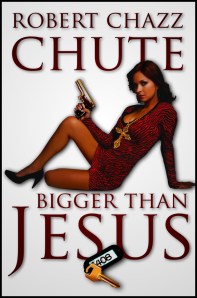
She Who Must Be Obeyed suggested this idea for a cover: We need a gorgeous Latina for Lily. In one hand she holds a key (to a padlock) labeled 408. In the other hand, a SIG Sauer 225 (Jesus’s handgun) or a Beretta if you prefer. And around this gorgeous woman’s neck? A big gold cross hanging by a thick gold chain. Think Madonna/High Catholic ornate for this. Title: Bigger Than Jesus. Author tag: Robert Chazz Chute in my usual cherry red. I’ll just need an ebook cover to start but I’ll be needing a full front/spine/back cover for the paperback as well soonish.
 
I sent you a link to an article about making the author’s name bigger. As this is a thriller and I’m trying to build a brand for a series, I’d like to try that. I can always switch it up later, but let’s try big author name up top to make it look more brandy, less indie, more swagger. What do you think of that idea?
Ideas get bandied about. Kit does other work for me. Then:
Hi Chazz,
…as discussed, I’m attaching a few drafts of Bigger Than Jesus (covers) for you to have a look at…Sorry there are so many drafts, but it should at least give you a little variety. Of course, as well, at this stage they’re all pretty rough. As ever, if none of them are suitable, I’m more than happy to go back to the drawing board.
Note: Any of the covers Kit sent me, and there were six in total, would have been pretty great to great, but Kit is patient and doesn’t mind fine tuning. Sorry I can’t show you the other covers to see what I’m talking about and to compare, but the draft covers are proprietary until they’re paid for. My break down gives you a hint, though:
Kit! My man!

Whee! This is exciting! Bigger Than Jesus II.png has a nice Pulp Fiction feel. Bigger Than Jesus III.png is closer to what I was picturing to begin with and the model is awesome. I wish we had the model from Bigger Than Jesus III.png in the pose from Bigger Than Jesus IV.png. Bigger Than Jesus I (blur).png has a movie poster vibe, though I like the colours in the next, more cartoonish variation. But, the winner is…I think we should go with a variation on the last one, Bigger Than Jesus IV.png. 

So here are my thoughts for the variation on Bigger Than Jesus IV.png: 
1. Put my name at the top and bump up the size. Please put the title where the author tag is, not at the bottom. 
2. Love the key. Can we make the key shiny gold? 
3. Love the model. Can we make the cross she’s wearing gold and or bigger so it pops out? Hard to make it out as is. Too bad she’s not wearing red. Do you think we could make the gun gold as well so it pops? (Either that or lighten the background a little so we see the gun better? I’m worried the awesomeness of the cover will be lost at thumbnail size.) I’m playing off the Jesus-thing obviously, but I also don’t want anyone to actually think it’s a religious book. I want them to be intrigued with the juxtaposition of the gun and the word Jesus. As is, I think potential readers might skip over it if the “Jesus” pops out quite as much as it does.
4. Also, with the girl in the centre, can we make her any bigger? I think Bigger Than Jesus III.png will at least be the alternative cover for the future just as it is. 
5. I think the gold accents of the key, the gun and the cross will really make it pop. 
Doable? Thoughts?
Kit sent me the revised draft that was close, but I was still worried:
 
Hi Kit!

 We’re getting there. This looks pretty good, but I’m concerned it’s too dark. Especially at thumbnail size, I don’t think the image will show up well enough. Can we go with a lighter background and make the cross and key even brighter gold so they pop like the gun, please? I don’t mind if the shine is so bright it’s unrealistic (i.e. think Man with the Golden Gun movie poster.) The shinier the better. And a question: When I find someone to give me a cover blurb for this, do we just scale down the title a little bit so we can fit it in somewhere?
 Thanks, man. (Hey, she looks better in the red dress!)
And finally, by Thor I’m hard to please, but Kit is patient:
Hi Kit,

 Better, but I’m thinking the answer for this cover is more contrast. Up for an experiment? What if we make the background white and the text black or maybe cherry red? Can the cross be a shinier gold, or bigger, or both? The cross is still getting lost. I think it will pop more this way.
Success! Though we went for a white background in the end, Kit added a black frame which was not present in earlier drafts. White backgrounds tend to look lost in the retail catalogue if they don’t have a defined edge. Amazon takes .tiffs and jpegs, so Kit sent me a cleaned up version where he edited the fine points on the image I’ll never know about. That’s for the tattooed Scottish elves and Kit to know about.
This was the most protracted back and forth we’ve had over one cover, mostly because I’m picky and kept asking, “What if we made the key and cross so shiny the reader actually gouged out their own eyes to stop the searing pain in their retinas?” By contrast, the art for my book on writing (TBA) came together very quickly. Kit sent me four or five variations of the cover for that book and I pretty much just picked one and that was it, right out of the gate.) If you’re thinking you need a graphic artist for your book, I can’t sing loud enough about the powers of The Kit.
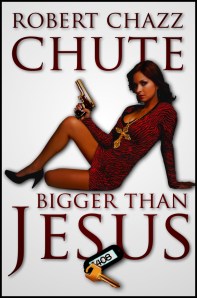
Oh, and here’s the cover. I love it.

Here’s the final draft of the Bigger Than Jesus cover.

Filed under: publishing, , , , , , , , , , ,

Author Blog Challenge: In 12 hours, Bigger Than Jesus

A lot can happen in twelve hours. Twelve hours ago I began work on formatting my debut crime novel, Bigger Than Jesus. I used Scrivener and I was feeling pretty optimistic that I could knock it out pretty quickly. I’ve formatted plenty before, but not with Scrivener. I’ve been writing with Scrivener, but today was the test to see if I could get the book over to Amazon in one day. Foolish pressure.

I couldn’t put the front matter in for the longest time. At one point I had two tables of contents and neither of them was quite right. I started with the Scrivener video tutorials — fell into a spiral of anguish and frustration — and then got hopelessly lost in the Scrivener manual. I found my way back to sanity by searching for people who had the same frustrations I did. Google. It’s the thing you need when you’re stuck.

That didn’t get me quite all the way to done. Some alchemy and experimentation was involved but, just a few minutes ago I yelled, “It’s alive! IT’S ALIIIIVE!” Twelve hours ago I began formatting. Twelve hours from now, it’ll be up on Amazon (fingers crossed!) I won’t believe it until I see it up there with my other precious babies.

What a day. What a night. I’ll have much more to say about Bigger Than Jesus, of course. I want to tell you about how I worked with my amazing graphic designer, Kit Foster, to come up with the cover. I want to talk about the book and the factors that brought it to fruition. I want to hint at what’s next for the series and all my other books. The important thing for me was to give it a rigorous editorial scrubbing and then send it out in the world. I’ll play catch up with all the other things I have to do to make this baby grow, but sunlight took priority over having everything in place.

And there’s so much yet to do! I have to ask people to review the book, buy the book, get blurbs. It’s going to be an audiobook and a paperback (and soon!). I have big plans for my funny, clever, hit man Jesus Salvador Diaz. People will like and pity him despite themselves because Murphy’s Law will take him down long before the NYPD, if the lovely Lily doesn’t break his heart irreparably first. His stories are a Coen brothers’ movie: bad things happen on the wide and easy road out of town.

For tonight, though, I’m going to toast my milestone, sit back and watch Real Time with Bill Maher and maybe Bridesmaids and know that I’ve put in my full day at Ex Parte Press and I don’t have to feel guilty for sitting back and watching TV tonight.

If you don’t know this feeling yet, I hope you experience it soon.

Filed under: publishing, , , , , , , , , ,

Author Blog Challenge 9: The key to a great critique group is… (plus a funny bonus)

English: Smith & Wesson 686 6" .357 Magnum

English: Smith & Wesson 686 6″ .357 Magnum (Photo credit: Wikipedia)

*If you’ve just popped in for the funny (and insightful!) bonus, you’ll find the link to the Writing Critique Group Decoder at the bottom of this post. Thanks for visiting ChazzWrites.com and please do subscribe.

Today’s Author Blog Challenge writing prompt is: Have you participated in a critique groups? If so, how did it work out for you? If not, why have you avoided them to this point?

True story:

I visited a writing group and much of the discussion was dominated by an imperious woman who was keen to get a critiquing group started. Only she pronounced it: “Kr-eye-teaking.” Then she said, “Kudos to you!” But she pronounced it “KA-doos“.

I didn’t want to be part of her critique group.

Then another writing group invited new members and I checked it out.

Nice folks, but they were light on writing experience and didn’t read the genres in which I write. Worse, one guy (who would have been 25% of the group) spoke at great length about the book he would someday write. It was sci-fi, which was fine, but he was too invested in theory and he didn’t have a story. He had a wacky setting which took half an hour to explain. It would be hard to get invested in a story where the characters were inert alien rods…unless we’re talking about the aliens behind Third Rock from the Sun. (That’s kind of funny if you remember the details of that sit com.)

I didn’t join that group, either. We didn’t have enough in common in what we liked to read and write and if I had to hear another word about this amazing civilization living in the rings of Saturn, I would have had to shoot myself in the face.

But I do have a critique group and that’s working out great. Well, not exactly. They’re my beta team.

For my crime novel, Bigger Than Jesus, I needed a beta team to proof my manuscript and find bugs. It was the betas that reminded me that Dirty Harry didn’t carry a .357 Magnum. It was a .44. The beta team caught that the Coen brothers of movie fame don’t spell their name with an h. (I guess I was thinking of the Cohen brothers of legal fame.)

The key to finding your critique group, or beta team, is: Choose wisely. Say no. Don’t settle.

I found a great team in a SWAT trainer, an ex-military buddy, a teacher, a psychologist, two fellow writers and the funniest woman I know who also happens to be a voracious reader. They’re all getting signed copies of the paperback with a spot in the Acknowledgements section and help with their books when they decide to write them. And lollipops.

*BONUS:

A while back I wrote The Critique Group Decoder as a service to writers uninitiated in the dance. Click for the laughs. Stay for the reality.

 Related articles

Filed under: publishing, , , , , , , , , ,

Author Blog Challenge (plus a sneak peek podcast*): Outlining, pantsing, spilling & sprinting

If you just popped in for the suspenseful sneak peek podcast, click here to hear The First Fiction Friday Edition of my podcast.

The Author Blog Challenge prompt asked how I stay organized as I write. My methods have changed over time. I used to come up with plots on the fly early on. Then I got scared off from that strategy when I got deep into a dreadfully long novel and found I had to backtrack fifty pages. Hitting a dead end is, well, death. It’s a waste of time and energy and I hate it.

I started outlining because I was writing big books and I didn’t want to lose whole sections of my book in which I was already invested. When you write 80 – 100,000 words or (ye gods!) more, an outline helps. I didn’t write an outline with Roman numerals and all that formal, high school nonsense. Instead, I planned the book one cogent sentence at a time. I described the actions in each chapter to plot the arcs of A and B stories. I looked for where those paths would logically cross, discover the beats and suss out the high and low points. Index cards got to be too much to keep track of, so in the end my outline was just three pages with a numbered list. I read and reread the outline and then I didn’t look at it again. That got me through the big books pretty well.

Recently I read Run by Blake Crouch, and as Blair Warner used to say on The Facts of Life,

“I just had another one of my brilliant ideas!”

It’s about speed. I resolved to write a crime novel with the same furious pace as Run — a book I couldn’t put down. Yeah. I know it’s a cliché, but this cliché is both apt and true in the case of Run. (Great book. Buy it.)

I resolved to do the thing I love with stories. The chapters would be relatively short. They would skip along. There would be lots of twists and turns to my racetrack. I wrote Bigger Than Jesus in about a month, one chapter a day, roughly 2,000 words each. There was no outline. Instead, I wrote with the expectation that I’d get my hero into a troubling cliffhanger at the end of each chapter. If I wrote myself into a corner in the process, too bad. I’d be clever and write my way out of it and keep moving forward. Writing like this is as fresh and as exciting as walking a tightrope naked in a high wind over a crowd of angry TSA agents with a new shipment of polar mint rubber gloves.

Many nights I went to bed thinking that I had no idea what I would write in the morning, but I trusted that I could figure it out. I believed in lightning strikes. The juice kept flowing and with it came a high level of complexity. It’s a crime novel so people lie a lot. If I’d taken longer to write it, it would have necessarily been less complex because I’d be afraid of losing track of the threads. There’s shocking emotional depth, too. Nobody, including me, foresaw the strange and sad angle on my main character’s childhood. It sneaks up.

Why did this work?

1. I knew the opening chapter and the last line so I had a target at which to aim. I’m also a more confident writer than I was with those early attempts, I suppose.

2. If I didn’t know what was going to happen next, the reader wouldn’t be able to guess, either.

3. Speed. The book is not especially long and I wrote it all in a short space of time so I could keep it all in my head at once without getting lost.

How else do I keep organized? 

In the Point File, I note things like street names I’ll use twice and aspects like eye colour so they don’t change from the beginning of the book to the end. I did mess up in having twin brothers as bad guys with names that were awfully similar. I had to go back to make sure I was talking about the right brother at the correct stage of the book.

I always have a Spill File handy so if I do write something that I end up dumping, I save it for later. I might change my mind about how useless it is or I might use it another time in another story. In Bigger Than Jesus, the writing went so quickly and breezily that I never had anything to pour much into the Spill File. I wrote fast and then went back to the stage of writing where I’m always sure I’m a deluded idiot: revisions. I cut, prune and delve. More of the jokes come clear on the second pass, too. Typically, by the third pass, I begin to feel good about the book again. Bigger Than Jesus was just about as easy as writing a blog post a day, actually. Maybe easier sometimes because what dictated the action was logic and surprise. When in doubt, surprise!

Some writers labor under a notion that I once shared: To be good, you must write slowly, perhaps even at a glacial pace, and the serifs are where your heart and soul get squeezed in and choked for blood. There are books I have tinkered with for years. One short story went through many incarnations over a year before I felt I nailed the landing and deserved 10s from all the judges. However, Self-help for Stoners came together quickly and everything worked out well with that.

Bigger Than Jesus will be released in the next week or so and all the feedback I’m getting from the editorial team tells me I’m glad I didn’t buy into the idea that it had to come slowly to be worthy. I think that’s true sometimes, but not always — not for every book and not for every writer. That’s good news because I’m using the same strategy with the next book in the series. It’s coming fast and well and I do enjoy the danger of not knowing what happens in the next chapter. Those angry TSA agents are actually spurring me to succeed.

*BONUS:

Please take a few minutes to enjoy my latest podcast on the author site. It’s The First Fiction Friday Edition! 

It’s a sneak peek at Chapter 8 from my first novel in the Poeticule Bay Series:

An old woman is lost with her tiny dog in the Maine woods and snow is on the way.

Related articles

Filed under: publishing, , , , , , , , , , , , , , , , , , , ,

Bestseller with over 1,000 reviews!
Winner of the North Street Book Prize, Reader's Favorite, the
Literary Titan Award, the Hollywood Book Festival, and the
New York Book Festival.

http://mybook.to/OurZombieHours
A NEW ZOMBIE ANTHOLOGY

Winner of Writer's Digest's 2014 Honorable Mention in Self-published Ebook Awards in Genre

The first 81 lessons to get your Buffy on

More lessons to help you survive Armageddon

"You will laugh your ass off!" ~ Maxwell Cynn, author of Cybergrrl

Available now!

Fast-paced terror, new threats, more twists.

An autistic boy versus our world in free fall

Suspense to melt your face and play with your brain.

Action like a Guy Ritchie film. Funny like Woody Allen when he was funny.

Jesus: Sexier and even more addicted to love.

You can pick this ebook up for free today at this link: http://bit.ly/TheNightMan

Join my inner circle at AllThatChazz.com

See my books, blogs, links and podcasts.

Enter your email address to follow this blog and receive notifications of new posts by email.

Join 2,063 other subscribers