C h a z z W r i t e s . c o m

See all my books at AllThatChazz.com.

Author Blog Challenge 14: Eleven ways writers get surprised

Gremlins will push you 'round^ Look where you'...

Gremlins will push you ’round^ Look where you’re going^ Back up our battleskies^ – NARA – 535380 (Photo credit: Wikipedia)

Some surprises you’re in for when you publish your book

Please note: This list of surprises for writers is not meant to be comprehensive. The worst surprises, like dying by flaming harpoon attack to the forehead (before you finish your novel) or a hard drive exploding and taking out two floors of your house are not included. Those circumstances just aren’t lighthearted enough for my intent here. Oops. Well, I guess you’re worried about that stuff now, too.

1. You thought your manuscript was clean and it was, it was! Gremlins went in and put those ugly typos in there! That’s the only reasonable explanation.

2. Publishing your book is a huge event in your life. Remember when you had a baby and you expected the world to pause to acknowledge your contribution to, and sacrifice for, the human race? Wars should stop and the earth’s rotation should cease for a moment, if only so we can all bow. Sadly, it’s not a huge event in everyone’s else’s life. Many people are indifferent and it’s just not efficient to go out and kill all of them with a rusty axe.

3. The people you thought would love your book? They don’t. My dad still hasn’t read anything I’ve written. He’s waiting for me to write about him. (What he doesn’t know is that he really doesn’t want that!)

4. Lots of people are readers but they do not write reviews. You’ll expect reviews. Eventually you probably beg for reviews. Worse? You still won’t get them, even from friends and family! I thought about it, but there is no joke I can tag on this item that will soothe the sting. It’s more tragic than a flaming harpoon to the crotch.

5. Someone will object to something you wrote. What will surprise you is what they object to. For example, some people get riled up about which font you chose for your cover. You’ll assume that joke your main character made about religion was, at most, funny. At worst? Somewhat innocuous. Some blogger, somewhere, will call you the Anti-Christ and call on Jesus to smite you because, apparently, Jesus loved capital punishment. Oh, wait… (At least outrage and threats of censorship increase sales, so there’s that.)

6. Some people will treat you better, briefly, because you’re an author. Then they’ll treat you worse when they find out you’re a self-published author. For some reason, you have to answer for every grammatical mistake and every (so-called) undeserved success of your breed. Corollary: If you become a very successful traditionally published author, some people will hate you because lots of people read your books. Or the haters will hate because they aren’t you. Suggestion: A dog is reliably faithful. Definitely buy a dog. They can’t read so they’re blameless.

7. Formatting will be tough the first time. The first time, you’re a dim-witted chimpanzee with a keyboard. The second time you do it, you’ll be surprised how easy it is. You will have evolved to a very intelligent Rhesus monkey.

8. By the time you’re through revisions and formatting, you and your editorial team will have gone through the manuscript so many times you’ll be sick of it. This is the story you loved so much. Now your cute baby has grown into an angry, gangly, acne-scarred teenager and you just want them out of the house they can go make money and so you can make room for a sweet new baby who loves to cuddle.

9. Actual publication won’t be quite as momentous as you anticipated. How could it equal all those dreams you’ve had since childhood? You pictured a limo and an elegant cocktail party. Instead, it’s you in sweats, late at night and a little drunk on weighty potential and rum and Coke, debating if you’ve done everything you can before pushing a button. It will feel more like pulling a trigger. You may be filled with more dread of bloody failure than anticipation of success. I’m about to push that button and I’ve had stress headaches all week. I just want to sleep instead of poking around Scrivener‘s bowels to prep the manuscript for Amazon and CreateSpace. You’re not alone in the struggle, but that’s of little solace because you are alone in the room.

10. Getting someone to read your book is harder than writing your book. You’ll spend more time marketing than you ever dreamed necessary, even if you figured it would take a lot of time. Triple your marketing expectations and get a treadmill desk so your ass won’t get as big and wide as your hopes and dreams for your writing career.

11. But here’s the biggest surprise: Though you will get luckier the harder you work, it’s still a lot about luck and timing and some happenstance. Nobody admits this variable. When you win, it’s all attributable your meteoric wisdom. When you succeed, you’ll figure it’s because you made all the right moves and you knew what you were doing with every step. Revising history and shining up the truth is natural. Everybody does that. It keeps us from running away screaming from that “Click to Publish” button.

Filed under: publishing, , , , , , , , , , , , , ,

Writing: The Rule of Three & the peril of semi-colons

Massey Hall, Toronto

Image via Wikipedia

Saturday night I saw Bill Maher at Massey Hall in Toronto. Good show, fun time. Bill is known for Real time with Bill Maher, his documentary Religulous, his comedy and his New Rules books. Watching him perform, I noticed he never breaks the Rule of Three. It is a good rule, an effective rule and a memorable rule that I just demonstrated with this very sentence.

Wikipedia puts it like this: The “Rule of Three” is a principle in writing that suggests that things that come in threes are inherently funnier, more satisfying, or more effective than other numbers of things.”

Of course, you will write longer lists, but when you use a colon, do so sparingly unless you’re composing a scientific paper. Semi-colons can be very useful in separating elements in a list after a colon. However, if you use the semi-colon to separate related clauses, please do so sparingly. Wikipedia says, “According to the British writer on grammar, Lynne Truss, many non writers avoid the colon and semicolon…”

I disagree. It’s not just non-writers who avoid the semi-colon to separate interdependent clauses. 

The semi-colon can be a useful device occasionally, but as a punctuation mark, it is often either misused or has fallen out of favor.

When Lynne Truss refers to “non-writers”, does she not also mean people who are readers? Shouldn’t it be the common reader who sets the standard for what’s easily read and understood? I invoke the common usage rule here. When something has fallen out of common use, it’s too rusty to use without a lot of irritating squeaking. For instance, if a writer uses the word “behooves,” he sounds like he’s trying to be Charles Dickens. You just aren’t old enough for that.

Similarly, the semi-colon has fallen so far out of common use that when a reader encounters one, it pulls them out of the narrative to think, “Hey, look! A semi-colon! Why did the author feel it was necessary to separate related thoughts with a semi-colon, instead of separating those ideas with a simple period? Anything that stops me from breezing along through a novel is a speed bump that I would prefer shaved down so I can speed along and focus on content instead of transmission static.

I have never read a sentence with a semi-colon that I did not reread at least twice.

I’m not saying  you shouldn’t use semi-colons, if they suit you; I am saying, I won’t use the semi-colon.

Anymore.

Filed under: Editing, Editors, grammar, , , , , , , , , , ,

Editing tools and typo tips

Book cover (Dust jacket) for the 15th edition ...

Image via Wikipedia

Write_your_book
EDIT YOUR BOOK!

When you’re checking your manuscript, use your word processor’s Spellcheck. Some editors turn up their snobby little noses at Spellcheck, but it can flag problems you might otherwise miss. Nobody’s perfect and problems will always appear once you’ve published your book (yes, in both traditional and self-published books). Don’t take every suggestion; Spellcheck isn’t always right. It’s a tool, not a panacea. You can also use Find and Replace to look for problems Spellcheck misses: its, it’s, there, their and so on. Spellcheck doesn’t replace editors and they don’t replace thinking. But you’ll catch more using it.

To the rude editor I met at the conference who said she never used Spellcheck: Yes, I’m saying that was arrogant and, just like the rest of us, you’re not nearly as smart as you think you are. Or funny. And you need to work on your social skills. (Now I’m worried that I’m projecting.)

I don’t edit blog posts obsessively, but when I’m working on a book, I have several websites up on my browser: Chicago Manual of Style, Wikipedia, and dictionary.com. I also use Autocrit for more input.

For me, yesterday was single quote day. I wrote parts of my books with Open Office, so I had to go through the manuscript and make all my single quotes curly…and curly in the right direction. I was cross-eyed and HULK ANGRY by 5 pm.

PentecostSelf-publishing guru and author of Pentecost, Joanna Penn, has a great suggestion to deal with typos: Publish your ebook first. Your readers will let you know (politely or not) about your book’s typos. Corrections to the ebook are easier than correcting your printed book. Corrections to print books are called “second editions.” Great tip! For more information from Joanna, check out this very useful interview. I loved this inspiring interview and it helped me calm down after Curly Quote Day. Well…much later, after the photo below.

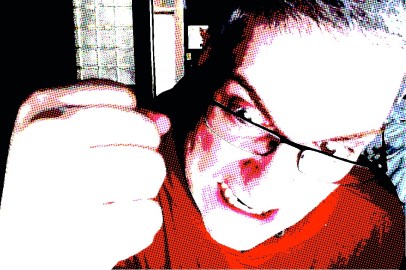
Me after Curly Quote Day

Filed under: Books, DIY, Editing, Editors, getting it done, grammar, writing tips, , , , , , , , , , , , ,

Don’t listen to writers too much

The phrase that pays.

Image by pirateyjoe via Flickr

When I first graduated from massage school, I visited new massage therapists all the time. Too often, I didn’t enjoy the experience much. I was too evaluative of each therapist to just lay back and receive the treatment in the spirit in which it was given. I wasn’t concentrating on the feeling of the massage, but on the mechanics. It took me some time to get past that mindset.

You see the same thing with editors sometimes, too. A bad editor jumps straight to corrections too fast without reading for story first. Typos are the last thing you correct in the story construction process. You need to look at the big blocks in the structure first to see how it holds together. Developmental editing always happens before detailed copy editing.

You shouldn’t listen too much to other writers for similar reasons. They see your work through a prism that doesn’t necessarily match ordinary reader expectations.

Writers are great people, but they usually aren’t your market. We sometimes forget that there are a lot of people in the world who have no literary ambitions. They don’t want to write a book. They just want to read a good story.

Writers are readers, but they aren’t typical readers. Writers look at your work differently. Writers are not  the average reader.

Among writers, there is a higher percentage of people who will pick apart your mechanics. Any grammatical variation from what they expected (and there are variations) will provoke more irritation than may be warranted. They will be the readers who skip from irritation at your typos to outrage, indignation and threats to take away your writer’s license and livelihood. Some will want to burn down your house.

Writer friends and editors can help you develop your work, improve and self-publish. But because of the way we are wired, we might not enjoy your work as much as typical readers will.

BONUS: 

I’m networked with a lot of great writers who help me a lot. I like them, appreciate them and thank them.

However, you’ll run into some writers who are so competitive, they do not wish you well.

Either through jealousy or the misconception that your success takes something away from them, they want you to fail.

Watch out for the hypercritical, the rabid grammarians, the perfectionists, the haters and snipers. They mistake their subjective taste for law all the time.

By the way, I wish you every success.

Filed under: publishing, Rant, Rejection, writing tips, , , , , , ,
The Writer Rejection Scam

Stephen King signature.

Image via Wikipedia

Sometimes I hear writers take pride in the number of rejections in their file cabinets. The idea is that they compete with writer friends to pile up the rejection slips. The person with the most number of rejections by a certain date…er…”wins.” Riiiight. I don’t know how this myth got started but it’s a popular one.

It’s not that this is a totally useless strategy (and I’ll review the advantages in a moment) but first, let’s burst the rejection scam bubble:

If you are writing fast without second drafts or third or umpteenth drafts in order to pump up your submission rate, you’re losing. More rejection slips? That’s no measure of how close you are to publication. If that were true, the worst writers in the world submitting the most illiterate crap across the planet are all just on the cusp of bestsellerdom.

If you get a lot of rejection slips that don’t actually include personal notes on how the writing didn’t work for the reviewer, you’re losing.

It’s also very hard to get any personal notes on your work, by the way. Many agents and editors don’t believe in detailing the reasons for rejection. There are so many variables to evaluate writing that are idiosyncratic and peculiar to the editor, it doesn’t profit you to hear they rejected you for subjective reasons.

Neither does it profit them to take the time to give you a heads up that you were a near miss. Many editors have so many submissions on their desk that they really don’t want to encourage more people to resubmit. The mailbox will be full tomorrow regardless and your persistence is expected without free coaching and hand holding. (And just because you submitted a manuscript, no editor owes you free manuscript evaluations, feedback or reasons for rejection.)

If you’re clearing an alley of bad guys, use the twelve gauge with the .00 load. With manuscript submission, however, scatter shot is less effective than picking and aiming at your targets.

Submit everywhere without careful thought on how to target your market? Then you’re losing. It’s time you’re losing primarily, though the loss of confidence and self-esteem can’t be glossed over. It takes a lot of ego to put yourself out there, so choose carefully how you put yourself out there. Artists need all the narcissistic hope and unreasonable aspirations of a lottery player.

If you’re submitting everywhere in the slim hope that an agent or editor will take the time to take you under their wing, build you a nest and show you where you went wrong with your flightless novel, you’re losing. When dealing with mass submissions, editors and agents get impatient with bad writing, or even writing that isn’t bad but doesn’t suit them. I’ve seen it personally. Behind closed doors there’s even a lot of laughter at published writers’ work that’s bound for publication. (Oh, yeah, that’s right! I said it! I’ve seen it and endured it!)

If it’s feedback you’re after, alpha readers, beta readers, hired editors, writing and critique groups will get you more feedback than can be fit on a tiny rejection slip. Plus, you’ll be getting much more careful evaluation.
People going through a slush pile aren’t there to help the writer. They are there to evaluate whether your manuscript is a good bet for a business deal that suits their purposes and interests.

Much is made of Stephen King‘s pile of rejection slips. I think too much has been made of the rejection slips impaled on that spike in King’s attic. It’s not that some magic kicks in once you hit a special number of slips. It is, instead, what the rejection slips symbolize: sweat equity and time invested in improving craft. I’m not suggesting you submit fewer manuscripts per se. I’m saying, offer your work wisely.

A higher number of rejection slips is not an achievement to be celebrated any more than failing to complete every race you enter makes you a better runner. It might make you a noble aspirant. Or maybe you’re too bull-headed to train properly and learn. Either possibility has validity.

It was all the writing and reading King did while the slips piled up that mattered

It was the feedback he got from a newspaper editor that mattered

That editor sat down with King and went over a story about a high school basketball game. He showed King how to tighten his writing. A little mark up, some rearranging and red pen work et voilà!: The magic of editing improved the writer’s craft. (If you haven’t read Stephen King’s On Writing yet…well, just go do that and thank me later.) 

What are the advantages of piling up rejection slips? If you need to compete with a friend to get you to write, I don’t see anything wrong with that. Everybody needs some gentle  motivation (or a kick in the bum) sometimes. (Okay, maybe you don’t ever need a writing crutch, but that makes you an inhuman freak, Trollope!)

If you get personal feedback and encouragement from editors and agents, that’s a good sign you’re on the right track. If you just get a note or two though, that doesn’t constitute a trend you should necessarily heed. Editors and agents have their own agendas that may reflect very little on your writing and you’ll never know what’s in their minds.

Don’t rush to produce writing at the expense of quality. As Truman Capote said of Jack Kerouac‘s On the Road, “That’s not writing. That’s typing!”  (Granted, Capote could be a bitch and lots of people like On the Road.)

Still, getting a big pile of rejection slips is not the end game. Writing extensively (and well), reading broadly (and well) and getting righteous feedback will get you where you want to go.

Yes, I know: Rejection is part of the process. But neither should rejection be fetishized and assumed useful. Some lucky few writers are a hit right out of the gate. Are they still bad writers because they haven’t “paid their dues” and “jumped through hoops”?

That thick skin some say you’re supposed to develop through rejection would be used more effectively if you  got a manuscript evaluation or joined a critique group. (And thick skin is another thing that’s overrated and fetishized. Thick skin helps you take writing advice, yes. But when the reviews come in and someone writes something nasty in a comment about your book —your baby!—on Amazon, veteran author or newbie, you’ll be just as pissed.

Now, how do you target your submissions to likely editors and agents? 

Well, that’s a post for another day. Another day that will come soon.

Stay tuned. 

Filed under: Books, manuscript evaluation, publishing, Writers, writing tips, , , , , , , , , , , , , ,

How to edit without reading

Lettrine A edtion 1570 Venise I quattro libri ...

Image via Wikipedia

You: Edit without reading? How is that even possible? 

Me: You can tell when a story has problems at a glance if the page is too dark.

You: Um. What?

Me: This page. Look at all that unbroken text.

(HOLDS OUT A MANUSCRIPT AT ARM’S LENGTH)

It’s an intimidating, heavy block. Unless you are Proust—wait. Are you Proust?

You: (SURLY) No.

Me: Okay. When there are big unbroken blocks of text, you’re demanding a lot of the reader.

You: So I should assume my reader is too stupid to handle a long paragraph?

Me: Yes.

You: What?!

Me: Attention spans are shorter. Big blocks of text do not skip along. It’s hard to get a sense of making progress when faced with all that text. You need to break it up.

You: Show me.

Me: The first thing is, have you used paragraphs correctly? Maybe the unified sentences are there but you’ve missed opportunities to paragraph appropriately. Think of each paragraph as  one logically unified thought. Look for the flow, either progression or back and forth, to identify where the next paragraph proceeds.

You: Uh-huh. I’m not an idiot, you know.

Me: I’m sure you’re not. I didn’t create you to be an idiot, but a dialogue foil so I could parry back and forth a bit. Break up the didactic drudgery.

You: Wha–wait. What?

Me: (SMOOTHLY) So the next usual suspect is long speeches. Soliloquies usually need to be broken up with action, interaction and conflict from other characters.

You: Or?

Me: Or you get big blocks of text. Readers like white space, but this isn’t just an aesthetic issue. It’s an editorial issue. Shorter paragraphing looks more appealing, true, but when dialogue flies back and forth, shorter paragraphs are an indication of dynamism on the page.

You: And you think you don’t have to actually read the story to know it’s not dynamic enough?

Me: I don’t have to actually read the story to know that unless you get more white space on the page, no one will read it. I’m trying to give your story a chance at daylight. I haven’t read a word, but I’ve seen enough holding it at arm’s length and glancing through a few pages to see the pattern. If you send it to an editor or agent, they will heave a great sigh and turn away quickly. If you try to sell it yourself, it will not sell.

You: Do you actually talk to writers like this when you edit them?

Me: Of course not. This is just a blog post between me and an imaginary writer…you know, for educational purposes.

You: Educa…. About what you…hey! You’re saying I’m not real?

Me: (PULLS A WOODEN STAKE FROM BENEATH A DARK CLOAK)

The problem is real. The editorial trick is real. You, I made up.

(PLUNGES STAKE INTO THE FICTION’S CHEST AND ROOTS AROUND FOR THE HEART IN QUICK, GRISLY CIRCLES)

You: Ouch. Hey, that was…surprisingly painless.

Me: It’s okay. Sh. I wrote your reality this way so it doesn’t hurt anyone.

You: Oh. Thanks.

Me: You’re welcome. You live in the Matrix. It’s a bitch, but I try to make it easy on everybody.

(PULLS OUT THE STAKE AND THE SOUND IS LIKE AIR FARTED OUT OF A PARTY BALLOON)

(THE FICTIONAL AUTHOR WHIZZES AWAY LIKE SAID PARTY BALLOON AND, AT FULL DEFLATION, DISAPPEARS INTO AN UNENDING GREEN SEA UNDER A CLOUDLESS NIGHT SKY AND A BLUE, TROPIC MOON.)

THE WARM BREEZE, SMELLING OF COLITAS AND CARRYING THE SOUNDS OF THE JUNGLE TO THE WEST WHISPERS STERNLY: “Stop now, Chazz! It’s overwritten already!

Me: FADE INTO DARKNESS. THEN GOES SHOPPING.

And that’s how you edit without reading. 

Filed under: Books, Editing, Editors, Writers, writing tips, , , , , , ,

Editing post: Words to do without

Harbour of Peggys Cove, Nova Scotia

Image via Wikipedia

Monday morning I woke at 4:17 a.m. to a thunderclap. The storm had knocked out our phone and satellite already. And a A story poured like liquid gold into my mind. The premise was there appeared and all I had to do was pull the string to find where the thread ended up. Before I pulled myself out of bed, I had my story pretty much worked out.

I went right to work on it when I got up. I’ve been editing a lot and writing less, so although I was prepped, I had to warm up to my story. I found myself writing wrote a paragraph or two, doubling doubled back, revising revised, then moving moved forward. It’s not ideal for me, but since I had such a clear idea I wanted to match that vision as closely as I could. right away.

And I noticed I have tics. All writers have them. I grew up in Nova Scotia, so when I speak or write a sentence (the first time) I seem incapable of writing “The house was across the street from the store.” I have to write, “The house was right across the street from the store.” Right is my tic.

And “just”. Just is sadly ubiquitous. “I just thought…” “He had just dropped his underwear on the floor when…” There is a place and a time for “just” but it shouldn’t be littered everywhere. It’s a word you can often do without.

Like “that”. It’s also a word that you can often do without.

Look for words you can do without.

Filed under: ebooks, Editing, writing tips, , ,

Writers: Your mistakes taunt you

The original Ruby slippers used in The Wizard ...

Image via Wikipedia

I saw the movie Limitless over the weekend. I loved it (and it helped the loser/hero starts out as a scrambled slacker writer who is hopelessly blocked . It’s a great time, but as I hit the parking lot I thought, (MINI-SPOILER! SPOILER! SPOILER!) how come they left the dangling thread of the unsolved murder? Was it lost on the editing room floor?

There are plenty of precedents for such mistakes. For instance, a truly great classic, Casablanca is brutally flawed if you think about the ending for a moment. The engine of the plot turns on there being only two travel passes so only two people can leave. Will Ilsa go with Rick or Victor? The resistance needs Victor so Rick must sacrifice his desires for Ilsa for the greater good. But there are no Nazis checking passports at the airport!

In fact, in the background at the end of Casablanca just a few little people (they were “dwarves” when the same extras were in The Wizard of Oz) pretend to fuel a cardboard cut-out plane. Rick could have escaped, as well. Instead he stays with Louie and they begin a beautiful friendship that, years later, would inspire the raw, hot homo-eroticism of Bert and Ernie of Sesame Street fame. (Okay, I made up that last bit.)

Sometimes people underestimate the importance of editing. When stuff is left out, it sticks out. Even if you enjoy a story, as you put it down, you think about that niggling deficit. I guess it’s just the way our brains are wired. You forget praise, but point out a screw up, that you remember forever.

I recently went through a writing sample for an author. I might have seemed harsh though I took great pains to be kind. The truth is, I found a lot to fix. The author wanted to send it off for traditional publication. Without those fixes, there was no way it was going to get past the first gatekeeper.

Publishing has changed. There are fewer editors doing more work and if they accept a new author at all, they do not want to have to do much editing at all.
With To Kill a Mockingbird, Harper Lee‘s acquisition editor took a year off to perfect the book. There is no way in hell that would happen today.

You want your text to be excellent. If you publish it yourself, good might do. Even “good enough” might pass. But is that really what you want? Mistakes in books stand out and stick, burning you at the thought of readers stumbling over a glaring error and questioning your ability, craft or intelligence.

Errata are in all books. They shouldn’t be dancing around in neon taunting you.


Filed under: authors, Books, Editing, Editors, movies, publishing, Writers, writing tips, , , , , , , , ,

Writers: “Amount of” versus “number of”

Syrniki. Syrniki, fried quark cheese pancakes,...

Image via Wikipedia

There are a number of cheese pancakes in this picture: six.

The amount of cheese is in the recipe. You wouldn’t say the number of cheese or the amount of pancakes.

A number of mistakes in a book I read recently kind of bugged me. Overall, there weren’t that many mistakes in the book, but one kept coming up. The problem was that, while the author tried to quote statistics and make a compelling argument, she repeatedly undermined herself by misusing the phrase “an  amount of.”

“A  number of” things can be counted.

“An amount of” refers to a measure of volume.

For instance, there are a large number of armies on earth. The amount of their combined firepower is uncertain. There is a certain amount of apple sauce in this recipe. There are a number of apples in that recipe.

Is it a big deal? Not really, but it’s a distraction and your job, as a writer, is to eliminate distractions from your thesis or your story. As a reader, you’ll notice mistakes and that’s often what you’ll remember rather than the writer’s point.

Filed under: Editing, Editors, grammar, publishing, Writers, writing tips, , , ,

Editing Part IV: Wording to avoid, uh, Words to avoid

This is a game of Snatch in progress. Snatch i...

Image via Wikipedia

I’ve talked about editing out words to watch out for. Here are some more:

Use says or said for dialogue tags. Don’t use claim unless you want to cast doubt on what the speaker is saying.

Watch out for too qualifiers. They have their place, but when around, about, a bit, somewhat, sort of, and kind of crop too much, you’re hedging. and the Your reader will pick up on your Readers notice waffling.

Avoid tautology: actual facts, adequate enough, stand up, sit down, mix together, gather together. One right word is better than two words that repeat the same an idea.

That got meta.


Filed under: Editing, Editors, getting it done, publishing, rules of writing, writing tips, , , , , ,

Bestseller with over 1,000 reviews!
Winner of the North Street Book Prize, Reader's Favorite, the
Literary Titan Award, the Hollywood Book Festival, and the
New York Book Festival.

http://mybook.to/OurZombieHours
A NEW ZOMBIE ANTHOLOGY

Winner of Writer's Digest's 2014 Honorable Mention in Self-published Ebook Awards in Genre

The first 81 lessons to get your Buffy on

More lessons to help you survive Armageddon

"You will laugh your ass off!" ~ Maxwell Cynn, author of Cybergrrl

Available now!

Fast-paced terror, new threats, more twists.

An autistic boy versus our world in free fall

Suspense to melt your face and play with your brain.

Action like a Guy Ritchie film. Funny like Woody Allen when he was funny.

Jesus: Sexier and even more addicted to love.

You can pick this ebook up for free today at this link: http://bit.ly/TheNightMan

Join my inner circle at AllThatChazz.com

See my books, blogs, links and podcasts.

Enter your email address to follow this blog and receive notifications of new posts by email.

Join 2,063 other subscribers