C h a z z W r i t e s . c o m

See all my books at AllThatChazz.com.

Writers: Reality check

Aspire to Inspire eBook JPGPassion is more important than discipline.

Passion is the why. Discipline is the how that comes after the why. If you have passion for your writing, you won’t have to whip yourself to get to your keyboard. If you love what you do, it’s not work. It is play.

If you’re having fun, chances are your readers will have fun along with you.

Are you having fun with your writing? Is it alive and lively or are you forcing it? If you’re complaining about the work of writing, you haven’t hauled a huge wood stove into somebody’s basement down steep stairs, crawled through itchy pink insulation in a hot attic or dealt with some jerk from the wrong side of the Customer Service Counter. “I’m sorry, but if you don’t have a receipt for this blender…sure, you can complain to my manager about what a bad person I am for enforcing the rules everyone who isn’t a pinhead knows…sir.”

Writing isn’t for wimps, though.

As you write your next sentence, paragraph or chapter, dare to take the story in an unexpected direction. The expected direction is too easy. Your audience is people who read. They’re smart. They’ll spot the easy trajectory, the facile solution and clichéd dialogue. They’ll yawn and put down your book. Don’t let them. Keep them up all night, wondering. Challenge yourself and your characters more. Sure your heroine wins in the end, but who saw the inebriated monkey with the bandsaw coming? Only you could make that story arc work (wow, how awesome are you!)

Stretch.

Dare to be funny. Do some research so they’ll believe you and do some more so you can tell them something they don’t know. Let them hear your distinctive voice in their heads as they read. I once heard an author do a reading of a crime scene. It could have been any opening scene to a Law & Order (i.e. jogger finds beautiful corpse in Central Park/cops discuss). But she gave us flat characters and added nothing to make it different or memorable. It wasn’t just boring. It insulted the audience because the author expected to roll out her most minimal effort and earn applause. She received polite, golf green applause and I hated her a little for having to give her that much.

Write like it matters because it does.

In writing, you are creating new neural connections and giving your brain a dopamine bath. You’re reaching out to readers through time and space to distract them from our collective doom. Entertainment isn’t a “mere” entertainment. It’s an escape from existential horror. It’s respite from the retail hell for some poor girl in Idaho who needs a break after slaving all day in a Mrs. Field’s outlet at the mall. That girl needs to fill her brain with love, adventure, giggles and false hope or she won’t make it through another day of standing at that godforsaken counter praying for an asteroid strike and doling out diabetes.

Writing is one of the few things that is simultaneously brave and joyful.

Your profession is a daily act of compassion. Writing is Art, dammit! Besides feeding a loved one, kissing a boo-boo or strangling a mime, what could be better than a hot cup of coffee and the privilege of exploring the mysteries in an undistracted hour?

Writing is the best meditation.

When I can make myself laugh or cry with my words (and hope to touch another) it almost makes me doubt I’m soulless. When it’s especially good, our work has the power to stir emotions, learn the secrets our minds keep from us and maybe even squeeze meaning from stars. Don’t you dare complain you had a tough go at it today. You’re nothing less than a psychonaut divining what’s real and valuable from the deception others call The Ordinary. Writers know nothing is ordinary and our vision takes us to greater depths to pull our readers to heights. We help people fly through an otherwise egregious hour and make it feel like minutes in a better world. We’re the drug in the doctor’s waiting room. We make getting trapped, housebound in a snowstorm, worthwhile. 

Love yourself and love others by writing today.

Aspire to inspire others with your words and let your actions fall into natural alignment with your mission. Write!

We are writers.

We are the lucky ones.

Make it a great day.

Filed under: Writers, writing tips, , , , , , , , ,

Writers, Readers and the Blame We Get

Dark Higher Than Jesus banner adI know a couple of erotica authors well enough to tell you that their private lives are not a full schedule of whips, naked gymnastics and ropes with elaborate knots. They’ve never had sex at the top of the Eiffel Tower with multiple hunky Norwegians. They’re ordinary moms who share your concerns about life. They have vivid imaginations that stay busy while they’re stuck in traffic as they chauffeur their children to play dates. Some readers draw conclusions about the character of the writer from the books they write. Unless it’s an autobiography, that’s an annoying habit.

When I wrote Self-help for Stoners, some readers assumed I was a drug addict. Never mind my liberal stance on unwinnable drug wars and the hypocrisy and sadism of sanctions against marijuana users. My addictions are sovereignty, choice and chocolate croissants. The drug I toss back most? Caffeine, just like you. When I wrote Sex, Death & Mind Control, some people thought I dabbled in the occult. Not so. I am not in a cult, either, (though I wouldn’t be averse to leading one for those awesome tax perks.) My work is fiction and my brain makes odd neural connections. Ideas get put together in new and exciting ways. That’s writing and that’s all.

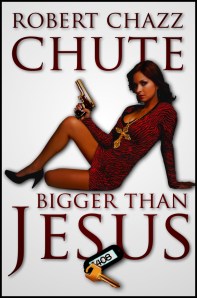
When I gave my dad Higher Than Jesus for Christmas, he felt self-conscious about reading a crime novel written by his son that included sex. I know that because he tried to make me feel self-conscious about it. Yes, there’s a particularly blushworthy chapter, but I told him when I gave it to him that he never complained about the violence in my books, so he didn’t get to object to the sex. Here’s that fun phone conversation:

Me: Merry Christmas, Dad!

Him: I’m almost finished reading Higher Than Jesus. It’s quite the book.

Me (catching the tone): Uh-huh.

Him: I think you have fantasies about long legs —

Me: Stop! It’s fiction, Dad. I’m a writer. You’re an adult. I’m treating you like one.

Him (apparently unconvinced of points one through four): Mm, yeah. Well, I did enjoy it.

Me (deadpan): Imagine my relief.

Worse? Now I’m a bit worried. Since the gut-wrenching horror of the tragedy and loss in Newtown, Connecticut, even I’m becoming concerned that my fiction might intersect with real life. Part of the plot of Higher Than Jesus turns on a gun control issue and the actions of a fanatical group. Real life events have turned since I wrote that novel. Congruence make me think that my fiction and conjecture could actually line up with plots in reality. If something in particular (a very bad thing) happens in January, will some reader try to make that connection to my funny, sexy crime novel? They won’t call me prescient. They’ll wonder if a nut read my book!  

I hope law enforcement officers will foil any real life plots. Jesus Diaz is an interesting character, but I don’t think issues of national security and international peace should be left to my goofy, conflicted, love-obsessed, Vicodin-addicted hit man. He foils plots, too, but never in an easy, linear way. Our world has lots of tough problems, but fiction isn’t the problem. If anything, it’s a solution. Fiction is a safe outlet for revenge fantasies. Art yields entertainment, not sorrow. (Yes, I believe this is true about video games, too. Penn & Teller did an episode about the safety of video games. Here’s a link to that vulgar, NSFW video on my author site. This video is not for the easily offended or anyone who refuses to even consider that video games might not cause horrible school shootings.)

To readers: Please don’t ascribe words on the page to the character of the author. We’re just tap dancing to entertain you and most of us prefer to keep our violence where it can be safely managed: In fiction. Yes, my revenge fantasies are rooted in a deep dark place, but I learned to sublimate my rage with humour. If you’re going to make assumptions about me from my books, please assume I’m better than I am, not worse.

"Worthy of Elmore Leonard with shades of Thomas Harris..."

“Worthy of Elmore Leonard with shades of Thomas Harris…”

~ Robert Chazz Chute writes suspense and crime novels. He’s not Cuban. He’s not a hit man. He’s close to the same height as his Cuban hit man, though, so clearly he’s exactly like his fictional killer. Hear the All That Chazz podcast and check out his books at the links at AllThatChazz.com.

Filed under: publishing, , , , , , , , , , , , , , , , ,

iCarly, Art and what it means

Find tons of tips and inspiration here.

Free until Dec 15! Please click the image to learn more about writing and publishing.

The news came in last night that I am no longer an artistic hero to a friend of mine. My fall from grace came when I announced on Facebook that I looked forward to seeing the series finale of iCarly. As a crime novelist whose anti-hero gets tortured and frequently kills, clearly I’d damaged any tough guy rep I’ve built in the Hit Man Series. I’m not too torn up at my fallen status in the eyes of my friend, but his joke did get me thinking about the big question: What is the nature of Art and what’s good Art?

As a stay-at-home dad, I’ve watched a lot of kid shows with my children. Most shows came and went as the kids went through stages. Teletubbies was a short foray followed by The Wiggles. Dora the Explorer was great but the kids outgrew it and declared it a “baby show” quickly. iCarly hit my kids at just the right time. As the stars of the show got taller, so have my kids. The two constants have become Spongebob and iCarly. Somebody told me they thought the stuff that qualifies as Great Art is the stuff that lasts. (Not sure about that. How long does a shooting star last?)

Let’s address the worry first: What’s a grown man doing watching iCarly? It’s simple. I have a pretty bleak outlook and monstrous rage I sublimate with humor. iCarly is silly fun and in each episode I was sure that everything would work out okay. Entertaining TV lights a candle where there is so much darkness.

It is clever silliness, though. If you are a little older and you watched the iCarly finale with your kids, there was a moment when you roared with laughter and your kids have no clue why. They did a tribute to another iconic moment in television history: The group hug/group shuffle from The Mary Tyler Moore Show. That bit was a wink and a nod for the old ones watching with their kids. I loved it.

Watching iCarly kind of balances out my favorite shows: Dexter, Breaking Bad and The Walking Dead. I’ve also become riveted by season 1 of a Showtime drama  called Sleeper Cell which is a taut story about an FBI agent who is out to bring down terrorists. He’s undercover and also happens to be Muslim. I mention these shows not to try to win back any lost cred, but to say that Art comes in all shapes and sizes, tastes and brands.

Please click here to get Bigger Than Jesus

Please click here to get Bigger Than Jesus

Recently a troll went to work on a colleague’s blog, acting unnecessarily rude in a comment thread. My first reaction was what troll’s want: I was annoyed. Then I thought about the chasms and vast distance between iCarly and Sleeper Cell and how I enjoyed them both for different reasons. A commentator from On The Media mentioned recently that he didn’t think a famous self-published author’s work was very well-written. He then added, “But how great does it have to be when you can buy her books for $2.99 cents?”

I suspect the troll doesn’t understand what the commentator groks: There is no real Art in the sense that “This is The Good and This is the Bad.” There is nuance and too many variables for our pea brains to handle when it comes to what people like. The commentator allows a nuance that doesn’t register in Troll World: If you get it cheap, you don’t expect it to be perfect. And what a relief that is! We all strive for excellence, but nothing is perfect. Through that lens, I saw the troll differently, too. In Troll World, criticism is used to try to control others so you feel better about yourself. How else to explain anger directed at artists that comes with a heat that should be reserved for perpetrators of genocide? My annoyance melted to pity. How sad and lonely trolls must be when they project such anger. They bring no joy because they have no joy.

There’s room for all kinds of Art. That book you love? I hate it. The book I love? You hate. Someone once said criticism (distinct from trolling) has value because it isn’t merely subjective. It is intersubjective. Yes, when it’s practiced at a high level, you can provide measures and good reasoning why I shouldn’t like something. However, like and love is like laughter: It is involuntary. Bad reviews are often irrelevant. I notice now that a vocal group (the minority?) don’t trust good reviews, either. A good critique is often entertaining, but that does not automatically equate to believing the critic. Several times I have soothed a fellow author’s hurt feelings over a bad review by pointing out that people often pay no attention to a bad review, especially if it’s poorly written or the reasoning is shaky. Criticism is an art in itself, but I give it a small a, not a capital, because it based on what others speak, write, produce, act, direct or sing first. I’ve read a lot of art criticism, but for its own sake, not to determine which movie to see on any given Saturday night. The critic is not me. To believe the critic, he or she has to share my sensibilities. How often do we match up so well that we can switch out our opinion for another’s judgment? Rarely.

Art is the place where we meet strangers in safety. You wouldn’t want to meet my characters in real life. They’re dangerous. I write

A quick-moving plot with lots of surprises and a clear-eyed examination of addiction.

A quick-moving plot with lots of surprises and a clear-eyed examination of addiction.

stories of Bad versus Evil. But I’m complex and I have an emotional range. There’s room for a sponge who flips burgers and whose best friend is a starfish who is so creative in how entertainingly dumb is. And there was room in iCarly for Sam to get into and out of trouble by beating people with a slab of butter in a gym sock. Spencer hanging with an ostrich? Priceless. And we need Gibby and Guppy to be freakishly obtuse and endearing because all your surreal friends in real life are in jail for possession.

What’s good Art? That’s not the big question I thought it was. The nature of Art trumps the question because Art is so much bigger than that question. Art is multidimensional with infinite variety, as varied as we are. There’s room for everything and for everyone’s individual taste.

And now, one last time: “Gibby!”

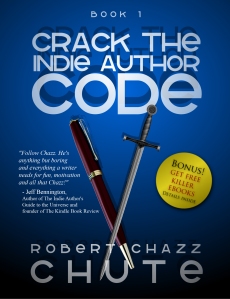
~ Robert Chazz Chute is the author of Crack the Indie Author Code and Write Your Book: Aspire to Inspire as well as a bunch of books of suspense including Bigger Than Jesus, Higher Than Jesus and Self-help for Stoners. His new book, Murders Among Dead Trees, is the definitive collection of his short stories. It will be released later this week. To hear the All That Chazz podcast, go to the author site, AllThatChazz.com. For all the links to Chazz’s books, click here.

Filed under: publishing, , , , , , , , , , , , , , , , , , , , , , , , , ,

#NaNoWriMo: You’re tired. Dream some more.

Crack the Indie Author Code and Write Your Book: Aspire to Inspire both have bonus offers of free ebooks.

Writers are a tribe bound together in loose nomadic groups travelling in the same direction along parallel lines. We are  slathered in poverty and fear and unrealistic hopes. But we are also sharers and people pleasers. We are the dreamers.

If you are a writer, someone in your life is trying to wake you from your dream: You are a child lost and frantic in a busy marketplace and that chasing frenzy will pull you from sleep’s safety. Readers are beautiful objects of desire but your love is unrequited. You have disappointed yourself and fallen into the gap between the great vision you saw from far away and the lesser book you crafted with your hands. Everyone falls short, but nomads keep moving. Writers continue to stretch and reach. Sometimes you will curse your blessing and you will wake, startled and disoriented and blocked. Go back to sleep.

Stay asleep and dream. Burrow down under the blankets. Pull the quilt over your head. Some people — busy but still somehow accomplishing little or nothing — can’t bear to see someone warm and comfortable. Busy people in busyness are blind to your mind. They can’t see that you are happily occupied in Creation, elsewhere and elsewhen. We are Zen masters, actively doing nothing for a larger cause that awaits us in paper and pixels. New futures demand that you be different.

Write and, when you run out of space in your dreams, read to make more room for the next night’s escape. You have the creative virus. Those who would wake you from your dreams can’t understand the compulsion your disease insists upon.

Write and make worlds. Your dreams are important. Never doubt that. Your night work is important because we are the creators of escapes from the waking world and busyness.

Writing, above all, is a kind thing to do.


Filed under: publishing, , , , , , , , , , , , , , ,

Writers: Who do you want to be?

Ever been to a writer’s conference or a Comi-Con? Both kinds of conventions have something in common: Lots of people who wish they were someone else. The exhibitionist dresses as Poison Ivy (and has very close friends willing to paint her ass green.) The twenty-something is dressed up as a sad Autobot made of cardboard. The writer wants to be an author. Of these three examples, it’s the writer who can do something more concrete and lasting about his or her ambition. 

I feel self-conscious, uncomfortable and sometimes a little claustrophobic at these events. Mainly, I’m acutely aware of the Us and Them aspect of the relationship. The “celebrities” are over there, with security, publicists, handlers and an aura of wary separation. We “wannabes” and fans are in the pit, reaching up, grasping at the edges of dark holes, daring to touch the light in search of heat.

We yearn. We have not attained.

As writers, we want recognition of our work. We want privileges and respect, too. That power is illusory, sure. Knowing intellectually how fleeting and useless it is doesn’t make that goal any less tantalizing. As powerless as writers are in so many ways, the indie author feels his or her potential most. That’s the power of seething delusion transmuted into hope by our next great idea for a book. Art seduces its creator first. Indie authors have few barriers to publication and little time to wait. All that kinetic potential can make you high. Unrealized potential can make you angry.

It’s not jealousy that gives me this grim face. My annoyance is at myself. I’m bothered that I didn’t plan out my life in such a way that I am who and where I want to be. I’m not a “wannabe.” I’m a “shouldabeenbynow”. I want to be comfortable being me. I don’t want to stand on the outside of that metaphorical velvet rope, wishing I were someone suffering the problems that success brings. I want it all and, as Queen sang, I want it now.

Someone will tell me I should be happy with who I am. Bullshit. From where, then, would my ambition come? Needing to escape makes me try. I yearn for that addictive, dopamine-fueled floating sensation that comes with the composition of new life. I long for happy readers extolling me for aping God. Sharing entertaining stories with huge numbers of readers gives me stamina for the late night attack on that difficult, late middle in my manuscript. Greed and ego give me patience for solving seemingly endless formatting problems.

Let’s be clear: Wanting things is not the path to enlightenment. That’s okay. I’m not on the path to enlightenment. I’m on the path to publication. 

Some people say greed and ego and recognition are unworthy stimulants to propel you on your course. I say, take your motivation where you find it and go forward, self-aware and honest. Clearly, I’m not in the spirit of these events. I’ll go to these things again when the organizers ask me to sit on a panel. I’ll enjoy it much more when there’s someone excited to speak with me, not the other way around.

Meanwhile, my place is at the keyboard

dreaming up the lies

that make me who I am supposed to be.

Filed under: publishing, , , , , , , , , , , , , , ,

The one critic who made me weep

We often don’t think deeply about the good that criticism can do. The kids are watching the charming movie, Ratatouille, over and over. For reasons of my change in occupation in the last year (i.e. writing full-time) I paid more attention to the review within the movie, a voice over by the character of the demanding critic, Anton Ego. It’s a fun movie, but this one bit about criticism? Hearing it afresh in new circumstances and caught by surprise, the speech moved me to tears. Not a lot of tears, but definitely misty.

“The new needs friends.” Oh, my, yes.

Here is Anton Ego on the good critics can do:

In many ways, the work of a critic is easy. We risk very little, yet enjoy a position over those who offer up their work and their selves to our judgment. We thrive on negative criticism, which is fun to write and to read. But the bitter truth we critics must face, is that in the grand scheme of things, the average piece of junk is probably more meaningful than our criticism designating it so. But there are times when a critic truly risks something, and that is in the discovery and defense of the *new*. The world is often unkind to new talent, new creations. The new needs friends. Last night, I experienced something new: an extraordinary meal from a singularly unexpected source. To say that both the meal and its maker have challenged my preconceptions about fine cooking is a gross understatement. They have rocked me to my core. In the past, I have made no secret of my disdain for Chef Gusteau’s famous motto, “Anyone can cook.” But I realize, only now do I truly understand what he meant. Not everyone can become a great artist; but a great artist *can* come from *anywhere*. It is difficult to imagine more humble origins than those of the genius now cooking at Gusteau’s, who is, in this critic’s opinion, nothing less than the finest chef in France. I will be returning to Gusteau’s soon, hungry for more.

See the movie again. It might get to you, too.

Filed under: publishing, , , , , , , , , , , , , ,

NSFW: Make stuff

As you regular readers know, I love Kevin Smith. Here’s another reason.

(And yes, this applies to books, too.)

Filed under: publishing, , , , , , , , , , , , , ,

Ultimate Blog Challenge: Risk more

There’s a scene in the Woody Allen movie Midnight in Parisin which Owen Wilson’s character meets Salvador Dali. I’m a fan of

Woody Allen

Woody Allen (Photo credit: ThomasThomas)

Dali and Adrien Brody makes him weird and charming and, at that moment, obsessed with rhinos. After meeting Dali, Wilson’s writer character (an undisguised Woody Allen surrogate) starts to think that he needs to let his imagination off the leash and be more creative with his writing. I do wish more writers took chances and drew outside the lines.

Experimental fiction has a bit of a bad rep and sometimes for good reasons. It also gets a bad rep for bad reasons and the big bad reason is the author’s fear. Too often we hear that readers want to be made “comfortable” with a story. Agents and editors want “the same thing only different” from the successful authors they happen upon. You can write a competent mystery, thriller, romance — whatever your flavor — but I don’t think you can do anything great if you don’t stretch at least a little bit. Playing it safe means going with the tried and true. There’s plenty of that already.

The reader and writer in me is screaming, “No!”

A writer wants to do something more, different and great. A reader wants to feel like they are in confident, competent hands so they won’t invest a lot of time in a book and three-quarters of the way through discover the story has gone off the rails. Take your risks but make it plausible within the context of the book. I’ve just put a book down because an author made a choice that was implausible and annoying. For the first chunk of the book, we understand we are dealing with astronauts just back from Mars. After the three-year mission is over, they discover that one of said astronauts isn’t what he appears to be. He’s an astronaut impersonator. Really? Maybe that would work for some people, but it didn’t work for me and I put the book down, possibly never to pick it up again. I’ve got a lot to read. Life’s too short to waste on books that don’t work for me. If the author had made the astronaut impersonator the guy who messed up more, the conceit might have worked. Instead, the non-astronaut is the ultimate astronaut. Yeah, right. Got a brain tumour? Hand the scalpel to the brilliant amateur because he’s read some books and has a fresh take on this whole “surgery” thing. Ugh.

Please do take risks with your stories.

Go to unexpected places and surprise me.

Make me believe

(because I really want to believe.)

Midnight in Paris isn’t a great movie, but there is something very appealing about a cadre of artists in Paris in the ’20s who interact with each other, bounce ideas off each other and critique and encourage each other to reach beyond the norm. Too many people were living lives of quiet desperation (like now) while Hemingway or Gertrude Stein asserted themselves and their art as an important value, not a frivolous hobby. I don’t care for Stein’s writing at all and I prefer Hemingway’s short stories, but how noble to be so invested in art for art’s sake! Are we still invested in art or is our attention too fractured? Is there an equivalent to Paris in the ’20s now? Or have we devolved in our expectations of the value of art so much that we melt into the lowest common denominator of art critic: a mewling pack of trolling eunuchs at the harem with nothing to offer but barely literate, troglodytic snipe and snark in one-star book reviews?

Midnight in Paris succeeds only so much as nostalgia for an ex-pat community of artists in the 1920s succeeds, but I do love elevating art. When two hoods in an Elmore Leonard novel or a Quentin Tarantino movie or a Guy Ritchie film have conversations that you don’t expect, that’s a writer taking a risk to bring us more beyond the usual schtick and making it work. That’s “a Royal with Cheese.” That’s “Leave the guns, take the cannolis.”

Smack your reader with something they don’t expect.

Make them love you anyway.

Filed under: publishing, , , , , , , , , , , , , , ,

On judging books by their covers

Thank you to everyone for your input on the covers for my book, Self-help for Stoners, Stuff to Read When You’re High (available on all e-readers Nov. 1, cha-cha-cha!)

The input has been put in. By a huge majority, the votes are for the bright orange cover (below). When it’s on a shelf, digital or wooden, it will stand out. It was an interesting experiment to see how people reacted to the covers. The happy thing is that, even among people who weren’t so sure about the orange cover, most of them still thought that cover could be effective. The other aspect about book cover colors is a little more inside baseball: The rule of thumb is that, unless it’s a golf or gardening book, green covers don’t sell very well.  (It’s one of those weird little details I learned from the Banff Publishing Workshop. It was reinforced by years of selling books for multiple publishers. I’m not sure about much, but that tidbit is pretty consistent except for The Celestine Prophecy.) 

Soon you’ll be hearing from my graphic designer, Kit Foster of www.kitfosterdesign.com. Kit’s a novelist, too, and very talented. Someone told me the other day how impressed he was with Kit’s covers. They do look like they’re from a large publishing house, not my tiny kingdom of Ex Parte Press. We’re all told we shouldn’t judge a book by its cover, but we all do. Without a solid cover, no one will pick it up or click on it to discover the tasty treats inside.

The process of working with a graphic designer: When Kit and I started a dialogue about book covers, the arrangement evolved organically. I described what I had in mind and sent him a sample of the manuscript. He suggested a few things and I saw his wisdom and asked for some tweaks. He sent me a cover and we narrowed it down with another round or two or three of tweaks. His input was invaluable. I have no idea how he does what he does and I bowed to his experience with graphics. Even though I have a deep background in selling books, my focus was the words. Kit came up with the images to sell the words. With Sex, Drugs & Romeo, the final graphic is very close to his original proposal. With Sex, Death and Mind Control (for fun and profit), we went back and forth a bit more, but Kit was always patient and helpful. The only element I knew I wanted to keep was the author tag. I wanted it to be consistent across the bottom in cherry red on all the covers so my books would be instantly identifiable for cross-promotion purposes.

Kit’s great at what he does and a photographer friend of mine is also awesome. I’m going to ask them to guest post and drop some science on us about the art of book cover creation. In the meantime, rethink your green cover and ask for a poll from your network of writer friends and readers. People will often help if you dare to ask.

Filed under: Books, ebooks, self-publishing, What about Chazz?, , , , , , , , , , , ,

TOP 10: People (who are not fans)

Old marketing decreed:

Get everybody! Your sales quota must include all sentient species with a credit card in the known universe!

New world marketing responds:

Nope. Establish a base of just a bunch.

But the bunch has to be rabid and slavering for your next masterpiece, book, song, film, poem, service, comic, or sex toy.

In short, you need fans (as in fanatics.)

For self-publishers, everybody in your fan base starts out as a reader, but they won’t all join you on your journey and buy in to your revolution. A lot of people can’t even be bothered to cross the street to spit on you. Something I learned a long time ago was that I am not everyone’s cup of pee. (Note to non-fans: that’s a joke and a point, not a typo.) I learned that to build successful businesses or loving followings, I had to focus on the people who appreciate me and ignore the rest. Oddly, everyone knows the 80-20 Rule, but how many apply it to their lives?

Critics will sap you of time and energy if you pay them too much attention. A fellow writer got one bad review recently. All his reviews were overwhelmingly positive except for that one. That burned like a cigarette in the eye. That’s the key to understanding the dark side of Internet marketing. Yes, you can spread the word faster about a good thing. However, negative reviews can get a lot of attention, too, mostly from the author who serves as the critic’s target. In fact, several authors have observed a bandwagon effect among some reviewers and book bloggers. One bad review can lead to more bad reviews. Ironically, as Reena Jacobs observed recently, it may be worse not to be reviewed at all than to receive negative reviews. If readers love or hate your book, at least you’ve spurred a reaction. If you ignite no fire at all, that may be a bad sign.

Here’s what to keep in mind when you read something negative about your work:

1. People (who are not fans) are nastier on the net than they would ever dare in person. They aren’t talking to you as a person with feelings and aspirations. They’re having a conversation in their heads with the idiot they imagine you are. Cyberspace allows distance, anonymity and depersonalization. Your nice neighbour, that little old lady who gets your mail for you while you’re on vacation and bakes cookies at Christmas? If her favorite author kills off a regular series character, the old dear’s mind can curdle into that of a serial killer when she writes an Amazon review.

2. People (who are not fans) mistake your work for you and judge you along with the work. If one of your books, blog posts, comics etc.,… is not as good as the others (and inevitably that will be so) critics will make assumptions about you and your mental state. Don’t you mistake all of your work for you though. They’ll make it personal, but don’t fall for that trap. Unfortunately, because we wrap up the author’s persona with his or her book to sell it, we foster an absurd inseparability in people’s minds. For instance, when Deepak Chopra was on the road selling a natural health book and had the temerity to drink coffee (OH-MY-STARS-AND-GARTERS!) a reader tried to shame him for it. That little old lady was pissed.

3. People (who are not fans) are more likely to write something negative than positive. Look at all those letters to the editor in the newspaper. Not so many saying, “Good job!” are there? Now think of the five best books you’ve ever read. Go to Amazon. See those negative reviews of the books that changed your life? Are you starting to see the weight you should give negative reviews yet? This is a subjective business. Repeat that until it sinks in. (I’m still repeating it, too.)

4. People (who are not fans) say things for their own reasons that don’t necessarily have anything to do with you. Maybe they made a bad day and want to export it. Maybe junior high was tough and the Internet is where they get even with strangers. Review the beginning of the movie Wanted. Remember the “I’d feel sorry for you if you weren’t such a bitch, Janet” speech? Repeat as necessary. (If you’ve ever worked in a cubicle farm, that scene alone will make you leap off the couch and spill your Cheetos all over the floor.)

5. Maybe you gave the person (who is not a fan) a negative review and it’s payback time. Yes, this happens. Maybe you friended them on Facebook, but you weren’t fast enough about getting that friend confirmation done and they took offence. Who knows? Everyone take everything personally because we are all the stars of our own movies. This has nothing to do with your work, but your work gives an opportunity for nasty people to say something shitty. Some authors don’t read reviews at all because, they argue, “If I believe the good ones, I’d have to believe the bad ones, too.” These are very mature people I can’t relate to. I don’t personally know anyone with that much self-control. I envy their sagacity.

6. Negative reviews are easier to write than positive reviews. Snark is easy. Snark is even funny sometimes, but mean’s no good. And if you’re going to be at all mean, you better be twice as smart as you are mean. For instance, I enjoy listening to Slate’s Culture Gabfest podcast….but sometimes I wonder, “Do these people ever like anything?” People (who are not fans) enjoy being clever at your expense. That does not necessarily equal constructive criticism. Maybe it’s just bitchy. Or stupid or wrong. Or all three. In this part of the equation, it’s not about you or your work. It’s that some people’s only creative outlet is criticism. Some fleas think they are driving the dog.

7. People (who are not fans) hope you’ll fail so they can feel better about their failures…or that they failed to try at all. Doing nothing at all is a great way to avoid criticism. Except for that pesky self-loathing and the long darkness before dawn when the demons come to torture your dreams and stifle your soul’s breath. (Yes, I’m saying that being a loser is like sleep apnea and all the implied dangers of heart disease but without the medical attention and sympathy from friends and family.)

8. People (who are not fans) don’t have enough going on in their lives, but they’ve got lots of time to focus on you. Otherwise, why the hyperbole about how bad your book is? I love books, but it’s just a book review, not the Nuremberg trial. The way some reviewers go on, you’d think trying and failing to entertain or educate or pass the time was a hanging offence. Another friend got a bad review recently. The ebook she gave out was free. The level of criticism did not match the critic’s financial and emotional investment. This author was wise enough to ignore the naysayer because she knew the guy wasn’t in her fan base and never would be. So what? There are plenty of readers out there to be converted to your peculiar brand of evil jocularity.

9. People (who are not fans) may be right. Maybe you do suck. But you can’t think that and succeed. You can only try to do better. Forgive yourself. You are a work in progress. “Books are never finished,” Oscar Wilde said. “they are merely abandoned.” Only listen to the people you trust. There are too many variables in the skulls of strangers who are not your fans. Write to please yourself first and don’t listen to input from writers too much. To write is to do your thing. That’s one reason so many people keep writing despite insufficient recompense, Carpal Tunnel Syndrome and their parents’ bitter disappointment. (On the other hand, if every review is negative except the one from Mom, rethink.)

10. People (who are not fans) can be fickle. Tim Ferris, author of The 4 Hour Body, observed that a fan base has two extremes. At the top are the people who will follow you down the mouth of a cannon. At the bottom are haters who want to fire you out of said cannon. Ferris feels that the people at the extremes can switch places. Do something too different and some former fanatics will resist the new direction and even become haters. Be unexpectedly nice to your enemies and a few may come around to decide you are a worthy human being after all.

Or you could say “Screw ’em!”,

focus on the people who do get you

and move along briskly.

If you read all the way to here and hated the post, why did you read this far? It was too long a post for that nonsense. I will never understand that about haters. Don’t they have shit to do?

If you loved this post and it came at just the right time and you couldn’t have done without it…thank you. I love you for a selfish and stupid reason: You love something I wrote.

Filed under: publishing, Rant, Rejection, reviews, self-publishing, web reviews, Writers, writing tips, , , , , , , , , , , , , , , ,
Bestseller with over 1,000 reviews!
Winner of the North Street Book Prize, Reader's Favorite, the
Literary Titan Award, the Hollywood Book Festival, and the
New York Book Festival.

http://mybook.to/OurZombieHours
A NEW ZOMBIE ANTHOLOGY

Winner of Writer's Digest's 2014 Honorable Mention in Self-published Ebook Awards in Genre

The first 81 lessons to get your Buffy on

More lessons to help you survive Armageddon

"You will laugh your ass off!" ~ Maxwell Cynn, author of Cybergrrl

Available now!

Fast-paced terror, new threats, more twists.

An autistic boy versus our world in free fall

Suspense to melt your face and play with your brain.

Action like a Guy Ritchie film. Funny like Woody Allen when he was funny.

Jesus: Sexier and even more addicted to love.

You can pick this ebook up for free today at this link: http://bit.ly/TheNightMan

Join my inner circle at AllThatChazz.com

See my books, blogs, links and podcasts.

Enter your email address to follow this blog and receive notifications of new posts by email.

Join 2,063 other subscribers