C h a z z W r i t e s . c o m

See all my books at AllThatChazz.com.

TOP 10: Get your writing motivation back & finish your book

Pie chart of Wikipedia content by subject as o...

Image via Wikipedia

Sometimes you lose the thread. You burn through the first 40 or 50 pages and then…now what?  Augusten Burroughs doesn’t believe in writer’s block. He says that if you think you have writer’s block, write about the block and you’ll find your way out. Frankly, that hasn’t worked for me. This is what I do to churn the letter butter and make it thick:

1. Reread the last ten pages before you got stuck. There’s probably something there to riff from.

2. Reread the first ten pages and get back to where you were headed to begin with so you can find the trail you lost.

3. If you’ve got an outline, go write an easy scene. If the book is a ball small enough that you can hold it in one hand–and you make it small by using an outline–you can skip forward to a scene you are sure of.

4. When you’re stuck, go back to the characters. What’s the special need and want of the character (often not the same thing in a layered, complex text)? Find the truth of that character. What does the character do next?

5. Search for the emotional truth between and among your characters. Write that.

6. Search the conflict between and among your characters. Maybe you’re stuck because your characters are too agreeable.

7. Change the setting. Too many characters stand around in living rooms talking at each other instead of engaging the world. It’s not a stage play. A novel has as large a canvas as you can imagine. Get your characters up and out in the world where things happen.

8. Think visually. What would the movie of your book look like? What are people doing? Do they have special skills? Draw on your own experience or do a little research to get you through a scene. (Do as little research as possible on the front end, though. I wrote a story in which a character got pulled into a saw at a lumber mill. First I wrote the scene. Then I consulted an expert who said it shouldn’t be a saw but a machine called an edger.)

9. Still stuck? My trick is to get out a book (usually a dictionary) and choose three words at random. Work those words into your next chapter. (Clicking random in Wikipedia works great for this strategy, too.) This will take you places you wouldn’t have found otherwise.

10. Take a break. Change your setting. Trying to tough it out so you produce typing but no worthwhile writing is not working smart. Do something totally different. Go get chased by a bear, move, run, go watch people, have an espresso or nap. Refresh your writing mind by demanding nothing of it. The world will have to wait until you’re back where you need to be.

Filed under: Writers, Writing exercise, writing tips, , , , ,

New mugs for editors at http://www.cafepress.ca/chazzwrites

As I recover from minor surgery, I’m taking it easy today. However, I do have a new product up at the store for editors who want to gently remind writers that it’s not called a liveline. It’s a deadline. Check out the new mugs here.

In fact, check out all the inventory at my store.

Tomorrow, in case you are struggling with a deadline: Top 10 ways to get back your motivation to write. Then, a post on how to edit without reading. Crazy shit, I know! Stay tuned.

Now I’m back to the couch with one more day feeling sorry for myself. I’ll get my groove back tomorrow, Stella.

(I’m okay. Minor injury sustained while defending Gotham from dark forces.)

Filed under: blogs & blogging, Editing, Editors, Shop Happy, writing tips, , , , ,

Controversial blog posts, hate mail & puppies on fire

I write a column for a trade magazine. I get a lot of fan mail (he said modestly). I have a folder stocked with happy reader feedback so if I ever need talking in off the ledge, many kind subscribers’ letters to the editor might stop me from the jump to pavement lasagna. But,  of course, it’s the negative reviews you remember.  

What’s surprising about negative feedback is how surprising it is. Let me explain that obnoxious tautology: I’ve written columns I was certain would stick in somebody’s craw. I’m reasoned, but sometimes provocative and I do poke the odd sacred cow through the skull with a nail gun.

But it’s often the posts

I consider more bland which spark  readers’ ire most!

For instance, I wrote a humorous feature that detailed the uses of therapeutic laughter. The tone was light, though I did stir in an interview with a neurobiologist and instructive tips. Most people didn’t just like it. They loved it. We got a lot of really nice letters. It’s a special thing when people take the time to say good things about you. The spur to action usually skews the other way. Angry people write more letters than happy people do.)

As great as the response to the article was, from that same feature there was one letter from the reader who did not just like it. In fact, she loathed the piece (and me.) She objected to the jokes. It was clear she didn’t get the jokes. There are, perhaps, billions of people who don’t share my sense of humor. Not only can I not change that, I wouldn’t want to appeal to the humorless.

People who get all angsty and vituperative about your writing share a common trait. They act like the one thing you write is the sum and totality of your writing. It kind of amuses me (okay, it amuses me after some time passes) when people get bent out of shape from one thing I wrote. I write lots of stuff. Read it all and get really pissed, or realize that if you don’t care for something, there’s always the next page. There’s always something else to read.

Don’t say something you don’t believe just to be provocative. Satire is fine. Parody’s good. Be fun and playful. Be as funny as you like, but make time to be sincere when you’re making a serious point. Don’t pander.

People sometimes accuse Bill Maher of saying outrageous stuff just to get a reaction. Not true. One survey showed that Maher’s die hard fans only agreed with him 14% of the time! He’s funny, insightful and can be cranky. But he’s not a crank easily dismissed. He’s thinking and doesn’t fall to one side of all issues all of the time.

This is counterintuitive to how many people act as they write their (unread) blog pasts. People often think that only people who agree with them will like them. If you’re funny and interesting and reasoned, thinking people will listen. Your blog’s grasp can go beyond the reach of your mom.

When I read blog posts I dislike, I rarely comment on something with which I disagree unless I know the people involved or think it will make a difference. I won’t be phoning Rush Limbaugh or Glenn Beck to try to disagree with him on air, for instance. People don’t listen to Rush to get ideas. They listen to confirm their own fears and prejudices. Echo chambers aren’t designed for more than one loud voice. Life’s too short to pursue debates with people who will never change their minds no matter what. (And I won’t change my mind on that.)

“Pearls before swine,” as Jesus said.

(Note to Mr. Beck: Jesus is an important guy in the bible whose words are written in red so they are easy to find. Like you, he talks about economics a lot, too. You appear unaware of the things Jesus said. Take a look.)

Real world example: Today a friend linked to a post so I checked it out. I found it utterly vile. The essay was an extreme so-serious-I-hope-it’s-parody, divisive, lying hit piece that underestimated both liberal and conservative thought. I didn’t comment on the post itself because I’m not giving that hateful essayist the satisfaction. Instead I left a comment on the original Facebook link to let my friend know I thought his link choice was disturbing.

To be fair to him, his intent puzzled me. I’m really not sure if he linked to it as an example of a good thing or a bad thing. Whatever his opinion on that issue, he’s still a great guy and a great friend and I’m not writing him off if he shares those (crazy) views. He no doubt has a lot of other views I agree with and I know he is an admirable, heroic fellow. (And no, I don’t know if he reads this blog or not since he’s not in publishing.)

Mental note:

Don’t provide links to hate-filled sites.  

Debate and dialogue of substance? Okay. 

Stupid shit? No time.

The take away? Don’t let negative feedback throw you. If what you write is so bland it never offends anyone, it often isn’t worth writing. There’s nothing new and interesting about your blog posts if every one of them is the equivalent of a basket of puppies. If you’re going to keep readers, you’re going to have to be compelling, informative or at least engaging. Don’t tell me about the weather. Say something you believe. Make me laugh. Make me spew my coffee over the screen. Set a basket of puppies on fire once in a while.

Case in point: You might expect conservative readers to object to me condescending to Glenn Beck. Perhaps defenders of the mentally unstable will chime in on that score, too. You might expect liberal readers to object to any mention of Rush or Beck since they already get too much attention everywhere. Maybe you think people will get angry about the notion of setting fire to a basket of puppies.

Personally? Since a basket of puppies set afire is an obvious joke in terrible taste, I’m betting someone will object to the reference to a nail gun through a cow’s skull. Vegans are fascists worse than Hitler. (Kidding! Kidding!)

As Bill Maher says, “I kid! I kid because I love!” 

Heh. 

Filed under: blogs & blogging, Intentionally Hilarious, Rant, Rejection, reviews, Writers, writing tips, , , , , , , ,

India Drummond’s generous book give away

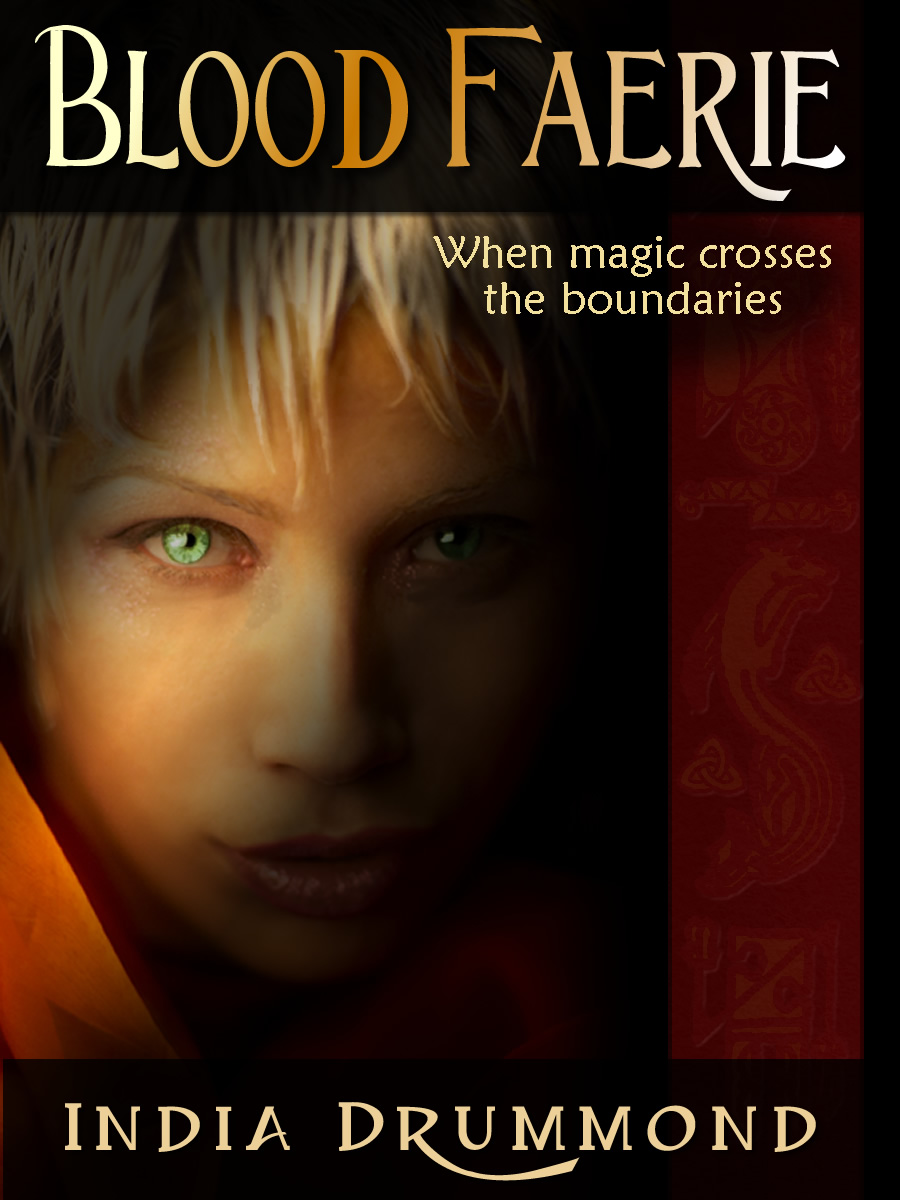
To celebrate the launch of her latest urban fantasy novel, Blood Faerie, author India Drummond will give away five Kindle copies of her book on its release day, June 1, 2011.

Blood Faerie is the first in India Drummond’s new series, Caledonia Fae.

Unjustly sentenced to death, Eilidh ran—away from faerie lands to the streets of blood-faeriePerth, Scotland. Just when she has grown accustomed to exile, local police discover a mutilated body outside the abandoned church where she lives. Recognizing the murder as the work of one of her own kind, Eilidh must choose: flee, or learn to tap into the forbidden magic that cost her everything.

To enter to win a Kindle copy of the new book, all you have to do is sign up for her email newsletter. The email list is only used to announce book releases and important events, and emails are sent out infrequently. (It’s free, and it’s easy to unsubscribe after the contest date if you find it’s not for you.) Sign up here.

Five winners’ names will be announced on the India Drummond newsletter on June 1st, along with instructions for how winners can claim their free Kindle books. Only subscribers are eligible to win.

No Kindle? No problem! Anyone with a PC, Mac, or smart-device (iPhone, Blackberry, Android phone, etc) can read a Kindle book. Download free reading software here: http://www.amazon.com/gp/feature.html/ref=sa_menu_karl3?ie=UTF8&docId=1000493771

Want to quadruple your chances of winning? Simply tweet about the contest with a link to any participating blog post and include @IndiaDrummond in your tweet. Or, share the link on Facebook. (But be sure to add @India Drummond to tag her on the link so she will see it! – You can add her to your friend list here: http://www.facebook.com/india.drummond)

And finally, add another entry to the list by posting about the contest on your blog.– Tweet and share the link as much as you like, but only one additional entry per method, per person.
Good luck, everyone!

Filed under: authors, Books, Contest announcement, e-reader, ebooks, links, , , ,

Writers: Story first. Message last.

Solar panels, thermal energy, wind power, nuclear power, the fact that you can read these words in pixels: Ours is a sci-fi continent in a horror world. The horror world is patrolled by robot drones whose pilots are on the other side of the planet raining death on warmongers and civilians alike.

So where are you in this world? Does your fiction enhance understanding? Are you making anything better? Is that even your job as a writer?

You may have a lot to say and a lot to teach, but don’t start from that place. Your themes will emerge from your story. And let your readers draw their conclusions instead of telling them what to think and how to feel.

It’s tempting to speechify. My first drafts are full of speeches. Then I cut it, or break it up or intersperse action or provide another character’s counterpoint to increase tension, drama and conflict.

A good story well told will evoke emotions. Find the truth of those emotions and people will read your story all the way through. And after they’ve closed your book they’ll still have something to think about.

Start from the message and they won’t get to the end of your book.

Filed under: Writers, writing tips, , ,

25 odd things you didn’t know about me

Photograph of right posterior human distal rad...

Image via Wikipedia

1. Years ago I worked as a healer and got a woman who was nearly a quadriplegic out of a wheelchair. She recovered to the point of independence and is still walking and driving and traveling to this day. She became a healer in turn.

2. I’ve chipped two teeth, broken a toe and fractured a wrist while fighting. (The wrist belonged to someone else. It was a sparring accident.) I got much more hurt and into much more trouble preparing for violence than having to deal with it for real. I should have taken verbal judo, instead.

3. Before I was an atheist, I was a member of a fundamentalist Christian church. I lost my faith—or tossed it over my shoulder on the way out—after a couple of close friends died.

4. At one point I trained six hours a day in Hapkido. I thought I did it because I was a bad ass. Actually, I did it because I am not a bad ass. I was searching for a way to protect myself from a childhood filled with violence.

5. I didn’t have a sense of humor, or express it much, anyway, until I was 22. I learned I could make people laugh at the Banff School of Fine Arts. I had tried to be funny previously, but my family and high school and college experience repeatedly shut me down. “Who do you think you are?” they said. Once I got out of bad situations I realized the answer to that question is, “You’re uptight, I’m me. And that’s enough.”

6. I had a job from which I should have been fired. I made the boss laugh so hard every time we weren’t arguing that I kept the job until I finally left of my accord. Sadly. Shoulda gotten out of there much sooner.

7. I lost a job I did very well. The Powers that Be didn’t like questionable policies being  questioned. They assumed I did my job poorly because I was a pain in the ass. They didn’t recognize what integrity looked like. I’m better off. They’re the same.

8.  I’m still convinced someone’s watching me but I don’t believe in God. I cannot resolve this contradiction. Could be narcissism, though. This very list would seem to tip the scale that way.

9. I read ten books at one time. Minimum. Aside from enjoying my huge book collection, I browse a library is like a crack head loots a pharmacy in a riot.

10. I’m writing four books at one time, which explains why they are so slow to come to market. When they do arrive later this year, they’ll arrive in a mighty clump. Or, if you’re not into my fiction, a big dump.

11. I’ve been a best man only once, at a gay wedding. That should be an innocuous fact. Instead, since the world is the fearful place it is, it’s a fact of which I am very proud. One day soon, it will be a fact that should construe nothing more than an idle curiosity.

12. I used to be angry all the time. Now I sublimate my rage with humor. Actually, I joke around a lot. Now that I think of it, that’s still all rage.

13. I remember every slight, real or imagined, with perfect eidetic clarity. I’m still angry at dead people who insulted me when I was seven.

14. I am an extremely gifted massage therapist. My palpation skills, knowledge and execution are beyond compare. It’s not the sort of thing that gets much respect, though.

15. If I hadn’t met my wife and soul mate, there’s an excellent chance I’d be living in a refrigerator box. Or extremely depressed in a very responsible job with a couple of angry  ex-wives. Instead I’m always safe at home, hiding in my fortress of solitude.

16. One of the best, oldest friends I ever had walked away from me one day. I called and called and he never called back. At first I assumed he was injured or dead. Then I found out I was dead to him. I have suspicions, but the truth is, I really don’t know why that happened. I wish him well, wherever he is.

17.  Before kids, fear defined me. My children redefined my life (as happens to everyone, right?) Now it’s all about the love. I thought I’d work much more after the birth of my eldest. Then I held her for the first time, locked eyes and I knew I couldn’t allow anyone else to guard her. I became a house husband and stay-at-home dad permanently.

18.  I’m scared about a future with no financial security. I’m taking more risks, not fewer, to change that. Take the shot.

19. I wish my few friends lived right next door. There’s not much chance of that considering I’ve moved about twenty times in my life and have lived for extended times in three provinces, far east, far west and central.

20. I give a lot because I’m a people pleaser. Sometimes I wonder if I’ll ever get much back. They say karma’s a bitch. I say karma’s an extremely slow bitch. Where’s my lottery win, bitch?!

21. My childhood really began when I escaped a small town childhood. They resented me for saying life would begin when I left. I was right, though. Cities are my natural environment. (Also, I was right about the algebra: Never used it, never will.) Escape is my answer again.

22. Fiction allows me to murder people in a socially acceptable way. I think about it. A lot.

23. I’m a caring and very sensitive person. I’m also selfish. I cannot resolve this contradiction for you if you are confused.

24. In my internal monologue, there’s a lot more swearing.

25. My ego’s bigger than yours. Also, my id is BIG LIKE HULK. But aside from reading that here, even if you met me in person, you would never ever know it.

I have held a human heart in my hands.

However, even if you saw open somebody’s head and peer in, no one really knows the inside of anyone else’s skull. 


Filed under: Unintentionally hilarious, What about Chazz?, , , , , ,

Writers & Readers: I say something new & cranky

Joe Rogan

Image via Wikipedia

Alfred Hitchcock once said a painter needs a brush, a writer a pen and a director an army. The numbers needed to make a film are coming down, but it’s still a collaborative, team sport (or a war, depending how indie you are as a filmmaker.) Painting  is still a solo pursuit and for a long time writing was solitary. Then writing got decidedly less solitary. And now, with self-publishing, the game has changed again.

Authors used to have publishers. Later, agents entered the industry and took pressure off editors by curating. They helped many authors get better deals. Now a lot of agents want to intermediate and perform more of an editorial function, possibly because other traditional roles they have fulfilled are shrinking. See this post for more on that and much more.

Now there can be fewer people between you and publication. Publishing isn’t necessarily a team sport anymore. Publishing with a group of lovers of all things literary  has produced many great books (and has probably interfered with the production of great books, too.) You may think many minds produce better material because all of us have more brain power than one of us. I used to believe that was true in all cases.

Then comedian Joe Rogan challenged that idea for me and articulated something that was slowly percolating through my cranium. In his experience as a comedian on The Man Show, he found that more suits on the set diluted the funny. His stand-up is a pure art form, moderated only by his own sense of humor and direct feedback from his audience. (I saw him at Massey Hall in Toronto recently. He rocks hard.)

It’s an old adage that too many cooks spoil the broth. Now science, as presented in the fascinating book 59 Seconds: Change Your Life in Under a Minute, has disproved the notion that more brains help a creative project. The most creative solutions are not arrived at by the most creative person in the room. They are directed by the loudest person in the room.

So, if your agent says “I’m not submitting your work because I don’t think it’s ready,” and you cede that power, your work isn’t going to market whether your agent is right or not.

This is the sort of thing that drives the traditional world of publishing nuts. Without those mediators, obstacles, curators, gatekeepers, shepherds and rabbis, the worry is that we shall be inundated with a slew of awful, awful books. The deluge shall be as a fire hose pointed at the tiny tea cup of our fevered minds. Without those helpful interlocutors, who will keep the bad books away?

Rather than address the curation question directly (and I’ve already addressed it many times on this blog), I’d like to say something new on the subject:

Even if that objection is valid, so the f**k what? I reject the premise. I say this is not about your convenience in going to a legacy publisher you trust for all your curation wants. This is about my freedom to express my art, which you can enjoy or not. As they say at the convenience store, “Buy or leave!”

The marketplace of ideas is opening up to a lot more shelf stock. Buckle up and put on your big boy Underoos and your big girl panties. Soon you might find more variety and much more current reading material to explore and fill your mind.

I value my sovereignty of expression more than your convenience.

I said this was a revolution. I asked you to join me.

Did you really think no one would get hurt along the way to the shinier, freer new world we’re creating? 

The results will surely be messy, but the cost of your tender sensibilities is really negligible. There will be a lot of bad books delicate grammar doilies will decry. You’ll see a lot of typos (though I see a lot of typos in traditional books, too, by the way, and yet the earth keeps on spinning.)

We value freedom and freedom of expression. A lot. The US Supreme Court allows the Westboro Baptist Church to protest at funerals with ghoulish signs without regard to the feelings of the families of the dead. Evidence obtained illegally is routinely thrown out and murderers are sometimes set free as a result. We accept some consequences far worse than inconvenience so that greater individual sovereignty is assured.

If it sounds like I’m saying your worries

about all the coming bad books don’t matter,

you’ve read this blog post correctly. 

Filed under: agents, authors, Books, censors, publishing, self-publishing, , , , , , , ,

Write your thriller in chapters: 10 tips for greater productivity

There’s no one way to write a novel. I do, however, have ten suggestions to make it go easier and faster:

1. Outline. Have some idea where you’re going and what the destination might be. It’ll save you time doubling back from dead ends. Believe me, I’ve written myself into cul-de-sacs and it’s a time suck no one can afford. (No, you’re not married to the outline and you don’t have to go OCD with the Roman numeral outline you learned in grade eight. I’m trying to increase your productivity and enhance your creativity, not shackle it.)

2. If you outline, you don’t have to write your story in sequence. With an outline, you already have the beats, the bases you have to touch as you tell your story. If you’re not feeling very inspired one day, no big deal. Focus on the high points of your outline on the days you don’t start off “in the mood.” Bonus benefit: you’ll get all your sex scenes written first.

3. Write each chapter as if it’s a short story. Your novel has a beginning, middle and end. So should your chapters. I often see substandard chapters which finish without the pulls of intrigue, a cliffhanger or a bang. Some writers reason that if they make the larger story interesting, they can afford to have a chapter or two that isn’t compelling. It does sound reasonable. It’s also wrong. Tension has one direction: up. There are way too many great books to read (and a million other things to do) so, for many readers, you bore them, you lose them. Sure, you’ve made this sale, but they won’t be burnt again.

4. For each chapter, identify a purpose. If a chapter has no dramatic purpose, drop it. Too often I see manuscripts where the characters are up and moving around, but to no purpose. (When editing, purposeless activity is called “business” as in “busy-ness.” There’s movement, but nothing’s really happening.  A chapter without purpose signals self-indulgence, a writer who got lost for awhile, not enough editing or an author who insisted on a tangent at the expense of the book.

The other common problem? Too much world-building and not enough character. A writer once described to me in excruciating detail about the far out environment of his book. It was a very ethereal place in space with no points of reference between human readers and the gaseous clouds that were his characters. I had to shut him up. He was driving me crazy with exhaustive, pretty detail. “But what’s the story? How is your reader going to relate to that?” Science fiction is about people first. Fantasy is about people first. Stories are all, at their core, about people and the choices they make. Sift your world-building detail in amongst action and character development. Otherwise, it will be unreadable, confusing or the reader won’t care.

Chapters with purpose are compelling and propelling toward an conclusion the reader wants to discover. (But they also want to be fooled, too. So make them say, “Ah, I bet I know what happens next.” Then find a way to surprise them. Read any of William Goldman’s novels to really get this deep into the marrow.)

5. What are the scenes in your chapter and are they in the right sequence? Are you revealing too much early in the story? Are you being too coy with the reader in later chapters? Does the pace pick up as you reach the climax and solve the novel’s core problem? Is it really a surprise (and logical) when you get to that climax?

6. Are you taking shortcuts in logic or logistics? Somewhere in your book there’s a less favorite scene or something that requires more research that, frankly, you don’t want to do. If your heroine is in Paris and your hero is in New York, they can’t meet in the middle of the Atlantic on a train (unless your novel is set in the future or a past that never was, of course.)

Are you missing a bridge to get you from one event to another? This is a logistics problem. Your FBI investigators are in Virginia at Quantico. The kidnapping is in the Pacific Northwest. Do you need a scene of conflict within the team on the private or military jet to get to the crime scene? You may make that transition in just a single sentence or it might be a chapter, but without some acknowledgement of the travel issue, it will be jarring for the reader to have them materialize in Seattle. Time and space and placement of people in relation to each other is something to trip over if you don’t make the effort to handle it logically.

7. Do your chapters fit together? Suppose you have an entire book that takes place, A to B, sequentially over the course of the hottest August in a century. But there’s that one winter scene you’re slipping in with a flashback. Does this puzzle piece fit in with the tone of your other chapters? If not, is there a reason for it? For instance, if your hero needs a look back at an early Christmas morning for the one time he was happy to give him a clue or change of direction, it fits better than an odd chapter that seems plugged in.

8. Is each chapter satisfying? This is a little different from #3, and a larger, more esoteric editorial question. You’ve written each chapter as a short story. That’s fine and can help you face the challenge of writing an entire novel-length manuscript. Now I’m asking, does each chapter feel full? Is it contributing something more to the larger story arc? When all these short stories are cobbled together, will each contribute to a greater whole than the sum of the parts? Is there a richness in description, character and action that will leave the reader satisfied with the effort overall? Is the core problem big enough to bother with a full-length book? Do you force the reader through several hundred pages only to kill off the protagonist (can be done, but often iffy) or worse, find out said protagonist is a lummox they hate? Too often, authors make their obstacles too small, the villains too stupid, the stakes microscopic and the core problem not nearly big enough. You don’t have to save the world on every outing. Maybe you’re just saving one person, but make us care.

9. Does each chapter’s length make sense? When I say “make sense” here, I mean, do you achieve in the chapter what you need to accomplish at an appropriate pace? Chapters don’t have to have a uniform length. Mary Higgins Clarke’s chapters get progressively  shorter as she goes so it feels like a race to the finish. I find I like short chapters as a reader (and as an editor) because I feel like I’m making progress as I go through, marking up the milestones. Short chapters often feel like a breezy  read. As a writer, however, I find my chapters are longer so they have time and space to wind to their conclusion. However, some writers go so short they aren’t providing enough beats within each chapter. I sometimes see underwritten, choppy chapters where action isn’t happening and characters aren’t developing. When that happens, you don’t have a chapter yet. In that case, you probably have the components for scenes within one chapter.

10. Set a schedule. If you use each suggestion here as a guideline, you also have an estimation for how long it will take you to write your novel based in real time.  Since you’re writing your novel as short stories, progressing at a fairly predictable pace, set an end date for the first draft. Make a schedule to get to that date and stick to it.

Follow these guidelines and you’ll make real progress toward your goals. 

Related Articles

Filed under: Books, Editing, getting it done, publishing, Writers, writing tips, , , , , , , , , , , ,

Writing Conference: 10 Bad things

When you go to a writing conference, there’s going to be information that’s good and information that doesn’t apply to you and information that’s quite bad. Here are some of the things that came up at my most recent conference which you can safely ignore as wrong or silly or misguided:

1. How will we curate all those bad books coming from self-publishers? I’m so tired of this objection, and have dealt with it so much elsewhere here, I’m not ev–zzz. (See Related articles below for that rehash if you feel the urge.)

2. Don’t mix gay narrative with straight narrative. So…ghettoize gays and keep everyone separate, as if our gayness or straightness is our single defining characteristic? Nope! I reject the premise. Screw you…in whatever way you prefer.

3. Order 1,000 books because, due to cost per unit, 1,000 won’t cost much more than 200 books. This, versus the more experienced publisher who pointed out that he only ordered what he needed because he knew it would take him two years to sell 500 books. (Plus a garage full of books is so depressing and unnecessary with the advent of POD.)

4.  Any worries about Amazon’s first novel contest. You have nothing to lose from participating in it.

5. Any worries that someone will steal your idea. There is a scientific correlation to this particular worry: The more you worry about it, the more your idea sucks anyway.

6. This is the end of publishing. Publishing’s changing, that’s all. Adapt or die.

7. I shudder at e-books. Then you’re old. Get over it or wait and that problem will resolve itself.

8. “Twitter is awful. What can I say in 140 characters?” This, from an editor. My internal monologue was: You must be a really lousy editor and you’re telling me you are committed to not being at all clever.

9. “Twitter cuts into my writing time.” This, from the same editor. If she read my blog (DEATH STARE!) she’d know (CHAZZ LAW) Twitter is for time that would be unproductive anyway. Fully functional adults manage their time. (And addicts have to want to change.)

10. “Get an editor for your self-published book!” This is not bad advice. It’s not wrong. However, it is condescending. The people who will take this advice are already on board. The people who won’t take this good advice won’t change no matter what you say.

Filed under: Books, Writers, Writing Conferences, writing tips, , , , , ,

Massage & Bodywork: Good news

The magazine in which I write a column just won another major award: best digital magazine of the year, for the second year in a row.

In a word: Yay.

Here’s a sample (I’m also on the contributor’s page): http://bit.ly/fl59B4

Filed under: publishing

Bestseller with over 1,000 reviews!
Winner of the North Street Book Prize, Reader's Favorite, the
Literary Titan Award, the Hollywood Book Festival, and the
New York Book Festival.

http://mybook.to/OurZombieHours
A NEW ZOMBIE ANTHOLOGY

Winner of Writer's Digest's 2014 Honorable Mention in Self-published Ebook Awards in Genre

The first 81 lessons to get your Buffy on

More lessons to help you survive Armageddon

"You will laugh your ass off!" ~ Maxwell Cynn, author of Cybergrrl

Available now!

Fast-paced terror, new threats, more twists.

An autistic boy versus our world in free fall

Suspense to melt your face and play with your brain.

Action like a Guy Ritchie film. Funny like Woody Allen when he was funny.

Jesus: Sexier and even more addicted to love.

You can pick this ebook up for free today at this link: http://bit.ly/TheNightMan

Join my inner circle at AllThatChazz.com

See my books, blogs, links and podcasts.

Enter your email address to follow this blog and receive notifications of new posts by email.

Join 2,063 other subscribers