C h a z z W r i t e s . c o m

See all my books at AllThatChazz.com.

Editing tools and typo tips

Book cover (Dust jacket) for the 15th edition ...

Image via Wikipedia

Write_your_book
EDIT YOUR BOOK!

When you’re checking your manuscript, use your word processor’s Spellcheck. Some editors turn up their snobby little noses at Spellcheck, but it can flag problems you might otherwise miss. Nobody’s perfect and problems will always appear once you’ve published your book (yes, in both traditional and self-published books). Don’t take every suggestion; Spellcheck isn’t always right. It’s a tool, not a panacea. You can also use Find and Replace to look for problems Spellcheck misses: its, it’s, there, their and so on. Spellcheck doesn’t replace editors and they don’t replace thinking. But you’ll catch more using it.

To the rude editor I met at the conference who said she never used Spellcheck: Yes, I’m saying that was arrogant and, just like the rest of us, you’re not nearly as smart as you think you are. Or funny. And you need to work on your social skills. (Now I’m worried that I’m projecting.)

I don’t edit blog posts obsessively, but when I’m working on a book, I have several websites up on my browser: Chicago Manual of Style, Wikipedia, and dictionary.com. I also use Autocrit for more input.

For me, yesterday was single quote day. I wrote parts of my books with Open Office, so I had to go through the manuscript and make all my single quotes curly…and curly in the right direction. I was cross-eyed and HULK ANGRY by 5 pm.

PentecostSelf-publishing guru and author of Pentecost, Joanna Penn, has a great suggestion to deal with typos: Publish your ebook first. Your readers will let you know (politely or not) about your book’s typos. Corrections to the ebook are easier than correcting your printed book. Corrections to print books are called “second editions.” Great tip! For more information from Joanna, check out this very useful interview. I loved this inspiring interview and it helped me calm down after Curly Quote Day. Well…much later, after the photo below.
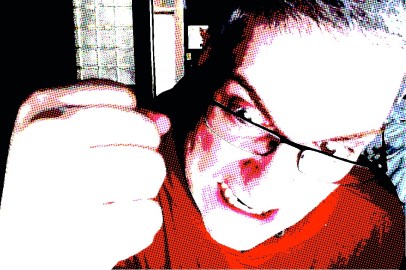
Me after Curly Quote Day

Filed under: Books, DIY, Editing, Editors, getting it done, grammar, writing tips, , , , , , , , , , , , ,

Update: The choice to go indie

A friend had heard a rumour that I was quitting my part-time job to go full-time as a writer and self-publisher. “What’s this I hear?” he said. He didn’t sound impressed with my chutzpah.

I explained my plans and he crossed his arms. “That’s an…interesting choice.”

I mimicked him and made a joke out of it, but clearly, he’s worried about me. Then he mentioned that a relative, after years of writing short stories and playing the submit/reject/resubmit game, just got a publishing deal with a traditional publisher for his first novel.

“That’s great!” I said. “When does his book come out?”

“Not for another year or so.”

And there it is. I’m truly happy for him (I am!) but by the time he has his first novel out, I’ll have at least six ebooks for sale. There are trade-offs, but this is a great time to be a writer who has a problem with authority.

Filed under: authors, DIY, ebooks, getting it done, publishing, self-publishing, Writers, , , , ,

Writers: Not everyone will love us. I’m okay with that.

AllgemeineGesichts-Hals massage

Image via Wikipedia

I’m a couple of months away from writing and publishing full-time now. After 18 years as a massage therapist, I’m seeing an unflattering commonality between professions. Writers and massage therapists both seem to want respect desperately. And that’s the problem.

As I move into writing full-time, I see some of the same mistakes among the self-published that I witnessed in my (soon-to-be-former) occupation. Massage therapists want respect so badly they often give up their power to other health care practitioners and bureaucrats . That’s not how to gain respect. They should get respect by doing great things rather than trying to regulate to the lowest common denominator. (But that’s another rant about having a shred of dignity for another time and place.)

As writers seeking respect, we must give respect, but not require it of others artificially. Instead of respect, I suggest we seek out a readership.Respect must arise organically from circumstance and accomplishment. We have to do what we do well. That is all that’s needed. There’s a lot to that process, of course. Writing well, editing well, proofing well, formatting well, publishing with as few mistakes as possible…makes the head spin, doesn’t it? Most of all, tell a good story that keeps readers engaged. Sell a lot of books. Ultimately, sales will really get the attention of naysayers (and then they’ll really get cranky with you!)

Until then, self-published authors are called wannabes, amateurs, pretenders, unvetted, unproven, and unserious hobbyists.

Don’t worry about that.

You can mount a number of logical, fiscally sound arguments worthy of Joe Konrath, but until you deliver on the numbers, you’re just another “one of those.”

Sales figures aren’t subjective.

In my crotchety opinion, the best thing self-published authors can do is stay the course and ignore naysayers. Don’t even try to convince them. Let your success with readers be your argument. You know why, right? Because some publishers and critics and traditionally published authors don’t want to concede anything. They don’t want to give what you’re doing any respect. They fear change. They don’t want to like you. Maybe that will come later. (I’m not saying all critics and legacy authors want to dislike you, of course. However, the naysayers are loud and already get too much attention. They can hurt your feelings and sap your motivation if you give them your energy.)

You know who does want to like what you do? People who like stories. Readers. Readers and writers are not the same group. Readers differ from writers in number, grammar fetish, decibels, expertise, enjoyment and predisposition. Readers want to like your story and they want to like you. Cater to the right audience and maybe someday the naysayers will come around. If they don’t, either you didn’t do a good job or they are very determined snobs. If it’s the former, improve and carry on. If it’s the latter, screw ’em. Not everybody has to love you.

Wanting love without needing it from just any bonehead?

That’s the beginning of self-respect.

Filed under: DIY, ebooks, getting it done, self-publishing, Writers, writing tips, , , , , , , ,

Book Review Circle: Growing ideas (& an announcement about great things to come)

Salient points:

1. You won’t review the same author who reviewed you. That’s why we need a big circle. That’s one way to getting solid reviews, too.

2. This is a give-to-get situation where you will only review one or two books a year. Once it’s posted on this site, you can repost your review elsewhere.

3. Check the post below for details on the information you need to send. This helps me match you up with a genre that interests you.

4. Send said information to: expartepress@gmail.com 

Ah, and here’s another grand pronoucement:

I’ll be posting the book circle reviews on the new website (coming this fall.)

This blog will continue, but Chazz Writes is primarily a place for writers interested in indie publishing.

The new site will run concurrently, like sentences for both stealing fireworks and accidentally lighting your school on fire with those fireworks.

The new site will be a place  for readers.

Book Reviews: A Very Decent Proposal (chazzwrites.wordpress.com)

Filed under: authors, book reviews, Books, DIY, ebooks, getting it done, web reviews, What about Chazz?, Writers, , , , , ,

The “But At What Cost?” Miscalculation

John Locke has written a book: How I Sold 1 Million Ebooks in Five Months.* (I recommend it) How_I_sold_1_million_ebooks_in_5_months

LA Times writer Carolyn Kellogg wrote a piece that asks, “At What Cost?” Here’s that nonsense argument and my bit of nonsense follows.

The upshot is, Ms. Kellogg thinks Mr. Locke undersold himself. He sold a million ebooks, but charged 0.99 for many of them. She says he could have made a million of with higher pricing instead of making do in the $300,000 range. (A figure that would make many authors swoon.) There are many interesting observations in the comments section of the LA Times article that pick apart Ms. Kellogg’s worries very well.

Here’s my take away: I had never heard of John Locke until now. He used 0.99 loss leaders to sell a shit-ton of books. Yes, he “only” made 0.30 on the 0.99 ebooks, but  low or no pricing allowed wary readers to try him out. And now many more people know  about him. And I bought his non-fiction ebook which details his success so far. And I bought it for $4.99.

Kellogg is saying Locke was an idiot for leaving money on the table, assuming he could have moved so much and so quickly with a middle man trad publisher involved. Why would she assume that, I wonder? There’s no basis for it. The new world is not the old world and hers is classic old world thinking.

Now you know, if you didn’t, who John Locke is. And now you’re thinking, maybe I should buy one of his books and give it a try. Maybe more than one, huh?

*Thanks to Joanna Penn for her post on Mr. Locke. I love Joanna’s blog and podcast, The Creative Penn. Subscribe if you haven’t!  

Filed under: authors, DIY, ebooks, getting it done, links, Media, Publicity & Promotion, publishing, self-publishing, Writers, , , , , , , ,

Zoe Who? I recommend you find out who! (PLUS GREAT VIDEO)

Becoming an Indie AuthorThe Little Me Update: I’m reading and  writing a lot lately. Yesterday was an incredibly productive day as I get closer to putting a (long) short story called The Dangerous Kind up on Smashwords. It’s amazing how many alterations I still want to tinker with as I go through the editing process. Still! 

Anyway, I’m also in book recommendation mode this week, so…

Have you subscribed to Zoe Winters blog yet? If you are an indie author, you definitely should. I especially like her ranty goodness on her wordpress blog. As I waited for my son to finish soccer practice I started digging into the last chapter of Zoe Winters’ book: Smart Self-Publishing: Becoming an Indie Author.

This is the single most helpful book on the business of self-publishing I’ve read. (I have the Sony e-reader version, though I think I’ll want to get the print copy, too, for easy reference and permanent residence on my bookshelf. Yes, I do that, too!)

Zoe has a no-nonsense approach to the subject which boils things down to what you need to know to succeed as an indie author. There are a lot of useful books on the subject out there, but this is delivers the bullet without preamble or extra excavation needed on the part the reader. Zoe Winters has broken the trail and mapped out the way so it’s easier for you.

I especially love how frank she is about the self-publishing strategies that didn’t work. The book is worth your time and money for the troubleshooting section alone.

And she’s good at spotting the details others might have missed. For instance, everyone agrees Goodreads can be a great place to boost awareness of self-published books. But Zoe is savvy to point out the pitfalls, too (like if the regulars get a whiff of the stink of self-promotion on you they’ll find your home, break in and beat you to death with Webster’s dictionaries.)

If you don’t love her already, she also made a series of YouTube Videos about breaking into publishing the indie way. Go to YouTube and search for the series called Zoe Who? . Enjoy. (And buy her guide.)

Here’s a sample video of Zoe Who? by Zoe Winters:

Filed under: authors, book reviews, Books, DIY, ebooks, getting it done, self-publishing, Useful writing links, Writers

Life & book marketing update shouted from a speeding car

Happy Sunday. Things are moving somewhat quickly as I start making transitions to writing full-time. I have a marketing plan: It’s important to be prolific. I believe in being available across as many e-platforms as possible (and zero DRM). Having just one ebook up won’t cut it. Being prolific allows cross-promotion (e.g. You like this? Then you might like to buy that, too!)

Over the coming months I’ll be offering individual short stories (at 0.99 each), a collection of short stories ($1.99 or 2.99, haven’t decided yet), a novella ($1.99) and another collection of short stories with a quirky hook I can market effectively ($2.99). At some point I’ll package the aforementioned individual stories—there are six—in another book (conveniently priced at $2.99 probably.)

There are several full-length novels that are written and need revision before they’re ready to be swallowed by the masses, but most of them are for next year.

A few things about the slingshot launches:

1. I’m doing a soft launch until I have a bunch of ebooks available. Then I’ll be carpet bombing (more details to come in another post on what that means.)

2. I will be launching another website in addition to this one. Chazz Writes is all about writing craft and publishing and I intend to continue. However, I have broader plans for the new website that will expand my mandate and goals. I’ll be talking about a lot of different things on the new site.

3. And I do mean talking. I’ll be incorporating video and podcasts. Fancy plans with pants to match. More on that closer to the new website launch.

4. I want to do  a hard launch of the first novel in my line, but I’m not sure if I can pull it together for Christmas. There are more than the usual variables. For instance, I need to get permissions to use the names of a major Hollywood star and a major porn star. (Yes, I’m familiar with the rules of fair use—and both characters as they appear in the novel are adored by the hero. However, this isn’t a fair use issue. It’s a Smashwords rule issue.)

5. I’m not in the least interested this year in printing books with which to assail bookstores. It’s a lot of work for less reward. It’s an exciting venture I do not, at present, have time to pursue. (And yes, I’ve looked at the numbers.)

6. However, I will need printed Advance Reading Copies (ARCs) for promotional purposes when the hard launch takes off. I’ll be using CreateSpace to print a few sample copies since there is no punishing fee for each revision. For bigger print runs, once the formatting is solidified, I’ll switch to Lightning Source.

If you’re wondering how I’ll get it all done, sometimes I wonder, too. Then I remember that I’m severely underemployed. (Except for the soul-crushing poverty, it’s a fantastic advantage and a real time saver.)

There’s more to the book marketing and promotion plan and I’ll share it with you as soon as I can. In the meantime, back to my editing suite in the batcave beneath the bunker under the Chuck E. Cheese.

Thanks to my buddies Jeff Bennington, author of Reunion, and author Rebecca Senese (look her up, she’s a fountain of short stories), for clarifying my strategy on the issues in #6. Both these lovely people have guest blogged here. You’ll remember Rebecca did a great job summarizing the workings of Smashwords and Jeff compared CreateSpace with Lightning Source. (If you don’t remember their posts, search this site in the search box top right. Sorry! I’d link it for you but I’m in a huge hurry just this minute. I bet you can guess why when you see this tiny portion of my to-do list.)

Jeff tells me he will do me the honour of another guest blog soon. I think the discussion will be about book promotion and what he found effective for his massive push for Reunion

Filed under: authors, blogs & blogging, Books, DIY, e-reader, ebooks, getting it done, Publicity & Promotion, publishing, What about Chazz?, Writers, , , , , , , , , ,

Publishing: Ownership

Ever see the follow-up to Get Shorty? It was Be Cool with Uma Thurman and John Travolta. While generally entertaining, there was a sour note and just didn’t feel at all right. It’s a problem with a lot of artistic gestation.

Uma’s character confesses her life’s ambition. She wants to turn on the radio and hear one of her songs. She says, “A song I produced.”  But she’s not talking about a song she wrote or sang or drummed or strummed. She’s talking about the bureaucracy that brings the art out and to the masses.

Producers talk about “their” films, “their” writers, “their” stable of talent. Like they own that talent, or at least rent it. When I hear an editor or agent refer to “their” writers, entitlement and ownership creeps into their tone. “I tell my writers…” “My books….”

But they aren’t your books, films and music, are they? Bureaucrats, like the rest of us, are each the star of their own movie. Money and access has been the root of that uneven power relationship.

Key words: Has been. Now agents and publishers are struggling harder to justify their roles. Why do you need an agent for access to digital publishing when you can DIY? Why should an author only get 25% for ebooks? (Or Harlequin’s egregious offer of 8%!) Meanwhile, some agents are morphing into writing coach services, expanding their offerings to stay in the role of taking care of authors. Some authors want to be taken care of. That’s fine, as long as they know their options.

The writer has been the last to get the cash. The writer has written on spec and often been a “speck” in the way they’re treated. It’s upside down. Writers are content providers. We make up things from nothing.

If you still feel powerless before the system, a small cog in a great machine, a serf among lords, a peon The Man pees on—now you’re just doing it to yourself. Take ownership of your ambitions and destiny.

Don’t blame them.

If you want power, don’t ask permission.

Just go take it.

I did. I’m now president and chief bottle washer, turd polisher and executive in charge of toilet paper replacement and Creative Arts at Ex Parte Press. Boo-ya!

Filed under: agents, authors, Books, DIY, ebooks, Editors, getting it done, Useful writing links, Writers, writing tips, , , , , , , , ,

Write your thriller in chapters: 10 tips for greater productivity

There’s no one way to write a novel. I do, however, have ten suggestions to make it go easier and faster:

1. Outline. Have some idea where you’re going and what the destination might be. It’ll save you time doubling back from dead ends. Believe me, I’ve written myself into cul-de-sacs and it’s a time suck no one can afford. (No, you’re not married to the outline and you don’t have to go OCD with the Roman numeral outline you learned in grade eight. I’m trying to increase your productivity and enhance your creativity, not shackle it.)

2. If you outline, you don’t have to write your story in sequence. With an outline, you already have the beats, the bases you have to touch as you tell your story. If you’re not feeling very inspired one day, no big deal. Focus on the high points of your outline on the days you don’t start off “in the mood.” Bonus benefit: you’ll get all your sex scenes written first.

3. Write each chapter as if it’s a short story. Your novel has a beginning, middle and end. So should your chapters. I often see substandard chapters which finish without the pulls of intrigue, a cliffhanger or a bang. Some writers reason that if they make the larger story interesting, they can afford to have a chapter or two that isn’t compelling. It does sound reasonable. It’s also wrong. Tension has one direction: up. There are way too many great books to read (and a million other things to do) so, for many readers, you bore them, you lose them. Sure, you’ve made this sale, but they won’t be burnt again.

4. For each chapter, identify a purpose. If a chapter has no dramatic purpose, drop it. Too often I see manuscripts where the characters are up and moving around, but to no purpose. (When editing, purposeless activity is called “business” as in “busy-ness.” There’s movement, but nothing’s really happening.  A chapter without purpose signals self-indulgence, a writer who got lost for awhile, not enough editing or an author who insisted on a tangent at the expense of the book.

The other common problem? Too much world-building and not enough character. A writer once described to me in excruciating detail about the far out environment of his book. It was a very ethereal place in space with no points of reference between human readers and the gaseous clouds that were his characters. I had to shut him up. He was driving me crazy with exhaustive, pretty detail. “But what’s the story? How is your reader going to relate to that?” Science fiction is about people first. Fantasy is about people first. Stories are all, at their core, about people and the choices they make. Sift your world-building detail in amongst action and character development. Otherwise, it will be unreadable, confusing or the reader won’t care.

Chapters with purpose are compelling and propelling toward an conclusion the reader wants to discover. (But they also want to be fooled, too. So make them say, “Ah, I bet I know what happens next.” Then find a way to surprise them. Read any of William Goldman’s novels to really get this deep into the marrow.)

5. What are the scenes in your chapter and are they in the right sequence? Are you revealing too much early in the story? Are you being too coy with the reader in later chapters? Does the pace pick up as you reach the climax and solve the novel’s core problem? Is it really a surprise (and logical) when you get to that climax?

6. Are you taking shortcuts in logic or logistics? Somewhere in your book there’s a less favorite scene or something that requires more research that, frankly, you don’t want to do. If your heroine is in Paris and your hero is in New York, they can’t meet in the middle of the Atlantic on a train (unless your novel is set in the future or a past that never was, of course.)

Are you missing a bridge to get you from one event to another? This is a logistics problem. Your FBI investigators are in Virginia at Quantico. The kidnapping is in the Pacific Northwest. Do you need a scene of conflict within the team on the private or military jet to get to the crime scene? You may make that transition in just a single sentence or it might be a chapter, but without some acknowledgement of the travel issue, it will be jarring for the reader to have them materialize in Seattle. Time and space and placement of people in relation to each other is something to trip over if you don’t make the effort to handle it logically.

7. Do your chapters fit together? Suppose you have an entire book that takes place, A to B, sequentially over the course of the hottest August in a century. But there’s that one winter scene you’re slipping in with a flashback. Does this puzzle piece fit in with the tone of your other chapters? If not, is there a reason for it? For instance, if your hero needs a look back at an early Christmas morning for the one time he was happy to give him a clue or change of direction, it fits better than an odd chapter that seems plugged in.

8. Is each chapter satisfying? This is a little different from #3, and a larger, more esoteric editorial question. You’ve written each chapter as a short story. That’s fine and can help you face the challenge of writing an entire novel-length manuscript. Now I’m asking, does each chapter feel full? Is it contributing something more to the larger story arc? When all these short stories are cobbled together, will each contribute to a greater whole than the sum of the parts? Is there a richness in description, character and action that will leave the reader satisfied with the effort overall? Is the core problem big enough to bother with a full-length book? Do you force the reader through several hundred pages only to kill off the protagonist (can be done, but often iffy) or worse, find out said protagonist is a lummox they hate? Too often, authors make their obstacles too small, the villains too stupid, the stakes microscopic and the core problem not nearly big enough. You don’t have to save the world on every outing. Maybe you’re just saving one person, but make us care.

9. Does each chapter’s length make sense? When I say “make sense” here, I mean, do you achieve in the chapter what you need to accomplish at an appropriate pace? Chapters don’t have to have a uniform length. Mary Higgins Clarke’s chapters get progressively  shorter as she goes so it feels like a race to the finish. I find I like short chapters as a reader (and as an editor) because I feel like I’m making progress as I go through, marking up the milestones. Short chapters often feel like a breezy  read. As a writer, however, I find my chapters are longer so they have time and space to wind to their conclusion. However, some writers go so short they aren’t providing enough beats within each chapter. I sometimes see underwritten, choppy chapters where action isn’t happening and characters aren’t developing. When that happens, you don’t have a chapter yet. In that case, you probably have the components for scenes within one chapter.

10. Set a schedule. If you use each suggestion here as a guideline, you also have an estimation for how long it will take you to write your novel based in real time.  Since you’re writing your novel as short stories, progressing at a fairly predictable pace, set an end date for the first draft. Make a schedule to get to that date and stick to it.

Follow these guidelines and you’ll make real progress toward your goals. 

Related Articles

Filed under: Books, Editing, getting it done, publishing, Writers, writing tips, , , , , , , , , , , ,

The publisher’s temperament

Last week a baby video went viral. Two little twin boys babbled at each other. Back andSelfpublishing forth they went with a lively conversation “Da! Da! Da! Da!” Though unintelligible, they both were excited to talk to each other. I couldn’t hep but think of the conversation that goes back and forth about whether you should publish, or self-publish. There’s a lot of energy but not a lot of signal getting through.

The answer to the question of whether you should self-publish depends on the “you”.

Are you prepared to think of yourself as more than a hobbyist? Are you intimidated by new and unknown practices so much that you’re frozen? Do you prefer that others take care of things for you without you hiring them? Do you have any financial cushion? Are you prepared to take a chance? What is your real tolerance for risk? What is your tolerance for some people underestimating your work’s worth because you went your own way. Are you open to learning what you don’t yet know and ready to be a beginner?

There are a plethora of other factors to consider,  but first and foremost, it’s about you. Some people just aren’t interested in entrepreneurship. That’s not a judgment. Starting a business is not for everyone. You have to have a lot of discipline and interest in things beyond simply writing a good book (and god knows there’s nothing simple about that.)

Ask yourself, do you really want to do this?

We’ll have better self-published books when more authors ask themselves this question first. Why? Because they won’t just be self-publishers and the negative things that currently implies. We’ll have more publishers who happen to be publishing themselves.

Filed under: DIY, getting it done, publishing, self-publishing, Writers, writing tips, , , , , , , ,

Bestseller with over 1,000 reviews!
Winner of the North Street Book Prize, Reader's Favorite, the
Literary Titan Award, the Hollywood Book Festival, and the
New York Book Festival.

http://mybook.to/OurZombieHours
A NEW ZOMBIE ANTHOLOGY

Winner of Writer's Digest's 2014 Honorable Mention in Self-published Ebook Awards in Genre

The first 81 lessons to get your Buffy on

More lessons to help you survive Armageddon

"You will laugh your ass off!" ~ Maxwell Cynn, author of Cybergrrl

Available now!

Fast-paced terror, new threats, more twists.

An autistic boy versus our world in free fall

Suspense to melt your face and play with your brain.

Action like a Guy Ritchie film. Funny like Woody Allen when he was funny.

Jesus: Sexier and even more addicted to love.

You can pick this ebook up for free today at this link: http://bit.ly/TheNightMan

Join my inner circle at AllThatChazz.com

See my books, blogs, links and podcasts.

Enter your email address to follow this blog and receive notifications of new posts by email.

Join 2,063 other subscribers