C h a z z W r i t e s . c o m

See all my books at AllThatChazz.com.

Writers: Time for some controversy

Book-shelf complete

Image by Medusa's Lover via Flickr

Since I’m still recovering from a Toronto weekend conference, Green Hornet and Black Swan, here are a couple of recent links you may have missed:

Dean Wesley Smith blows agents’ future aspirations out of the water (make sure you read through the pithy comment section, too!) and Anis Shivani tells you to forget everything you thought you knew about writing and publishing.

Much of it appeals to me because neither believes in sucking up and allowing yourself to be put down or kept down by The Man.

What do you think? 

Is Shivani’s rant satire or for real?

Will you dare to take this advice?

Filed under: agents, authors, DIY, ebooks, Editing, getting it done, Rant, self-publishing, Useful writing links, writing tips, , , , , , ,

Writers: The self-publishing/Massage Therapist Correlation

Massage in Tarifa, Spain taken on May, 6 2007 ...

Image via Wikipedia

I haven’t had what my father would call a real job since 1991. The factors that make that so are all tied up in being a writer and editor.

Years after training as a journalist, working in newspapers and working in the publishing industry, I went back to school again to become a massage therapist, too. The reasons why were varied, but the most important factor was that I wanted to work for myself. I have an independent streak and I hated working for The Man. I still hate working for The Man. Writing, editing, therapeutic massage: it’s all independent work. There is no hierarchy. The Chazz does not do hierarchy.

But a lot of people do. Most people have a boss. The fact is, I don’t understand how they stand it. I pull at authority’s leash so hard I have sometimes hurt myself in tiny acts of rebellion.

Despite the rebel yell, the truth is I have many bosses. Everyone I encounter in my practices as an editor, writer and massage therapist is my boss. I have chosen many bosses instead of one. I have chosen one-to-one interaction instead of dealing with a group. I deal with people for an hour at a time or for short projects, always with an eye to where the next project will come from. There’s no security in this. My income goes up and down unpredictably.

On the other hand, with all that I do, there is the security of knowing they can’t all fire me at one time. If you have one boss who wants to lose you on a whim, they can do that. That’s the smug solace of the lone wolf. 

But lots of people accept authority as the way of the world. That’s becoming less true as massive unemployment forces some to seek out their own solutions and form their own businesses. Entrepreneurship used to seem like it was for the few who chose the harder way. Now, when so many can’t find work, starting up a sole proprietorship and going for it is forced upon them.

Here’s what I notice: People are just wired one way and not the other. Most massage therapists and writers I know have an independent streak. We have to grit our teeth a bit to do something that is in many ways outside money’s eco-system.

But there are a bunch of therapists who do, in fact, want to work for somebody. They want someone else to take care of the laundry, the advertising, the tax paperwork and anything else that doesn’t directly relate to physically doing the work. They love that they can come into the office, do their thing and leave without another thought to the running of the business. I wouldn’t call it freedom, but they do.

In the past, the publishing industry has been built on the hierarchical model. Someone else will publish your book. Someone else will take care of the editing and (some) of the promoting and it will all be part of one complete package. Thanks to technology, authors are discovering they have more options than history has provided.

For authors deciding when to make the leap to independent publishing, there is a lot to consider: market factors, price points and leveraging your platform to sell enough books to make the enterprise profitable.

Beyond the practical and esoteric (which must be figured out, too) you have to start with the personal: you. Which way are you bent? Do you want someone else to take care of things (and give them a deeper cut of the profits and losses)? Are you up for the nitty-gritty of doing the work of many on your own? Can you hire an editor, find a publicist, do the research and build your audience? It won’t be easy. You’ll have to talk with a lot of people and the greater your network the more chance you’ll get your feelings hurt. When the mesh of your network tightens to a closer knit, there will be friction.

Only you can decide if you have enough of the anti-authoritarian, do-it-my-way, I’m-a-control-freak, entrepreneurial-bent. Once you’ve figured that out, here’s a great article that explores the location of the tipping point between traditional publishing and going indie.

No matter which way you are wired, if you’re a writer you’ve got a muse.

Next stop on the Reality Train:

Introspection Station.

Self-publishing has developed to a point where it is neither good nor bad. Depending on your temperament, it could be a solid choice or a horrible one.

Filed under: authors, Books, DIY, ebooks, Editing, getting it done, publishing, self-publishing, , , , , , , , , ,

Writers: Five editing tricks and tips (plus editing marks)


1. Editing onscreen is more difficult and less accurate than printing out your manuscript and attacking it with a pencil. Unless you’re well-practiced at editing pixels, print it out.

2. As you read your manuscript, read aloud. You will pick up more problems that way and if you run out of breath, it’s probably a run-on sentence.

3. Some experts tell you to read your manuscript backwards, one word at a time, to catch more typos. Though it is true this technique works, you must have a form of OCD to act on it. This is advice editors give, but never do themselves. If you don’t believe me, try it with any book-sized manuscript. (Wait! First make sure there are no sharp objects or firearms nearby!)

4. As you edit, read slowly. Your brain is wired to skip over mistakes when you read quickly.

5. Farm it out. You need someone else’s fresh eyes on your manuscript to see the thing you are missing. Hire editors. (Here’s one!)

Filed under: authors, Books, Editing, Editors, getting it done, publishing, rules of writing, Writers, writing tips, , , , , , , , , , , ,

Writers: How to tell when your manuscript is ready

Freytag's Pyramid, which illustrates dramatic ...

Image via Wikipedia

Writing takes time and is often the most fun part of the journey. Then you rewrite and revise and revise again. Before you send your manuscript to an editor, make sure you’ve done as much as you can to clean it up.

Be aware of:

Formatting, hooking the reader, character development, story arcs, consistency of narrative, consistency of voice, differentiation of characters’ voices, typos, grammatical errors, plot logic, plot holes, pacing, three-act structure, rising action, scene length, passive voice, telling instead of showing

(gasp!)

…the list goes on and on, but you get the idea.

Make it as good as you are capable.

Once you’ve gone through however many revisions  you must endure (maybe two, maybe dozens) to write your story, go through one more time.

How will you know when you’re ready to send it off to an editor for new input?

You’ll be sick of your manuscript. (And if you have been holding on to a manuscript too long, let go of your perfectionism and the manuscript. It’s a torturous form of self-hatred.)

A manuscript is never truly finished. You could polish forever. However, when your editing goes sideways, meaning it’s not better but merely different, it’s time to send it off.


Filed under: Editing, Editors, getting it done, publishing, Writers, writing tips, , , , , , ,

Writers: Why self-publishing sucks (and what you can do about it)

Vanity

Image via Wikipedia

A couple of years ago I put together a chapbook of poetry. A few seconds after I handed a copy to a beta-reader he found a mistake. It was a glaring mistake on the first page he turned to. Alas. Embarrassment is an emotion that can run through you, both hot and cold.

Typos, grammatical errors, consistency problems and a host of other plagues suck the credibility and professionalism from your manuscript. At least for me it was a beta-reader and, contrary to first impressions, the rest of the manuscript emerged clean.

Some writers see self-publishing as a shortcut. When writers treat the medium as the quick and easy path to becoming an author, that’s still vanity publishing.

When you approach it seriously and make sure your manuscript has been combed for problems, that’s publishing (nevermind the “self” part.) When you choose to self-publish, publish. Form a company. Be a publisher. Hire editors (yes, I’m aware of the conflict of interest, but if you are, too—yes, I edit—we’re covered.) Get proofreaders lined up.

Take it seriously and you will be taken seriously.

Filed under: authors, ebooks, Editing, Editors, getting it done, grammar, publishing, Rant, self-publishing, writing tips, , , , , , ,
Writers: On sending your stuff

J. K. Rowling, after receiving an honorary deg...

Image via Wikipedia


To the right is a picture of JK Rowling. Notice that she is not me. As with Highlander, “There can be only one!” I’m sorry this has become necessary to point out.

One of the posts here is a neat spreadsheet that shows how JK Rowling plotted out Harry Potter. Recently I got an email with several errors addressing me as JK Rowling that asked me to email the writer so I could read some of her work. Billionaire authors don’t do that much. In fact, as presented, I wouldn’t do it, either.

I’d feel bad about pointing out this error so publicly, but it’s apparent the writer is not someone who reads this blog. Please read the blog (and also www.chazzwrites.vpweb.ca). When someone jumps from my bio page to ask about my bio, it just feels like spam and carelessness. Writers are detail-oriented and email, no matter how casual you want to appear, should reflect that. (In fact, I’ve sometimes gone through several drafts on queries to make them appear breezy and casual.) Whether you’re sending a manuscript, a query or a short email, you must pay attention to the details.

I know what you’re thinking. You already know this. Okay, but obviously many people still don’t. One writer told me she had already written several books. That’s a good sign. However, in one short paragraph, she made seven errors. That went into my evaluation of how much I could help her right away. I decided editing her book would be time and cost-prohibitive for me and for her.

When I take on a project, I have to take into account how much time I will have to invest in the book. From that short paragraph, I had to conclude that, were I to take her on, the job would be rewriting, not editing and proofing. When it starts out that bad, it doesn’t make me confident about larger issues like attention to detail, story arcs, characterizations and narrative logic and consistency. I have ghosted a couple texts. Writing and rewriting are not out of the question, but I have to know the scale of what the job requires going in (or I may as well be working behind a counter wearing a paper hat and slinging fries.)

Does your project have to be perfect for me to work on it? Of course not. If it were perfect you wouldn’t need anyone (and you’d be god.) I’m not being nitpicky or cranky. It’s just that when I get a query, I’m looking for signs the author is serious. If you’re asking me to take your work more seriously than you do, that’s a bad sign.

Queries and sample chapters give you an idea of how I work and they tell me how much time your book will take up. That’s one of the main variables in determining my rate, so please, don’t shoot off an email—to me or any other editor—before reading what you wrote at least once.

I’m trying to end on a positive note, so I’ll add that I just took on an editing project that excites me. The author’s serious, nice and I can’t wait to dig into her book and take it from great to fantastic. In fact, the antidote to amateurish folks is waiting on my desk. I’m off to work on the manuscript.

Filed under: authors, blogs & blogging, Editing, Editors, getting it done, links, Rant, Rejection, What about Chazz?, Writers, writing tips, , , , , , , , , ,

Writers: Top 10 of the 2010 Top 10 Chazz Writes posts

Top10

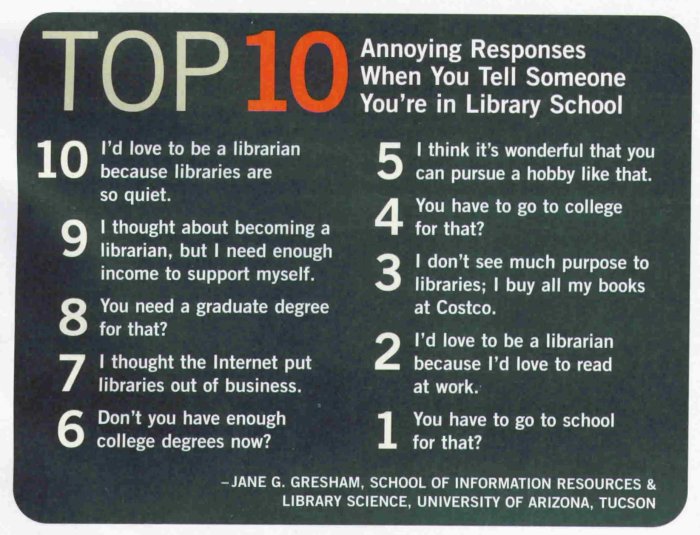
Early last year I considered going back to school to become a librarian. (I dumped that idea before I saw this graphic, but it does make me feel better about my choice.)

After some career counselling, I decided to refocus my efforts on my writing and editing. I needed (and need!) to bring art to the front burner. I began this blog as part of reorganizing my life to that end. Since last May I’ve posted 402 times and gained lots of readers, friends and even some clients (hurrah!) Things progress.

 For lucky #403, this is a look back through the Top 10 lists of 2010:

1. Authors! Part II: Top Ten Lessons from the Networking Master

2. Top 10 Ways Writers Waste Time

3. Writers & Editors: Top 10 Editorial Considerations

4. (Top 10 Things +1) Writers Love

5. Top 10 Reasons We Write Sci-fi

6. Top 10 (plus one) Publishing Conference Lessons

7. Top 10 Things Writers Fear

8. Top 10 Reasons We Write Horror

9. Top 10 Reasons We Write Romance

10. Writers Top Ten: Why blogging about publishing is important

Filed under: authors, Books, ebooks, Editing, Editors, getting it done, Horror, Publicity & Promotion, publishing, Rant, Top Ten, Useful writing links, Writers, writing tips, , , , , , , , , , , , ,

Writers: Does the term “wannabe” irk you?

Kevin Smith

Image by wvs via Flickr

Just read an editor using the term “wannabe.” I’ve probably used it in the past, too, but no more. (I am a writer and I’m an editor who works with writers, so why wouldn’t I show them as much respect as I can and avoid an irksome term?)

Whether the editor in question meant it that way or not, it came off as dismissive. Anyone who read my blog regularly knows I have a man crush on writer-director indie legend Kevin Smith. He wrote something a while ago that really got my attention and it applies here.

He wanted to be a director. He was in Jersey and no money and no plan.

When he told his sister of his ambition, she replied,

“Then BE a director!”

Don’t want it. Be it.

If you write, you’re a writer. If you aren’t published yet, approach the work professionally and act as if you already are. (That means improve your craft, take criticism, educate yourself about the industry and comport yourself with grace and ease.)

I’m a published writer and I can tell you, after a time, seeing your name in print is not that big a deal. It’s the work that matters, and when it’s at its best, it will feel like play.

What matters is the writing:

Do it.

Enjoy it.

Get it down,

Get it done.

Write more.

Write again.

Writers write.

Don’t get caught up in status, hierarchy and aspirations. Do the work because writers write, whether they’re going to be published or not.

Filed under: authors, Books, DIY, Editing, Editors, getting it done, publishing, Writers, writing tips, , , , , , , , ,

Here’s a good one on editors, authors & the dance we do

This article is a long read but definitely worth the time. This gives quite an insight into the long process we must all endure (whether you’re self-published or traditionally published.) It’s especially useful to see how editors and authors relate. Check it out:

Five Writers Talk About Their Book Editors | The Awl

Racing off to help someone in need at the moment.

Alfred! My cape! My cowl!

See you back here tomorrow morning, same bat-time, same bat-channel.

Filed under: authors, Editing, Editors, publishing, self-publishing, Writers, writing tips, , ,

Writer Links: Stephen King, evil editors and plugging plot holes

Stephen King, American author best known for h...

Image via Wikipedia

You’ve already worked hard today, right? Take a break.

Here are some useful links for your Friday afternoon:

Stephen King’s Top 7 Tips for Becoming a Better Writer

Editors are evil, and other fairy stories‏

AOS: How to avoid inconsistencies and plot holes

The Must-Have Writing Routine‏


Filed under: authors, Editing, Editors, Friday Publishing Advice Links, Useful writing links, Writers, writing tips, , , , , , , , , ,

Bestseller with over 1,000 reviews!
Winner of the North Street Book Prize, Reader's Favorite, the
Literary Titan Award, the Hollywood Book Festival, and the
New York Book Festival.

http://mybook.to/OurZombieHours
A NEW ZOMBIE ANTHOLOGY

Winner of Writer's Digest's 2014 Honorable Mention in Self-published Ebook Awards in Genre

The first 81 lessons to get your Buffy on

More lessons to help you survive Armageddon

"You will laugh your ass off!" ~ Maxwell Cynn, author of Cybergrrl

Available now!

Fast-paced terror, new threats, more twists.

An autistic boy versus our world in free fall

Suspense to melt your face and play with your brain.

Action like a Guy Ritchie film. Funny like Woody Allen when he was funny.

Jesus: Sexier and even more addicted to love.

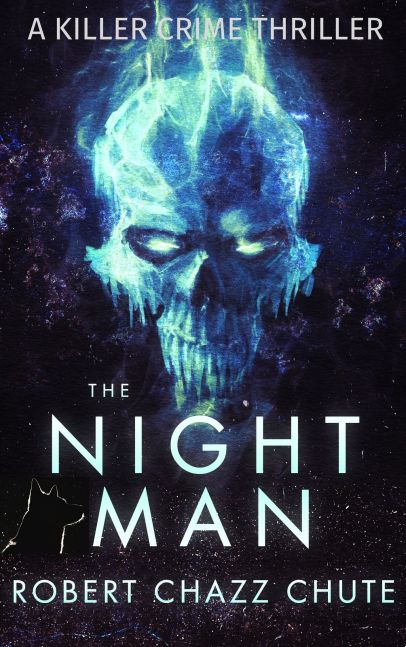
You can pick this ebook up for free today at this link: http://bit.ly/TheNightMan

Join my inner circle at AllThatChazz.com

See my books, blogs, links and podcasts.

Enter your email address to follow this blog and receive notifications of new posts by email.

Join 2,063 other subscribers