C h a z z W r i t e s . c o m

See all my books at AllThatChazz.com.

Stephen King: On Writing Under the Dome

It helps to be a fast typist. It helps to write fast and edit fast.

The reason is, you have to keep it all in your head. Maybe you’ve written out a plan or maybe you’re writing a day at a time without knowing how the story will twist to its end. Even if you don’t feel you have to know everything ahead of you, you still have to keep the details clear in what’s happening behind you. It’s a lot to track.

If you’re writing your first book, aim for the low end of the acceptable word count. If your first attempt is a vast sprawl of a trilogy, there’s an excellent chance it will suck. Finishing a book at all is an amazing accomplishment. Don’t try to write too long too quickly.

JK Rowling wrote a sprawling series with Harry Potter, but the first book is relatively short compared to the big bricks that came later.

Filed under: Author profiles, authors, getting it done, publishing, Writers, writing tips, , , , , ,

Editing Tips Part 1: Story bible

my eye

Image via Wikipedia

Since I’m in heavy edit mode this week, it’s going to be all about editing all week. You asked. I give. And so:

A story bible is a document beside your manuscript where you keep track of characters’ names, ages and details. It will keep you from screwing up too much and make your revision process go faster. It’s very frustrating, for instance, to go through a 450-page manuscript looking for the hero’s little sister’s eye color page by page. It’s the equivalent of losing a productive hour to search the house for a misplaced checkbook.

Keep your story bible close so you can add to it without interrupting your writing flow. I use a yellow legal pad though if you have the document on-screen you could search it, I suppose. (A bible that is too long goes unread but is an excellent device to keep you procrastinating instead of writing and revising.)

Even if you’re less of a planner (the seat-of-the-pants writer) it helps to have some minimal plan or a story bible so you can keep track of characters and key details. It’s better than losing a character along the way. It is embarrassing to write an entire novel and think you’re done only to have one of your beta readers ask, “What happened to Mrs. Haversham? Did she survive the fall to the bottom of the stairs on page 139? And what happened to the alien prostitute who got locked in the truck?”

It’s a huge problem in self-publishing because there aren’t teams of editors and proofreaders combing manuscripts. It happens with traditional publishers, too (and will increase becaus of cutbacks.) For instance, in Lucifer’s Hammer, an astronaut is described as short, but by the end of the book he’s standing tall and commanding in the bow of a boat. In Under the Dome,  Stephen King introduces a supernatural element on the good guy’s side that is never explained and seems forgotten, as if the angels whispered in the hero’s ear and then got distracted and wandered away. (When you write a book that big, it’s easy to lose threads and drop stitches.)

As you edit, things will crop up and it will help you to add edit points to your bible. Edit points are policy issues. It saves you a lot of time, and money, to have a clean manuscript. Decide up front, are you basically going with the Chicago Manual of Style? AP Style? Canadian or American spelling? Serial commas or no?

By keeping a list, you’ll discover some idiosyncrasies will crop up and it may grow to a long list. For one instance, you might type gray when you mean to write grey. In your bible under a heading that reads Editing Points, write in bold GReY NOT GRaY!

When you think you’re done your manuscript, drag out your list of troublesome words.

Use the Search and Replace tool.

You thought you got them all.

You didn’t.

Nobody does.

Related Articles

Filed under: Books, Editing, Editors, getting it done, publishing, Writers, writing tips, , , , , , , , ,

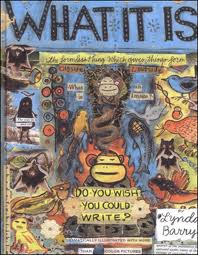
Lynda Barry tells What It Is

This is a book about writing like you’ve never seen:

What_It_Is

If you know Lynda Barry‘s work, you  know hers is an inimitable style. But I grok her. I had some reservations as I plucked the book from the shelf, but when somebody bares their soul in their art, you either look away embarrassed and confused or you look deeper, identify and get swallowed up, too.

Her ideas on writing prompts could get you going. Letting go to get going appeals to me. Most of all? I understand what she means by escaping into writing and getting “that floaty feeling.” If you write, you know what she means, too. If you don’t, buy What It Is, do the exercises and find your way into The Float. 

The immediate rewards of writing (slipping through “the escape hatch” as Stephen King puts it) are right now. Even as I write this, I feel a tickle in my brain. Some happy dopamine is spreading somewhere through my skull as I type this. I’m a junkie.

You may or not get published, but there’s more to it than that, isn’t there?

Some people don’t get that, so I ask them this: “Did you ever play tennis or run or swim? Did you keep doing it even though you knew you weren’t going to end up at Wimbledon, the Boston Marathon or the Olympics?”

Filed under: authors, book reviews, Books, publishing, Writers, Writing exercise, writing tips, , , , , ,

Writers: Beware of Pen Names

This image is a reproduction of an original pa...

Image via Wikipedia

Good Christmas Eve afternoon to you!

Since you’re all out doing battle in malls, cutting your way through the crowds with a machete,

I’d like to make a quick point with this quick post:

Watch out for pen names. There’s a use for them, but there’s been some bad advice splashed around because of some weird over thinking about branding. I use my middle name and go by Robert Chazz Chute for this blog and my fiction submissions. I do this for the same reason Michael J. Fox has a J. There is a native American poet from Maine who goes by the name Robert Chute. He came first, so to avoid confusion and out of respect, I went with my middle name. I think that’s a good reason to use a nom de plume.

About the bad uses of pen names: In the past, agents, editors and publishers often advised writers to use pen names when writing for different genres. They feared brand confusion. That was silly. Consider the biggest book brand of them all: Stephen King. I’ve read all his horror. It turns out I have no interest in his Dark Tower series or the any of those graphic novels. But I did try them out because I like Stephen King books generally. If you like an author’s book, you might like their other books.

Too few people buy and read books to play games making it more difficult to find your work!

Consider James Patterson and his 157 or so books that are now out in different genres. One name provides cross-marketing and cross-pollination for his body of work. Isaac Asimov wrote what? 500 books? Much of it was non-fiction, too. (The most readable anatomy book I own is by Isaac Asimov.)

So if you’re going to use a nom de plume, do it for considered reasons. Don’t do it because you fear your romance audience won’t follow you to your fantasy epic.

People who read books get enthusiastic about particular authors, not just particular books.


Filed under: authors, Publicity & Promotion, publishing, Rant, rules of writing, What about Chazz?, Writers, writing tips, , , , , , , , , , , , , ,

Writer Links: Stephen King, evil editors and plugging plot holes

Stephen King, American author best known for h...

Image via Wikipedia

You’ve already worked hard today, right? Take a break.

Here are some useful links for your Friday afternoon:

Stephen King’s Top 7 Tips for Becoming a Better Writer

Editors are evil, and other fairy stories‏

AOS: How to avoid inconsistencies and plot holes

The Must-Have Writing Routine‏


Filed under: authors, Editing, Editors, Friday Publishing Advice Links, Useful writing links, Writers, writing tips, , , , , , , , , ,

#NaNoWriMo: Five Advantages of Fast Writing

Traditional wisdom is that it takes a lot of time and energy to write a book. That’s generally true. However, that counts the entire process. It takes a long time to revise, edit and hone aWriting_fast book until you feel you’re ready to let it go. That doesn’t mean you can’t write a first draft quickly. Some purists will protest that haste will decrease the quality of a writer’s work in favour of quantity. Sure. I have a different take on that objection. Assume your first draft is going to suck anyway. Since you’re best writing is rewriting, it’s best to have something to revise. For many writers, if they didn’t write the first draft in haste, they might not have anything to revise at all. You can’t edit a blank page.

So here’s my contrarian view on why  fast writing can be a very good thing:

1. You maintain your enthusiasm for the project because you get the first draft done quickly. Marathon writing takes endurance. A sprint can be advantageous, especially if you haven’t completed a manuscript in the past and you’re developing those muscles.

2. When you write in haste, you can see the whole project’s development at once. You’re less likely to drop threads when you get the first draft done in a short time. If you’ve read Under the Dome by Stephen King—a huge and heavy book of great length which, in general, I enjoyed—maybe you noticed that he seemed to have a supernatural element on the protagonist’s side that is never explained and soon forgotten. It took him three years or so to write it. That might be why something’s amiss.

3. Increased productivity primes your art pump. If you produce a lot, you tend to produce more the rest of the time, too. It’s the literary equivalent of, if you want the job done, give it to a busy person. Artists need to get into the habit of production and treat their work as a business and a craft (instead of something that can only produced when the planets align and you have a handy vial of unicorn blood to consecrate your art-making ceremony.)

4. Increased production equals more money in the long run. That’s not mercenary. That’s math. If you can produce four books (and sell them) in the time it takes someone else to write one, you’re ahead (unless the other guy is William Styron, but he’d be ahead in any case…and he’s dead.)

5. You may not sell everything you write. In fact, if you’ve got an agent, an editor and a publisher between you and the market, there’s an excellent chance someone will stand up at some point and say, this isn’t ready for your customers. (They may or may not be right about that. When Robert Munsch‘s publisher told him the world wasn’t ready for Love You Forever, he took that controversial children’s book elsewhere. And had a hit.)

My point is, if you spend ten years writing a book and it does not sell, you will be sad. If you have other books to sell, the one disappointment won’t sting so much. You know how every second Star Trek movie was great and the others suck?  It evens out when you have more out there.

If I sound like I’m blaming, shaming and pointing fingers, I apologize. I have been guilty of acting like a dilettante about my fiction. I’ve had to gather unicorn blood before I could summon the muse. That’s changed recently as I’ve reevaluated. I’m motivated now to go into heavy production and get to work on the revisions for my books and, as Seth Godin puts it, “Ship!” (Also, see the post below on Lessons Received from An Evening with Kevin Smith for the whys and wherefores. )

My book production won’t happen overnight. But it will happen faster than it was happening. Boo-ya!

Filed under: NanNoWriMo, writing tips, , , , , , , ,

Top 10 Reasons We Write Horror

Stephen King signature.

Image via Wikipedia

1. Childhood.

2. Anticipating old age.

3. 9 to 5 isn’t as exciting as zombies breaking down the door.

4. The existential horror of it all goes down better with the sugar of a plot.

5. Halloween fetish.

6. We heard it was easier to break into horror.

7. Mom and Dad and that thing they did that we weren’t supposed to see.

8. Mom and Dad gave us Stephen King books instead of a babysitter.

9. Vengeance fantasy on siblings…and all those other stupid kids who laughed at us at the academy.

10. Horror is closest to the truth of our existence and best expresses our worldview (when we aren’t entertaining at children’s birthday parties.)

Filed under: Horror, publishing, Top Ten, , ,

Writers: Publishing Advice Links

Seduced By History: Author One Sheets  ‏One Sheets are a great networking idea.

Accentuate Writers Forum – Writing Contests & Writing Grants

10 Lies that Cripple New Bloggers

Everything You Need to Know About Writing Successfully: in Ten Minutes with Stephen King. By the way, my favorite book on writing is undoubtedly Stephen King’s On Writing.

Freelance Writing Jobs Network: Traffic Secrets for Writers

 Six Free and Amazing Ways to Promote Your Business

Filed under: blogs & blogging, Publicity & Promotion, publishing, writing tips, , , , , ,

Stephen King on Stephenie Meyer Controversy

Filed under: Writers, , ,

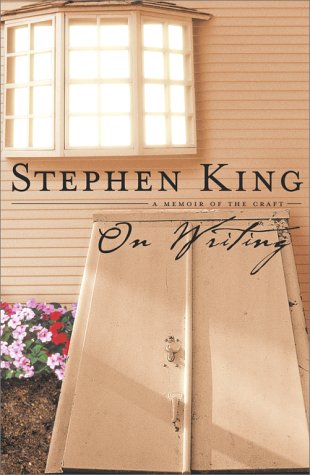
Stephen King On Writing

Horror doesn’t just describe a genre, but what the reader is supposed to feel. I took in a short gasp of horror when I read a sidebar in The Writer which blithely informed us that we’d learn more from Danse Macabre than we’d glean from Stephen King On Writing.

Everybody’s entitled to their wrong opinion but the casual dismissal of On Writing took me aback for the simple reason that Danse Macabre is broad and descriptive of the genre, but On Writing is prescriptive, beating the adverbs out of you and even giving a solid example (if not a template) for approaching agents etc.,…. I’ve read and reread On Writing and it bears reading and rereading. It’s useful in its instruction and lyrical in biography (though for no reason I can understand King denies it’s a biography.)

Lots of people–okay, I’ll say it, English Majors–have discounted King in the past, and too easily. They forget that not only has he been one of the most successful writers on the planet, he used to teach writing, too. If you are a writer, you must own this book.

Filed under: book reviews, Writers, writing tips, , ,

Bestseller with over 1,000 reviews!
Winner of the North Street Book Prize, Reader's Favorite, the
Literary Titan Award, the Hollywood Book Festival, and the
New York Book Festival.

http://mybook.to/OurZombieHours
A NEW ZOMBIE ANTHOLOGY

Winner of Writer's Digest's 2014 Honorable Mention in Self-published Ebook Awards in Genre

The first 81 lessons to get your Buffy on

More lessons to help you survive Armageddon

"You will laugh your ass off!" ~ Maxwell Cynn, author of Cybergrrl

Available now!

Fast-paced terror, new threats, more twists.

An autistic boy versus our world in free fall

Suspense to melt your face and play with your brain.

Action like a Guy Ritchie film. Funny like Woody Allen when he was funny.

Jesus: Sexier and even more addicted to love.

You can pick this ebook up for free today at this link: http://bit.ly/TheNightMan

Join my inner circle at AllThatChazz.com

See my books, blogs, links and podcasts.

Enter your email address to follow this blog and receive notifications of new posts by email.

Join 2,063 other subscribers