C h a z z W r i t e s . c o m

See all my books at AllThatChazz.com.

The price and value of ebooks Part II

A Picture of a eBook

Image via Wikipedia

There’s a lot of talk about ebook pricing. You’ve seen the numbers. Today I’m pointing you to the comments section on a post on this very blog because a great dialogue arose that I haven’t seen elsewhere and I don’t want it lost. A writer and a reader have a very thoughtful point-counterpoint discussion, not just about the numbers, but how they feel about the numbers.

Thanks to both Tracy Poff and Reena Jacobs for both their passion and civility as they had an impressive meeting of the minds about ebook pricing from an author’s and reader’s perspective.

You’ll find the comments under this post: Do readers expect too much of ebooks?

Filed under: author Q&A, authors, ebooks, Guest blog post, publishing, self-publishing, , , , , , , , , , ,

Is your fiction “just made up”?

Recently I heard an author complain about a poet because she hadn’t done any research. The poetry was about prostitutes, their struggles and how they reacted to being raped. No interviews! No research! Worse, the poet had made the (hyper)critical error of not actually being a raped prostitute herself. The poet simply made up a story for her poem based on her own imagination. No, I haven’t read the poems, but I don’t think I need to know the details of particular human tragedy to extrapolate the feelings of violation that must entail. I’ve read a lot of fiction that was clearly “just made up”, but the writers I love still strike a common chord of humanity that spur me to cry, get angry and get engaged.

The writer was disgusted with the poet because she “just made up” her fictive poetry.

“Beyond the pale!” she said.

I’m skeptical of proponents of research, especially if it falls into the category of “exhaustive.” It’s not that knowing your stuff is a bad thing. It’s that knowing your stuff can often lead to recording instead of creation. (Sometimes military thrillers beat you over the head with the research so hard, you’d think the serial numbers on the missile casing is more important than the nuclear warhead exploding over Miami.) For me, the authenticity of the enjoyment of the writing — the feelings stirred — trump the details of the particular brand of cigarette available in certain cities at certain times. Which is a fancy way of saying I don’t give a shit as long as the story is plausible within its own world. For instance, do all prostitutes read Proust? It’s probably not required reading, but you could easily convince me one prostitute reads Proust if you can write a convincing context.

Is it necessarily better fiction because it springs directly from the real world? Kevin Bacon went back to high school for a day before filming Footloose, for instance. Do you think that was crucial to performing what was already in the script? And if the writer of the script hadn’t grown up in a repressed town that outlawed dancing, would Footloose be any less awesome? (I refer here, of course, to the original Footloose. There’s a remake, but I decree it shall not be discussed and anyone associated with that abomination can go shoot themselves in the face…I digress.)

There is a dangerous trend in fiction that many writers think is required. It goes like this: If you’re going to have anything to write about, you have to go have a lot of experiences, many of them bad. That’s the dry, sterilized version. In practice, it’s more like this: You can’t write about rehab unless you’re an alcoholic or a junkie first. Terrible life choices make for great writing, assuming you don’t kill yourself in stage one of the writing process in which you’re actively pursuing bar brawls each night. Unless you’ve experienced what you’re writing about, it’s not authentic enough.

And I call bullshit. It’s fiction. Make it up but make it seem real enough that I can suspend my disbelief. We all have human experiences and we can imagine pain and transfer it to the page. You’re experience doesn’t have to be exactly what you’re writing about. Otherwise, you’re not even writing fiction. That’s memoir.

About fictive memoir (since this case inevitably springs to mind): Some people bought into the overhyped nonsense around A Million Little Pieces because James Frey fictionalized some of his “memoir” of addiction (after first shopping it around as a novel.) Nobody gives David Sedaris a hard time for doing the same thing to very humorous effect. Also, a lot of people also said that A Million Little Pieces helped them kick their addictions, even though some of it wasn’t real. Placebos often work on people, even when they know it’s a placebo, so what’s the harm in a book that’s 80% correct to the facts of one junkie’s life and 100% true to the feelings of thousands?

I have censored myself when my fiction didn’t pass my personal standard for believability. I admit I have recently dumped two short stories involving military personnel because, though I grew up around the military, I’ve never been in the military. I just wasn’t confident enough that I had the details quite right. I was writing about people, but I didn’t think the environment they swam in was there to deftly suspend disbelief. However, I have written stories from the perspective of old Asian men, a little girl, an autistic boy, adult women and a gay dinosaur.

For the record, I have never been a gay dinosaur

(not that there’s anything wrong with that.)

A few years ago a group within PEN Canada insisted no one could write about the minority female experience except minority female authors. I think that idea kind of fizzled because of the unrealistic limits (and ghettoization) such a policy could lead to. First, it was censorship, which most writers are against and (Thank Zeus!) there wasn’t a way to enforce the decree, anyway. Second, its logical conclusion was that black women could never write about white men. We would all have to conform to our stereotypes and human beings are way more variable than our stereotypes. After a short hullabaloo, the idea lost traction. Shakespeare, after all, was not Italian and never saw Verona.

We’re often told “write what you know.” That would leave a lot of sci-fi and fantasy out of our lives. Instead, I suggest you write what you care about. Write what you can make me believe. If someone doesn’t think you did a good job of recreating their real experience, they can go ahead and write their memoir so the heroine smokes the authentic brand of cigarette (good for Writer 1, but I’m fairly certain I still won’t give a shit.)

Fiction is a work of the imagination.

It’s our job as writers to make it believable.

It’s our job as readers to get into the spirit of the art instead of looking for things to bitch about.

Filed under: authors, censors, censorship, movies, Poetry, publishing, Rant, Rejection, writing tips, , , , , , , , ,

Do readers expect too much of ebooks?

I love people who wisely challenge authority and the status quo.

They question the way things are to make them better.

Recently I pointed the way to a post by the insightful Derek Haines over at The Vandal. The discussion evolved from talk about how low, low, low ebook prices don’t match up with many readers’ expectations of perfection. I promoted Mr. Haines’ blog post, but too clumsily since I just mentioned it in a comment reply. Mr. Haine’s thoughts need more attention than I gave them so I’m remedying that today. Derek Haines was one of the first people to  welcome me to Twitter. I often find his blog posts eye-opening (e.g. Free e-books, do they get read? and The Self-publishing Money Trap). His thoughts on ebook pricing, value and quality, What did you expect for 99 cents?, are in need of a good, solid ponder. 

To freshen and deepen the discussion, novelist Reena Jacobs wrote in with something very thoughtful and heartfelt. I didn’t want her contribution lost down in the bottom of the comments. I asked her if I could repost. The first link takes you to the original post by the great Derek Haines and here’s Reena’s comment again as a guest post:

Derek Haines makes an excellent point. It broke my shriveled blackened heart to offer my full-length novel at $0.99, considering all the work I put into it. To think I toiled over the book for months…over a year with no pay, and folks didn’t even want to shell out $0.99…and forget $2.99.

Indie authors aren’t asking much but I think some readers expect perfection when they’re not willing to pay an asking price which is less than fair to the author to begin with. Some seem to forget the money used from sales is not only necessary to earn back the money already spent, but also to invest in future publications.

I don’t go to people’s place of businesses and demand freebies. Or worse, insult them with comments like, this should have been free or I’m glad I didn’t pay for this. If it’s free, folks should be happy they even had an opportunity to try it. Someone took time out of their life to offer readers a gift. It may not be to the readers’ liking or meet their personal set of standards, but it was still a gift. It has value.

Anyway, my wee little heart couldn’t take it anymore. If people want a $0.99 work from me, they’re welcome to my short story. I’d rather hoard all my works and never publish another title again than beg for $0.99 ($0.35 royalty) for a work I put months of my heart and soul into. Every time I read about someone complaining about a $0.99-2.99 work, it makes me want to bump my prices again. It’s gotten to the point I don’t even care if folks buy my books (kinda…’cause let’s be serious, sales matter to all authors) as long as I don’t feel like people are taking advantage of me and implying my work is worth less than it is.

Like Derek said, it doesn’t make sense to invest big money into a product that yields little return. In my opinion, that’s bad business.

I’ve already made a goal not to spend more money on publishing books than I make in sales. If that means no more full-length works, then so be it. Short stories are quick, dirty, and can be edited entirely through a critique group. I can part with one for $0.99 and not feel ripped off.

Reena Jacobs is just your typical writer who loves to see her words in print. As an avid reader, she’s known to hoard books and begs her husband regularly for “just one more purchase.” Her home life is filled with days chasing her preschooler and nights harassing her husband. Between it all, she squeezes in time for writing and growling at the dog. You can find Reena on Ramblings of an Amateur Writer, Amazon, Goodreads, Barnes & Nobles, and Smashwords

www.reenajacobs.com

www.reenajacobs.com/blog

http://twitter.com/ReenaJacobs

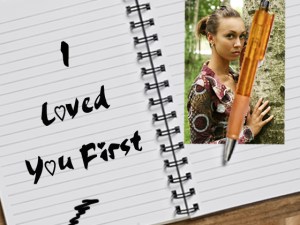
Alexandria (Alex) Carmichael guards two secrets close to her heart.

One–she’s in love with her best friend, Seth. Two–he’s gay.

 Add I Loved You First to your Goodreads list!

 I Loved You First

Filed under: blogs & blogging, Books, DIY, ebooks, Guest blog post, publishing, self-publishing, , , , , , , ,

We only have one book in us

To increase sales, one winning strategy is to write a series. Readers like to get invested in characters they know and travel along with them to vast reaches. If readers like one of your books, there’s a good chance they will like them all.

The reason for this is that many authors write the same book over and over.

This is not a criticism. It’s a common observation. For instance, Kurt Vonnegut’s books could be one long book of varying characters but of unified theme and voice. Vonnegut searches for humanism and usually fails to find it so instead he settles for acceptance of the gap between human potential and reality. With each book, Hemingway and Mailer tried to define their manhood. Palahniuk can’t hide his fascination with how weird we are, and weird is all we are.

There is nothing wrong with writing the same book again and again as long as each excursion seems fresh. The boat gets redecorated for each trip. The destination is always the same. Not only do readers not mind, real fans prefer sameness. I like Stephen King stories, for instance. Everyman confronts his fears and loses some and wins some in a harsh world. But the Dark Tower series? Not for me. Give me more of what I like, the familiar unfamiliar.

As I edit my own stories I see the same story emerge repeatedly: Escape is required and losses will be incurred and it’s up to the reader to decide if the escape was worth the price of freedom. That’s probably all I’ll ever write, whether the novel takes place in a New York high school today or in tomorrow’s post-apocalyptic North America.

I know where that comes from: I escaped home.

Every turning point in my life has been a narrow escape.

Happily, there’s enough there to fill all the books I could ever write.

Filed under: Books, publishing, Writers, writing tips, , , , , , ,

Self-publishers and the traditionally published (not versus)

I spotted it again today and frankly, I’m kind of tired of the narrative

that all self-publishers are a bunch of talentless hacks.

I can think of quite a few traditionally published authors who fit that category.

This is not to shit on the traditionally published.

This is simply to suggest that everybody ease up on the “everybody sucks but ___ ” rhetoric and the gatekeeper drama.

There’s room for everybody without getting too emo about it. You might even end up trying both routes.

Discuss.

Filed under: publishing, self-publishing, Writers, , , , , ,

TOP 10: People (who are not fans)

Old marketing decreed:

Get everybody! Your sales quota must include all sentient species with a credit card in the known universe!

New world marketing responds:

Nope. Establish a base of just a bunch.

But the bunch has to be rabid and slavering for your next masterpiece, book, song, film, poem, service, comic, or sex toy.

In short, you need fans (as in fanatics.)

For self-publishers, everybody in your fan base starts out as a reader, but they won’t all join you on your journey and buy in to your revolution. A lot of people can’t even be bothered to cross the street to spit on you. Something I learned a long time ago was that I am not everyone’s cup of pee. (Note to non-fans: that’s a joke and a point, not a typo.) I learned that to build successful businesses or loving followings, I had to focus on the people who appreciate me and ignore the rest. Oddly, everyone knows the 80-20 Rule, but how many apply it to their lives?

Critics will sap you of time and energy if you pay them too much attention. A fellow writer got one bad review recently. All his reviews were overwhelmingly positive except for that one. That burned like a cigarette in the eye. That’s the key to understanding the dark side of Internet marketing. Yes, you can spread the word faster about a good thing. However, negative reviews can get a lot of attention, too, mostly from the author who serves as the critic’s target. In fact, several authors have observed a bandwagon effect among some reviewers and book bloggers. One bad review can lead to more bad reviews. Ironically, as Reena Jacobs observed recently, it may be worse not to be reviewed at all than to receive negative reviews. If readers love or hate your book, at least you’ve spurred a reaction. If you ignite no fire at all, that may be a bad sign.

Here’s what to keep in mind when you read something negative about your work:

1. People (who are not fans) are nastier on the net than they would ever dare in person. They aren’t talking to you as a person with feelings and aspirations. They’re having a conversation in their heads with the idiot they imagine you are. Cyberspace allows distance, anonymity and depersonalization. Your nice neighbour, that little old lady who gets your mail for you while you’re on vacation and bakes cookies at Christmas? If her favorite author kills off a regular series character, the old dear’s mind can curdle into that of a serial killer when she writes an Amazon review.

2. People (who are not fans) mistake your work for you and judge you along with the work. If one of your books, blog posts, comics etc.,… is not as good as the others (and inevitably that will be so) critics will make assumptions about you and your mental state. Don’t you mistake all of your work for you though. They’ll make it personal, but don’t fall for that trap. Unfortunately, because we wrap up the author’s persona with his or her book to sell it, we foster an absurd inseparability in people’s minds. For instance, when Deepak Chopra was on the road selling a natural health book and had the temerity to drink coffee (OH-MY-STARS-AND-GARTERS!) a reader tried to shame him for it. That little old lady was pissed.

3. People (who are not fans) are more likely to write something negative than positive. Look at all those letters to the editor in the newspaper. Not so many saying, “Good job!” are there? Now think of the five best books you’ve ever read. Go to Amazon. See those negative reviews of the books that changed your life? Are you starting to see the weight you should give negative reviews yet? This is a subjective business. Repeat that until it sinks in. (I’m still repeating it, too.)

4. People (who are not fans) say things for their own reasons that don’t necessarily have anything to do with you. Maybe they made a bad day and want to export it. Maybe junior high was tough and the Internet is where they get even with strangers. Review the beginning of the movie Wanted. Remember the “I’d feel sorry for you if you weren’t such a bitch, Janet” speech? Repeat as necessary. (If you’ve ever worked in a cubicle farm, that scene alone will make you leap off the couch and spill your Cheetos all over the floor.)

5. Maybe you gave the person (who is not a fan) a negative review and it’s payback time. Yes, this happens. Maybe you friended them on Facebook, but you weren’t fast enough about getting that friend confirmation done and they took offence. Who knows? Everyone take everything personally because we are all the stars of our own movies. This has nothing to do with your work, but your work gives an opportunity for nasty people to say something shitty. Some authors don’t read reviews at all because, they argue, “If I believe the good ones, I’d have to believe the bad ones, too.” These are very mature people I can’t relate to. I don’t personally know anyone with that much self-control. I envy their sagacity.

6. Negative reviews are easier to write than positive reviews. Snark is easy. Snark is even funny sometimes, but mean’s no good. And if you’re going to be at all mean, you better be twice as smart as you are mean. For instance, I enjoy listening to Slate’s Culture Gabfest podcast….but sometimes I wonder, “Do these people ever like anything?” People (who are not fans) enjoy being clever at your expense. That does not necessarily equal constructive criticism. Maybe it’s just bitchy. Or stupid or wrong. Or all three. In this part of the equation, it’s not about you or your work. It’s that some people’s only creative outlet is criticism. Some fleas think they are driving the dog.

7. People (who are not fans) hope you’ll fail so they can feel better about their failures…or that they failed to try at all. Doing nothing at all is a great way to avoid criticism. Except for that pesky self-loathing and the long darkness before dawn when the demons come to torture your dreams and stifle your soul’s breath. (Yes, I’m saying that being a loser is like sleep apnea and all the implied dangers of heart disease but without the medical attention and sympathy from friends and family.)

8. People (who are not fans) don’t have enough going on in their lives, but they’ve got lots of time to focus on you. Otherwise, why the hyperbole about how bad your book is? I love books, but it’s just a book review, not the Nuremberg trial. The way some reviewers go on, you’d think trying and failing to entertain or educate or pass the time was a hanging offence. Another friend got a bad review recently. The ebook she gave out was free. The level of criticism did not match the critic’s financial and emotional investment. This author was wise enough to ignore the naysayer because she knew the guy wasn’t in her fan base and never would be. So what? There are plenty of readers out there to be converted to your peculiar brand of evil jocularity.

9. People (who are not fans) may be right. Maybe you do suck. But you can’t think that and succeed. You can only try to do better. Forgive yourself. You are a work in progress. “Books are never finished,” Oscar Wilde said. “they are merely abandoned.” Only listen to the people you trust. There are too many variables in the skulls of strangers who are not your fans. Write to please yourself first and don’t listen to input from writers too much. To write is to do your thing. That’s one reason so many people keep writing despite insufficient recompense, Carpal Tunnel Syndrome and their parents’ bitter disappointment. (On the other hand, if every review is negative except the one from Mom, rethink.)

10. People (who are not fans) can be fickle. Tim Ferris, author of The 4 Hour Body, observed that a fan base has two extremes. At the top are the people who will follow you down the mouth of a cannon. At the bottom are haters who want to fire you out of said cannon. Ferris feels that the people at the extremes can switch places. Do something too different and some former fanatics will resist the new direction and even become haters. Be unexpectedly nice to your enemies and a few may come around to decide you are a worthy human being after all.

Or you could say “Screw ’em!”,

focus on the people who do get you

and move along briskly.

If you read all the way to here and hated the post, why did you read this far? It was too long a post for that nonsense. I will never understand that about haters. Don’t they have shit to do?

If you loved this post and it came at just the right time and you couldn’t have done without it…thank you. I love you for a selfish and stupid reason: You love something I wrote.

Filed under: publishing, Rant, Rejection, reviews, self-publishing, web reviews, Writers, writing tips, , , , , , , , , , , , , , , ,

Update: The choice to go indie

A friend had heard a rumour that I was quitting my part-time job to go full-time as a writer and self-publisher. “What’s this I hear?” he said. He didn’t sound impressed with my chutzpah.

I explained my plans and he crossed his arms. “That’s an…interesting choice.”

I mimicked him and made a joke out of it, but clearly, he’s worried about me. Then he mentioned that a relative, after years of writing short stories and playing the submit/reject/resubmit game, just got a publishing deal with a traditional publisher for his first novel.

“That’s great!” I said. “When does his book come out?”

“Not for another year or so.”

And there it is. I’m truly happy for him (I am!) but by the time he has his first novel out, I’ll have at least six ebooks for sale. There are trade-offs, but this is a great time to be a writer who has a problem with authority.

Filed under: authors, DIY, ebooks, getting it done, publishing, self-publishing, Writers, , , , ,

Ponderables

1. Even when I don’t want to work, there’s always a little something I can do while listening to podcasts that still makes me feel like I’m edging forward. But underneath that? It really feels like I’m fooling myself.

2. I feel most energized about eating well right after I’ve eaten something I  shouldn’t have. Clearly this is stupid. And repeated often. Why am I repeating behaviour I know hurts me and may kill me? Common doesn’t make it any less crazy.

3. Watching the news, this seems like a good time for bad ideas. From flirting with default to stock market plunges to riots in Britain. It’s like a vortex of Bad has opened and started spewing. It’s sucking energy from the Good vortex.

4. In university I sank to my enemy’s level. I had a very bad professor in Journalism school who was a real sphincter. In retaliation, I too, was an asshole. And I still don’t see any reasonable alternatives after all these years. Still!

5. A teenager I knew years ago was a tremendous singing talent. I was sure he’d be famous someday. I checked. He’s not. In fact, he disappeared. I know he didn’t get picked up by a record company because he was almost as fat as he was talented. He should be a household name, a millionaire, a success. I hope he’s the best something else he can be. But how many of us are destined for one pinnacle and reach our zenith elsewhere?

Filed under: publishing, What about Chazz?, , ,

Don’t listen to writers too much

The phrase that pays.

Image by pirateyjoe via Flickr

When I first graduated from massage school, I visited new massage therapists all the time. Too often, I didn’t enjoy the experience much. I was too evaluative of each therapist to just lay back and receive the treatment in the spirit in which it was given. I wasn’t concentrating on the feeling of the massage, but on the mechanics. It took me some time to get past that mindset.

You see the same thing with editors sometimes, too. A bad editor jumps straight to corrections too fast without reading for story first. Typos are the last thing you correct in the story construction process. You need to look at the big blocks in the structure first to see how it holds together. Developmental editing always happens before detailed copy editing.

You shouldn’t listen too much to other writers for similar reasons. They see your work through a prism that doesn’t necessarily match ordinary reader expectations.

Writers are great people, but they usually aren’t your market. We sometimes forget that there are a lot of people in the world who have no literary ambitions. They don’t want to write a book. They just want to read a good story.

Writers are readers, but they aren’t typical readers. Writers look at your work differently. Writers are not  the average reader.

Among writers, there is a higher percentage of people who will pick apart your mechanics. Any grammatical variation from what they expected (and there are variations) will provoke more irritation than may be warranted. They will be the readers who skip from irritation at your typos to outrage, indignation and threats to take away your writer’s license and livelihood. Some will want to burn down your house.

Writer friends and editors can help you develop your work, improve and self-publish. But because of the way we are wired, we might not enjoy your work as much as typical readers will.

BONUS: 

I’m networked with a lot of great writers who help me a lot. I like them, appreciate them and thank them.

However, you’ll run into some writers who are so competitive, they do not wish you well.

Either through jealousy or the misconception that your success takes something away from them, they want you to fail.

Watch out for the hypercritical, the rabid grammarians, the perfectionists, the haters and snipers. They mistake their subjective taste for law all the time.

By the way, I wish you every success.

Filed under: publishing, Rant, Rejection, writing tips, , , , , , ,

Same Tired Arguments

Via Scoop.itWriting and reading fiction

Misquoting me makes you sound stupid. So does taking what I say out of context, putting words in my mouth, and drawing false conclusions based on things I’ve said.   That out of the way, I keep seeing the same poor, tired arguments and examples repeated over and over around the Internet. Either folks are writing about self-publishing for the very first time, and naturally falling into the lazy trap of not thinking clearly, or they’re purposely trying to disguise failed ideas as something new, like intelligent design and creationism. (Just to be clear–intelligent design is no different than creationism, and creationism is flat-out wrong. Period.)   Here are some outright falsehoods that continue to perpetuate.
Show original

Filed under: publishing

Bestseller with over 1,000 reviews!
Winner of the North Street Book Prize, Reader's Favorite, the
Literary Titan Award, the Hollywood Book Festival, and the
New York Book Festival.

http://mybook.to/OurZombieHours
A NEW ZOMBIE ANTHOLOGY

Winner of Writer's Digest's 2014 Honorable Mention in Self-published Ebook Awards in Genre

The first 81 lessons to get your Buffy on

More lessons to help you survive Armageddon

"You will laugh your ass off!" ~ Maxwell Cynn, author of Cybergrrl

Available now!

Fast-paced terror, new threats, more twists.

An autistic boy versus our world in free fall

Suspense to melt your face and play with your brain.

Action like a Guy Ritchie film. Funny like Woody Allen when he was funny.

Jesus: Sexier and even more addicted to love.

You can pick this ebook up for free today at this link: http://bit.ly/TheNightMan

Join my inner circle at AllThatChazz.com

See my books, blogs, links and podcasts.

Enter your email address to follow this blog and receive notifications of new posts by email.

Join 2,063 other subscribers