C h a z z W r i t e s . c o m

See all my books at AllThatChazz.com.

Writers: Self-published book wins big on CBC’s Canada Reads

Cover of "The Best Laid Plans"

Cover of The Best Laid Plans

CBC’s Canada Reads winner is Terry Fallis,

author of The Best Laid Plans.

Congratulations to Mr. Fallis

for his well-deserved victory.

You know what’s really great about this story, right? Mr. Fallis submitted his manuscript to agents and publishers everywhere and was turned down flat.

Next, he podcasted his book.

Then he self-published his book.

That would have been the end of it, but when he won the Stephen Leacock award, finally McClelland & Stewart paid attention.

Now Best Laid Plans is celebrated.

(I wonder, are any of the publishers who passed up on the opportunity to publish the book questioning their judgment today? Of course not. That’s a rhetorical question.)

Shrill British paint guru Debbie Travis defended The Birth House (poorly). She might have fared better if she understood that (a) she should have read all of Best Laid Plans instead of dismissing it with such disdain, and (b) she might even have won if she wasn’t so damn cranky. When she dismissed other contestants’ objections as “ridiculous” I knew she already lost.

The Birth House might be a good book, but after Debbie Travis’s poor representation, I’m sure I’ll never give that one a chance. It’s kind of important to be likeable, even in debate. No, it’s not fair to the author, Ami McKay, (sorry Ms. McKay!) but it’s clear it’s more diatribe than novel.

Note to CBC Radio‘s Q host Jian Ghomeshi: Maybe she’s good for ratings but she’s no good for books. A judge who doesn’t read all of the books, and then has the temerity to condemn it without reading it all, shouldn’t be back on air.

Filed under: authors, Books, Contest announcement, podcasts, Publicity & Promotion, publishing, Rant, self-publishing, writing contests, , , , , , , , ,

News Flash: Allan Stratton’s sales are about to go way up (even more)

Cover of "Chanda's Secrets"

Cover of Chanda's Secrets

This e-mail just in from my friend Peter:

The film Life Above All based on the lovely book Chanda’s Secrets by the
lovely Allan Stratton is on the Oscar nom short list. Fingers crossed!

Go see the movie and better yet go buy the book and see if you don’t blat before you finish!

I’ve met Allan Stratton and can confirm that he is indeed lovely. We had dinner at Garlic’s and then went to the Grand to see one of his plays. Lots of lovely all around. Yes, indeed, read the book! See the film!

For more information, follow the link from the press nugget below:

LIFE ABOVE ALL (CHANDA’S SECRETS) has made it into the Oscar finalist
pool of nine films from which the five nominees will be selected for
Best Foreign Film. Nominees announced tomorrow.
http://www.allanstratton.com
http://allanstratton.blogspot.com

Filed under: authors, links, Media, movies, Publicity & Promotion, publishing, Writers, , , , , , ,

Writers: The Power of Small (and why press releases don’t work)

A picture of author Carolyn See

Image via Wikipedia

When I worked in a city newsroom, one of my jobs was to go through press releases to find gems. There weren’t many of those clichéd diamonds in the rough. Reporters see so many press releases, they begin to look upon them with suspicion and even resentment.

What’s an author to do? You want an interview. You want your book reviewed. How do you make it happen? The traditional approach was to send out lots of press releases and books. It wasn’t very effective. In fact, sending out a lot of review copies is expensive.

There’s an alternative:

Go small. Go low-tech. Write a note.

This isn’t a practical approach for in-house publicists working for major publishers (but they usually work in short bursts for particular authors, anyway.) The low-tech, patient strategy is for indie authors looking for ways into the media. Unfortunately, publishers focus on very small windows of opportunity. They are looking to move a lot of books quickly (before the book stores send them all back for credit.) Marketing in book publishing has been long periods of silence interspersed with short frenzies. As an indie author selling e-books, you’re opting out of big, expensive and short-term strategies. This isn’t so much for Wiley (publishers since 1807!) authors. This is especially for wily indie authors.

As an independent author and publisher, you can play the long game instead. You can write a note or two a day. One author/guru Carolyn See made it her practice to write a “charming note” every day to an editor or publisher or agent.* Why not to reporters, too?

But there’s a trick to making it effective. You know how I’m always saying that if you want to hit up an agent, don’t look for the big, established names? Agents fresh from the factory who are up and coming in established agencies are better bets. They are still hungry and not as jaded. They don’t hate all queries yet. They still have hope and the scales have not yet developed over their eyes.

The same is true for reporters. The book editor of a large magazine already has lots of books lined up. The independent author has lots of indie-spirit, but most book editors still look down on them. So screw them.

Work on getting into smaller newspapers. Send a charming note to a general reporter who would love to do a cushy author interview instead of chasing some city council member who doesn’t want to speak to them. I’d rather talk to an author than cover a house fire any day.

You know why it will work?

It will work because you will be charming (“Loved that piece you wrote on the local scaled railroad hobbyists so I thought…”)

It will work because general reporters think entertainment reporters have a cushier job (and they’re right.)

It will work because all journalists also want to write a book some day.

And while we’re talking small, send off a friendly email to book bloggers. That counts as a charming note, too.

Ask to guest blog. Bloggers love a break and crave hits, connection, track backs, links and love.

Ask for an author profile. I profile an author on Chazz Writes almost every week. It’s not the New York Times Review of Books, but since they aren’t calling, how about alerting like-minded people to your creations? If you can’t go huge, you can still be ubiquitous.

Instead of just showing up at a bookstore and asking to see the manager, send a charming note ahead of you to break the ice and soften her up for a reading. Better, be even more charming and offer to organize readings for your local bookstore. (Later this year I’ll profile an author who did just that. Not only did he help many other authors, his own career got a boost from building community among colleagues.) 

Your book needs attention. I’m sure you’re already working on developing and maintaining your audience. Don’t forget that etching away at it a day at a time over the long haul can reap big rewards. With patience, you can build your empire. Don’t underestimate the power of a low-tech, targeted, personal and charming note.

These days, the mail is mostly for bills. This approach is more powerful than it ever was because you hate what’s in your mail box. But when you get a letter, you’re excited. It will work because it has worked.

*Read Carolyn See’s Making a Literary Life for details. Or, don’t fool around and head straight to Amazon to buy her book.

 Related Articles

Filed under: Author profiles, authors, book reviews, Books, DIY, getting it done, links, Publicity & Promotion, publishing, self-publishing, writing tips, , , , , , , ,

Writers: Top 10 of the 2010 Top 10 Chazz Writes posts

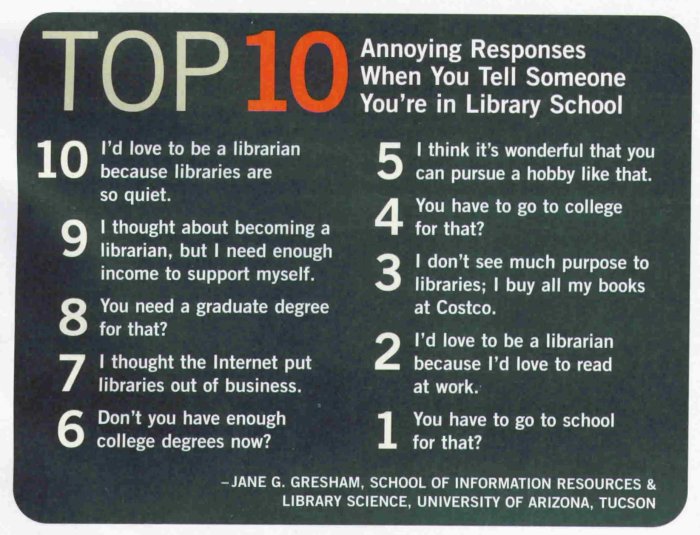
Top10

Early last year I considered going back to school to become a librarian. (I dumped that idea before I saw this graphic, but it does make me feel better about my choice.)

After some career counselling, I decided to refocus my efforts on my writing and editing. I needed (and need!) to bring art to the front burner. I began this blog as part of reorganizing my life to that end. Since last May I’ve posted 402 times and gained lots of readers, friends and even some clients (hurrah!) Things progress.

 For lucky #403, this is a look back through the Top 10 lists of 2010:

1. Authors! Part II: Top Ten Lessons from the Networking Master

2. Top 10 Ways Writers Waste Time

3. Writers & Editors: Top 10 Editorial Considerations

4. (Top 10 Things +1) Writers Love

5. Top 10 Reasons We Write Sci-fi

6. Top 10 (plus one) Publishing Conference Lessons

7. Top 10 Things Writers Fear

8. Top 10 Reasons We Write Horror

9. Top 10 Reasons We Write Romance

10. Writers Top Ten: Why blogging about publishing is important

Filed under: authors, Books, ebooks, Editing, Editors, getting it done, Horror, Publicity & Promotion, publishing, Rant, Top Ten, Useful writing links, Writers, writing tips, , , , , , , , , , , , ,

Book Marketing: What I learned from Joe Rogan

Joe Rogan

Image by Jordan Larrigan via Flickr

Joe Rogan has one of the most interesting podcasts on the net. You might know him as the Fear Factor Guy, or the ultimate fighting commentator or as Joe Guerrelli, the electrician on News Radio who made his own duct tape. (News Radio is still one of the best sitcoms ever, by the way.) There’s a lot more to him than that, though. He’s a walking, talking brain-stimulant. Plus, he makes me laugh my ass off.

I caught his podcast, The Joe Rogan Experience,  in which he was talking about the challenges of marketing. It was kind of a throw-away comment about the crazy world of stand-up comedy, but I got a lot out of it that applies to books and writers, too.

As a young comic, Joe left the marketing to someone else. He didn’t see his marketing as his job. He was doing stand-up. He didn’t feel he should have to be hysterically funny, crass and thought-provoking and sell the tickets, too.

When he saw how badly people were selling him—or that no one was selling him at all—he took up that responsibility. Now he tweets his shows and promotes himself through podcasting, YouTube, web presence and appearances on radio, other podcasts, etc.,… Rogan’s got a cult. Rogan has staked out his land. He has followers and fans. Joe Rogan is not melting into the background of the culture’s collage.

Many writers still hope someone else will take care of marketing their books. The truth is, unless you were already huge, in most cases your publisher didn’t do a great job marketing your book. They didn’t send out that many review copies. They didn’t publicize you enough. They probably didn’t have the budget for it and if they did have a budget for your book, it was built on short-term thinking. If your book didn’t take off right away, they were off to some other author quickly to try to capitalize on short-term heat and newness. That kind of thinking is going out the window with technology.

Be fair. Publishers have many authors on their list. You’re just one and so their efforts must be scattered. Who can focus on your book the most? You can. Who can spend money on a book launch? You. (That’s what that piddling advance you got is really for.) Writers have long memories and enjoy nostalgia, so some of us are still in love with the idea of writing our books in isolation and never having to interact with a fan, a hater, or the indifferent. It’s time for all of us to get past that ideal and put on our big-boy underwear and big-girl panties. Whether you’re going indie or are with a traditional publisher, the self-promotion side of the business really has been an indie-spirit proposition for a very long time. Don’t feel bad about it, it’s a common misconception. Instead, embrace the energy of the challenge.

Who is thinking about each book on a long-term sales basis? That would be you because publisher’s talk about “their” list, but that book isn’t theirs. It’s yours. Your name is on it so you care about it more than anyone, right? That means you have to take the responsibility it promote it and help your audience find your story amid a sea of books. Daunting yes, but that’s what building your platform is all about.

Who cares more about your book than anyone else?

No one.

Overcome your fear factor. Get out there.

For starters…got that Twitter account set up yet?


Filed under: authors, DIY, Intentionally Hilarious, Publicity & Promotion, publishing, Rant, Writers, writing tips, , , , , , , , , ,

Techies: Writers need an ebook curation app

A piece of sulfur burning with a blue flame th...

Image via Wikipedia

TiVo figures out what you like and makes television programming suggestions. What if there was an app for that?

A modest proposal for book marketing – The Shatzkin Files

Brilliant idea. Until the robots rise, we’ll have to do it for ourselves.

On blogs like this.

Uh-oh.

Obsolescence, dear fellow-bloggers, smells sulphurous.

Filed under: ebooks, Publicity & Promotion, publishing, , ,

Writers: Two links on promoting your work the right way

business,accounts,accountant,office,boss,manag...

Image via Wikipedia

Sometimes the toughest part of marketing is not annoying your target audience.

Try to market in smart and happy ways to avoid overkill.

I know when you’re talking about your babies, it’s hard to hold back.

An Author’s Plan for Social Media Efforts by Bestselling Author and Social Media Expert, Chris Brogan

Book Marketing Floozy

Filed under: Publicity & Promotion, publishing, , , , , , , , ,

Writers: Beware of Pen Names

This image is a reproduction of an original pa...

Image via Wikipedia

Good Christmas Eve afternoon to you!

Since you’re all out doing battle in malls, cutting your way through the crowds with a machete,

I’d like to make a quick point with this quick post:

Watch out for pen names. There’s a use for them, but there’s been some bad advice splashed around because of some weird over thinking about branding. I use my middle name and go by Robert Chazz Chute for this blog and my fiction submissions. I do this for the same reason Michael J. Fox has a J. There is a native American poet from Maine who goes by the name Robert Chute. He came first, so to avoid confusion and out of respect, I went with my middle name. I think that’s a good reason to use a nom de plume.

About the bad uses of pen names: In the past, agents, editors and publishers often advised writers to use pen names when writing for different genres. They feared brand confusion. That was silly. Consider the biggest book brand of them all: Stephen King. I’ve read all his horror. It turns out I have no interest in his Dark Tower series or the any of those graphic novels. But I did try them out because I like Stephen King books generally. If you like an author’s book, you might like their other books.

Too few people buy and read books to play games making it more difficult to find your work!

Consider James Patterson and his 157 or so books that are now out in different genres. One name provides cross-marketing and cross-pollination for his body of work. Isaac Asimov wrote what? 500 books? Much of it was non-fiction, too. (The most readable anatomy book I own is by Isaac Asimov.)

So if you’re going to use a nom de plume, do it for considered reasons. Don’t do it because you fear your romance audience won’t follow you to your fantasy epic.

People who read books get enthusiastic about particular authors, not just particular books.


Filed under: authors, Publicity & Promotion, publishing, Rant, rules of writing, What about Chazz?, Writers, writing tips, , , , , , , , , , , , , ,

Writers: DIY vs traditional publishing

Figure 1:Conceptual Model of Philosophical Com...

Image via Wikipedia

Last month I posted a piece in appreciation of director Kevin Smith after attending one of his Q&As.

Today I ran across Alex Greenwood’s guest post, Shoot the Gatekeepers on Shelly Kramer’s blog. It reminded me again of that indie spirit I love to see.

I’m not telling anyone to go independent exactly. Going rogue is not for everyone because not everyone has the entrepreneurial spirit.

You can find the knowledge and tech support you need to make it happen, but if you don’t want to do all that in the first place, it’s not for you. I guess that’s why I straddle the line here between traditional publishing and going indie. I talk about how to get an agent and a publisher. I also talk a lot about maintaining control of your work, DIY, and marketing yourself to the world. Authors from both sides of the coin need many of the same skill sets, anyway. For instance, even if you’re a traditionally published author, you’re crazy to depend on your publisher to promote and publicize you much at all and none of those efforts are sustained.

It’s frustrating when one entrenched camp mocks the other for their choices. It’s especially bad when those opinions are not so much informed as they are outmoded dogma. For instance, once again today I ran across writers and editors who fail to make a distinction between vanity publishing and independent publishing. I gritted my teeth. Then I found the link above, took a few deep breaths and smelled the roses of someone who gets it. Thanks for a solid post, Mr. Greenwood. I love the indie spirit.

Here’s the shameless plug: If going alone is for you, I’m an editor so I can help. However, if you’re going the traditional route, I’ve been on the inside, so I appreciate what you’re going through and can help with that, too. (At my business site you’ll find more information on getting editing help for your manuscript or web content.)

Here’s the crux: I love books, no matter how they’re produced. It’s about story! Love of story is at the heart. Contrary to what you’ve heard, the medium is not the message. I care much less about a book’s process to publication than I do its narrative. Sometimes I think people who fetishize paper over electronic books love stories much less than they think they do. They’re worrying too much about how the story go to their brains. Dump that worry. Just get your art out there!

Write your story. Make it the best you can. Send it to agents, publishers or directly to fans. Whatever. Just commit to art and the value of your creativity.

Filed under: DIY, getting it done, Publicity & Promotion, publishing, Rejection, self-publishing, , , , , , , , , ,

Writers: What really happens in book marketing meetings (Plus: What sells books)

Books in the Douglasville, Georgia Borders store.

Image via Wikipedia

It’s interesting to see the profession of book sales rep disappear. I was a journalist first and that’s evaporated. Later I was a book rep and that’s on the way out, too.  Book sales was somewhat romanticized. From the inside of the industry, book marketing isn’t romantic at all. Occasionally I hung out with authors and going to book fairs and sales meeting in nice places was fun. Yes, there were a few cocktail parties. Most of the year, however, you’re hauling so many samples around in your car, the shocks go. You spend a lot of time trying to get to the next appointment on time and worry about finding a good place to park.

I met some really nice booksellers. I also met many awful book retailers. The crux of that problem was that the young booksellers were doing it as a joe job and the older booksellers got into the job for idealistic reasons. No one tells aspiring bookstore owners that, not only are the big chains going to force them out of business, they won’t spend near as much time reading as they planned. Instead, they’ll spend an inordinate amount of time calculating the GST, paying the GST and trying to assist book buyers who aren’t informed book readers. (e.g. “I want to buy a book for my daughter I heard about on the CBC last month. You know. That one…? It’s by that guy? With the thing…? Surely you know that one!”)

So I dealt with the bored and disillusioned. Not exclusively! It’s just that those negative people are the sales experiences I remember best. That miserable bookseller in Owen Sound was an impatient sort who, when I dared to use the word comedy, corrected me and told me the book was “humour.” I’m surprised she was familiar with either facet of the concept. Then there was the condescending one north of Toronto who thought I was stupid since I was still enthusiastic. She beat that out of me quick. “Okay,” I said. “For the remainder of this meeting, I’ll power through the list and act just as pissed off as you appear to be. Happy? Am I smarter now?”

It wasn’t all bad. The owner of the now-defunct Frog Hollow Books in Halifax has a special place in my heart. She was a sweetie, had a great store and she bought a lot of merchandise from me gladly, even in the press of the Christmas rush. I wish that bookstore was still around.

What I find interesting in other people’s reports of marketing meetings is they say sales rep opinions  are valued. I hear of book reps getting input into the list, commenting on the marketing challenges and the dubious appeal of certain covers and so forth. Book reps on some planet get to turn something down and require changes in order to make a book sell. I repped sixteen publishers of various sizes and I can tell you, my input didn’t carry any weight. It wasn’t asked for, either. I was their traveling salesman. If the book didn’t sell, they figured it was my fault.

At a sales conference, the editorial team is selling their enthusiasm for the list they built. In my experience, if we dared to mutter about a lousy cover, we did so among ourselves. Voicing any reservations would be met with derision. We weren’t graphic artists, so maybe the cover proved to be lousy and many booksellers would tell us so as we made our rounds. However, in the context of the sales conference,we were getting flown out to someplace nice for one reason. We were supposed to sit there, take notes, and listen. The graphic artist and the editor got to have opinions on anything creative. Our job was to sell their old ugly dogs with the same conviction as the cute puppies. If we didn’t believe the dogs with mange and pushed-in snouts would sell, obviously we were idiots or traitors to the cause.

It sure didn’t feel like the powerful position some portray. Lots of articles on the publishing process mention the input of the sales team on titles. Not so in my experience. I watched editors and their minions show covers, talk about the books and maybe pass out review copies. True, we’d worry over price points. We’d look at the page count and comment that the heft of the book was light for the expense. (“People buy books by weight,” was a common bit of wisdom. “Green covers don’t sell it’s a golf book,” was the other bit. That was true, I think.) However, the publisher and their editors had already committed their resources to the books by the time we came into the picture. By then, they would understandably be reluctant to make major changes in their plans for two reasons: expense and ego. We weren’t going to change a done deal.

In the hierarchy of the book industry, the editors and publicists put themselves above the salespeople, especially if anyone referred to books as “product.” (Only a few did that.) Sales reps weren’t creative. We just did the grotty part with the filthy lucre that allowed the creativity to continue.

Many editors idolized some authors. Privately though, many put the authors at the bottom of the hierarchy. Yes, writers are the engine of the industry who provide the art to sell and a reason for editor’s existence. Perhaps it’s envy or resentment. Maybe it’s because acquisition editors see themselves as gatekeepers so they feel they made the authors.

In a less complex analysis, everyone’s the star of his or her own movie and authors come and go like background extras.

And some, being arty and human, are a pain in the ass. For instance, I sold Matt Cohen‘s books. For some he was an icon as well as a somewhat famous Canadian author. However, there was a bookseller nearby who didn’t care for his books and refused to stock them. When the publisher took the author out for lunch, naturally they stopped in to see how his books were selling. I soon got a angry memo. “What’s going on?!”

What was going on was not every bookseller is obliged to carry every book and the publisher’s embarrassment wasn’t a factor in the decision. The bookstore owner simply didn’t like Matt Cohen’s books. The proximity of our house to the store didn’t convince the owner. I despised that bookstore owner (a notorious and cadaverous blowhard.) I agreed with his right to stock whatever he pleased, however. Personally, I found Cohen’s books neurotic, but not in a good way.

At first my territory was Toronto (and in the summer, Cottage Country, too.) Later on, I worked for a book distributor so I sold books wholesale across the country as well as in downtown Toronto, Ottawa and all points north and east. I can’t say I ever felt like more than a minion. It wasn’t that the editorial staff was particularly unkind. It was simply that we had no creative input. That’s why I wonder about these reports I’ve read about the publishing process. When in-house editors tell authors, “Marketing didn’t like this or that,” are they really hiding behind the closed doors of those marketing meetings? Is it just a ploy to bring down the author’s expectations from the sky-high hopes, dreams and promises that originated in the editorial department?

Blah, blah, blah. You’re an author. You want to know what sells books. I’ll tell you.

I sold hundreds of books at a time. Some I read, but there wasn’t enough time to read them all. Instead I recited the catalogue copy and gave my impressions for each book’s appeal. If there was any kind of marketing campaign, I’d talk about that. It’s a gift to a book’s potential (and the haggard sales rep reciting the same spiel for the 100th time) to be able to say, “We think this one has a shot at the Giller,” or, “We’re putting a lot of work into getting this one on that particular CBC show you like etc.,…”

What sells books is word of mouth for a book with good writing that tells a compelling story. It takes a lot of incompetence on the publishing team’s part to overcome that. The other thing that sells books is the human connection between the book sold and the person who wrote it. What helped me sell the most books was meeting the author. Booksellers are on the frontlines of retail, far from the cocktail party action. They want to hear a sales rep’s funny story about meeting That Author.

One of the better people on the planet? One the sweetest people you could ever meet? Amy Tan. I sold her books. I sold a ton of her books. Utterly charming and genuine. When I met with booksellers, I didn’t talk much about her book. I sold her to them instead. We push the people we like harder.

When you get invited to a sales conference (if you ever do) or go on a book signing (arrange your own if your publisher won’t), remember to treat the minions well. Be nice. Be fun and memorable. The sales reps will remember you. The booksellers will hand sell you book.

Extra tip:

That’s why it doesn’t matter so much if a lot of people don’t come to your bookstore signing.

The customers may come or not, but the bookstore staff are always there.

Make a good impression and they’ll hand sell your book.

And the next.

And the next.

What really sells your books?

You do, through the force of your creativity, the shimmer of your personality and audience you cultivate.

Filed under: Books, Editors, getting it done, links, Publicity & Promotion, publishing, Rant, Useful writing links, writing tips, , , , , , , , ,

Bestseller with over 1,000 reviews!
Winner of the North Street Book Prize, Reader's Favorite, the
Literary Titan Award, the Hollywood Book Festival, and the
New York Book Festival.

http://mybook.to/OurZombieHours
A NEW ZOMBIE ANTHOLOGY

Winner of Writer's Digest's 2014 Honorable Mention in Self-published Ebook Awards in Genre

The first 81 lessons to get your Buffy on

More lessons to help you survive Armageddon

"You will laugh your ass off!" ~ Maxwell Cynn, author of Cybergrrl

Available now!

Fast-paced terror, new threats, more twists.

An autistic boy versus our world in free fall

Suspense to melt your face and play with your brain.

Action like a Guy Ritchie film. Funny like Woody Allen when he was funny.

Jesus: Sexier and even more addicted to love.

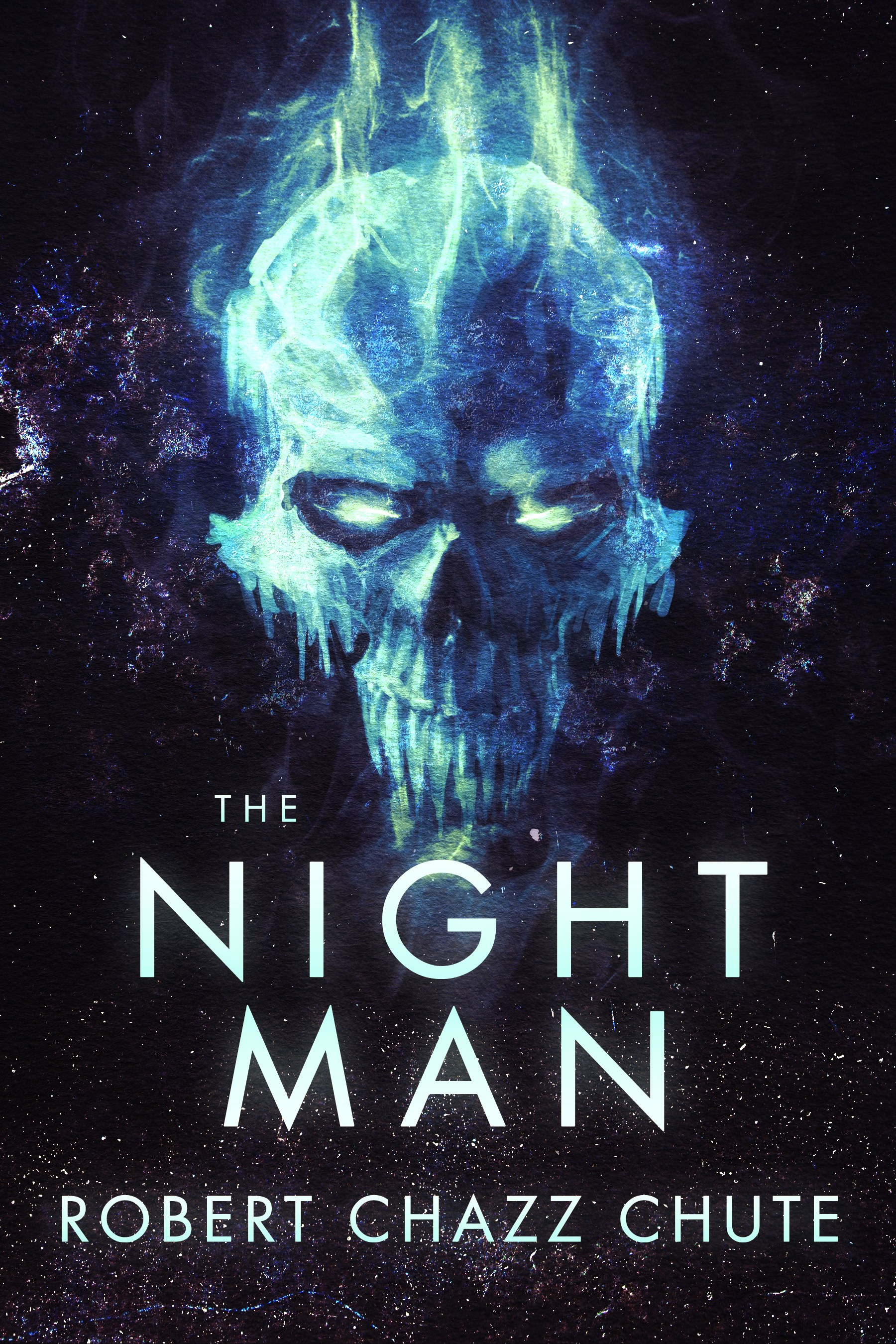
You can pick this ebook up for free today at this link: http://bit.ly/TheNightMan

Join my inner circle at AllThatChazz.com

See my books, blogs, links and podcasts.

Enter your email address to follow this blog and receive notifications of new posts by email.

Join 2,063 other subscribers