C h a z z W r i t e s . c o m

See all my books at AllThatChazz.com.

#NaNoWriMo: How to make reading like cardio

A quick-moving plot with lots of surprises and a clear-eyed examination of addiction.

 Get all the details of the Seven Words or Less Contest and enter here.

Last night I wrote two more chapters for my next crime novel, Hollywood Jesus, starring my Cuban hit man, Jesus Diaz. The first chapter worked very well, but the second needs tinkering right away. Here’s what happened and my rationale for how I’m dealing with it.

The first chapter of the day was a fast-paced and clever chase (even if I say so myself). Good guy* chases bad guy/reversal/good guy’s now at a disadvantage and, as they say, the hunter becomes the hunted. The tension cranked higher when I put the good guy in a seemingly impossible situation. He’s either dead or going to federal prison or maybe even Gitmo if he’s caught. The latest police tools, tactics and technology are used against him and Diaz has to figure out a solution.

Actually, it would be awesome if my hit man figured out the solution himself, but I wrote him into a corner and I had to find a plausible way to write him out of that trap. Whenever I stick him in a bad situation, he’s looking at me going, “Get me out of here, you sadist!” I did get him off the meat hook again and it was both funny and sweat-inducing. Yay, me. Now what about the next, problem chapter?

The tension has to be cranked down from that high a little bit so there’s some kind of emotional range for the reader. However, I messed up. I cranked the tension down too far with a transitional chapter. I hate that. In the transitional chapter, I had too much exposition with not enough events occurring. After a daring escape, my hero gets picked up by his Sancho Panza with fresh clothes and a new mission to add to his growing pile of trouble. The chapter is devoted to explaining to Diaz what happened in his absence.

There’s a lot to fill in for Diaz and for the reader: A friend and an enemy are in hospital, the ultra-bad guy is on the loose and the cops are investigating the violent and creepy events of the night before. The hit man has to find these things out, but changing clothes while going for a ride in the back of a van slows the pace too much. I want the reader to have a breather for a moment, but I don’t want the reader to actually recover. For cardio and thrillers to work, you have to keep the heart rate up.

The Fix: After the perilous escape, Jesus Diaz will be picked up by his aide. However, the chapter must start at the next beat where, aside from being a fugitive from the LAPD and the FBI, he’s got a new client thrust upon him by the old client. Both are beautiful, intelligent women in danger and at the moment, both hate the hit man’s guts. I’m sticking with the conflict instead of allowing the congenial conversation with the buddy who gives him a safe, friendly ride.

But why not plunge forward, blow up the word count for the day and “fix it in post”? I see the problem now so I’m fixing it now. Dealing with the problem immediately saves me revision time later. When I go into full revision mode, I want little puzzle pieces that have to fit, not big chunks that throw off the trajectory of the story, kill the fast pacing and make me go all the way back in order to move forward.

Besides, I was already well past the word count for the day with the previous chapter. On those days I’m productive, I sleep well. The sleepless nights after a non-productive day are torture. There are only so many days.

Speaking of the next book, have you entered for a chance to get your name in Hollywood Jesus yet? Get all the details of the Seven Words or Less Contest and enter here.

* I use “good” guy here loosely. Jesus Diaz is a killer, but funny and ultimately, a sympathetic vigilante. I think of my books as Bad versus Evil.

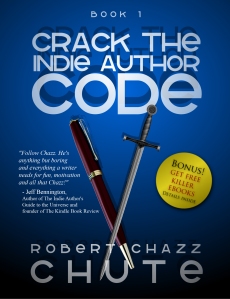
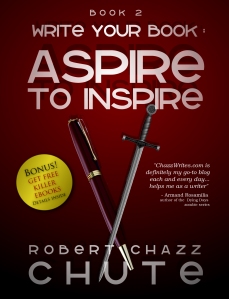
~ The sweetest  fig Chazz ever loved was the one he stole from a tree in the former Yugoslavia. Robert Chazz Chute is the author of Bigger Than Jesus, Higher Than Jesus, The Dangerous Kind & Other Stories, Self-help for Stoners and Sex, Death & Mind Control as well as the guides for writers and self-publishers, Crack the Indie Author Code (free until Friday) and Write Your Book: Aspire to Inspire. For links to all the books and to hear the latest All That Chazz podcast, slip over to AllThatChazz.com.

Free until Nov. 30, 2012. Click it to grab it now!

Filed under: publishing, , , , , , , , , , , , , , , , , , , , , , , , ,

#NaNoWriMo: You can’t murder Miss Marple

Free to you Nov. 26 – 30, 2012

There’s an essential difference between a book that stands alone and a book in a series. In a one-off, anything can happen. In particular, you can kill off your protagonist. You’d be very unhappy with an Agatha Christie novel that ended with the gory strangulation of that sweet Miss Marple using piano wire. (What is it about piano wire that we always associate with strangulation? Was there a sale? Home Depot has lots of wire, but none in the category of “Piano”. Barbed wire would be meaner and razor wire would be more efficient. Yes, I spend too much time thinking about these issues.)

Though Sherlock Holmes went over the falls because Conan Doyle was sick of writing his “mere entertainments”, Sherlock survived in the end. It’s generally bad form to take a reader in hand and walk them through an intriguing story only to kill off the protagonist. It often makes the reader feel they’ve invested a lot of time and energy into a hero or heroine for naught. Kill off the intrepid heroine and, unless you follow her into an amazing Afterlife, readers will feel cheated of the victory they expected. Exceptions exist, but downer endings without some larger goal achieved easily go sour. Be careful about killing off the good guy.

When you write a series, character is even more important than usual because no matter what pressure cookers you throw your protagonist into, the reader is pretty sure he or she will come out reasonably okay in the end and uncooked. Character is key. Sacrifices are demanded. Red shirts are required. Captain Kirk was responsible for the deaths of many of the Enterprise Crew. Everybody would be much safer if they stayed home on Earth, but, whether we’re writers, appreciative readers or just out of Starfleet Academy and beaming down to the planet in Come-Eat-My-Face Red, “Risk is our business.”

Click the image to get Higher Than Jesus

The trick is to get the reader invested in your protagonist’s goals, make them real and ensure they are sympathetic. For example, my hit man, Jesus Diaz, is an orphan with a history of childhood abuse. That’s explored in the first book in the series, Bigger Than Jesus. In  Higher Than Jesus, he’s dealing with moral issues around what he does for a living while battling Vicodin addiction and some bad guys who are much worse than he. He’s also in love again and out to save the future Mrs. Diaz. Despite everything against him, Jesus is also a funny guy and the deeper the trouble, the funnier he is. That’s his key to multiple books.

Somebody asked me if my inspiration for that quirk was Spider-Man. I used to collect comics and yes, Spider-man is, as they used to say in the Silver Age of comics, “a real cut-up”. However, I first discovered the power of the funny in myself when I encountered a guy with a knife intent on slicing me up. My fear fuelled something in me and I was never as hilarious as when I was sure I was about to die. It was under the controlled conditions of an Operating Room, but still…

Click it to get it.

Click for suspense and hilarious frivolity in Self-help for Stoners.

~Robert Chazz Chute is the author of crime novels, two books about writing and publishing and several books of suspense, including Self-help for Stoners. He has hugged the man who inspired the book, director Kevin Smith of Silent Bob fame, but it was a man-hug. Self-help for Stoners is in Kevin Smith’s bathroom for reading when the whim strikes. Hear the podcast and consume the muted glory that is his author site at AllThatChazz.com.

Filed under: publishing, , , , , , , , , , , , , , , , , ,

#NaNoWriMo: The key tip to write a much better book

When we plunge into writing a book, there’s lots of enthusiasm on the front end of the challenge. But how will we fill all those pages, especially in that saggy middle where we really don’t know exactly what’s going to happen? How will we give our story verisimilitude? How will we make readers care about our characters and give the book depth? Where will all the conflict come from? How will we sustain our enthusiasm all the way to the end of NaNoWriMo?

There is a solution that many writers shy away from to their detriment. They want their protagonists to be likeable so they make them Christlike figures. This saps a lot of juice from your book. Here’s why you must make your characters more flawed:

1. With flawed characters, there’s much more to write about. A former writer on Seinfeld said recently that stories that focussed on Jerry were always the hardest to write because he had the fewest flaws. George and Kramer and Elaine had plenty of neuroses and quirks, so that allowed the writers plenty of material with which to play. Give your detective an obsession or a hobby that doesn’t help him. Nero Wolfe had the orchids upstairs. Monk has OCD. Everybody has a blind spot or maybe even a fatal flaw that your plot can turn on.

2. Flawed characters have an interesting past that has a bearing on the present and future. My hit man in Bigger Than Jesus and Higher Then Jesus was abducted and abused as a child. Those scars interfere with his love life now. He wears very expensive suits and can’t stand to have sex without his clothes on because he has emotional scars. He also doesn’t want a lover to see the physical scars across his chest. His psychological quirks go deep, dealing with PTSD, addiction and his relationships with women. He falls in love too quickly always searching for a woman he can idolize and worship. Or is he really looking for mom?One of my favorite chapters in Higher Than Jesus is the one in which my hit man goes to group therapy (and fails miserably at it.)

You don’t want to stop your narrative cold with flashbacks too often, but if you can weave those flashbacks into the story well — and if those flashbacks are compelling enough — you’ve got a tool to give your readers a much richer story.

3. Flawed characters create tension. Your plot should spring from character. For instance, Jesus Diaz is prideful. If there’s a problem, he feels he has to handle it. Other circumstances conspire to make him feel he can’t simply call the police to handle his issues, but his resolve is key to that plot point. Higher Than Jesus would be at least a third shorter if Jesus solved problems the same way normal people solve problems.

4. Flawed characters have more conflict with their world. Jesus has a hard time relating to anyone else as a “boss”, for instance. He’s not a guy who is meant for the 9 – 5 world, especially with his limited skill sets in finding people, his inability to work in law enforcement because of his shady history and the creative uses he finds for super glue. Tension and heat increase from friction so be mean to your protagonist and make at least some of his problems his own damn fault.

Crack the Indie Author Code and Write Your Book: Aspire to Inspire both have bonus offers of free ebooks. Buy two books and you get four!

5. Readers relate to flawed characters. A novice writer asked me to read a chapter from her paranormal romance. The hero was very heroic — blandly so — and had an impossibly heroic name. The heroine was everything you’d expect from a heroine and more. They’d never done anything wrong and never would. They were always right, always predictable and always relatively safe because they were amazingly capable. Meanwhile, most readers think they should get to the gym today and most of us won’t make it. When you write your hero as if he’s Superman, he’s boring and you have a book the length of a comic book with just as much believability. Go Batman. In the ’60s comics, he was written as The World’s Greatest Detective, kind of Sherlock Holmes in a cowl with a cool car. The character’s real surge came when writer Frank Miller tuned into the underlying subtext of Batman’s vibe: He’s a billionaire with Daddy issues who trains himself to become a psychotic badass vigilante who won’t kill, but he’s no boy scout, either. That’s much more interesting than relentless virtue.

My hit man is obsessed with movies (just like me). Movies are our society’s touchstone, so Jesus has seen the same movies you’ve seen and sees the world through that Hollywood prism. He not only wants the Happily Ever After ending; he thinks he deserves it. Through movies, I make readers share a common interest and knowledge base with a hit man.

Consider Elmore Leonard’s characters: They’re often a bunch of criminals doing crazy things you’d never do, but some of their traits remind you of your crazy, racist Uncle Larry or that nutty girl you shared a room with in second semester before she dropped out to go to Art School. Flawed characters are people we know and believe because we’re surrounded by people who are flawed.

Resist the urge to make your characters better than human. In fact, we’ll like and believe them more if they aren’t perfect.

For more tips, inspiration and motivation for National Novel Writing Month, check out Crack the Indie Author Code and Write Your Book: Aspire to Inspire, on sale now.

~ Robert Chazz Chute is the author of Crack the Indie Author Code, Write Your Book: Aspire to Inspire, Self-help for Stoners, The Dangerous Kind & Other Stories, Bigger Than Jesus, Higher Than Jesus and Sex, Death & Mind Control (for fun and profit).

BONUS:

A fresh podcast is up at AllThatChazz.com which explains how you can get free ebooks. 

Filed under: publishing, , , , , , , , , , , , , , , , , , , , , , , , , , , , , ,

The Next Big Thing Blog Hop

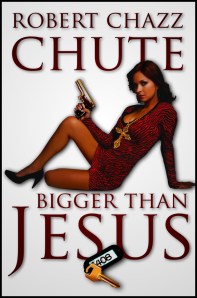
The foundation book of the Hit Man Series is available as an ebook and in paperback.

I’m in the middle of revisions on next my crime novel, so I’m grateful that the amazing Bridgette O’Hare suggested the Next Big Thing Blog Hop. As I creep closer to publishing Higher Than Jesus, she asked me ten questions about my Work in Progress. Ta-da!

What is the working title of your book? 

Higher Than Jesus (It’s pronounced “Hay-soose”. The “Higher” is a reference to drugs and thrills.) This is the second in The Hit Man Series. The foundation book was Bigger Than Jesus (released in June.) Five books are planned in the series so far. It’s a lot of fun, because stuff we thought we knew about Jesus Diaz from the first book go deeper. He has a darker past than I revealed the first time around and there are a lot of layers to his onion. The one thing you can count on with Jesus is that not much ever goes according to plan.

Where did the idea come from for the book?

The main character began with a cool idea I had for a suspense story called “The Inevitable” which appeared in my first book, Self-help for Stoners. Our first glimpse of Jesus was as a Cuban hit man who helps out women going through ugly divorces. That’s actually a glimpse of Jesus in the future, as a more experienced, mature assassin.

What genre does your book fall under?

Suspense, thriller, action/adventure. Whichever category appeals to you more.

Which actors would you choose to play your characters in a movie rendition?

I picture Enrique Eglesias as Jesus right now, but I’ve thought John Leguizamo, too. For the role of Willow Clemont, I’d need a very tall blonde glamazon. I’m not sure which actress fits the bill best. I’m not up on my tall, blonde actresses. As for the role of Chilli Gillie (another recurring good guy character from my Poeticule Bay Stories) who shows up in Higher Than Jesus, it’s kind of a sore subject. I pictured Michael Clarke Duncan. Sadly, he just died of a heart attack. I note Chilli’s resemblance to Mr. Duncan several times in the book and now I’m debating about rewriting that aspect and how to do so.

What is the one-sentence synopsis of your book?

In Higher Than Jesus, luckless hit man Jesus Diaz is on the run in Chicago when he takes up a mission to free himself and his girlfriend from addiction to Vicodin and to thwart the evil plans of a group of gun running white supremacists.

Will your book be self-published or represented by an agency?

I’m published by Ex Parte Press. This is the one company that cares most about my book. It’s my company.

How long did it take you to write the first draft of your manuscript?

The first draft was a month or two. I write fast. Then the long editorial tail kicks in. That has more people involved, and so, more variables.

What other books would you compare this story to within your genre?

The pace of Blake Crouch’s Run had a big impact on me as well as an old book by William Goldman called Edged Weapons. I like a book that skips along at a fast clip with lots of chuckles and clever surprises. I should also add that fans of Bigger Than influenced Higher Than quite a bit. Everyone commented on how funny Bigger Than Jesus was in unexpected ways. From what fans said, I decided that I needed to keep the pacing and reversals of the first book, but to always look for the humor in situations that aren’t all that funny. That’s what I do on and off the clock, anyway. I think finding the cosmic joke is what we all have to do to get through every day.

Who or What inspired you to write this book?

I have a dopamine addiction, so I’m compelled to write. I was born this way. Why write this book in particular? I read a lot, but I’m having a hard time finding this sort of book. Humorous books don’t tend to have a lot of action. Books with a lot of action often fall short on humor. I love snappy dialogue, so I probably owe more of an inspirational debt to the Coen brothers’ movies and Quentin Tarantino movies. If you can’t find the book you want to read, you have to write it.

What else about your book might pique the reader’s interest?

There’s a lot in there that provides deep context and verisimilitude for the plot, like some controversial observations about talk therapy, PTSD and drug addiction. My wife is a psychologist and I had to warn her that Jesus comes down hard on talk therapy, but it’s mental stimulation I’m dealing out. I’m not presenting Truth with a capital T, but an opinion from a guy who has serious problems, like killing people for a living.

Also, as a former military policeman, Jesus uses some clever surveillance tactics, skip tracer ruses and knowledge about IEDs that are all drawn from real life. Between research and some things I picked up from experts, the story yields some fun, interesting details and new twists that will amaze. Promise.

Who’s up next in the Next Big Thing Blog Hop? Look for more posts next Wednesday from:

The always-encouraging Jo Michaels, the lovely Jordanna East, the historically mysterious Laura Seeber, lover of all things just Lee Ann Sontheimer Murphy and the ever-enthusiastic Ronald Fischman.

Related articles

Filed under: publishing, , , , , , , , , , , , ,

My interview with Patrick Satters


I’ve been away from my desk for a few days, but the hilarity continued. I have a nice chat about The Hit Man Series with Patrick Satters:

What is your latest book called and could you explain to us in 20 words what it is about?

Bigger Than Jesus is the foundation book for a series of crime thrillers. Twenty words or less? Jesus Diaz is a luckless hit man who wants to escape with his girlfriend and a stolen mafia fortune. That’s nineteen words. Laughs. That’s twenty…

 Read on here!


Filed under: publishing, , , , , ,

Top Ten: My best fight

I’m so happy with my new fight scene from Higher Than Jesus.

Here’s why:

Check out all the books by Robert Chazz Chute here.

1. My first draft of this chapter was too easy on the protagonist. I wanted to show that Jesus had skills. He’s not a lame sad sack, though he is subject to Murphy’s Law: If something can go wrong, it will. This seems particularly true of my Cuban hit man Jesus Diaz. When I went revised, the chapter doubled in length to a much more tense and intense sequence.

2. I needed to use this scene to show that the heroine was worth fighting for. I really dislike stories where the heroine is merely an interchangeable object who, when things get dicey, can’t be depended upon. There are already too many stories out there where the guy fights the bad guy while the woman runs away, is tied up, twists an ankle, or presses herself against a wall while looking on in horror. (That’s a way too retro view of women. I like strong women.) A real man in any fight for his life will shriek, “Grab a shovel and hit this monster in the head! Don’t just stand there! He’s trying to kill me, for god’s sake!” Heroes who fight alone with an ally/romantic interest nearby aren’t heroes. They’re morons.

3. I put my protagonist through the burner. His reactions are realistic. He shakes. He trembles. He feels the euphoria of savagery and depths of fear. When bad things happen, he doesn’t just shrug it off. When somebody shoots at you, it’s totally unrealistic to react as if the shooter has offered you a sandwich of a sort you simply do not prefer.

4. The obstacles don’t stop. The guiding principle in The Hit Man Series is this: I don’t like it when the reader knows what’s coming next. Try to anticipate the unexpected. A lot of the time, I’m not sure what’s coming next, either. Expect a fast pace, twists and reversals.

5. A lot of fight scenes are dumb. This one isn’t. It means something much more to the larger story and to the characters.

6. There are long term consequences to a good fight scene. It’s not an episodic chapter of action only for action’s sake.

7. This fight scene elucidates in part how Jesus got the skills he did so what he can do doesn’t arrive out of nowhere.

8. The fight unearths something from Jesus Diaz’s personal history that overturns what readers think they know about his origin story. There was much more going on in Cuba than was revealed in the first book. I only found out when Jesus told me the other day.

9. The fight scene establishes my hit man’s amoral centre, but, because of his love for the heroine, he wants to reach higher. He wants to change. One of his challenges for the long arc of the series is, can he change? Can anyone?

10. When Higher Than Jesus comes out, you’ll see what I mean about this. No spoilers here, but I can say when the action is fast, the scene slows to take in details and make you grit your teeth. When the action slows down, the tension cranks up so there are questions that propel the story to the last word of the scene and the chapter.

This particular fight scene shows where Jesus Diaz has been and where he’s going.

The fight isn’t just with a couple of bad guys.

It’s about the fight between the two sides of Jesus’s character.

It’s about the fight we all face with the devils of our worse nature.

~ Like my flavor? Listen to the first chapter of my crime thriller, Bigger Than Jesus. I’m podcasting the book through the summer. Enjoy! (Or be a hero and just click the cover to grab it. Thanks for reading!)

UPDATE: Click here for the audio of Bigger Than Jesus, Chapter 2.

Filed under: publishing, , , , , , , , , , , , , , , , , ,

Author Blog Challenge: I love the voices in my head

Michael Clarke Duncan at the Warner Brothers L...

Michael Clarke Duncan at the Warner Brothers Lot in Burbank, California. (Photo credit: Wikipedia)

One of the writing prompts for the Author Blog Challenge is to choose a favorite literary character. That’s tough. I mean, I relate to Tyler Durden from Fight Club, but the cognitive dissonance kicks me in the pills when I realize that, beside the insomnia and ennui, I am not even Tyler’s alter-ego. I have a few things in common with Portnoy from Portnoy’s Complaint, though. Ugh.

This isn’t a dodge and I don’t mean to fall into douchey pimping, but the truth is my favorite literary character is whichever one I’m writing at this moment. I have several works on the go, so let me introduce the interesting people I hang out with while strangers assume I’m staring off into space and drooling:

Legs Gabrielle is a very funny comedian whose career has fallen through the floor. She finds herself back in Poeticule Bay, Maine, in the house she ran away from as a teenager. A killer has come to town, the Sheriff disappears, the deputy is cute, her sister has cancer (and might also be crazy.) I love Legs’s sense of humour and she’s a pleasure to write for the jokes that work as  counterpoint to her emotional depth. Hollywood has rejected her, but she’s the star of her own book soon.

Chili Gillie is a Michael Clarke Duncan lookalike, Legs’ bodyguard and has Mike Tyson’s voice. He’s a sweet man who only looks mean when needed. He’s the calm rationality around which the crazy revolves. His presence is extraordinary, but he’s the most normal of my characters. Both Legs and Chili are the stars of the first story in Self-help for Stoners and Chili shows up again in Bigger Than Jesus in a larger role. I’ve got big plans for him.

Dr. Circe Papua turns up a lot in my fiction. She’s a psycho psychotherapist who is magically persuasive and can be deadly if provoked. I love her cunning, unexpected lethality. Circe’s complex relationships with her patients often demand a battle of wills and wit. She shows up in different incarnations in Self-help for Stoners, Vengeance is #1, Corrective Measures and Sex, Death & Mind Control (for fun and profit).

Jesus Diaz is a mob enforcer who doesn’t want to be what his tragic childhood and circumstance has made him. He wants, above all, to fall in love with the right woman (if he can ever find her) and go relatively straight. He’s the main character in my crime novel, Bigger Than Jesus and I like him most for three things: he’s clever and prefers to lie rather than fight; he’s not really all that tough despite his profession; and he’s funny. I like funny people and chapters that whip along, full of pops and surprises. The series reads like a Cohen brother’s movie. Bad things keep happening even though you think you have an easy way out. This book will be out very soon and I’m jonesing for it. Just nailing down the cover and then we’re just about there. Jesus Diaz originally came to me as a story for Self-help for Stoners, but in that incarnation, he’s a much older, wiser and experienced assassin.

Jack (from Corrective Measures and Sex, Death and Mind Control.) Jack is a serial killer who I find interesting because of the way he sees our world. He thinks about vengeance quite a bit, but I’m actually more interested in writing him when he’s not himself. He’s fascinating when he’s trying to fit in and working through his twisted motivations and problems. He’s a dark avenging angel who has to hide his wings (metaphorically, that is) as he punishes people he decides deserve bad ends.

What’s fun is, eventually, I’m going to have all these characters meet in one book, but they have a lot of work to do before they meet. I have a lot of books to write before that happens, too. It’s exhilarating, daunting and pretty cool. Yeah, I said so myself.

Filed under: publishing, , , , , , , , , , , , ,

Bestseller with over 1,000 reviews!
Winner of the North Street Book Prize, Reader's Favorite, the
Literary Titan Award, the Hollywood Book Festival, and the
New York Book Festival.

http://mybook.to/OurZombieHours
A NEW ZOMBIE ANTHOLOGY

Winner of Writer's Digest's 2014 Honorable Mention in Self-published Ebook Awards in Genre

The first 81 lessons to get your Buffy on

More lessons to help you survive Armageddon

"You will laugh your ass off!" ~ Maxwell Cynn, author of Cybergrrl

Available now!

Fast-paced terror, new threats, more twists.

An autistic boy versus our world in free fall

Suspense to melt your face and play with your brain.

Action like a Guy Ritchie film. Funny like Woody Allen when he was funny.

Jesus: Sexier and even more addicted to love.

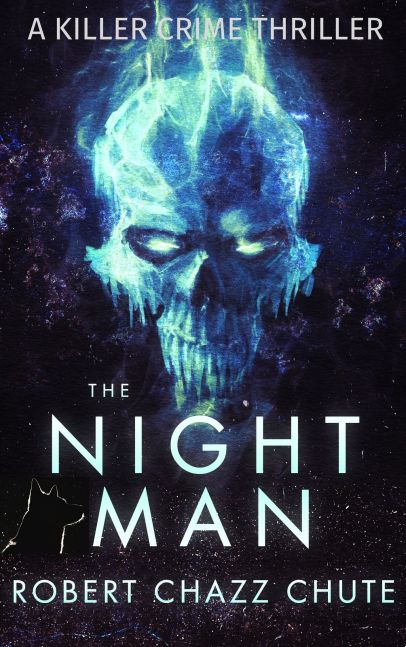
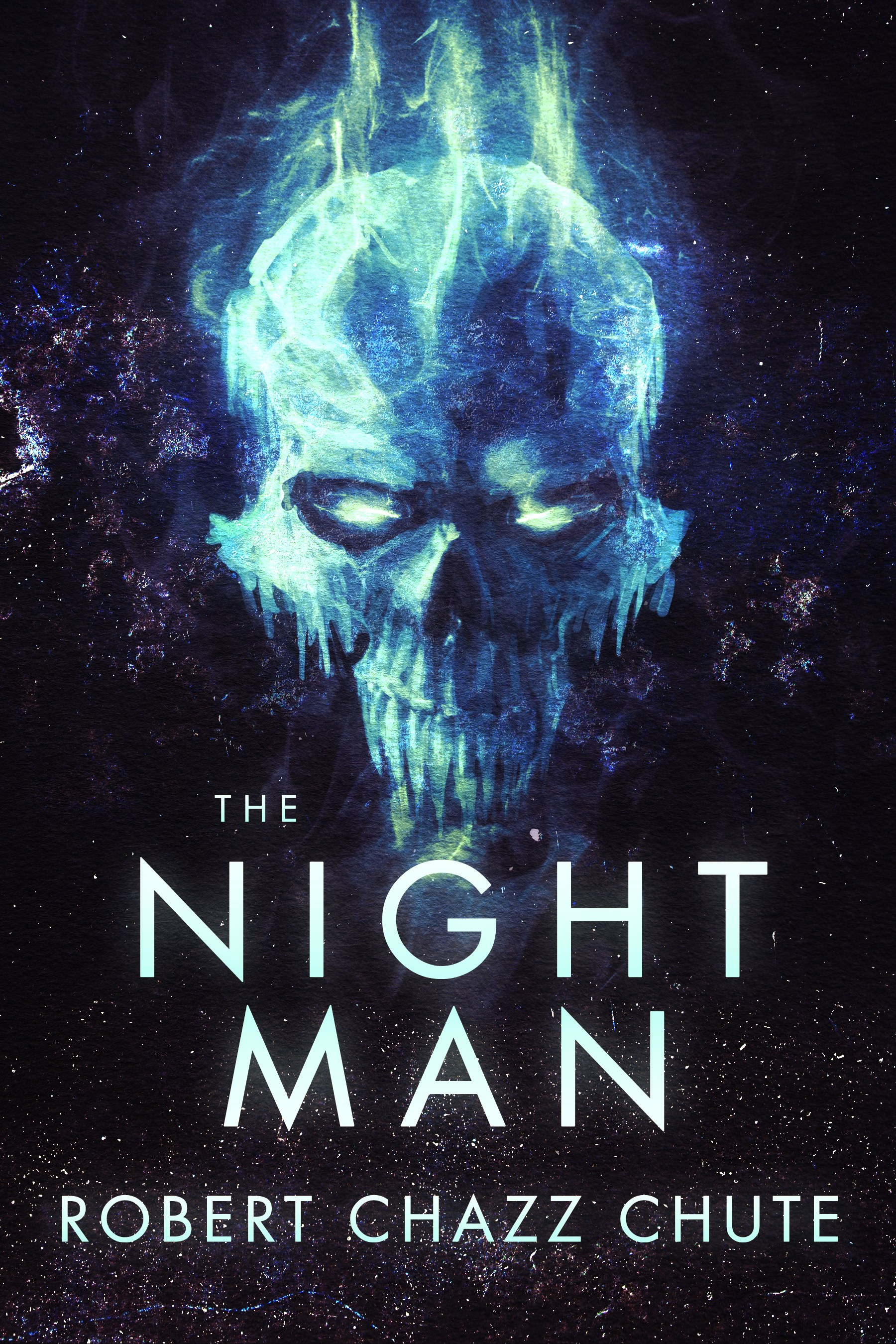
You can pick this ebook up for free today at this link: http://bit.ly/TheNightMan

Join my inner circle at AllThatChazz.com

See my books, blogs, links and podcasts.

Enter your email address to follow this blog and receive notifications of new posts by email.

Join 2,063 other subscribers