C h a z z W r i t e s . c o m

See all my books at AllThatChazz.com.

Writers: Five editing tricks and tips (plus editing marks)


1. Editing onscreen is more difficult and less accurate than printing out your manuscript and attacking it with a pencil. Unless you’re well-practiced at editing pixels, print it out.

2. As you read your manuscript, read aloud. You will pick up more problems that way and if you run out of breath, it’s probably a run-on sentence.

3. Some experts tell you to read your manuscript backwards, one word at a time, to catch more typos. Though it is true this technique works, you must have a form of OCD to act on it. This is advice editors give, but never do themselves. If you don’t believe me, try it with any book-sized manuscript. (Wait! First make sure there are no sharp objects or firearms nearby!)

4. As you edit, read slowly. Your brain is wired to skip over mistakes when you read quickly.

5. Farm it out. You need someone else’s fresh eyes on your manuscript to see the thing you are missing. Hire editors. (Here’s one!)

Filed under: authors, Books, Editing, Editors, getting it done, publishing, rules of writing, Writers, writing tips, , , , , , , , , , , ,

Writers: How to tell when your manuscript is ready

Freytag's Pyramid, which illustrates dramatic ...

Image via Wikipedia

Writing takes time and is often the most fun part of the journey. Then you rewrite and revise and revise again. Before you send your manuscript to an editor, make sure you’ve done as much as you can to clean it up.

Be aware of:

Formatting, hooking the reader, character development, story arcs, consistency of narrative, consistency of voice, differentiation of characters’ voices, typos, grammatical errors, plot logic, plot holes, pacing, three-act structure, rising action, scene length, passive voice, telling instead of showing

(gasp!)

…the list goes on and on, but you get the idea.

Make it as good as you are capable.

Once you’ve gone through however many revisions  you must endure (maybe two, maybe dozens) to write your story, go through one more time.

How will you know when you’re ready to send it off to an editor for new input?

You’ll be sick of your manuscript. (And if you have been holding on to a manuscript too long, let go of your perfectionism and the manuscript. It’s a torturous form of self-hatred.)

A manuscript is never truly finished. You could polish forever. However, when your editing goes sideways, meaning it’s not better but merely different, it’s time to send it off.


Filed under: Editing, Editors, getting it done, publishing, Writers, writing tips, , , , , , ,

Writers: Why self-publishing sucks (and what you can do about it)

Vanity

Image via Wikipedia

A couple of years ago I put together a chapbook of poetry. A few seconds after I handed a copy to a beta-reader he found a mistake. It was a glaring mistake on the first page he turned to. Alas. Embarrassment is an emotion that can run through you, both hot and cold.

Typos, grammatical errors, consistency problems and a host of other plagues suck the credibility and professionalism from your manuscript. At least for me it was a beta-reader and, contrary to first impressions, the rest of the manuscript emerged clean.

Some writers see self-publishing as a shortcut. When writers treat the medium as the quick and easy path to becoming an author, that’s still vanity publishing.

When you approach it seriously and make sure your manuscript has been combed for problems, that’s publishing (nevermind the “self” part.) When you choose to self-publish, publish. Form a company. Be a publisher. Hire editors (yes, I’m aware of the conflict of interest, but if you are, too—yes, I edit—we’re covered.) Get proofreaders lined up.

Take it seriously and you will be taken seriously.

Filed under: authors, ebooks, Editing, Editors, getting it done, grammar, publishing, Rant, self-publishing, writing tips, , , , , , ,

Writers: The Secret to Writing a Bestseller

bestseller_logo

Image via Wikipedia

The only thing you can do to ensure

you come at all close to writing a bestseller is:

Write your book!

After that? I hate to disappoint you, but there is no secret.

There is information you should consider, however, like acting on the things you can affect (factors) and refraining from making yourself crazy trying to change things that have a negative effect on you (variables.) 

Don’t focus on variables.

Focus on factors you can control:

1. Write the best book you can.

2. Build your audience (Teach, review, tweet, blog, network, learn, connect etc.,…)

3. Get your book to market (trad or indie publishing—that’s a different post.)

4. Do it again.

You’re going to want to come back to and act on 1 – 4 again and again.

The rest is explication.

I can already hear howls of protest about the title of this post. However, if you get an email from someone claiming they have insider secrets to making your book an instant bestseller, you can safely move on. There are some wacky claims out there, so let’s unpack and debunk.

First off, there are far too many variables that are out of your hands for any one person to direct you to bestsellerdom. In the publishing process there are a lot of variables. All of them have to fall into place for your book to be sold, but even if that were to happen, there are no guarantees your book will climb the charts…even if it’s good.

There are a lot of good books. Sadly, that doesn’t mean we’ve heard of them.

Consider Chuck Palahniuk‘s Fight Club and Choke. They both became movies, but just before it was announced Brad Pitt was going to do the Fight Club movie, I saw it in the remainder bin. They got whipped out of there when his book got the movie deal and the newest hire had to peel off all those stickers that read: Marked Down. The author wrote a great book in Fight Club, but he was headed back to anonymity before the lucky break. (He’s proved his worth since over and over, too; he’s prolific and, weirdly, I even saw a major review that didn’t even mention Fight Club.)

His case is a perfect example of something falling into place that was totally out of the author’s control. If Antonio Sabato Junior had played the role instead of Tyler Durden and Lindsay Lohan had played Marla instead of Helena Bonham-Carter, you would never have heard of Palahniuk’s books (because that’s a lot of stink to overcome.) Antonio was good in the few minutes he was in The Big Hit, but generally, if you see a movie poster with Lindsay and Antonio, you don’t think,  “Ooh, gotta see that!”

The most important reason you can’t just follow set rules and write a bestseller is that what William Goldman said about Hollywood also applies to publishing. “Nobody knows anything.”

That’s why there are sleeper hits. I wandered into Fargo and Highlander, didn’t know what to expect, and was blown away. Margaret Atwood snuck up and surprised me with The Year of the Flood—okay, maybe other people expected great things from Atwood every time, but that’s the book that turned me around on that author. (Can’t wait for the third in the series!)

When manuscripts go up for auction to big publishing houses, acquiring editors bid because they want a hit. Even when books go for big money, that’s no guarantee of great success. In fact, if the author doesn’t earn out that big advance, it’s a very public failure. That blemish on their record hurts authors when they try to sell their next book.

It’s a subjective business. If agents and acquiring editors really knew much beyond their own taste, then every book they bought would sell very well. Look at the bestseller lists. There are only so many spots in the top ten lists. Then look at the book store shelves packed with midlist titles. That’s a lot of books, and those are just the books the stores stock. There are many more books published than ever make it to bookshelves, yet somebody thought each book would earn out its advance.

Nobody’s betting on losers on purpose. The bestsellers are the frontlist. The books that aren’t expected to do as well are the midlist. Midlist authors are still generally expected to earn out their advance, however. Remember: it’s business, not charity.

Hm. Somebody’s going to object that there are exceptions (and, of course, there always are. Can we say much at all without some generalizing?) So I must admit I did know a publisher who bet on losers pretty much exclusively. Maybe he was noble and doing it only for the art (and government grants) or maybe his judgement was just galactically poor. He’s out of business now so no more art. (Last parenthetical, I promise: And if you publish poetry, nothing is frontlist or midlist because no one pubishes poetry expecting to make money.)

Back to the book store: See all those dogs in the remainder bin? Somewhere, someone bet a lot that each one of those books would sell really well.

Some books aren’t a surprise when they do well, but for those books, that’s not the game anymore. When a publisher buys a Sarah Palin book, they aren’t so concerned whether it will sell. Their concern with a book like that is, how much and how fast will it meet higher expectations and sell more? When a book succeeds, the publisher has to time the next printing right and gauge how much promotional money should go into the publicity campaign to push it as far as it can profitably burn.

Publishers concentrate their limited resources on the few books they think will have a shot at bestsellerdom because they will take a loss on most of their catalogue. Some don’t believe it and authors lament it, but publishing is a business. And it’s a business with very small margins.  

Even when publishers get books on the shelf, it’s not even over then. The sell-through is what’s important. Unlike any other business, publishing’s tradition—blame Simon & Schuster—is that books that don’t sell may be returned for credit. It’s a tradition that may eventually be dropped, especially when there are fewer book stores around.

I’m dying here! Give me some good news, Chazz!

Okay. The good news is that when you get rejected, you can take comfort in the knowledge that nobody knows anything. Maybe the guy who rejected you also rejected JK Rowling, so what do they really know anyway? Maybe you are destined to be a sleeper hit.

Do better than that, Chazz! I said I’m dying!

Sorry. How about this? Contests, bestseller lists, critics and reviews might help an unknown author, but it’s really word of mouth that makes a book popular. (Or a big movie deal.) The antidote to your angst is to keep writing and pitching. Find your audience and put yourself out there to be found.

How?

Go back to Factors 1 -4 at the top of this post.

Better? Now go write.

Filed under: authors, Books, Editors, getting it done, links, Poetry, publishing, Rant, Rejection, rules of writing, Writers, writing tips, , , , ,

Writers: On sending your stuff

J. K. Rowling, after receiving an honorary deg...

Image via Wikipedia


To the right is a picture of JK Rowling. Notice that she is not me. As with Highlander, “There can be only one!” I’m sorry this has become necessary to point out.

One of the posts here is a neat spreadsheet that shows how JK Rowling plotted out Harry Potter. Recently I got an email with several errors addressing me as JK Rowling that asked me to email the writer so I could read some of her work. Billionaire authors don’t do that much. In fact, as presented, I wouldn’t do it, either.

I’d feel bad about pointing out this error so publicly, but it’s apparent the writer is not someone who reads this blog. Please read the blog (and also www.chazzwrites.vpweb.ca). When someone jumps from my bio page to ask about my bio, it just feels like spam and carelessness. Writers are detail-oriented and email, no matter how casual you want to appear, should reflect that. (In fact, I’ve sometimes gone through several drafts on queries to make them appear breezy and casual.) Whether you’re sending a manuscript, a query or a short email, you must pay attention to the details.

I know what you’re thinking. You already know this. Okay, but obviously many people still don’t. One writer told me she had already written several books. That’s a good sign. However, in one short paragraph, she made seven errors. That went into my evaluation of how much I could help her right away. I decided editing her book would be time and cost-prohibitive for me and for her.

When I take on a project, I have to take into account how much time I will have to invest in the book. From that short paragraph, I had to conclude that, were I to take her on, the job would be rewriting, not editing and proofing. When it starts out that bad, it doesn’t make me confident about larger issues like attention to detail, story arcs, characterizations and narrative logic and consistency. I have ghosted a couple texts. Writing and rewriting are not out of the question, but I have to know the scale of what the job requires going in (or I may as well be working behind a counter wearing a paper hat and slinging fries.)

Does your project have to be perfect for me to work on it? Of course not. If it were perfect you wouldn’t need anyone (and you’d be god.) I’m not being nitpicky or cranky. It’s just that when I get a query, I’m looking for signs the author is serious. If you’re asking me to take your work more seriously than you do, that’s a bad sign.

Queries and sample chapters give you an idea of how I work and they tell me how much time your book will take up. That’s one of the main variables in determining my rate, so please, don’t shoot off an email—to me or any other editor—before reading what you wrote at least once.

I’m trying to end on a positive note, so I’ll add that I just took on an editing project that excites me. The author’s serious, nice and I can’t wait to dig into her book and take it from great to fantastic. In fact, the antidote to amateurish folks is waiting on my desk. I’m off to work on the manuscript.

Filed under: authors, blogs & blogging, Editing, Editors, getting it done, links, Rant, Rejection, What about Chazz?, Writers, writing tips, , , , , , , , , ,

Writers: Top 10 of the 2010 Top 10 Chazz Writes posts

Top10

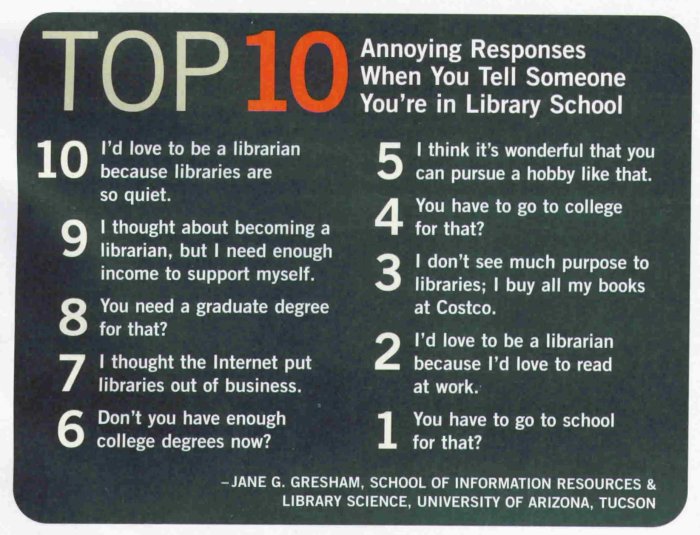
Early last year I considered going back to school to become a librarian. (I dumped that idea before I saw this graphic, but it does make me feel better about my choice.)

After some career counselling, I decided to refocus my efforts on my writing and editing. I needed (and need!) to bring art to the front burner. I began this blog as part of reorganizing my life to that end. Since last May I’ve posted 402 times and gained lots of readers, friends and even some clients (hurrah!) Things progress.

 For lucky #403, this is a look back through the Top 10 lists of 2010:

1. Authors! Part II: Top Ten Lessons from the Networking Master

2. Top 10 Ways Writers Waste Time

3. Writers & Editors: Top 10 Editorial Considerations

4. (Top 10 Things +1) Writers Love

5. Top 10 Reasons We Write Sci-fi

6. Top 10 (plus one) Publishing Conference Lessons

7. Top 10 Things Writers Fear

8. Top 10 Reasons We Write Horror

9. Top 10 Reasons We Write Romance

10. Writers Top Ten: Why blogging about publishing is important

Filed under: authors, Books, ebooks, Editing, Editors, getting it done, Horror, Publicity & Promotion, publishing, Rant, Top Ten, Useful writing links, Writers, writing tips, , , , , , , , , , , , ,

Writers: Does the term “wannabe” irk you?

Kevin Smith

Image by wvs via Flickr

Just read an editor using the term “wannabe.” I’ve probably used it in the past, too, but no more. (I am a writer and I’m an editor who works with writers, so why wouldn’t I show them as much respect as I can and avoid an irksome term?)

Whether the editor in question meant it that way or not, it came off as dismissive. Anyone who read my blog regularly knows I have a man crush on writer-director indie legend Kevin Smith. He wrote something a while ago that really got my attention and it applies here.

He wanted to be a director. He was in Jersey and no money and no plan.

When he told his sister of his ambition, she replied,

“Then BE a director!”

Don’t want it. Be it.

If you write, you’re a writer. If you aren’t published yet, approach the work professionally and act as if you already are. (That means improve your craft, take criticism, educate yourself about the industry and comport yourself with grace and ease.)

I’m a published writer and I can tell you, after a time, seeing your name in print is not that big a deal. It’s the work that matters, and when it’s at its best, it will feel like play.

What matters is the writing:

Do it.

Enjoy it.

Get it down,

Get it done.

Write more.

Write again.

Writers write.

Don’t get caught up in status, hierarchy and aspirations. Do the work because writers write, whether they’re going to be published or not.

Filed under: authors, Books, DIY, Editing, Editors, getting it done, publishing, Writers, writing tips, , , , , , , , ,

Writers: The mire of conflicting advice & unfair criticism

The hierarchical structure of the autobiograph...

Image via Wikipedia

When I got into the business, there was a criticism meant to shut writers down.

“Too autobiographical” was the kiss of death.

That’s ironic for several reasons:

Biographies and autobiographies are moneymaking books. Sarah Palin‘s ghosts have already published more books than you and possibly more books than she’s read. Okay, that was a cheap shot, but somewhat funny and it has the added bonus of being an Irish fact—that is, something that is a lie, but should be true.

I digress.

Back to the issue of unfair criticisms and misguided advice:

 The mind boggles at Augusten Burroughs work. How much childhood trauma can one man recycle into his fiction and non-fiction? He has enough monsters, addictions and insanity in his past that he’s set for several more books at least.

“Too autobiographical” is now a stale criticism when you consider the movement of the market toward tell-alls, whistleblowing and confessionals. There’s a lot of popular fiction that’s thinly veiled life story, too. In fact, if you’ve been a lion tamer-stripper-celebrity-prostitute, you’re a much easier sale than if you’re just another writer working away at your desk making stuff up.

Diablo Cody is a talented writer, but she had a lot more heat going into the fray because of her tattooed image and history as a stripper. I’m not saying she wouldn’t have sold the brilliant Juno script anyway, but really, how many celebrity screenwriters can you name besides her, McKee and William Goldman? If you came up with a few names, it’s probably because they are famous writer-directors, not just writers.

(And notice that irksome phrase “just writers.” I use it advisedly, as a synonym for “merely,” since that’s the stature writers generally have in film, television and publishing.)

“Too autobiographical” was once a stinging barb. It marked a talent that was undeveloped. It suggested teenage angst worthy of a diary, not of publishable quality.

The worm has turned. Now your tortured history as a brawler helps; Chuck Palahniuk brawled a bit and escorted sick people to support groups long before Fight Club. Your time in seedy bars lends authenticity to your writing and manuscript evaluators may well take you more seriously because of the stuff you don’t want your mom to know. A work can still be too autobiographical, but that criticism doesn’t carry the weight it once did.

Evaluators can be off the mark in what they think qualifies as authentic, anyway. One writer, for instance, was told that her dialogue didn’t ring true for how contemporary teenagers speak. She was advised to hang out with some kids to catch the flavor of the real thing. What the manuscript reader didn’t know was the writer was 17 at the time.

We’re a culture that worships celebrity, so “too autobiographical” isn’t a criticism that comes up as much (unless your life story is deadly dull.)

The true irony is that the same editors who would say “too autobiographical” would also routinely tell aspiring writers to “Write what you know.”

That’s bad, even egregious advice. Don’t write what you know. If you only write what you knew, there wouldn’t be much fantasy, science fiction…or much literature at all, come to think of it.

Instead, write what you care about.

 Your research and the knowledge

flows from caring, anyway.

Filed under: authors, book reviews, Books, Editors, links, manuscript evaluation, Rant, scriptwriting, Useful writing links, writing tips, , , , , , , , , , , , ,

Writers : How “hands-on” do you want your agent to be?

A diagram of cognitive dissonance theory

Image via Wikipedia

I ran across an interview with an agent here. She sounds very nice. But the first couple of questions got me to wondering…

The agent mentions that she’s been lucky to never have to work on a book she didn’t “love.”

Okay. That’s great. Or is this a red flag? It’s a common sentiment among agents across the board. They want to be “delighted.” They have to love it to sell it. Hm. As a former sales rep of hundreds (thousands?) of books, I can tell you I sold many books I hadn’t even read. I’m not recommending that. I am saying that’s real. I fail to understand why agents have to love books to sell them. Shouldn’t the question be, would others want to read this? Do I know an editor who would like this?

You’ve bought a lot of books. You’ve read quite a few of that number, even to the end. How many books have you read that you really and truly “love”?

Then the agent discusses being very “hands-on.” There’s kind of a cognitive dissonance here, isn’t there? I’m not picking on this one agent. Again, she’s saying stuff that a lot of agents say. But on the one hand, the agent has to love the manuscript. On the other, there’s apparently lots of work ahead before it’s presentable for submission to an editor. Uh…whut? Shouldn’t it be one or the other?

Here’s a take on this from an author who sees the agent-author relationship a different way, and by that I mean upside-down from the way it’s usually portrayed. Dean Wesley Smith sees the agent as his employee and is not interested in jumping through their hoops. He doesn’t want to be slowed down by the agent’s process (though he has used agents.) He’s not interested in any employee slowing his process, production or sales. I recommend you read all his posts on Killing the Sacred Cows of Publishing. It’s refreshing.

So here are my questions:

Do you want your agent to love your book or is liking it good enough for you?

Do you want your agent to edit your manuscript to make it better up front?

Do you prefer that your agent be more hands-off and just get it to market?

Addendum: The agent adds, “Basically, build yourself as big of a social media platform as you can before your book ever comes out.” Good advice for both the indie published and the traditionally published. But, if you can get your social media platform big enough, do you need a traditional publisher at all?

My new BFF Jason Alexander Greenwood asked himself these questions and came up with an indie answer. If you missed my link to his post on Sunday, read Shoot the Gatekeepers here.

Filed under: agents, authors, Editors, getting it done, links, manuscript evaluation, publishing, Rant, Rejection, , , , , ,

Writers: What really happens in book marketing meetings (Plus: What sells books)

Books in the Douglasville, Georgia Borders store.

Image via Wikipedia

It’s interesting to see the profession of book sales rep disappear. I was a journalist first and that’s evaporated. Later I was a book rep and that’s on the way out, too.  Book sales was somewhat romanticized. From the inside of the industry, book marketing isn’t romantic at all. Occasionally I hung out with authors and going to book fairs and sales meeting in nice places was fun. Yes, there were a few cocktail parties. Most of the year, however, you’re hauling so many samples around in your car, the shocks go. You spend a lot of time trying to get to the next appointment on time and worry about finding a good place to park.

I met some really nice booksellers. I also met many awful book retailers. The crux of that problem was that the young booksellers were doing it as a joe job and the older booksellers got into the job for idealistic reasons. No one tells aspiring bookstore owners that, not only are the big chains going to force them out of business, they won’t spend near as much time reading as they planned. Instead, they’ll spend an inordinate amount of time calculating the GST, paying the GST and trying to assist book buyers who aren’t informed book readers. (e.g. “I want to buy a book for my daughter I heard about on the CBC last month. You know. That one…? It’s by that guy? With the thing…? Surely you know that one!”)

So I dealt with the bored and disillusioned. Not exclusively! It’s just that those negative people are the sales experiences I remember best. That miserable bookseller in Owen Sound was an impatient sort who, when I dared to use the word comedy, corrected me and told me the book was “humour.” I’m surprised she was familiar with either facet of the concept. Then there was the condescending one north of Toronto who thought I was stupid since I was still enthusiastic. She beat that out of me quick. “Okay,” I said. “For the remainder of this meeting, I’ll power through the list and act just as pissed off as you appear to be. Happy? Am I smarter now?”

It wasn’t all bad. The owner of the now-defunct Frog Hollow Books in Halifax has a special place in my heart. She was a sweetie, had a great store and she bought a lot of merchandise from me gladly, even in the press of the Christmas rush. I wish that bookstore was still around.

What I find interesting in other people’s reports of marketing meetings is they say sales rep opinions  are valued. I hear of book reps getting input into the list, commenting on the marketing challenges and the dubious appeal of certain covers and so forth. Book reps on some planet get to turn something down and require changes in order to make a book sell. I repped sixteen publishers of various sizes and I can tell you, my input didn’t carry any weight. It wasn’t asked for, either. I was their traveling salesman. If the book didn’t sell, they figured it was my fault.

At a sales conference, the editorial team is selling their enthusiasm for the list they built. In my experience, if we dared to mutter about a lousy cover, we did so among ourselves. Voicing any reservations would be met with derision. We weren’t graphic artists, so maybe the cover proved to be lousy and many booksellers would tell us so as we made our rounds. However, in the context of the sales conference,we were getting flown out to someplace nice for one reason. We were supposed to sit there, take notes, and listen. The graphic artist and the editor got to have opinions on anything creative. Our job was to sell their old ugly dogs with the same conviction as the cute puppies. If we didn’t believe the dogs with mange and pushed-in snouts would sell, obviously we were idiots or traitors to the cause.

It sure didn’t feel like the powerful position some portray. Lots of articles on the publishing process mention the input of the sales team on titles. Not so in my experience. I watched editors and their minions show covers, talk about the books and maybe pass out review copies. True, we’d worry over price points. We’d look at the page count and comment that the heft of the book was light for the expense. (“People buy books by weight,” was a common bit of wisdom. “Green covers don’t sell it’s a golf book,” was the other bit. That was true, I think.) However, the publisher and their editors had already committed their resources to the books by the time we came into the picture. By then, they would understandably be reluctant to make major changes in their plans for two reasons: expense and ego. We weren’t going to change a done deal.

In the hierarchy of the book industry, the editors and publicists put themselves above the salespeople, especially if anyone referred to books as “product.” (Only a few did that.) Sales reps weren’t creative. We just did the grotty part with the filthy lucre that allowed the creativity to continue.

Many editors idolized some authors. Privately though, many put the authors at the bottom of the hierarchy. Yes, writers are the engine of the industry who provide the art to sell and a reason for editor’s existence. Perhaps it’s envy or resentment. Maybe it’s because acquisition editors see themselves as gatekeepers so they feel they made the authors.

In a less complex analysis, everyone’s the star of his or her own movie and authors come and go like background extras.

And some, being arty and human, are a pain in the ass. For instance, I sold Matt Cohen‘s books. For some he was an icon as well as a somewhat famous Canadian author. However, there was a bookseller nearby who didn’t care for his books and refused to stock them. When the publisher took the author out for lunch, naturally they stopped in to see how his books were selling. I soon got a angry memo. “What’s going on?!”

What was going on was not every bookseller is obliged to carry every book and the publisher’s embarrassment wasn’t a factor in the decision. The bookstore owner simply didn’t like Matt Cohen’s books. The proximity of our house to the store didn’t convince the owner. I despised that bookstore owner (a notorious and cadaverous blowhard.) I agreed with his right to stock whatever he pleased, however. Personally, I found Cohen’s books neurotic, but not in a good way.

At first my territory was Toronto (and in the summer, Cottage Country, too.) Later on, I worked for a book distributor so I sold books wholesale across the country as well as in downtown Toronto, Ottawa and all points north and east. I can’t say I ever felt like more than a minion. It wasn’t that the editorial staff was particularly unkind. It was simply that we had no creative input. That’s why I wonder about these reports I’ve read about the publishing process. When in-house editors tell authors, “Marketing didn’t like this or that,” are they really hiding behind the closed doors of those marketing meetings? Is it just a ploy to bring down the author’s expectations from the sky-high hopes, dreams and promises that originated in the editorial department?

Blah, blah, blah. You’re an author. You want to know what sells books. I’ll tell you.

I sold hundreds of books at a time. Some I read, but there wasn’t enough time to read them all. Instead I recited the catalogue copy and gave my impressions for each book’s appeal. If there was any kind of marketing campaign, I’d talk about that. It’s a gift to a book’s potential (and the haggard sales rep reciting the same spiel for the 100th time) to be able to say, “We think this one has a shot at the Giller,” or, “We’re putting a lot of work into getting this one on that particular CBC show you like etc.,…”

What sells books is word of mouth for a book with good writing that tells a compelling story. It takes a lot of incompetence on the publishing team’s part to overcome that. The other thing that sells books is the human connection between the book sold and the person who wrote it. What helped me sell the most books was meeting the author. Booksellers are on the frontlines of retail, far from the cocktail party action. They want to hear a sales rep’s funny story about meeting That Author.

One of the better people on the planet? One the sweetest people you could ever meet? Amy Tan. I sold her books. I sold a ton of her books. Utterly charming and genuine. When I met with booksellers, I didn’t talk much about her book. I sold her to them instead. We push the people we like harder.

When you get invited to a sales conference (if you ever do) or go on a book signing (arrange your own if your publisher won’t), remember to treat the minions well. Be nice. Be fun and memorable. The sales reps will remember you. The booksellers will hand sell you book.

Extra tip:

That’s why it doesn’t matter so much if a lot of people don’t come to your bookstore signing.

The customers may come or not, but the bookstore staff are always there.

Make a good impression and they’ll hand sell your book.

And the next.

And the next.

What really sells your books?

You do, through the force of your creativity, the shimmer of your personality and audience you cultivate.

Filed under: Books, Editors, getting it done, links, Publicity & Promotion, publishing, Rant, Useful writing links, writing tips, , , , , , , , ,

Bestseller with over 1,000 reviews!
Winner of the North Street Book Prize, Reader's Favorite, the
Literary Titan Award, the Hollywood Book Festival, and the
New York Book Festival.

http://mybook.to/OurZombieHours
A NEW ZOMBIE ANTHOLOGY

Winner of Writer's Digest's 2014 Honorable Mention in Self-published Ebook Awards in Genre

The first 81 lessons to get your Buffy on

More lessons to help you survive Armageddon

"You will laugh your ass off!" ~ Maxwell Cynn, author of Cybergrrl

Available now!

Fast-paced terror, new threats, more twists.

An autistic boy versus our world in free fall

Suspense to melt your face and play with your brain.

Action like a Guy Ritchie film. Funny like Woody Allen when he was funny.

Jesus: Sexier and even more addicted to love.

You can pick this ebook up for free today at this link: http://bit.ly/TheNightMan

Join my inner circle at AllThatChazz.com

See my books, blogs, links and podcasts.

Enter your email address to follow this blog and receive notifications of new posts by email.

Join 2,063 other subscribers