C h a z z W r i t e s . c o m

See all my books at AllThatChazz.com.

Writers: Top 10 of the 2010 Top 10 Chazz Writes posts

Top10

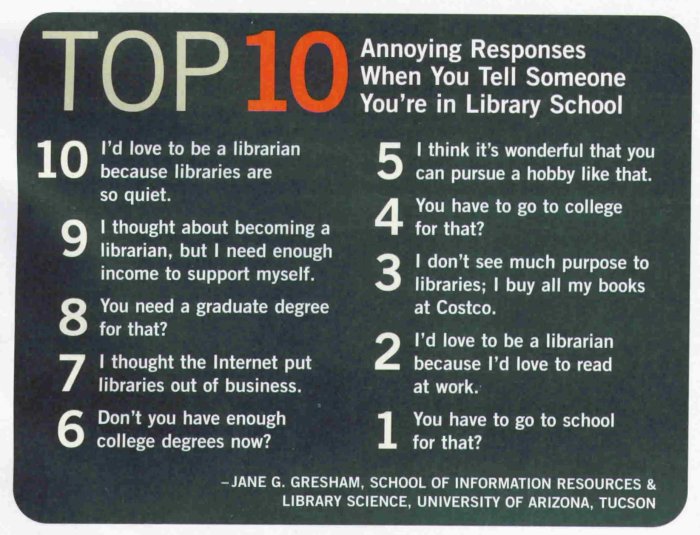
Early last year I considered going back to school to become a librarian. (I dumped that idea before I saw this graphic, but it does make me feel better about my choice.)

After some career counselling, I decided to refocus my efforts on my writing and editing. I needed (and need!) to bring art to the front burner. I began this blog as part of reorganizing my life to that end. Since last May I’ve posted 402 times and gained lots of readers, friends and even some clients (hurrah!) Things progress.

 For lucky #403, this is a look back through the Top 10 lists of 2010:

1. Authors! Part II: Top Ten Lessons from the Networking Master

2. Top 10 Ways Writers Waste Time

3. Writers & Editors: Top 10 Editorial Considerations

4. (Top 10 Things +1) Writers Love

5. Top 10 Reasons We Write Sci-fi

6. Top 10 (plus one) Publishing Conference Lessons

7. Top 10 Things Writers Fear

8. Top 10 Reasons We Write Horror

9. Top 10 Reasons We Write Romance

10. Writers Top Ten: Why blogging about publishing is important

Filed under: authors, Books, ebooks, Editing, Editors, getting it done, Horror, Publicity & Promotion, publishing, Rant, Top Ten, Useful writing links, Writers, writing tips, , , , , , , , , , , , ,

Writers: The mire of conflicting advice & unfair criticism

The hierarchical structure of the autobiograph...

Image via Wikipedia

When I got into the business, there was a criticism meant to shut writers down.

“Too autobiographical” was the kiss of death.

That’s ironic for several reasons:

Biographies and autobiographies are moneymaking books. Sarah Palin‘s ghosts have already published more books than you and possibly more books than she’s read. Okay, that was a cheap shot, but somewhat funny and it has the added bonus of being an Irish fact—that is, something that is a lie, but should be true.

I digress.

Back to the issue of unfair criticisms and misguided advice:

 The mind boggles at Augusten Burroughs work. How much childhood trauma can one man recycle into his fiction and non-fiction? He has enough monsters, addictions and insanity in his past that he’s set for several more books at least.

“Too autobiographical” is now a stale criticism when you consider the movement of the market toward tell-alls, whistleblowing and confessionals. There’s a lot of popular fiction that’s thinly veiled life story, too. In fact, if you’ve been a lion tamer-stripper-celebrity-prostitute, you’re a much easier sale than if you’re just another writer working away at your desk making stuff up.

Diablo Cody is a talented writer, but she had a lot more heat going into the fray because of her tattooed image and history as a stripper. I’m not saying she wouldn’t have sold the brilliant Juno script anyway, but really, how many celebrity screenwriters can you name besides her, McKee and William Goldman? If you came up with a few names, it’s probably because they are famous writer-directors, not just writers.

(And notice that irksome phrase “just writers.” I use it advisedly, as a synonym for “merely,” since that’s the stature writers generally have in film, television and publishing.)

“Too autobiographical” was once a stinging barb. It marked a talent that was undeveloped. It suggested teenage angst worthy of a diary, not of publishable quality.

The worm has turned. Now your tortured history as a brawler helps; Chuck Palahniuk brawled a bit and escorted sick people to support groups long before Fight Club. Your time in seedy bars lends authenticity to your writing and manuscript evaluators may well take you more seriously because of the stuff you don’t want your mom to know. A work can still be too autobiographical, but that criticism doesn’t carry the weight it once did.

Evaluators can be off the mark in what they think qualifies as authentic, anyway. One writer, for instance, was told that her dialogue didn’t ring true for how contemporary teenagers speak. She was advised to hang out with some kids to catch the flavor of the real thing. What the manuscript reader didn’t know was the writer was 17 at the time.

We’re a culture that worships celebrity, so “too autobiographical” isn’t a criticism that comes up as much (unless your life story is deadly dull.)

The true irony is that the same editors who would say “too autobiographical” would also routinely tell aspiring writers to “Write what you know.”

That’s bad, even egregious advice. Don’t write what you know. If you only write what you knew, there wouldn’t be much fantasy, science fiction…or much literature at all, come to think of it.

Instead, write what you care about.

 Your research and the knowledge

flows from caring, anyway.

Filed under: authors, book reviews, Books, Editors, links, manuscript evaluation, Rant, scriptwriting, Useful writing links, writing tips, , , , , , , , , , , , ,

Writers: Why your worst ideas ever might be your best

Andy Warhol: Campbell's Soup Cans (MoMA - New ...

Image via Wikipedia

Three words: Andy Warhol. Soup.

Warhol made his name by making art out of the everyday. Campbell’s soup cans became transcendent when we saw them again through Warhol’s eyes. But don’t you think he encountered a lot of resistance along the way? Lots of people have.

When you look at creative endeavours, it can be very difficult to tell a good idea from a terrible one. In fact, some of the best ideas, appear to be the worst ideas ever at first glance. 

Ghandi said, “First they ignore you, then they laugh at you, then they fight you, then you win.”

Publishing. Film. Art. It can all be like that.

Books have been written about rejection (and a lot of them were probably rejected quite a bit before finally getting published.) They are pretty funny when you look back on them now. Keats was told he couldn’t use language. The first guy who looked at Everybody Comes to Rick’s wrote that he gave the writer ten pages to grab him and he didn’t. Everybody Comes to Rick’s became Casablanca. Neil Gaiman‘s The Graveyard Book is a more recent example. It’s a great book about a baby whose family is murdered. The baby wanders down to the local boneyard to be raised by the ghosties there.

Yeah, I know! And yet. And yet.

Feel bad about getting rejected? Remember this: “Norton, this idea of yours is so crazy, it might just work!”

Great ideas often come in disguise. From the outside, they look just terrible. when you finally succeed (or go indie and make it happen on your own sans gatekeepers) you can wipe your tears away with a fifty.  (Okay, a five-spot. You’re a writer, after all.)

Filed under: publishing, Rant, Rejection, Writers, writing tips, , , , , , , , ,

Writers: What is your genre? What do you read?

St. Augustine writing, revising, and re-writin...

Image via Wikipedia

Most of you are writers.

Please let me know the genre in which you write.

Also, what do you read?

Some writers avoid reading fiction from their own genre because they worry it will influence their own writing. I think there’s a difference between a good influence, a bad influence and plagiarism, so I read a lot within my genre (literary fiction and horror.) I also read widely outside my genre.

I usually have ten or so books going at one time. I either have an undiagnosed case of Attention Deficit Disorder or I’m easily bored. Oh, or maybe those two things are de facto the same thing. (I know I’ve hit a really good book when I don’t switch it out with another book. and slow down to savour it.)

I also have an extensive collection of reference books and how-to books on writing, social media and most aspects of publishing. Do you have a favourite book on writing or perhaps you reject the premise? What writing books do you love? Which could you (and the universe) do without?

I’d like to hear from you.

Please leave a comment and let me know your thoughts.

Thanks!

Filed under: book reviews, Writers, , , , , , , , , , , ,

Writer Links: Stephen King, evil editors and plugging plot holes

Stephen King, American author best known for h...

Image via Wikipedia

You’ve already worked hard today, right? Take a break.

Here are some useful links for your Friday afternoon:

Stephen King’s Top 7 Tips for Becoming a Better Writer

Editors are evil, and other fairy stories‏

AOS: How to avoid inconsistencies and plot holes

The Must-Have Writing Routine‏


Filed under: authors, Editing, Editors, Friday Publishing Advice Links, Useful writing links, Writers, writing tips, , , , , , , , , ,

Writers: Update & three links for you

a Science fiction city (Paris in a future.)

Image via Wikipedia

I had another frustrating day dealing with tech support that, for awhile, actually made things worse. Now another modem is on order and I’m searching for a technician to come save me. Yeah, it’s that bad.

However, this too shall pass. I’m going to try to get some writing done on my little AlphaSmart Neo. Once you’ve done all you can, you’ve done all you can. I’ve messed with the computer so much I’ve lost two days of my life. While others were enjoying snow days, I was staring at a screen trying to move the immoveable. No more.

Today I get back to my life and focus on the fun parts. I’ll let the on site tech deal with the trouble. (For those who missed it, a cyber attack is to blame, but don’t be afraid. I’m not contagious.)

I recently finished a major editing stage for a client’s book so now it’s time to work on something of my own: a dystopian novel about soulful robots and a drug that improves human brains. Think Robert J. Sawyer meets William Gibson. Ooh, that’s high falutin’ talk. Anyway, I’ll put aside my present-day tech troubles and write about future tech troubles.

And finally, I’ll have some fun. Writing fiction is always fun. If you aren’t having fun as you write, your readers won’t have a chance. Stop putting it off. Go have fun, too. If you have to delegate your worries to get them away from you, then do that.

 (Well…after you check out these cool links, anyway.)


The Writers Alley: The Quixotic Pull of Your Future Novel‏

10 media and tech luminaries on the future of reading

7 Ways to Help Writers Survive the Holidays

Filed under: authors, My fiction, publishing, Useful writing links, What about Chazz?, writing tips, , , , , , , ,

Writers: Publishing breakdown by the numbers

"L'Enfant et la Fortune" by French p...

Image via Wikipedia

MAKE MINE MYSTERY: The Three Rules of Dialogue

Agent Mollie Glick Talks: 7 Things Agents Want to See in a Query, and 9 Things They Don’t

An Agent Breaks Down Royalty Numbers

Seven Rules of Writing

10 Mistakes Authors Make that Can Cost a Fortune (and how to avoid them) : Selling Books

5 Ways to Promote your Blog: What You Should Be Writing Besides Blog Posts

Be My Villain: 10 Things That Will Make Your Writing Better (and Your Editor Happier)


…and a partridge in a pear tree!


Filed under: agents, blogs & blogging, links, Useful writing links, writing tips, , , , , ,

How to be a Bad Editor

The phrase that pays.

Image by pirateyjoe via Flickr

Most editors are pretty good to great. Then there are the others. Here’s how to be one of those bad editors:

1. Edit without being asked. A copy editor I knew came up with a detailed critique of small advertisement I had for one of my businesses. I hadn’t asked and his manner was that he had caught me out at something. He hadn’t, actually. He didn’t like the paragraph’s wording but everyone else was okay with it. At best, his editorial suggestion was a lateral move. Worse, when I gently brushed him off, he didn’t have the grace to shut up. Then I had to brush him off with force.

2. Treat catches like a moral victory. A newspaper editor descended on me because, on my first day, I wrote Sidney instead of Sydney, Nova Scotia. I thanked her for catching my error. “This is not a minor error!” she said. “I said thanks,” I replied. “Were you looking for? Blood? I’m fresh out.” Mistakes happen. It was her job to catch my errors. I owed her my gratitude, not an apology.

3. Be very sure, and pissy about it, even when you’re wrong. A teacher, who was presumably responsible for helping generations of students, circled a word in a business document. She used her red pen as if I were one of her unfortunate, young charges (though I was about 30 at the time.) “You got this wrong!” she said with delight. (See #2) By that time I’d already edited and/or proofread hundreds of books. I knew what I was talking about and here’s the rule: You affect the effect. This is a common mistake. She stayed sure I was wrong. It was just too delightful to think she was right, I guess. That’s another common mistake.

4. Treat your writers like crap. (And refer to them as “your” writers, as if we’re owned.) Working in a big daily’s newsroom was an intense environment, sometimes unnecessarily so. For some reason, the air was also very dry. You’d think all those tears would be humidifying. Anyway, I had a nosebleed and some assignment editor (who was all of a year or two my senior) walked up and dropped an assignment on the keyboard upon which I was trying not to bleed. He didn’t say a word about my hemorrhage and went on about his work. A year later I was working in publishing with someone who had worked at the Toronto Star and she told me she’d experienced the exact same story with a person who was just as uncaring about her welfare. Weird.

5. Be a strict grammarian. Insist on obsolete rules. Insist the legendary “to boldly go where no one has gone before” was a mistake in two Star Trek series, a crime worthy of beheading. And never allow anyone to start a sentence with “And.” Also, grow visibly nauseous when anyone dares to end a sentence with a preposition. That’s something up with which you will not put.

6. Insist that new word usage is the cause of all our economic, political and moral woes. Insist we should freeze the language at some arbitrary point that makes you comfortable. Verbing nouns particularly irks you. Exclaim your objections and try not to faint with the vapours when someone says, “I’ll google that.” Civilization began to end when we started using “impact” as a verb and texting abbreviations are not analogous to a new language. Texting is a sign of End Times.

7. Be a tyrant. Change your mind. A lot. This is particularly fun for assignment editors. Expect writers to read your mind about how you want the story to go. Don’t tell them what you want. That would ruin your fun. Instead, get angry when they guess wrong. For extra bonus douche points, decree that you loathe simultaneous submissions and take forever to answer queries (or don’t answer them at all.) Pay a pittance on publication. Better, pay in bird-cage liners and tell seasoned writers they should be grateful you’re allowing them to “pay their dues.”

8. Be cruel in your rejections. When work you’ve turned down succeeds elsewhere, never doubt your judgment. Sniff at the plebian tastes of the masses instead. Better, put up examples of queries you find execrable and hilarious on your website. Mock it mercilessly. Sure, you’re a ball breaker and a soul crusher, but if you call what you do helping, it’s okay.

9. When you edit, don’t focus on making the text better. Focus on making yourself feel better. It’s that kind of prioritizing that can make you a famous infamous editor. Be sure to crow to everyone how x,y, and z author owes everything to you because you gave them their big break. Act as if you did them a favour (instead of the business decision it really was.) When your fledgling authors come to their senses and flee to work with someone sane, declare them a bunch of ingrates and try to have them banned from ever making a living or even having lunch in your town again. (Yes, these legends aren’t just in New York. I’ve met a couple of these demons in Toronto’s publishing houses,too. They’re people who never figured out that it’s not how you treat your superiors and your supposed equals that defines you. How people see you is determined by how you treat your assistant and those lowly writers.)

10. Be a frustrated writer. I once knew an editor who worked in educational publishing. She was a nice person, or at least I thought so until I saw an example of her work. While it’s true, particularly of educational publishing, that there is a style to follow, her changes to copy were gratuitous. She wanted to write, not edit. It showed. 

Follow these ten examples and you will soon be recognized as an editor to fear, loathe and avoid. Congratulations!

Filed under: Editing, Editors, grammar, Horror, publishing, Rant, Top Ten, , , , , , ,

Introductions: Sending your manuscript the right way. Meeting editors and agents.

Fragment of M. Lomonosov's manuscript "Ph...

Image via Wikipedia

Do you have a manuscript you want to submit? Here’s your check list. Do not try to stand out by breaking these industry conventions.

Now suppose you’ve sent off your manuscripts but you haven’t had any luck yet (and yes, luck is part of the process.)

You decide to head off to a writers’ conference and actually meet agents and editors personally. If you can meet them in person, you reason, you can turn them on to your work. Slow down on that plan. The Kill Zone gives you tips so you’re ready to meet those industry professional as equals.

The power differential in the agent/editor/author relationship drives writers crazy. There’s much more drama around meeting editors and agents than there needs to be.

You are an equal. You’re a human being, neither above nor below. Don’t go hat in hand.

It’s a friendly business meeting. Think of it that way.

Filed under: agents, Editing, manuscript evaluation, publishing, queries, Writing Conferences, writing tips, , , , , , , ,

Gender bias against female writers

Description unavailable

Image by pennstatelive via Flickr

Author Tawni O’Dell has written a great piece about the bias against female writers. She writes convincingly that women aren’t taken seriously in an industry that is still (still!) very patriarchal. This is an example of WGL, or Worldview Generational Lag. The publishing industry is filled with women. Women read more books than men. Women write tons and edit tons of books every year. And yet. And yet.

I’m enlightened, so ladies, when the revolution comes, don’t forget who was on your side. That’s right. I’m a sex traitor.

…Hm, that doesn’t sound right.

Okay, I’m a traitor to my sex…except that…come to think of it…all my favorite writers…OH-MY-GOD! They’re all men!

Sorry. I was one of them and I didn’t even know it! Are you one of them or us?

Wait. Now I’m confused.

Filed under: book reviews, Books, publishing, Useful writing links, web reviews, , , , , , ,

Bestseller with over 1,000 reviews!
Winner of the North Street Book Prize, Reader's Favorite, the
Literary Titan Award, the Hollywood Book Festival, and the
New York Book Festival.

http://mybook.to/OurZombieHours
A NEW ZOMBIE ANTHOLOGY

Winner of Writer's Digest's 2014 Honorable Mention in Self-published Ebook Awards in Genre

The first 81 lessons to get your Buffy on

More lessons to help you survive Armageddon

"You will laugh your ass off!" ~ Maxwell Cynn, author of Cybergrrl

Available now!

Fast-paced terror, new threats, more twists.

An autistic boy versus our world in free fall

Suspense to melt your face and play with your brain.

Action like a Guy Ritchie film. Funny like Woody Allen when he was funny.

Jesus: Sexier and even more addicted to love.

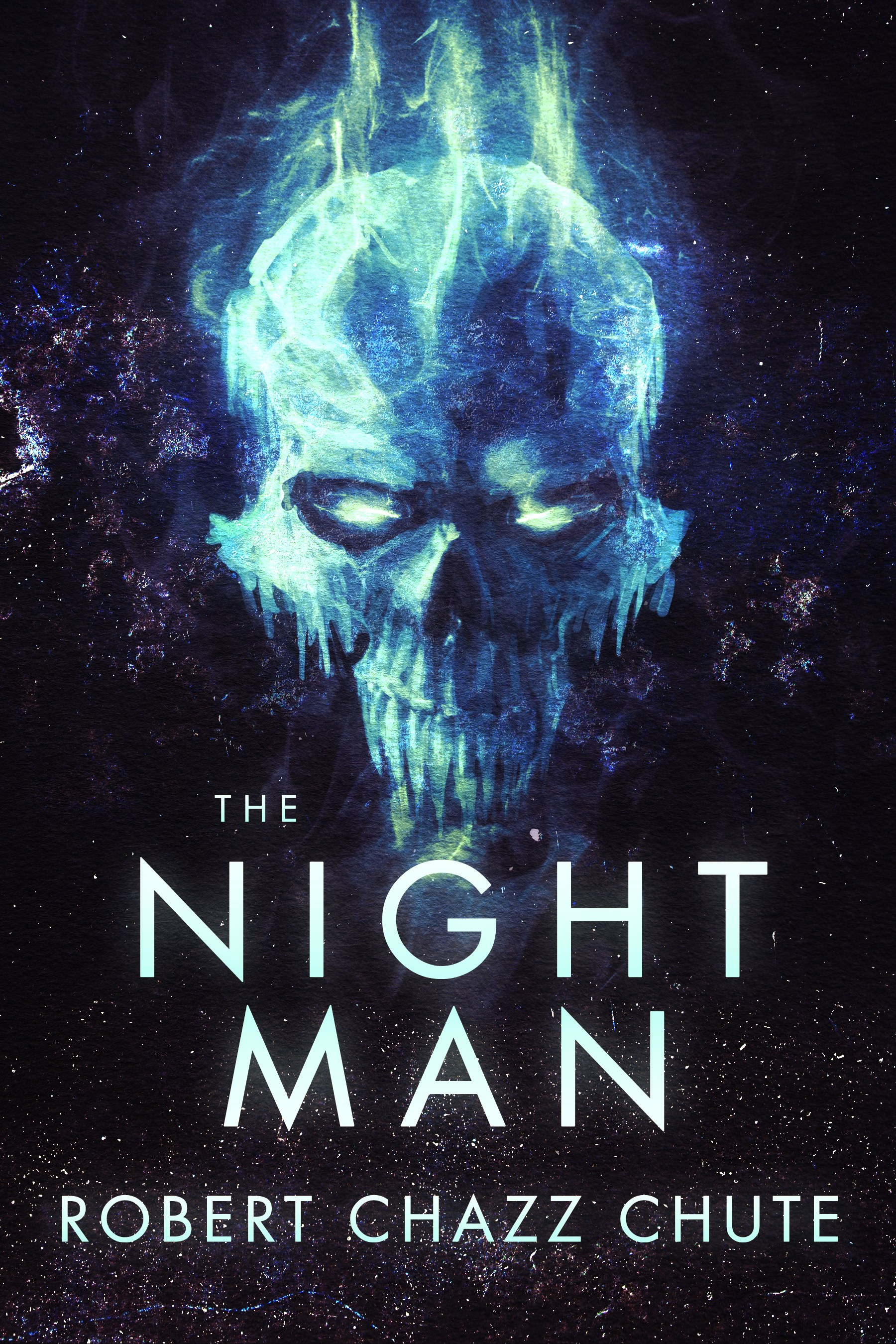
You can pick this ebook up for free today at this link: http://bit.ly/TheNightMan

Join my inner circle at AllThatChazz.com

See my books, blogs, links and podcasts.

Enter your email address to follow this blog and receive notifications of new posts by email.

Join 2,063 other subscribers