C h a z z W r i t e s . c o m

See all my books at AllThatChazz.com.

My crucial brain hack to win #NaNoWriMo

There’s a trick I use for problem-solving, plot twists, brainstorming and inspiration that really works. (I blogged about it long ago, but it’s so powerful, it bears repeating and you probably haven’t seen it.)  This writing tip will be especially useful to you if you’re a pantser, but plotters can use it, too.

I wrote Bigger Than Jesus and Higher Than Jesus (each over 60-some thousand words in about a month for the first drafts) using the hypnogogic state. I wrote these thrillers chapter by chapter, covering at least a couple of thousand words a day. Most nights I went to bed not knowing what adventures and twists my hit man, Jesus Diaz, would face in the morning.

If you’ve read the books, you know  it’s always something surprising. Things go well and things go awry (mostly awry) in clever, unexpected ways. Getting into the hypnogogic state is not hypnosis per se, but this technique does access a state of mind that’s particularly useful for writers, especially during National Novel Writing Month where you need a lot of cool ideas in a short time.

To access the hypnogogic state for greater creativity:

STEP 1: Just before I go to sleep, I plant the seed. What question do I want answered in the morning? (e.g. What will happen to my Cuban hit man in the next chapter? How will he get off that cliff he’s hanging from?)

STEP 2: Go to sleep. No light in the bedroom, no TV. Beds are for sex and sleeping and that’s all. Turn your clock face away so the big glowing red numbers don’t taunt you. Avoid stimulants, alcohol and exercise late in the day. The magnesium in mineral water can help you relax, but don’t drink so much you’re up peeing all night. Do whatever you normally do to achieve a good night’s sleep.

STEP 3: Wake up slow. It’s far preferable if you do not wake to an alarm clock. The time between sleeping and waking is a precious time and you want to prolong it. (That’s what all that great stuff in Step 2 is about, so you don’t need to wake to alarm bells.)

In that time between sleeping, dreaming and waking? That is where you will access your creative genius and, as you slowly swim up to consciousness, ask yourself: What’s the answer? The answer will come to you in that special, relaxed state.

Sounds too simple doesn’t it? It works for me every night and every morning.

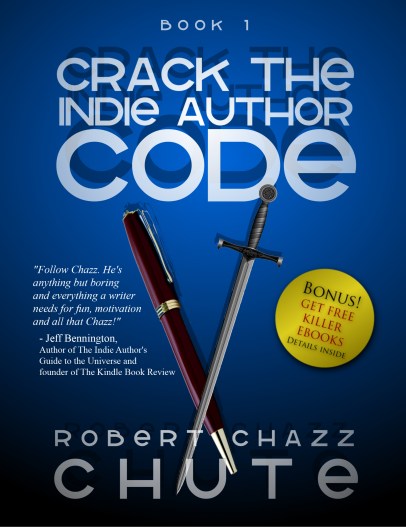
~For more writing tips, inspiration and motivation for your journey from keyboard to publishing, pick up Crack the Indie Author Code and Write Your Book: Aspire to Inspire by Robert Chazz Chute. Chazz — a former newspaper journalist, magazine columnist and insider in traditional publishing — now has seven books for sale.

Filed under: publishing, , , , , , , , , , , , , , , , , , ,

NaNoWriMo: My crucial mistake

The first time I tried National Novel Writing Month, I did a lot right but I did one crucial thing wrong. 

What went right:

1. I created a loose outline before NaNoWriMo started so I wouldn’t write myself into too many corners and dead ends.

2. I planned my calendar and even reserved babysitters to make sure I had enough time to write.

3. I wrote more than the bare minimum each day (1,666 words) so I got ahead of my word count goal early. You don’t want to derail your NaNoWriMo challenge just because you had the flu for a few days or other work demands pulled you away unexpectedly. 

The crucial mistake:

It’s okay to paste in the broad strokes to fill in later (e.g. “insert awesome sex scene here” or “this is the chapter where little Bobby discovers he can crush badger skulls with the power of his mind.”)

However, as I reached 50,000 words, I stopped short. I didn’t write the last scene before typing “The End”. Later, when I returned to my manuscript to revise and edit, the magic momentum was gone. The missing end sucked my enthusiasm for the project. NaNoWriMo is a sprint and it feels great to cross that finish line. Fifty-thousand words isn’t the only finish line. Build the skeleton of the entire book and you’ll have something more solid to work with when you’re done.

For more on National Novel Writing Month and brainstorming tips, tricks and inspiration to carry you to the end, get my new book, Crack the Indie Author Code.

Crack the Indie Author Code and Write Your Book: Aspire to Inspire both have bonus offers of free ebooks. Buy two books and you get four!

Filed under: publishing, , , , , , , , , , , , , , , , , ,

As NaNoWriMo comes to a close…take a break!

Congratulations to all who participated in NaNoWriMo and got it done!

You stayed up late and got up early to write your novel. You got hired a babysitter for a couple of hours of uninterrupted time. You took the phone off the hook and got writer’s cramp instead of whining about writer’s block. Good for you!

Next stop: EDITING.

But first, let that manuscript breathe. Please.

Give it some time before you go back to revisit. Take a break before you get down into the dirty business of sifting through the carnage for the good stuff. Give yourself some time. You’ve had a crazy month so tonight, celebrate. Relax. Catch up on the TV you recorded through November.

Or why not kick back and relax with a comedy podcast? Oh, look at that. I have one!  Self-help for Stoners is also on iTunes. If you like it, leave a review. (If you don’t like it, go do something you do like.)

Filed under: NanNoWriMo, , , , ,

21 Bold Predictions: The changing future of books

Sure, you need to write a good book to make it marketable. But what will be more marketable in the future? What will be different? Here are my sweeping predictions:

1. Non-fiction Shrink: Got a question? Got a problem? Ask.com or Wikipedia or any number of  quick searches will probably answer that question. What do I need you (and your book) for? In the future we still won’t have flying cars. There will also be less call for a lot of non-fiction. Instant, quick answers beat your treatise on bed bug infestations. I just want to know who to call and what to do to get rid of them.

Another instance: After faithfully reading the magazine for years, I don’t buy Writer’s Digest anymore. There is already more information than I can possibly read on writing blogs. For free. Um, like right here, three times a week, for instance.

2. Short form explosion: My horror and sci-fi writing friend Rebecca Senese articulated this for me first and it makes sense. People have less time and shorter attention spans as the web changes their brains away from the usual experience of deep reading. Cyber ADD aside, short stories are also 0.99 each, so people will download a little bouquet of short stories and take a chance on new authors that way.

Also, with ebooks, novellas and short novels are practical again from a manufacturing/pricing perspective. Think of the works of Albert Camus. 50,000 words for a novel was common. Then New York lost confidence in that formula and bigger books became the norm (so much so, in fact, that many authors now scoff at NaNoWriMo‘s 50,000-word winners.) Now, book length is less relevant. Ebooks don’t have page numbers.

3. Merchandise and books shall marry: Your platform and your content should optimally come together in a cult that wants more of your work. Witness all the Fight Club quotes, Youtube videos, tees and, well, actual fight clubs (years after the film phenomenon.) You’ll be spreading the awesome with passive income from whatever secondary sources you can manage. (I already started to plant my seeds here.)

4. Domination by Series: Having more ebooks available improves your marketability. Having more ebooks in a series improves your marketability even more. So, rather than sticking to a one off, consider how you can turn your masterpiece into the foundation for a series of books fans will clamor for. Your advantage as a self-published author is long tail merchandising. Your work shall be available until we embrace the Singularity and join ebooks in the cyberspace holodeck of our disembodied, fully-uploaded immortal minds.

5. Product integration: Slightly different from #3, here I’m talking about books as vehicles for products instead of the other way around.

You are a carpenter who specializes in bathroom renos. Order the book on how to renovate a bathroom in three days. The book pushes the advantage of your special caulking gun, available for immediate drop shipping before sledgehammering the bathtub.

6. First-person non-fiction: More authors who did something stupid and dangerous (tour Iraq for pleasure or go skiing off the approved slopes) will write their own first-person accounts. They’ll self-publish and the covers won’t say “as told to” some ghostwriter. The results will be horrific and ubiquitous.

7. Excellent journalists will find their place in analysis: The freelance market sucks for writers. However, if you’re a journalist with extensive financial expertise a la Too Big To Fail or can write like Matt Taibbi in Rolling Stone, you can provide the long tail analysis of WTF happened?

8. To be successful, freelance writers must own smaller niches: If you aren’t a genius like Matt Taibbi, there’s still hope, but you’ll have to think small. Maybe microscopic, like the asbestos beat in the tri-state area.

Generalist writing isn’t dead exactly. In fact, generalists are everywhere, but they are also free.  You may not think of it this way, but really, blogging is instant publishing. If I want a non-expert opinion, that’s the simplest thing in the world to get and the blogger probably isn’t seeing a dime from it. The writers who are making money now are either tech experts  or people who are plowing ahead to make way for the rest of us in the digital publishing revolution.

9. Cross-genre will be accepted: Cross-genre books (a la Scott Sigler, for instance) have long been a problem for publishers. Even if they loved it, if it was sci-fi and horror, they worried which bookshelf it should be placed on to sell. (For those of you who aren’t sure, go look up what a bookstore used to be. That worry used to be much more relevant.) Cross-genre’s stigma is fading. And self-publishers care not at all, though they will have to do a really good job with their promotion and publicity.

10. More humor: In order for a humor book to sell, traditionally it had to be penned by a celebrity or it had to have a Shit My Dad Says-worthy hook (in other words, a novelty book.)

Comedy writer Ken Levine has a long history of sit com hits, from Mash and Cheers to Frasier, among others. Despite his track record, he wasn’t famous in front of the camera so traditional publishing hasn’t given him a chance to screw it up. Who he was wasn’t enough for traditional publishing to invest.

However, Ken has an incredibly popular blog with a following. He could go back to trad publishing and ask them how they like him now. Or he could just publish himself and keep the profits.  He has a platform that heretofore went unrecognized. He’s a guy with a blog today. He could be the new Dave Barry tomorrow.

11. People will get better at platform: Not long ago a clueless agent told a baffled writer,”Go make a viral video.” Yeah, sure. But what makes a video go viral? As time has passed, we have a better idea of what elements make something go viral.

I’m not saying there’s a formula. However, I think we’re at the point where we recognize what won’t go viral. If your book trailer is going to catch fire on Youtube, it will have to be powerful or clever or charming or heartfelt yet funny or at least cute. If you don’t have any of those elements, you’ll know (and if you don’t know, I hope you have good friends who will warn you.) At least the tech has improved so if you’ve got GarageBand, you already have a shot at putting together a better book trailer. And if you screwed it up, you can take comfort in trying again since the costs of trying have come way down.

12. Curation will get worse, then improve: People are already learning to distrust Amazon reviews. Many reviews are by haters with nothing better to do but snark on others’ work. Other reviews are by friends of writers or even by the writers themselves. There are a lot of books coming down the pipe and you are going to need a filter. Goodreads, for instance, seems to be a place for real people to provide feedback on what they love. I’d trust that (or a friend with similar tastes) before depending on Amazon alone for a helpful review.

13. Eventually: Ebooks will boil down to one or two standard formats.

14. Eventually (after #13): Your device will get sophisticated enough to take the download and format your downloaded ebook however you like it, no matter what the Big Six decree. Proprietary defenses (DRM) will be cracked as fast or faster than they are now so prices will fall, many current publishers will be former publishers and if you want money to eat, you’ll have to make up the difference with volume.

15. And #14 won’t happen on an e-reader: I love my e-readers, but they are interim devices, like pagers and electronic planners were. When e-readers go, they’ll probably be replaced by tablets that can do everything. The screens will be expandable so you won’t be peering at books through the keyhole like on a smart phone. Also, we’ll be back to the two-page spread you’re used to with paper books.

Some say ereaders are already on the way out but they’re in a rush. Ereaders will be around for some time to come because lots of people want to read ebooks, but they can’t afford higher-end integrated devices. Ereader prices will fall so market saturation will soak much deeper and faster than previously thought.

16. Media integration: I tried to read an integrated ebook. The experience sucked.  It won’t suck forever. You’ll have that two-page spread, but you’ll be able to bop over to a cut scene of the story’s climactic event. Merch links will be embedded into the text so you can buy the t-shirt your hero is wearing and the villain’s yummy high heels. One click (only it will be a swipe and eventually, a voice command. Later, a grunt. Then, a thought.)

17. The future of reading is hearing: Audio will rise much higher in popularity. You don’t have time to read so you listen in your car, while you work out, while you walk the dog, while you do the dishes and/or have sex. Time management is more important than  money management (though they are often merely equated. that’s a different post for the glorious future.)

Audio will continue to be more expensive until voice tech improves. While we’re still paying actors to read (minimum $150 an hour and usually $300 an hour and up) audio will stay the indie authors last foray. No disrespect to actors. I know some. However, your computer’s voice inflection is improving so when that dramatic reading is up to snuff, this Jetson’s future will kick in. The voice of George Jetson will come from a computer, not a talented voice actor.

18. You’ll care less about grammar: Well, not you. But your kids probably, especially since in school they are already taught spelling (and handwriting) matter less. As an editor, I regret every grammatical and typographical error. But with the deluge of self-published books replete with typos, we’ll relax our standards. Instead of fetishizing a book’s typographic purity, we’ll freak out less when we spot a typo. Instead, high praise will be, “That one didn’t have that many typos.” Practical acceptance will ensue once today’s outrage becomes the new normal. Sure, you pride yourself on being a sharp word nerd, but anyone who can sustain the level of outrage required will be exhausted and have no friends.

On the plus side, a book that is well written and well edited will stick out more.

19. Instant will be prized more: Trad publishing works on long publication deadlines because of budgets and logistics. (Though it’s a factor for the editorial staff, contrary to what you’ve heard, quality is not actually Job One.) If they could pump books out faster than 16 to 18 months per book, they certainly would. That kind of agility would allow them to be more topical, hit trends and, most important, have more stuff for sale. Recently I read an ebook that mentioned the Japanese earthquake. Compare that to how long it took 9/11 to show up in traditionally-published novels out of New York.

There will be little to no delay in the future. An ebook on the ramifications of Bin Laden’s death was up for sale within a week of his death. You might think it was mostly prepared ahead of time, but actually it was a bunch of emails from socio-political experts contacted as soon as Seal Team Six did their job.

20. Romance will continue to dominate, but now it will be recognized: The love of the paranormal romance genre is not a new thing, but romance has never been recognized as the dominant force it really is. Amanda Hocking’s recent success is no accident, especially because she writes in a genre that dominates reader demand.

Look at bestseller lists. You’ll see “important literary works”  by big publishers. Good for them! Those are the sorts of books I like. However, those weekly bestseller lists are often based on booksellers reporting which books are sitting in front of them in the biggest cubes and stacks. Much of the math is suspicious, especially since bestseller lists don’t take into account sales from non-traditional book venues (Walmart, drugstores, the spinner rack at beach resorts or the vast call for romance books among ESL learners. Nope. Not kidding about that. If you’re learning english, simple stories of ribaldry and girl-next-door heroines are one way to do it.)

You won’t see Harlequin romances on bestseller lists. However, I used to work at Harlequin. I’ve seen the numbers. Romance sells huge. Romance sells much bigger than anything on bestseller lists. Why? Because english majors run Big Six editorial departments. They do not run the real world. Yann Martel writes great books. Nora Roberts writes fast, easy reads. Even snobby english majors read trashy, naughty novels for a break from lit that might be fresh and surprising. In the real word, the hare beats the tortoise.

21. Someday soon, everyone will make these changes in spelling: email, ereaders, ebooks. Of all these predictions, this is probably the one which will happen first.

And yes, #18 will probably happen last. As in, over your dead body.

Filed under: Books, DIY, e-reader, ebooks, Editing, publishing, Rant, self-publishing, , , , , , , , , ,

#NaNoWriMo: Five Advantages of Fast Writing

Traditional wisdom is that it takes a lot of time and energy to write a book. That’s generally true. However, that counts the entire process. It takes a long time to revise, edit and hone aWriting_fast book until you feel you’re ready to let it go. That doesn’t mean you can’t write a first draft quickly. Some purists will protest that haste will decrease the quality of a writer’s work in favour of quantity. Sure. I have a different take on that objection. Assume your first draft is going to suck anyway. Since you’re best writing is rewriting, it’s best to have something to revise. For many writers, if they didn’t write the first draft in haste, they might not have anything to revise at all. You can’t edit a blank page.

So here’s my contrarian view on why  fast writing can be a very good thing:

1. You maintain your enthusiasm for the project because you get the first draft done quickly. Marathon writing takes endurance. A sprint can be advantageous, especially if you haven’t completed a manuscript in the past and you’re developing those muscles.

2. When you write in haste, you can see the whole project’s development at once. You’re less likely to drop threads when you get the first draft done in a short time. If you’ve read Under the Dome by Stephen King—a huge and heavy book of great length which, in general, I enjoyed—maybe you noticed that he seemed to have a supernatural element on the protagonist’s side that is never explained and soon forgotten. It took him three years or so to write it. That might be why something’s amiss.

3. Increased productivity primes your art pump. If you produce a lot, you tend to produce more the rest of the time, too. It’s the literary equivalent of, if you want the job done, give it to a busy person. Artists need to get into the habit of production and treat their work as a business and a craft (instead of something that can only produced when the planets align and you have a handy vial of unicorn blood to consecrate your art-making ceremony.)

4. Increased production equals more money in the long run. That’s not mercenary. That’s math. If you can produce four books (and sell them) in the time it takes someone else to write one, you’re ahead (unless the other guy is William Styron, but he’d be ahead in any case…and he’s dead.)

5. You may not sell everything you write. In fact, if you’ve got an agent, an editor and a publisher between you and the market, there’s an excellent chance someone will stand up at some point and say, this isn’t ready for your customers. (They may or may not be right about that. When Robert Munsch‘s publisher told him the world wasn’t ready for Love You Forever, he took that controversial children’s book elsewhere. And had a hit.)

My point is, if you spend ten years writing a book and it does not sell, you will be sad. If you have other books to sell, the one disappointment won’t sting so much. You know how every second Star Trek movie was great and the others suck?  It evens out when you have more out there.

If I sound like I’m blaming, shaming and pointing fingers, I apologize. I have been guilty of acting like a dilettante about my fiction. I’ve had to gather unicorn blood before I could summon the muse. That’s changed recently as I’ve reevaluated. I’m motivated now to go into heavy production and get to work on the revisions for my books and, as Seth Godin puts it, “Ship!” (Also, see the post below on Lessons Received from An Evening with Kevin Smith for the whys and wherefores. )

My book production won’t happen overnight. But it will happen faster than it was happening. Boo-ya!

Filed under: NanNoWriMo, writing tips, , , , , , , ,

#NaNoWriMo: The Back-up Plan (& The Hypnogogic Writing Tip)

Visual representation of The double-aspect the...

Image via Wikipedia

I really struggled with my plot for NaNoWriMo. I laid down beats for one-and one-half books before I scrapped it all. It wasn’t that the ideas were bad exactly. The ideas were not ambitious enough. The stories were strong up front but I couldn’t see my enthusiasm carrying me through to the end. 

When I say “scrapping it all,” it sounds rather careless and casual. It wasn’t. With only a few days before the start, I didn’t have a story I wanted to tell. That was surprising (to me, least) because the bigger the story, the more I want an outline. Compounding my worry (and shame) was that I had already advised others that they needed an outline to increase their chance of NaNoWriMo success. I have written a couple of half-books before. Poor abandoned halflings they were. They’d been born strong and healthy but they went bad,  failed to thrive and died on the table in my surgery. Agony crushes your heart. Reaching for something that isn’t there caves your skull. Non-writers would call it self-doubt (but nevermind non-writers. I don’t understand them any better than I grok non-readers. Bunch’a freaks.)

Halloween night as little goblins and comically-short Vader imposters came to the door for cavity and diabetes inducers, I looked over my outlines. How would I make them work? Could I rig the stories so I’d have the energy to ride all the way home? No, I decided. Problems can be fixed, but a lack of enthusiasm for one whole plot and the utter lack of the second half of a book? I might wake up with a solution to those conundrums some day, but I was sure I couldn’t force a solution over a 30-day writing stretch. Not without breaking something.

Then I decided, screw it. <insert sigh of self-loathing here>  I’ll wing it.

Or…waitadamnminute…what did I say about waking up with a solution? Of course!

I let the hypnogogic state come to my rescue. The hypnogogic state is that special twilight of consciousness between sleep and waking that is rich territory for buried treasures and epiphanies. I’ve used it to resolve many issues. As I fall asleep I ask the question. As I wake, the answer comes. I’ve plotted solutions, found resolution and clarity and come up with intuitive and counter-intuitive ideas for many questions in my life and work. It didn’t fail me this time, either.

Yesterday morning I woke thinking about a short story I’d written recently. It’s an alternative future as many of my stories are. It occurred to me that I had left the end of that sad story on a somewhat comic and hopeful note for change.

The epiphany was, “That hopeful ending worked as a short story. If you trash the hero’s hopes for that resolution, it’s the end of an early chapter.” A-HA!

Few plot developments fail if the author is determined to torture the protagonist. I had created a rich world in that short story. Now that early preparation could be useful for the NaNoWriMo project. I’d use that world and link it up with the half-story I had plotted. The two stories are unrelated, but they could share that world of secret police, relentless surveillance and a theocracy run amok. 

I woke up smiling with a good beginning and a hero who was now a Cheech and Chong/Fugitive meets Mr. Spock in search of a Terminator (played by Summer Glau, not the governator.)  The first story was about the discovery and governmental repression of a miracle drug. The second was about robots reaching such complexity they are indistinguishable from humans. Now those stories will be in the same timeline. 

I’ve found my enthusiasm for the story. It will carry me to the end now.

Filed under: NanNoWriMo, publishing, writing tips, , , ,

The Rewards of Writing: Why do you write?

NANOWRIMO Sticker

Image by Tojosan via Flickr

Most of us don’t write for much money. Fame, if it comes, is fleeting. Writing is a need that can’t be fully explained. I got my first byline pretty young and before that I had letters to the editor published. It was a thrill then, narcissistic and validating. It’s not such a big deal now, although I admit I did experience a little extra pride when I had two articles in two separate magazines side-by-side on the shelf at Chapters. But why do we do it, really?

NaNoWriMo has begun! Are you off to the races? All stocked up on coffee? Good. Pace yourself. It’s a long month. Forgive yourself your lapses and keep pushing forward. You can always figure out the plot holes later. 

Today I received a nice fan letter for my column. She started out with a couple of nice compliments (always a good start) and followed that with a thoughtful letter on the subject of the piece. She, too, was compelled to write on the my topic. She couldn’t expect any reward for her efforts in putting together a long letter except the passion to be heard and to expound. It felt great to stimulate such deep discussion. However, I don’t write in the hope I’ll receive the odd fan letter. Sometimes I wonder why I write at all. I managed to give it up for a few years there, but no matter what I did, I felt like I was doing something other than what I should do.

I do remember I got the bug early. When my older sister left for college she left behind an old manual Underwood. I must have been seven. Working the keys got my attention. I can’t say why. Like I said, the urge to write cannot be explained fully. I like telling stories. I began by telling them to myself.

As we begin the month-long challenge of writing a 50,000-word novel, there are lots of bits and pieces of encouragement I could prattle on about. But the most important is to feel the fun of it. Lose yourself in your story. National Novel Writing Month is a gift to make our usually solitary journey feel a little less lonely as we travel along our separate paths.

Good luck NaNoWriMo people. And when you have a moment, please do leave a comment. I’d love to know if you have any clearer idea than I why you write. For me, the answer is obscure. I was born this way. I did not choose it.

Filed under: NanNoWriMo, Writers, , , , ,

10 Tips for NaNoWriMo

240/365 National Novel Writing Month begins
Image by owlbookdreams via Flickr

NaNoWriMo begins November 1. A few suggestions:

1. If you can do more than 1700+ words per day, try to do so. It takes the panic out of the equation when you miss a day. And you will miss a day. You aren’t a machine. You may miss several. Do more when you are able so there’s a cushion.

2. Stay calm. You’re not actually writing with a gun to your head. Remember this is supposed to be fun.

3. It’s probably best to have an outline. Yes, you can explore instead, but when you’re against the clock, it’s good to plan out what the major scenes are going to be ahead of time. If you find yourself pulled in another direction, there’s still no gun to your head. You can veer off as necessary and discover an entirely different ending than you had pictured. It happens all the time.

4. Remember, this is just a first draft. Don’t worry about heavy research. That’s for later. You can always fill in gaps and correct niggling details in your next draft.

5. Remember, this is just a first draft. Every year agents and editors get some submissions which are obviously the raw feed. Novels are not ready for submission just because a writer takes the time to hit spell check once.

6. Write with a buddy. Write against a buddy. Make a bet. Get some stakes in this game.

7. Know why you’re writing. Maybe this is the one way you will get a first draft done…or a good start on a first draft.

8. Try to get to the end of you story. Even if you have to stick in pages that summarize scenes, this tip will help you complete your draft later. (e.g. X happens here, write that. Y happens here, write this.) That strategy will help you harness the momentum NaNoWriMo gives and protect you from frustration and disappointment. 

9. Know why you’re doing NaNoWriMo. Some writers have acted like poo heads (not Winnie the) about National Novel Writing Month. They dislike it because they figure it’s for people who aren’t very serious about their writing. Well, d’uh! They’re right! A lot of participants aren’t very serious about it. Some people participate just so they can scratch “Write a novel” off their bucket list. If you’ve read No Plot? No Problem! you know that the spirit of this thing is fun.

10. For others, it’s deadly serious and provides the motivation they feel they need to get started. What’s wrong with that? They know it’s their first draft. Maybe they haven’t written anything and been paid for it. Yet. So what? Every professional writer started out from that same place. The hotheads must be awfully threatened and snobby. Or worse, they receive awful first draft manuscripts from naïve people who don’t know the word revision.


Filed under: NanNoWriMo, , , , , ,

NaNoWriMo Prep: Brainstorming Your Way to Surprising Stories

Pie chart of Wikipedia content by subject as o...

Image via Wikipedia

One of the dangers in writing a novel is that halfway through, you run out of steam. It happens a lot. Everybody is eager and can’t type fast enough as they begin their story. As the pages pile up, it’s easy to lose the plot’s thread. Enthusiasm wanes. We wonder, What did I think was so great about this idea? I can’t remember. You might not necessarily get writer’s block, though running out of ideas in the middle is common, especially if you’re discovery writer (meaning you find out what the story is going to be as you write it instead of outlining.)

If your middle is a muddle, there are a few common tricks. Knowing the final scene is helpful. Outlining helps. Writing out the major plot points. (And if you haven’t read No Plot? No Problem! yet, you should grab a copy before you begin your National Novel Writing Month adventure.)

I propose a fun exercise to get your mind going, and do this before you start outlining (or before you sketch out the major scenes and beats.) An outline is a map that will carry you through to the end, but I’m going to suggest an innovative strategy I use to open my mind up to possibilities I would not have ordinarily discovered. Try this:

1. Get out a legal pad.

2. Write the numbers 1 – 40.*

3. Get out a dictionary, hit random on Wikipedia, drag out your Goth Bible and any books on myths and legends. Use what resources you have. (I have The Book of Tells. That may prove very useful for the story I have in mind. I want the villains to be formidable, so they’ll be sensitive to body language that gives the hero away.) Atlases, trivia or histories can give you some clues, too.

4. On each of the lines, 1 – 40, write three words from your resources in #3. (Choose words with which you are unfamiliar. Don’t slow down to do research. That’s for later. Now is for writing 120 words or phrases as fast as you can. Anything that strikes you as interesting will do. Geographical names might end up as a character name, for instance. Don’t worry about that now. Write quickly.

5. When you’re done, look at your list. Your plot will develop in the next stage when you construct your actual outline. However, you’ll find those 40 trios may influence the development of your plot.

Here’s an example of a few trios:

A. peroxide, absinthe, firebomb

B. picayune, letters to the editor, Bond movie

C. Malta, the actress Pam Grier, ecstasy

D. Blue Mountains, security scan, divinity school

So, from Trio A, I see an interesting image. How about this?:  

The protester pushed past him, breaking through the line. Dressed in rags, her face was covered with a camouflage veil—a poor defense against tear gas. Her shock of peroxide blonde hair made her an easy target for police, but they shrank behind their riot shields as she menaced them with the molotov cocktail. Defiant, she stood her ground and held the green bottle high in one hand, its rag fuse alight. Green, he thought. The bottle’s contents were bright green! Who would use a $100 bottle of absinthe for a molotov cocktail?

Will I use this passage? I don’t know yet. I know I wouldn’t have come up with it had I not built my trio list, though. I’ll find out as I build my beats and scenes timeline. If I choose to deviate later, that’s okay. First drafts are supposed to be a journey of discovery, free and easy. Write the first draft for you.

You may choose to use each of your trios or you may opt out.  The point is to stir your imagination. If you find yourself stuck, going back to your trios. Find ways to incorporate them into your text (without trying too hard) to get you writing again. Try it and you may be surprised what new ideas occur to you and what spins and reels your story will take.

*Are you wondering why I chose 40 trios? Math is involved, but it’s easy. For my own fiction, I prefer short chapters that skip along. You’re going to need to write over 1,600 words per day to complete NaNoWriMo successfully. I shoot for 2,000 words a day so if I miss a day in the process, I’m still ahead of the game overall. Two-thousand words each day for 30 days over 40 chapters is 80,000 words.

You actually only have to get to 50,000 to get a pass from NaNoWriMo. Me? I want a book at the end that I can revise and 80,000 words is a good length for what I have in mind. I am not interested in participating as a writing exercise. I write plenty as it is, so I want the time spent to be productive. When I’m done the sprint, I want a first draft I can doctor. Construct as many trios as you like. Planning ahead will give you a proper blueprint for your story. You do not want to hit November 15, sit in front of your keyboard and ask that terrible question, “Now what?” Using this technique, I developed two trio sheets and two outlines for two different books yesterday. By November 1, I’ll have to choose down which rabbit hole I intend to throw myself.

Filed under: NanNoWriMo, Writing exercise, writing tips, , , , ,

Friday Publishing Advice Links

iPad with on display keyboard

Image via Wikipedia

Sorry for the late post today. I’m feeling a bit under the weather, but that must not stop the great publishing links!

 To kick things off, the top link is a great review of the iPad as a writing tool. Mr. David Hewson confirms my opinion that iPad is a great information consuming tool. It’s not a productive writing tool. He’s got me excited about Android tablets as an intriguing alternative to the iPad.
Read his detailed review here: David Hewson.

Remember those old Ronco ads? But wait, there’s more!

A writer’s blog on taking the NaNoWriMo challenge.

I Want to Publish My Book. Now what?

How to Write for Love and Money

10 Marketing Excuses That Can Kill Your Book and Career | The Official BookBuzzr Blog

Interview with Richard Hine on building a better book trailer.

Will You Be An Independent Author? « BubbleCow

A writer in the final stages of the book polish contemplates the wait ahead.

And last, but not at all least from Roger C. Parker…(make a drumroll sound in your brain)…

The 100 best writing books
 More to come Monday morning, but first…a nap!


Filed under: Friday Publishing Advice Links, NanNoWriMo, publishing, self-publishing, web reviews, writing tips, , , , , , ,

Bestseller with over 1,000 reviews!
Winner of the North Street Book Prize, Reader's Favorite, the
Literary Titan Award, the Hollywood Book Festival, and the
New York Book Festival.

http://mybook.to/OurZombieHours
A NEW ZOMBIE ANTHOLOGY

Winner of Writer's Digest's 2014 Honorable Mention in Self-published Ebook Awards in Genre

The first 81 lessons to get your Buffy on

More lessons to help you survive Armageddon

"You will laugh your ass off!" ~ Maxwell Cynn, author of Cybergrrl

Available now!

Fast-paced terror, new threats, more twists.

An autistic boy versus our world in free fall

Suspense to melt your face and play with your brain.

Action like a Guy Ritchie film. Funny like Woody Allen when he was funny.

Jesus: Sexier and even more addicted to love.

You can pick this ebook up for free today at this link: http://bit.ly/TheNightMan

Join my inner circle at AllThatChazz.com

See my books, blogs, links and podcasts.

Enter your email address to follow this blog and receive notifications of new posts by email.

Join 2,061 other subscribers