C h a z z W r i t e s . c o m

See all my books at AllThatChazz.com.

Freelancing for Beginners

 Someone has asked me how to break into freelancing.

 A few ideas about breaking in–specifically to non-fiction markets since that’s an easier place to start for everyone:

Of course the Internet is the future, but there are many kinds of freelancing. The internet is bursting with a need for content though in many cases the pay is ridiculously, insultingly low. At guru.com, you’re competing with people willing to do outsourcing/freelancing/writing work for pennies an hour. There are ways to make money with the Internet, but I don’t think they fall under the assignment I was given here–what advice would I give to someone looking to begin freelancing?

My first suggestion would be to take inventory. What are your interests and what do you already know? If you’re a canoeist, I’d be looking at canoeing and backpacking mags. If you’re into walking, I know there were at one time three walking mags and if it’s a particular English family with no last name you’re wild about, there were five mags the last time I checked on the Royals. Really, I can’t imagine how much there is to say. The point is, whatever your interest, there’s a magazine about it.

Start small. Even if you have a perfect idea, if you have no experience, editors won’t trust that you’ll be able to deliver. Often very short pieces in the front of a magazine are a great way to start with an editor and get a track record and a relationship going. If I were approaching a cookbook I might pitch a query–or just write 150 words and send it in–on the topic of how long to boil an egg. (There’s a variance depending if you’re at sea level.)

You probably won’t plan your path. You’ll discover your path as you keep moving forward. My love is writing mostly psychological, often torturous and always existential horror (“If you’re skin doesn’t crawl, it’s on too tight” as an old movie tagline goes.)

My expertise is in alternative health care issues, but I had an advantage going in. I started with my local newspaper when I was 17. Later I had specific medical training to draw on so my non-fiction is often about that. My original training and work in journalism (dailies/weeklies/mags) gave me lots of clips to show a track record.

After I wrote  a lot for one magazine in particular they gave me a column. Get out there and build your track record, whatever it’s going to be. My time reading was more important than any formal training.

You don’t need an MFA to be a freelancer of any kind, either. (Go ahead and do it if you want to, but it’s not necessarily the expressway to getting published.) You need to write a lot and keep sending stuff out.

Proof: I know a lot of PhDs through my wife, who’s also a doc. A lot of them–a startling number of them–are not as intelligent as you’d expect. (An expert, after all, is someone who knows so much about so little that eventually they know everything about practically nothing. Personality disorders are common. However, they completed a (usually) grueling course of study. They have something you need. It’s not their smarts. It’s their persistence.

An aside about payment: If it’s going to get published, try to get paid something. They’re paying everyone else from the janitor to the printer so they should pay for the stuff people buy the magazine for! Too many writers sell themselves way too short. If they’re going to print it, it’s worth something. They aren’t printing anything to do you a favor. Don’t work for free or buy the crap about “paying your dues.” (It makes the transition to getting paid harder, makes getting paid harder for all of us, and when you do get paid it will be too little and long overdue.)

From the Ministry of the Bleeding Obvious:

Study the magazine you’re aiming at and pay attention to the ads. They’ll tell you what audience you’re writing for. If there are ads for Axe and electronic gadgets, it’s Gen  X and Y and Z. If it’s Depends, it’s old boomers. Station wagons? The youngest boomers and the oldest Gen X. Gear your tone and subject accordingly.

EVEN MORE TIPS: Newspapers pay poorly but a guest editorial is sometimes an easy clip to get for a start and may pay $100. Ooh. You could fill a gas tank with that.

In your queries, highlight your interest and experience in a given topic. Freelancers with more experience often write about stuff they have zero prior knowledge of, but I don’t know anyone who started out that way and many stick close to their personal areas of expertise and interest. It’s efficient and efficiency means you’re making more money.

Brainstorm ideas and spend a lot of time on your first queries. Once you’ve established a relationship with an editor you can do breezy queries that get read before the unknown writers’ queries. Editors are busy–insanely busy and they don’t have enough staff. Understand that often editors are so busy that they do the reading part of the job on their so-called personal time. Their work time is spent haggling, buying, planning, editing and dying slowly in meetings.

Make sure your query is killer. Then query again. I started with writing on spec and often still do. I like it. If who I’m thinking of doesn’t go for it I’ll sell it somewhere else. When I write for myself first, there’s no pressure and I can write to my vision. This isn’t a formula for making a ton of money freelancing. It is an easier way to start, and since the product is already known–the editor is holding the whole thing in her hands already–it makes it more comfortable for editors to buy your early work. The bigger money is in getting assignments.

Where’s the real money in freelancing? Corporate work. I like advertising work and charge heavily for faxes to blast and flyers to mail. Business reports aren’t so much fun but freelancers who want to boost their bottom line easily eventually do PR work and brochures because the pay is far and away above what mags pay. An employee handbook isn’t a ton of fun but it is needed and maybe you can get some latitude to make it fun so someone will actually read it. I’ve been paid as much for a 100 word fax blast as I would for a column and all the original material was already there to massage. I just had to edit it, inject a new take, spruce it up, maybe add some hyperbole to make it work to make money for the company. 

What about fiction? Not my main focus for this post but such a dear subject I can’t resist adding this perspective: In the 40s, 50s and 60s writers could make really good money selling short fiction. Wow. Those were the good old days. Kurt Vonnegut made more as a short story writer than he did as a PR flack for GE.

By the time young Steve King came along, his market was mostly the filler between the pictures of naked ladies in Screw. After a short while, there were fewer and fewer stories even there and the ratio went high for more pictures of naked ladies. That was also the division of the marketplace into dozens of venues that have all devalued writing–now called “content,” AKA the shit between the ads. Don’t worry about Mr. King, though. I understand things worked out for him despite the disadvantages.

Today we’re competing for time from a populace that doesn’t read much that’s not pixellated.  So many choices leaves less room for you. It’s DVD versus Blue Ray vs. Wii vs. Play Station vs. porn vs. the gym and the lures of the outside world when the weather’s nice. Too often people read now when trapped on a subway or it’s something they save solely for a rainy afternoon at the cottage when there’s nothing else to do and the kids are down for a nap. And then it won’t be your fiction. It’ll be one of a dozen bestsellers–only bestsellers.

Still, there are people who read…soon to be wheeled out at the Smithsonian once a year for display and the awe of illiterate troglodytes. (If you can read but don’t, you have zero advantage over people who tragically can’t read.) For freelancers pursuing the non-fiction market, there are lots of venues out there and you’ll find them all online. Don’t bother with print editions filled with editors’ names and addresses. If they’re on paper, they are out of date.

What about book proposals? Isn’t non-fiction easier to sell? Yes. You’ll do better to be the brilliant (and hilarious) quantum theorist with a corner on a new take on reality or a freelancer with lots of clips before you approach a publisher. (In fact, it’s best if you’re a celebrity who is best friends with Oprah and you have an immense following already.

This isn’t meant as a comprehensive treatise on all the ways to get into all the markets, but it is meant as an overview for those of you interested in starting up a freelance enterprise and aren’t sure how to begin dipping a toe in the pool and testing the temperature.

Filed under: writing tips, , , ,

It’s about the work

I’ve been a bit of a crank on here for several posts (and my whole life) so I should mention that it’s not always like that. This evening I got an e-mail. I had sent in a spec feature to a health mag and the editor bought it. The contract is on the way.

When they tell you they are sending cash, it does tend to feel good. The thrill of  seeing your stuff in print wains a bit (though I remember being quite high when I had articles in two mags that sat side by side on a news stand at one time.)

But the fun has to be in the writing itself. If it’s not fun, there are plenty of other things to do that pay more and probably hurt less, since you’re only as good as your next piece.

Filed under: writing tips, ,

Delicious Word for Horror Writers

EXOCULATE

 (Brace yourself)

To tear out someone’s eyes

What does it say about the human race that there’s a word for that?

Filed under: Cool Word of the Day, , , ,

The ABCs of Content Provision with XYZ

The SET UP: Three executives at a conference table.

The ACTORS: X, a young man and  Y, a middle-aged woman (both in sharp power suits)  sit on either side of Z, an older man in hideous golf attire, all day-glow plaid.

Z listens as X and Y discuss a new advertising campaign.

X: Let’s get the old business out of the way first. The copywriter from the last push is still calling about getting paid for those brochures.

Y: Keep stalling.

X: He threatened to firebomb the building.

Y: Where’s he live?

X: The west coast.

Y: At his rate he can’t afford to travel. He won’t bomb the building.

X: He sounded pretty…motivated.

Z (piping up for the first time): Tell senior staff to bring a sweater just in case. I’ve got a tee time to make. Can we hurry this along?

Y: Only senior staff, sir?

Z: No need to get the minions excited. If that kook does show up it’ll probably be a single molotov cocktail. How much can that do? I don’t know anyone  who works below the 28th floor so let’s keep our eyes on the big picture, okay? (He taps his watch.)

X: Right. New business. I’ve been thinking about the new ad campaign–

Y (self-assured and interrupting breezily): What’s the webmaster saying?

X: What he always says. “More white space.”

Y: I don’t speak HTML but from what you’ve told me, that’s all he ever says.

X: Then he must be right.

Y: Yes. Nobody can be that arrogant all the time and ever be wrong.

X: We’ve gone over this. He won an award from Wired for his designs.

Y: I know. I know. It was a brown black smudge with six-point type in yellow. To read the content you’d need a microscope.

X: The article must have been about microscopes.

Y: Ah. Now I get it. That makes sense.

X: Well, I’m just guessing. Maybe not. Maybe it’s a comment on our superficiality in a post-literate society.

Z and Y look at each other blankly.

Y (to Z): I did warn you about hiring a goddamn English major, sir. How’s the ad campaign costing out, Professor?

X: We have several applications. I put it out for a bid on the web.

Y (glancing at Z): And? And?

X: Uh, well, this one from Angola looked promising but he wants to be paid with a goat.

Y: I told you, this is just content. We don’t have to pay a whole goat’s worth.

X: Do you think we can get it done for a couple of chickens?

Y (to Z): That’s the problem with these young guys. They want to spray money everywhere like that fixes the problem. I tell them all, do more with less. It makes them creative.

X (jumping in defensively): I’ve got a guy from Idaho who’ll do it for a single kind word from another human being.

Z grins and throws a knowing wink at Y.

Y (shaking her head and pleased to be destroying X with a condescending smile): We don’t do that.

X: Oh.

Z: I’d be on the tee right now if you just went with the lowest bid.

Y: Yes. Exactly. You’re exactly right, sir. What about it, X?

X (putting the sheaf of applications down, steeling himself): That’s just it, sir. I have a revolutionary proposal that will save the company–

Y: Oh, lordy! Sir, I had no idea he was going to waste your valuable golf work time.

X: I was talking.

Y: You haven’t discussed anything about this with me so it’s inappropriate–

X: I didn’t discuss it with you because I wasn’t interested in having you take credit for my ideas again.

Z’s mouth drops open. He looks back and forth between the two as Y stands up, furious.

Y: Pack up your personal things from your desk. Bruno will see you out.

X (talking just to Z now): Sir, it was me who came up with the idea for third world galley slaves to row your yacht.

Y: Sir! This is outrageous!

X: …and you can hear me out or I can take my brilliant idea for an ad campaign over to the competition and be in a VP suite by this afternoon.

Y is still standing, trembling with murderous rage. Z stares in X’s eyes for a full minute and X does not waiver. Finally, Z nods for Y to take a seat and turns back to X.

Z: Ballsy move, son.

X: Thanks, Dad.

Z: Not here. Go ahead. Let’s hear it. It better be good. And quick.

X: Well, I was thinking.

Y (rolling her eyes): Oh, God!

Z silences her with a look.

X: I was at this party and somebody was telling me about an old hamburger campaign that was really successful. I don’t know which one. It was long before I was born but (sweating but pressing forward, his eyes boring into Z’s) the point is, it was an old lady just saying “Where’s the beef?” The thing was, the line was improvised.

Z: So you’re saying improvise the content, not pay some schmoe a chicken to write it?

Y (reaching for a phone): Shall I call Bruno to escort him out, sir?

X: I’m not finished.

Z (putting out a hand to restrain Y from the phone): What else you got?

X: The problem is that whenever anyone speaks the content on TV the damn actors union insists the people talking get paid. But, if they don’t talk, they don’t get paid!

Y: What are you suggesting? We get the deaf to market our products with sign language? Some civil rights group would still insist we pay them. You can’t screw with the handicapped in this country. You have to outsource to Korea and China for that. (Beat) Idiot!

X: Oh yeah? Well, you didn’t think of this. I figured out who has less self-esteem and less power than writers and actors.

Z: What species is that?

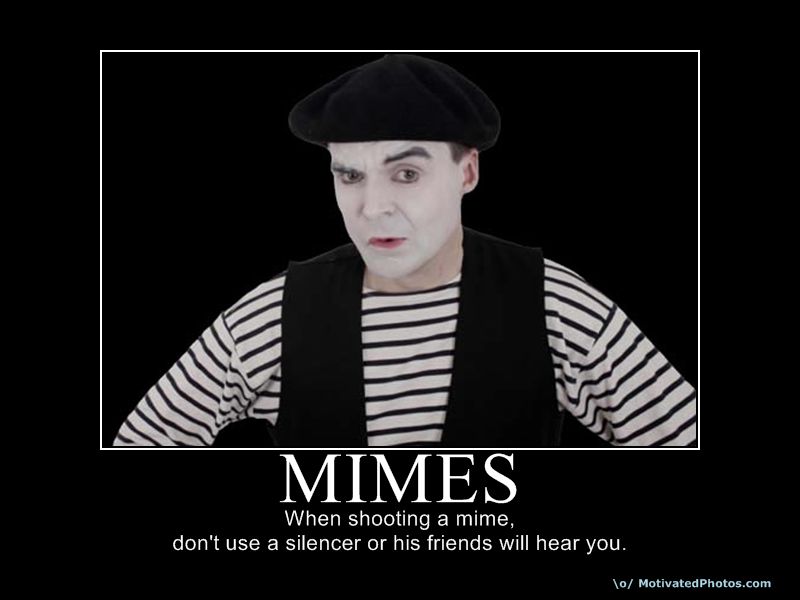
X (triumphantly): Mimes! We get improvising mimes to do their performance art thing to get our message out. They’ll do anything and get paid nothing.

Y: Do you really think putting out TV commercials with mimes can communicate the intricacies we need consumers of complicated financial services products to swallow?

X (sitting back, self-satisfied and throwing it in Y’s face): Big picture, big picture, big picture! You’ve missed the big picture. We’ll get them to do radio commercials, too.

Z sits back, obviously stunned. Then, to Y: Call Bruno. Somebody needs to clear out a desk around here.

Y (snatching up the phone receiver): Finally!

Z: Clear out your desk, Y. I want my new VP here to have that corner office of yours.

(To X) You’ll love it. It’s got a view of the city, you can watch the wage apes all day and it’s got the only windows in the whole tower–besides mine–where you can toss out water balloons on the hapless throngs below.

X (brightly): Or acid balloons!

Z (delighted) : You are on a roll, boy!

Y (ashen) improvises a gutteral vowel sound for which she will not be paid.

Z: Don’t worry. I’m not sending you to the curb, Y. You’ve given me too many long years of loyal service not to keep you under my thumb to ensure your continued indentured misery. (He utters a terrifying baby-eater’s maniacal laugh.)

A single bitter tear makes its way down Y’s cheek.

Y: But sir–

Z (getting up): I’m sure we can find you something on the first floor by a window. You can keep a look out for angry writers with bombs.

Y: S-s-sir!

Z: Come with me, m’boy. It’s time I taught you the sweet science of the putter. Tomorrow you can drive downtown and start rounding up mimes. Stack ’em in the back of a truck and we’ll put some lipstick on the ol’ advertising pig, eh?

X: Thanks, Da–um, sir.

And…scene.

Filed under: Rejection, , ,

What Happens Next?

If you’re telling a compelling story well, you keep your reader wondering what happens next. 

When I don’t know, here’s what I do. I sleep on it. (Wait, it gets better.) Each night before I go to sleep I ask myself what problem (plot problem, character issue, niggling story detail) I want answered when I wake up. When I wake the next morning into that special hypnagogic state between sleep and full wakefulness,  I find my answer. The hypnagogic state is a very powerful state of mind where you can be most creative. It allows the subconscious to supply the answer you’re looking for. It really works.

BONUS:

I’ve had several requests from potential freelancers. If you want to be a freelancer, read Jenna Glatzer’s How to Make a Real Living as a Freelance Writer. It’s solid advice. There are a ton of these books out there but it’s certainly one of the better ones.

WORD of the DAY UPDATE:

Hagiographic:

A study of the lives of saints or idealizing biographical books.

To paraphrase Steve Martin:

Latin. They’ve got a word for everything.


Filed under: Books, writing tips

Where does the Darkness Come From?

Short Answer:

The darkness comes from everywhere.

Longer Answer:

Tales of horror arrive in the newspaper every day. This week a toddler was stuck in a high chair for six days while her dead mother lay on the floor in front of her. The child managed to survive because she could reach food from where she sat. The mother had suffered a chronic illness. When a child services worker rang the bell, no one answered but she could hear the child crying, she called police. They broke down the door to find a body beginning to decay and a terrified child. 

When asked by an interviewer, “Where does the darkness come from?” these were my answers. Of course, we all have terrible childhoods and can draw on the thousand arrows flesh is heir to, but when done right, fiction can be the valve that lets off pressure. Fiction can make sense in a world that is plotless (though all stories that end with “happily ever after” are conveniently ended before the going gets nasty.)

I said to my wife (it’s funny but I’m dead serious, too): This is our happily ever after now. But make no mistake, this will all end horribly…unless a carbon monoxide leak kills us all in our sleep, of course.

Fiction is the lie that tells the truth. Humour can do that, too. There’s an element in the question that’s subtle and insulting, also. I wrote a short story that would convince you I’ve drowned at least one person in a bathtub. When people reacted to me with alarm, I smiled and pointed out, “It is fiction.” Perhaps they’re disturbed that I give these matters so much thought.

~Mr. Sunshine strikes again

Filed under: Rant, short stories, writing tips, , ,

The Circle of Crap is Complete

We were waxing nostalgic about how precious and beautiful my baby girl was at less than a year old. I had her in a stroller and was  going through Chapters when a woman ahead of me said brightly, “Ohmygawd! You blinked! You’re real! For a minute there I thought your baby was a doll!”

“Wasn’t that sweet?” I said to my daughter.

“She thought I wasn’t real?” my daughter, who is now 10, said.  “She must have been an idiot.”

Ah, my teachings have percolated through her cortex.

Delicious.

Filed under: Unintentionally hilarious,

The Basics of a Good Writing Critique

My clients appreciate my input into their projects because:

1. I’m encouraging and I accentuate the positive.

2. I’m not coming up with criticism because I’m convinced they must be there to be found since you asked. All criticism is the constructive kind and I help people find solutions to their story problems.

3. I strive to be gentle and insightful.

4. I don’t mock effort or ambition (I’m looking at some of you FBAs*).

5. My clients know I’m trying to help them make their project better. I’m on their side and it’s their choice to adopt my editorial suggestions.

I’m for the underdog.

*FBAs= Famous Blogging Agents

Filed under: manuscript evaluation, , ,

Slap (on) a happy face

I just read some advice for short story writers (from The Writer’s Handbook) where a rather harsh critic slams stories where the protagonist is an unlikeable character and bad things happen to him or her.

Uh-oh. In my stories, that’s my thing. I think just about anyone will disappoint you if you get to know them well enough. That’s my worldview. To be successful by this critic’s estimation, I’m going to need a brain transplant. But I gotta be me.

When a short story of mine won an award, lots of people focussed on the torture. However, the reason it won was that in the last sentence there was a twist of transcendence. It wasn’t about torture. It was about the second chance. Read it here.

 I got a reply from another judge (different contest, same story) who was very dismissive. He seemed not to have read it very carefully, perhaps deciding early on it wasn’t something he would care for so he wrote it off quickly. For instance he said, “This doesn’t make sense. Why would a collection agency pursue dead files?” Because I made it clear the bill collector is a bad guy. If I spelled it out more, they’d call me pedantic. Sometimes you can’t win.

I’ll have to ignore that particular advice from The Writer’s Handbook I guess. I’ll keep on writing about flawed people and I’ll keep doing bad things to them. (Flawed characters make some of the best characters. Examples? Plenty, but off the top of my head, Breaking Bad, Dexter and Battlestar Galactica and Portnoy’s Complaint.)

Filed under: manuscript evaluation, short stories, writing contests, , ,

Overlap. Overlap. Matrix.

When my daughter was three, and in a philosophical mood, she told me, “Some things happen and other things don’t happen.”  

“Um, yeah,” I said. “That’s true.”  

Some things happen and they seem like very odd coincidences. For instance, I was working at Harlequin Enterprises (yes, that  Harlequin) on the night shift. I’m too tired and ashamed to type out the details of my job there, but one odd story stands out in my mind.  

A woman who also worked on the night shift recounted her previous journalism experience. Uncaring, egomaniacal jerks surrounded her. That was my experience, too. In fact, I was one of them. Monica, the fellow employee of the Dark Empire, told how she was working on a story at a newspaper close to deadline when a nosebleed came over her. She bled copiously. I sat up a little straighter, remembering that the same thing had happened to me. I wondered if newsrooms in daily newspapers above the 49th parallel all have such uncommonly dry air that this might be a common experience.  

Then she told me about how an editor came over to her work station and handed her a piece of paper. Something to be rewritten or a press release to follow-up or some such thing. She couldn’t remember. The grating thing about the incident was that he did not acknowledge her hemorrhaging in the least. Reporters are a dime a dozen apparently and if you bleed to death at your desk, you can quickly be replaced.   I sat so straight at attention my bum felt light in the chair. The exact scenario had happened to me…to the letter.

Odd.  Small world. Maybe it’s The Matrix Phenomenon: so many stories overlap because there are so few stories because it’s all fake. We’re just coppertops feeding the machines. Maybe. I’m just still egomaniacal enough to consider that possibility seriously. 

 In other news, I’m going to try pronouncing the “b” in the word doubt for a week and see if anyone notices. I wonder how often it will come up.

Filed under: What about Chazz?

Bestseller with over 1,000 reviews!
Winner of the North Street Book Prize, Reader's Favorite, the
Literary Titan Award, the Hollywood Book Festival, and the
New York Book Festival.

http://mybook.to/OurZombieHours
A NEW ZOMBIE ANTHOLOGY

Winner of Writer's Digest's 2014 Honorable Mention in Self-published Ebook Awards in Genre

The first 81 lessons to get your Buffy on

More lessons to help you survive Armageddon

"You will laugh your ass off!" ~ Maxwell Cynn, author of Cybergrrl

Available now!

Fast-paced terror, new threats, more twists.

An autistic boy versus our world in free fall

Suspense to melt your face and play with your brain.

Action like a Guy Ritchie film. Funny like Woody Allen when he was funny.

Jesus: Sexier and even more addicted to love.

You can pick this ebook up for free today at this link: http://bit.ly/TheNightMan

Join my inner circle at AllThatChazz.com

See my books, blogs, links and podcasts.

Enter your email address to follow this blog and receive notifications of new posts by email.

Join 2,063 other subscribers