C h a z z W r i t e s . c o m

See all my books at AllThatChazz.com.

10 Tips to Write Faster

Here’s how to get it down on paper and out the door:

write-faster1. Outline first. To write fast, it is a good idea to have some sort of structure in mind before you sit down to write. Beginners need outlines (even rough outlines will do) so no time is wasted having to recover from 50 pages of dead-end writing. Plots need twists. Things need to come together and make sense. Outlines help you keep on track and save time in the long run. (Yes, of course, you can deviate from your outline when you find your characters are taking you down a certain unexpected path. Your creativity is not restricted by outlining. It’s enhanced because you have structure upon which you can hang your narrative.)

Real life Example:

I wrote an incredibly long apocalyptic thriller that was way complex. My outline consisted of five pages, one sentence to a line. Each line answered one question: What happens next? Your outline need not be exhaustive and set up with Roman numerals like they taught you in school. In fact, if it’s too detailed, it will feel like a straitjacket and will take too much time to build. Mind map it. Free associate. Then go.

2. Don’t edit as you go. Let it go and let it flow. Writing the first draft quickly gets you to the revision stage fast. It’s important to write fast for a simple reason. By the time you’re done with writing any book , you’re going to be a little sick of it. (No shame in this. The next book is always more interesting than the middle you’re slogging through as you tackle a tough plot point.)

The danger is that you tinker forever. Perfectionism can allow you to keep your masterpiece hidden away in a drawer for the rest of your life. Writers never finish revisions. They just stop because they can’t face it anymore. Save revisions for follow-up drafts. There is no time to indulge your inner critic when you’re in first-draft mode.

Don’t succumb to the lure of perfectionism and taking it slow. Writing fast allows you to keep up your enthusiasm for the project over the long haul.

3. Reconnaissance saves time. Recon is your list of characters and their traits. Keep track of your characters with a rough sketch. For most characters, you probably won’t need more than a paragraph for name, eye colour, occupation, and most important, what does each character want? If two characters sound too much alike, or serve the same purpose, they are better as one character. I discovered this very thing in my latest manuscript when the english teacher and the drama teacher could be one person. 

CHAZZ RULE:

If two characters can be one person, they should be one person.

Make up your Recon sketches at the beginning, not halfway through. By page two-hundred I was at a loss as to the name of the drama teacher from the first chapter and had to backtrack. That was a waste of time and energy I could have poured into the draft. Not knowing such things at once is like a disorganized desk. You can waste years of your life looking for misplaced things. Life is too short for that, especially if you want to get published before you die.

4. Set a deadline. Make it. Short deadlines are better than long deadlines. Take one luxurious deadline and cut it in half. That’s still a realistic deadline. Now shave off 20% of the time you’ve allowed yourself for the first draft. Now you have pressure. Refer to yesterday’s time management post (below) to figure out how you’re going to make that crazy deadline. You can achieve it and, with that achievement, your enthusiasm and confidence will grow. Very few things are as satisfying as typing The End on a draft.

5. Report to someone. Dieting works if you don’t keep your accountability to yourself. It’s the same with writing. Got a big project you want to complete? Make your word counts or page counts known. Tell people you know and respect what youre trying to do and that will help keep your resolve from day to day.

6. Compete with someone. Choose a writer you trust and respect. By the end of the week, one of you will have written more words. Loser buys Sunday brunch. Go to work on that first draft as if it’s a race—it is. The more you write, the better. This tool will get you where you want to be. A writing buddy will motivate you to productivity you wouldn’t have otherwise. (And really, do this one challenge and you’ll both win.)

7. Learn to type properly. I got through journalism school without ever learning how to type correctly. When I get lazy I fall back on my own system of spidering my fingers across the keys inefficiently. That is sub optimum. Productivity is king. Publishers and agents evaluate their risk and return on investment partially on how prolific you are. (And see yesterday’s post below for more on keyboarding. I’ve retrained myself and my speed and accuracy almost doubled in just a few lessons.)

8. Commit. I attended two writing conference this year. At the next conference in 2011, I’ll meet up with the friends and contacts I made. I’ll have a manuscript to sell and a new manuscript I’m working on. Are you still talking about the same book you were working on two years ago? You’re not alone, but honestly? That’s a bad sign. Get it done. 

9. Be consistent in your commitment. Are you still waiting for The Muse? The Muse is a fantasy only amateurs indulge. Save that claptrap for the book tour interviews. Writing sometimes feels like work, especially in the moments before you actually get your ass in that chair and start doing it.

10. Move on. Not every book you write is destined for publication. When you fail to compose quickly, your enthusiasm for the project will likely sag over time. That’s a sign you need a fresh perspective, and probably a new book to write.

Every time a famous author dies, a novel they weren’t proud of surfaces. It’s a “trunk book” and that’s where it should have stayed. Its goals were not realized during the author’s lifetime and sometimes an adoring son or daughter (or greedy publisher) pushes the sad coda into print. If you find you can’t commit and compose quickly, that’s a sour sign that you just aren’t interested enough to complete the work on this book. Don’t throw good time after bad.

Get a new book going. Make sure this one sets you on fire. Write the book that you want to read. Write the book you feel in your bones the world needs. Your enthusiasm is the key to getting it done.

The cliché is true: If you aren’t interested, readers won’t be, either.

BONUS:

Got an IPod or Iphone?

Download the Streaks app to keep you honest about your progress in writing every day to achieve your goals.

Filed under: getting it done, writing tips, , , ,

Ken Levine on TV Script Don’ts

Avoid dream sequences, don’t shop around your script for an old show, keep the budget and logistics in mind and many more tips and observations from The Great Levine. (Sounds like a 70s hypnotist, doesn’t it?) Actually, Ken Levine knows TV as a writer and director. He wrote for MASH, Frasier, Cheers and many others. In this post, he tells you what not to do if you’re trying to break in as a TV writer. Lots of sage advice here (although the advice about the fly made me think of the most critically acclaimed episode of Breaking Bad this season. Well, the fly’s perspective didn’t take up the whole episode.)

Bookmark his blog. There’s always some chewy goodness for scriptwriters and comedy lovers of all heights and glycemic indexes.

Filed under: scriptwriting, Writers, writing tips, , , , ,

How to Get the Time You Need to Write Your Novel

Writers who complete their books often steal time and sometimes buy it. You might have to get up earlier or stay up later (or both) but you’ll find lots of tips here on how to get your first draft written. Don’t get sucked into the idea that you need huge blocks of time to make progress. Sometimes all you can do is little bits, but if you write consistently, the little bits will add up. I have a draft of a novel to edit, but I’ve also started another. Summer is very child-intensive for me, so I have a notebook and every day I make progress on writing the new book with a calligraphic pen. The second draft will be typed, of course, but I’m stealing time here and there to get it done. I can get words on paper at the kids’ swimming lessons. Typing’s preferred, but  getting it done is the higher goal. Find time. Find time to write every day.

Are you losing writing time to petty errands? That may be a sign of procrastination. Resistance can easily be rationalized but it doesn’t serve your goal of getting a draft written (and eventually published.) Outsource where you can. Getting a babysitter for movie night is a good break, but  we also hire a babysitter just so we can get work accomplished without interruptions. I hate to mow the lawn so I hire a teenager to do it for me. For the few bucks it takes to get that done, it’s also saving me valuable writing time. When I hear that mower crank up, it’s also a reminder I should be writing. Buy time.

Maybe you aren’t getting it done because you are not prioritizing. If working out is really important to you, you schedule it, just like a meeting or a dentist appointment. Same with writing. Is it on your calendar? Does your family know writing time is, in fact, Writing Time in big block letters on the family schedule? If you want time, you have to be clear with the people in your life that the time you set aside for writing is sacred. Make time. Value your time. Defend your time.

Surprise tip:

Do not multitask. Doing more than one thing at a time is inefficient.

Find efficiencies. How are your keyboarding skills? Are you a fast typist? Faster is better. Publishers want prolific writers with gestational times more like a rabbit than an elephant. I recommend the Mavis Beacon keyboarding programs to increase your typing speed. If you cannot type quickly, have you tried Dragon or some other dictation strategy?

Don’t ponder. Work from a rough outline so you can plow ahead instead of plod. When we compose, our typing speed typically slows. This is not the way to go. Edit later. Whether you’ve got any kind of plan for what you will write that day or are more of an exploratory writer, punch the keys and don’t stop. The faster you type, the faster your book will be written. Resist the urge to tinker. Messing around with comma placement doesn’t get your first draft done. Save time and write fast. Editing is for later. It is impossible to edit a blank page.Don’t waste time. My general rule is, I don’t watch reruns unless it’s a must-see (bearing in mind that most must-see TV, isn’t.) There are a lot of things I don’t want to do. If they can be avoided, I don’t do them. The biggest time suck is the temptation to surf the net. When you’re writing (at that sacred time you’ve set each day) don’t open your browser and don’t check your email more than twice a day. I type on a little keypad called the Neo. It has 700 hours of life off three AA batteries, it doesn’t heat up like a normal laptop and best of all, it has no internet access. I can take it anywhere and write without even the temptation of internet distraction (read: games and porn.)

A special note about Twitter:

I love Twitter, but as Seth Godin says, “Twitter is never done.” You must be careful how you use it. Here’s how: I post frequently on Twitter. (Plug: you get fresh updates on the latest publishing links on your right of this screen so this blog always has updated content through the day.) However, I never post to Twitter from my desktop. Twitter is for the in-between times. Twitter is for down time. Twitter is productive time when you would otherwise be unproductive. Twitter is for commercials (if you aren’t already saving years of your life by saving your TV shows on PVR and zipping through commercials.)

I use Twitter to:

Follow-me-on-TwitterHelp people find links to useful information.

Say something funny and read something funny. Life is tough. @thesulk makes me feel better about our common destiny as worm food.

Answer questions and connect with people I wouldn’t otherwise.

If it isn’t useful or funny, I’m doing something else.

Please do follow me (@RChazzChute) on Twitter for the latest on the best book publishing information.

BONUS:

Do not consult your thesaurus as you write your first draft. If you’re searching for another word, you’re slowing down.

Compose in sprints.

More on that tomorrow…

Filed under: getting it done, Twitter, writing tips, , , , , , , ,

Family Guy: What About That Novel of Yours?

Filed under: getting it done, Media

Ten Steps to be a Writer

1. Write. Most people want to write. Most don’t. Don’t be that guy.
2. Head down. Hands on keyboard.
3. Do not worry about rejection. (If you figure out how to do this, help me understand.)
4. Set a deadline. Don’t make it too far off and take it seriously.
5. Keep your work circulating. Repeat until you succeed.
6. Seek support. Eschew those who don’t support your dreams.
7. Be original. Don’t try to be the next anybody but you.
8. Read. It’s how you connect with experience beyond your own and it helps you improve your writing.
9. Don’t be a schmuck. Learn about the publishing industry so you can navigate it.
10. Don’t be a fraidy cat. Normal is for the mediocre. Dare a stab at immortality. (Did I mention you should write? I mean now!)

Filed under: publishing, Writers, writing tips, , , ,

Book Covers that Sell: 10 Crucial Elements

Your book’s cover needs:

1. A designer (99% likely.)

2. Color (usually. The Road was all black with white lettering). Not green. Green covers never sell unless the book is about golf or lawn care. (Royal blue sells better than other colors.)

3. A known author’s name. (If you’re not at all known, it would really help if you got that way. Go rob a bank or save the president or something. Get a life, and, as Zola said, “Live out loud.”

4. Failing #3, a great quote recommending the book by a known name.

5. A compelling picture. What “compelling” is, is subjective (though we do know sex sells.)

6. If not sex, violence.

7. If not violence, awe me or lure me with a (relevent) image that makes me curious.

8. A great title. A short title. (Something I can remember from the local radio interview to the bewildered bookstore clerk: Fight Club, Portnoy’s Complaint, The Dome, Calculating God, God is Not Great, The 4-Hour Work Week, White Teeth, Another Bullshit Night in Suck City.)*

9. Repeat #8 again. Kick me in the teeth with that title. (Rather than a long title to explain more, let the subtitle do that work if you must.)

10. The back cover is a cover, too. Sometimes I pick up a (usually self-published) book whose back cover is blank (and put it right back on the bookstore shelf.) That’s not clever, eye-catching or minimalist. It’s wasted advertising space. Your story blurb must be killer. Happy quotes by big reviewers/authors help if you have them.

*This is tends to be more so with fiction titles. Non-fiction titles have more latitude and tend to explicate more. Still, give me pith (as in The 4-hour Work Week example above, there’s little doubt what’s it’s about. It also happens to be a great and useful book which I just read and certainly recommend for those looking for freedom.)

Filed under: Books, publishing, writing tips, , , ,

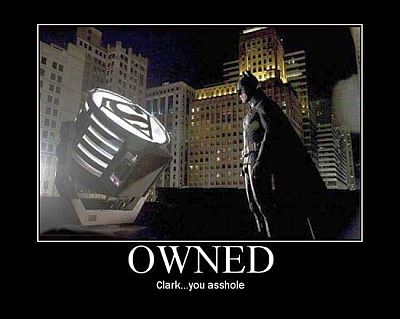
Create more interesting characters (Superman vs. Batman)

superman-vs-batmanSuperman and Batman. They are both orphans, but that’s pretty much where the similarity ends. Batman is the world’s greatest detective and/or a psychotic bad ass, depending on what vintage of comic you’re reading. Superman is an all-powerful boy scout with too few weaknesses. Batman is just a human who risks his secret identity every time he pulls his underwear over his Kevlar long johns.

Batman is more interesting. His story is dark so there’s more to explore. He is weak compared to Superman, but for story, you don’t want a hero who is safe from just about everything. You want a hero who is in danger every second. Then you put your characters through the grinder.

Don’t fall in love with your characters because, for your story to be at all readable, you’re going to do some horrible things to them.

Filed under: writing tips, , ,

Writing Tip: 3 Common Exposition Mistakes

1. Don’t let your villain explain everything to the captured hero (e.g. “I expect you to die, Mr. Bond, but first let me give you a tour of the rocket base whose deadly payloads are aimed at Topeka!”)

2. Don’t allow your exposition device to go on too long. Your hero should struggle to solve the mystery, a little at a time and with a few red herrings. If your protagonist finds the one person who knows it all–and all is explained in one big info dump—the narrative will lag and it’s a variation of deus ex machina.

3. Avoid overexplaining. Enough said.

Filed under: writing tips, , ,

3 Cliched Openings to Avoid

1. Don’t start with your protagonist waking up in the morning.

2. Don’t start with your protagonist starting a trip.

3. Please do not start with a dream…unless you’re writing Inception 2.

Filed under: writing tips, , ,

How Not to Write a Novel: The Bookfomercial

Filed under: Books, publishing, web reviews, writing tips, , ,

Bestseller with over 1,000 reviews!
Winner of the North Street Book Prize, Reader's Favorite, the
Literary Titan Award, the Hollywood Book Festival, and the
New York Book Festival.

http://mybook.to/OurZombieHours
A NEW ZOMBIE ANTHOLOGY

Winner of Writer's Digest's 2014 Honorable Mention in Self-published Ebook Awards in Genre

The first 81 lessons to get your Buffy on

More lessons to help you survive Armageddon

"You will laugh your ass off!" ~ Maxwell Cynn, author of Cybergrrl

Available now!

Fast-paced terror, new threats, more twists.

An autistic boy versus our world in free fall

Suspense to melt your face and play with your brain.

Action like a Guy Ritchie film. Funny like Woody Allen when he was funny.

Jesus: Sexier and even more addicted to love.

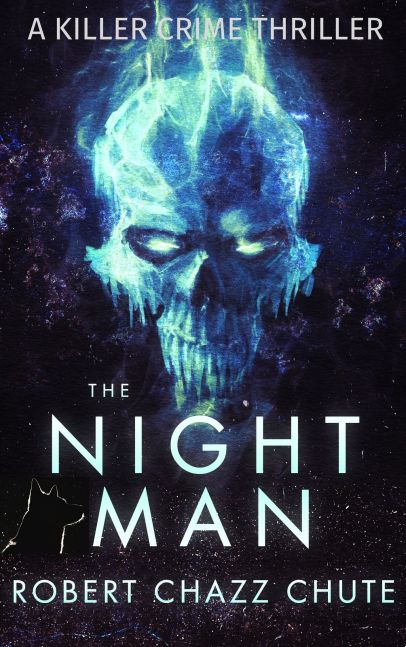
You can pick this ebook up for free today at this link: http://bit.ly/TheNightMan

Join my inner circle at AllThatChazz.com

See my books, blogs, links and podcasts.

Enter your email address to follow this blog and receive notifications of new posts by email.

Join 2,063 other subscribers