C h a z z W r i t e s . c o m

We are the publishing revolution

Ultimate Blog Challenge: Writing Books on Writing

Can writing be taught?Sure, but what most people mean by the question is, can anyone write to a professional level? One

On Writing

On Writing (Photo credit: Wikipedia)

newspaper colleague of mine insisted that it was something you were born with or you weren’t. I think the desire to immerse yourself in writing might spring from a quirk of genetics, but after that it’s up to you.

Certainly, anyone’s writing can be improved. Eliminate excess adverbs and don’t strain a metaphor until it breaks and you’re off to a good start. I’ve taught a couple of writing classes now and I suspect that writing skill is self-selecting anyway. If you aren’t interested in writing to begin with — as it is with anything — you probably won’t improve much. The best training in writing I got was first to read extensively early on. In my childhood home, books were a big deal and they still are now that I’m supposed to be a grown-up. Toward the end of journalism school, I think the best training I got in writing was to write copiously for a daily newspaper with feedback from editors.

There are a ton of books on writing advice and I’m sure I’ve read just about all of them. Reading about writing is often less about learning something new (there’s not really that much new to say about craft, is there?) as it is confirming my thoughts, feelings and biases. Sometimes a unique idea will rise out of that reading. Mostly I read writing advice books to enjoy the voice and the company of likeminded writers and to find inspiration. It’s motivating, yet cozy as a warm blanket, to read a book on writing advice and think, “Yes, I agree. I’m doing that. I could try that. I should go write some more now.” I end up reading writing advice for the same reasons I drink coffee. It’s a stimulant that makes you feel warm inside.

That’s ultimately why I decided I will soon add to the tonnage of writing advice books. Some books are very specific and prescriptive about writing. Others give excellent advice and strategies for marketing for the indie author (like Jeff Bennington’s intrepid Indie Author’s Guide to the Universe.)

Mine will be a softer approach for newer writers, like Bird by BirdI’ve gone back to Stephen King’s On Writing again and again. These are the books that told me I wasn’t alone and this wasn’t so hard or crazy if I just pecked away at it. It was simply craft and there isn’t a secret besides sitting down (or getting on my treadmill desk) and doing the work I knew I could do.

The aspiration for this book is more modest than some who take a step-by-step, flow chart approach. My book on writing will be inspiration for the new indie author, much of it drawn from posts on this blog. Early on I linked to others less and wrote more about craft (instead of focusing on marketing the Indie Author Revolution as I seem to do now.) I selected the best and most useful posts from over 900 articles on ChazzWrites.com, then added to them, wrote some new stuff and edited again.

My book won’t be as ambitious as some who (may Thor bless them) give strict advice on what to do and how to do it. My ideal reader will be a writer like me who wants to grab a steaming coffee, curl up in an armchair and read Crack the Indie Author Code: Aspire to Inspire (yes, that’s what I called it and yes, it’s coming soon). Readers will find an ally, inspiration and company on the journey to publication. For me, the work is about the writing first and foremost. The real fun happens in our heads as we write and nurture that spark of inspiration into a flame that throws light and heat. I’m happiest at my keyboard hooked up to the coffee in the intravenous drip.

Do I think writing can be taught? Sure. If you want it enough to bother to go looking for the education, that’s the cardinal sign and symptom that you’re already infected with the writing bug, anyway.

Filed under: publishing, , , , , , , , , , , , ,

Ultimate Blog Challenge: Top 10 things I wish I didn’t know about readers

Small-town terrors and psychological mayhem in Maine.

1. They get bored too easily. We used to have writers who were flavours of the month. With Amazon rankings, you can be the flavour of the hour and then disappear into obscurity unless you fight the death spiral and/or get lucky.

2. Readers are too busy. With the proliferation of “free” we all have huge To Be Read piles. Sadly, as with to-do lists, many of us never get to the bottom of those piles.

3. Many people prefer a genre I don’t write. Romance is much more popular. I used to read romances professionally when I worked for Harlequin. My books have a key romantic element, but they are not romances, so de facto, I am not on the radar of a large group of very dedicated readers.

4. The readers who love me might get sick of me trying to reach the readers who don’t know me. I’m very careful on Twitter to promote others, not just me. Still, I need to kick back and tweet a little joke here and there and say hello. It’s difficult to find the balance.

Paranormal persuasion and scary stories.

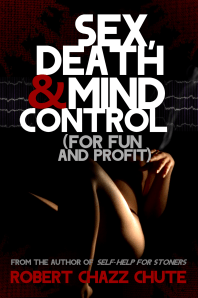
5. I’m not reaching some readers because I made some choices in titles that were challenging. (I almost wrote “unfortunate”, but that would put the onus on me and I’m not ready to own that yet.) The thing is, Sex, Death & Mind Control is one of the best things I’ve written but it has the lowest sales. It’s not sexy enough for those searching for erotica. It’s paranormal suspense (with award winners!), but when you see that always-interesting “What Else Customers Viewed” list, it’s almost all erotica on the Sex, Death & Mind Control sales page. “End of the Line” is probably the best short story I’ve ever written, but it  remains a hidden treasure because I turned readers off with a title I thought would get more attention, not less.

6. Ditto Self-help for Stoners. It was a clue for me when one of the reviewers who loved it added, “Don’t let the title scare you off.” It’s a weird mix of War of Art self-help and suspense. Strange, I know, but not really all that transgressive. (Should have called it Self-help for Surrealists to pull in readers who are also painters!) My strategy going in was to have an identifiable group to market to instead of saying it was for anybody who loved suspenseful fiction. To some extent that worked, but not as well as I’d hoped. (It still outsells Sex, Death & Mind Control four to one. I can’t say the Self-help for Stoners strategy was a failure, just that it could do better.)

You don’t have to be high to enjoy it. Sure, it would make you a better audience but…

7. Readers have less patience now. I changed my plotting and pacing with Bigger Than Jesus to cater to that lack of patience. I see it in myself. Maybe the Internet did it to our brains, I don’t know. That’s not even be a bad thing per se, but expect more Blake Crouch pacing and less Annie Proulx meandering. There used to be more room for both approaches.

8. There are still prejudices against anything labeled “experimental”. I wrote Bigger than Jesus in present tense, second-person. That alone is reason enough for some readers to run screaming. I can tell them all day that it worked. Won’t matter. That’s okay, but it’s still a prejudice.

I wanted to do something that some people thought couldn’t or shouldn’t be done and I wanted to do it so well they’d either quickly forget their prejudice or give me more credit for doing it so well. Blanket pronouncements of “You can’t do that!” are one of the reasons I did it. I don’t like being told what I can’t do. In fact, it makes me want to do it all the more. (I admit this attitude is not something that serves me well all the time. Having a job in the regular world, for instance, is uh…a problem.)

9. Readers look for ties to your real life. This is a byproduct of increased author/reader interaction. However, the Internet isn’t to blame for this one. This was very much the rage in English departments across the world years ago. Students were taught they couldn’t understand the fullness of the fiction without making judgments about the author, his or his gender, origin and life experience. They shouldn’t have done that. No one truly knows the inside of someone else’s skull. (I’ve even opened it up and had a look. Trust me, nobody really knows.) Besides, it’s fiction. Take it on its own merit. Please don’t make assumptions about the author from what you read in a book of fiction. Don’t make me kill again. (See what I mean?)

10. Readers fade. Even if they love your work, they move on. They get hungry for something new and different unless you keep feeding them. I don’t think anyone should race to publication if they aren’t up to the schedule and you do have to build in editorial time to make the book better. However, they are hungry and it is a race. People will tell you it isn’t. They’re wrong. It is. It’s a race against time. We don’t live forever and we have books in us and a readership to find and a readership we hope finds us. William Styron came out with a nice juicy thick book every ten years, but he was William Styron and that was before ebooks and our shiny,  new demand-per-click culture.

I love readers. People who don’t read creep me out. I can say that because how would they know I’ve insulted them? What do non-readers have to contribute? Those dummies!

Ha! Wait. You aren’t reading this aloud to someone are you?

~ Like my flavor? Listen to the first chapter of my crime thriller, Bigger Than Jesus. I’m podcasting the book through the summer. Enjoy! (Or be a hero and just click the cover to grab it. Thanks for reading!)

Filed under: publishing, , , , , , , , , , , , , , , , , ,

Ultimate Blog Challenge: Risk more

There’s a scene in the Woody Allen movie Midnight in Parisin which Owen Wilson’s character meets Salvador Dali. I’m a fan of

Woody Allen

Woody Allen (Photo credit: ThomasThomas)

Dali and Adrien Brody makes him weird and charming and, at that moment, obsessed with rhinos. After meeting Dali, Wilson’s writer character (an undisguised Woody Allen surrogate) starts to think that he needs to let his imagination off the leash and be more creative with his writing. I do wish more writers took chances and drew outside the lines.

Experimental fiction has a bit of a bad rep and sometimes for good reasons. It also gets a bad rep for bad reasons and the big bad reason is the author’s fear. Too often we hear that readers want to be made “comfortable” with a story. Agents and editors want “the same thing only different” from the successful authors they happen upon. You can write a competent mystery, thriller, romance — whatever your flavor — but I don’t think you can do anything great if you don’t stretch at least a little bit. Playing it safe means going with the tried and true. There’s plenty of that already.

The reader and writer in me is screaming, “No!”

A writer wants to do something more, different and great. A reader wants to feel like they are in confident, competent hands so they won’t invest a lot of time in a book and three-quarters of the way through discover the story has gone off the rails. Take your risks but make it plausible within the context of the book. I’ve just put a book down because an author made a choice that was implausible and annoying. For the first chunk of the book, we understand we are dealing with astronauts just back from Mars. After the three-year mission is over, they discover that one of said astronauts isn’t what he appears to be. He’s an astronaut impersonator. Really? Maybe that would work for some people, but it didn’t work for me and I put the book down, possibly never to pick it up again. I’ve got a lot to read. Life’s too short to waste on books that don’t work for me. If the author had made the astronaut impersonator the guy who messed up more, the conceit might have worked. Instead, the non-astronaut is the ultimate astronaut. Yeah, right. Got a brain tumour? Hand the scalpel to the brilliant amateur because he’s read some books and has a fresh take on this whole “surgery” thing. Ugh.

Please do take risks with your stories.

Go to unexpected places and surprise me.

Make me believe

(because I really want to believe.)

Midnight in Paris isn’t a great movie, but there is something very appealing about a cadre of artists in Paris in the ’20s who interact with each other, bounce ideas off each other and critique and encourage each other to reach beyond the norm. Too many people were living lives of quiet desperation (like now) while Hemingway or Gertrude Stein asserted themselves and their art as an important value, not a frivolous hobby. I don’t care for Stein’s writing at all and I prefer Hemingway’s short stories, but how noble to be so invested in art for art’s sake! Are we still invested in art or is our attention too fractured? Is there an equivalent to Paris in the ’20s now? Or have we devolved in our expectations of the value of art so much that we melt into the lowest common denominator of art critic: a mewling pack of trolling eunuchs at the harem with nothing to offer but barely literate, troglodytic snipe and snark in one-star book reviews?

Midnight in Paris succeeds only so much as nostalgia for an ex-pat community of artists in the 1920s succeeds, but I do love elevating art. When two hoods in an Elmore Leonard novel or a Quentin Tarantino movie or a Guy Ritchie film have conversations that you don’t expect, that’s a writer taking a risk to bring us more beyond the usual schtick and making it work. That’s “a Royal with Cheese.” That’s “Leave the guns, take the cannolis.”

Smack your reader with something they don’t expect.

Make them love you anyway.

Filed under: publishing, , , , , , , , , , , , , , ,

Click here for AllThatChazz.com books & podcasts

Jesus Diaz on the run in New York

Jesus hits Chicago

"You will laugh your ass off!" ~ Maxwell Cynn, author of Cybergrrl

Write to live

Publish, conquer your fears, inspire others

The definitive short story collection by Robert Chazz Chute

Build your brand 6 seconds at a time

Mean people. They're out to get you.

This Plague of Days launchesJune 15th, 2013
21 days to go.

Enter your email address to follow this blog and receive notifications of new posts by email.

Join 3,190 other followers

Brain Spasms a la Twitter

Community

Follow

Get every new post delivered to your Inbox.

Join 3,190 other followers

%d bloggers like this: